Vaping aerosol is not water vapor that disappears harmlessly. It is a dense suspension of propylene glycol, vegetable glycerin, nicotine, and flavoring compounds that behaves exactly like PM2.5 pollution and lingers in room air for 15 to 45 minutes after each exhale.
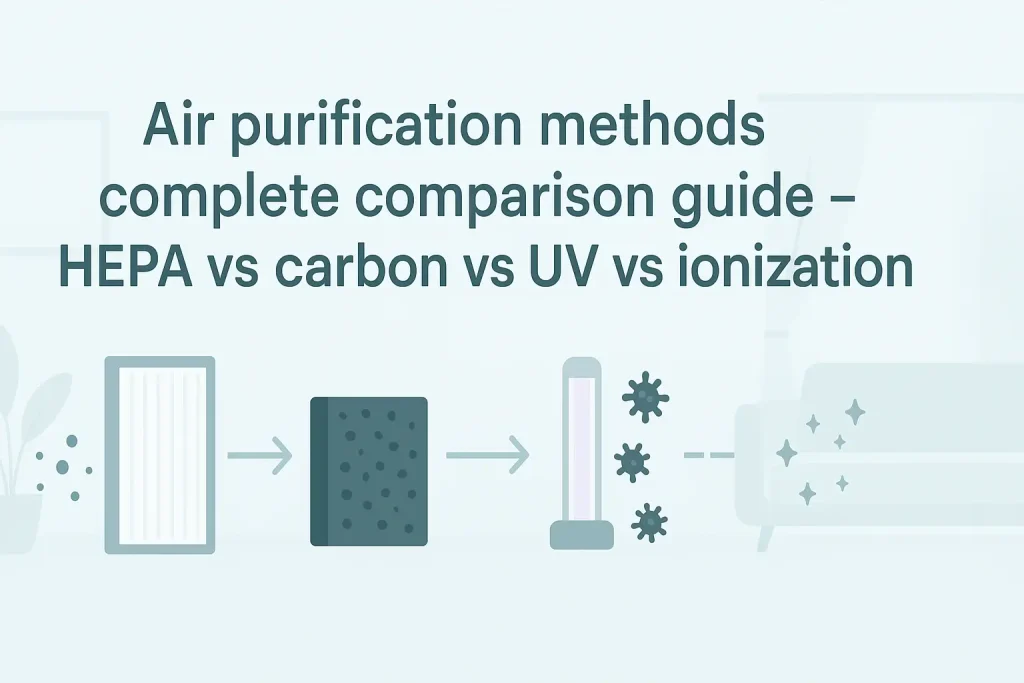
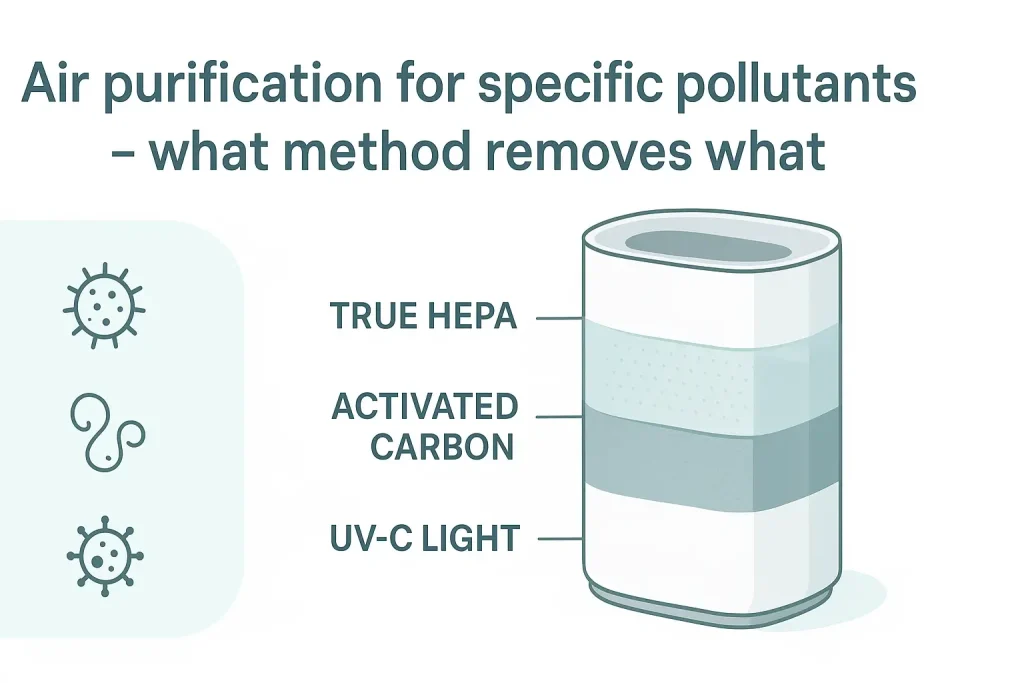
A standard True HEPA air purifier captures the aerosol particles. But it does nothing for the volatile organic compounds that give vape clouds their smell. You need both filtration stages or you are solving only half the problem.
This guide covers every filter type, specification, and placement decision that matters when you are buying an air purifier specifically to handle vaping aerosol. You will learn exactly which CADR rating, which carbon bed weight, and which certifications separate a unit that actually clears vape clouds from one that just moves air around.
| Photo | Popular Air Purifiers | Price |
|---|---|---|

|
Air Purifiers for Home Large Room up to 1500ft², Tailulu H13 True HEPA Air Purifier for Pets Dust Odor Smoke, Air Purifier for Bedroom with 15dB Quiet Sleep Mode for Bedroom Office Living Room | Check Price On Amazon |
|
Afloia Air Purifier for Home, 4-in-1 Washable Filter for Allergies, Covers Up to 1076 ft², Quiet Operation, Auto Shut-Off & Night Light, Removes Pet Dander, Pollen, Dust, Mold, and Smoke, White,Pluto | Check Price On Amazon |

|
Nuwave OxyPure ZERO Air Purifier with Washable and Reusable Bio Guard Tech Air Filter, Large Room Up to 2002 Ft², Air Quality Monitor, 0.1 Microns, 100% Capture Irritants like Smoke, Dust, Pollen | Check Price On Amazon |

|
Air Purifiers for Home Large Room Up to 1,996 Ft², EOEBOT Air Purifier for Home Pets with Washable Filter, Quiet Sleep Mode, Air Quality Monitor, Air Purifier for Bedroom, Pet Hair, Dust, Smoke, White | Check Price On Amazon |
|
Afloia 2 IN 1 Air Purifier with Humidifier Combo, 3-Stage Filters for Home Allergies Pets Hair Smoker Odors, Evaporative Humidifier, Auto Shut Off, Quiet Air Cleaner with Seven Color Light,White | Check Price On Amazon |
We will walk through True HEPA plus activated carbon hybrid units across four budget tiers. Each recommendation includes smoke CADR in CFM, coverage area at 2 ACH and 5 ACH, noise level at sleep mode, and annual filter replacement cost with genuine manufacturer filters.
Air Quality Data
Vaping Aerosol and Indoor Air Quality – What the Research Shows
Sources: EPA Indoor Air Quality, ASHRAE, peer-reviewed studies on e-cigarette aerosol
What Is Actually in Vaping Aerosol That an Air Purifier Must Remove?
Vaping aerosol contains three categories of airborne contaminants. Each requires a different filtration mechanism. A unit that handles only one category leaves the room with residual odor, invisible chemical residue, or both.
The visible cloud is primarily propylene glycol and vegetable glycerin condensed into submicron droplets. These droplets measure 0.1 to 0.3 microns at the point of exhale and grow to 0.5 to 1 micron as they absorb moisture from ambient air. This particle size range falls directly inside the most penetrating particle size for human lungs and is exactly what True HEPA filtration is tested to capture at 99.97% efficiency.
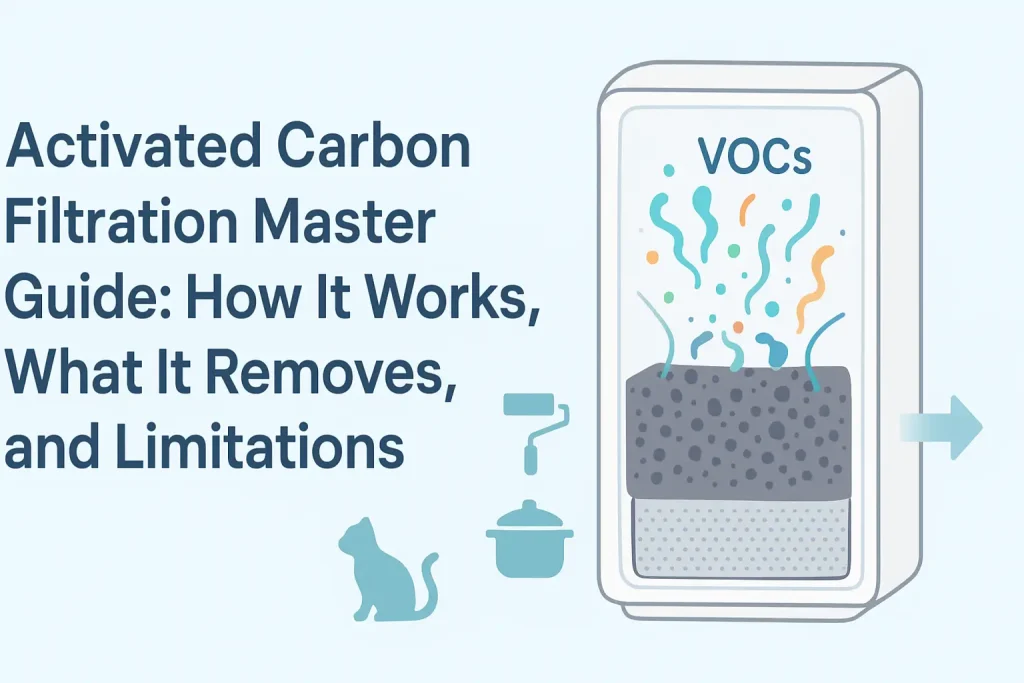
The odor and chemical fraction comes from flavoring compounds. These are volatile organic compounds, primarily aldehydes including vanillin, benzaldehyde, cinnamaldehyde, and diacetyl. A True HEPA filter cannot capture VOCs because VOCs are gases, not particles. They pass straight through the HEPA media unchanged.
Nicotine residue is a third concern. Nicotine in aerosol form deposits on surfaces as the droplets evaporate. An air purifier reduces airborne nicotine before it settles, but surface deposition still occurs. The purifier’s job is to capture it while it is still airborne, which is the window of 15 to 45 minutes post-exhale depending on room air exchange rate.
This happens because vaping aerosol behaves as a condensation aerosol. The hot coil vaporizes the e-liquid, and the vapor condenses into droplets when it hits cooler ambient air. This only occurs when the temperature differential between the coil and room air exceeds approximately 100 degrees Fahrenheit. If the room is already saturated with aerosol from prior exhales, the new aerosol takes longer to dissipate. The result is cumulative PM2.5 buildup that a properly sized air purifier can reduce by 80 to 90 percent within 30 minutes at 5 ACH.
Why a Standard Air Purifier Without Activated Carbon Fails for Vaping Rooms
A True HEPA-only air purifier captures the aerosol droplets. Within 20 to 30 minutes of operation at the correct CADR, PM2.5 levels drop substantially. But the room still smells like the flavoring that was vaped because the VOCs passed through the HEPA filter unchanged.
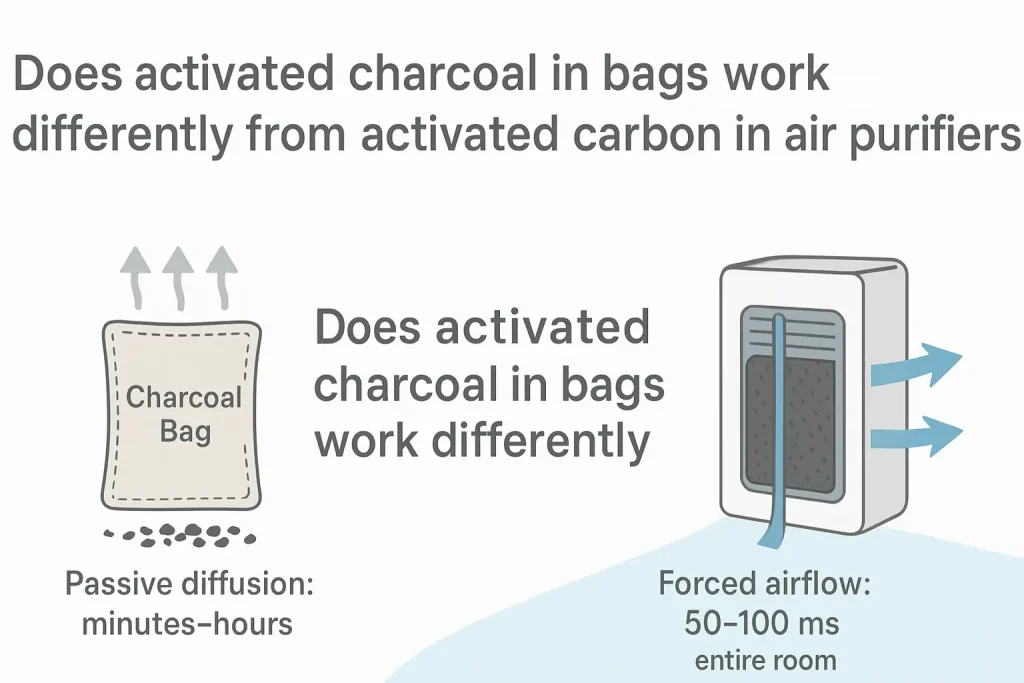
This is the core reason vaping rooms need a unit with a substantial activated carbon stage. The carbon adsorbs VOCs onto its porous surface through van der Waals forces. A thin carbon sheet, which is what most budget purifiers include, saturates within days of regular vaping and stops working. You need a granular activated carbon bed or a pelletized carbon filter with at least 3 to 5 pounds of carbon for a room where vaping occurs daily.
The carbon stage works differently from the HEPA stage. Activated carbon replacement filters have a finite adsorption capacity measured in grams of VOC per kilogram of carbon. Once saturated, the carbon stops capturing VOCs and may release some of the adsorbed compounds back into the air if humidity spikes. Replace the carbon filter every 3 to 6 months in a room with daily vaping. This is double the replacement frequency recommended for standard household use.
The particle filtration side is more straightforward. A True HEPA air purifier with a smoke CADR of at least 200 CFM handles aerosol from one or two people vaping in a 200-square-foot room at 5 ACH. The math: 200 sq ft multiplied by 8 ft ceiling multiplied by 5 ACH divided by 60 minutes equals 133 CFM required. A 200 CFM unit provides a safety margin for furniture, open doors, and varying room layouts that reduce real-world performance by 15 to 25 percent versus laboratory test conditions.
Use the interactive tool below to get a personalized recommendation based on your specific vaping situation and budget.
Interactive Tool
Find the Right Air Purifier for Your Vaping Setup
Answer 2 questions for a personalized filter type and product recommendation specific to vaping aerosol and odor control.
Select your primary concern and budget above to see a personalized recommendation.
How to Calculate the Correct CADR for Your Vaping Room Size
CADR, or Clean Air Delivery Rate, is the only objective measurement of how fast an air purifier cleans a room of a specific particle size. AHAM tests CADR separately for smoke (0.09 to 1 micron particles), dust (0.5 to 3 microns), and pollen (5 to 11 microns). For vaping aerosol, use the smoke CADR rating because vaping droplets are in the 0.1 to 1 micron range before they grow.
The formula is straightforward. Required smoke CADR in CFM equals room length in feet multiplied by room width in feet multiplied by ceiling height in feet multiplied by your target air changes per hour, all divided by 60. For a 12-by-15-foot bedroom with an 8-foot ceiling at 5 ACH, that is 12 times 15 times 8 times 5 divided by 60, which equals 120 CFM. That is your minimum. Add a 25% safety margin for real-world conditions and you need at least 150 CFM smoke CADR.
For a 20-by-25-foot living room with a 9-foot ceiling at 5 ACH, the calculation yields 20 times 25 times 9 times 5 divided by 60, which equals 375 CFM. Very few single units deliver 375 CFM smoke CADR. The Blueair 605 at 500 CFM and the Coway Airmega 400 at 400 CFM are among the few that do. For rooms above 450 square feet, two mid-sized units placed at opposite ends often outperform one large unit because they address dead zones near walls and furniture.
CADR Reference
Smoke CADR Needed by Vaping Room Size and Air Changes Per Hour Target
All values pre-calculated at standard 8 ft ceiling height. Formula: (room area x 8 x ACH) / 60. Source: AHAM methodology.
| Room size (8 ft ceiling) / ACH target | 2 ACH (light vaping) | 4 ACH (moderate vaping) | 5 ACH (heavy vaping) | 6 ACH (shared room with continuous vaping) |
|---|---|---|---|---|
| 100 sq ft (small bedroom) | 27 CFM | 53 CFM | 67 CFM | 80 CFM |
| 200 sq ft (master bedroom or vape den) | 53 CFM | 107 CFM | 133 CFM | 160 CFM |
| 300 sq ft (bedroom or office with multiple vapers) | 80 CFM | 160 CFM | 200 CFM | 240 CFM |
| 500 sq ft (living room or open plan) | 133 CFM | 267 CFM | 333 CFM | 400 CFM |
| 700 sq ft (large open plan with multiple vapers) | 187 CFM | 373 CFM | 467 CFM | 560 CFM |
Formula: smoke CADR needed = (room length ft x room width ft x 8 ft ceiling x ACH) / 60. For rooms with daily vaping, use the 5 ACH column. For shared rooms with continuous vaping, use 6 ACH. Add 25% margin for furniture and real-world airflow obstructions. Two units placed at opposite ends of the room sum their CADR values.
True HEPA vs Activated Carbon vs Hybrid: Which Filter Type Handles Vaping Best?
No single filter type handles both vaping aerosol particles and vape VOCs. You need a hybrid unit with both True HEPA and a granular activated carbon bed. The table below breaks down what each filter type does and does not do for vaping-specific air quality.
Use the table below to decide which filter configuration matches your specific vaping situation based on whether particles, odors, or both are your primary concern.
Product Comparison
Filter Technology Comparison for Vaping Aerosol and Vape Odor Removal
Detailed comparison of the four filter configurations commonly sold for air purification, evaluated specifically for vaping aerosol particles and vape flavoring VOCs.
| Feature | True HEPA Only | Activated Carbon Only | True HEPA + Thin Carbon Sheet | True HEPA + Granular Carbon Bed |
|---|---|---|---|---|
| Vape aerosol particles (PM2.5 droplets) | Captures 99.97% at 0.3 microns | Does not capture particles effectively | Captures 99.97% at 0.3 microns | Captures 99.97% at 0.3 microns |
| Vape flavoring VOCs (aldehydes, esters) | No VOC removal at all | Adsorbs VOCs based on carbon mass | Minimal: saturates in days with daily vaping | Effective: 3 to 15 lbs of carbon lasts months |
| Nicotine residue in air | Captures airborne nicotine droplets | Does not capture nicotine droplets | Captures droplets; weak on gas-phase nicotine | Captures both droplet and gas-phase nicotine |
| Carbon filter lifespan with daily vaping | Not applicable | 6 to 12 months (standalone carbon unit) | 1 to 2 months before saturation | 3 to 6 months with 5+ lbs carbon |
| Annual filter replacement cost (vaping use) | $25 to $60 per year | $50 to $150 per year | $50 to $150 per year (frequent replacement needed) | $60 to $250 per year depending on carbon mass |
| Typical purchase price range | $50 to $250 | $150 to $600 | $80 to $200 | $150 to $900 |
| Best for vaping scenario | Outdoor-adjacent room with open window; odor not a concern | Odor-only concern with no visible cloud issue | Occasional vaping only; not suitable for daily use | Daily vaping in any room; handles both cloud and odor |
| Our verdict for vapers | Incomplete: solves only the visible cloud | Incomplete: solves only the odor | Adequate for light use only | Best choice: complete vaping air solution |
Carbon filter saturation estimates based on daily vaping of 3 to 5 mL e-liquid in a 200 sq ft room with standard ventilation. Heavier use or larger rooms accelerate saturation. Thin carbon sheets are defined as under 1 lb of carbon. Granular carbon beds are defined as 3 lbs or more of pelletized or granular activated carbon.
How to Position Your Air Purifier for Maximum Vaping Aerosol Capture
Placement determines whether the purifier captures the aerosol cloud before it disperses throughout the room. A purifier placed across the room from where vaping occurs cleans the general room air but does not capture the fresh exhale before it spreads. A purifier placed within 3 to 5 feet of the vaping position captures a much higher fraction of the aerosol at its highest concentration.
This happens because vaping aerosol is exhaled as a concentrated plume that moves upward and outward from the mouth. The plume is warm and rises slightly before cooling and dispersing. A purifier with its intake facing the vaping position and placed at roughly the same height captures the plume before dilution reduces its concentration by a factor of 10 to 50 across the room volume.
This only works when the purifier intake faces the direction of the exhale. If the intake faces a wall or is blocked by furniture, the concentrated plume bypasses the purifier entirely. The result is that the purifier must cycle the entire room air volume multiple times instead of capturing the contaminant at the source. Fix this by positioning the purifier so its front intake grill faces the area where people vape, with no obstructions between the vaping position and the intake within a 3-to-5-foot line of sight.
For shared living spaces like apartments or common rooms, choosing a purifier for shared apartments with designated vaping areas requires placing units near the specific seating area where vaping occurs rather than against a far wall. A corner placement reduces effective coverage by 20 to 30 percent versus a central or near-source placement.
Filter Replacement Schedule When You Vape Daily: What Actually Happens
Vaping accelerates filter loading by a factor of two to three times compared to standard household air quality conditions. A True HEPA filter rated for 6 to 8 months of normal use in a bedroom without vaping will saturate in 2 to 4 months in a room where someone vapes 3 to 5 mL of e-liquid daily. The aerosol droplets contain propylene glycol, which is hygroscopic and attracts moisture, causing the filter media to load faster than dry particulate like dust or pollen.
The carbon stage degrades even faster. A thin carbon sheet in a budget purifier saturates within 4 to 8 weeks of daily vaping because the VOC load from flavorings is continuous and concentrated. A granular carbon bed with 5 or more pounds of activated carbon lasts 4 to 6 months under the same conditions. When the carbon saturates, you will notice the vape odor returning even when the purifier is running at full speed. That is your replacement signal.
Check your pre-filter every 2 weeks if you vape daily. The pre-filter catches the largest aerosol droplets and visible residue before they reach the HEPA stage. A washable pre-filter rinsed under warm water and dried completely before reinsertion extends the HEPA lifespan by 30 to 50 percent. If your unit does not have a washable pre-filter, consider a replacement pre-filter sheet cut to size and attached to the intake grill.
Why CARB Certification Matters Specifically for Vaping Air Purifiers
CARB certification means the air purifier has been tested and verified to emit no more than 0.050 parts per million of ozone. This matters for vaping rooms because some purifiers use ionizers, electrostatic precipitators, or UV-C lamps that produce ozone as a byproduct. Ozone reacts with terpenes and other compounds in vape flavorings to create secondary organic aerosols and formaldehyde, which are more harmful than the original aerosol.
This happens because ozone is a strong oxidizer that breaks down unsaturated organic compounds through ozonolysis. Vape flavorings often contain terpenes like limonene, linalool, and myrcene that are highly reactive with ozone. This only occurs when an ozone-producing purifier runs in the same room where vaping happens. If you use a CARB-certified purifier with no ionizer or with an ionizer that can be switched off, this reaction does not occur. The result is that a CARB-certified True HEPA plus carbon unit cleans the air without creating new harmful compounds.
Always verify CARB certification on the California Air Resources Board certified air cleaning devices list before buying. A product labeled “ozone-free” without CARB certification is making an unverified claim. The CARB list is the only regulatory standard in the United States that enforces a legally binding ozone emission limit for portable air cleaners.
Complete Buying Checklist for a Vaping Air Purifier
Before you spend money on an air purifier for a vaping room, run through every item on the checklist below. Each point addresses a common failure mode that leaves vapers with a unit that is too small, too loud, lacks sufficient carbon, or costs far more to run than the purchase price suggested.
Buying Guide
Before You Buy an Air Purifier for Vaping – Complete Checklist
Check off each point before making your decision. Based on AHAM CADR standards, CARB certification requirements, and real-world vaping aerosol behavior.
Top Air Purifier Recommendations for Vaping Rooms by Budget Tier
Budget Tier: Under $100 – Best Value for Small Vaping Rooms
The Levoit Core 400S delivers 260 CFM smoke CADR with True HEPA H13 and a carbon filter that is larger than the Core 300S. It covers 200 square feet at 5 ACH, which handles one person vaping in a bedroom. Sleep mode at 24 dB. Annual filter cost approximately $35 at standard replacement intervals, or $50 to $70 at the accelerated schedule needed for daily vaping.
Key Specifications:
- Smoke CADR: 260 CFM
- Coverage at 5 ACH: 200 sq ft
- Carbon type: Activated carbon filter (thin but larger than budget alternatives)
- Noise at sleep mode: 24 dB
- Annual filter cost (vaping schedule): $50 to $70
- CARB certified: Yes
The Levoit Vital 200S at a similar price point offers 242 CFM smoke CADR with a slightly larger carbon stage. Either unit works for a small bedroom or office with one vaper. Do not expect either to handle a living room above 250 square feet with multiple vapers.
Mid-Range Tier: $100 to $200 – The Sweet Spot for Most Vapers
The Winix 5500-2 is the most complete vaping air purifier in this price range. It delivers 243 CFM smoke CADR with True HEPA, a washable carbon grid, and a Plasmawave ionizer that can be switched off. Switch the ionizer off for vaping rooms. The washable carbon grid extends carbon life compared to non-washable carbon sheets, but it is not a substitute for a granular carbon bed. Covers 290 square feet at 5 ACH. Annual filter cost approximately $40 to $50.
Key Specifications:
- Smoke CADR: 243 CFM
- Coverage at 5 ACH: 290 sq ft
- Carbon type: Washable activated carbon grid
- Noise at sleep mode: 27.8 dB
- Annual filter cost (vaping schedule): $40 to $50
- CARB certified: Yes
The Coway AP-1512HH is the quieter alternative at 246 CFM smoke CADR and 30 dB at sleep mode. Its carbon stage is a thin sheet rather than a grid, so it saturates faster with daily vaping. Choose the Coway if noise is your top priority. Choose the Winix if odor control matters more.
Premium Tier: $200 to $400 – Large Room and Heavy Vaping Solutions
The Coway Airmega 400 delivers 400 CFM smoke CADR through dual fans, covering 480 square feet at 5 ACH. This handles a living room with two or more people vaping. Washable pre-filter, meaningful activated carbon stage, and sleep mode at 22 dB. Annual filter cost approximately $60 under normal conditions, or $80 to $100 at the accelerated vaping schedule.
Key Specifications:
- Smoke CADR: 400 CFM
- Coverage at 5 ACH: 480 sq ft
- Carbon type: Activated carbon filter (granular, moderate mass)
- Noise at sleep mode: 22 dB
- Annual filter cost (vaping schedule): $80 to $100
- CARB certified: Yes
For rooms where odor control is the primary concern at this price point, the Austin Air HealthMate contains 15 pounds of activated carbon and zeolite. This is the highest carbon mass available in any residential air purifier under $700. The trade-off is a lower CADR and a utilitarian design that some find industrial. For a dedicated vape den with strong flavorings, the carbon mass advantage outweighs the CADR limitation.
Flagship Tier: $400 and Above – Maximum Performance
The IQAir HealthPro Plus is the reference standard for combined particle and VOC filtration. HyperHEPA captures particles down to 0.003 microns at 300 CFM. The V5-Cell gas filter contains activated carbon and impregnated alumina for broad-spectrum VOC adsorption including aldehydes and ketones common in vape flavorings. Covers 360 square feet at 5 ACH. Annual filter cost approximately $250. The unit is expensive but filter life extends to 3 to 4 years under normal conditions, which partially offsets the cost.
Key Specifications:
- Smoke CADR: 300 CFM
- Coverage at 5 ACH: 360 sq ft
- Carbon type: V5-Cell multi-gas filter with activated carbon and alumina
- Noise at lowest speed: 25 dB
- Annual filter cost (vaping schedule): $200 to $280
- CARB certified: Yes
The Blueair 605 offers an alternative for rooms where particle clearing speed matters more than VOC removal depth. At 500 CFM smoke CADR, it is the fastest single-unit particle clearing purifier available. The carbon stage is moderate, not a deep bed. Choose the Blueair 605 for large open-plan rooms with high ceilings where vape clouds need to be cleared fast. Choose the IQAir for smaller rooms where complete chemical removal is the priority.
Can an Air Purifier Completely Remove Vape Smell, or Just Reduce It?
An air purifier with a granular activated carbon bed of 5 or more pounds reduces vape odor by 70 to 90 percent during active operation at the correct CADR for the room. It does not eliminate odor entirely because some VOCs adsorb onto walls, fabrics, and carpets before the purifier can capture them. These adsorbed VOCs desorb slowly over hours or days, releasing trace odor even when the purifier is running.
This happens because VOCs from vape flavorings have varying vapor pressures. Low-vapor-pressure compounds like vanillin adsorb onto surfaces quickly and release slowly. High-vapor-pressure compounds like diacetyl stay airborne longer and reach the carbon filter. A purifier captures the airborne fraction continuously but cannot extract VOCs already embedded in room surfaces. The solution is to run the purifier continuously at a speed that delivers at least 4 to 5 ACH, which captures VOCs as they desorb from surfaces over time.
For maximum odor reduction, combine the purifier with a PM2.5 air quality monitor to verify that particulate levels drop below 12 micrograms per cubic meter, which is the EPA’s healthy 24-hour standard. A VOC sensor can confirm that total VOC levels trend downward during purifier operation, though consumer-grade VOC sensors are less precise than PM2.5 sensors.
What Is the Difference Between Vaping Aerosol and Cigarette Smoke for an Air Purifier?
Vaping aerosol and cigarette smoke are fundamentally different aerosol types that challenge air purifiers in different ways. Cigarette smoke contains tar, thousands of combustion byproducts, and particles that are stickier and more chemically complex than vaping aerosol. Vaping aerosol is primarily a condensation aerosol of propylene glycol and vegetable glycerin with dissolved flavorings and nicotine. It contains no tar and no combustion products because nothing burns.
Cigarette smoke particles are smaller on average, with a count median diameter of 0.1 to 0.2 microns, and are more numerous per unit mass. Vaping aerosol particles are larger at 0.1 to 0.5 microns initially and grow as they absorb moisture. A True HEPA filter captures both particle types effectively because both fall within the 0.3-micron most penetrating particle size that HEPA is tested against. The difference is that cigarette smoke loads filters faster with sticky tar residue, while vaping aerosol loads filters with hygroscopic PG and VG that attract moisture and can promote mold growth if the filter is not replaced on schedule.
The VOC profile is also different. Cigarette smoke contains benzene, formaldehyde, acrolein, and polycyclic aromatic hydrocarbons from combustion. Vaping aerosol contains flavoring aldehydes, esters, and alcohols with a different chemical profile. Activated carbon adsorbs both types of VOCs, but the specific carbon impregnation matters. Carbon impregnated with potassium permanganate handles formaldehyde and other small aldehydes better than plain activated carbon, which is relevant for both cigarette smoke and some vape flavorings.
Does a Portable Air Purifier Work for Vaping in Different Rooms or on the Go?
A portable air purifier works for vaping in a single room at a time but does not work for whole-house coverage or for vaping in multiple rooms throughout the day unless you move the unit from room to room. A unit rated for 300 square feet at 5 ACH handles a bedroom or a home office. It does not handle an open-plan living area and kitchen that totals 600 square feet.
For people who vape in multiple rooms, a lightweight portable purifier under 12 pounds with a carrying handle can be moved from the bedroom to the home office to the living room as needed. The Levoit Core 400S at 12.7 pounds and the Coway AP-1512HH at 15 pounds are both portable enough to move daily. For truly on-the-go vaping in hotel rooms or other temporary spaces, a compact unit like the Levoit Core 300S at 7.5 pounds handles small rooms up to 150 square feet at 5 ACH.
One purifier per occupied room that sees regular vaping is the correct approach. Rental apartments with multiple rooms used for vaping may require two or three mid-sized units rather than one large unit, because walls and doors block airflow and prevent a single unit from servicing the entire apartment.
Why Does My Air Purifier Smell Sweet or Strange After Running in a Vaping Room?
A sweet or chemical smell from your air purifier after running in a vaping room means the carbon filter is saturated. Saturated carbon can no longer adsorb VOCs, and some of the previously adsorbed compounds may be releasing back into the air stream when humidity or temperature changes. This is called desorption and it is the most common failure mode for carbon filters used in vaping rooms.
This happens because activated carbon adsorbs VOCs through weak van der Waals forces, not strong chemical bonds. The VOCs are held on the carbon surface but can be displaced by water vapor when humidity rises above 60 percent. Vaping rooms often have elevated humidity because PG and VG are hygroscopic and the exhaled aerosol adds moisture to the air. This only becomes noticeable when the carbon is more than 70 to 80 percent saturated, which is the threshold where desorption rates become detectable by smell.
Replace the carbon filter immediately when you notice the sweet or chemical smell. Running the purifier with a saturated carbon filter provides no VOC removal and may actually increase perceived odor in the room. For units with thin carbon sheets, this can happen within 6 to 8 weeks of daily vaping. For units with granular carbon beds weighing 5 pounds or more, it typically takes 4 to 6 months. If this happens before the expected replacement interval, your vaping volume is higher than the carbon mass was designed to handle. The solution is to upgrade to a unit with more carbon mass or replace the carbon filter more frequently.
Is an Air Purifier With an Ionizer Safe for a Vaping Room?
An air purifier with an ionizer is not safe for a vaping room if the ionizer produces ozone. Vape flavorings contain terpenes and other unsaturated organic compounds that react with ozone to produce formaldehyde, secondary organic aerosols, and ultrafine particles that are more harmful than the original vaping aerosol. The ionizer feature should be switched off entirely in any room where vaping occurs.
This happens because ionizers generate ozone as a byproduct of corona discharge or electrostatic precipitation. Even small amounts of ozone below the CARB limit of 0.050 ppm can react with terpenes like limonene and linalool, which are present in many fruit, citrus, and dessert vape flavorings. The reaction produces formaldehyde at concentrations that can exceed California’s chronic reference exposure level of 7 parts per billion. This only occurs when both the ionizer and vaping are active in the same enclosed space. If your purifier has an ionizer that cannot be switched off, do not use it in a vaping room. Choose a CARB-certified unit with mechanical filtration only.
The Winix 5500-2 includes a Plasmawave ionizer that can be toggled off with a button. The Coway AP-1512HH and Airmega 400 have an ionizer that is off by default and not recommended for use. The Levoit Core series and IQAir HealthPro Plus have no ionizer at all. For a vaping room, zero ionizer operation is the safest choice regardless of CARB certification status.
Do I Need a Humidifier or Dehumidifier Alongside an Air Purifier for Vaping?
You do not need a humidifier for vaping air quality. PG and VG are already hygroscopic and the exhaled aerosol adds moisture to the air. A humidifier increases ambient humidity, which accelerates carbon filter saturation because water vapor competes with VOCs for adsorption sites on the carbon surface. A dehumidifier is more useful than a humidifier in a vaping room because keeping relative humidity between 40 and 50 percent extends carbon filter life and reduces the perception of stale vape odor.
This happens because activated carbon preferentially adsorbs water vapor over many organic VOCs when humidity exceeds 60 percent. The water molecules occupy adsorption sites that would otherwise capture vape flavoring compounds. This only becomes a measurable problem in consistently humid environments above 60 percent relative humidity. If your vaping room naturally stays between 40 and 55 percent relative humidity, a dehumidifier is unnecessary. If you live in a humid climate or the room has poor ventilation, a small dehumidifier maintaining 45 to 50 percent relative humidity extends carbon filter life by 20 to 30 percent.
Can I Use a DIY Corsi-Rosenthal Box for Vaping Aerosol Instead of a Commercial Purifier?
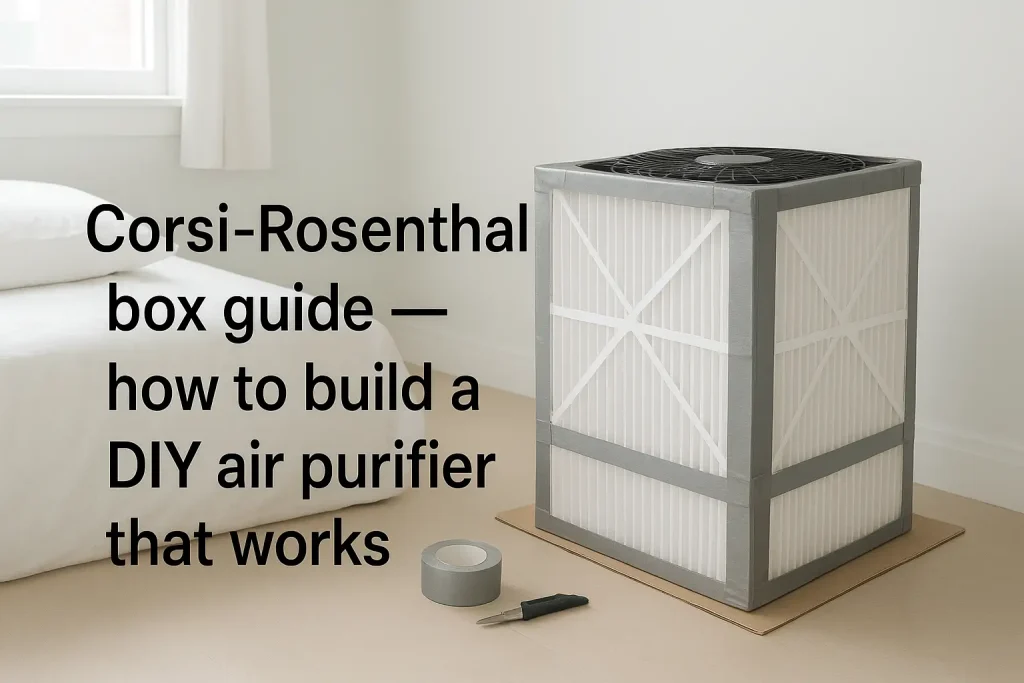
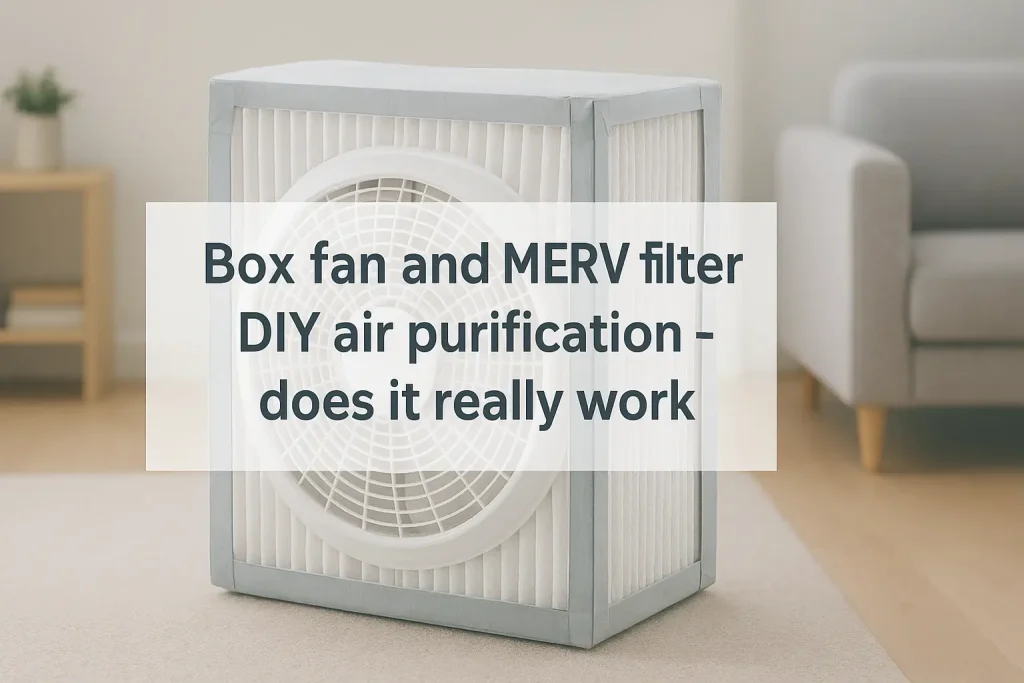
A Corsi-Rosenthal box built from a 20-inch box fan and four MERV 13 20-by-20-inch furnace filters captures vaping aerosol particles effectively at a smoke CADR equivalent of approximately 300 to 600 CFM depending on fan speed and filter configuration. It costs $60 to $80 to build and the filters last 6 to 12 months. However, a Corsi-Rosenthal box provides no meaningful VOC or odor removal because MERV 13 filters are particle filters without activated carbon.
This means a Corsi-Rosenthal box solves the visible cloud problem completely and cheaply for large rooms. It does nothing for vape odor. You can add carbon by taping an activated carbon filter sheet to the exhaust side of the fan, but the airflow resistance of carbon sheets reduces CADR and the thin carbon saturates quickly. A Corsi-Rosenthal box plus a standalone activated carbon canister filter is a viable two-device solution for dedicated vaping rooms, but a single hybrid commercial unit is simpler and more compact.
The build requires a 20-inch box fan rated for at least 2,000 CFM and four MERV 13 20x20x1 filters arranged in a cube with the fan as the exhaust face. Tape all seams with duct tape and point the exhaust away from walls. This setup clears a 400-square-foot room at 5 ACH for under $80 in materials, making it the most cost-effective particle-only solution available.
How Long Should I Run My Air Purifier Each Day in a Vaping Room?
Run the air purifier continuously, 24 hours per day, in any room where vaping occurs daily. Vaping aerosol lingers for 15 to 45 minutes after each exhale, and if people vape at different times throughout the day, the PM2.5 and VOC load is nearly continuous. A purifier that runs only during active vaping sessions misses the post-exhale period when aerosol droplets are dispersing and VOCs are off-gassing from surfaces.
This happens because the room air is a reservoir that accumulates aerosol from each vaping session. If the purifier runs for 2 hours during an evening vaping session and then shuts off, aerosol that was exhaled in the final 30 minutes of the session remains in the room air for hours. VOCs adsorbed onto surfaces during the session desorb into the room air overnight, building up a background concentration that the morning airing-out does not fully clear. Running the purifier continuously at a medium speed that delivers at least 2 to 3 ACH maintains a baseline clearance rate that prevents accumulation.
Set the purifier to auto mode if it has a reliable PM2.5 sensor that ramps up fan speed when it detects elevated particles. The Coway Airmega 400 and Levoit Core 400S both have good auto modes that respond to vaping aerosol. For units without auto mode, set the fan speed to deliver your target ACH rate continuously. At 5 ACH in a 200-square-foot room, the purifier cycles the entire room air volume every 12 minutes, which keeps PM2.5 below 12 micrograms per cubic meter even during active vaping.
What Went Wrong When My Air Purifier Made the Vape Smell Worse?
An air purifier that makes vape smell worse has a saturated carbon filter that is releasing previously adsorbed VOCs back into the air. This is a common failure mode that occurs when the carbon filter has exceeded its adsorption capacity and humidity or temperature changes trigger desorption. The fix is immediate carbon filter replacement.
A secondary cause is an ionizer producing ozone that reacts with vape flavoring compounds to create new, more pungent oxidation products. If your purifier has an ionizer and the room smells different or sharper with the purifier running compared to when it is off, switch off the ionizer and run only the fan and mechanical filters. If the smell improves within 30 minutes, the ionizer was the cause and should remain off permanently for vaping rooms.
A third possibility is that the purifier is stirring up VOCs that have deposited on room surfaces without capturing them. This occurs when the CADR is too low for the room size or when the purifier is placed in a corner where its exhaust blows across VOC-laden walls and curtains, resuspending surface deposits into the air. Move the purifier to a central location, increase the fan speed, and clean room surfaces including walls, curtains, and upholstery that have absorbed vape residue over time.
Summary: The Single Most Important Specification for a Vaping Air Purifier
The single most important specification for a vaping air purifier is whether it combines True HEPA with a granular activated carbon bed of at least 3 pounds. A True HEPA-only unit handles the visible cloud. A carbon-only unit handles the odor. Only a hybrid unit with both stages handles the complete vaping aerosol challenge, and only units with granular carbon rather than thin carbon sheets maintain odor control beyond the first 6 to 8 weeks of daily vaping.
Match the smoke CADR to your room size at 5 ACH using the table earlier in this guide. Choose a CARB-certified unit with the ionizer switched off. Position it within 5 feet of where vaping occurs with the intake facing the vaping area. Replace the carbon filter every 3 to 6 months and the HEPA filter every 4 to 8 months when vaping daily. A True HEPA air purifier with granular activated carbon configured this way reduces vaping aerosol PM2.5 by 80 to 90 percent and vape odor by 70 to 90 percent when running continuously at the correct CADR for the room.