Most air purifiers claim to remove chemicals from indoor air. Few actually do it well. The difference comes down to one specification most buyers ignore: the weight and type of activated carbon inside the filter.
True HEPA filters capture particles like dust and pollen. They do nothing for formaldehyde, benzene, or the volatile organic compounds (VOCs) off-gassing from furniture, paint, and cleaning products. For chemical removal, you need an air purifier engineered with a substantial activated carbon stage, not a thin carbon sheet sprayed onto a foam pre-filter.
This guide ranks the five best air purifiers for chemicals based on carbon filter weight, VOC reduction data, and long-term operating cost. You will also find a buyer guide explaining exactly what to look for, what to avoid, and how to match a unit to your specific chemical sensitivity or indoor air quality concern.
What Makes Chemical Air Purifiers Different from Standard HEPA Units?
A standard air purifier removes solid particles. A chemical air purifier removes gases. The distinction matters because the filtration mechanism is completely different.
| Photo | Popular Air Purifiers | Price |
|---|---|---|

|
Air Purifiers for Home Large Room up to 1500ft², Tailulu H13 True HEPA Air Purifier for Pets Dust Odor Smoke, Air Purifier for Bedroom with 15dB Quiet Sleep Mode for Bedroom Office Living Room | Check Price On Amazon |
|
Afloia Air Purifier for Home, 4-in-1 Washable Filter for Allergies, Covers Up to 1076 ft², Quiet Operation, Auto Shut-Off & Night Light, Removes Pet Dander, Pollen, Dust, Mold, and Smoke, White,Pluto | Check Price On Amazon |

|
Nuwave OxyPure ZERO Air Purifier with Washable and Reusable Bio Guard Tech Air Filter, Large Room Up to 2002 Ft², Air Quality Monitor, 0.1 Microns, 100% Capture Irritants like Smoke, Dust, Pollen | Check Price On Amazon |

|
Air Purifiers for Home Large Room Up to 1,996 Ft², EOEBOT Air Purifier for Home Pets with Washable Filter, Quiet Sleep Mode, Air Quality Monitor, Air Purifier for Bedroom, Pet Hair, Dust, Smoke, White | Check Price On Amazon |
|
Afloia 2 IN 1 Air Purifier with Humidifier Combo, 3-Stage Filters for Home Allergies Pets Hair Smoker Odors, Evaporative Humidifier, Auto Shut Off, Quiet Air Cleaner with Seven Color Light,White | Check Price On Amazon |
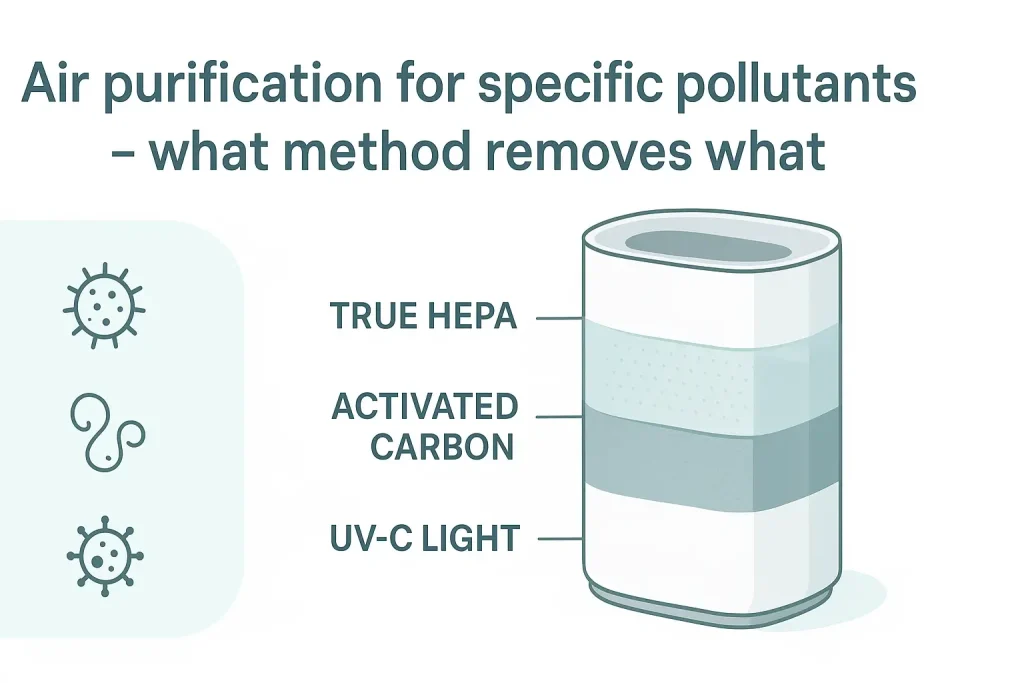
HEPA filters use dense fiber mats to physically trap particles as small as 0.3 microns at 99.97% efficiency. VOCs, formaldehyde, and other gaseous chemicals pass straight through HEPA fibers. They are molecules, not particles. They measure 0.0001 to 0.001 microns across, roughly 300 to 3,000 times smaller than the HEPA test particle size.
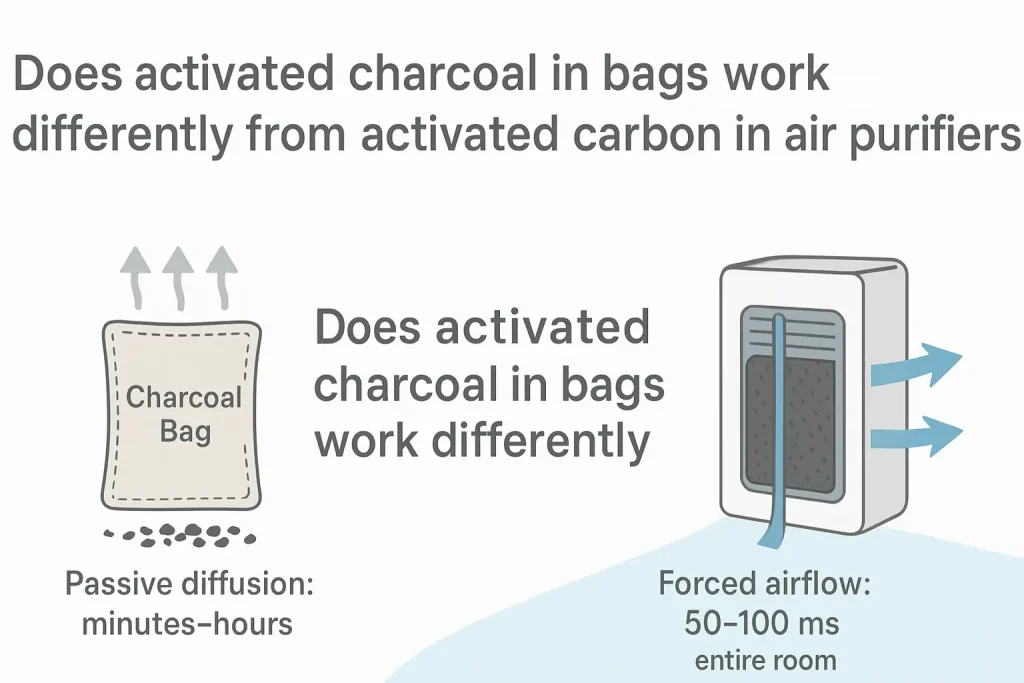
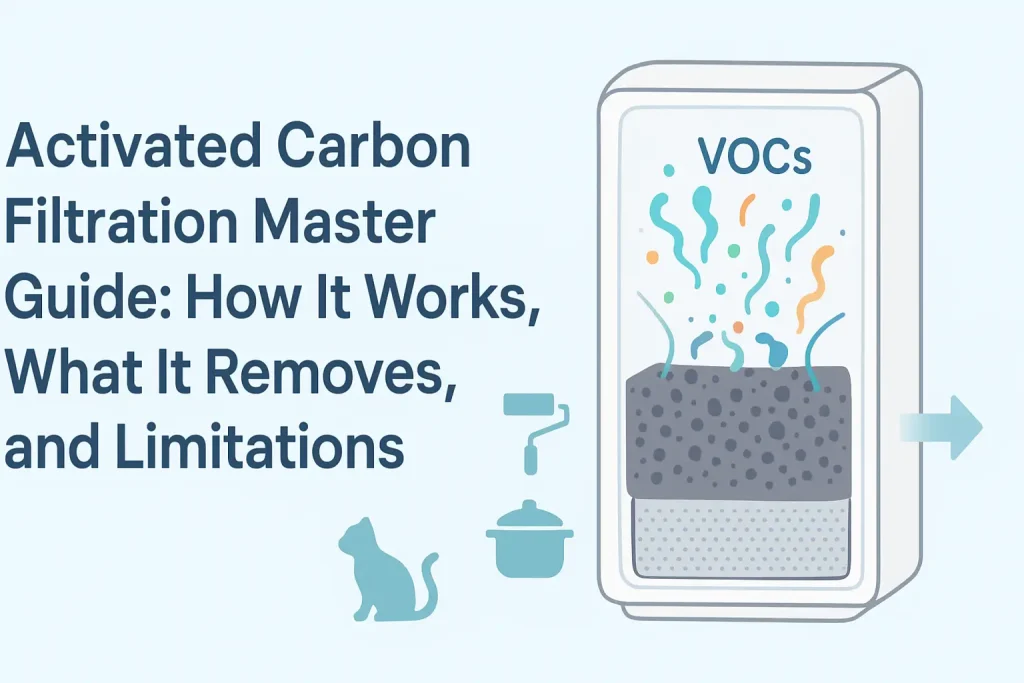
Activated carbon removes gases through a process called adsorption. The carbon granules have microscopic pores that create an enormous internal surface area: one pound of high-quality activated carbon provides 50 to 125 acres of surface area. Gas molecules enter the pores and bond to the carbon surface through van der Waals forces. This process is physical, not mechanical. The carbon acts as a molecular sponge, not a sieve.
Carbon weight is the single most important specification for chemical filtration. A thin carbon sheet weighing 0.5 pounds saturates within days. A carbon canister weighing 15 pounds or more can filter VOCs for six to twelve months before replacement. The relationship is linear: double the carbon weight, double the service life, all else being equal.
Some units add potassium permanganate or zeolite to the carbon blend. Potassium permanganate chemically oxidizes formaldehyde, converting it into harmless compounds. Zeolite targets ammonia and hydrogen sulfide. A blended media filter provides broader chemical coverage than plain activated carbon alone.
Air Quality Data
Chemical Filtration for Indoor Air: What the Research Shows
Sources: EPA Indoor Air Quality, CARB, American Lung Association
Health Conditions That Require Chemical Air Filtration
Multiple Chemical Sensitivity (MCS) affects an estimated 12.6% of the U.S. population according to a study published in the Journal of Occupational and Environmental Medicine. People with MCS react to VOC concentrations far below what healthy adults perceive. Symptoms include headaches, dizziness, respiratory irritation, and cognitive fog triggered by fragrances, paint fumes, cleaning products, and new furniture off-gassing.
Asthma sufferers face compounded risk from chemical irritants. VOCs do not directly cause asthma attacks the way allergens do, but they inflame airways and lower the threshold for particle-triggered bronchospasm. The American Lung Association identifies formaldehyde and benzene as respiratory irritants that worsen asthma control when present at indoor concentrations above 0.1 ppm.
New home occupants and renovation survivors face acute VOC exposure. Particleboard cabinets, carpet adhesives, paint, and vinyl flooring off-gas formaldehyde for months to years after installation. A 2014 study in Indoor Air journal documented formaldehyde levels exceeding 0.3 ppm in newly constructed homes, three times the WHO guideline of 0.1 ppm for short-term exposure.
Pet owners dealing with litter box odors, cooking enthusiasts managing grease and gas fumes, and urban residents living near highways with benzene and toluene infiltration all benefit from chemical-capable air purification. The common thread: particles are not the problem. Gases are.
How to Match a Chemical Air Purifier to Your Specific Pollutant Concern
Chemical filtration is not one-size-fits-all. Different carbon blends, filter weights, and housing designs target different pollutant profiles. A unit built for formaldehyde may perform poorly on hydrogen sulfide, and vice versa. The selector tool below routes you to the correct filter strategy based on your health condition and primary pollutant.
Use the interactive tool below to identify which filter configuration matches your specific indoor air chemistry challenge. Each combination of health condition and pollutant type produces a tailored recommendation based on carbon weight requirements, filter media composition, and certification needs.
Top 5 Air Purifiers for Chemicals: Ranked by Carbon Weight and VOC Reduction
These five units represent the best available chemical filtration across different budgets and room sizes. Each ranking considers activated carbon weight, filter media composition, CADR for particle coverage, annual operating cost, and certification status. All units are CARB certified producing less than 0.050 ppm ozone.
Use the comparison table below to identify which unit matches your room size, chemical concern, and annual budget. The table includes carbon weight, the specification most sellers omit, because carbon weight determines how long the filter lasts before VOC breakthrough.
Product Comparison
Top 5 Chemical Air Purifiers: Head-to-Head Comparison
Carbon weight sourced from manufacturer specifications. CADR data from AHAM Verifide database where available.
| Model | Carbon Weight | Media Type | Smoke CADR | Room at 5 ACH | Noise Min/Max | Annual Filter Cost | Best For |
|---|---|---|---|---|---|---|---|
| IQAir HealthPro Plus | 5 lbs (V5-Cell) | Activated carbon + potassium permanganate | 300 CFM | 360 sq ft | 22 dB / 57 dB | $200-$280 | Asthma, MCS, formaldehyde |
| Austin Air HealthMate Plus | 15 lbs | Activated carbon + zeolite + potassium permanganate | 200 CFM | 240 sq ft | 30 dB / 60 dB | $150-$200 | Heavy VOC load, pets, long filter life |
| Airpura C700 | 26 lbs | Activated carbon (pure, no blend) | 180 CFM | 216 sq ft | 28 dB / 62 dB | $250-$350 | Chemical sensitivity, maximum carbon |
| Coway Airmega 400S | 2.2 lbs | Activated carbon sheet | 350 CFM | 420 sq ft | 22 dB / 52 dB | $70-$90 | Large rooms, moderate chemical load |
| Levoit Core 600S | 0.8 lbs | Activated carbon sheet (nylon frame) | 410 CFM | 492 sq ft | 26 dB / 55 dB | $50-$70 | Budget, light odor, large rooms |
CARB certification confirmed for all units. Room coverage at 5 ACH calculated as: (Smoke CADR × 60) / (5 × 8 ft ceiling). Annual filter cost based on manufacturer recommended replacement schedule at current pricing.
1. IQAir HealthPro Plus: Best Overall for Chemical and Particle Filtration
The IQAir HealthPro Plus combines medical-grade True HEPA filtration with the V5-Cell gas filter containing 5 pounds of activated carbon and potassium permanganate impregnated alumina. This unit delivers the highest smoke CADR among dedicated chemical purifiers at 300 CFM, covering 360 square feet at 5 ACH with an 8-foot ceiling.
The V5-Cell targets a broad spectrum of chemicals: formaldehyde, benzene, toluene, xylene, and hundreds of other VOCs. The potassium permanganate component chemically oxidizes formaldehyde rather than merely adsorbing it, which prevents re-emission when the filter approaches saturation. IQAir tests each unit individually and ships with a hand-signed certificate of performance.
Key Specifications:
- Smoke CADR: 300 CFM (AHAM verified)
- Carbon weight: 5 lbs (V5-Cell gas filter)
- Pre-filter: F8 (captures 85%+ of particles 0.3 microns and larger)
- Noise: 22 dB at speed 1, 57 dB at speed 6
- Annual filter cost: $200 to $280 (Pre-filter $40 every 12 months, V5-Cell $100 every 24 months, HEPA $140 every 48 months)
- CARB certified: Yes (0.050 ppm ozone limit)
- Warranty: 10 years (limited)
The HealthPro Plus costs more upfront than any other unit on this list. The long-term value equation shifts when you consider that the HEPA filter lasts four years and the V5-Cell lasts two years under normal residential VOC loads. For asthma sufferers and chemically sensitive individuals, the combination of certified performance and broad chemical coverage justifies the premium.
Check the IQAir HealthPro Plus on Amazon for current pricing and availability.
2. Austin Air HealthMate Plus: Best Carbon Weight for the Price
The Austin Air HealthMate Plus contains 15 pounds of blended filter media: activated carbon, zeolite, and potassium permanganate impregnated carbon. This is three times the carbon weight of the IQAir at roughly 60% of the price. The carbon-zeolite blend targets VOCs, ammonia, hydrogen sulfide, and formaldehyde simultaneously.
The trade-off is lower CADR. At 200 CFM smoke CADR, the HealthMate Plus covers 240 square feet at 5 ACH. The unit uses a four-stage filter: large-particle pre-filter, medium-particle pre-filter, 15 pounds of carbon-zeolite blend, and True HEPA. The steel housing is powder-coated with zero off-gassing plastics in the air path, an important consideration for chemically sensitive users.
Key Specifications:
- Smoke CADR: 200 CFM (estimated, not AHAM verified)
- Carbon weight: 15 lbs (carbon + zeolite + potassium permanganate blend)
- Pre-filter: Dual stage (large particle + medium particle)
- Noise: 30 dB at low, 60 dB at high
- Annual filter cost: $150 to $200 (single filter assembly replaced every 5 years at $750 to $1,000 total)
- CARB certified: Yes
- Warranty: 5 years mechanical, 5 years pro-rated filter
The five-year filter life changes the cost calculus. Instead of annual carbon replacement, you replace the entire filter assembly once every five years. For pet owners managing ammonia and odor alongside general VOC concerns, the zeolite component provides targeted coverage that plain carbon lacks. The unit is also manufactured in the United States with domestically sourced materials.
View the Austin Air HealthMate Plus on Amazon for detailed specifications and reviews.
3. Airpura C700: Maximum Carbon for Severe Chemical Sensitivity
The Airpura C700 contains 26 pounds of activated carbon in a dedicated canister, the highest carbon weight of any residential air purifier on the market. This unit prioritizes gas filtration above all else. The smoke CADR of 180 CFM reflects the airflow restriction imposed by 26 pounds of carbon media. The C700 is not a particle-first machine. It is a gas removal specialist.
The housing is powder-coated steel with a sealed design that prevents bypass. No plastics contact the air stream. No adhesives are used in filter construction. No ionizers, UV lamps, or fragrance dispensers are present. For individuals with diagnosed Multiple Chemical Sensitivity, these design choices matter as much as the filtration performance itself. Off-gassing from the purifier housing can trigger symptoms in sensitive individuals.
Key Specifications:
- Smoke CADR: 180 CFM (estimated)
- Carbon weight: 26 lbs (pure activated carbon, no blend)
- Pre-filter: Polyester media pad (replaceable)
- Noise: 28 dB at low, 62 dB at high
- Annual filter cost: $250 to $350 (carbon canister $200 to $300 every 12 to 18 months, pre-filter $15 every 3 months)
- CARB certified: Yes
- Warranty: 5 years
The C700 works best in a dedicated room for someone with confirmed chemical sensitivity. The high annual filter cost reflects the 26-pound carbon replacement. For vocations involving chemical exposure like artists using solvents, nail technicians, or people living in areas with industrial emissions, the C700 provides protection that lighter carbon filters cannot match.
Check the Airpura C700 availability and pricing on Amazon.
4. Coway Airmega 400S: Best Large-Room Option with Carbon
The Coway Airmega 400S delivers 350 CFM smoke CADR, covering 420 square feet at 5 ACH. The carbon filter weighs 2.2 pounds, significantly less than the top three units but adequate for moderate VOC loads in large open spaces. This unit makes sense when your primary concern is particle control in a large room with secondary chemical concerns from cooking, pets, or household products.
The dual carbon sheet design places activated carbon on both sides of the filter frame. The 400S includes a pollution sensor that auto-adjusts fan speed and displays real-time PM2.5 concentration. For rental homes with limited floor space, the 400S provides high CADR in a compact footprint relative to its coverage.
Key Specifications:
- Smoke CADR: 350 CFM (AHAM verified)
- Carbon weight: 2.2 lbs (dual carbon sheet)
- Pre-filter: Washable mesh
- Noise: 22 dB at sleep, 52 dB at turbo
- Annual filter cost: $70 to $90 (HEPA + carbon combo $70 to $90 every 12 months)
- CARB certified: Yes
- Warranty: 5 years motor, 1 year parts
The 400S cannot replace a dedicated chemical purifier for someone with MCS or severe VOC sensitivity. It does provide meaningful odor and light chemical reduction for households where particles and moderate gases coexist. The low annual filter cost and high CADR make it the best value on this list for large rooms.
Find the Coway Airmega 400S on Amazon with current pricing.
5. Levoit Core 600S: Best Budget Option for Light Chemical Loads
The Levoit Core 600S achieves the highest smoke CADR on this list at 410 CFM, covering 492 square feet at 5 ACH. The carbon filter weighs approximately 0.8 pounds in a nylon-frame sheet configuration. This is a particle-first machine with a thin carbon stage suitable for light odors from cooking, pets, and everyday household activities.
The Core 600S uses Levoit’s VortexAir technology to maximize airflow through a cylindrical filter design. The unit connects to the VeSync app for scheduling, auto-mode based on its PM2.5 sensor, and filter life tracking. For bedroom placement where quiet operation matters, the 26 dB sleep mode and light-blocking display make this unit particularly suitable.
Key Specifications:
- Smoke CADR: 410 CFM (manufacturer claimed, not AHAM verified)
- Carbon weight: 0.8 lbs (nylon-frame carbon sheet)
- Pre-filter: Integrated with main filter
- Noise: 26 dB at sleep, 55 dB at turbo
- Annual filter cost: $50 to $70 (single filter assembly replaced every 12 months)
- CARB certified: Yes
- Warranty: 2 years
The Core 600S is not a chemical air purifier in the same sense as the Airpura C700 or Austin Air HealthMate Plus. It is a high-CADR particle purifier with a carbon layer for light odor management. For someone with diagnosed chemical sensitivity, choose one of the top three units. For someone wanting better air quality in a large room with occasional cooking odors, the Core 600S provides excellent value.
See the Levoit Core 600S on Amazon for current deals.
What Is Activated Carbon and How Does It Remove Chemicals from Indoor Air?
Activated carbon is carbon that has been processed to create an extensive network of microscopic pores. The activation process, typically steam treatment at 1,800 degrees Fahrenheit, erodes the internal structure of the carbon to produce surface area measured in acres per pound. One gram of high-quality activated carbon provides 500 to 1,500 square meters of surface area.
When air passes through a bed of activated carbon granules, gas molecules enter the pores and physically bond to the carbon surface. This process, called physisorption, relies on van der Waals forces. The bond is weak enough that extreme heat or pressure can reverse it, which is how carbon filters are regenerated in industrial settings, but strong enough to hold VOCs permanently under normal indoor conditions.
The pore size distribution determines which chemicals a given carbon captures. Micropores smaller than 2 nanometers capture small molecules like formaldehyde. Mesopores between 2 and 50 nanometers capture larger VOCs like benzene and toluene. A high-quality activated carbon filter contains a distribution of pore sizes to address a broad spectrum of indoor chemicals. Cheap carbon sheets typically lack microporosity, which is why they perform poorly on formaldehyde.
Carbon becomes saturated when all available adsorption sites are occupied. At saturation, the filter stops capturing new VOCs. In some cases, previously captured VOCs can re-emit from saturated carbon, a process called desorption. This is why carbon filter replacement schedules matter. A saturated carbon filter is worse than no carbon filter because it can release concentrated VOCs when temperature or humidity shifts.
Carbon Weight: The Specification That Determines Chemical Filtration Performance
Carbon weight is the single most predictive specification for chemical filtration performance. A 0.5-pound carbon sheet saturates within days under moderate VOC load. A 15-pound carbon canister lasts six to twelve months under the same conditions. The relationship between carbon weight and service life is approximately linear, assuming consistent pellet size and pore distribution.
Filter manufacturers rarely advertise carbon weight prominently. They use terms like “activated carbon filter” or “carbon layer” without disclosing quantity. A “carbon filter” weighing 0.3 pounds and a “carbon filter” weighing 15 pounds are both accurately described by the same phrase. The difference in actual VOC removal capacity is 50-fold. Always check the specification sheet for carbon weight before buying a purifier marketed for chemical removal.
Pellet size affects the rate of adsorption but not the total capacity. Smaller pellets provide more surface area per gram, adsorbing VOCs faster. Larger pellets allow higher airflow with less backpressure, improving CADR. The ideal carbon filter balances pellet size against airflow. Units with very high carbon weight, like the Airpura C700 at 26 pounds, use larger pellets to maintain adequate airflow through the deep carbon bed.
Impregnated carbon adds chemical reactivity to physical adsorption. Potassium permanganate impregnated carbon oxidizes formaldehyde into carbon dioxide and water. The chemical reaction destroys the formaldehyde molecule rather than merely trapping it. This prevents desorption and extends the effective filter life against formaldehyde specifically. For homes with known formaldehyde concerns from particleboard furniture or recent renovations, impregnated carbon provides protection that plain carbon cannot match.
How Room Size and ACH Determine the CADR You Need for Chemical Filtration
Chemical filtration adds a complication to room sizing that particle-only purifiers do not face. Carbon filters restrict airflow. A unit with 26 pounds of carbon, like the Airpura C700, achieves 180 CFM smoke CADR. A unit with 2.2 pounds of carbon, like the Coway Airmega 400S, achieves 350 CFM smoke CADR. The heavier carbon filter cleans air more slowly but for much longer before saturation.
The formula for calculating required CADR is: CADR = (Room Length × Width × Ceiling Height × ACH) / 60. A 300-square-foot bedroom with 8-foot ceilings at 4 ACH requires 160 CFM smoke CADR. The same room at 5 ACH, recommended by the EPA for allergy and asthma management, requires 200 CFM. All five units on this list meet the 160 CFM threshold for a 300-square-foot room at 4 ACH.
For open-plan living areas, the calculation changes. A 600-square-foot living room with 9-foot ceilings at 4 ACH requires 360 CFM. Only the IQAir HealthPro Plus at 300 CFM, Coway Airmega 400S at 350 CFM, and Levoit Core 600S at 410 CFM approach this requirement. The Austin Air HealthMate Plus at 200 CFM and Airpura C700 at 180 CFM cannot achieve 4 ACH in a space this large. They require placement in smaller rooms or running two units.
Multiple units in a large space provide better chemical coverage than one large unit. A single purifier creates a zone of clean air around it with diminishing effectiveness at distance. Two units placed at opposite ends of an open-plan space provide more uniform VOC reduction. For tiny homes and compact spaces, one appropriately sized unit with sufficient carbon weight provides adequate coverage because the total air volume is small and the purifier can cycle all room air within minutes.
Filter Replacement Costs: The Hidden Expense of Chemical Air Purifiers
Chemical air purifiers cost more to maintain than particle-only units. The carbon filter requires periodic replacement as adsorption sites saturate. Annual filter costs for the units on this list range from $50 for the Levoit Core 600S to $350 for the Airpura C700. Over five years, filter replacement costs often exceed the initial purchase price of the unit.
The IQAir HealthPro Plus uses a modular filter system where each stage has a different replacement interval. The pre-filter lasts 12 months at $40. The V5-Cell gas filter lasts 24 months at $100. The HyperHEPA filter lasts 48 months at $140. Annualized, this works out to $200 to $280 per year depending on usage and pollution load.
The Austin Air HealthMate Plus uses a single integrated filter assembly that lasts five years at $750 to $1,000. Annualized cost is $150 to $200. The advantage is simplicity: one replacement every five years. The disadvantage is that all filtration media ages at the same rate even though carbon saturates faster than True HEPA clogs.
The Airpura C700 requires carbon canister replacement every 12 to 18 months at $200 to $300, plus pre-filter replacement every 3 months at $15. Annualized cost is $250 to $350. This is the highest maintenance cost on the list, reflecting the 26-pound carbon canister. For someone with diagnosed MCS, this cost is a medical necessity, not a luxury.
The Coway Airmega 400S and Levoit Core 600S use combined HEPA + carbon filter assemblies replaced annually. Annual costs of $70 to $90 and $50 to $70 respectively make them the most affordable to maintain. The trade-off is that the thin carbon sheets in these units saturate quickly under significant VOC loads. If you have light odor concerns, these units provide adequate carbon performance at low cost. For heavy chemical loads, the higher annual cost of a dedicated carbon canister unit is unavoidable.
Ozone Safety and CARB Certification: What Every Chemical Purifier Buyer Must Check
Some air purifiers generate ozone as a byproduct of ionization or UV-C lamp operation. Ozone is a respiratory irritant that damages lung tissue at concentrations above 0.070 ppm over 8 hours according to the EPA’s National Ambient Air Quality Standard. The California Air Resources Board (CARB) sets a stricter limit: 0.050 ppm maximum ozone output from any air cleaning device sold in California.
CARB certification is not optional. Any air purifier sold in the United States that produces ozone must comply with the 0.050 ppm limit. Units that do not produce ozone receive CARB certification confirming zero ozone output. All five units on this list are CARB certified. Verify CARB certification on any purifier you consider by checking the CARB certified device list before purchase.
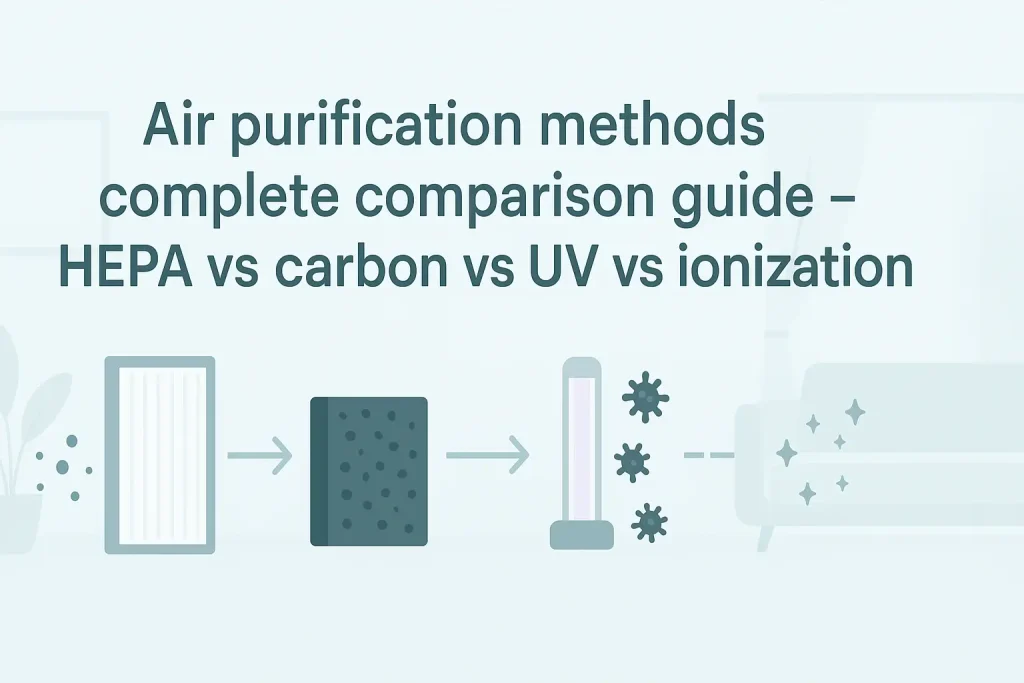
Ionizers and electrostatic precipitators generate ozone as a byproduct of corona discharge. UV-C lamps produce ozone when the UV wavelength is below 240 nanometers. Avoid ionizers entirely for chemical applications. Ozone can react with VOCs in indoor air to create secondary pollutants including ultrafine particles and aldehydes. An air purifier that generates ozone while claiming to clean chemicals may worsen air quality rather than improve it.
The safest chemical air purifiers use mechanical filtration exclusively: activated carbon for gases, True HEPA for particles, and no electronic air cleaning technologies. The IQAir HealthPro Plus, Austin Air HealthMate Plus, and Airpura C700 follow this design philosophy. They are purely mechanical filtration devices with zero ozone output and CARB certification to verify that claim.
Placement and Operation: How to Get the Most from Your Chemical Air Purifier
Chemical air purifiers perform best when placed centrally in the room with at least 12 inches of clearance on all sides. The intake and exhaust must have unobstructed airflow. Placing a purifier against a wall or in a corner reduces effective coverage by 20 to 30 percent because the intake side is partially blocked. The same unit placed in the center of the room delivers its full rated CADR.
Run the purifier continuously, not intermittently. VOC off-gassing from furniture, building materials, and household products is continuous. The concentration builds steadily when the purifier is off. Running the unit 24 hours per day maintains a steady state of low VOC concentration. Most chemical purifiers draw 40 to 120 watts at medium speed, adding $35 to $105 to annual electricity costs at the U.S. average rate of 13 cents per kilowatt-hour.
For chemically sensitive individuals, run the purifier in the bedroom at the highest speed you can tolerate acoustically during the day and reduce to a lower speed for sleep. Eight hours of clean air while sleeping provides the most significant health benefit because respiratory rate is steady and the body repairs oxidative damage during sleep. For nurseries and children’s rooms, prioritize units with quiet sleep modes and fully sealed housings to prevent any material off-gassing near infants.
Close windows and doors when running a chemical purifier. Outdoor air introduces new VOCs, especially in urban areas with vehicle traffic. The purifier must capture both indoor-generated VOCs and infiltrated outdoor VOCs. Sealing the room improves steady-state VOC reduction. If you need ventilation for CO2 management, run the purifier on high for 30 minutes after closing windows to reduce any accumulated VOCs.