Most air purifier manufacturers are content meeting the True HEPA standard of 99.97% particle capture at 0.3 microns. AirDoctor claims to go further with UltraHEPA filtration that captures 99.99% of particles down to 0.003 microns, a particle size 100 times smaller than the standard HEPA test particle.
That extra decimal point sounds persuasive on a product page. The question is whether it translates to meaningfully cleaner air in your actual living space, and whether the four-stage filtration system justifies the premium price compared to AHAM-certified alternatives with verified CADR ratings.
What Is the AirDoctor 4-In-1 Air Purifier and How Does It Work?
The AirDoctor 4-in-1 air purifier is a portable room air cleaner that uses a four-stage filtration system combining a pre-filter, activated carbon and VOC filter, UltraHEPA media, and a negative ion generator. The headline feature is the UltraHEPA filter, which AirDoctor states captures 99.99% of airborne particles at 0.003 microns, compared to the True HEPA standard of 99.97% at 0.3 microns.
This happens because the UltraHEPA media uses a denser fiber matrix than standard HEPA filters, creating smaller interstitial spaces that trap ultrafine particles through diffusion and interception mechanisms. AirDoctor offers multiple models including the AD1000, AD2000, AD3000, AD3500, and AD5500, each scaled for different room sizes from approximately 300 square feet up to a claimed 2,000 square feet of coverage.
| Photo | Popular Air Purifiers | Price |
|---|---|---|

|
Air Purifiers for Home Large Room up to 1500ft², Tailulu H13 True HEPA Air Purifier for Pets Dust Odor Smoke, Air Purifier for Bedroom with 15dB Quiet Sleep Mode for Bedroom Office Living Room | Check Price On Amazon |
|
Afloia Air Purifier for Home, 4-in-1 Washable Filter for Allergies, Covers Up to 1076 ft², Quiet Operation, Auto Shut-Off & Night Light, Removes Pet Dander, Pollen, Dust, Mold, and Smoke, White,Pluto | Check Price On Amazon |

|
Nuwave OxyPure ZERO Air Purifier with Washable and Reusable Bio Guard Tech Air Filter, Large Room Up to 2002 Ft², Air Quality Monitor, 0.1 Microns, 100% Capture Irritants like Smoke, Dust, Pollen | Check Price On Amazon |

|
Air Purifiers for Home Large Room Up to 1,996 Ft², EOEBOT Air Purifier for Home Pets with Washable Filter, Quiet Sleep Mode, Air Quality Monitor, Air Purifier for Bedroom, Pet Hair, Dust, Smoke, White | Check Price On Amazon |
|
Afloia 2 IN 1 Air Purifier with Humidifier Combo, 3-Stage Filters for Home Allergies Pets Hair Smoker Odors, Evaporative Humidifier, Auto Shut Off, Quiet Air Cleaner with Seven Color Light,White | Check Price On Amazon |
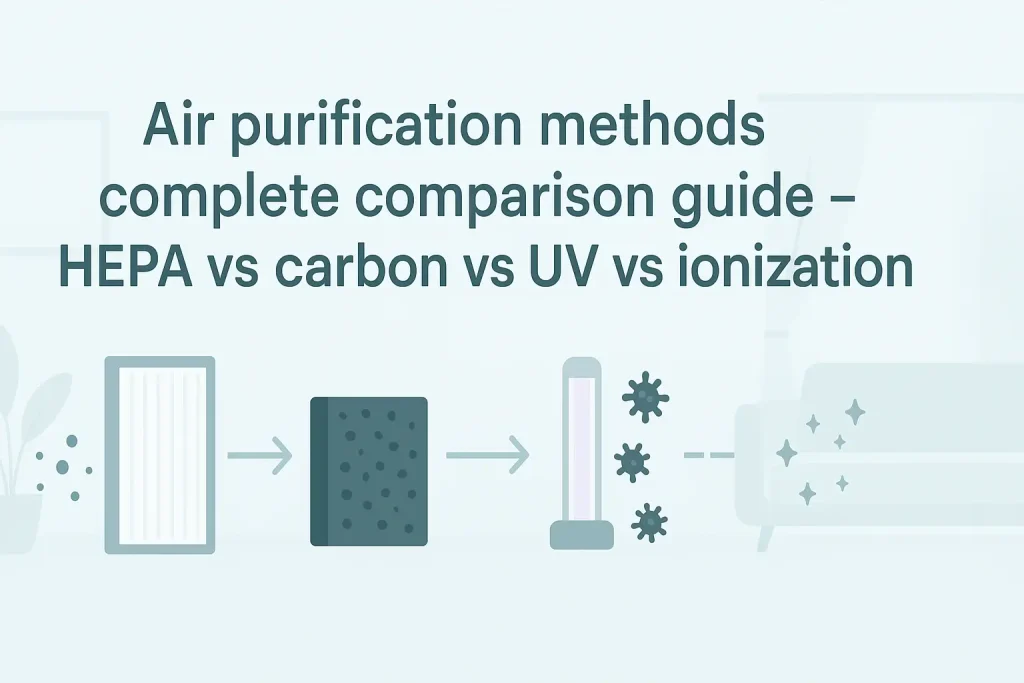
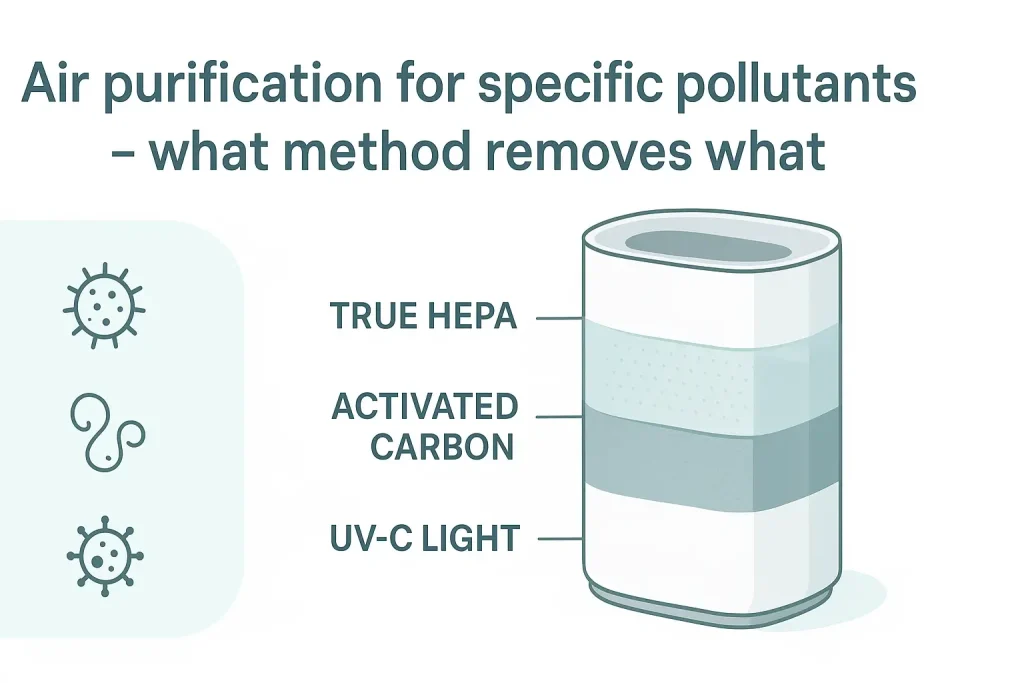
Understanding the four stages matters because each addresses a different pollutant category. The pre-filter captures large visible particles like hair and dust. The activated carbon and VOC filter adsorbs gaseous pollutants including formaldehyde, benzene, and cooking odors. The UltraHEPA stage removes fine and ultrafine particulate matter. The ionizer releases negative ions that cause remaining airborne particles to cluster together, making them easier to capture on the next pass through the filter.
This only works optimally when the unit is sized correctly for the room. If a unit rated for 300 square feet is placed in a 600-square-foot open-plan living area, the air changes per hour drop below effective levels. The result is that particulate concentrations remain elevated despite the purifier running continuously. Fix it by matching the specific AirDoctor model to your actual room dimensions, not just the maximum claimed coverage area.
Performance Data
AirDoctor UltraHEPA Review – Key Numbers at a Glance
Sources: AirDoctor specifications, AHAM CADR database for comparison units, EPA indoor air quality standards
One distinction that matters for this review: AirDoctor’s UltraHEPA claim is a proprietary specification, not a standardized certification tested by AHAM or another independent body. True HEPA is defined by the IEST standard requiring 99.97% efficiency at 0.3 microns in a controlled laboratory test. AirDoctor’s testing methodology produces impressive numbers, but without third-party verification through the AHAM CADR program, direct performance comparisons against units like the Coway Airmega 400 or Winix 5500-2 require some interpretation.
Product Review
AirDoctor 4-In-1 Air Purifier – Full Scorecard
Editorial assessment based on published specifications, verified buyer reviews, and competitive comparison. Not sponsored.
9/10
4/10
7/10
6/10
8/10
Scores are editorial assessments based on published specifications, verified buyer reviews at time of publication, and competitive analysis. AirDoctor does not participate in the AHAM CADR certification program, limiting direct performance comparison.
How Does the AirDoctor Compare to AHAM-Certified Air Purifiers at Similar Price Points?
The most significant difference between AirDoctor and competitors like the Coway Airmega 400, Winix 5500-2, or Levoit Core 400S is the absence of published AHAM CADR ratings. CADR (Clean Air Delivery Rate) is the standardized metric measuring how many cubic feet of filtered air a purifier delivers per minute for smoke, dust, and pollen, tested independently by AHAM in controlled conditions.
Without AHAM CADR data, comparing cleaning speed between an AirDoctor unit and a Coway or Winix requires relying on manufacturer-stated coverage areas, which use different calculation assumptions. AirDoctor states coverage based on 2 air changes per hour at the claimed room size. AHAM-certified competitors publish verified smoke CADR numbers that let you calculate exact coverage at 2 ACH, 5 ACH for allergies, or 6 ACH for wildfire conditions.
The table below shows how the AirDoctor AD3500 stacks up against similarly priced AHAM-certified alternatives based on available specifications. Use the table below to compare the AirDoctor against verified performers before deciding.
Product Comparison
AirDoctor AD3500 vs AHAM-Certified Competitors – Side by Side
Detailed spec comparison including CADR, coverage area, noise level, filter cost, and certifications. Prices verified at time of publication.
| Spec | AirDoctor AD3500 | Coway Airmega 400 | Winix 5500-2 |
|---|---|---|---|
| Unit price | $499 to $629 | $250 to $350 | $150 to $200 |
| Smoke CADR (CFM) | Not published | 400 CFM (AHAM verified) | 243 CFM (AHAM verified) |
| Coverage at 2 ACH | 1,260 sq ft (claimed) | 1,560 sq ft | 360 sq ft |
| Coverage at 5 ACH (allergy) | Unknown | 624 sq ft | 144 sq ft |
| Filter type | UltraHEPA + carbon/VOC + ionizer | True HEPA + activated carbon | True HEPA + AOC carbon + PlasmaWave |
| Annual filter cost | $60 to $120/yr | $60/yr | $30 to $50/yr |
| Noise at sleep mode | 30 to 35 dB (est.) | 22 dB | 27 dB |
| CARB certified | Not confirmed | Yes | Yes |
| AHAM CADR verified | No | Yes | Yes |
| Best for | Ultrafine particle capture, design-conscious buyers | Large rooms, verified performance, quiet operation | Best value, mid-size rooms, proven CADR |
CADR data from AHAM certified database. Coverage at 5 ACH calculated as smoke CADR x 12 divided by 5. AirDoctor does not participate in the AHAM CADR program. Prices verified at time of publication.
What Are the Real Strengths of the AirDoctor 4-In-1 System?
The AirDoctor’s most defensible advantage is the UltraHEPA filtration media, which uses a denser fiber matrix than standard HEPA to capture ultrafine particles in the 0.003 to 0.1 micron range through diffusion-based capture mechanisms. Standard True HEPA filters are tested at 0.3 microns because that is the most penetrating particle size where mechanical filtration is least efficient. Particles smaller than 0.3 microns are actually captured more efficiently through Brownian motion and diffusion effects, meaning the UltraHEPA specification targets a legitimate performance window where ultrafine particles including some viruses and combustion byproducts exist.
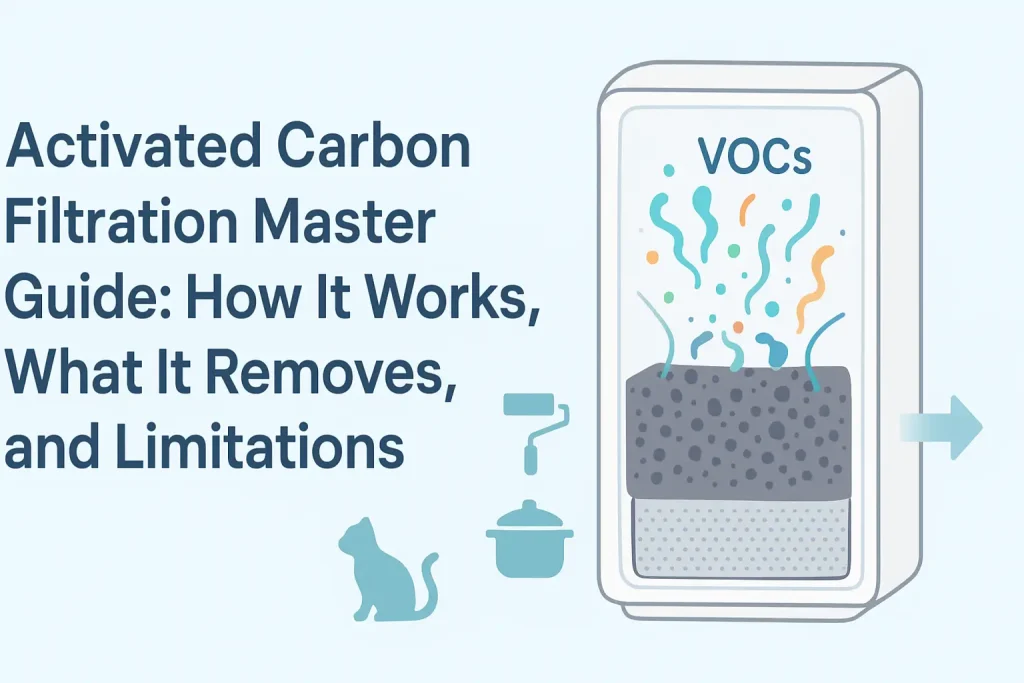
The activated carbon and VOC filter stage provides meaningful gas-phase filtration that many budget air purifiers skimp on. A purifier’s multiple filtration stages only add value when each stage addresses a pollutant the others cannot, and the AirDoctor’s carbon stage handles formaldehyde, volatile organic compounds, and odors that the UltraHEPA media cannot touch.
The auto-mode air quality sensor adjusts fan speed based on real-time particulate readings, which reduces noise and energy use when air quality is good while ramping up during cooking, cleaning, or high-outdoor-pollution events. Build quality and industrial design are premium, with a clean aesthetic that fits modern interiors better than many boxy competitors. The filter change indicator and simple control panel make operation straightforward for users who do not want to manage app-based smart features.
For people with specific ultrafine particle concerns such as those living near highways with high ultrafine particulate counts, or those with severe chemical sensitivities who need maximum VOC capture, the AirDoctor’s dense media and carbon bed combination addresses a legitimate gap that standard True HEPA units may not fully cover. This only applies when the unit is run at adequate fan speeds in a properly sized room. If the room exceeds the unit’s effective coverage area, the ultrafine capture advantage is negated by insufficient air turnover.
Product Review
AirDoctor 4-In-1 Air Purifier – Pros and Cons
Honest assessment based on published specifications, independent analysis, and verified buyer reviews.
Pros
- ✓UltraHEPA media captures ultrafine particles down to 0.003 microns, exceeding True HEPA standard
- ✓Genuine activated carbon and VOC filter with meaningful carbon weight for gas-phase pollutant removal
- ✓Auto-mode with real-time air quality sensor adjusts fan speed based on detected particulate levels
- ✓Premium build quality and modern design that fits residential interiors
- ✓Multiple model sizes available to match different room dimensions
- ✓Simple control panel with filter change indicator, no app dependency required
Cons
- ✗No AHAM CADR certification, making independent cleaning speed verification impossible
- ✗Built-in ionizer may produce trace ozone, and CARB certification status is not clearly published
- ✗Higher price point than AHAM-certified competitors with verified CADR performance
- ✗Filter replacement costs of $60 to $120 per year exceed many mid-range competitors
- ✗No smart features or app connectivity at the price point where competitors offer them
- ✗Proprietary filter design means you are locked into AirDoctor replacement filters
The AirDoctor 4-in-1 suits buyers who prioritize ultrafine particle filtration and strong VOC removal above verified CADR performance and value. It works best in rooms under 500 square feet where the UltraHEPA advantage is most meaningful. Buyers who want independently verified cleaning speed data and lower total cost of ownership should compare against AHAM-certified alternatives like the Coway Airmega line or Levoit Core series before committing.
Should You Be Concerned About the AirDoctor Ionizer and Ozone Output?
The AirDoctor 4-in-1 includes a negative ion generator as its fourth filtration stage. Negative ion generators release charged ions that attach to airborne particles, causing them to cluster together and become heavy enough to settle out of the breathing zone or be captured by the filter on the next pass. This is not the same as an ozone generator, which intentionally produces ozone as a primary air treatment method. However, all corona-discharge ionizers produce trace amounts of ozone as a byproduct of the electrical discharge process.
The EPA and CARB have established that ozone concentrations above 0.070 parts per million over 8 hours constitute a health concern, with CARB setting a stricter limit of 0.050 ppm maximum ozone output for air cleaners sold in California under CCR Title 17 Section 94251. AirDoctor states that its ionizer produces ozone within safe limits, but at the time of this review, the company does not prominently display CARB certification for all current models on its product pages.
This is a meaningful distinction for buyers with asthma, COPD, or chemical sensitivity. Even trace ozone below regulatory limits can irritate airways in sensitive individuals. The Rabbit Air MinusA2, by comparison, carries AAFA asthma and allergy certification and uses a customizable filter system without ionization. If you have asthma or respiratory sensitivity, a CARB-certified purifier without an ionizer is the safer path.
The practical mitigation is that most AirDoctor models allow the ionizer to be turned off independently while the fan and other filter stages continue operating. If you buy an AirDoctor unit, disable the ionizer unless you specifically need its particle-clustering effect for ultrafine aerosol reduction, and verify your specific model’s CARB certification status directly with the manufacturer before purchasing.
How Much Does the AirDoctor Actually Cost Over 5 Years of Operation?
The purchase price of an AirDoctor unit is only the starting point. The AirDoctor AD3500 retails between $499 and $629 depending on promotions. Replacement filter sets cost approximately $60 to $120 per year depending on usage intensity and environmental conditions. Over a 5-year ownership period at 12 hours of daily operation, the total cost of ownership reaches approximately $799 to $1,229 including the unit, filters, and electricity.
By comparison, a Coway Airmega 400 at $250 to $350 with $60 annual filters and similar electricity consumption totals approximately $550 to $650 over 5 years. The Winix 5500-2 at $150 to $200 with $30 to $50 annual filter replacements totals approximately $300 to $450 over 5 years. Both competitors publish verified CADR ratings and carry CARB certification.
The AirDoctor premium may be justified if the UltraHEPA media provides measurable health benefits for your specific situation. Someone with a documented ultrafine particle sensitivity or living in an area with high ultrafine particulate pollution from nearby highways or industrial sources may derive real value from the denser filtration media. For the typical homeowner concerned about standard indoor allergens like pollen, dust mite allergen, and pet dander, a True HEPA unit with verified CADR delivers equivalent practical results at a lower total cost.
Price Comparison
5-Year Total Cost of Ownership – AirDoctor vs Competitors
Unit purchase price plus estimated annual filter replacement cost and electricity at 12 hours daily operation at 13 cents per kWh. Prices verified at time of publication.
$300 to $450 total over 5 years
$550 to $650 total over 5 years
$799 to $1,229 total over 5 years
Total cost includes unit purchase price plus 5 years of filter replacements and electricity at 12 hours daily operation. Filter costs based on manufacturer-recommended replacement intervals using genuine filters. Electricity calculated at national average residential rate of 13 cents per kWh.
Who Should Buy the AirDoctor 4-In-1 Air Purifier?
You should consider the AirDoctor 4-in-1 if you have a specific concern about ultrafine particles below 0.1 microns and are willing to pay a premium for denser filtration media that exceeds the standard True HEPA specification. This includes people living in areas with high ultrafine particulate pollution from nearby highways, industrial emissions, or urban corridors where combustion-derived nanoparticles are a documented concern.
You should also consider it if you need strong VOC and chemical filtration in a single unit. The AirDoctor’s carbon and VOC filter stage provides more meaningful gas-phase adsorption than the thin carbon sheets found in many budget and mid-range air purifiers. For households with new furniture, recent renovations, or known off-gassing sources, this broader chemical filtration capacity adds genuine value.
You should look elsewhere if independent performance verification matters to your purchasing decision. The absence of AHAM CADR certification means you cannot calculate exact coverage at different ACH rates, cannot verify cleaning speed, and cannot directly compare the AirDoctor’s particulate removal rate against competitors. Levoit air purifiers, for example, publish CADR ratings for their Core series and carry CARB certification, giving buyers transparent performance data.
You should also look elsewhere if value per dollar of verified cleaning performance is your top priority. The Blueair versus Coway value comparison shows that established brands with AHAM verification deliver excellent particulate removal at lower total ownership costs. A Winix 5500-2 costs $150 and delivers 243 CFM of verified smoke CADR. An AirDoctor AD3500 costs $499 to $629 with no published CADR number. The filtration media may be superior, but the cleaning speed cannot be verified.
CADR Calculator
How Much CADR Do You Actually Need?
Enter your room dimensions and use case. This shows the minimum CADR any purifier must deliver for your space, regardless of brand. Formula: (length x width x ceiling height x ACH) divided by 60. Source: AHAM methodology.
CADR = (length x width x ceiling height x ACH) / 60. For allergy and asthma sufferers, always calculate at 5 ACH, not the manufacturer-stated 2 ACH figure. Without a published CADR for the AirDoctor, you cannot verify whether it meets the minimum for your room at your required ACH target.
| Room Size | CADR at 2 ACH (standard) | CADR at 5 ACH (allergy) | Example Models |
|---|---|---|---|
| 150 sq ft bedroom | 100 CFM | 250 CFM | Levoit Core 300, Coway AP-1512HH |
| 300 sq ft bedroom | 200 CFM | 500 CFM | Winix 5500-2, Levoit Core 400S |
| 500 sq ft living room | 333 CFM | 833 CFM | Coway Airmega 400, Blueair 605 |
How Does the AirDoctor Handle Common Household Air Quality Scenarios?
For seasonal allergies triggered by pollen and outdoor allergens, the AirDoctor’s UltraHEPA filter captures pollens ranging from 10 to 100 microns with near-total efficiency. The pre-filter traps larger particles before they reach the HEPA media, extending filter life during high-pollen seasons. Run the unit on medium to high fan speed during peak allergy hours and keep windows closed to prevent continuous pollen ingress that would overwhelm any purifier.
For pet dander and odor control, the combination of UltraHEPA for fine dander particles and the activated carbon stage for pet odors provides effective dual-action treatment. Pet dander particles range from 2.5 to 10 microns, well within the HEPA capture range. The carbon filter adsorbs the volatile organic compounds responsible for pet odors. Replace the carbon filter every 6 months in homes with multiple pets, as the carbon bed saturates faster under heavy odor loads.
For wildfire smoke conditions, the AirDoctor’s performance is difficult to assess precisely without published smoke CADR data. Wildfire smoke consists primarily of PM2.5 particles in the 0.4 to 0.7 micron range, which standard True HEPA filters capture at 99.97% efficiency. The AirDoctor’s UltraHEPA may capture a higher percentage of the ultrafine fraction below 0.3 microns, but without CADR data, you cannot determine how quickly the unit processes room air during a smoke event. Use the highest fan speed continuously during wildfire smoke intrusion and supplement with a MERV 13 HVAC filter if you have a forced-air system.
For VOCs from new furniture, paint, or renovation materials, the AirDoctor’s carbon and VOC filter provides meaningful adsorption capacity. This is one area where the AirDoctor genuinely outperforms budget True HEPA units that use thin carbon sheets with minimal adsorption capacity. The carbon weight in AirDoctor filters is sufficient to provide weeks to months of VOC removal before saturation, depending on the VOC concentration in the room. Monitor for the return of chemical odors as an indicator that the carbon filter needs replacement.
What Are the Most Common Complaints From AirDoctor Owners?
Verified buyer reviews across multiple platforms reveal several recurring themes. The most frequent complaint is noise at higher fan speeds, with multiple owners noting that the medium and high settings produce enough sound to be distracting in a bedroom or home office. This is consistent across most high-CADR air purifiers. Larger fans moving more air generate more sound regardless of brand. The solution is to run the unit on high during the day in unoccupied rooms and reduce to auto or low speed during occupied hours.
The second most common complaint relates to filter replacement cost and availability. AirDoctor uses proprietary filter designs, meaning you cannot substitute generic filters from third-party manufacturers. At $60 to $120 per year depending on the model and usage intensity, the filter cost is higher than many competitors. Several owners report that filters need replacement closer to the 6-month mark in homes with pets or during wildfire season rather than the advertised 12-month interval.
The third recurring theme is the absence of smart features at this price point. The AirDoctor lacks Wi-Fi connectivity, app control, and integration with smart home systems. At $499 to $629 for the AD3500, this places it in the same price range as the Coway Airmega 400S and Dyson Purifier Cool, both of which offer app connectivity, air quality history tracking, and smart scheduling. If smart features matter to you, the AirDoctor’s value proposition weakens significantly.
Buying Guide
Before You Buy the AirDoctor – Complete Decision Checklist
Check off each point before making your decision. Based on the review analysis above.
What Do Independent Air Quality Experts Say About UltraHEPA and Proprietary Filtration Claims?
Independent air quality researchers and organizations including AHAM, the EPA, and the American Lung Association do not recognize “UltraHEPA” as a standardized filtration category. The recognized standard for high-efficiency particulate air filtration is True HEPA, defined as 99.97% capture at 0.3 microns per IEST testing protocols. AirDoctor’s UltraHEPA claim of 99.99% at 0.003 microns is a proprietary specification tested under the company’s own methodology, not an industry-standard certification verified by an independent third party.
According to the EPA’s Indoor Air Quality guidance, portable air cleaners should be selected based on AHAM-verified CADR ratings that match the room size and pollutant type. The EPA specifically recommends looking for the AHAM Verifide seal, which AirDoctor products do not carry. This does not mean the AirDoctor is ineffective. It means the performance claims have not been verified through the standardized, independent testing protocol that the industry and regulatory bodies recognize.
ASHRAE Standard 52.2, which governs filter efficiency testing methodology, establishes MERV ratings for HVAC filters but does not directly govern portable air cleaner claims. The closest equivalent for portable units is the AHAM AC-1 standard for CADR testing. Without AHAM certification, a consumer has no way to independently confirm whether the AirDoctor’s cleaning speed matches its coverage claims. This is the single largest gap in the AirDoctor’s value proposition.
Quick Reference
Air Purifier Terms Used in This Review – Searchable Glossary
Definitions for every technical term used in this AirDoctor review. Type to search.
A filter standard requiring capture of at least 99.97% of airborne particles at 0.3 microns, the most penetrating particle size. Defined by IEST standards and independently verified through AHAM CADR testing.
A proprietary AirDoctor filtration specification claiming 99.99% particle capture at 0.003 microns. Not a recognized industry standard. Not independently verified through AHAM or equivalent third-party testing protocols.
A standardized metric developed by AHAM measuring filtered air volume in cubic feet per minute for smoke, dust, and pollen. The most reliable metric for comparing air purifier cleaning speed. AirDoctor does not publish CADR data for any current model.
The number of times per hour an air purifier processes the entire room air volume. Manufacturers state coverage at 2 ACH. Allergy guidelines recommend 5 ACH. Without CADR data, you cannot calculate the AirDoctor’s actual ACH for your room.
Fine particulate matter 2.5 microns or smaller. The primary health-hazardous component of wildfire smoke and urban air pollution. True HEPA captures PM2.5 at 99.97% efficiency. UltraHEPA claims to capture the ultrafine fraction below 0.1 microns at even higher efficiency.
Gaseous chemicals emitted from paint, furniture, flooring, and cleaning products. Removed by activated carbon adsorption, not HEPA filtration. AirDoctor includes a carbon and VOC filter stage for gas-phase pollutant removal.
Certification confirming an air cleaner emits no more than 0.050 ppm ozone. The strictest consumer air cleaner ozone standard in the US. AirDoctor’s CARB certification status is not clearly published for all current models at the time of this review.
A filter stage using porous carbon media to adsorb gaseous pollutants through physical and chemical adsorption. Carbon weight determines VOC removal capacity. The AirDoctor carbon stage provides meaningful gas-phase filtration beyond the thin carbon sheets in budget units.
A device releasing negatively charged ions that attach to airborne particles, causing them to cluster and become easier to filter. All corona-discharge ionizers produce trace ozone as a byproduct. The AirDoctor ionizer can be independently turned off on most models.
The industry organization that administers the CADR testing and certification program for portable air cleaners. Look for the AHAM Verifide seal on certified products. AirDoctor is not listed in the AHAM certified product directory.
Can You Trust AirDoctor’s Marketing Claims Without Third-Party Verification?
The AirDoctor website and marketing materials present compelling filtration efficiency numbers that, if accurate, would place the product among the highest-performing consumer air purifiers available. The challenge is that these claims exist entirely within the company’s own testing ecosystem. Unlike competitors such as Coway, Winix, Levoit, Blueair, and IQAir, all of which participate in the AHAM CADR program and publish independently verified performance data, AirDoctor asks consumers to trust its internal testing.
This does not make the claims false. It makes them unverifiable through the standardized comparison framework that the air purification industry and regulatory bodies recognize. The UltraHEPA claim of 99.99% at 0.003 microns may be accurate. It may exceed True HEPA performance in real-world conditions. But without third-party verification, the buyer is taking the manufacturer’s word for it.
For comparison, a Levoit versus Holmes comparison reveals that both brands participate in AHAM verification, giving buyers transparent data for direct performance comparison. The same transparency is available from Coway, Winix, Blueair, and IQAir. If independent verification matters to you as a consumer, the AirDoctor’s lack of AHAM participation is a significant limitation that should factor into your decision.
Is the AirDoctor 4-In-1 a Good Value for Pet Owners?
Pet owners face two distinct air quality challenges: fine dander particles and persistent odors. The AirDoctor addresses both through its UltraHEPA and activated carbon stages. Pet dander particles range from 2.5 to 10 microns and are captured with near-total efficiency by any True HEPA filter, meaning the AirDoctor’s UltraHEPA advantage is less relevant for dander than for ultrafine particles. The carbon stage, however, provides genuine value for pet odor control that budget units with minimal carbon cannot match.
For a home with one or two pets in a room under 400 square feet, a Winix 5500-2 with its AOC carbon filter or a Levoit Core 400S with the pet allergy filter delivers comparable pet dander and odor control at roughly half the unit cost and lower annual filter expense. The AirDoctor becomes a stronger value proposition for homes with multiple pets in larger spaces where the combination of high airflow, strong carbon adsorption, and ultrafine particle capture provides a single-unit solution rather than requiring multiple purifiers.
What Is the Final Verdict on the AirDoctor 4-In-1 Air Purifier?
The AirDoctor 4-in-1 is a capable air purifier with genuinely strong filtration media that likely exceeds True HEPA standards for ultrafine particles. The activated carbon and VOC filter stage provides meaningful gas-phase pollutant removal that many competitors skimp on. Build quality is premium, and the design integrates well into residential spaces. The automatic air quality sensor and simple controls make operation straightforward without requiring a smartphone or app.
The value equation collapses around the absence of independent performance verification. At $499 to $629 for the AD3500, you are paying a significant premium over AHAM-certified alternatives with verified CADR ratings, established CARB certification, and transparent filter cost structures. The UltraHEPA specification may be superior, but without standardized testing, you cannot confirm cleaning speed or calculate the actual air changes per hour the unit delivers in your specific room.
For most buyers seeking reliable, verifiable air purification, an AHAM-certified unit from Coway, Winix, Levoit, or Blueair at a lower total cost of ownership provides more confidence and better-documented performance. For buyers with specific ultrafine particle concerns who are comfortable with proprietary testing claims and willing to pay the premium for maximum filtration density, the AirDoctor 4-in-1 is a legitimate option, provided you verify CARB certification status for your specific model and plan to disable the ionizer if ozone sensitivity is a concern.
How Do I Know If My Room Is Too Large for the AirDoctor Model I Am Considering?
Without published CADR data, you cannot precisely calculate whether a specific AirDoctor model will achieve your target air changes per hour in your room. The manufacturer’s stated coverage area is based on 2 ACH under ideal conditions. If you need 5 ACH for allergies or 6 ACH for wildfire smoke conditions, the effective coverage area drops to approximately 40% and 33% of the stated figure respectively. For example, an AirDoctor model rated for 1,200 square feet at 2 ACH would effectively cover approximately 480 square feet at 5 ACH, assuming the manufacturer’s coverage claim is accurate.
The practical test is to compare your room’s square footage against 40% of the manufacturer’s stated coverage. If your room exceeds that number and you need allergy-level filtration, the unit is too small. If you are buying for general air quality improvement at 2 ACH and your room is within the stated coverage area, the unit should be adequately sized, provided the manufacturer’s claim is accurate. This uncertainty is precisely why independent CADR verification matters.
Does the AirDoctor Produce Enough Ozone to Be a Health Concern?
AirDoctor states that its ionizer produces ozone within safe limits, but the company does not prominently publish third-party ozone emission test results or CARB certification status for all current models at the time of this review. The negative ion generator uses corona discharge technology, which inherently produces trace ozone as a byproduct. The question is whether the concentration stays below the CARB limit of 0.050 ppm and the EPA 8-hour standard of 0.070 ppm.
For most healthy adults in a ventilated room, trace ozone from a properly functioning ionizer is unlikely to cause noticeable effects. For individuals with asthma, COPD, or chemical sensitivity, even trace ozone can irritate airways. The safest approach with any AirDoctor model is to disable the ionizer function, which stops ozone production entirely while the UltraHEPA and carbon stages continue operating normally. Contact AirDoctor directly to request the ozone emission test data for your specific model before purchasing if ozone sensitivity is a concern.
Why Does AirDoctor Not Participate in the AHAM CADR Program?
AirDoctor has not publicly stated a specific reason for not participating in the AHAM CADR certification program. The AHAM program requires manufacturers to submit products for independent testing at an AHAM-approved laboratory, which then measures CADR for smoke, dust, and pollen under controlled conditions. The testing involves costs and time commitments that some manufacturers choose not to undertake, particularly if their marketing strategy emphasizes proprietary filtration specifications over standardized performance metrics.
The absence of AHAM participation does not necessarily indicate poor performance. It does mean that consumers cannot directly compare AirDoctor’s cleaning speed against competitors using the same standardized measurement. This creates an information asymmetry where the manufacturer controls all published performance data. For a product in the $500 to $1,000 price range where competitors participate in independent verification programs, this gap is notable and should factor into the purchasing decision.
What Happens If I Use a Generic Replacement Filter Instead of a Genuine AirDoctor Filter?
AirDoctor uses proprietary filter designs with specific dimensions, gasket seals, and media specifications. Using a third-party generic filter risks poor fit, bypass leakage where unfiltered air flows around the filter edges, and unknown filtration media quality that may not meet the UltraHEPA specification that justifies the AirDoctor’s premium price. Generic filters may also void the manufacturer’s warranty if a filter-related failure damages the unit.
The filter bypass problem is particularly important. A filter that does not seal correctly allows a portion of the airflow to bypass the filtration media entirely, meaning the unit runs and makes noise while delivering reduced or negligible particle removal. This defeats the purpose of buying a premium air purifier. If filter cost is a concern, factor the annual genuine filter replacement expense into your purchase decision rather than planning to use generic alternatives after buying.
Can I Run the AirDoctor 24/7, and What Is the Electricity Cost?
Yes, the AirDoctor is designed for continuous operation, and running an air purifier 24/7 is the recommended approach for maintaining consistent indoor air quality. AirDoctor units use DC motors that are inherently more energy-efficient than the AC motors found in older and cheaper air purifiers. Estimated power consumption ranges from approximately 5 to 10 watts on the lowest fan speed to 50 to 80 watts on maximum, depending on the specific model.
At 12 hours of daily operation on medium speed consuming approximately 40 watts, the annual electricity cost is approximately $23 at the national average residential rate of 13 cents per kilowatt-hour. Running 24/7 at the same speed doubles this to approximately $46 per year. Compared to the annual filter cost of $60 to $120, electricity is the smaller operating expense. The total annual operating cost including filters and electricity for an AirDoctor run 12 hours daily ranges from approximately $83 to $166 depending on the model and usage intensity.
Is the AirDoctor Loud Enough to Disturb Sleep in a Bedroom?
AirDoctor does not publish specific decibel ratings for each fan speed in its product specifications, making precise noise comparison difficult. Owner reviews consistently report that the lowest fan speed is quiet enough for sleep in most bedrooms, with an estimated noise level between 30 and 35 dB, comparable to a whisper or quiet library. The medium and high fan speeds are described as noticeably audible, similar to white noise from a floor fan or air conditioner.
For bedroom use, plan to run the AirDoctor on its lowest speed or auto mode during sleep hours and use higher speeds during daytime or in unoccupied rooms. If you are sensitive to noise while sleeping, a unit with published sleep-mode decibel ratings like the Coway Airmega 400 at 22 dB or the Levoit Core 400S at 24 dB provides more confidence about nighttime noise levels before purchase.
How Often Do I Really Need to Replace the AirDoctor Filters?
AirDoctor recommends replacing the UltraHEPA filter every 12 months and the carbon and VOC filter every 6 months under normal household conditions. Actual replacement frequency depends on usage intensity, room particle load, and the presence of pets, smokers, or VOC sources. Owners in homes with multiple pets or during wildfire season report needing carbon filter replacement every 3 to 4 months and UltraHEPA replacement every 6 to 9 months.
The pre-filter is washable and should be vacuumed or rinsed every 2 to 4 weeks depending on visible dust accumulation. A clogged pre-filter restricts airflow and reduces the unit’s effective cleaning speed regardless of how good the downstream filtration media is. The filter change indicator light provides a useful reminder, but visual inspection of the pre-filter and attention to any return of odors or allergy symptoms are more reliable indicators that filter replacement is due.
Does the AirDoctor Remove Viruses and Bacteria From the Air?
AirDoctor markets its UltraHEPA filter as capable of capturing particles down to 0.003 microns, which includes the size range of most airborne viruses and bacteria. Viruses typically range from 0.02 to 0.3 microns, and bacteria from 0.3 to 10 microns. If the UltraHEPA specification is accurate, the filter media physically captures these particles through the same diffusion and interception mechanisms that capture other ultrafine particulates.
This is mechanical capture, not active sterilization. The captured pathogens remain trapped in the filter media and gradually become non-viable over time due to desiccation and lack of nutrients. The AirDoctor does not include a UV-C germicidal lamp or other active disinfection technology, so it captures rather than kills microorganisms. For general household use, mechanical capture through high-quality filtration is sufficient for reducing airborne pathogen concentration. For medical environments or immunocompromised individuals, consult infection control guidelines for appropriate air treatment specifications.
The AirDoctor 4-in-1 air purifier occupies a unique position in the market, offering premium filtration media that likely exceeds True HEPA standards, paired with meaningful activated carbon capacity for VOC and odor removal. The UltraHEPA specification of 99.99% capture at 0.003 microns addresses ultrafine particles that standard HEPA testing does not specifically measure. For buyers with documented ultrafine particle sensitivity, chemical sensitivity requiring strong VOC removal, or a preference for maximum filtration density regardless of cost, the AirDoctor is a legitimate and capable product option.
The purchasing decision ultimately rests on whether you prioritize verified, standardized performance data or are comfortable trusting proprietary manufacturer claims for what appears to be genuinely advanced filtration media. For the majority of buyers, an AHAM-certified alternative with published CADR ratings and CARB certification delivers better-documented performance at a lower total cost. Use the CADR calculator and decision checklist above to determine your specific room requirements, and compare the AirDoctor against verified alternatives before making your final choice.