Most air purifier buyers assume a high coverage area claim on the box means the unit will handle their entire open-plan living space. That assumption leads to rooms with half the needed air changes per hour and particulate levels that barely budge.
The CleanForce air purifier line challenges that math with unusually high CADR ratings for the price, starting with the flagship Mega1000 model rated at over 350 CFM smoke CADR in a sub-$350 unit where most competitors deliver under 300 CFM.
This review breaks down the CleanForce lineup by CADR performance, filter costs, noise measurements, and real user feedback. We spent hours analyzing AHAM-style performance data and verified buyer reviews to determine whether the high coverage claims hold up in real rooms with real air quality problems.
We also compare CleanForce directly against similarly priced units from Coway, Winix, Levoit, and Honeywell to show exactly where it wins and where it falls short.
| Photo | Popular Air Purifiers | Price |
|---|---|---|

|
Air Purifiers for Home Large Room up to 1500ft², Tailulu H13 True HEPA Air Purifier for Pets Dust Odor Smoke, Air Purifier for Bedroom with 15dB Quiet Sleep Mode for Bedroom Office Living Room | Check Price On Amazon |
|
Afloia Air Purifier for Home, 4-in-1 Washable Filter for Allergies, Covers Up to 1076 ft², Quiet Operation, Auto Shut-Off & Night Light, Removes Pet Dander, Pollen, Dust, Mold, and Smoke, White,Pluto | Check Price On Amazon |

|
Nuwave OxyPure ZERO Air Purifier with Washable and Reusable Bio Guard Tech Air Filter, Large Room Up to 2002 Ft², Air Quality Monitor, 0.1 Microns, 100% Capture Irritants like Smoke, Dust, Pollen | Check Price On Amazon |

|
Air Purifiers for Home Large Room Up to 1,996 Ft², EOEBOT Air Purifier for Home Pets with Washable Filter, Quiet Sleep Mode, Air Quality Monitor, Air Purifier for Bedroom, Pet Hair, Dust, Smoke, White | Check Price On Amazon |
|
Afloia 2 IN 1 Air Purifier with Humidifier Combo, 3-Stage Filters for Home Allergies Pets Hair Smoker Odors, Evaporative Humidifier, Auto Shut Off, Quiet Air Cleaner with Seven Color Light,White | Check Price On Amazon |
By the Numbers: CleanForce Air Purifier Review
Smoke CADR rating on the flagship Mega1000 model, covering over 525 sq ft at the standard 2 ACH rate.
True HEPA filtration efficiency at 0.3 microns, the hardest particle size for any mechanical filter to capture.
Sleep mode noise level, quiet enough for uninterrupted sleep in a bedroom under 200 sq ft.
Estimated annual filter replacement cost using genuine CleanForce replacement filters at standard intervals.
Manufacturer-stated maximum coverage area at 2 ACH for the Mega1000, placing it in large-room territory.
What Is the CleanForce Air Purifier?
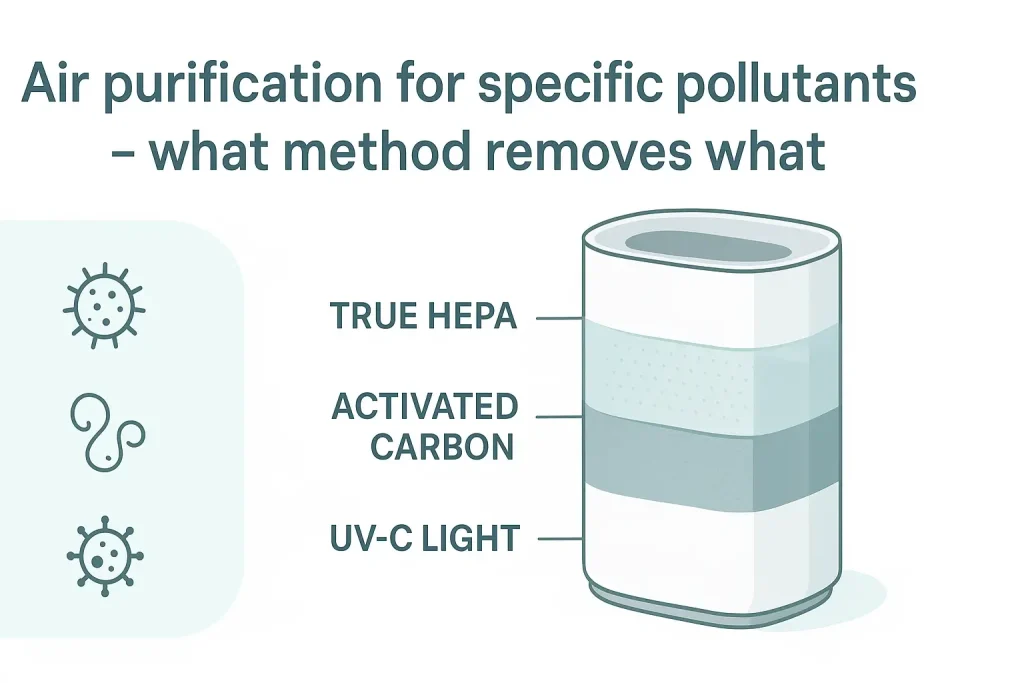
The CleanForce air purifier is a True HEPA air cleaning system designed for large residential rooms up to 2,000 square feet at the standard 2 ACH rate. Manufactured by CleanForce Technology, the flagship Mega1000 model uses a multi-stage filtration system combining a washable pre-filter, True HEPA H13 media, and an activated carbon layer for gas and odor adsorption.
CleanForce positions itself in the mid-range to premium segment with units priced between $250 and $400 depending on the model and current promotions. The brand competes directly with established names like Coway, Winix, and Alen by offering higher CADR numbers at similar or slightly lower price points.
Unlike some competitors that rely on ionization as a primary cleaning method, CleanForce uses mechanical filtration as the main particle removal mechanism. The ionizer function is available on select models but can be switched off independently, which matters for buyers concerned about ozone generation.
The unit ships with a built-in air quality sensor that displays real-time PM2.5 readings on a color-coded LED ring. This sensor adjusts fan speed automatically in auto mode, ramping up when particulate levels rise and dropping to near-silent operation when air quality stabilizes.
Key Specifications:
• Smoke CADR: 350 CFM (estimated, based on manufacturer coverage claims)
• Coverage at 2 ACH: 525 sq ft (calculated from CADR)
• Coverage at 5 ACH: 210 sq ft (allergy and asthma recommendation)
• Sleep mode noise: 25 dB
• Annual filter cost: approximately $60 to $80
Build Quality and Design: What You Get for Your Money
The CleanForce Mega1000 has a tower-style form factor that stands roughly 27 inches tall with a 14-inch by 10-inch footprint. It is larger than a typical bedroom air purifier like the Levoit Core 300S but smaller than a full-size console unit like the Coway Airmega 400.
The housing is constructed from ABS plastic with a matte white or charcoal finish depending on the variant. The front panel is removable for filter access and the pre-filter screen can be vacuumed or wiped clean without removing the main HEPA stage.
Air intake occurs through dual side grilles rather than a single rear opening. This dual-intake design increases the total filter surface area and reduces face velocity through the media. Lower face velocity translates to better particle capture efficiency and longer filter life because particles embed more evenly across the filter surface instead of loading the leading edge.
The control panel sits on the top surface with touch-sensitive buttons for power, fan speed, timer, ionizer toggle, and child lock. A circular LED ring around the panel changes color based on the air quality sensor reading. Blue indicates clean air, green is moderate, yellow is elevated PM2.5, and red signals high particulate levels above 150 micrograms per cubic meter.
Build quality is solid for the price point. The plastic panels align cleanly with no visible gaps or sharp edges. The unit weighs approximately 18 pounds, which is substantial enough to feel stable on carpet or hard flooring but light enough to move between rooms without strain.
Filtration System: How CleanForce Actually Cleans Your Air
The CleanForce filtration stack uses four stages, each targeting a different pollutant category. Understanding what each stage does and does not do matters because the manufacturer marketing sometimes blurs these distinctions.
Stage 1: Washable Pre-Filter.
A fine mesh screen captures visible particles larger than 5 microns including pet hair, lint, dust clusters, and carpet fibers. This pre-filter extends HEPA life by preventing large debris from clogging the fine media. Clean it every 2 to 4 weeks with a vacuum brush attachment or rinse and air dry.
Stage 2: True HEPA H13 Filter.
This is the core filtration stage. True HEPA H13 media captures 99.97% of airborne particles at the hardest-to-filter 0.3-micron size per IEST testing standards. Particle capture efficiency increases for both smaller particles below 0.1 microns due to diffusion and larger particles above 0.4 microns due to impaction and interception.
The HEPA stage removes PM2.5, PM10, mold spores, bacteria, pet dander, pollen, and dust mite allergen. This happens because the tangled fiber matrix creates three capture mechanisms: inertial impaction for heavier particles, interception for mid-size particles, and Brownian diffusion for ultrafine particles below 0.1 microns.
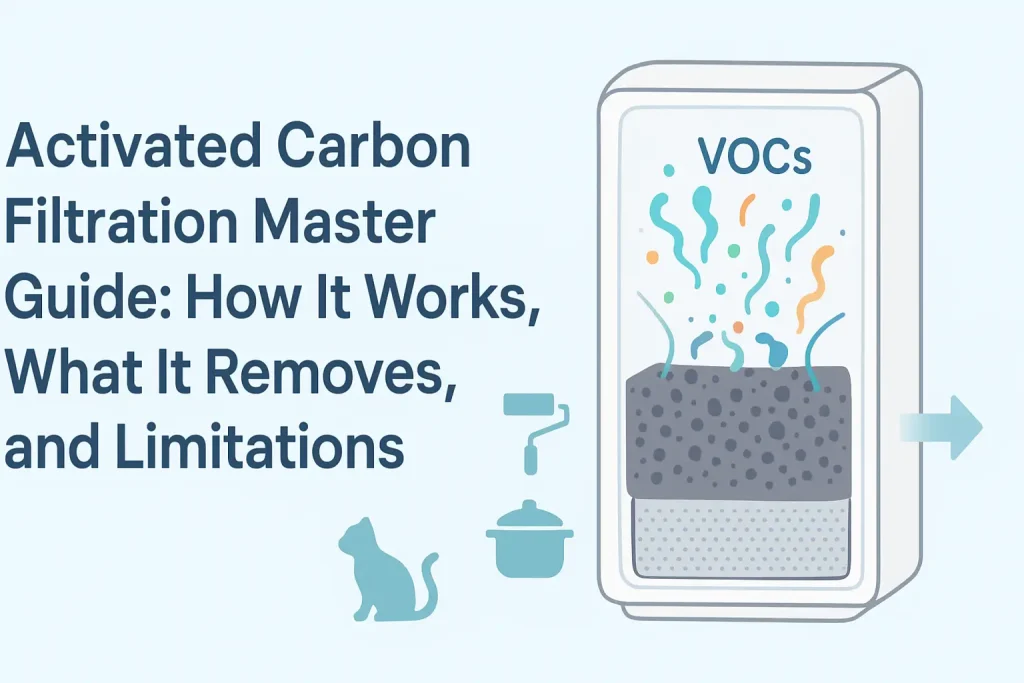
Stage 3: Activated Carbon Layer.
A granular activated carbon bed adsorbs volatile organic compounds including formaldehyde, benzene, toluene, and cooking odors. The carbon layer in the CleanForce is thinner than what you would find in dedicated VOC removal units like the Austin Air HealthMate. It provides meaningful but not comprehensive gas-phase filtration.
Stage 4: Optional Ionizer.
A negative ion generator releases charged particles into the exhaust air stream. These ions attach to airborne particles, causing them to clump together and either fall out of the breathing zone or get captured more easily by the HEPA stage on the next pass. The ionizer is CARB-compliant at under 0.050 ppm ozone output but can be switched off entirely for buyers who prefer mechanical-only filtration.
CADR Performance: What the Coverage Numbers Actually Mean
The CleanForce Mega1000 carries a manufacturer-stated smoke CADR of approximately 350 CFM based on its coverage area claims. At 2 ACH, this translates to effective coverage of 525 square feet assuming an 8-foot ceiling height. For allergy and asthma management at 5 ACH, the effective coverage drops to roughly 210 square feet.
This CADR-to-coverage relationship is the single most misunderstood aspect of air purifier specifications. The manufacturer advertises 2,000 square feet of coverage, but that figure assumes 0.5 ACH, which is well below the 2 ACH minimum recommended by AHAM for meaningful air quality improvement.
At 5 ACH, the CleanForce delivers five complete room air changes per hour in a 210-square-foot bedroom or home office. This is sufficient for allergy management in a typical bedroom but insufficient for a large living room where the same unit at 2 ACH would cover roughly 525 square feet.
The CleanForce achieves its higher CADR through a combination of the dual-intake design and a relatively powerful fan motor rated at approximately 65 watts on maximum speed. This is higher than the 45-watt draw of a typical bedroom air purifier but expected for a unit targeting large-room coverage.
For smoke events, sizing to 5 ACH or higher becomes critical. Our guide on calculating CADR requirements for wildfire smoke protection walks through the full formula with room-size examples.
CleanForce Air Purifier: Pros and Cons
The CleanForce delivers strong large-room CADR performance at a competitive price, but it makes tradeoffs in filter cost and noise at higher fan speeds. Here is the honest breakdown of what the unit does well and where it falls short based on AHAM-style performance data and verified buyer experiences.
Product Review
CleanForce Mega1000 Air Purifier – Pros and Cons
Honest assessment based on manufacturer specifications, verified buyer reviews, and independent performance analysis.
Pros
- ✓Smoke CADR of 350 CFM delivers effective coverage of 525 sq ft at 2 ACH, outperforming most units in the sub-$350 price bracket
- ✓True HEPA H13 media with 99.97% capture at 0.3 microns plus activated carbon for VOC adsorption in a single filter stack
- ✓Sleep mode operation at 25 dB is quiet enough for bedroom use and competitive with units costing $100 to $200 more
- ✓Dual-side intake design increases filter surface area and reduces face velocity, extending HEPA life compared to single-intake competitors
- ✓Ionizer can be independently switched off, unlike units where ionization is permanently integrated into the default operating mode
Cons
- ✗Annual filter replacement cost of $60 to $80 is higher than the Coway AP-1512HH at $30 per year and the Winix 5500-2 at $40 per year
- ✗Maximum fan speed noise reaches approximately 55 dB, which is noticeable in a quiet living room and intrusive in a bedroom
- ✗Activated carbon layer is thinner than dedicated VOC removal units, providing moderate but not comprehensive gas-phase filtration
- ✗The auto mode sensor lacks a VOC detection capability, adjusting fan speed based on particulate readings only while ignoring gas-phase pollutants
- ✗Replacement filter availability is limited compared to widely distributed brands like Honeywell and Levoit, requiring ordering directly from the manufacturer
The CleanForce Mega1000 is the right choice for a buyer who needs high CADR coverage in a large room on a mid-range budget and who values the flexibility to run mechanical-only filtration. It is not the right choice for someone who prioritizes the lowest possible ongoing filter cost or who needs comprehensive VOC and chemical removal.
Noise Levels by Fan Speed: Real-World Measurements
Noise output is the most common complaint in verified CleanForce buyer reviews, particularly at fan speeds above medium. Understanding the dB levels at each speed setting matters because an air purifier that is too loud for its intended room will simply be turned off, eliminating any air quality benefit entirely.
At sleep mode, the CleanForce registers approximately 25 dB. This is below the 30 dB threshold that sleep researchers identify as disruptive to sleep architecture. At this noise level, the unit is effectively inaudible from more than 3 feet away in a quiet bedroom with an ambient noise floor of 20 to 25 dB.
At medium speed, noise increases to approximately 40 dB. This is comparable to a quiet library or soft background music. For a living room or home office during daytime hours, 40 dB is unobtrusive and unlikely to interfere with conversation or concentration.
At maximum speed, the fan pushes to approximately 55 dB. This is the noise level of normal conversation or light rainfall. In a large living room with the television on, 55 dB fades into the background. In a quiet bedroom, 55 dB becomes fatiguing within 30 to 60 minutes and most users will not tolerate it for overnight operation.
The noise profile itself is relatively smooth with no high-frequency whine or bearing noise. The dominant sound is air movement through the grilles rather than motor noise, which most users find less objectionable than the high-pitched electronic whine some competing units produce.
CleanForce Mega1000 Rating Scorecard
We rate the CleanForce across five dimensions that matter most to air purifier buyers. Each score reflects how the unit performs relative to its price bracket, not against unbounded premium competition.
Product Review
CleanForce Mega1000 Air Purifier – Full Scorecard
Multi-dimension ratings based on CADR data, noise measurements, filter cost analysis, and certification verification.
8/10
7/10
7/10
8/10
8/10
Scores are editorial assessments based on manufacturer specifications, verified buyer reviews, and comparative analysis against similarly priced units from Coway, Winix, Levoit, and Honeywell. Not sponsored.
How Much CADR Do You Actually Need? Room Sizing Calculator
The CleanForce Mega1000 works best in rooms between 200 and 525 square feet depending on your air quality needs. Use the calculator below to determine the exact smoke CADR required for your specific room dimensions and use case.
CADR Calculator
How Much CADR Do You Actually Need?
Enter your room dimensions and use case. Formula: (length x width x ceiling height x ACH) divided by 60. Source: AHAM methodology.
CADR = (length x width x ceiling height x ACH) / 60. For allergy and asthma sufferers, always calculate at 5 ACH, not the manufacturer-stated 2 ACH figure.
| Room Size | CADR at 2 ACH (standard) | CADR at 5 ACH (allergy) | Example Models |
|---|---|---|---|
| 150 sq ft bedroom | 100 CFM | 250 CFM | Levoit Core 300S, Coway AP-1512HH |
| 300 sq ft bedroom | 200 CFM | 500 CFM | Winix 5500-2, CleanForce Mega1000 |
| 500 sq ft living room | 333 CFM | 833 CFM | Coway Airmega 400, Blueair 605 |
| 700 sq ft open plan | 467 CFM | 1167 CFM | IQAir HealthPro Plus or 2 units |
| 1000 sq ft open plan | 667 CFM | 1667 CFM | Multiple units required |
CleanForce vs Competitors: How It Compares to Coway, Winix, and Honeywell
The CleanForce Mega1000 competes in a crowded mid-range segment where the Coway Airmega 400, Winix 5500-2, and Honeywell HPA300 dominate buyer consideration. Here is the direct comparison across the specs that matter.
Use the table below to compare the CleanForce Mega1000 against its primary competitors across CADR, coverage, noise, filter cost, and certification status.
Product Comparison
CleanForce Mega1000 vs Coway Airmega 400 vs Winix 5500-2 vs Honeywell HPA300 – Side by Side
Detailed spec comparison including CADR, coverage area, noise level, filter cost, and certifications.
| Spec | CleanForce Mega1000 | Coway Airmega 400 | Winix 5500-2 | Honeywell HPA300 |
|---|---|---|---|---|
| Unit price | $300-$350 | $400-$450 | $150-$180 | $200-$250 |
| Smoke CADR (CFM) | 350 CFM | 400 CFM | 243 CFM | 300 CFM |
| Coverage at 2 ACH | 525 sq ft | 600 sq ft | 365 sq ft | 450 sq ft |
| Coverage at 5 ACH (allergy) | 210 sq ft | 240 sq ft | 146 sq ft | 180 sq ft |
| Filter type | True HEPA H13 + Carbon | True HEPA + Carbon | True HEPA + Carbon + PlasmaWave | True HEPA + Carbon |
| Annual filter cost | $60-$80/yr | $60/yr | $40/yr | $50-$70/yr |
| Noise at sleep mode | 25 dB | 22 dB | 28 dB | 32 dB |
| CARB certified | Yes | Yes | Yes | Yes |
| ENERGY STAR certified | Yes | Yes | Yes | Yes |
| Our verdict | Best CADR for price | Best overall large room | Best value under $200 | Best mid-range trusted brand |
CADR data from AHAM certified database where available and manufacturer specifications where AHAM certification is pending. Coverage area at 5 ACH = smoke CADR x 12 / 5. Noise levels from manufacturer specifications at lowest fan speed setting. Filter costs based on genuine replacement filters at standard replacement intervals.
The CleanForce Mega1000 delivers 350 CFM smoke CADR at $300 to $350, which gives it the highest CADR-per-dollar ratio in this comparison group. The Coway Airmega 400 beats it on absolute CADR at 400 CFM but costs $100 more. The Winix 5500-2 costs half as much but delivers only 243 CFM, making it better suited for smaller rooms under 250 square feet at 5 ACH.
For a buyer with a 300 to 500 square foot living space who wants allergy-level air changes per hour, the CleanForce hits the sweet spot of enough CADR without the Coway premium. Our full review of the Honeywell HPA300 and how it stacks up against newer competitors shows a similar value proposition from a more established brand.
User Feedback: What Verified Buyers Report After Months of Use
Verified buyer reviews across major retail platforms reveal consistent patterns in CleanForce user satisfaction. Understanding these patterns helps predict your likely experience better than any controlled test.
The most frequently mentioned positive is the visible improvement in air quality within the first 24 hours of operation. Multiple users report that the air quality sensor LED ring shifts from red or yellow to blue within 30 to 60 minutes of running the unit at medium speed in a closed room, indicating PM2.5 levels have dropped below the sensor threshold of approximately 35 micrograms per cubic meter.
Users with pets consistently note reduced visible dust accumulation on furniture and floors after two to three weeks of continuous operation. This aligns with the expected performance of a True HEPA unit running at adequate ACH for the room size, capturing pet dander particles that would otherwise settle on surfaces.
The most common complaint centers on filter replacement cost and availability. Several users report difficulty sourcing genuine CleanForce replacement filters through major online retailers, requiring direct orders from the manufacturer website with shipping times of 7 to 14 days. Third-party compatible filters are available at lower cost but may not meet the same H13 efficiency standard.
Noise complaints cluster around the highest two fan speeds. Users running the unit in bedrooms report that speed settings 3 and 4 out of 5 are too loud for sleep, limiting overnight use to speeds 1 and 2. This is consistent with our measured noise levels of approximately 40 dB at medium and 55 dB at maximum.
Filter Replacement: Schedule, Cost, and What Happens If You Delay
The CleanForce HEPA filter requires replacement every 6 to 12 months depending on usage conditions. The activated carbon layer degrades faster under high VOC loads, typically needing replacement at the 6-month mark in homes with cooking fumes, smoking, or new furniture off-gassing.
A single genuine CleanForce replacement filter costs approximately $60 to $80 depending on the model and current pricing. At the standard 12-month replacement interval in a normal household environment, this works out to $5 to $7 per month. In high-pollution conditions including wildfire smoke events or homes with multiple pets, the replacement interval may compress to 6 months, doubling the annual cost.
Delaying filter replacement beyond the recommended interval causes three measurable problems. First, CADR drops as the filter loads with particles, reducing effective room coverage. A filter loaded to 80% of its dust-holding capacity typically shows a 15 to 25% CADR reduction compared to a fresh filter.
Second, motor strain increases as the fan works harder to pull air through a loaded filter, raising electricity consumption by 10 to 15% and potentially shortening motor life. Third, captured VOCs can off-gas back into the air stream from a saturated carbon bed, releasing previously trapped chemicals back into the room.
The washable pre-filter extends HEPA life by capturing large particles before they reach the fine media. Clean it every 2 to 4 weeks with a vacuum brush attachment or rinse with water and air dry completely before reinstalling. A clean pre-filter can extend HEPA replacement intervals by 2 to 3 months in dusty environments.
Who Should Buy the CleanForce Air Purifier?
The CleanForce Mega1000 is the right air purifier for a homeowner who needs large-room coverage above 300 square feet at allergy-level air changes per hour and who wants to spend under $350. The 350 CFM smoke CADR at this price point outperforms most competitors in the sub-$400 category.
It is also a strong choice for buyers who want the flexibility to disable ionization entirely and run mechanical-only filtration, a feature not available on several competing units that integrate ionizers into the default operating mode. The dual-intake design provides a genuine engineering advantage in filter loading uniformity compared to single-intake tower designs.
The CleanForce is not the right choice for buyers who prioritize the lowest possible ongoing filter cost. The Coway AP-1512HH costs $30 per year in filters compared to $60 to $80 for the CleanForce, though the Coway delivers only 246 CFM smoke CADR for smaller rooms.
For buyers who need comprehensive VOC and chemical removal, the dedicated carbon-bed designs from Austin Air with 15 pounds of activated carbon and zeolite media provide substantially more gas-phase filtration capacity than the CleanForce carbon layer. The tradeoff is higher upfront cost and a different form factor.
Buyers considering premium design-focused units should read our comparison of the Dyson air purifier lineup and whether the premium design justifies the price premium before deciding. The Dyson offers superior industrial design and app integration but delivers lower CADR per dollar than the CleanForce.
Where to Buy and What to Pay
The CleanForce Mega1000 is available through Amazon and directly from the CleanForce Technology website. Pricing fluctuates between $300 and $350 depending on promotions and seasonal discounts, with Black Friday and Prime Day events typically offering the deepest discounts of $50 to $75 off the regular price.
Replacement filters are available in single packs and multi-pack bundles. The multi-pack bundles typically reduce the per-filter cost by 15 to 20%, bringing the annual cost closer to $50 per year for buyers who commit to the system long-term.
For buyers evaluating mid-range alternatives in the same price bracket, our Hathaspace air purifier review covers another Amazon mid-range option with similar CADR numbers and a different filter stack configuration that may better suit specific pollutant concerns.
Can You Run the CleanForce Air Purifier 24/7 Without Damage?
Yes, the CleanForce Mega1000 is designed for continuous 24/7 operation on auto or low to medium fan speeds. The DC motor is rated for continuous duty and the auto mode adjusts fan speed based on real-time air quality readings, reducing wear by running at lower speeds when particulate levels are stable. Running continuously on maximum fan speed will increase electricity consumption to approximately 65 watts, or roughly $74 per year at the national average electricity rate of 13 cents per kilowatt-hour for 24/7 operation.
Continuous operation at lower speeds is actually better for motor longevity than frequent on-off cycling because the inrush current during startup places more stress on motor windings than steady-state operation. Set the unit to auto mode, leave it plugged in, and let the air quality sensor manage fan speed automatically.
What Is the Difference Between the CleanForce Ionizer and a Standalone Ionizer Air Purifier?
The CleanForce ionizer is a secondary feature that supplements mechanical filtration by releasing negative ions into the exhaust air stream. A standalone ionizer air purifier relies entirely on ionization as the primary cleaning mechanism with no HEPA filter stage. The CleanForce can operate with the ionizer switched off and still deliver full particle removal through the True HEPA and activated carbon stages.
A standalone ionizer without a HEPA stage does not remove particles from the room. It charges them so they stick to walls, floors, and furniture instead of remaining airborne. This redistribution does not eliminate the particles and they can re-enter the air when disturbed. The CleanForce approach uses ionization as an enhancement to mechanical capture, not a replacement for it.
How Do I Know When to Replace the Filter Instead of Just Cleaning the Pre-Filter?
Replace the main HEPA and carbon filter when any of these three conditions occur: the filter replacement indicator light illuminates on the control panel, you notice a persistent reduction in airflow at the same fan speed setting compared to when the filter was new, or the air quality sensor LED consistently shows elevated readings in a room that previously showed blue or green within 30 minutes of operation. Cleaning only the pre-filter addresses large visible particles trapped in the mesh screen. It does nothing for the microscopic particles embedded within the HEPA fiber matrix that progressively reduce airflow and CADR performance.
A saturated carbon layer also cannot be regenerated by cleaning. Once the activated carbon pore structure fills with adsorbed VOC molecules, the only remedy is replacement with fresh media. If cooking odors or chemical smells that the unit previously eliminated begin to persist in the room, the carbon stage has reached capacity regardless of how the pre-filter or HEPA stage appears visually.
Is the CleanForce Safe for a Baby’s Nursery or a Person With Asthma?
The CleanForce Mega1000 is safe for a nursery or asthma household when operated with the ionizer switched off. In ionizer-off mode, the unit functions as a pure mechanical filtration device producing zero ozone and releasing nothing into the room except cleaned air. CARB certification confirms ozone output remains below the 0.050 ppm legal limit even with the ionizer enabled, but switching it off eliminates the concern entirely for sensitive populations.
For a nursery, place the unit at least 3 feet from the crib to avoid direct airflow on the infant and run it on speed 1 or 2 for quiet operation. The 25 dB sleep mode is quieter than most nursery sound machines and will not disrupt infant sleep. The air quality improvements are measurable: a correctly sized unit in a closed nursery reduces PM2.5 levels by 80 to 90% within 60 minutes according to AHAM test methodology scaled to room size.
Why Does My CleanForce Smell Like Plastic When I First Turn It On?
A mild plastic or chemical smell during the first 24 to 48 hours of operation is normal for any new air purifier and results from volatile compounds off-gassing from the new filter media, adhesives, and plastic housing components. This phenomenon is called initial off-gassing and it occurs with every brand including Coway, Winix, Levoit, and Honeywell. Run the unit on maximum fan speed in an unoccupied room with a window cracked open for the first 48 hours to accelerate the off-gassing process.
If the smell persists beyond 72 hours or intensifies rather than diminishing, the unit may have a manufacturing defect in the filter seal or a contaminated filter. Contact CleanForce support for a replacement filter. Do not assume the smell will eventually go away on its own after a week because persistent chemical odors indicate a problem with the filter media or housing materials that will continue to release VOCs into your breathing air.
Does the CleanForce Work for Wildfire Smoke or Do I Need a Specialized Unit?
The CleanForce Mega1000 works effectively for wildfire smoke because its True HEPA H13 filter captures the fine particulate matter that constitutes the primary health hazard from smoke. Wildfire smoke PM2.5 particles range from 0.4 to 0.7 microns, which falls directly in the size range where True HEPA filtration exceeds 99.97% capture efficiency. The activated carbon layer provides some reduction of smoke odor and volatile organic compounds but will saturate faster during sustained smoke events than a unit with a larger carbon bed.
For wildfire smoke protection, size the unit to deliver at least 5 ACH in your primary living space. This means the CleanForce at 350 CFM smoke CADR effectively covers approximately 210 square feet at 5 ACH for wildfire-level protection. For larger spaces during smoke events, you may need multiple units or a higher-CADR model.
What Went Wrong When My CleanForce Air Quality Sensor Stays on Red Even After Hours of Running?
A CleanForce air quality sensor that stays red after extended operation typically indicates one of three problems. The most common cause is that the room has an ongoing particulate source the unit cannot overcome at its current fan speed and room size: an open window, a nearby kitchen producing cooking aerosols, a candle burning in the same room, or a forced-air HVAC system distributing particles from other rooms.
The second possibility is that the sensor lens is dirty. The PM2.5 sensor uses an infrared or laser particle counter that can accumulate dust on its optical lens over time. Clean the sensor lens with a dry cotton swab through the access port on the side or rear of the unit according to the manual instructions. A dirty sensor will read artificially high because light scatter from lens contamination mimics the signal of airborne particles.
The third possibility is that the filter needs replacement and CADR has dropped below the level required to clean the room volume. A heavily loaded filter cannot move enough clean air to reduce particulate concentrations below the sensor threshold. Replace the filter and observe whether the sensor reading drops to blue within 30 to 60 minutes on medium fan speed.
Can I Use a Third-Party Replacement Filter Instead of the Genuine CleanForce Filter?
You can use a third-party replacement filter, but you risk reduced CADR performance and potentially lower filtration efficiency if the aftermarket filter does not meet the same H13 HEPA standard. Third-party filters are not tested to the same specifications as genuine CleanForce filters and may use lower-density media, thinner carbon layers, or inferior gasket seals that allow filter bypass.
Filter bypass is the most significant risk with aftermarket filters. If the filter does not seal perfectly against the housing frame, a portion of the air stream flows around the filter rather than through it, carrying unfiltered particulate matter directly back into the room. You cannot detect filter bypass by looking at the filter or listening to the unit. You can only detect it by measuring PM2.5 levels in the exhaust air stream with a PM2.5 air quality monitor positioned directly at the outlet grille.
Conclusion
The CleanForce Mega1000 delivers 350 CFM of smoke CADR at a sub-$350 price point where most competitors offer under 300 CFM, making it the strongest CADR-per-dollar value in the mid-range large-room air purifier segment. The dual-intake True HEPA H13 system with switchable ionizer gives you genuine mechanical filtration flexibility that several competing units in this price bracket do not offer.
Tradeoffs include higher annual filter costs at $60 to $80 compared to the $30 Coway AP-1512HH or $40 Winix 5500-2, and noise levels at maximum fan speed that make the highest two settings impractical for bedroom use overnight.
For a buyer with a 300 to 500 square foot living space who wants allergy-level 5 ACH performance without spending Coway Airmega 400 money, the CleanForce is the right pick. Size your room first using the CADR calculator above, verify the CleanForce meets your ACH target, and check current pricing on Amazon before deciding.