Hair salons generate a unique cocktail of airborne pollutants that standard air purifiers are not designed to handle. The combination of ammonia-based hair dyes, peroxide developers, aerosol sprays, and fine-cut hair particles creates an indoor air quality challenge that demands specific filtration capabilities.
Most salon owners discover this the hard way: they buy a highly-rated air purifier only to find it struggling within weeks. The filter clogs prematurely, chemical odors persist, and clients and stylists continue complaining about headaches and respiratory irritation.
This guide identifies the exact specifications an air purifier needs to perform in a salon environment and ranks the top five models that meet those requirements. Every recommendation is based on measurable performance data: CADR ratings for particulate, carbon weight for chemical adsorption, and operating costs for business viability.
Stylists spend eight to ten hours daily breathing salon air. That exposure accumulates across years of career work, making air quality a long-term health investment rather than an optional luxury.
| Photo | Popular Air Purifiers | Price |
|---|---|---|

|
Air Purifiers for Home Large Room up to 1500ft², Tailulu H13 True HEPA Air Purifier for Pets Dust Odor Smoke, Air Purifier for Bedroom with 15dB Quiet Sleep Mode for Bedroom Office Living Room | Check Price On Amazon |
|
Afloia Air Purifier for Home, 4-in-1 Washable Filter for Allergies, Covers Up to 1076 ft², Quiet Operation, Auto Shut-Off & Night Light, Removes Pet Dander, Pollen, Dust, Mold, and Smoke, White,Pluto | Check Price On Amazon |

|
Nuwave OxyPure ZERO Air Purifier with Washable and Reusable Bio Guard Tech Air Filter, Large Room Up to 2002 Ft², Air Quality Monitor, 0.1 Microns, 100% Capture Irritants like Smoke, Dust, Pollen | Check Price On Amazon |

|
Air Purifiers for Home Large Room Up to 1,996 Ft², EOEBOT Air Purifier for Home Pets with Washable Filter, Quiet Sleep Mode, Air Quality Monitor, Air Purifier for Bedroom, Pet Hair, Dust, Smoke, White | Check Price On Amazon |
|
Afloia 2 IN 1 Air Purifier with Humidifier Combo, 3-Stage Filters for Home Allergies Pets Hair Smoker Odors, Evaporative Humidifier, Auto Shut Off, Quiet Air Cleaner with Seven Color Light,White | Check Price On Amazon |
A standard air purifier with a thin carbon sheet filter will saturate within days in a busy salon. The unit ends up recirculating chemically-laden air while the owner believes the problem is solved because the fan is running.
KEY STATISTICS
Hair Salon Air Quality By The Numbers
Data compiled from OSHA salon air quality surveys and EPA indoor air studies.
3x-5x
Higher VOC concentrations in salons compared to typical indoor office environments, per OSHA sampling data.
15+ lbs
Minimum activated carbon weight needed for effective chemical fume adsorption in a 600 sq ft salon.
4 ACH
Minimum air changes per hour recommended for commercial spaces with continuous chemical use.
$250-$600/yr
Realistic annual operating cost range for salon-grade air purification, including filters and electricity.
What Makes Salon Air Pollution Different From Standard Indoor Air?
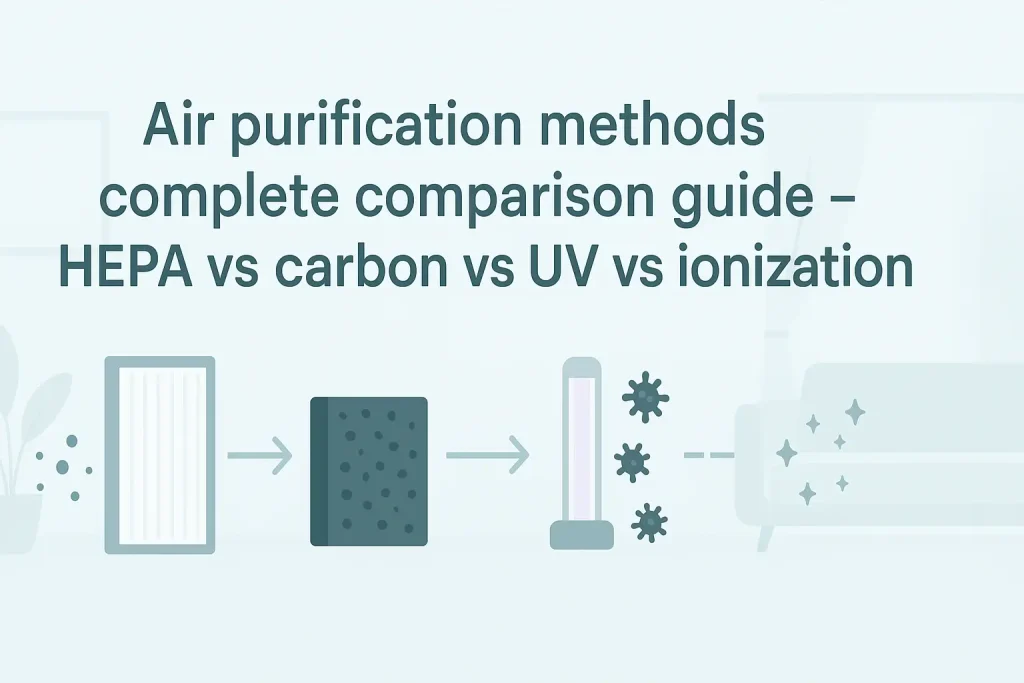
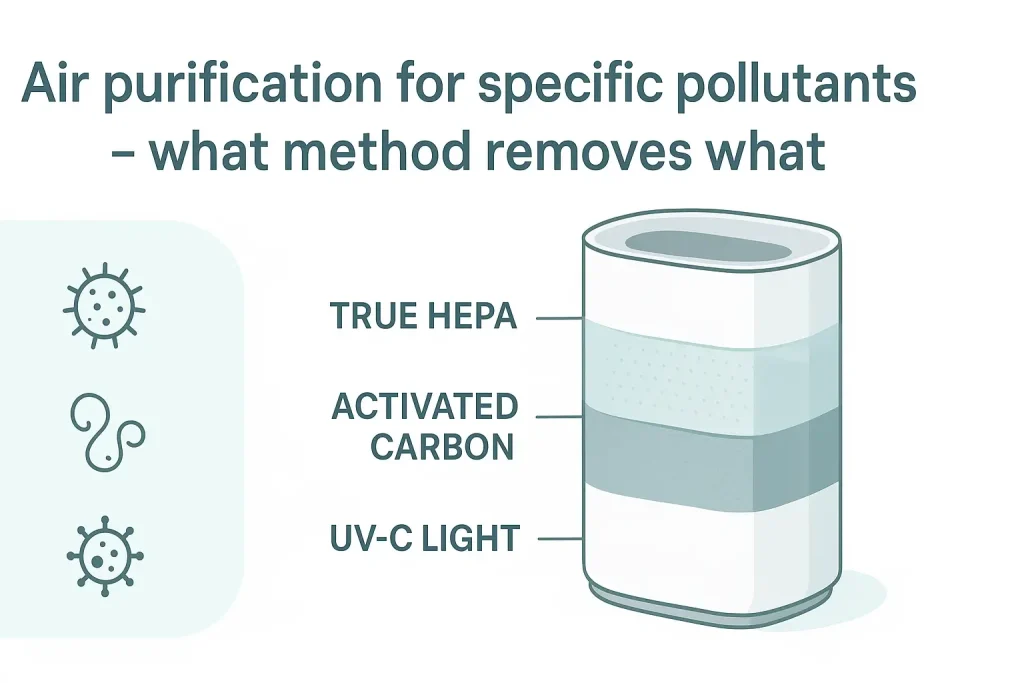
Hair salons produce three distinct pollutant categories simultaneously, and each requires a different filtration mechanism. Particulate matter from cut hair and skin cells floats at sizes between 0.5 and 10 microns, easily captured by True HEPA media that traps 99.97% of particles at 0.3 microns.
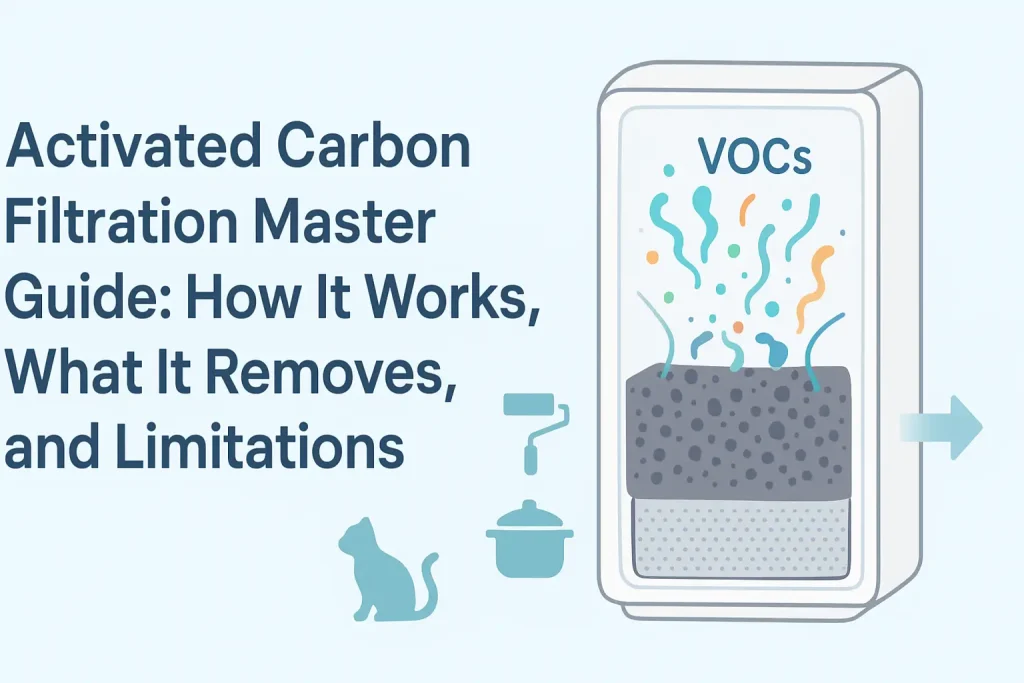
Volatile organic compounds from hair dyes, bleach, relaxers, and styling products off-gas continuously throughout the day. These chemical vapors pass straight through HEPA filters because they exist as gas molecules, not solid particles, and must be adsorbed onto activated carbon or other sorbent media to be removed from the airstream.
Odors from ammonia, thioglycolates, and fragrance compounds present the third challenge. These odor molecules are chemically distinct from both particulates and many VOCs, requiring carbon media with specific pore structures and sometimes additional impregnated carbons for compounds like ammonia and formaldehyde.
A purifier that excels at one of these three tasks but ignores the others will leave salon air essentially untreated in the missing categories. This is why general-purpose home air purifiers consistently underperform in salon environments: the carbon stage is typically a thin coated foam sheet containing less than one pound of actual carbon media, which saturates within 48 to 72 hours of continuous salon chemical exposure.
For context on why carbon weight matters so much for chemical-laden environments, our guide on benzene sources and indoor reduction strategies explains how activated carbon functions at the molecular level and why thin carbon sheets provide minimal protection against continuous VOC sources.
Top 5 Air Purifiers for Hair Salons: Ranked by Filtration Performance
Each model below was evaluated against salon-specific criteria: total carbon weight for chemical adsorption, smoke CADR for particulate clearance, noise levels at the fan speed needed to achieve target ACH in a typical 400 to 800 square foot salon, and annual operating costs.
Standard home-use purifiers with carbon sheets under one pound were excluded from consideration regardless of CADR performance, because carbon saturation in a salon environment renders them ineffective for chemical protection within days.
1. IQAir HealthPro Plus: Best Overall for High-Volume Salons
The IQAir HealthPro Plus delivers 5 pounds of granular activated carbon and impregnated alumina in its V5-Cell gas filter, the highest carbon capacity of any residential-grade unit suitable for commercial salon deployment. Its HyperHEPA filter captures particles down to 0.003 microns with 99.5% efficiency, exceeding standard True HEPA by a factor of 100 in particle size capture threshold.
A smoke CADR of 300 CFM translates to 4 air changes per hour in a 450-square-foot salon or 2 ACH in a 900-square-foot space. At speed 4 of 6, the unit produces 41 dB while delivering approximately 220 CFM of cleaned air output, sufficient for maintaining target ACH without disruptive noise levels during client appointments.
Key Specifications:
- Smoke CADR: 300 CFM / Dust CADR: 300 CFM / Pollen CADR: 300 CFM
- Carbon weight: 5 lbs (V5-Cell granular activated carbon and impregnated alumina)
- Coverage: 450 sq ft at 4 ACH / 900 sq ft at 2 ACH
- Noise: 25 dB (speed 1) / 41 dB (speed 4) / 59 dB (speed 6)
- Annual filter cost: Approximately $380-$420 in salon use (V5-Cell replacement every 12-18 months at salon chemical load)
The primary tradeoff is the upfront investment: at approximately $899 for the IQAir HealthPro Plus, it represents the highest purchase price among the five recommendations. For salons exceeding 800 square feet, two units may be necessary to achieve 4 ACH throughout the entire floor area.
2. Austin Air HealthMate Plus: Best Chemical Filtration Per Dollar
The Austin Air HealthMate Plus contains 15 pounds of activated carbon and zeolite in a single filter cartridge, triple the carbon mass of the IQAir at a lower purchase price. This carbon-zeolite blend is specifically formulated for chemical adsorption, targeting formaldehyde, ammonia, and volatile organic compounds, which are the primary chemical exposure concerns in salon environments.
The True HEPA stage provides 99.97% particle capture at 0.3 microns with a smoke CADR of approximately 250 CFM. This yields 4 ACH in a 375-square-foot salon or 2 ACH in a 750-square-foot space. The unit operates at a fixed fan speed without variable settings, producing approximately 50-55 dB continuously, which is audible but not disruptive during normal salon conversation levels.
Key Specifications:
- Smoke CADR: ~250 CFM (estimated, not AHAM certified)
- Carbon weight: 15 lbs (activated carbon and zeolite blend)
- Coverage: 375 sq ft at 4 ACH / 750 sq ft at 2 ACH
- Noise: ~50-55 dB single speed
- Annual filter cost: Approximately $290-$330 (single filter cartridge replacement every 12 months at salon load)
The Austin Air HealthMate Plus at around $715 offers the best chemical-to-cost ratio among all salon-suitable purifiers. The single-speed operation and industrial appearance are the main compromises. For a deeper understanding of why multiple filtration stages matter when targeting both particles and chemicals, our analysis of multi-stage filtration explains which stages actually contribute to real-world performance.
3. Coway Airmega 400S: Best Smart Features for Busy Salon Environments
The Coway Airmega 400S combines a True HEPA filter with a substantial activated carbon stage containing approximately 1.5 pounds of granular carbon, more than most competitors in its price range but significantly less than the IQAir or Austin HealthMate. Its smoke CADR of 328 CFM is the highest in this comparison, enabling 4 ACH in a 490-square-foot salon or 2 ACH in a 980-square-foot space.
Real-time air quality monitoring with an LED display and automatic fan speed adjustment makes this unit particularly suitable for salons where pollutant levels fluctuate throughout the day as chemical services are performed. The companion mobile app provides filter life tracking and remote control, useful for salon managers overseeing multiple locations.
Key Specifications:
- Smoke CADR: 328 CFM / Dust CADR: 328 CFM / Pollen CADR: 400 CFM
- Carbon weight: ~1.5 lbs granular activated carbon
- Coverage: 490 sq ft at 4 ACH / 980 sq ft at 2 ACH
- Noise: 22 dB (sleep) / 34 dB (low) / 52 dB (high)
- Annual filter cost: Approximately $220-$260 (HEPA + carbon filter set every 6-8 months in salon use)
The Coway Airmega 400S at approximately $549 is best suited for salons under 500 square feet where chemical service volume is moderate and the carbon stage can be replaced every 6 months before saturation occurs. For high-volume chemical service salons, the limited carbon capacity means more frequent filter replacements that increase annual operating cost.
4. Alen BreatheSmart 75i: Quietest Operation With Salon-Specific Filter Options
The Alen BreatheSmart 75i offers a unique advantage for salons: four interchangeable filter types including a VOC/Smoke filter with approximately 3.6 pounds of activated carbon and an odor-specific filter with additional potassium permanganate impregnation for ammonia and formaldehyde capture. This customization allows salon owners to match filtration chemistry to their specific service mix.
With a smoke CADR of 347 CFM, the BreatheSmart 75i covers 520 square feet at 4 ACH or 1,040 square feet at 2 ACH. Its noise profile is the quietest among the top five: 25 dB at speed 1 and 49 dB at turbo, measured using Pink Noise testing methodology. The quiet operation at effective fan speeds makes it ideal for upscale salons where ambient noise is part of the client experience.
Key Specifications:
- Smoke CADR: 347 CFM / Dust CADR: 340 CFM / Pollen CADR: 500 CFM
- Carbon weight: ~3.6 lbs (VOC/Smoke filter variant)
- Coverage: 520 sq ft at 4 ACH / 1,040 sq ft at 2 ACH
- Noise: 25 dB (speed 1) / 39 dB (speed 2) / 49 dB (turbo)
- Annual filter cost: Approximately $160-$200 (VOC filter replacement every 8-10 months in salon use)
The Alen BreatheSmart 75i priced around $749 carries the lowest annual operating cost among the top-tier recommendations due to its efficient filter design and moderate replacement frequency. The primary limitation is the single filter cartridge design that bundles HEPA and carbon together, meaning both media types are replaced simultaneously even if only the carbon has saturated.
5. Levoit Core 600S: Best Budget Option for Small Salons Under 400 Sq Ft
The Levoit Core 600S delivers a smoke CADR of 410 CFM at a purchase price of approximately $299 for the Levoit Core 600S, the highest CADR-to-dollar ratio available. Its VortexAir 3.0 technology achieves 4 ACH in a 615-square-foot salon, making it capable of handling larger spaces than any other sub-$400 unit on the market.
The carbon stage, however, is the critical limitation for salon use. The unit contains a carbon-coated filter frame with less than 0.5 pounds of actual carbon media, which saturates rapidly under continuous chemical exposure. For salons performing more than two to three chemical services per day, the carbon stage will be depleted within 4 to 6 weeks, leaving VOC and odor protection minimal for the remainder of the filter cycle.
Key Specifications:
- Smoke CADR: 410 CFM / Dust CADR: 390 CFM / Pollen CADR: 425 CFM
- Carbon weight: Under 0.5 lbs (carbon-coated filter frame)
- Coverage: 615 sq ft at 4 ACH / 1,230 sq ft at 2 ACH
- Noise: 26 dB (sleep) / 38 dB (low) / 55 dB (high)
- Annual filter cost: Approximately $140-$190 (filter replacement every 4-6 months)
This unit works best in small salons under 400 square feet with low-to-moderate chemical service volume, or as a supplementary particulate filtration unit paired with a separate high-carbon system for chemical control. The impressive CADR performance at a budget price makes it a legitimate option, but buyers must understand the carbon limitation before purchasing for salon deployment.
PRODUCT COMPARISON
Quick-Glance Salon Air Purifier Comparison
Use the search field and dropdown filters below to narrow down the best air purifier for your salon size and budget.
| Model | Price | Smoke CADR | Carbon Weight | 4 ACH Coverage | Annual Cost | Best For |
|---|---|---|---|---|---|---|
| IQAir HealthPro Plus | $899 | 300 CFM | 5 lbs | 450 sq ft | $380-$420 | High-volume salons |
| Austin Air HealthMate Plus | $715 | ~250 CFM | 15 lbs | 375 sq ft | $290-$330 | Chemical-heavy salons |
| Coway Airmega 400S | $549 | 328 CFM | ~1.5 lbs | 490 sq ft | $220-$260 | Smart-monitored salons |
| Alen BreatheSmart 75i | $749 | 347 CFM | ~3.6 lbs | 520 sq ft | $160-$200 | Quiet upscale salons |
| Levoit Core 600S | $299 | 410 CFM | Under 0.5 lbs | 615 sq ft | $140-$190 | Small low-chemical salons |
How to Choose an Air Purifier for Your Hair Salon: Complete Buying Guide
Selecting the right air purifier for a salon requires evaluating three performance dimensions that general consumer reviews rarely address together: particulate CADR for hair dust and skin cells, carbon capacity for chemical vapor adsorption, and sustained noise levels at the fan speed needed to achieve your target air changes per hour throughout the workday.
The decision framework below prioritizes these salon-specific factors in order of importance, because getting any one of them wrong means the purifier will fail at its primary job regardless of how well it performs on the other two.
Step 1: Calculate Your Salon’s Required CADR
Measure your salon’s floor area in square feet. Multiply by your ceiling height to get cubic feet. Divide by 15 to find the CADR needed for 4 ACH, which is the minimum recommended air exchange rate for spaces with continuous chemical use.
For example: a 500-square-foot salon with 10-foot ceilings has 5,000 cubic feet. Divided by 15, that equals a required smoke CADR of 333 CFM. If your measured CADR requirement exceeds any single unit’s rating, plan for two purifiers positioned at opposite ends of the salon to achieve combined coverage.
Step 2: Match Carbon Weight to Your Chemical Service Volume
Count the average number of chemical services performed daily: color, bleach, relaxer, perm, and keratin treatments all generate significant VOCs. Salons performing eight or more chemical services per day need 5 pounds or more of activated carbon media replaced every 12 months. Salons with three to seven daily chemical services can manage with 1.5 to 5 pounds of carbon replaced every 6 to 8 months.
Salons under three daily chemical services may use units with lighter carbon stages, but should still replace carbon filters every 4 to 6 months. The carbon saturation timeline is the single most underestimated variable in salon air purifier selection, and it directly determines long-term chemical protection effectiveness.
Step 3: Verify Noise Levels at Required Fan Speed
Most manufacturers advertise their lowest noise reading at sleep mode, which delivers minimal CADR. For salons, the relevant measurement is noise at the fan speed that achieves your target ACH. Above 55 dB, client conversation becomes strained. Above 60 dB, the noise becomes a competitive disadvantage for salons marketing a relaxing experience.
For more on which air purifier specifications translate to real performance improvements and which are marketing features with minimal impact, our analysis of air purifier features worth paying for separates genuine performance drivers from marketing claims.
Placement and Operation: Getting Maximum Performance From Your Salon Air Purifier
Even the best air purifier delivers a fraction of its rated performance when positioned incorrectly. Salon layouts with styling stations, shampoo bowls, and drying areas create airflow obstacles that reduce effective coverage by 20 to 30 percent compared to an open room of the same square footage.
Position the purifier in the central zone of the salon where the highest concentration of chemical services occurs, typically near the color and styling stations. Maintain at least 18 inches of clearance on all sides for unrestricted air intake. Never place the unit in a corner or behind furniture, which can reduce effective CADR delivery by up to 40 percent due to restricted airflow patterns.
Run the purifier continuously during all operating hours at the fan speed calculated to achieve your target ACH. Turning the unit off between clients or running it only when odors are noticeable results in VOC accumulation that takes hours to clear, because chemical off-gassing from products, surfaces, and hair continues even when no active service is being performed.
For salons in regions affected by wildfire smoke, the particulate filtration demands increase significantly during smoke events. Our comparison of air purifier brands for wildfire smoke PM2.5 removal provides additional guidance on brands that excel at fine particle filtration, which becomes relevant when outdoor smoke infiltrates salon ventilation systems.
Filter Maintenance Schedule for Salon Air Purifiers
Salon environments demand more frequent filter maintenance than residential settings. Pre-filters that capture visible hair clippings and dust should be vacuumed or washed weekly, because a clogged pre-filter restricts airflow and forces the fan motor to work harder, increasing both noise and electricity consumption.
HEPA filters in salon use typically require replacement every 18 to 24 months, approximately 30 to 40 percent sooner than the manufacturer’s general guidance for home use. The accelerated replacement schedule accounts for the higher particulate load from continuous occupancy, hair cutting, and product aerosolization throughout the workday.
Carbon filters demand the most attention. A carbon stage with under 2 pounds of media operating in a salon performing five or more daily chemical services should be replaced every 4 to 6 months. Carbon stages with 5 pounds or more can typically last 12 to 18 months under the same conditions. The indicator that carbon has saturated is the return of chemical odors despite the fan running at full speed, which means the adsorption sites are fully occupied and VOC molecules are passing through untreated.
Understanding what PM2.5 is and how it behaves indoors helps salon owners recognize when particulate filtration is working correctly and when a filter change is overdue based on visible dust accumulation patterns around the unit.
Do You Need More Than One Air Purifier for Your Salon?
Salons exceeding 800 square feet or those with separated service areas such as a color room, cutting floor, and drying lounge typically benefit from two strategically placed purifiers rather than one oversized unit. Airflow does not navigate around walls, partial dividers, or through doorways effectively enough for a single unit to maintain consistent ACH across separated zones.
The calculation is straightforward: total the square footage of each separated area and assign a purifier sized for 4 ACH in that specific zone. Two mid-sized units delivering 4 ACH in their respective zones produce better overall air quality than one large unit delivering 2 ACH averaged across the entire floor plan, because the average conceals dead zones where air exchange drops below effective thresholds.
How Much Should You Budget for a Salon Air Purifier System?
A realistic budget for salon-grade air purification starts at $300 to $900 for the hardware purchase and $200 to $420 annually for filter replacements and electricity. The total three-year cost of ownership, including purchase price and operating expenses, ranges from approximately $900 for a budget unit in a small low-chemical salon to $2,100 for a premium unit in a high-volume chemical service environment.
This cost should be evaluated against the alternative: stylist respiratory issues, client complaints about chemical odors, and the potential loss of business from customers who choose salons with visibly better air quality. In markets where air quality awareness is growing, a visibly operating high-quality air purifier serves as a competitive differentiator that justifies premium pricing.
What Is the Difference Between a True HEPA Filter and a HEPA-Type Filter for Salon Use?
A True HEPA filter meets the DOE standard of 99.97% particle capture at 0.3 microns, the most penetrating particle size. A HEPA-type filter uses similar-looking media but captures only 85% to 95% of particles at the same size, allowing 15 to 50 times more particulate matter to pass through with each air cycle.
In a salon environment where fine hair particles, aerosolized product droplets, and skin cells continuously enter the air, the difference between 99.97% and 90% capture compounds dramatically over an eight-hour workday. After 4 ACH for eight hours using True HEPA, approximately 0.001% of particles remain. After the same treatment with a 90% efficient filter, approximately 6.5% of particles remain, a concentration over 6,000 times higher.
Can I Use an Ionizer Air Purifier in My Hair Salon?
Ionizer air purifiers are not recommended for salon environments. Ionizers emit charged particles that attach to airborne pollutants and cause them to settle onto surfaces, including styling stations, mirrors, and client areas, rather than removing them from the space entirely.
More critically, most ionizers produce ozone as a byproduct of the corona discharge process used to generate ions. CARB limits ozone output to 0.050 ppm for certified air cleaning devices, and many ionizers exceed this threshold, creating a respiratory irritant in a space where stylists and clients already face elevated chemical exposure. Mechanical filtration with True HEPA and activated carbon achieves actual pollutant removal without introducing new hazards.
How Do I Know When to Replace the Carbon Filter in My Salon Air Purifier?
Carbon filter replacement timing is determined by saturation, not by a calendar date. The primary indicator of carbon saturation is the return of chemical odors that were previously controlled. When you can smell hair dye, perm solution, or ammonia odors despite the purifier running at normal speed, the carbon adsorption sites are full.
A secondary indicator is filter weight. New carbon filters have a specified weight from the manufacturer. A saturated carbon filter weighs 10% to 20% more than its dry weight due to adsorbed VOCs and moisture. Weigh the filter monthly after the first six months of use and replace it when the weight gain plateaus, indicating no remaining adsorption capacity.
Why Does My Air Purifier Smell Like Chemicals After a Few Weeks in the Salon?
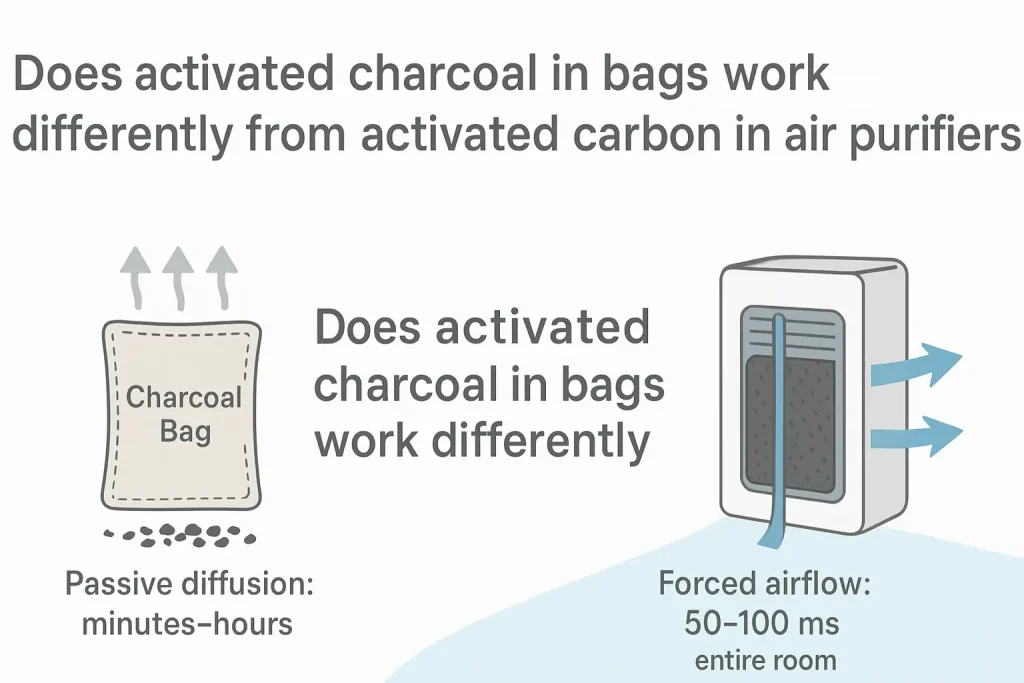
This odor indicates carbon filter saturation. Activated carbon adsorbs VOC molecules by trapping them within its microscopic pore structure. Once all available adsorption sites are occupied, incoming VOC molecules have nowhere to bind and pass through the filter, carrying their odor with them.
The saturated carbon may also desorb some previously captured compounds when humidity levels rise, releasing trapped VOCs back into the air. This is why an undersized carbon stage is worse than no carbon at all in a high-VOC environment: it creates a cycle of capture and release that concentrates chemical exposure during humid periods.
Is It Safe to Run an Air Purifier Continuously in a Salon With Clients Present?
Yes, running a CARB-certified air purifier continuously during all operating hours is not only safe but necessary for maintaining consistent air quality. CARB-certified units produce no measurable ozone, and the mechanical filtration process generates no chemical byproducts.
The noise produced at the fan speed required for 4 ACH is the only client-facing consideration. Select a unit with a noise rating under 55 dB at your target fan speed, which is roughly equivalent to moderate rainfall or background music at low volume, and position the unit where airflow noise does not concentrate near client seating areas.
What Size Air Purifier Do I Need for a 600-Square-Foot Hair Salon?
A 600-square-foot salon with standard 10-foot ceilings contains 6,000 cubic feet of air. To achieve 4 ACH, you need a smoke CADR of 400 CFM. This requires either a single high-output unit like the Levoit Core 600S at 410 CFM with the understanding that carbon capacity is limited, or a premium unit like the IQAir HealthPro Plus at 300 CFM supplemented with a second unit for combined coverage.
If your 600-square-foot salon performs more than five chemical services daily, prioritize carbon capacity over raw CADR. Two Austin Air HealthMate Plus units, each covering 375 square feet at 4 ACH with 15 pounds of carbon, will provide better overall chemical protection than a single high-CADR unit with limited carbon.
Do Air Purifiers Remove Formaldehyde From Salon Air?
Standard activated carbon has limited formaldehyde adsorption capacity. Formaldehyde is a small, polar molecule that requires chemically treated or impregnated carbon media for effective capture. The IQAir HealthPro Plus uses impregnated alumina specifically for formaldehyde, and the Austin Air HealthMate Plus uses a zeolite blend that improves formaldehyde adsorption compared to plain activated carbon.
For salons performing keratin treatments, which can release significant formaldehyde during the heating process, a purifier with specifically formulated formaldehyde capture media is essential. Standard carbon filters without chemical impregnation will saturate on formaldehyde within days of a single keratin treatment session.
Can a Dehumidifier Help My Salon Air Purifier Work Better?
Yes, maintaining relative humidity between 40% and 60% improves both particulate and chemical filtration efficiency. High humidity above 70% causes HEPA filter fibers to swell, reducing airflow and potentially supporting microbial growth on captured organic particles. It also accelerates carbon filter saturation because water vapor competes with VOC molecules for adsorption sites in the carbon pore structure.
In salons where shampoo bowls and steam treatments create localized humidity spikes, a dehumidifier in the wet zone combined with an air purifier in the chemical service zone provides a complementary system that addresses both humidity-driven and pollutant-driven air quality concerns.
How Long Does It Take for an Air Purifier to Clean Salon Air After a Chemical Service?
At 4 ACH, approximately 87% of airborne contaminants are removed within 30 minutes after the chemical source stops actively off-gassing. At 5 ACH, the same reduction occurs in about 24 minutes. Complete clearance to background levels typically requires 60 to 90 minutes at 4 ACH, depending on continued off-gassing from treated hair, open product containers, and contaminated surfaces.
This recovery timeline explains why running the purifier continuously is critical rather than activating it only during or after services. If the purifier is turned on only when a chemical service begins, the salon accumulates pollutants during the period when the unit is off, and the recovery time extends significantly because the starting concentration is much higher.
Choosing the right air purifier for your hair salon means matching CADR to your square footage for 4 ACH, selecting carbon weight proportional to your daily chemical service count, and verifying noise levels stay under 55 dB at the fan speed you will actually run. The IQAir HealthPro Plus leads for high-volume salons, the Austin Air HealthMate Plus delivers unmatched chemical filtration per dollar, and the Alen BreatheSmart 75i offers the quietest operation for client-facing luxury environments.
Start by measuring your salon, counting your daily chemical services, and calculating your required CADR. That number tells you exactly which of these five units fits your space, and it prevents the most common mistake salon owners make: buying a highly-rated purifier that is simply not designed for the pollutant load a working salon produces every single day.