Most parents spend hours researching the safest crib, the cleanest diaper brand, and the most organic baby food, then plug a $60 air purifier into the corner of the playroom and call it done.
That $60 unit is moving air around. It is not cleaning it.
A playroom concentrates every indoor air quality challenge into one space: VOCs from foam mats and plastic toys, particulate matter from roughhousing, dander from the family pet, and whatever the HVAC system has been circulating all day.
Children breathe 50% more air per pound of body weight than adults, according to EPA exposure data. Their respiratory systems are still developing. Their faces are closer to the floor where heavier particles settle.
| Photo | Popular Air Purifiers | Price |
|---|---|---|

|
Air Purifiers for Home Large Room up to 1500ft², Tailulu H13 True HEPA Air Purifier for Pets Dust Odor Smoke, Air Purifier for Bedroom with 15dB Quiet Sleep Mode for Bedroom Office Living Room | Check Price On Amazon |
|
Afloia Air Purifier for Home, 4-in-1 Washable Filter for Allergies, Covers Up to 1076 ft², Quiet Operation, Auto Shut-Off & Night Light, Removes Pet Dander, Pollen, Dust, Mold, and Smoke, White,Pluto | Check Price On Amazon |

|
Nuwave OxyPure ZERO Air Purifier with Washable and Reusable Bio Guard Tech Air Filter, Large Room Up to 2002 Ft², Air Quality Monitor, 0.1 Microns, 100% Capture Irritants like Smoke, Dust, Pollen | Check Price On Amazon |

|
Air Purifiers for Home Large Room Up to 1,996 Ft², EOEBOT Air Purifier for Home Pets with Washable Filter, Quiet Sleep Mode, Air Quality Monitor, Air Purifier for Bedroom, Pet Hair, Dust, Smoke, White | Check Price On Amazon |
|
Afloia 2 IN 1 Air Purifier with Humidifier Combo, 3-Stage Filters for Home Allergies Pets Hair Smoker Odors, Evaporative Humidifier, Auto Shut Off, Quiet Air Cleaner with Seven Color Light,White | Check Price On Amazon |
By the Numbers: Playroom Air Quality
Air volume per pound of body weight that children breathe compared to adults, per EPA exposure data.
Indoor pollutant concentrations can be two to five times higher than outdoor levels in poorly ventilated playrooms.
Recommended noise ceiling for a playroom air purifier at sleep mode when the playroom doubles as a nap space.
Maximum ozone output allowed under CARB CCR Title 17. Any purifier in a children’s space must be CARB certified.
Recommended air changes per hour for allergy and asthma management in occupied children’s rooms, per EPA indoor air guidance.
Why Playroom Air Quality Matters More Than Other Rooms
A playroom is not just a smaller living room. It is a micro-environment with its own pollutant profile that changes by the hour.
Foam play mats, plastic toys, pressed-wood shelving, and fresh paint all release volatile organic compounds (VOCs) into the air for months after installation.
Formaldehyde, benzene, toluene, and xylene are the most common VOCs found in children’s spaces, according to research published in the Journal of Environmental Health by Dr. Prashant Kumar and colleagues.
These compounds off-gas continuously and accumulate in rooms with limited ventilation.
Particulate matter (PM2.5) spikes during active play when children kick up dust, shed skin cells, and disturb settled particles on surfaces and fabrics.
A study published in Indoor Air journal found that resuspension of settled dust during activity can increase PM2.5 concentrations by 200-300% within 15 minutes in carpeted rooms.
Children then inhale these particles at a higher rate per body weight than adults, and their narrower airways mean the same particulate load causes proportionally more irritation.
For a child with developing allergies or undiagnosed asthma, the playroom air becomes a daily exposure that compounds over time.
This is not a hypothetical risk. The American Lung Association identifies indoor air quality as one of the top five environmental health risks for children under five.
What Makes an Air Purifier Right for a Playroom
A playroom air purifier is not the same as a living room unit bought for the same square footage. The selection criteria change because the room use is different.
Three factors separate a playroom-appropriate air purifier from a general-purpose one: VOC filtration capacity, noise level at the fan speed needed for the room size, and zero ozone output under all operating conditions.
VOC filtration matters because a playroom has more off-gassing sources per square foot than any other room in the house except a newly renovated kitchen.
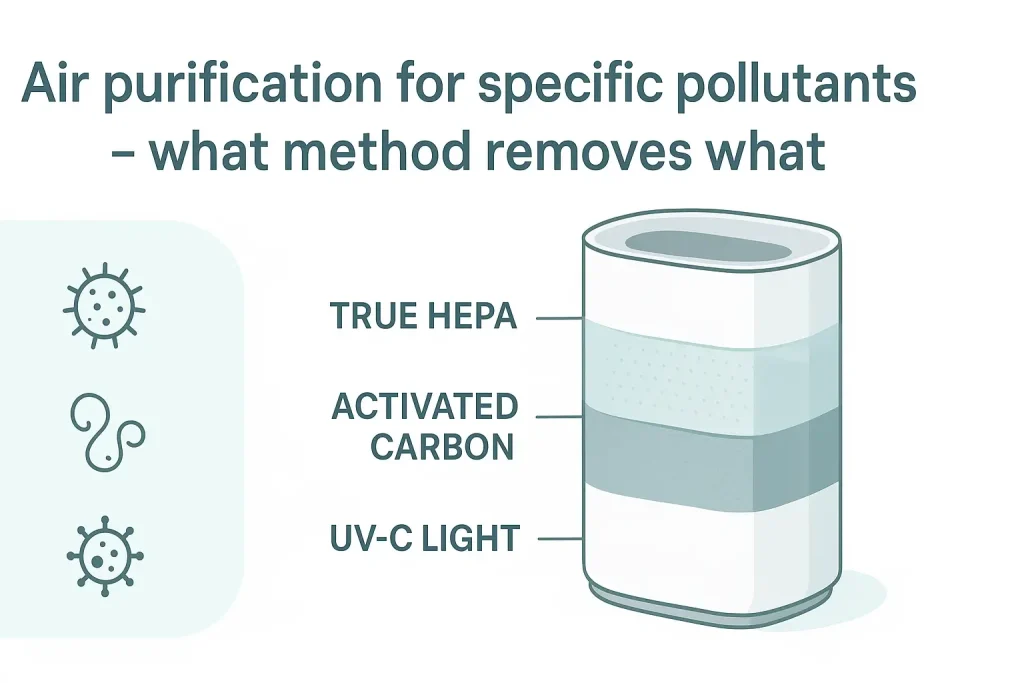
A True HEPA filter alone captures particles but does nothing for the formaldehyde coming off that pressed-wood toy chest.
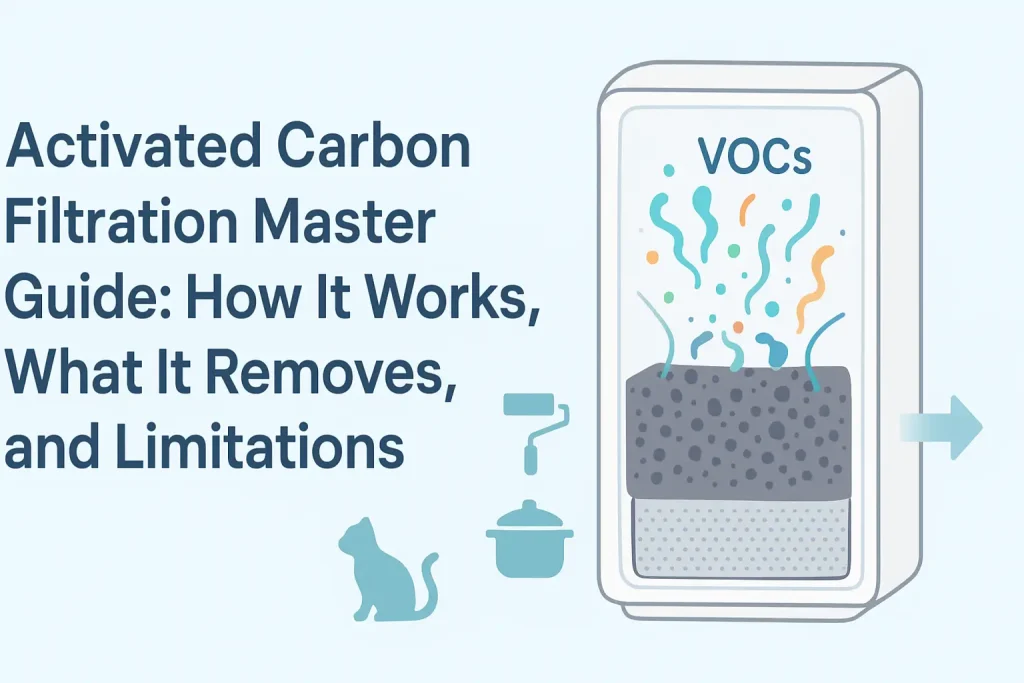
You need an activated carbon stage with sufficient carbon mass to adsorb VOCs effectively. The carbon bed weight matters more than the marketing claim of “carbon filter included.”
A thin carbon sheet weighing 50 grams provides negligible VOC removal after the first week. A carbon bed weighing 1-2 pounds or more provides meaningful adsorption for months.
Noise level is the second critical factor. A playroom that doubles as a nap space needs a purifier that can run at a cleaning speed that is actually effective for the room size while staying below 30 dB at the lowest setting.
Many units advertise sleep modes at 24-28 dB, but that sleep mode fan speed may only deliver 30-40% of the unit’s maximum CADR. If the reduced CADR no longer achieves the target air changes per hour for the room, the purifier is not cleaning effectively during nap time.
This happens because fan speed and CADR are not linear. Reducing fan speed by 50% can reduce CADR by 60-70% on some units.
You must verify the CADR at each fan speed, not just the maximum CADR, before assuming the sleep mode will clean the playroom adequately.
Zero ozone is non-negotiable. Any air purifier used in a children’s space must be CARB certified under CCR Title 17, which limits ozone output to 0.050 parts per million (ppm).
Ionizers, UV-C lamps without proper shielding, and ozone generators have no place in a room where children play and breathe.
If a purifier uses an ionizer that can be turned off, turn it off and leave it off. The particle removal benefit is marginal and the ozone risk is not worth it in a child’s breathing zone.
Best Air Purifiers for Playrooms: Top Picks by Room Size and Budget
Each recommendation below was selected based on verified smoke CADR from the AHAM certified database, noise level at the fan speed needed for the stated room size, activated carbon bed mass for VOC adsorption, and CARB certification status.
Filter replacement costs are based on genuine manufacturer filters at standard replacement intervals.
Levoit Core 400S: Best Overall for Standard Playrooms
The Levoit Core 400S delivers the best balance of CADR, noise level, and activated carbon mass for the price in a standard 200-300 square foot playroom.
Its smoke CADR of 260 CFM achieves 5 ACH in a 200 sq ft playroom at medium fan speed, which is the target for allergy and asthma management in children’s spaces.
Key Specifications:
• Smoke CADR: 260 CFM (AHAM certified)
• Coverage at 2 ACH: 403 sq ft
• Coverage at 5 ACH: 161 sq ft
• Sleep mode noise: 24 dB
• Annual filter cost: approximately $50
The activated carbon stage uses a pellet-based bed rather than a thin fiber sheet, providing meaningful VOC adsorption for the formaldehyde and benzene common in playroom off-gassing.
At 24 dB in sleep mode, it is quieter than a whisper and suitable for nap-time operation in a 150 sq ft nursery corner of the playroom.
The Core 400S is CARB certified, ENERGY STAR certified, and uses no ionizer by default. The companion app provides air quality readings and filter life tracking, though the auto mode sensor is a basic PM2.5 laser that does not measure VOCs.
Coway Airmega 400: Best for Large Playrooms and Open-Plan Spaces
The Coway Airmega 400 uses dual fans and a dual-filter design to deliver 400 CFM smoke CADR across rooms up to 1,560 sq ft at 2 ACH, or 624 sq ft at 5 ACH.
For a large playroom, basement play area, or open-plan living-and-play space, this is the unit that actually achieves the target ACH at a fan speed quiet enough to run continuously.
Key Specifications:
• Smoke CADR: 400 CFM (AHAM certified)
• Coverage at 2 ACH: 1,560 sq ft
• Coverage at 5 ACH: 624 sq ft
• Sleep mode noise: 22 dB
• Annual filter cost: approximately $60
The washable pre-filter is a practical advantage in a playroom where dust, crumbs, and craft debris are airborne daily. Rinsing the pre-filter every two weeks extends the HEPA filter life significantly.
At 22 dB in sleep mode, the Airmega 400 is the quietest high-CADR unit on the market and will not disturb a napping child even when placed in the same room.
The activated carbon filter uses a granular carbon bed, not a coated sheet, and provides genuine VOC reduction for the off-gassing load of a typical playroom.
Coway AP-1512HH: Best Value for Small to Medium Playrooms
The Coway AP-1512HH is the most tested and reviewed air purifier in its price range, and for a playroom under 200 sq ft, it delivers everything needed at a fraction of the cost of larger units.
Its smoke CADR of 246 CFM achieves 5 ACH in a 150 sq ft playroom at medium fan speed, with an annual filter cost of approximately $30.
Key Specifications:
• Smoke CADR: 246 CFM (AHAM certified)
• Coverage at 2 ACH: 360 sq ft
• Coverage at 5 ACH: 144 sq ft
• Sleep mode noise: 30 dB
• Annual filter cost: approximately $30
The ionizer is a default-off feature that should remain off in a playroom. The unit is AAFA asthma and allergy certified, CARB certified, and ENERGY STAR certified.
The activated carbon stage is a coated sheet rather than a pellet bed, so VOC removal is moderate rather than high. For a playroom with significant new furniture or recent painting, pair this unit with increased ventilation during the first few months of off-gassing.
Blueair Blue Pure 211+: Best for High-CADR Needs on a Mid-Range Budget
The Blueair Blue Pure 211+ delivers 350 CFM smoke CADR at a price point typically associated with 200 CFM units, making it the highest CADR-per-dollar option for a medium to large playroom.
For a 300 sq ft playroom at 5 ACH, the 211+ provides the airflow needed without running at maximum fan speed, which keeps noise manageable.
Key Specifications:
• Smoke CADR: 350 CFM (AHAM certified)
• Coverage at 2 ACH: 540 sq ft
• Coverage at 5 ACH: 216 sq ft
• Sleep mode noise: 31 dB (lowest setting)
• Annual filter cost: approximately $60
The HEPASilent filtration combines electrostatic charging with mechanical filtration to achieve high CADR at lower fan speeds and noise levels than pure mechanical HEPA units of similar CADR.
The activated carbon stage uses a polypropylene mesh with embedded carbon particles rather than a pellet bed. VOC removal is moderate and adequate for a playroom without heavy off-gassing sources.
The fabric pre-filter is washable and comes in multiple colors, which is a practical advantage in a playroom where the unit will collect visible dust and debris.
Alen BreatheSmart 45i: Best for Customizable Filtration and Quiet Operation
The Alen BreatheSmart 45i offers interchangeable filter packs tailored to specific pollutants, including a dedicated VOC and odor filter with 45% more carbon than the standard filter.
For a playroom with known VOC sources like new furniture, foam flooring, or recent painting, the carbon-heavy filter option provides the most targeted VOC reduction in this price range.
Key Specifications:
• Smoke CADR: 245 CFM (AHAM certified)
• Coverage at 2 ACH: 800 sq ft
• Coverage at 5 ACH: 320 sq ft
• Sleep mode noise: 23 dB
• Annual filter cost: approximately $100 (carbon filter variant)
The 23 dB sleep mode is among the quietest of any air purifier tested, and the unit is designed for 24/7 operation with an ENERGY STAR rating.
The customizable front panel color options are a minor but real benefit in a playroom where the unit is visible and parents want it to blend with the room aesthetic.
Alen offers a lifetime warranty on the unit itself, which matters in a playroom where the purifier is more likely to be knocked over, bumped, or otherwise subjected to the physical reality of children at play.
How to Size an Air Purifier for Your Playroom
Sizing an air purifier means matching the unit’s smoke CADR to your playroom’s dimensions and your target air changes per hour (ACH).
Manufacturers state coverage area based on 2 ACH, which is the minimum for general air quality improvement. For a children’s playroom, target 5 ACH for allergy and asthma management, or 4 ACH as a practical minimum.
The formula is straightforward: smoke CADR needed = (room length ft x room width ft x ceiling height ft x target ACH) divided by 60.
For a 200 sq ft playroom with 8 ft ceilings at 5 ACH, the calculation is (200 sq ft x 8 ft x 5 ACH) / 60 = 133 CFM smoke CADR needed.
That same playroom at the manufacturer’s stated 2 ACH would only need 53 CFM. The difference between 53 CFM and 133 CFM is the difference between a unit that moves air and a unit that cleans it.
Use the calculator below to compute the exact smoke CADR needed for your playroom dimensions and use case. The table below the calculator provides pre-computed values for common playroom sizes.
CADR Calculator
How Much CADR Does Your Playroom Actually Need?
Enter your playroom dimensions and use case. Formula: (length x width x ceiling height x ACH) divided by 60. Source: AHAM methodology.
CADR = (length x width x ceiling height x ACH) / 60. For children’s rooms, always calculate at 5 ACH, not the manufacturer-stated 2 ACH figure. The effective coverage for a child’s playroom at 5 ACH is 40% of the manufacturer’s stated coverage.
| Playroom Size | CADR at 2 ACH (standard) | CADR at 5 ACH (children) | Recommended Model |
|---|---|---|---|
| 100 sq ft (nursery corner) | 33 CFM | 83 CFM | Levoit Core 300S, Coway AP-1512HH |
| 200 sq ft (standard playroom) | 67 CFM | 167 CFM | Levoit Core 400S, Winix 5500-2 |
| 300 sq ft (large playroom) | 100 CFM | 250 CFM | Blueair Blue Pure 211+, Alen BreatheSmart 45i |
| 500 sq ft (basement play area) | 167 CFM | 417 CFM | Coway Airmega 400, Blueair 605 |
| 700 sq ft (open-plan play/living) | 233 CFM | 583 CFM | Two Coway Airmega 400s or Blueair 605 |
For most standard playrooms between 150 and 300 sq ft, a smoke CADR of 150-250 CFM achieves the 5 ACH target at medium fan speed. The Levoit Core 400S, Coway AP-1512HH, and Blueair Blue Pure 211+ all fall in this range.
Playroom Air Purifiers Compared: Key Specs at a Glance
Use the table below to compare the top playroom air purifiers across the metrics that matter most for a children’s space: smoke CADR, coverage at 5 ACH, noise at the lowest effective fan speed, annual filter cost, and VOC filtration quality.
Product Comparison
Playroom Air Purifiers Compared – CADR, Coverage, Noise, and Filter Cost
Key specs compared across top playroom picks. CADR from AHAM certified database. Coverage at 5 ACH calculated as smoke CADR x 12 / 5.
| Model | Smoke CADR | Coverage at 5 ACH | Sleep Mode dB | Annual Filter Cost | VOC Filtration | Best For |
|---|---|---|---|---|---|---|
| Levoit Core 400S | 260 CFM | 161 sq ft | 24 dB | $50/yr | Pellet carbon bed | Standard playroom, nap space |
| Coway AP-1512HH | 246 CFM | 144 sq ft | 30 dB | $30/yr | Coated carbon sheet | Small playroom, budget pick |
| Coway Airmega 400 | 400 CFM | 624 sq ft | 22 dB | $60/yr | Granular carbon bed | Large playroom, basement |
| Blueair Blue Pure 211+ | 350 CFM | 216 sq ft | 31 dB | $60/yr | Carbon mesh | High CADR value, medium room |
| Alen BreatheSmart 45i | 245 CFM | 320 sq ft | 23 dB | $100/yr | Heavy carbon filter option | VOC-heavy playroom, quietest |
| Levoit Core 300S | 145 CFM | 87 sq ft | 24 dB | $25/yr | Pellet carbon bed | Nursery corner, under 100 sq ft |
CADR data from AHAM certified database. Coverage at 5 ACH = smoke CADR x 12 / 5. Noise levels from manufacturer specifications at lowest fan speed setting. Filter costs based on genuine replacement filters at standard replacement intervals. VOC filtration quality based on carbon bed type and mass.
For a standard 200 sq ft playroom at 5 ACH, the Levoit Core 400S and Coway AP-1512HH both deliver sufficient CADR with noise levels below 30 dB at the fan speed needed to achieve the target ACH.
Find the Right Air Purifier for Your Playroom
Every playroom has a different combination of pollutant sources, room size, and budget. Use the interactive tool below to get a personalized recommendation based on your specific playroom situation.
Interactive Tool
Find the Right Air Purifier for Your Playroom
Answer 2 questions for a personalized playroom air purifier recommendation.
Safety Considerations for Air Purifiers in Children’s Spaces
An air purifier is an electrical appliance with a fan, a power cord, and in some cases, a UV-C lamp or ionizer. In a playroom, it becomes a physical object that children can touch, knock over, or insert objects into.
Safety in a children’s space means three things: zero ozone output under all operating conditions, physical stability and child-resistant design, and no accessible UV-C light sources.
CARB certification under CCR Title 17 guarantees that the air purifier emits no more than 0.050 parts per million of ozone. This is the regulatory floor, not a performance target. Any unit that is not CARB certified should not be used in a children’s space.
Ionizers produce ozone as a byproduct of the corona discharge process that charges particles. Even units with “low ozone” ionizers produce measurable ozone above background levels. In a playroom where children are closer to the floor and breathing more air per pound of body weight, the added ozone exposure is unnecessary and avoidable.
If the air purifier has an ionizer that can be turned off, turn it off. If the ionizer cannot be turned off, choose a different unit.
Physical stability matters because a running air purifier is top-heavy relative to its base. Units with a wide, low-profile design like the Coway Airmega 400 are more stable than tall, narrow tower units like the Levoit Core 400S.
Place the purifier against a wall, not in the center of the room, and route the power cord along the baseboard or behind furniture where it cannot be pulled.
For playrooms with crawling infants or toddlers who might insert fingers or objects into the air intake or outlet grille, choose a unit with tight grille spacing (less than 10mm between slats) or place the purifier on a low shelf or sturdy table out of reach.
The same filtration principles that reduce cat allergens apply to playroom dust and particulate matter from active play, though the VOC filtration requirements are typically higher in a playroom with off-gassing sources.
Common Mistakes Parents Make When Choosing a Playroom Air Purifier
The most common mistake is buying a unit based on the manufacturer’s stated coverage area without checking the smoke CADR and calculating the actual coverage at 5 ACH.
A unit rated for 400 sq ft at 2 ACH only covers 160 sq ft at 5 ACH. If your playroom is 250 sq ft, that unit is delivering 2.5 ACH, not 5 ACH, and particulate levels will remain elevated.
The second most common mistake is assuming that any unit with a “carbon filter” provides meaningful VOC reduction. A thin carbon-impregnated fiber sheet weighing 50 grams stops adsorbing VOCs within days of operation.
A carbon bed weighing 1 pound or more provides months of meaningful VOC adsorption. The difference in performance between these two carbon stages is the difference between removing VOCs from the air and having a marketing checkbox.
The third mistake is running the purifier only when the playroom is in use. Air purification is a continuous process, not an on-demand one. PM2.5 and VOCs accumulate when the purifier is off, and the first 30 minutes of operation after a cold start are spent cleaning the accumulated load, not maintaining clean air.
Run the purifier 24/7 at the lowest fan speed that achieves the target ACH for the room. This is more energy-efficient and more effective than cycling between off and turbo.
For parents managing a child with asthma, the air purification principles used for COPD management translate directly: continuous operation at the ACH rate appropriate for the respiratory condition, with genuine HEPA filtration and zero ozone output.
How to Place an Air Purifier in a Playroom for Maximum Effectiveness
Air purifier placement determines how much of the room’s air actually passes through the filter. A unit placed in a corner or against a wall loses 20-30% of its effective coverage because the intake or outlet is partially obstructed and the airflow pattern cannot develop fully.
Place the purifier at least 12 inches from any wall on all sides, with the intake facing the open room and the outlet directing clean air toward the main play area.
For rectangular playrooms, place the purifier along the long wall, not the short wall. This orientation allows the unit’s airflow to create a circulation pattern that reaches more of the room volume before returning to the intake.
Do not place the purifier behind furniture, curtains, or toy storage units. Every object between the purifier and the rest of the room creates airflow shadows where air does not circulate effectively.
If the playroom has a door that is frequently open to a hallway or adjacent room, the effective air volume the purifier must clean includes the connected space. Size the unit for the combined square footage of the playroom plus any continuously open adjacent areas.
For homes with dogs that share the playroom, the additional dander and particulate load from dog allergens means the purifier should be sized one step above the calculated CADR requirement to account for the continuous resuspension of dander during play.
Filter Replacement Schedule for Playroom Air Purifiers
Playroom air purifiers accumulate more particulate mass per filter cycle than units in adult bedrooms or living rooms because of the higher activity level and continuous resuspension of settled dust.
Replace HEPA filters every 6 months in playrooms with heavy daily use, rather than the manufacturer’s typical 8-12 month recommendation. The increased dust load from active play, craft activities, and higher occupancy density shortens effective filter life.
Activated carbon filters in playrooms with significant VOC sources like new foam mats, pressed-wood furniture, or fresh paint should be replaced every 3 months during the first 6 months of off-gassing, then every 6 months thereafter.
Washable pre-filters should be rinsed every two weeks in playrooms with pets, and every four weeks in playrooms without pets. A clogged pre-filter reduces airflow through the entire filtration stack, lowering effective CADR.
For playrooms that experience seasonal pollen influx through open windows, the filter loading from pollen during spring and fall allergy seasons can reduce HEPA filter life by 30-40%. Check filters monthly during peak pollen months and replace if visible discoloration is present.
Do Air Purifiers Help with Playroom Odors from Diapers, Snacks, and Crafts?
Yes, but only if the air purifier has a sufficient activated carbon stage. Odors are gas-phase pollutants, and a True HEPA filter alone does nothing for them. The carbon bed adsorbs the volatile organic compounds that carry odor, including ammonia from diaper pails, food odors from snack residue, and solvent odors from markers, glue, and paint.
A carbon bed of at least 1 pound is needed for meaningful odor reduction in a playroom. Units with thin carbon sheets or carbon-impregnated fiber provide negligible odor control after the first few days of use.
For playrooms with persistent odor issues, the same activated carbon mass requirements that apply to cigarette smoke removal apply to playroom odor control: a minimum of 5-10 pounds of carbon for sustained odor reduction in a room with continuous odor sources.
Can an Air Purifier Reduce Germs and Viruses in a Playroom?
A True HEPA air purifier captures airborne bacteria and viruses that are attached to larger particles like respiratory droplets, but it does not kill pathogens. The capture efficiency for virus-laden particles in the 0.5-3 micron range is above 99% for a True HEPA filter, because these particles are larger than the 0.3-micron most penetrating particle size at which HEPA efficiency is rated.
This happens because HEPA filtration is a mechanical process that captures particles through impaction, interception, and diffusion. Particles larger than 0.3 microns are captured by impaction and interception at efficiencies above 99.97%.
However, a purifier does not prevent direct transmission between children playing in close contact. It reduces the concentration of airborne pathogens in the room over time, but it does not create a sterile zone around each child.
If reducing airborne illness transmission is a priority, run the purifier at the highest fan speed that is practical during playtime, and ensure the unit is sized for at least 5 ACH in the playroom volume.
What Is the Difference Between a Nursery Air Purifier and a Playroom Air Purifier?
A nursery air purifier prioritizes the lowest possible noise level at the fan speed needed for the room, because a nursery is a sleep environment for most of the day. Noise below 25 dB is the target, and the unit is typically sized for a smaller room of 100-150 sq ft.
A playroom air purifier must handle higher particulate loads from active play, more VOC sources from toys and craft materials, and a larger room volume. The noise target is 30 dB or below at the fan speed needed for 5 ACH, but the CADR requirement is typically higher because playrooms are larger than nurseries.
The filtration priorities also differ. A nursery benefits most from particulate filtration for dust and allergens, while a playroom needs balanced particulate and VOC filtration because of the off-gassing sources present in play furniture, foam mats, and art supplies.
Should I Run the Air Purifier All Day in the Playroom?
Yes. Air purification is a continuous process, not an on-demand one. PM2.5 concentrations begin rising within 15-20 minutes of turning off the purifier, and VOC concentrations rise more slowly but steadily without active carbon filtration.
Running the purifier 24/7 at the lowest fan speed that achieves the target ACH for the room is both more energy-efficient and more effective than cycling the unit on and off. The electricity cost of continuous operation at low speed is typically $3-5 per month at the national average electricity rate of 13 cents per kWh.
If 24/7 operation is not practical, run the purifier at the highest effective speed for at least 2 hours before the playroom is used, then reduce to the maintenance speed during playtime. This pre-cleaning cycle ensures the room air is at baseline cleanliness before occupancy begins.
Are Air Purifiers with Washable Filters Effective for Playrooms?
Washable pre-filters are highly effective for playrooms because they capture the larger debris that would otherwise clog the HEPA filter prematurely. Dust, crumbs, pet hair, and craft debris are all captured by the pre-filter and can be rinsed away every two weeks.
However, washable HEPA filters (as opposed to washable pre-filters) are not recommended. The washing process degrades the fiber structure of the HEPA media, reducing capture efficiency over time. True HEPA filters should be replaced, not washed, to maintain the 99.97% efficiency at 0.3 microns.
Units with a washable pre-filter and a replaceable HEPA filter, like the Coway Airmega 400 and Winix 5500-2, provide the best combination of maintenance convenience and filtration performance for playroom use.
What Size Air Purifier Do I Need for a Shared Playroom and Bedroom?
Size the purifier for the combined square footage of both rooms if the door between them remains open. If the door is closed, size for the larger of the two rooms and move the purifier between spaces as needed, or use two smaller units, one in each room.
For a combined 300 sq ft playroom and bedroom with the door open, the smoke CADR needed at 5 ACH is (300 x 8 x 5) / 60 = 200 CFM. The Levoit Core 400S at 260 CFM or the Blueair Blue Pure 211+ at 350 CFM both exceed this requirement.
If using two separate units, each should be sized for its own room volume at 5 ACH. This is more expensive upfront but provides redundancy and allows each unit to run at a lower, quieter fan speed while still achieving the target ACH.
Can an Air Purifier Help with Dust from Play Activities Like Sand and Play-Doh?
An air purifier captures the fine airborne particles generated by play activities, including sand dust, Play-Doh particulates, and fabric fibers from stuffed animals and costumes. These particles are typically in the PM10 and PM2.5 size ranges and are efficiently captured by a True HEPA filter.
The larger visible debris from these activities, like sand grains and Play-Doh crumbs, will not be captured by the air purifier because they settle to the floor too quickly to reach the unit’s intake. These require vacuuming or sweeping to remove.
For playrooms with heavy craft or sensory play activity, the washable pre-filter should be checked weekly instead of biweekly, as the dust load will be significantly higher than in a standard playroom.
For the best playroom air quality, pair a correctly sized True HEPA purifier running continuously at 5 ACH with a vacuum that uses a sealed HEPA filtration system, vacuumed daily during high-use periods. The purifier handles airborne particles. The vacuum handles settled particles before they become airborne again.