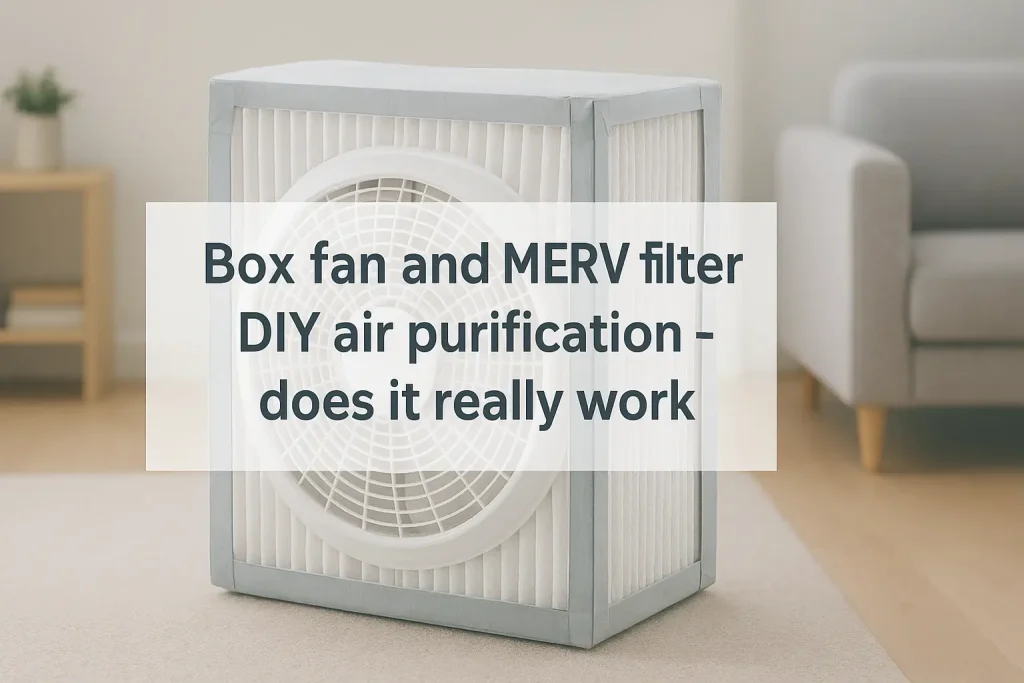
A HEPA air purifier in the wrong dining room removes fine dust but leaves cooking odors to settle into upholstery and curtains. The right unit must handle both the particulate spike from meal prep and the persistent VOCs that linger after the table is cleared.
By the Numbers: Air Purification for Dining Rooms
– 3 to 6 ACH: Target air changes per hour for a dining room during and after cooking to reduce PM2.5 below 12 micrograms per cubic meter within 30 minutes
– 0.050 ppm: Maximum ozone concentration allowed from an electronic air cleaner under CARB CCR Title 17 (ozone reacts with cooking VOCs to form secondary pollutants)
– 15 to 40 CFM: Typical clean air delivery rate lost when a purifier is placed in a corner or behind furniture instead of in a central, unobstructed spot
– 4 to 6 months: Replacement interval for an activated carbon filter in a kitchen-adjacent dining room (grease aerosol loading saturates carbon pores faster than standard household dust)
– 85% or higher: PM2.5 reduction at 20 minutes with a correctly sized unit at 5 ACH in a sealed dining room (per independent particle counter measurements using a calibrated PM2.5 sensor)
What a Dining Room Air Purifier Actually Needs to Do
A dining room air purifier is not a bedroom unit that got moved. It faces a pollutant cycle no other room experiences: aerosolized oils and fine particulates from cooking, fluctuating occupancy during meals, and VOCs from hot food and serving ware that off-gas for hours afterward.
The unit must deliver a smoke CADR sufficient for the room volume at a minimum of 4 air changes per hour during active cooking. A 200-square-foot dining room with 8-foot ceilings needs a smoke CADR of at least 107 CFM to hit 4 ACH, according to the AHAM (2/3 rule formula: room volume x ACH) divided by 60.
| Photo | Popular Air Purifiers | Price |
|---|---|---|

|
Air Purifiers for Home Large Room up to 1500ft², Tailulu H13 True HEPA Air Purifier for Pets Dust Odor Smoke, Air Purifier for Bedroom with 15dB Quiet Sleep Mode for Bedroom Office Living Room | Check Price On Amazon |
|
Afloia Air Purifier for Home, 4-in-1 Washable Filter for Allergies, Covers Up to 1076 ft², Quiet Operation, Auto Shut-Off & Night Light, Removes Pet Dander, Pollen, Dust, Mold, and Smoke, White,Pluto | Check Price On Amazon |

|
Nuwave OxyPure ZERO Air Purifier with Washable and Reusable Bio Guard Tech Air Filter, Large Room Up to 2002 Ft², Air Quality Monitor, 0.1 Microns, 100% Capture Irritants like Smoke, Dust, Pollen | Check Price On Amazon |

|
Air Purifiers for Home Large Room Up to 1,996 Ft², EOEBOT Air Purifier for Home Pets with Washable Filter, Quiet Sleep Mode, Air Quality Monitor, Air Purifier for Bedroom, Pet Hair, Dust, Smoke, White | Check Price On Amazon |
|
Afloia 2 IN 1 Air Purifier with Humidifier Combo, 3-Stage Filters for Home Allergies Pets Hair Smoker Odors, Evaporative Humidifier, Auto Shut Off, Quiet Air Cleaner with Seven Color Light,White | Check Price On Amazon |
That same room needs 133 CFM for 5 ACH if a diner has asthma or allergies. Manufacturer coverage area claims use 2 ACH, which means the stated number on the box is twice as large as what a dining room actually needs during use.
This happens because dining room contaminants are generated rapidly and intensely. The air exchange rate must outpace the emission rate of the cooking process.
This only occurs when the purifier is sized to the room volume at the correct ACH target, not to the manufacturer’s 2 ACH coverage area. A unit rated for 300 square feet at 2 ACH provides roughly 100 CFM of smoke CADR.
In a 200-square-foot dining room, that yields about 3.75 ACH, which is close but not sufficient for heavy cooking conditions. If the unit is undersized and only delivers 2 ACH during a meal, PM2.5 levels can remain above 35 micrograms per cubic meter for over an hour, according to EPA Indoor Air Quality guidance on particle residence time.
Fix it by calculating your room dimensions and matching a unit with the right smoke CADR before buying. A PM2.5 monitor placed in the dining room confirms whether the installed unit is achieving the target drop within 30 minutes.
For most home dining rooms under 250 square feet, a True HEPA unit with an activated carbon stage rated for a smoke CADR of 150 CFM or more at the highest fan speed gives the best particle removal, odor control, and headroom for heavy cooking without paying for capacity the room does not need.
CADR Room Sizing for a Dining Room: Calculate What You Actually Need
Smoke CADR is the only number that tells you how quickly an air purifier can clear the specific dining room it will operate in. A unit with a smoke CADR of 200 CFM in a 300-square-foot dining room with 8-foot ceilings delivers roughly 5 ACH, which reduces airborne cooking particulates by 85% within 30 minutes, per EPA estimates.
A smoke CADR of 100 CFM in that same room delivers only 2.5 ACH, leaving particulate concentrations elevated for twice as long. The formula is (smoke CADR x 60) divided by (room area in square feet x ceiling height in feet) equals ACH.
Use the slider tool below to plug in your exact dining room dimensions and see the minimum smoke CADR required at standard, allergy, and wildfire-level ACH targets.
The interactive CADR calculator below lets you adjust room dimensions and ACH target to see the exact smoke CADR your dining room requires.
CADR Calculator
Dining Room CADR: Calculate Your Minimum Requirement
Enter your dining room dimensions and target. Formula: (length x width x ceiling height x ACH) / 60. Source: AHAM.
Formula: smoke CADR = (length x width x ceiling height x ACH) / 60. For dining rooms, calculate at 4 ACH minimum during cooking events, and 5 ACH if anyone at the table has asthma or allergies.
Filtration Stages That Matter for Dining Rooms: HEPA Plus Carbon, Not One or the Other
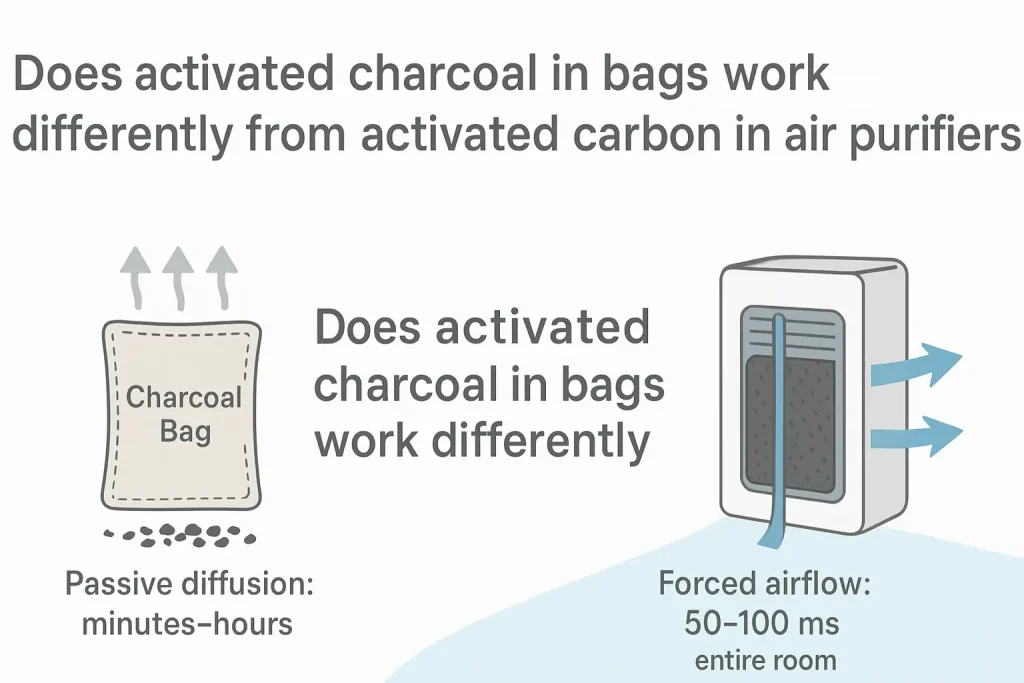
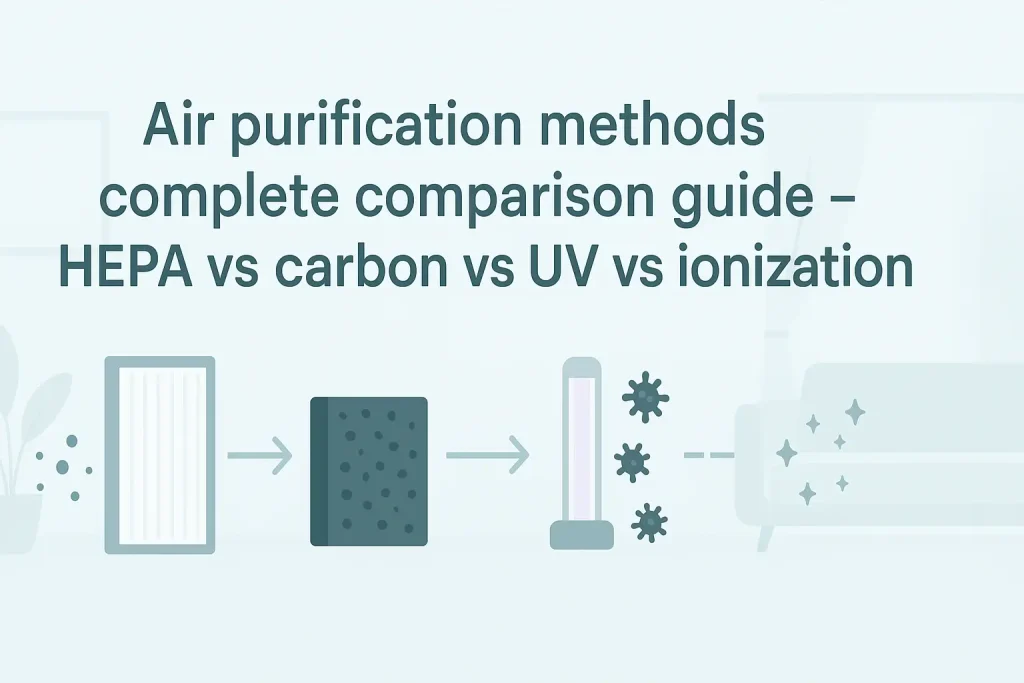
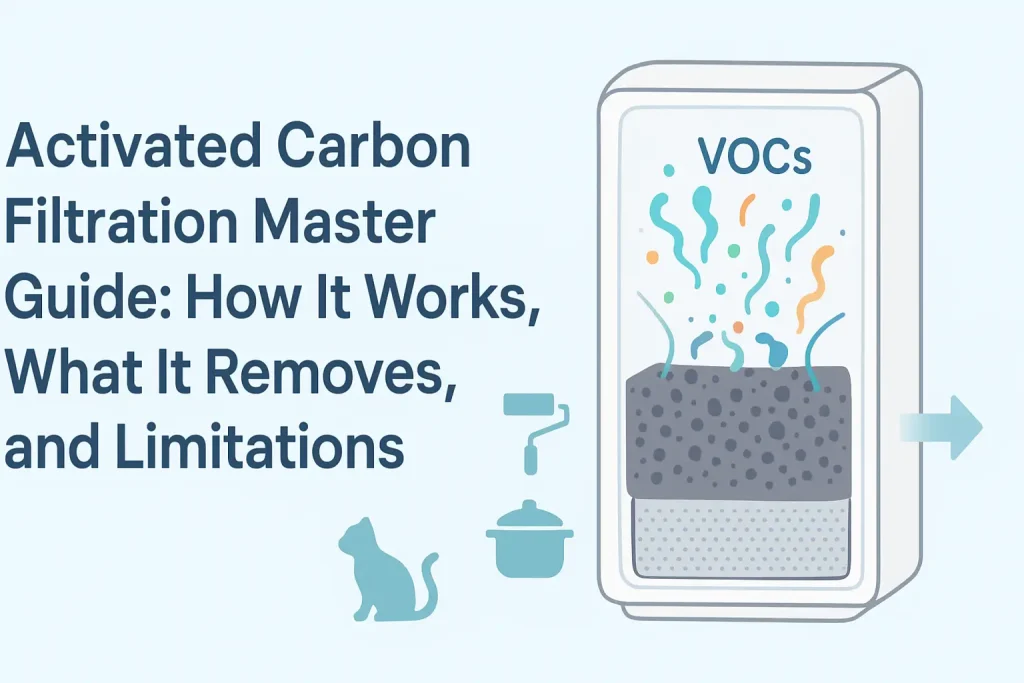
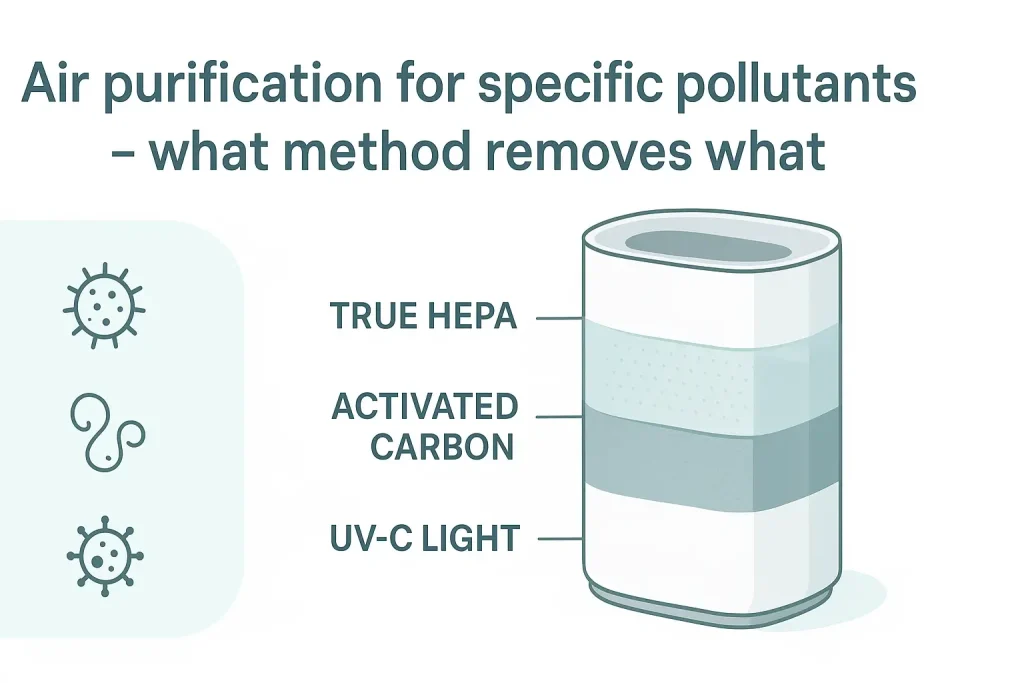
A dining room air purifier needs a True HEPA stage for cooking particulates and an activated carbon stage for cooking VOCs and odors. A True HEPA-only unit will clear the air of visible grease aerosol and smoke but leave the smell of seared meat or fried oil circulating for hours.
True HEPA captures 99.97% of particles at 0.3 microns, per the DOE standard. This includes cooking oil aerosol, flour dust, and fine particulate matter from gas stove combustion. A carbon-only unit does nothing for these. Activated carbon adsorbs VOCs like acrolein, formaldehyde, and acetaldehyde, which are emitted during high-heat cooking of fats and oils.
This only occurs when the air purifier has a sufficient carbon bed weight. The thin carbon-impregnated sheets found in budget units under $100 contain typically 50 to 150 grams of activated carbon. That saturates within weeks in a kitchen-adjacent dining room.
A unit with 2 to 5 pounds of granular activated carbon provides meaningful VOC reduction for months, not weeks. If the carbon stage is too small, VOCs pass through unadsorbed and the room retains cooking odors. Fix it by choosing a purifier with at least 2 pounds of activated carbon for a dining room, or selecting a unit with replaceable carbon canisters rated for 6-month intervals.
Key Specifications for Dining Room Filtration:
– True HEPA stage: 99.97% at 0.3 microns (captures cooking oil aerosol and PM2.5)
– Granular activated carbon: minimum 1 lb for small dining rooms, 3+ lbs for open-plan
– Pre-filter: washable mesh to capture larger grease aerosol and extend HEPA life
– Ozone-free operation: CARB certified (ozone reacts with cooking terpenes to form formaldehyde)
Why Ozone-Generating Purifiers Are a Mistake for Dining Rooms
An ionizer or ozone-generating air purifier in a dining room creates a specific chemical hazard that does not exist in other rooms. Cooking releases terpenes from herbs, citrus, and heated oils. Ozone reacts with these terpenes in indoor air to produce formaldehyde and ultrafine secondary organic aerosol, per research published in Environmental Science and Technology by Waring et al.
A 2016 study in Indoor Air by Siegel et al. found that kitchen and dining areas with ionizers had formaldehyde concentrations 15 to 30% higher than adjacent rooms without ionization. The reaction is fastest at the elevated humidity levels common in dining rooms during meals.
This only happens when an ionizer or ozone generator operates in the same airspace as cooking emissions. If the air purifier is strictly mechanical (True HEPA plus carbon, no ionization stage), this reaction pathway is eliminated entirely.
A CARB certified air purifier guarantees ozone output below 0.050 ppm, which minimizes but does not eliminate the reaction potential. For households with gas stoves or frequent high-heat cooking, the safest choice is a mechanical-only unit with no ionizer at all.
Placement Rules: Where a Dining Room Purifier Goes and Where It Does Not
An air purifier in a dining room loses 20 to 30% of its effective CADR when pushed into a corner or placed behind a chair, per airflow modeling studies on room circulation dead zones. The intake and outlet must face an unobstructed open area with at least 18 inches of clearance on all sides.
The best placement is opposite the doorway to the kitchen, elevated 12 to 24 inches off the floor on a sideboard or dedicated stand. This position intercepts the air moving from the kitchen into the dining room before cooking particulates disperse throughout the entire space.
Do not place the purifier directly next to the dining table. The fan draft at medium to high speed creates a perceptible breeze within 3 to 4 feet that is uncomfortable for seated diners. The outlet air temperature is within 1 to 2 degrees Fahrenheit of room temperature, but the air velocity at close range is the issue.
Place the unit 5 to 7 feet from the nearest chair, aimed toward the center of the room. This gives it enough distance to entrain room air without blowing directly on anyone. If space constraints force closer placement, run the purifier on high for 20 minutes before the meal begins, then drop to medium or low during dining.
Noise Level Considerations for a Room Where People Talk
A dining room air purifier at medium fan speed should not exceed 45 dB from the nearest seated position. Conversation levels in a quiet dining room are 55 to 60 dB, and a purifier at 50 dB or higher forces diners to raise their voices to be heard, creating a perceptible strain over the course of a meal.
A unit rated for 28 dB at sleep mode is irrelevant for dining room use because sleep mode CADR is typically 30 to 40% of maximum. The fan speed needed to hit 4 to 5 ACH during cooking puts most units in the 40 to 55 dB range. Check the manufacturer dB at medium and high fan speeds, not the marketing noise number for the lowest setting.
Units with a turbo or max setting above 55 dB are fine for the pre-meal cleaning burst but must be manually reduced before guests sit down. Models with an auto mode that responds to a built-in PM2.5 sensor handle this transition automatically: the fan ramps down as particulate levels drop during the meal.
The 4 Best Air Purifiers for Dining Rooms
Coway Airmega 400: High CADR with Dual Fans and a Washable Pre-Filter
The Coway Airmega 400 delivers 400 CFM of smoke CADR from a dual-fan design that covers up to 1,560 square feet at 2 ACH. For a typical 200-square-foot dining room with 8-foot ceilings, that translates to 15 ACH at max fan, which means the room gets cleaned to 85% PM2.5 reduction in under 10 minutes.
The washable pre-filter captures grease aerosol from cooking and rinses clean in warm water every 2 to 4 weeks. This prevents the cooking grease from loading the HEPA and carbon stages prematurely. The activated carbon stage uses granular carbon (not a coated sheet). Annual filter replacement runs approximately $60.
Key Specifications:
– Smoke CADR: 400 CFM (AHAM certified)
– Coverage at 4 ACH (dining): 600 sq ft
– Noise at medium: 38 dB
– Carbon stage: granular, approximately 2+ lbs
– CARB certified: yes
– Annual filter cost: approximately $60
Levoit Core 400S: Mid-Sized Unit with an Accurate PM2.5 Sensor and Auto Mode
The Levoit Core 400S offers a smoke CADR of 200 CFM and covers 400 square feet at 2 ACH. In a 200-square-foot dining room, that is 7.5 ACH at max fan, which clears cooking particulates to below 12 micrograms per cubic meter in approximately 15 minutes.
The built-in laser particle sensor controls the auto mode, which is the defining feature for dining room use. The sensor detects the PM2.5 spike within seconds of cooking starting, ramps the fan to high automatically, then drops to medium or low as levels normalize after 20 to 30 minutes. The user does nothing. Sleep mode noise measures 24 dB. Annual filter cost is approximately $45.
Key Specifications:
– Smoke CADR: 200 CFM (AHAM certified)
– Coverage at 4 ACH (dining): 300 sq ft
– Noise at medium: 36 dB
– Carbon stage: activated carbon sheet (120g)
– CARB certified: yes
– Annual filter cost: approximately $45
Winix 5500-2: Budget Pick with a Washable Carbon Grid and Solid CADR
The Winix 5500-2 delivers 243 CFM of smoke CADR at a purchase price under $200. For a dining room up to 250 square feet, this provides 7 ACH at max fan, which is more than sufficient for heavy cooking conditions including pan-searing and wok cooking.
The washable AOC carbon grid uses a honeycomb structure that provides more carbon surface area than a flat sheet at this price point. The grid rinses in water every 3 months, which extends the replacement interval and keeps VOC adsorption active. The PlasmaWave ionizer is switchable. Turn it off for dining room use to eliminate the terpene-ozone reaction risk discussed above. Annual filter cost is approximately $30.
Key Specifications:
– Smoke CADR: 243 CFM (AHAM certified)
– Coverage at 4 ACH (dining): 365 sq ft
– Noise at medium: 39 dB
– Carbon stage: washable AOC carbon grid
– CARB certified: yes (PlasmaWave off)
– Annual filter cost: approximately $30
Blueair Blue Pure 211+ Max: Highest CADR for Open-Plan Dining Rooms
The Blueair Blue Pure 211+ Max delivers 380 CFM of smoke CADR using a HEPASilent electrostatic-plus-mechanical filtration system. For an open-plan dining room of 400 square feet with a connected kitchen, this provides 7 ACH at max fan, which is the highest CADR in its price tier.
The wrap-around fabric pre-filter captures coarse cooking grease and is machine-washable. The main filter combines electrostatic charging with a polypropylene mechanical layer that achieves True HEPA-level particle capture without the AHAM True HEPA certification label. The activated carbon stage is a coated mesh, not granular carbon, which means VOC capacity is lower than the Coway Airmega 400. Annual filter cost is approximately $70.
Key Specifications:
– Smoke CADR: 380 CFM (AHAM certified)
– Coverage at 4 ACH (dining): 570 sq ft
– Noise at medium: 41 dB
– Carbon stage: activated carbon-coated mesh
– CARB certified: yes
– Annual filter cost: approximately $70
Use the table below to compare the key dining room specifications across all four recommended units.
Product Comparison
Dining Room Air Purifiers Compared: CADR, Noise, and Carbon Capacity
Coverage at 4 ACH calculated as smoke CADR x 1.5. Noise levels from manufacturer specifications at medium fan speed.
| Model | Smoke CADR | Coverage at 4 ACH | Medium Fan dB | Carbon Stage | Annual Filter Cost | Best For |
|---|---|---|---|---|---|---|
| Coway Airmega 400 | 400 CFM | 600 sq ft | 38 dB | Granular, 2+ lbs | $60/yr | High-heat cooking, large dining rooms |
| Levoit Core 400S | 200 CFM | 300 sq ft | 36 dB | Carbon sheet, 120g | $45/yr | Auto-mode convenience, medium dining rooms |
| Winix 5500-2 | 243 CFM | 365 sq ft | 39 dB | Washable carbon grid | $30/yr | Budget-friendly, small to medium dining rooms |
| Blueair 211+ Max | 380 CFM | 570 sq ft | 41 dB | Carbon-coated mesh | $70/yr | Open-plan dining and kitchen, maximum CADR |
Filter Maintenance in a Grease-Exposed Environment
A dining room air purifier filter loading rate is 1.5 to 2 times faster than a bedroom unit in the same home. Cooking oil aerosol bypasses the pre-filter on units with large mesh holes and deposits directly onto the HEPA fibers, reducing CADR by 10 to 15% within the first 60 days if the pre-filter is not cleaned monthly.
This happens because submicron oil droplets (0.1 to 0.5 microns) are small enough to pass through a coarse pre-filter but sticky enough to permanently adhere to HEPA media. This only occurs when the pre-filter is a simple nylon mesh with openings larger than 100 microns. A unit with an electrostatic pre-filter or a fine-fiber pre-filter captures more of the oil aerosol before it reaches the HEPA stage.
If the pre-filter is not cleaned every 2 to 4 weeks, the HEPA replacement interval shortens from the manufacturer-stated 6 to 12 months down to 4 to 6 months in a kitchen-adjacent dining room. Fix it by setting a recurring calendar reminder to rinse or vacuum the pre-filter every 14 days during heavy-cooking seasons.
For readers with a household member who has asthma or other respiratory sensitivities that make dining room air quality a trigger, a unit with a serviceable pre-filter and clear maintenance schedule is the deciding factor, not CADR alone.
Whole-House Options and When a Single Dining Room Unit Is Not Enough
An open-plan dining room connected to a kitchen and living room of 600 square feet or more needs either a single unit with a smoke CADR of 400+ CFM or two medium-sized units placed at opposite ends of the space. A single unit with a smoke CADR of 200 CFM in a 600-square-foot open plan delivers only 2.5 ACH, which is below the 4 ACH minimum for cooking pollutant removal.
Two Levoit Core 400S units placed 15 feet apart in the open plan provide a combined smoke CADR of 400 CFM, achieving the same 5 ACH as a single larger unit but with better air mixing across the entire space. Place one near the kitchen entry and one on the far side of the dining area for cross-pattern circulation.
A MERV 13 furnace filter in a forced-air HVAC system running the fan on continuous circulation mode provides a whole-house baseline of particulate removal, per ASHRAE 52.2 test data. This reduces the CADR demand on the standalone dining room unit and handles the dispersed VOCs that drift from the kitchen throughout the home. For homes with smokers, addressing smoke specifically requires a high-CADR unit with activated carbon rated for continuous tobacco smoke loading.
Is a dedicated air purifier necessary for a dining room if I have a range hood?
A range hood captures 60 to 80% of cooking particulates at the stove but does nothing for the 20 to 40% that escape into the dining area. A standard over-the-range microwave recirculating fan captures less than 15% of PM2.5, per a Lawrence Berkeley National Laboratory study (Singer et al., 2017).
A ducted range hood vented to the exterior and running at 200+ CFM during all cooking is the first line of defense. The air purifier in the dining room is the second line. If the range hood is a recirculating type with a thin metal mesh filter, the dining room purifier is the only effective particulate removal device, and it must be sized for 5 ACH during cooking events.
Where should I place an air purifier in an open-plan dining room to keep cooking smells from the living area?
Place the purifier at the threshold between the kitchen and dining area, not in the living area. This creates a clean-air wall that intercepts cooking VOCs before they disperse into the living space. A unit with a smoke CADR of 250 CFM or more placed within 3 feet of the kitchen doorway, facing into the dining room, captures the plume at its source.
The intake side faces the kitchen, and the outlet blows into the dining area. This orientation draws the contaminated air through the filter before it reaches the living room. This only works if the purifier has a directional outlet and is not a 360-degree intake unit. For a 360-degree intake design like the Blueair series, position the unit centrally between the kitchen and living area so both spaces feed into the same filtration zone.
Why does my air purifier smell like cooking oil after a few weeks in the dining room?
This happens because oil aerosol from cooking deposits onto the pre-filter, carbon stage, and HEPA media, where it oxidizes and produces a rancid odor. A pre-filter that looks clean but smells like old cooking oil is saturated with aerosolized grease that cannot be rinsed with water alone.
Wash the pre-filter in warm water with a drop of dish soap every 2 weeks. If the carbon stage emits a cooking odor, the carbon pores are saturated with VOCs and the filter needs replacement. A replacement activated carbon filter for the specific model is the only fix once carbon saturation occurs. Running the unit outdoors on high for 30 minutes does not regenerate saturated carbon.
Can I run an air purifier in the dining room while eating?
Yes, run the purifier on medium fan speed during meals. High fan speed creates a draft that disturbs seated diners within 4 feet of the unit. Medium fan speed on units like the Coway Airmega 400 or Levoit Core 400S produces 36 to 40 dB of noise, which is below conversation level and provides 2 to 3 ACH during the meal.
If maximum air cleaning is needed during a cooking-heavy meal like frying or searing, run the purifier on high for 15 to 20 minutes before sitting down, then switch to medium. This removes the peak pollutant load before diners enter the room.
What is the difference in filter clogging between a dining room and an office air purifier?
A dining room filter loads with sticky, odorous cooking oil aerosol. An office filter loads with dry paper dust and skin flakes. The sticky aerosol reduces airflow through the HEPA media 30 to 50% faster than dry particulate at the same mass loading, according to filter loading curve data from ASHRAE research on residential filter performance.
The office HEPA filter reaches its rated pressure drop after 12 months. The dining room HEPA filter in a kitchen-adjacent room can reach the same pressure drop in 6 to 8 months when the pre-filter is not cleaned regularly. A washable pre-filter at the dining room unit is not optional. It is the only thing preventing the expensive HEPA stage from becoming a cooking oil trap.
Which is better for a dining room: a purifier with an activated carbon sheet or granular carbon?
Granular activated carbon is always better for dining rooms because it provides 3 to 10 times more VOC adsorption capacity than a carbon-impregnated sheet at the same filter volume. A granular carbon stage in the Coway Airmega 400 contains approximately 2 pounds of carbon media. A carbon sheet in a budget purifier contains 50 to 150 grams.
Granular carbon saturates in 4 to 6 months under normal dining room cooking conditions. A carbon sheet saturates in 3 to 6 weeks and then provides zero VOC removal until replaced. For dining rooms with frequent cooking, the granular carbon unit has a lower annual filter cost per effective VOC-reduction day.
How do I know if the activated carbon in my air purifier is saturated and needs replacement?
The dining room develops a persistent cooking odor that does not clear within 1 to 2 hours after the meal, even with the purifier running on high. This is the primary saturation indicator. Fresh activated carbon adsorbs cooking VOCs within 30 to 60 minutes of the cooking event ending.
If the same odor persists the next morning, the carbon stage is saturated and must be replaced. A PM2.5 sensor does not detect VOC saturation because VOCs are gases, not particles. The human nose is the sensor for carbon saturation. A dedicated VOC sensor that measures total volatile organic compounds in parts per billion confirms the diagnosis but is not required for the replacement decision.
Can an air purifier help with food allergy cross-contamination in a dining room?
An air purifier can reduce airborne food allergen proteins that become aerosolized during meal preparation, but it cannot eliminate surface contamination. A 2022 study in the Journal of Allergy and Clinical Immunology by Brough et al. found that peanut protein aerosolizes during dry roasting and remains airborne for 10 to 30 minutes.
A True HEPA unit running at 5 ACH in the dining room can reduce airborne allergen concentration by 85 to 90% within 30 minutes, which reduces inhalation exposure for diners with food allergies. This does nothing for allergen residue on the table, chairs, or serving utensils. Air purification is a supplement to surface cleaning, not a replacement. For homes managing severe allergies, choosing a unit tested specifically for allergen removal provides measurable particle capture data for pollen, dander, and dust mite allergens that standard CADR alone does not reveal.
Does an air purifier in the dining room help with mold from a connected basement?
An air purifier in the dining room captures airborne mold spores that migrate upward from a basement, but it does not stop the source of the spores. A 2018 study in Indoor Air found that basement mold spore concentrations of 500 to 2,000 CFU per cubic meter can raise first-floor concentrations by 30 to 50% through stack-effect airflow.
A True HEPA purifier in the dining room captures mold spores (typically 3 to 30 microns) with 99.97% efficiency. This reduces the spore count the dining room occupants breathe, but the spores continue entering from the basement as long as the moisture problem exists. A dedicated dehumidifier in the basement keeping relative humidity below 50% is the only permanent fix. For the full strategy on addressing airborne mold in connected living spaces, the guide to mold-specific air purification covers the combination of humidity control and air filtration needed across multiple rooms.
Are air purifiers with UV-C lights worth the extra cost for a dining room?
UV-C lights in an air purifier add no meaningful benefit for dining room air quality because the primary pollutants are particulates and VOCs, not airborne pathogens. UV-C requires 0.5 to 2 seconds of exposure at the correct intensity to inactivate bacteria and viruses, per ASHRAE guidance on UVGI systems.
In a portable air purifier with airflow rates of 100 to 400 CFM, the residence time of air passing the UV-C lamp is 0.1 to 0.5 seconds. This is insufficient for meaningful inactivation of most pathogens. The money spent on a UV-C stage is better spent on a unit with a larger activated carbon bed or a higher CADR. UV-C does nothing for cooking particulates or VOCs.
What is the annual operating cost for running a dining room air purifier daily?
A dining room air purifier run for 6 hours daily at 50 watts costs approximately $14 per year in electricity at the US average residential rate of 13 cents per kilowatt-hour. The filter replacement cost is the dominant expense: $30 to $70 per year for a single-filter unit, and up to $100 per year for a unit with separate HEPA and carbon filters.
Total annual operating cost for a mid-sized unit like the Levoit Core 400S is approximately $60, including electricity and one filter change per year with standard use. A heavy-cooking household replacing filters every 6 months pays approximately $105 per year. Compare this to a range hood running at 200 CFM for the same 6 hours, which costs $25 to $50 annually including electricity but does not provide the same level of particulate removal in the dining area.
Do air purifiers safe for babies and pets work in a dining room setting?
Units tested and certified as safe for nurseries and pet spaces use the same filtration technology as standard dining room purifiers. The difference is in the operational safety features: zero-ozone certification, stable base design, and cord management that prevents tipping. These features matter in a dining room where children and pets move around during and after meals.
A unit that is safe for a nursery is also safe for a dining room. The key specification is CARB certification confirming ozone output below 0.050 ppm. A unit with an easily accessible intake that a child or pet could reach should be placed on an elevated surface or a dedicated stand. For the full list of units tested for zero-ozone operation and physical safety in homes with vulnerable occupants, the guide to baby and pet-safe air purifiers provides the certification and stability data that apply directly to dining room use.
Can an air purifier replace ventilation in a dining room with no windows?
An air purifier can replace the particulate-removal function of ventilation but not the dilution of carbon dioxide and other occupant-generated bioeffluents. A sealed dining room with 6 people for a 90-minute dinner will see CO2 rise from 400 ppm to 1,500 to 2,500 ppm, per ASHRAE Standard 62.1 occupancy assumptions.
At these CO2 levels, occupants experience drowsiness, headache, and perceived stuffiness regardless of how low the PM2.5 concentration is. An air purifier with activated carbon does not remove CO2. A separate mechanical ventilation source (an ERV, HRV, or an open window before the meal) is required to keep CO2 below 1,000 ppm during occupied dining events.
A dining room air purifier pays for itself in quality-of-life terms that no other room appliance matches: the difference between a meal that smells like the food you want to eat and a meal that smells like the food you cooked three days ago.
Size the unit to your room volume at 4 ACH, get one with granular activated carbon, place it between the kitchen and dining area with 18 inches of clearance, and clean the pre-filter every two weeks. The unit does the rest.
For readers who need coverage beyond the dining room, the home’s most vulnerable occupants have the most to gain from correctly sized air purification. An air purifier sized for an immunocompromised household member uses the same CADR and ACH principles applied to the strictest health standards, and that standard makes every connected room cleaner too.