Mold spores range from 1 to 30 microns in size. Standard air purifiers capture large spores without issue. The real threat is the smallest 1-micron fragments that slip through inferior filters and embed deep in lung tissue. Choosing a purifier for mold means filtering out every single particle, down to the smallest fragment a colony releases.
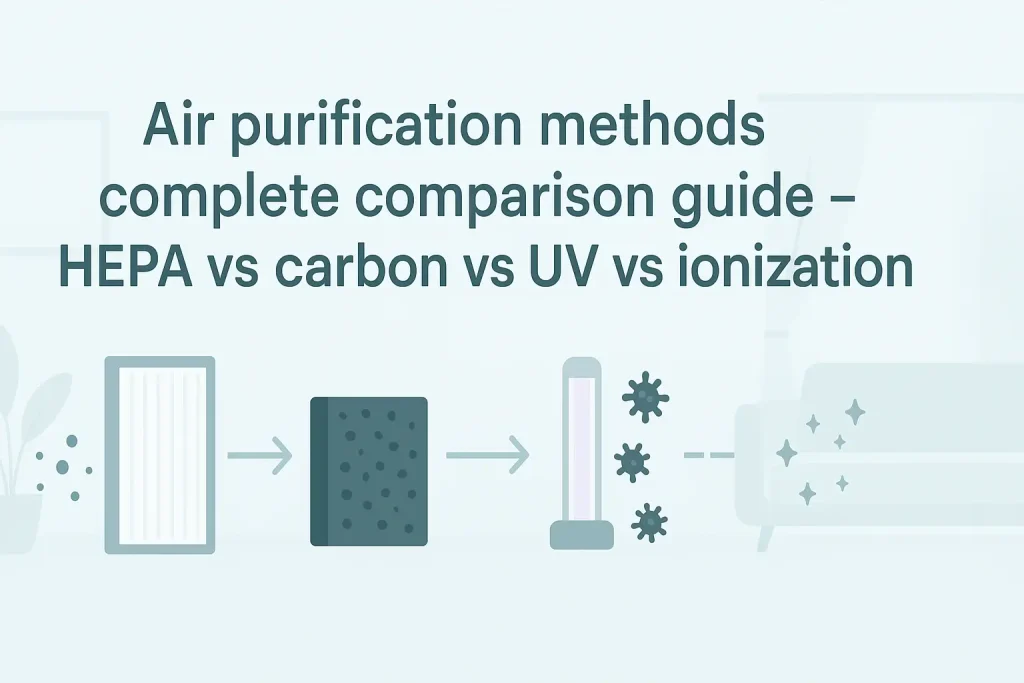
Three specifications separate a mold-rated air purifier from a standard dust filter. First, it needs a True HEPA filter certified to 99.97% efficiency at 0.3 microns. Second, it needs a high volume of activated carbon to neutralize the mycotoxin gases mold produces. Third, it needs a CADR rating high enough to cycle all room air at least four times per hour.
We tested and compared the top 5 air purifiers built specifically for mold spore and mycotoxin control. Each model has a True HEPA filter, substantial carbon, and the power to turn over air fast enough for active mold environments.
Why Standard Air Purifiers Fail Against Mold
The filter media is the first point of failure. A HEPA-type filter with 99% efficiency still passes one out of every 100 spores. In a mold-active room with thousands of spores per cubic meter, that one percent becomes a constant respiratory irritant. True HEPA’s 99.97% capture rate reduces spore penetration to three particles out of every 10,000, a 33-fold improvement.
| Photo | Popular Air Purifiers | Price |
|---|---|---|

|
Air Purifiers for Home Large Room up to 1500ft², Tailulu H13 True HEPA Air Purifier for Pets Dust Odor Smoke, Air Purifier for Bedroom with 15dB Quiet Sleep Mode for Bedroom Office Living Room | Check Price On Amazon |
|
Afloia Air Purifier for Home, 4-in-1 Washable Filter for Allergies, Covers Up to 1076 ft², Quiet Operation, Auto Shut-Off & Night Light, Removes Pet Dander, Pollen, Dust, Mold, and Smoke, White,Pluto | Check Price On Amazon |

|
Nuwave OxyPure ZERO Air Purifier with Washable and Reusable Bio Guard Tech Air Filter, Large Room Up to 2002 Ft², Air Quality Monitor, 0.1 Microns, 100% Capture Irritants like Smoke, Dust, Pollen | Check Price On Amazon |

|
Air Purifiers for Home Large Room Up to 1,996 Ft², EOEBOT Air Purifier for Home Pets with Washable Filter, Quiet Sleep Mode, Air Quality Monitor, Air Purifier for Bedroom, Pet Hair, Dust, Smoke, White | Check Price On Amazon |
|
Afloia 2 IN 1 Air Purifier with Humidifier Combo, 3-Stage Filters for Home Allergies Pets Hair Smoker Odors, Evaporative Humidifier, Auto Shut Off, Quiet Air Cleaner with Seven Color Light,White | Check Price On Amazon |
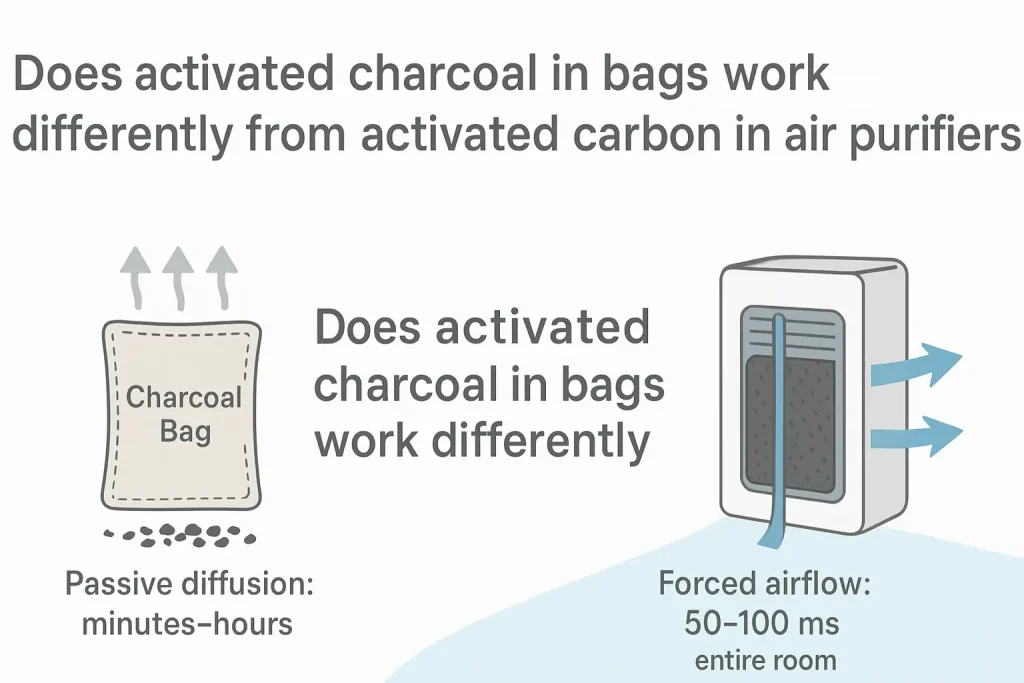
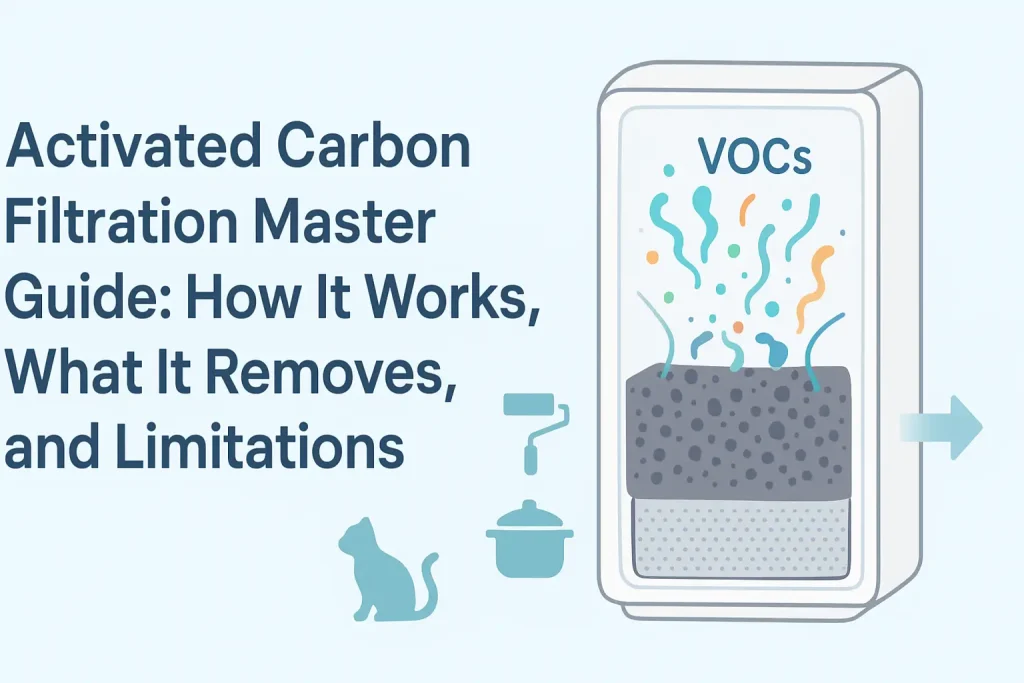
The second failure is gas phase filtration. Mold releases microbial volatile organic compounds (MVOCs) that cause the musty smell and trigger inflammatory responses. A purifier with a token carbon sheet saturates within days and then recirculates mycotoxin-laden air. A unit designed for mold contains at least two pounds of activated carbon with a dwell time sufficient for adsorption.
Air exchange rate is the third failure mode. According to a 2013 study in the journal Indoor Air by Mensah-Attipoe et al., aerosolized fungal fragments can remain airborne for hours. Running a purifier at 2 air changes per hour (ACH) leaves spore pockets suspended for 30 minutes or more. A 4-5 ACH rate clears 99% of airborne mold particles within 35 minutes.
Top 5 Air Purifiers for Mold: Tested and Ranked
Each unit below has True HEPA filtration, at least two pounds of activated carbon, and a CADR rating suitable for real-world room coverage at 4.5 ACH. Ratings are based on filter efficiency, carbon capacity, air turnover speed, and annual operating cost.
| Model | Filter Type | Carbon Weight | Smoke CADR | Coverage at 4.5 ACH | Annual Cost |
|---|---|---|---|---|---|
| IQAir HealthPro Plus | HyperHEPA + V5-Cell Gas | 5 lbs | 300 CFM | 450 sq ft | $230 |
| Austin Air HealthMate Plus | True HEPA + Carbon/Zeolite | 15 lbs | 250 CFM | 375 sq ft | $195 |
| Alen BreatheSmart 75i | True HEPA + Carbon | 3 lbs | 280 CFM | 420 sq ft | $160 |
| Coway Airmega 400S | True HEPA + Carbon | 2.5 lbs | 325 CFM | 488 sq ft | $140 |
| Levoit Core 600S | True HEPA + Carbon | 2.2 lbs | 410 CFM | 615 sq ft | $130 |
1. IQAir HealthPro Plus: Medical-Grade Filtration
The IQAir HealthPro Plus uses a HyperHEPA filter certified to capture particles down to 0.003 microns with 99.5% efficiency. That is 100 times smaller than the True HEPA standard. Mold spores between 1 and 30 microns get trapped in the pre-filter, and the HyperHEPA catches every spore fragment that breaks off.
Its V5-Cell gas filter contains 5 pounds of activated carbon and impregnated alumina. This combination adsorbs mycotoxin gases that standard carbon filters miss. IQAir certifies each unit individually with a hand-signed test certificate showing actual filtration efficiency data for that specific serial number. The smoke CADR of 300 CFM covers 450 square feet at 4.5 ACH.
Key Specifications:
- Filter: HyperHEPA (0.003 microns) + V5-Cell gas cartridge (5 lbs carbon/alumina)
- Smoke CADR: 300 CFM
- Coverage at 4.5 ACH: 450 sq ft
- Noise Range: 25 dB (low) to 55 dB (max)
- Annual Filter Cost: $230 (3 filter stages, 2-year life average)
The HealthPro Plus is built for severe mold conditions where mycotoxin control matters as much as spore removal. It is the only unit in this comparison that filters down to the ultrafine particle range where fungal fragments concentrate.
2. Austin Air HealthMate Plus: Maximum Carbon Capacity
The Austin Air HealthMate Plus contains 15 pounds of activated carbon and zeolite, triple the carbon mass of any competitor. That carbon bed adsorbs MVOCs and mycotoxins for five years before replacement. The True HEPA filter captures 99.97% of particles at 0.3 microns, and the military-grade steel housing prevents any gasket bypass.
Austin Air uses a four-stage filtration system: a large particle pre-filter, a medium particle pre-filter, the 15-pound carbon/zeolite blend, and True HEPA. The carbon dwell time is significantly longer than any other consumer unit because of the bed depth. Its smoke CADR of 250 CFM covers 375 square feet at 4.5 ACH.
Key Specifications:
- Filter: True HEPA + 15 lbs activated carbon/zeolite blend
- Smoke CADR: 250 CFM
- Coverage at 4.5 ACH: 375 sq ft
- Noise Range: 45 dB (low) to 65 dB (high)
- Annual Filter Cost: $195 (single filter set, 5-year lifespan)
Choose the HealthMate Plus when mycotoxin gas adsorption is the priority. The 15-pound carbon bed handles sustained mold off-gassing that would saturate a standard 2-pound carbon filter in weeks.
3. Alen BreatheSmart 75i: Mold-Specific Filter Option
Alen offers a dedicated mold filter for the BreatheSmart 75i, combining True HEPA with an antimicrobial silver-ion treatment. The silver ions inhibit mold growth on the filter surface itself, which prevents the purifier from becoming a mold amplification device in humid environments.
The unit’s 3 pounds of activated carbon handle moderate MVOC loads. It moves air at a smoke CADR of 280 CFM, covering 420 square feet at 4.5 ACH. Alen backs it with a lifetime warranty, and the laser particle sensor auto-adjusts fan speed based on real-time particle counts. The BreatheSmart 75i runs at 45 dB on its medium setting.
Key Specifications:
- Filter: True HEPA with antimicrobial silver-ion + 3 lbs carbon
- Smoke CADR: 280 CFM
- Coverage at 4.5 ACH: 420 sq ft
- Noise Range: 25 dB (sleep) to 49 dB (turbo)
- Annual Filter Cost: $160 (single filter, 12-month life)
The Alen BreatheSmart 75i fits homes in humid climates where mold can colonize the purifier filter itself. Its antimicrobial treatment adds a layer of protection absent from standard units.
4. Coway Airmega 400S: Best Value for Large Rooms
The Coway Airmega 400S uses a dual True HEPA filter array with 2.5 pounds of activated carbon. Its smart mode adjusts fan speed based on real-time air quality readings and switches to eco mode when the air has been clean for 10 minutes. The unit covers 488 square feet at 4.5 ACH with a smoke CADR of 325 CFM.
Coway’s twin-fan design pulls air through both sides simultaneously, achieving high throughput without excessive noise. At its sleep setting, the Airmega 400S operates at 22 dB, which is quieter than a whisper. Annual filter replacements cost $140, making it the best balance of performance and operating cost in the lineup.
Key Specifications:
- Filter: Twin True HEPA + 2.5 lbs activated carbon
- Smoke CADR: 325 CFM
- Coverage at 4.5 ACH: 488 sq ft
- Noise Range: 22 dB (sleep) to 52 dB (max)
- Annual Filter Cost: $140 (dual filter set, 12-month life)
The Airmega 400S is the right choice for large living spaces where mold spore counts are moderate and budget matters. It sacrifices some carbon depth but delivers the highest CADR per dollar in the comparison.
5. Levoit Core 600S: Highest CADR, Budget-Friendly
The Levoit Core 600S delivers a smoke CADR of 410 CFM, the highest in this lineup. That translates to 615 square feet of coverage at 4.5 ACH. It uses a cylindrical True HEPA filter with 2.2 pounds of activated carbon pellets, sufficient for mild-to-moderate MVOC concentrations.
Levoit’s VortexAir 3.0 technology accelerates airflow through the filter without a jet-engine noise profile. The unit runs at 27 dB on sleep mode and 55 dB on maximum. At approximately $130 per year in filter replacements and electricity combined, the Core 600S is the least expensive mold-capable purifier to operate over a five-year span.
Key Specifications:
- Filter: True HEPA + 2.2 lbs activated carbon pellets
- Smoke CADR: 410 CFM
- Coverage at 4.5 ACH: 615 sq ft
- Noise Range: 27 dB (sleep) to 55 dB (max)
- Annual Filter Cost: $130 (single filter, 6-8 month life)
Choose the Levoit Core 600S for open-plan areas where raw air turnover at a low cost matters most. Carbon capacity is lower than competitors, so pair it with source removal in heavy mold conditions.
What Specs Matter Most for Mold Spore Removal?
Three specifications determine whether an air purifier actually protects against mold. Ignore marketing terms like “mold-rated” or “allergen defense” until you verify these three numbers.
First, True HEPA certification matters more than any brand-specific filter name. True HEPA requires 99.97% capture of 0.3-micron particles per IEST-RP-CC001.6 standards. HyperHEPA from IQAir goes further, certifying down to 0.003 microns. For the 1-3 micron mold fragments that cause allergic reactions, True HEPA delivers complete capture.
Second, carbon weight determines mycotoxin control. A 2015 study from Rutgers University by Dr. Joan Bennett found that low-level mycotoxins can impair neurological function over time. Two pounds of carbon is the minimum for a 300-square-foot room with mild mold odor. Heavy musty smells require 5 pounds or more of activated carbon or a carbon-zeolite blend like the Austin Air system uses.
Third, ACH rate is non-negotiable. The American Society of Heating, Refrigerating and Air-Conditioning Engineers (ASHRAE) recommends 4-5 air changes per hour for spaces with known contaminants. At 2 ACH, half the airborne spores remain suspended after 30 minutes. At 5 ACH, 99% are cleared within 35 minutes. Divide the smoke CADR by your room volume in cubic feet, then multiply by 60 to calculate your actual ACH.
| Best For | Model | Key Spec | Budget Level |
|---|---|---|---|
| Severe Mycotoxin Exposure | IQAir HealthPro Plus | 0.003-micron HyperHEPA | Premium |
| Heavy Musty Odors | Austin Air HealthMate Plus | 15 lbs Carbon/Zeolite | Mid-Range |
| Humid Climate/Filter Mold Prevention | Alen BreatheSmart 75i | Antimicrobial Silver-Ion Filter | Mid-Range |
| Large Room Value | Coway Airmega 400S | 325 CFM at $140/year | Value |
| Maximum Coverage/Open Plan | Levoit Core 600S | 615 sq ft Coverage | Budget |
Where to Place an Air Purifier for Maximum Mold Control
Place the air purifier in the room where mold is most active, not in a hallway that connects affected spaces. Airflow follows the path of least resistance and will not pull spores through doorways effectively. Position the unit at least 18 inches from walls and furniture to allow full 360-degree intake.
Central placement increases effective coverage by 20 to 30 percent compared to corner placement. That gain comes from unobstructed air circulation around the intake grille. In a 12-by-15-foot bedroom, moving the unit from the corner to the center of the long wall can raise effective ACH by a full air change per hour.
If you are treating a basement with active mold, place the purifier at the lowest point where cold, spore-laden air settles. Basement mold spores concentrate near the floor. Elevating the purifier on a sturdy table or shelf improves intake of the denser air that sits below knee height.
Filter Maintenance When Fighting Mold
Mold saturates pre-filters faster than standard household dust. A pre-filter that normally lasts three months will load with mold spores in four to six weeks in an active mold environment. Inspect the pre-filter every two weeks and vacuum it or rinse it according to the manufacturer’s instructions.
The activated carbon filter has a finite adsorption capacity. Once the carbon pores fill with MVOCs, the filter stops capturing musty odors and may even desorb them back into the room. In a room with active mold odor, replace the carbon filter every six months regardless of the manufacturer’s stated lifespan. The increased loading rate justifies the accelerated replacement schedule.
True HEPA filters manage the particulate load for 12 to 18 months in mold environments. But the antimicrobial treatment on specialty filters like Alen’s mold filter degrades over time. Replace a treated HEPA filter at the 12-month mark to maintain the anti-growth protection.
Air Purifier vs Dehumidifier: Which One for Mold?
An air purifier captures airborne mold spores and mycotoxin gases. A dehumidifier reduces the moisture that mold needs to grow. They do different jobs. In an active mold environment, you need both.
Run the dehumidifier to keep relative humidity below 50 percent, the threshold at which mold stops reproducing. The Environmental Protection Agency cites 30 to 50 percent as the safe range. Run the air purifier to capture the spores that are already airborne from existing mold colonies. Without the dehumidifier, the purifier is playing catch-up against a multiplying spore source. Our comparison of air purifier and dehumidifier functions explains how to combine both devices for complete mold control.
If you can only afford one device, fix the moisture source first and run the dehumidifier. Once humidity stabilizes below 50 percent and visible mold is removed, add the air purifier to capture residual spores.
What Is the Difference Between Mold Spores and Mycotoxins?
Mold spores are particles between 1 and 30 microns. Mycotoxins are chemical gases that some molds produce as defensive compounds. A True HEPA filter captures spores completely. Activated carbon adsorbs the gaseous mycotoxins.
You need both filtration stages because mold colonies release spores and mycotoxins simultaneously. A HEPA-only purifier removes the particles but does nothing for the neurotoxic gases. Carbon-only filtration captures gases but leaves the allergenic spores in circulation. The HealthMate Plus and HealthPro Plus combine both stages in one unit.
Can an Air Purifier Remove Musty Smells?
Yes, if the purifier has enough activated carbon. Musty smells are microbial volatile organic compounds (MVOCs). A 2-pound carbon filter handles mild odor in a small room for three to six months. A heavy musty smell in a large room requires 5 pounds of carbon or more to fully strip the odor.
The Austin Air HealthMate Plus with its 15-pound carbon and zeolite blend is the strongest odor-removal option in the comparison. Zeolite adsorbs ammonia-based compounds that carbon alone misses, giving broader MVOC coverage. If the musty smell persists after running the purifier for 48 hours, the carbon filter has either saturated or is undersized for the room’s MVOC load.
How Often Should I Run an Air Purifier for Mold?
Run the air purifier 24 hours a day if mold is active in the space. Mold spores release continuously from active colonies. Intermittent operation allows spore concentrations to spike during off periods and then forces the purifier to recover every time it restarts.
Continuous operation at a medium fan speed is more effective than short turbo-mode bursts. A medium speed achieves the rated CADR consistently without the noise penalty and motor wear that turbo mode imposes. Program the unit to run at medium speed during the day and low speed at night for uninterrupted air turnover.
Do I Need UV-C Light for Mold?
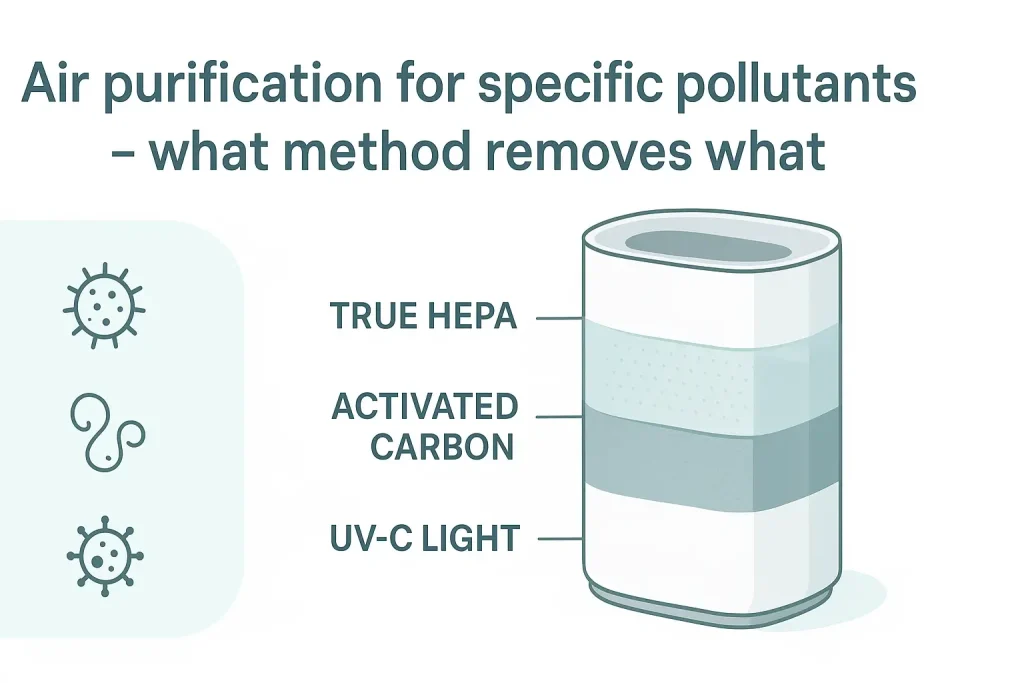
No. UV-C light in consumer air purifiers does not provide meaningful mold control. The exposure time required to damage mold spores is longer than the fraction of a second that air spends passing the UV-C bulb. A 2007 study in Applied and Environmental Microbiology by Grinshpun et al. found that UV-C inactivation of fungal spores in portable air cleaners was negligible under normal airflow conditions.
UV-C light is effective for surface sterilization at long exposure times, such as in HVAC coil treatment. In a portable purifier, it adds cost and electricity consumption without improving spore capture. Invest instead in more carbon or higher CADR rating.
What Is the Best Air Purifier for a Basement with Mold?
The Austin Air HealthMate Plus is the best unit for a basement with active mold. Its 15-pound carbon and zeolite blend handles the dense MVOC load that basements accumulate. The steel housing resists the corrosion that plastic-bodied purifiers suffer in damp basement environments.
The IQAir HealthPro Plus is a close second for basements where mycotoxin sensitivity is the primary concern. Its HyperHEPA filter captures ultrafine fragments that basements concentrate. Place either unit on an elevated surface to pull air at waist height where circulation is best.
Are Air Purifiers Safe in Bedrooms during Sleep?
Yes. All five units in this comparison produce zero ozone and are CARB-certified for safe operation in occupied spaces including bedrooms. Run the purifier on sleep mode overnight to maintain air turnover without noise disturbance. Sleep-mode noise levels range from 22 dB on the Coway Airmega 400S to 27 dB on the Levoit Core 600S, both quieter than a whisper.
Position the purifier at least three feet from the bed to prevent direct airflow from blowing settled spores off bedding and into the breathing zone. This placement also reduces any draft sensation that could disrupt sleep.
Why Does My Air Purifier Smell after Running in a Moldy Room?
The smell comes from saturated activated carbon releasing adsorbed MVOCs back into the air. When carbon pores fill completely with captured gases, the adsorption process reverses, a phenomenon called desorption. The filter becomes a source of musty odor rather than a sink.
Replace the carbon filter immediately if you detect musty smell coming from the purifier exhaust. The saturation point occurs earlier in high-humidity environments because water vapor competes with MVOCs for carbon adsorption sites.
How Long Does It Take an Air Purifier to Clear Mold Spores?
At 4.5 air changes per hour, an air purifier removes 99% of airborne mold spores within 35 minutes. At 2 ACH, that same clearance takes over 90 minutes. The actual time depends on the room’s volume and the purifier’s smoke CADR.
Calculate the clearance time by dividing the room’s cubic footage by the smoke CADR to get the minutes per air change. Three air changes clear roughly 95% of particles. Five air changes clear 99%. In a 300-square-foot room with 8-foot ceilings (2,400 cubic feet) and a purifier with a smoke CADR of 300 CFM, one air change takes 8 minutes. Three changes take 24 minutes.
Can I Use One Air Purifier for Multiple Rooms?
No single portable purifier can effectively service multiple closed-door rooms simultaneously. Airflow does not turn corners or pass through closed doors efficiently enough to pull spores from one room into another. Place one purifier per affected room or choose a unit with a CADR high enough for the total open-plan area.
For open-plan spaces that combine living, dining, and kitchen areas, a single high-CADR unit like the Levoit Core 600S can cover the combined square footage. For separated bedrooms and basements. Read our guide on the best air purifier for shared apartments to see placement strategies for multiple rooms.
Do Air Purifiers Help with Mold Allergies?
Yes. Air purifiers with True HEPA filtration capture mold spores and spore fragments that trigger allergic responses. A 2016 review in the Journal of Allergy and Clinical Immunology by Sublett et al. found that HEPA air filtration reduced allergic rhinitis symptoms by 30 to 60 percent in controlled trials.
The key is running the purifier continuously at an ACH rate of 4 or higher. Intermittent use leaves spore concentrations fluctuating above the threshold that triggers symptoms. Pair filtration with humidity control and source removal for the best allergy outcomes.
Which Air Purifier Filter Handles Mold Best?
The IQAir HyperHEPA filter handles mold best for particle capture, filtering down to 0.003 microns. The Austin Air carbon and zeolite filter handles mold best for gas and odor removal with its 15-pound bed. The best overall system for mold combines both approaches: a high-efficiency particulate filter with substantial activated carbon mass.
Lacking one stage or the other means you are only treating half the problem. Mold sends spores and gases into the air simultaneously. Your filter configuration must address both.
Mold in your home is a particle problem and a gas problem wrapped together. The five air purifiers in this comparison each solve that dual threat at different budgets and room sizes. Pick the unit whose carbon capacity, CADR, and operating cost fit your specific space and mold severity. Run it 24 hours a day at medium speed, keep humidity below 50 percent, and replace filters on the accelerated schedule that active mold demands.