A standard HEPA air purifier is not the tool you reach for when mold is actively growing inside your walls. An air scrubber is, and choosing the wrong one means spores keep circulating while you work.
This guide compares five air scrubbers built for mold remediation, water damage restoration, and construction dust containment. Each unit is rated by CFM output, filtration stages, coverage area, and the one spec that matters most for mold: whether the housing seals well enough to create actual negative air pressure.
What Is an Air Scrubber for Mold and Why Does It Matter?
An air scrubber is a high-CFM portable filtration unit that pulls contaminated air through stacked filter stages and exhausts clean air, either back into the room or out a window through ducting. It is the standard containment tool on every professional mold remediation job per IICRC S520 guidelines.
Unlike a residential air purifier that polishes already-clean air, an air scrubber is built to handle demolition-level particulate loads: airborne mold spores, disturbed mycelial fragments, and construction dust that a standard purifier’s motor and filter seal cannot manage.
| Photo | Popular Air Purifiers | Price |
|---|---|---|

|
Air Purifiers for Home Large Room up to 1500ft², Tailulu H13 True HEPA Air Purifier for Pets Dust Odor Smoke, Air Purifier for Bedroom with 15dB Quiet Sleep Mode for Bedroom Office Living Room | Check Price On Amazon |
|
Afloia Air Purifier for Home, 4-in-1 Washable Filter for Allergies, Covers Up to 1076 ft², Quiet Operation, Auto Shut-Off & Night Light, Removes Pet Dander, Pollen, Dust, Mold, and Smoke, White,Pluto | Check Price On Amazon |

|
Nuwave OxyPure ZERO Air Purifier with Washable and Reusable Bio Guard Tech Air Filter, Large Room Up to 2002 Ft², Air Quality Monitor, 0.1 Microns, 100% Capture Irritants like Smoke, Dust, Pollen | Check Price On Amazon |

|
Air Purifiers for Home Large Room Up to 1,996 Ft², EOEBOT Air Purifier for Home Pets with Washable Filter, Quiet Sleep Mode, Air Quality Monitor, Air Purifier for Bedroom, Pet Hair, Dust, Smoke, White | Check Price On Amazon |
|
Afloia 2 IN 1 Air Purifier with Humidifier Combo, 3-Stage Filters for Home Allergies Pets Hair Smoker Odors, Evaporative Humidifier, Auto Shut Off, Quiet Air Cleaner with Seven Color Light,White | Check Price On Amazon |
A commercial HEPA air scrubber moves 500 to 2,000 cubic feet of air per minute through True HEPA filtration. The housing is sealed with gaskets so no unfiltered air bypasses the filters, a failure point common in consumer-grade units repurposed for mold work.
By the Numbers: Air Scrubbers for Mold Remediation
True HEPA filter capture rate at 0.3 microns, the particle size mold spores fall within per IEST testing standards.
Typical airflow range for portable air scrubbers used in residential mold jobs. Higher CFM equals faster air turnover.
Recommended air changes per hour for mold remediation per IICRC S520 guidelines, far above the 2 ACH used for general air cleaning.
CARB CCR Title 17 maximum ozone limit. Any air scrubber producing ozone above this threshold is not legal for sale in California.
Minimum filtration depth for mold work: pre-filter, True HEPA, and activated carbon to capture spores, mycelial fragments, and mVOCs.
How an Air Scrubber Removes Mold Spores From Indoor Air
Mold spores range from 2 to 20 microns in diameter, well within the capture range of True HEPA filtration at 0.3 microns. This means a properly sealed air scrubber catches essentially every spore that enters the intake side of the machine. The mechanism is mechanical interception: particles physically collide with and embed in the filter fiber matrix.
This only occurs when the filter housing gaskets are intact, the filter is seated correctly, and the fan generates enough static pressure to pull air through all three stages without leakage. If any seal fails, contaminated air bypasses the HEPA stage and re-enters the room unfiltered.
If the housing seal is compromised or the wrong filter type is installed, the result is spore-laden air exiting the machine into the occupied space. Fix it by replacing the gasket, reseating the filter with firm pressure on all four corners, and confirming the manufacturer’s specified filter dimensions match what is installed.
For full coverage of whether these machines justify their cost across different use cases, our analysis on whether an air scrubber is worth the investment for homeowners versus contractors breaks down the equipment cost against the health and structural damage prevented.
Top 5 Air Scrubbers for Mold Remediation: Head-to-Head Comparison
Use the table below to match each air scrubber’s CFM output and filtration depth to your specific mold job size, from single-room bathroom remediation to whole-floor water damage restoration.
Product Comparison
Air Scrubbers Compared – CFM, Coverage, Filtration Stages, and Filter Cost
Key specs compared across the top five portable air scrubbers for mold remediation. CFM ratings from manufacturer specification sheets. Coverage at 4 ACH calculated as CFM x 60 / 4 / 8 ft ceiling height.
| Model | Max CFM | Coverage at 4 ACH | Filtration Stages | Annual Filter Cost | Best For |
|---|---|---|---|---|---|
| Abestorm 550 CFM | 550 CFM | 1,031 sq ft | 3-stage (pre + HEPA + carbon) | $120-180/yr | Medium residential jobs, 800 sq ft areas |
| Homelabs Portable 500 CFM | 500 CFM | 938 sq ft | 3-stage (pre + HEPA + carbon) | $100-150/yr | DIY homeowner remediation, 750 sq ft |
| MOUNTO HEPA500 Commercial | 500 CFM | 938 sq ft | 3-stage (pre + HEPA + carbon) | $110-160/yr | Contractor daily use, durable metal housing |
| PuriSystems 900 CFM | 900 CFM | 1,688 sq ft | 3-stage (pre + HEPA + carbon) | $150-220/yr | Large open-plan areas, 1,100+ sq ft |
| BlueDri BD-AS-550-BL | 550 CFM | 1,031 sq ft | 3-stage (pre + HEPA + carbon) | $120-170/yr | Budget professional unit, stackable design |
CFM data from manufacturer specification sheets at maximum fan speed. Coverage at 4 ACH calculated as CFM x 60 / 4 / 8 ft ceiling. Filter costs are estimates based on genuine replacement filters at manufacturer-recommended intervals of 6-12 months depending on particulate load during active remediation work.
Abestorm 550 CFM Air Scrubber: Best for Medium Residential Mold Jobs
The Abestorm 550 CFM delivers enough airflow to achieve 4 ACH in spaces up to 800 square feet with standard 8-foot ceilings, making it the right size for most single-room and basement mold remediation projects. Its three-stage filtration, pre-filter, True HEPA, and activated carbon, captures spores, mycelial fragments, and the musty mVOCs that signal active mold growth.
The housing uses a robust polyethylene shell with gasketed filter access panels rather than the snap-fit plastic found on consumer air purifiers. This matters because negative air pressure inside the housing pulls unfiltered air through any gap, and a gasketed seal eliminates that bypass path.
If you are sizing this unit for a specific room and want the full calculation with ACH targets, read our detailed breakdown on the Abestorm 550 CFM coverage area and performance data for 800 square foot spaces.
Key Specifications:
• Max Airflow: 550 CFM
• Coverage at 4 ACH: 1,031 sq ft (8 ft ceiling)
• Coverage at 6 ACH: 688 sq ft
• Filtration: 3-stage (MERV-10 pre-filter, True HEPA, activated carbon)
• Annual Filter Cost: approximately $120-180
Homelabs Portable Air Scrubber: Best for Homeowner DIY Remediation
The Homelabs Portable 500 CFM air scrubber is the most accessible entry point for a homeowner dealing with a contained mold issue, such as a single bathroom or laundry room. At 500 CFM with a three-stage stack (pre-filter, True HEPA, activated carbon), it hits the minimum airflow threshold for effective negative air containment in rooms up to 750 square feet at 4 ACH.
Its control panel is simpler than the commercial units: a variable speed dial rather than digital readouts, and a single indicator light for filter status. For a homeowner running one remediation project, that simplicity reduces setup errors that can compromise containment.
Our full review covers the unit’s real-world performance across different room sizes, which you can read in the Homelabs 500 CFM air scrubber test results and 750 square foot coverage analysis.
Key Specifications:
• Max Airflow: 500 CFM
• Coverage at 4 ACH: 938 sq ft (8 ft ceiling)
• Coverage at 6 ACH: 625 sq ft
• Filtration: 3-stage (pre-filter, True HEPA, activated carbon)
• Annual Filter Cost: approximately $100-150
MOUNTO HEPA500 Commercial Air Scrubber: Best for Contractor Daily Use
The MOUNTO HEPA500 is built for the contractor who runs an air scrubber five days a week across different job sites. Its metal housing and reinforced corners survive the back of a work van better than any polyethylene-shell competitor currently on the market at this CFM rating.
At 500 CFM with three-stage filtration, the airflow matches the Homelabs unit on paper. The difference is in the housing build: continuous-welded seams, gasketed filter access, and a motor rated for extended continuous operation rather than intermittent use. The unit also includes a ducting adapter for negative air exhaust out a window, standard on commercial units but often an add-on accessory on homeowner-grade machines.
For contractors evaluating daily-use durability and commercial performance specs, see the complete MOUNTO HEPA500 commercial air scrubber specifications and metal housing durability review.
Key Specifications:
• Max Airflow: 500 CFM
• Coverage at 4 ACH: 938 sq ft (8 ft ceiling)
• Coverage at 6 ACH: 625 sq ft
• Filtration: 3-stage (pre-filter, True HEPA, activated carbon)
• Annual Filter Cost: approximately $110-160
PuriSystems 900 CFM Air Scrubber: Best for Large Open-Plan Mold Remediation
The PuriSystems 900 CFM is the highest-airflow portable unit in this comparison, capable of achieving 4 ACH in spaces up to 1,100 square feet with standard ceilings. For a basement that spans the entire footprint of a house, or an open-plan ground floor after a pipe burst, this is the single unit that can maintain negative air pressure without needing to run two machines in tandem.
The 900 CFM rating comes from a larger blower motor and wider filter face area, which reduces the static pressure drop across the filter stack. Less pressure drop means the motor does not work as hard to pull air through the HEPA media, extending both filter life and motor longevity during continuous operation over multi-day remediation jobs.
For the full performance breakdown and coverage calculations at multiple ACH targets, our analysis of the PuriSystems 900 CFM air scrubber for 1,100 square foot coverage and high-airflow mold jobs covers sizing and setup specifics.
Key Specifications:
• Max Airflow: 900 CFM
• Coverage at 4 ACH: 1,688 sq ft (8 ft ceiling)
• Coverage at 6 ACH: 1,125 sq ft
• Filtration: 3-stage (pre-filter, True HEPA, activated carbon)
• Annual Filter Cost: approximately $150-220
CFM Output Comparison Across All Five Air Scrubbers
The chart below visualizes the airflow difference between these five units, since CFM is the dominant factor in determining how large a containment area each machine can handle at the 4-6 ACH required for mold work.
Performance Data
Max CFM Comparison – Top 5 Air Scrubbers for Mold Remediation
Source: Manufacturer specification sheets. Maximum airflow in cubic feet per minute (CFM) at highest fan speed setting.
How to Choose the Right Air Scrubber CFM for Your Mold Job Size
CFM determines everything: how fast you turn over the air in the containment area, whether you can maintain negative pressure, and whether a single unit handles the job or you need two. The formula is straightforward: multiply room square footage by ceiling height, multiply by your target ACH (4 for standard mold remediation per IICRC S520, 6 for heavy contamination), then divide by 60.
The most common mistake is buying a 500 CFM unit for a 1,200-square-foot basement and expecting 4 ACH. At 8-foot ceilings, that room requires 1,200 x 8 x 4 / 60 = 640 CFM. A 500 CFM unit falls 140 CFM short, reducing actual air changes to roughly 3.1 ACH, which extends remediation time and leaves spore concentrations elevated between air cycles.
For a complete breakdown of how these machines are priced across brands and what factors drive the cost differences between a $300 unit and a $900 unit, see our analysis on how much an air scrubber costs and what drives price differences across brands and CFM ratings.
Step-by-Step: How to Set Up an Air Scrubber for Mold Remediation
The steps below walk through a proper containment setup for a single-room mold job, from sealing the space to verifying negative pressure before you begin disturbing mold-contaminated materials.
Step-by-Step Guide
How to Set Up an Air Scrubber for Mold Remediation – Step by Step
5 steps – Setup time approximately 30-45 minutes – Per IICRC S520 containment guidelines
Seal the containment area with 6-mil polyethylene sheeting
Tape poly sheeting over doorways, vents, and any openings using contractor-grade duct tape. Overlap seams by 12 inches and tape both sides. The goal is an airtight barrier so the air scrubber can establish negative pressure relative to the rest of the building.
Position the air scrubber centrally and connect exhaust ducting to a window or exterior opening
Place the unit in the center of the containment area for even air circulation. Attach the flexible duct to the exhaust collar and run it to a window, sealing the window gap around the duct with poly and tape. This exhausts filtered air outside rather than recirculating it into the occupied building.
Confirm filters are seated correctly and gaskets are intact
Open the filter access panel and press firmly on all four corners of each filter. Check the rubber gasket around the access door for cracks or gaps. A compromised gasket allows unfiltered air to bypass the HEPA stage and exhaust spore-laden air outside, or worse, back into the building.
Start the unit on high and verify negative pressure with a smoke pencil or tissue test
Turn the air scrubber to maximum speed. Hold a smoke pencil or a thin tissue near the containment barrier seams. The smoke or tissue should pull inward toward the containment area. If it pushes outward or stays still, the seal is not adequate and the unit is not achieving negative pressure.
Monitor filter loading and replace when airflow drops or indicator shows restriction
During active demolition or mold disturbance, pre-filters load rapidly and may need replacement every 4-8 hours. A loaded pre-filter starves the HEPA stage of airflow, reducing CFM output and compromising negative pressure. Keep spare pre-filters on site and replace as soon as the pressure differential indicator shows restriction.
If you are considering renting a unit rather than purchasing for a one-time job, our guide on where to rent an air scrubber and what to expect for daily and weekly rental costs covers pricing, deposit requirements, and what to inspect before accepting a rental unit.
Mold-Specific Filtration: Why Three Stages Matter More Than CFM Alone
A 900 CFM air scrubber with only a HEPA filter and no pre-filter will destroy that expensive HEPA cartridge within the first hour of demolition work. Drywall dust, cellulose fragments, and mold-contaminated debris load the filter face so quickly that airflow drops below effective levels before you finish setting up containment.
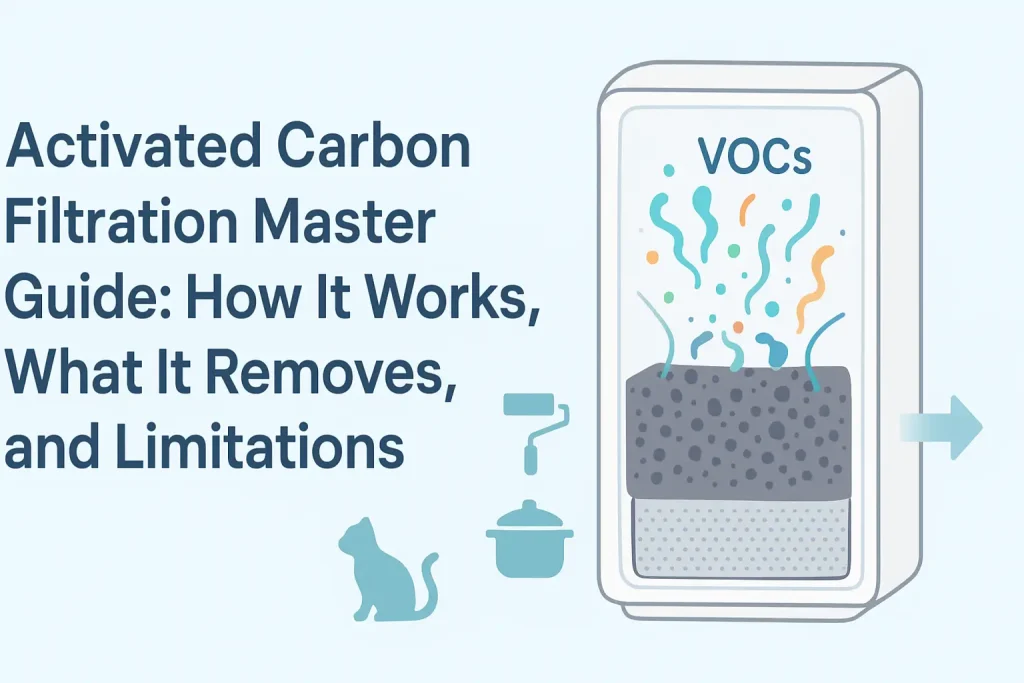
The three-stage stack exists for a reason. The pre-filter catches visible debris and the bulk of the particulate mass. The True HEPA stage captures mold spores at 99.97% efficiency at 0.3 microns. The activated carbon stage adsorbs mVOCs (microbial volatile organic compounds): the musty, earthy odors that mold produces as a metabolic byproduct and that signal active colonization even when visible mold is removed.
A replacement activated carbon filter for air scrubbers typically lasts 3-6 months under continuous mold remediation use, less if mVOC concentrations are high. Replace it when the musty odor returns at the exhaust side, even if the HEPA stage still shows acceptable airflow.
Coverage Area Math: Matching Air Scrubber CFM to Your Room Size at 4 ACH and 6 ACH
Every manufacturer lists a maximum coverage area on the product page. That number assumes 2 ACH, the baseline for general air cleaning. Mold remediation per IICRC S520 requires 4 ACH minimum, and heavily contaminated spaces call for 6 ACH. This means the manufacturer’s stated coverage area is effectively double what you can actually use for mold work.
A unit claiming 1,600 square feet of coverage at 2 ACH is actually a 1,600 x 8 x 2 / 60 = 427 CFM machine. At 4 ACH, that same unit covers 427 x 60 / 4 / 8 = 800 square feet, half the advertised number. At 6 ACH, coverage drops further to 534 square feet, roughly one-third of what is printed on the box.
For the most common residential mold scenario, a 200-square-foot bathroom with an 8-foot ceiling at 6 ACH heavy contamination protocol, you need 200 x 8 x 6 / 60 = 160 CFM minimum. Even the smallest unit in this comparison at 500 CFM exceeds that requirement, which means any of these five machines handles a single bathroom with capacity to spare.
Filter Replacement Costs and Long-Term Ownership Economics
The purchase price of the air scrubber is roughly half the total cost of ownership over a three-year period if you run it regularly for mold work. Filter replacements, particularly the True HEPA cartridge, represent the larger long-term expense. A HEPA filter for a 500-550 CFM unit costs $60-100 and lasts 6-12 months under typical remediation use. The pre-filter, at $15-25 each, may need replacement every few days during active demolition.
Annual filter costs across these five units range from $100 on the low end (Homelabs, with two filter changes per year) to $220 on the high end (PuriSystems 900, with its larger filter face area and higher replacement cartridge cost). Over three years, the filter spend alone exceeds the initial unit cost for the budget models and comes close to matching it for the commercial units.
A HEPA replacement filter cartridge for 500 CFM class air scrubbers must match the manufacturer’s specified dimensions and gasket type exactly. A filter that fits the housing but does not seal creates a bypass path that negates the entire purpose of running the machine inside a containment zone.
Ducting and Exhaust Configuration: Recirculation vs Negative Air Exhaust
An air scrubber can run in two modes. In recirculation mode, it pulls room air through the filter stack and exhausts clean air back into the same space, gradually reducing airborne spore concentrations with each pass. In negative air mode, the exhaust is ducted out a window or exterior opening, which pulls fresh air into the containment area through any gaps in the barrier and prevents spore-laden air from escaping into adjacent rooms.
Negative air mode is the standard for active mold remediation because it protects the rest of the building. Every cubic foot of air exhausted outside is replaced by air drawn from surrounding spaces, which means any leak in the containment barrier pulls clean air in rather than letting contaminated air out.
A flexible 8-inch layflat ducting hose for air scrubber exhaust connects to the exhaust collar on all five units in this comparison. Run the duct to the nearest window, seal the gap, and the unit operates in true negative air configuration rather than recirculating partially filtered air through the workspace.
What Is the Difference Between an Air Scrubber and an Air Purifier?
An air scrubber moves 500-2,000 CFM through gasketed, commercial-grade filter housings built for continuous demolition-duty operation. An air purifier moves 100-400 CFM through consumer-grade snap-fit housings designed for intermittent use in already-clean rooms. The air scrubber includes a ducting collar for negative air exhaust. The air purifier does not. The air scrubber is tested for filter bypass at high static pressure. The air purifier is not.
Using a residential air purifier for mold remediation fails in two ways. The CFM is too low to achieve 4 ACH in anything larger than a small bathroom, and the housing seals are inadequate to prevent contaminated air from escaping around the filter frame when the fan runs at maximum speed against a loaded filter.
Can You Use an Air Scrubber Without Ducting It Outside?
Yes, but only for post-remediation air scrubbing after all mold-contaminated materials have been removed and surfaces have been HEPA-vacuumed and wiped with antimicrobial solution. In recirculation mode, the unit polishes the air by capturing any remaining airborne spores that were disturbed during the final cleaning phase. This is standard protocol for the 24-48 hour post-remediation air scrub before clearance testing.
During active remediation, when you are cutting out drywall, removing insulation, or disturbing mold-colonized surfaces, the unit must exhaust outside. Running in recirculation mode during demolition loads the filters so rapidly that CFM drops below effective negative pressure levels within the first hour, and any filter bypass releases concentrated spore loads directly into the workspace.
Do Air Scrubbers Produce Ozone?
None of the five air scrubbers in this comparison produce ozone. They use mechanical filtration only: pre-filter, True HEPA, and activated carbon. No UV-C lamps, no ionizers, no PCO (photocatalytic oxidation) stages are present in any of these units. Mechanical filtration does not generate ozone as a byproduct, which means these machines are compliant with the CARB CCR Title 17 limit of 0.050 ppm ozone output without needing certification testing for electronic air cleaning components.
This matters because some duct-mounted and whole-home “air scrubbers” use UV-C or ionization and do produce ozone. The portable units reviewed here are exclusively mechanical filtration devices and carry zero ozone risk.
How Long Should You Run an Air Scrubber After Mold Remediation?
Per IICRC S520 guidelines, run the air scrubber continuously for a minimum of 24 hours after completing all remediation work and final cleaning, and continue running until a third-party indoor air quality professional clears the space with spore trap sampling. The post-remediation air scrub period captures spores that were disturbed during cleaning but had not yet settled, as well as any spores released from surfaces as they dry.
In practice, most professional remediation contractors run the air scrubber for 24-48 hours post-remediation at medium to high speed, then collect air samples for clearance testing. If spore counts are within 10% of outdoor baseline levels and the indoor/outdoor ratio for indicator species like Stachybotrys or Aspergillus/Penicillium is at or below 1.0, the space passes clearance and the air scrubber can be removed.
What Happens if You Use an Undersized Air Scrubber for the Containment Area?
The containment area never reaches negative pressure. Air leaks out through gaps in the barrier rather than being pulled in from surrounding spaces. This is the single most common failure mode in DIY mold remediation and the reason professional contractors oversize their air scrubbers by 20-30% above the calculated minimum CFM requirement.
An undersized unit also loads its filters faster because the air spends less time passing through each stage, which means the pre-filter saturates with debris before the HEPA stage can do its work. The result is a machine that runs continuously, consumes electricity, and exhausts partially filtered air that may still contain elevated spore concentrations, all while giving the operator a false sense of containment.
Can You Rent an Air Scrubber Instead of Buying One?
Yes, and for a single remediation project, renting is often the better financial decision. Equipment rental companies stock 500-2,000 CFM air scrubbers and charge daily or weekly rates that typically range from $40-100 per day for a 500 CFM unit and $80-200 per day for a 1,000+ CFM unit, depending on your location and the rental company’s pricing structure.
Before accepting a rental unit, inspect the filter condition and housing gaskets. A rental air scrubber that has been through multiple jobs may have compromised seals or partially loaded filters that reduce effective CFM below the rated specification. Ask the rental company when the filters were last replaced and request fresh filters if the unit shows visible debris accumulation on the pre-filter face.
For the complete rental cost breakdown, deposit expectations, and inspection checklist, our guide on air scrubber rental costs and what to inspect before accepting a unit covers everything you need to know before calling rental companies in your area.
Why Does My Air Scrubber Have Reduced Airflow After Only a Few Hours of Use?
The pre-filter is loaded with demolition debris: drywall dust, insulation fibers, and mold-contaminated particulate. This is normal and expected during active remediation. The pre-filter is sacrificial by design and will clog rapidly when the air is heavily loaded with particulate from cutting, scraping, and removing contaminated building materials.
Replace the pre-filter immediately and check the HEPA stage for any visible debris that bypassed the pre-filter. If the HEPA filter face shows dust accumulation, the pre-filter was either seated incorrectly (allowing bypass around the edges) or was left in place too long after loading. Keep a supply of at least 4-6 spare pre-filters on site for a full-day remediation job, and replace them as soon as the pressure differential indicator on the unit shows restriction.
Are Air Scrubbers Safe to Use in Occupied Areas of the Home During Remediation?
Yes, in adjacent rooms outside the containment zone. The air scrubber exhausts filtered air either outside (in negative air mode) or back into the containment area (in recirculation mode). Neither mode releases unfiltered air into occupied spaces. The containment barrier prevents spore migration, and the air scrubber maintains negative pressure so air flows from clean areas toward the containment zone, not the reverse.
Occupants in rooms adjacent to the containment area should not experience elevated spore counts if the barrier is correctly sealed and negative pressure is verified. However, sensitive individuals, particularly those with mold allergies or asthma, should consider temporarily relocating during active demolition phases when the containment barrier is opened and closed for worker entry and material removal.
For a broader evaluation of whether these machines justify their cost across different scenarios, see our analysis on whether air scrubbers are worth the investment for homeowners dealing with mold versus other indoor air quality concerns.
Your Air Scrubber Decision in One Minute
For a single bathroom or laundry room mold job under 750 square feet, the Homelabs Portable 500 CFM at the lowest price point handles the airflow requirement and includes the three-stage filtration stack needed for spore and mVOC capture. For multi-room or whole-basement remediation above 800 square feet, the Abestorm 550 CFM or PuriSystems 900 CFM provides the additional airflow headroom that prevents the unit from running at maximum speed continuously.
For contractors who need a machine that survives daily transport and extended continuous operation, the MOUNTO HEPA500 with its metal housing and reinforced build justifies the higher upfront cost through durability alone. Pair any of these units with a multi-pack of replacement pre-filters and an 8-inch flexible exhaust duct before you start the job, because running out of either mid-remediation means compromising containment or stopping work entirely.