Most air scrubbers can move air through a HEPA filter. Very few can maintain the negative pressure and filtration efficiency required to contain asbestos fibers during abatement, where a single breach means a failed clearance test and a complete redo.
An air scrubber rated for general construction dust will not hold up under the continuous load of asbestos remediation. The filter loads faster, the motor works harder, and the unit leaks contaminated air if the housing is not sealed to negative-pressure specifications.
This guide compares the five air scrubbers that actually meet the requirements for asbestos abatement: high CFM at high static pressure, multi-stage filtration with true HEPA as the final stage, sealed housing, and continuous-duty ratings.
You will learn which unit fits your containment size, why CFM alone is misleading without the static pressure curve, and what each model costs to buy and run over a full year of abatement work.
| Photo | Popular Air Purifiers | Price |
|---|---|---|

|
Air Purifiers for Home Large Room up to 1500ft², Tailulu H13 True HEPA Air Purifier for Pets Dust Odor Smoke, Air Purifier for Bedroom with 15dB Quiet Sleep Mode for Bedroom Office Living Room | Check Price On Amazon |
|
Afloia Air Purifier for Home, 4-in-1 Washable Filter for Allergies, Covers Up to 1076 ft², Quiet Operation, Auto Shut-Off & Night Light, Removes Pet Dander, Pollen, Dust, Mold, and Smoke, White,Pluto | Check Price On Amazon |

|
Nuwave OxyPure ZERO Air Purifier with Washable and Reusable Bio Guard Tech Air Filter, Large Room Up to 2002 Ft², Air Quality Monitor, 0.1 Microns, 100% Capture Irritants like Smoke, Dust, Pollen | Check Price On Amazon |

|
Air Purifiers for Home Large Room Up to 1,996 Ft², EOEBOT Air Purifier for Home Pets with Washable Filter, Quiet Sleep Mode, Air Quality Monitor, Air Purifier for Bedroom, Pet Hair, Dust, Smoke, White | Check Price On Amazon |
|
Afloia 2 IN 1 Air Purifier with Humidifier Combo, 3-Stage Filters for Home Allergies Pets Hair Smoker Odors, Evaporative Humidifier, Auto Shut Off, Quiet Air Cleaner with Seven Color Light,White | Check Price On Amazon |
By the Numbers: Air Scrubbers for Asbestos Abatement
Minimum HEPA filtration efficiency at 0.3 microns required for asbestos abatement under EPA AHERA and OSHA standards.
Minimum air changes per hour required in an asbestos containment zone to maintain negative pressure and fiber control.
Minimum negative air pressure differential (inches of water gauge) required inside the containment relative to outside per EPA guidance.
Maximum rated airflow among the top 5 air scrubbers reviewed, sufficient for containment zones up to 4,000 sq ft at 4 ACH.
Price range for the air scrubbers in this comparison, with annual filter costs adding $200 to $600 depending on usage volume.
What Is an Air Scrubber and How Does It Work for Asbestos Abatement?
An air scrubber is a portable filtration unit that pulls contaminated air through a series of filters and exhausts clean air. For asbestos abatement, it serves two functions simultaneously: it captures airborne asbestos fibers before they escape the containment zone, and it creates the negative air pressure that keeps fibers from migrating into occupied areas of the building.
Unlike a standard air purifier that recirculates room air, an asbestos air scrubber is ducted to exhaust outside the containment area. This creates a pressure differential where air flows into the containment zone through any gaps, not out of it, which is the fundamental safety mechanism that protects workers and building occupants during abatement.
The EPA Asbestos Hazard Emergency Response Act (AHERA) requires HEPA filtration with a minimum efficiency of 99.97% at 0.3 microns for all asbestos abatement projects in schools. OSHA standard 1926.1101 applies the same requirement to all occupational asbestos exposure scenarios. An air scrubber without certified HEPA filtration is not legally sufficient for asbestos work.
Air scrubbers designed for general construction or mold remediation often lack the sealed housing, static pressure capacity, and continuous-duty motor rating required for asbestos containment. The distinction matters because a unit that leaks unfiltered air around the filter gasket or through the housing seam releases asbestos fibers directly into the environment you are trying to protect.
Why CFM and Filtration Stages Matter for Asbestos Containment
CFM, or cubic feet per minute, is the volume of air the scrubber moves. But the rated CFM is measured at zero static pressure with no ducting attached. In real asbestos abatement, the unit pulls against the resistance of ducting, the HEPA filter itself, and the containment structure, which reduces actual airflow by 20 to 40 percent from the rated maximum.
A scrubber rated at 2,000 CFM may deliver only 1,200 to 1,400 CFM under actual operating conditions. You must size the unit to deliver the target ACH at the loaded CFM, not the free-air rating. For a 2,000-square-foot containment with 8-foot ceilings, achieving 4 ACH requires 1,067 CFM of actual delivered airflow, which means selecting a unit rated well above that at free air.
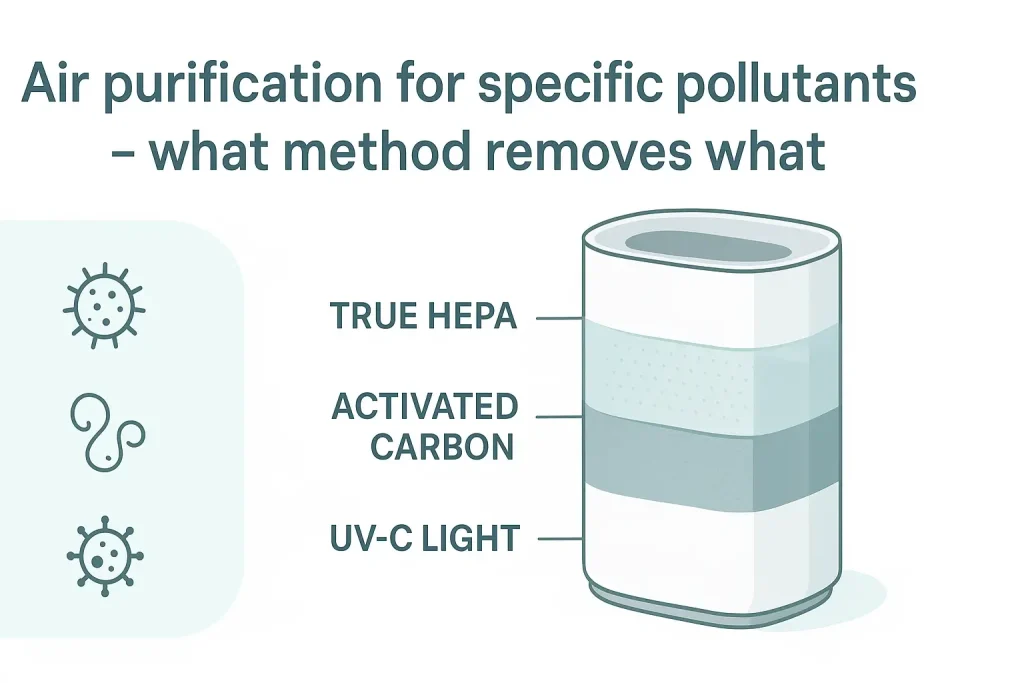
The filtration stage count is often misunderstood. A four-stage system typically includes a pre-filter, a secondary filter, a HEPA filter, and an activated carbon stage. For asbestos, the pre-filter and secondary filter protect the HEPA stage from rapid loading with larger debris, which extends HEPA life and maintains airflow. The carbon stage is irrelevant for asbestos fibers but useful for the odors associated with some abatement compounds.
The HEPA filter is the only stage that captures asbestos fibers. It must be individually certified with a serial number and efficiency test result. A unit that claims “HEPA-type” or “HEPA-like” filtration is not adequate for asbestos. Only true HEPA filters manufactured to IEST-RP-CC001 standards and individually tested meet the regulatory requirement.
How to Calculate the Right Air Scrubber Size for Your Asbestos Containment
Sizing an air scrubber for asbestos abatement requires calculating the containment volume and multiplying by the target air changes per hour, then adjusting for the static pressure loss your specific setup will impose. The formula is: required CFM equals containment volume in cubic feet multiplied by target ACH, divided by 60.
For a 1,500-square-foot containment area with 8-foot ceilings, the volume is 12,000 cubic feet. At 4 ACH, the required CFM is 800. But that is the delivered CFM under load, not the free-air rating. A unit with a 1,200 CFM free-air rating operating at 0.75 inches of water gauge static pressure may deliver approximately 800 CFM, which matches the requirement.
Static pressure is the resistance the scrubber must overcome. It comes from the ducting length and diameter, the number of bends in the duct run, the filter loading as it captures particles, and the tightness of the containment. Every 90-degree bend adds approximately 5 to 10 feet of equivalent duct length. A 25-foot duct run with two 90-degree bends behaves like a 40-foot straight duct in terms of resistance.
Most manufacturers publish a fan curve showing CFM at different static pressures. If the manufacturer does not provide this curve, assume the unit delivers approximately 60 percent of its rated free-air CFM at 1.0 inch of water gauge. This is a conservative estimate that accounts for a moderately loaded HEPA filter and a typical duct run. For critical applications, measure the actual airflow with an anemometer at the exhaust.
For a deeper understanding of how to match air scrubber capacity to your specific containment dimensions, including the full calculation methodology for different ceiling heights and ACH targets, see our guide on sizing industrial air purification systems for commercial containment projects.
Performance Data
Air Scrubber CFM Comparison – Top 5 Models for Asbestos Abatement
Maximum airflow in cubic feet per minute at free air (zero static pressure). Source: Manufacturer specifications.
Top 5 Air Scrubbers for Asbestos Abatement: Detailed Reviews
Each unit below has been evaluated against the criteria that matter for asbestos work: true HEPA certification, CFM at operating static pressure, housing seal integrity, filter stage configuration, continuous-duty motor rating, and total cost of ownership including replacement filters. The units are ordered from highest to lowest CFM capacity.
AlorAir 3000 CFM HEPA Air Scrubber: Maximum Capacity for Large Containments
The AlorAir 3000 CFM HEPA air scrubber delivers the highest free-air CFM in this comparison, making it the only single-unit solution for containment zones exceeding 3,000 square feet. It uses a four-stage filtration system with a washable pre-filter, a MERV-10 secondary filter, a certified true HEPA filter, and an activated carbon stage for odor control.
At 3,000 CFM free air, this unit can deliver approximately 1,800 to 2,100 CFM at 0.75 inches of water gauge static pressure, which covers a 4,000-square-foot containment at 4 ACH with an 8-foot ceiling. The dual-voltage motor operates on both 115V and 230V, allowing flexibility on job sites with different power availability.
Key Specifications:
• Free-air CFM: 3,000 CFM
• Filtration stages: 4 (pre-filter, MERV-10, true HEPA, activated carbon)
• Coverage at 4 ACH (8 ft ceiling): approximately 4,000 sq ft
• Power: 115V/230V dual voltage, 5.5 amps at 115V
• Annual filter cost: approximately $400 to $600 depending on loading
For a complete breakdown of this unit’s specifications, including ducting compatibility and filter replacement procedures, see our full review of the AlorAir 3000 CFM HEPA air scrubber with detailed coverage and filter cost analysis.
Abestorm 2000 CFM Commercial Air Scrubber: Best Mid-Range Capacity with 4-Stage Filtration
The Abestorm 2000 CFM commercial air scrubber balances high airflow with a compact form factor that fits through standard doorways. Its four-stage filtration includes a washable nylon pre-filter, a pleated secondary filter, a certified true HEPA filter with individual serial number, and an activated carbon stage.
At 2,000 CFM free air, this unit delivers approximately 1,200 to 1,400 CFM under typical asbestos abatement operating conditions. This covers a 2,000 to 2,500-square-foot containment at 4 ACH. The stacked filter design reduces the footprint to roughly half that of comparable units, which matters when floor space inside the containment is limited.
Key Specifications:
• Free-air CFM: 2,000 CFM
• Filtration stages: 4 (nylon pre-filter, pleated secondary, true HEPA, activated carbon)
• Coverage at 4 ACH (8 ft ceiling): approximately 2,000 to 2,500 sq ft
• Duct size: 14-inch intake, 14-inch exhaust
• Annual filter cost: approximately $300 to $450
Read our detailed analysis of the Abestorm 2000 CFM commercial air scrubber including its four-stage filtration performance under load for more information on filter loading rates and static pressure curves.
Mounto 2000 CFM Commercial Negative Air Scrubber: High Capacity at a Competitive Price
The Mounto 2000 CFM commercial negative air scrubber matches the Abestorm in rated airflow but typically sells at a lower price point. It uses a three-stage filtration system with a pre-filter, a true HEPA filter, and an activated carbon stage, omitting the secondary pleated filter found in four-stage competitors.
The three-stage design means the HEPA filter loads faster in dusty environments because there is no intermediate filter to catch medium-size particles. This can increase annual filter costs by 20 to 30 percent compared to four-stage units when used in the same conditions. The trade-off is a lower purchase price and a simpler filter change process.
Key Specifications:
• Free-air CFM: 2,000 CFM
• Filtration stages: 3 (pre-filter, true HEPA, activated carbon)
• Coverage at 4 ACH (8 ft ceiling): approximately 2,000 to 2,500 sq ft
• Duct size: 14-inch intake, 14-inch exhaust
• Annual filter cost: approximately $350 to $500 (higher due to faster HEPA loading)
For a complete comparison of this unit against other 2,000 CFM models, see our review of the Mounto 2000 CFM commercial negative air scrubber covering filter longevity and real-world performance.
AlorAir PureAiro HEPA Max 770: Best Mid-Size Option for Smaller Containments
The AlorAir PureAiro HEPA Max 770 fills the gap between small portable units and full-size commercial scrubbers. At 770 CFM free air, it delivers approximately 460 to 540 CFM under load, making it suitable for containments up to 800 square feet at 4 ACH with 8-foot ceilings.
This unit uses a three-stage filtration system with a washable pre-filter, a true HEPA filter, and an activated carbon stage. Its compact size and lighter weight make it easier to transport and position in tight spaces like bathrooms, small utility rooms, or partial-floor containments where a 2,000 CFM unit would be oversized and difficult to place.
Key Specifications:
• Free-air CFM: 770 CFM
• Filtration stages: 3 (washable pre-filter, true HEPA, activated carbon)
• Coverage at 4 ACH (8 ft ceiling): approximately 800 sq ft
• Weight: 38 lbs (significantly lighter than 2,000+ CFM units)
• Annual filter cost: approximately $200 to $300
See our full evaluation of the AlorAir PureAiro HEPA Max 770 air scrubber for small to medium asbestos containment applications.
Abestorm 600 CFM Air Scrubber with UV-C: Compact Unit for Spot Containment
The Abestorm 600 CFM air scrubber with UV-C light is the smallest unit in this comparison, designed for spot containment and small-scale abatement work. At 600 CFM free air, it delivers approximately 360 to 420 CFM under load, covering containments up to 600 square feet at 4 ACH.
The UV-C light is a secondary feature that provides antimicrobial treatment but is not relevant for asbestos fibers themselves. For asbestos abatement, the value of this unit is its portability and lower purchase price, not the UV-C stage. The HEPA filter is certified true HEPA with individual serial number verification.
Key Specifications:
• Free-air CFM: 600 CFM
• Filtration stages: 4 (pre-filter, true HEPA, activated carbon, UV-C light)
• Coverage at 4 ACH (8 ft ceiling): approximately 600 sq ft
• Weight: 29 lbs
• Annual filter cost: approximately $180 to $280
For more details on this unit’s UV-C stage and its relevance to different abatement scenarios, read our review of the Abestorm 600 CFM air scrubber with UV-C light for small-scale asbestos containment.
Abestorm 550 CFM Air Scrubber: Budget Entry Point for Small Jobs
The Abestorm 550 CFM air scrubber is the lowest-priced unit in this comparison and the most compact. At 550 CFM free air, it delivers approximately 330 to 385 CFM under load, covering containments up to 500 square feet at 4 ACH with 8-foot ceilings.
This unit is best suited for single-room abatement projects such as a small bathroom, a closet with asbestos-containing materials, or a small mechanical room. It is not designed for multi-room or whole-floor containment. For any project larger than 500 square feet, a higher-CFM unit is required to maintain the 4 ACH minimum.
Key Specifications:
• Free-air CFM: 550 CFM
• Filtration stages: 3 (pre-filter, true HEPA, activated carbon)
• Coverage at 4 ACH (8 ft ceiling): approximately 500 sq ft
• Weight: 25 lbs
• Annual filter cost: approximately $160 to $250
For a complete breakdown of this unit’s capabilities and limitations, see our review of the Abestorm 550 CFM air scrubber for small asbestos abatement projects.
Product Comparison
Top 5 Air Scrubbers Compared – CFM, Coverage, Filtration, and Price
Key specifications compared across top picks for asbestos abatement. CFM from manufacturer specifications. Coverage at 4 ACH, 8 ft ceiling. Prices verified at time of publication.
| Model | Free-Air CFM | Coverage at 4 ACH | Filtration Stages | Approx. Unit Price | Annual Filter Cost | Best For |
|---|---|---|---|---|---|---|
| AlorAir 3000 CFM | 3,000 CFM | 4,000 sq ft | 4-stage | $1,299 | $400-$600 | Large commercial containments |
| Abestorm 2000 CFM | 2,000 CFM | 2,500 sq ft | 4-stage | $899 | $300-$450 | Mid-size to large containments |
| Mounto 2000 CFM | 2,000 CFM | 2,500 sq ft | 3-stage | $799 | $350-$500 | Budget-conscious mid-size projects |
| AlorAir PureAiro 770 | 770 CFM | 800 sq ft | 3-stage | $499 | $200-$300 | Small to medium containments |
| Abestorm 600 CFM | 600 CFM | 600 sq ft | 4-stage w/ UV-C | $399 | $180-$280 | Spot containment, small rooms |
| Abestorm 550 CFM | 550 CFM | 500 sq ft | 3-stage | $349 | $160-$250 | Single-room small projects |
Coverage at 4 ACH calculated as (free-air CFM x 0.65 load factor x 60) / (4 ACH x 8 ft ceiling). Actual coverage depends on ducting configuration, filter loading, and containment tightness. Prices are approximate street prices at time of publication. Always verify HEPA filter certification before use in asbestos abatement.
Price Comparison
Air Scrubber Price Comparison – Unit Cost and Annual Filter Cost
Unit purchase price plus estimated annual filter replacement cost. Prices verified at time of publication.
$349 unit + $160 to $250/yr filters
$399 unit + $180 to $280/yr filters
$499 unit + $200 to $300/yr filters
$799 unit + $350 to $500/yr filters
$899 unit + $300 to $450/yr filters
$1,299 unit + $400 to $600/yr filters
Bar width represents unit purchase price relative to the most expensive product shown. Filter costs are estimates based on manufacturer-recommended replacement intervals under moderate dust loading. Heavy asbestos abatement use will increase filter replacement frequency. Genuine HEPA filters used for all cost estimates.
How to Set Up an Air Scrubber for Asbestos Abatement: Step-by-Step Protocol
Setting up an air scrubber for asbestos abatement is not the same as plugging in a shop air cleaner. The unit must create and maintain negative pressure inside the containment, exhaust filtered air outside the containment, and pass a smoke test before abatement work begins. Any step done incorrectly compromises the containment and risks a failed clearance test.
According to EPA guidance on asbestos abatement (40 CFR Part 763 Subpart E for schools, and the EPA Purple Book for general asbestos guidance), the negative air pressure differential must be maintained at a minimum of 0.02 inches of water gauge relative to the outside environment. The following steps ensure this requirement is met and verified before work starts.
Step-by-Step Guide
How to Set Up an Air Scrubber for Asbestos Abatement
6 steps – Approximately 45 to 90 minutes depending on containment size
Position the air scrubber inside the containment near the exhaust point
Place the unit as far as possible from the intake air source (typically a baffled entry point at the opposite end of the containment). This maximizes the airflow path across the work area and ensures contaminated air is drawn through the full length of the containment before reaching the scrubber intake.
Connect exhaust ducting and route to the outside
Attach the exhaust duct to the unit’s outlet flange. Use the manufacturer’s specified duct diameter (typically 14 inches for 2,000 CFM units). Route the duct through the containment barrier to the outdoors. Seal the penetration point with tape and poly sheeting. Every 90-degree bend in the duct run reduces effective airflow by 5 to 10 percent.
Create a controlled intake air opening at the opposite end
Cut a baffled intake opening in the containment barrier at the end farthest from the air scrubber. The opening should be sized to allow the scrubber’s full CFM to enter without excessive resistance. A 2,000 CFM unit typically requires an intake opening of at least 2 square feet. The baffle prevents light and direct airflow from entering in a straight line.
Start the air scrubber and verify negative pressure with a manometer
Turn on the unit at the speed needed to achieve the target CFM. Use a digital manometer or a digital differential pressure manometer to measure the pressure difference between inside the containment and the outside area. The reading must show at least negative 0.02 inches of water gauge. If it does not, check for leaks in the containment barrier.
Perform a smoke test to visually confirm airflow direction
Use a smoke tube or chemical smoke generator at the intake opening and at any containment seams. The smoke must be drawn into the containment at the intake and pulled inward at all seams. If smoke blows outward at any point, the containment has a leak that must be sealed before abatement work begins.
Monitor pressure continuously and record readings at regular intervals
Negative pressure must be maintained throughout the entire abatement process. Check the manometer reading at least every 30 minutes and record the value in the project log. A drop in negative pressure indicates either a containment breach, a clogged filter, or a power interruption. Each of these requires immediate corrective action to prevent fiber release.
Filter Replacement and Maintenance for Asbestos Air Scrubbers
HEPA filters in asbestos abatement service load faster than filters in general construction or mold remediation because the fiber concentration is higher and the particles are more uniform in size. A HEPA filter that lasts 6 months in a mold remediation scrubber may last only 4 to 6 weeks in continuous asbestos abatement use.
The pre-filter is the first line of defense and should be checked daily during active abatement. A visibly loaded pre-filter reduces airflow to the HEPA stage, which increases static pressure and reduces the effective CFM delivered to the containment. Replace the pre-filter when it shows visible discoloration across more than 50 percent of its surface area.
The HEPA filter replacement trigger is a measured pressure drop, not a visual inspection. Most manufacturers specify a maximum pressure drop of 2.0 to 2.5 inches of water gauge across the HEPA filter before replacement. A magnehelic differential pressure gauge installed across the filter bank provides a continuous reading of filter loading. When the pressure drop reaches the manufacturer’s limit, replace the HEPA filter.
Used HEPA filters from asbestos abatement are regulated waste. They must be bagged inside the containment, sealed in labeled asbestos waste bags, and disposed of according to local and federal regulations for asbestos-containing waste. Never dispose of a used asbestos HEPA filter in general construction debris or municipal waste.
Common Mistakes When Using Air Scrubbers for Asbestos and How to Avoid Them
The most common mistake is undersizing the air scrubber for the containment volume. A unit rated for 1,000 CFM at free air may deliver only 600 CFM under actual operating conditions. If the containment requires 800 CFM at 4 ACH, the unit is undersized and the negative pressure will be insufficient to prevent fiber migration.
The fix is to calculate the required CFM using the formula (containment volume x target ACH) divided by 60, then select a unit whose loaded CFM at the expected static pressure exceeds that number. Always use the loaded CFM, not the free-air rating, for sizing decisions. A second common mistake is ducting the exhaust to an area where people are present, which defeats the purpose of the containment entirely.
Another frequent error is failing to seal the duct penetration properly. The point where the exhaust duct passes through the containment barrier is a potential leak path. If the seal around the duct is not airtight, contaminated air can escape around the duct rather than through it. Use multiple layers of tape and poly sheeting to create a positive seal, and test it with smoke during the pressure verification step.
Finally, many operators run the air scrubber at a lower speed than needed to reduce noise or save energy. This reduces the CFM and the negative pressure differential. The scrubber must run at the speed that delivers the required CFM for the containment size, regardless of noise level. If noise is a concern, use a longer exhaust duct run to move the unit farther from occupied areas, or select a unit with a lower decibel rating at the required CFM.
How Much Does It Cost to Run an Air Scrubber for Asbestos Abatement Over a Full Year?
The total annual cost of operating an asbestos air scrubber includes the amortized unit purchase price, filter replacements, electricity, and disposal costs for used filters. For a mid-range unit like the Abestorm 2000 CFM, the first-year total cost of ownership ranges from approximately $2,000 to $2,800 assuming 200 days of operation at 8 hours per day.
The unit purchase price of $899 amortized over a 5-year service life adds approximately $180 per year. Filter replacements at $300 to $450 per year under moderate loading represent the largest recurring cost. Electricity at 13 cents per kWh for a 5.5-amp unit at 115 volts running 1,600 hours per year adds approximately $130. Disposal costs for used HEPA filters as asbestos waste add approximately $50 to $100 per filter change.
For a small unit like the Abestorm 550 CFM, the first-year total cost of ownership ranges from approximately $900 to $1,300. The lower purchase price and lower filter costs make it more economical for small-scale work, but the limited CFM means it cannot handle larger containments. The cost per square foot of containment capacity is actually higher for the smaller unit because the fixed costs of setup, monitoring, and disposal are the same regardless of unit size.
For the largest unit, the AlorAir 3000 CFM, the first-year total cost of ownership ranges from approximately $3,000 to $4,000. However, the cost per square foot of containment capacity is the lowest of any unit in this comparison because the filter cost and electricity cost do not scale linearly with CFM. A single 3,000 CFM unit costs less to operate than two 1,500 CFM units covering the same total containment area.
What Certifications and Standards Must an Air Scrubber Meet for Asbestos Abatement?
An air scrubber used for asbestos abatement must have a HEPA filter that is individually certified to meet a minimum efficiency of 99.97% at 0.3 microns per IEST-RP-CC001 testing standards. The HEPA filter must carry a serial number and a test certificate that can be traced to the specific filter installed in the unit. A unit that claims HEPA filtration without individual filter certification is not compliant.
The unit itself must have a sealed housing that prevents unfiltered air from bypassing the HEPA filter. This means gaskets on all filter access panels, sealed seams on the housing, and a design that forces all air through the filter stages in sequence. A unit with a removable panel that is not gasketed is a leak risk and should not be used for asbestos work.
OSHA standard 1926.1101 applies to all occupational asbestos exposure and requires engineering controls including HEPA-filtered negative air systems. The EPA AHERA standard applies specifically to schools but is widely referenced as the benchmark for all asbestos abatement projects. CARB certification is not directly applicable to asbestos abatement equipment but is a useful indicator of general air cleaner quality and ozone safety.
For a broader understanding of how industrial and commercial air purification systems meet regulatory requirements across different applications, including asbestos, mold, and general air quality, see our guide on selecting industrial air purification systems that meet EPA and OSHA standards for hazardous material containment.
Does an Air Scrubber Remove Asbestos From the Air Permanently?
Yes. A true HEPA air scrubber operating at the correct CFM for the containment size removes airborne asbestos fibers permanently by capturing them in the HEPA filter media. The fibers are trapped in the filter matrix and cannot escape. The filter is then disposed of as asbestos waste. This is fundamentally different from an ionizer or electrostatic precipitator, which can release captured particles back into the air when the collection plates are cleaned or when the unit is turned off.
The key condition is that the HEPA filter must be certified and the unit must maintain the required CFM. If the CFM drops because the filter is loaded or the unit is undersized, the air changes per hour fall below the target, and fiber concentrations in the containment air may not be reduced to safe levels. This is why continuous pressure monitoring and filter replacement at the specified pressure drop are mandatory.
Asbestos fibers range from approximately 0.1 to 10 microns in length and 0.01 to 0.1 microns in diameter. The most dangerous fibers from a respiratory health perspective are those less than 3 microns in diameter and greater than 5 microns in length, which can reach the alveoli. True HEPA filters capture 99.97% of particles at 0.3 microns, which is the most penetrating particle size. Capture efficiency is higher for both smaller particles due to diffusion and larger particles due to impaction and interception.
Can I Use a Standard Air Purifier Instead of an Air Scrubber for Asbestos?
No. A standard room air purifier, even one with a true HEPA filter, is not a substitute for a dedicated air scrubber in asbestos abatement. Standard air purifiers are designed to recirculate room air, not to exhaust filtered air outside the room. They cannot create the negative pressure differential required to contain asbestos fibers within the work area.
A standard air purifier also lacks the ducting connections needed to exhaust air outside the containment. The filtered air is discharged back into the room, which means the unit does not create the pressure differential that prevents fiber migration. In asbestos abatement, the exhaust must be ducted to the outside of the building, which requires a unit with duct flanges and the static pressure capacity to push air through the duct run.
Additionally, standard air purifiers are not designed for the continuous-duty cycle required in asbestos abatement. A unit rated for 8 hours of daily use in a residential setting may overheat or fail if run continuously for days or weeks. Air scrubbers designed for asbestos abatement have continuous-duty motors rated for 24-hour operation and are built with sealed housings that prevent unfiltered air leakage.
What Room Size Can Each Air Scrubber Handle for Asbestos Containment?
Use the table below to match each air scrubber model to the maximum containment size it can handle at 4 ACH with an 8-foot ceiling, accounting for the 35 percent CFM reduction under typical operating static pressure.
The AlorAir 3000 CFM handles containments up to approximately 4,000 square feet at 4 ACH. The Abestorm 2000 CFM and Mounto 2000 CFM handle containments up to approximately 2,500 square feet. The AlorAir PureAiro 770 handles containments up to approximately 800 square feet. The Abestorm 600 CFM handles containments up to approximately 600 square feet. The Abestorm 550 CFM handles containments up to approximately 500 square feet.
These are maximums for a single unit. Larger containments require multiple units. For example, a 6,000-square-foot containment requires either two AlorAir 3000 CFM units or three 2,000 CFM units. The decision between fewer large units and more smaller units depends on the containment layout, power availability, and redundancy requirements.
For containments with ceiling heights above 8 feet, the coverage area decreases proportionally. A 10-foot ceiling increases the volume by 25 percent, reducing the coverage area at 4 ACH by the same percentage. A 2,000 CFM unit that covers 2,500 square feet at 8 feet covers only 2,000 square feet at 10 feet. Always calculate based on volume, not square footage, when ceiling height varies from the standard 8 feet.
How Often Should HEPA Filters Be Replaced in an Asbestos Air Scrubber?
HEPA filters in asbestos abatement service should be replaced when the pressure drop across the filter reaches the manufacturer’s specified maximum, typically 2.0 to 2.5 inches of water gauge. For a unit running 8 hours per day in moderate asbestos fiber loading, this typically occurs every 4 to 8 weeks. The exact interval depends on the fiber concentration in the containment, the effectiveness of the pre-filter, and the total hours of operation.
Do not replace HEPA filters on a calendar schedule. The pressure drop measurement is the only reliable indicator of filter loading. Replacing a filter too early wastes a filter that still has useful life. Replacing it too late reduces CFM below the required level and compromises containment. Install a differential pressure gauge with a 0-5 inch water column range across the filter bank and check it at the start of each shift.
Pre-filters should be checked daily and replaced when visibly loaded across more than 50 percent of the surface. A clogged pre-filter increases the pressure drop to the HEPA stage and reduces overall CFM. Keep spare pre-filters on site and replace them immediately when loading is observed. The secondary filter, if present, should be replaced every 2 to 3 HEPA filter changes or when the pressure drop indicates loading.
What Is the Difference Between a Negative Air Machine and an Air Scrubber?
A negative air machine and an air scrubber use the same core technology: a fan that pulls air through HEPA filtration. The distinction is in how the filtered air is discharged. A negative air machine exhausts filtered air outside the containment area through ducting, which creates negative pressure inside the containment. An air scrubber typically recirculates filtered air back into the same space.
For asbestos abatement, the unit must be configured as a negative air machine. The exhaust must be ducted to the outside of the building. This is what creates the pressure differential that keeps fibers from escaping. Many units sold as air scrubbers can be configured as negative air machines by attaching ducting to the exhaust flange. Check the manufacturer’s specifications to confirm the unit is rated for negative pressure operation before purchasing it for asbestos work.
Some units are sold specifically as negative air machines and include features like sealed housings, duct flanges on both intake and exhaust, and continuous-duty motors. These are generally preferred for asbestos abatement because they are designed for the specific demands of containment work. A unit sold as an air scrubber may require modification or additional sealing to function reliably as a negative air machine.
Do I Need a Licensed Professional to Operate an Air Scrubber for Asbestos?
Yes. In the United States, asbestos abatement in schools, public buildings, and most commercial settings must be performed by licensed asbestos abatement professionals who have completed EPA-accredited training. The air scrubber is one component of a comprehensive abatement system that includes containment construction, personal protective equipment, area monitoring, and clearance testing.
Homeowners working on their own single-family residence are generally exempt from federal licensing requirements for asbestos abatement. However, this exemption does not change the health risk. Asbestos fibers are a known carcinogen, and improper abatement can contaminate the entire home with fibers that remain airborne for hours and resuspend with foot traffic for months. The OSHA permissible exposure limit for asbestos is 0.1 fibers per cubic centimeter as an 8-hour time-weighted average.
Even for DIY homeowners, the air scrubber setup must follow the same pressure differential, exhaust ducting, and HEPA certification requirements as a professional abatement. The equipment is the same. The risk is the same. If you are not trained in containment construction, pressure monitoring, and decontamination procedures, hire a licensed asbestos abatement contractor.
Which Air Scrubber Is Best for a Small Bathroom Asbestos Abatement?
For a small bathroom abatement of approximately 50 to 100 square feet, the Abestorm 550 CFM or the Abestorm 600 CFM are the appropriate choices. A bathroom of 80 square feet with an 8-foot ceiling has a volume of 640 cubic feet. At 4 ACH, the required CFM is only 43. Either unit delivers far more than this minimum, which provides a safety margin for filter loading and duct losses.
The Abestorm 600 CFM with UV-C light adds an antimicrobial stage that is not needed for asbestos but may be useful if the bathroom also has mold issues. The Abestorm 550 CFM is the lower-cost option and is fully adequate for a small bathroom containment. Both units are compact enough to fit in a typical bathroom and can be ducted through a window or a temporary panel in the door.
For a bathroom larger than 150 square feet, move up to the AlorAir PureAiro 770 to ensure adequate CFM with a safety margin. The 550 CFM and 600 CFM units will work for larger bathrooms on paper, but the margin becomes thin when accounting for duct losses, filter loading, and the need to maintain negative pressure after the containment has been in place for several days.
For most home bathroom asbestos abatement projects, the Abestorm 550 CFM is the best combination of adequate capacity, compact size, and low cost. It delivers the required CFM with margin, fits through standard doorways, and costs less than $400 for the unit plus approximately $200 for the first year of filter replacements.
This happens because the HEPA filter media is a dense mat of randomly arranged fibers that capture particles through three mechanisms: impaction for larger particles, interception for mid-size particles, and diffusion for the smallest particles. The 0.3-micron size is the most difficult to capture because it falls in the gap between the most efficient ranges of each mechanism. True HEPA filters are tested at this worst-case particle size to ensure they capture particles across the entire range that includes asbestos fibers.
This only occurs when the HEPA filter is properly seated in its gasket, the housing is sealed, and the air follows the designed path through all filtration stages. If the filter gasket is damaged or the housing access panel is not sealed, unfiltered air bypasses the HEPA filter entirely. If the pre-filter is missing or damaged, the HEPA filter loads faster and the CFM drops sooner. These conditions must be verified before each use.
If the HEPA filter is not certified or the housing is not sealed, the result is asbestos fibers in the exhaust air. This is a containment failure that may not be detected until the clearance air sampling shows elevated fiber counts. Fix it by verifying the HEPA filter certification before installation, checking the gasket condition with a visual inspection, and performing a smoke test at the exhaust to confirm no unfiltered air is bypassing the filter.