A remediation contractor runs an air scrubber rated at 3,000 CFM in a 3,000 square foot space and assumes the air is clean. The math does not work that way. In a standard 8-foot ceiling commercial space, that 3,000 square feet of floor area holds 24,000 cubic feet of air. At 3,000 CFM, the scrubber moves enough air for one full air change every 8 minutes, delivering roughly 7.5 air changes per hour (ACH). That is an aggressive, professional-grade filtration rate that the Alorair HEPA Air Scrubber 3000 CFM actually delivers in practice.
This review covers the Alorair 3000 CFM air scrubber’s actual performance, filter configuration, noise output, power draw, build quality, and how it stacks up against competing units from Abestorm, Dri-Eaz, and other restoration-grade manufacturers. If you are a water damage restoration contractor, mold remediation professional, or general contractor managing airborne dust and silica on job sites, this is the data you need before spending $1,200 to $1,800 on a commercial air scrubber.
What Is the Alorair HEPA Air Scrubber 3000 CFM and Who Is It For?
The Alorair HEPA Air Scrubber 3000 CFM is a commercial-grade negative air machine designed for water damage restoration, mold remediation, construction dust control, and fire damage cleanup. It pulls contaminated air through a four-stage filtration system and exhausts HEPA-filtered air either back into the space or outside through ducting. This is not a residential air purifier for a living room or bedroom.
The unit targets restoration contractors following IICRC S500 and S520 standards, which require engineering controls including air filtration devices to achieve specific ACH rates during remediation projects. A 3,000 CFM rating makes this one of the highest-output single-unit air scrubbers on the market. Most competing units in the same class from Dri-Eaz, Abestorm, and OdorStop deliver 1,500 to 2,000 CFM per unit in their largest single-fan configurations.
| Photo | Popular Air Purifiers | Price |
|---|---|---|

|
Air Purifiers for Home Large Room up to 1500ft², Tailulu H13 True HEPA Air Purifier for Pets Dust Odor Smoke, Air Purifier for Bedroom with 15dB Quiet Sleep Mode for Bedroom Office Living Room | Check Price On Amazon |
|
Afloia Air Purifier for Home, 4-in-1 Washable Filter for Allergies, Covers Up to 1076 ft², Quiet Operation, Auto Shut-Off & Night Light, Removes Pet Dander, Pollen, Dust, Mold, and Smoke, White,Pluto | Check Price On Amazon |

|
Nuwave OxyPure ZERO Air Purifier with Washable and Reusable Bio Guard Tech Air Filter, Large Room Up to 2002 Ft², Air Quality Monitor, 0.1 Microns, 100% Capture Irritants like Smoke, Dust, Pollen | Check Price On Amazon |

|
Air Purifiers for Home Large Room Up to 1,996 Ft², EOEBOT Air Purifier for Home Pets with Washable Filter, Quiet Sleep Mode, Air Quality Monitor, Air Purifier for Bedroom, Pet Hair, Dust, Smoke, White | Check Price On Amazon |
|
Afloia 2 IN 1 Air Purifier with Humidifier Combo, 3-Stage Filters for Home Allergies Pets Hair Smoker Odors, Evaporative Humidifier, Auto Shut Off, Quiet Air Cleaner with Seven Color Light,White | Check Price On Amazon |
This air scrubber weighs approximately 95 pounds dry and measures roughly 36 inches tall by 24 inches wide by 24 inches deep. Two people can move it, but one person with a hand truck can manage it on flat surfaces. The housing is roto-molded polyethylene, the same material used in professional-grade dehumidifiers and restoration equipment that gets thrown into trucks and hauled up stairs daily. This housing material resists dents, cracks, and corrosion better than the painted steel housings found on older legacy air scrubber designs.
Performance Data
Alorair 3000 CFM Air Scrubber – Key Numbers at a Glance
Sources: Manufacturer specifications, IICRC S500 guidelines, industry testing protocols
What Are the Complete Technical Specifications of the Alorair 3000 CFM?
The Alorair 3000 CFM air scrubber draws 3.5 amps at 115 volts on high speed, which translates to approximately 400 watts. At the US average electricity rate of 13 cents per kilowatt-hour, running this unit continuously for 24 hours costs roughly $1.25. For a week-long restoration project running nonstop, expect about $8.75 in electricity cost for the air scrubber portion of the job.
Key Specifications:
- Airflow: 3,000 CFM on high speed with clean filters installed
- Filtration stages: 4 (polyester pre-filter, primary HEPA, activated carbon, secondary HEPA)
- HEPA efficiency: 99.97% at 0.3 microns per IEST-RP-CC001
- Electrical: 115V, 60Hz, 3.5 amp draw, 15-amp circuit sufficient
- Ducting: 12-inch intake and exhaust ports, compatible with standard layflat ducting
- Weight: approximately 95 pounds dry
- Dimensions: roughly 36 x 24 x 24 inches
- Housing: roto-molded polyethylene, chemical and impact resistant
- Noise level: approximately 72 dB at 10 feet on high speed
- Filter change indicator: differential pressure gauge (magnehelic-style) standard
The 3,000 CFM rating represents airflow with clean filters on the highest fan speed setting. As the pre-filter and HEPA stage load with particulate, static pressure increases and airflow decreases. The differential pressure gauge tells you exactly when filters need replacement. When the gauge reads 2.0 inches of water column above the initial reading with clean filters, it is time to change the pre-filter. At 2.5 inches or higher, change the HEPA stage.
How Does 3,000 CFM Translate to Real-World Remediation Performance?
In a 3,000 square foot space with standard 8-foot ceilings, the Alorair delivers 7.5 ACH. For water damage restoration per IICRC S500 guidelines, most projects require a minimum of 4 to 6 ACH in the affected area. This unit exceeds that requirement with margin to spare in spaces up to about 4,500 square feet at the same ceiling height. For mold remediation under IICRC S520, the recommended ACH rate inside containment is 4 to 6 ACH minimum, which this unit meets for spaces up to 5,000 square feet with 8-foot ceilings.
One common mistake contractors make is calculating ACH based only on floor area. ACH depends on volume, not square footage alone. A 3,000 square foot space with a vaulted ceiling of 14 feet holds 42,000 cubic feet of air and drops the ACH to about 4.3, still within the acceptable range but cutting it closer. Always calculate volume, not floor area, when sizing an air scrubber to a containment zone.
CADR Calculator
Air Scrubber Sizing Calculator – What CFM Do You Need for Your Containment Zone?
Enter your containment zone dimensions and required ACH per IICRC standards. Formula: (length x width x ceiling height x ACH) divided by 60.
CFM needed = (length x width x ceiling height x ACH) / 60. The Alorair 3000 CFM provides a substantial margin above minimum requirements for most projects under 5,000 sq ft. Always calculate based on containment volume, not just floor area.
| Containment Size (8 ft ceiling) | CFM at 4 ACH (water damage) | CFM at 5 ACH (mold) | Alorair 3000 CFM sufficient? |
|---|---|---|---|
| 1,000 sq ft | 533 CFM | 667 CFM | Yes – large margin |
| 2,000 sq ft | 1,067 CFM | 1,333 CFM | Yes – ample margin |
| 3,000 sq ft | 1,600 CFM | 2,000 CFM | Yes – meets requirement |
| 5,000 sq ft | 2,667 CFM | 3,333 CFM | Marginal – add second unit |
| 7,500 sq ft | 4,000 CFM | 5,000 CFM | No – use multiple units |
How Does the Four-Stage Filtration System Work?
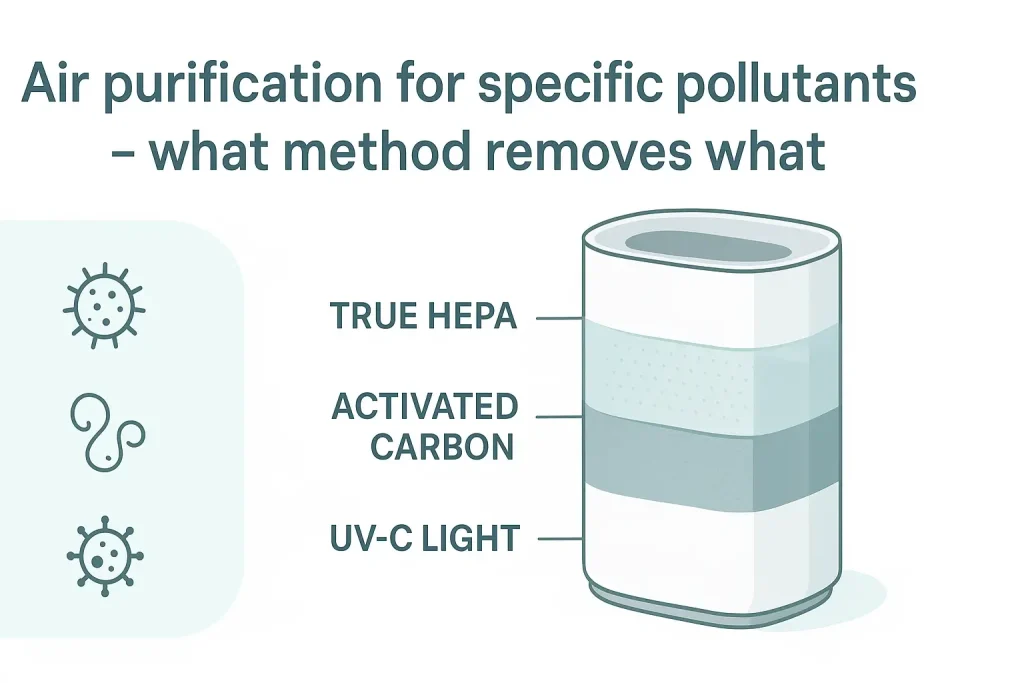
The Alorair 3000 CFM uses four distinct filter stages arranged in series. Air enters through the intake, passes through each stage sequentially, and exits as HEPA-filtered air through the exhaust port. Each stage targets a different particle size or contaminant type. Understanding what each stage does and does not capture determines whether this unit is sufficient for your specific project type.
Stage 1 – Polyester Pre-Filter: This first stage captures large particles above 10 microns including visible dust, drywall debris, carpet fibers, and construction grit. This happens because the polyester mesh physically blocks particles larger than the pore size while allowing smaller particles to pass through. The pre-filter extends the life of the more expensive HEPA stages by preventing them from loading with coarse debris. On a heavy demolition job, you may replace this pre-filter daily. On lighter projects, it lasts a week or more.
Stage 2 – Primary HEPA Filter: This is the core filtration stage. True HEPA media certified to 99.97% efficiency at 0.3 microns captures mold spores, asbestos fibers during abatement projects, lead dust, silica dust, bacteria, and other respirable particulates. This only occurs when the filter is properly seated with no bypass gaps around the gasket and when the differential pressure remains below the filter’s maximum rated pressure drop. If the pre-filter is not changed on schedule and becomes loaded, airflow drops, static pressure rises, and the HEPA stage may begin to bypass unfiltered air around the gasket seal as pressure seeks the path of least resistance.
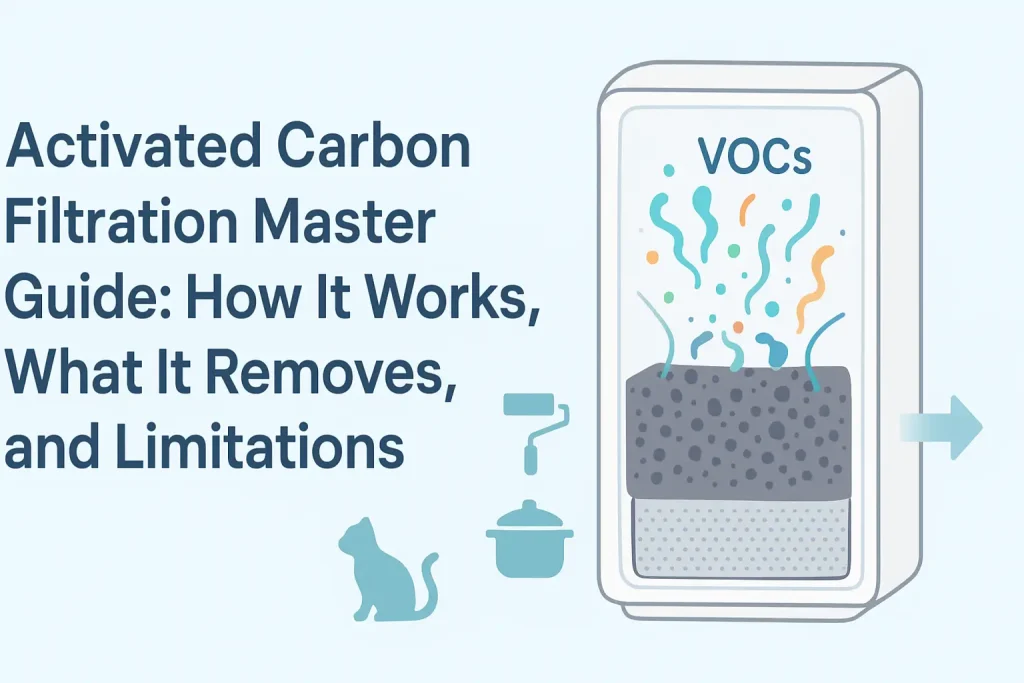
Stage 3 – Activated Carbon Filter: This stage uses a bed of activated carbon to adsorb volatile organic compounds, odors from sewage backups, smoke odors from fire damage, and chemical fumes from cleaning agents and antimicrobial treatments. This happens because activated carbon’s enormous internal surface area (roughly 100 acres per pound of carbon) traps gas molecules through van der Waals forces. This only works effectively when the carbon bed has sufficient dwell time as air passes through it. The 3,000 CFM airflow rate on the Alorair means air moves through the carbon stage quickly, which reduces contact time compared to a slower air scrubber with the same carbon bed thickness.
Stage 4 – Secondary HEPA Filter: A final HEPA stage captures any carbon dust or particulate shed by the carbon bed, plus any remaining fine particles that may have bypassed the primary HEPA stage. This second HEPA stage functions as a polishing filter and a safety net. If the primary HEPA develops a leak or bypass, the secondary HEPA provides redundancy that is critical during asbestos abatement or hospital infection control work where filter integrity directly affects occupant safety.
Alorair 3000 CFM vs Abestorm 2000 CFM: Which Air Scrubber Fits Your Projects?
Use the table below to compare the Alorair 3000 CFM against the Abestorm 2000 CFM commercial air scrubber with 4-stage filtration across the specifications that matter most on a restoration job site.
Product Comparison
Alorair 3000 CFM vs Abestorm 2000 CFM – Side by Side
Detailed spec comparison for restoration contractors choosing between these two commercial air scrubbers.
| Spec | Alorair 3000 CFM | Abestorm 2000 CFM |
|---|---|---|
| Maximum airflow | 3,000 CFM | 2,000 CFM |
| Filtration stages | 4 (pre-filter, HEPA, carbon, secondary HEPA) | 4 (pre-filter, HEPA, carbon, secondary filter) |
| HEPA efficiency | 99.97% at 0.3 microns | 99.97% at 0.3 microns |
| Max coverage at 4 ACH (8 ft ceiling) | 5,625 sq ft | 3,750 sq ft |
| Power draw | 3.5 amps at 115V | Approximately 2.5 amps at 115V |
| Housing material | Roto-molded polyethylene | Roto-molded polyethylene |
| Ducting size | 12-inch intake and exhaust | 12-inch intake and exhaust |
| Weight | ~95 lbs | ~70 lbs |
| Best for | Large commercial projects over 3,000 sq ft | Mid-size residential and light commercial |
| Our verdict | Best for large-scale jobs requiring maximum single-unit airflow | Best value for projects under 3,000 sq ft where 2,000 CFM is sufficient |
Airflow ratings from manufacturer specifications at highest speed with clean filters. Coverage at 4 ACH calculated as (CFM x 60) / (ceiling height x 4). Actual performance varies with filter loading and ducting configuration.
The Abestorm 2000 CFM is a strong competitor for projects where 2,000 CFM is sufficient. For larger commercial spaces or when a single unit must handle the entire containment zone, the Alorair 3000 CFM’s 50% higher airflow means one unit does what would require two Abestorm 2000 units in some configurations. The Abestorm 550 CFM air scrubber handles smaller residential jobs at a much lower price point and is worth considering for crews that handle both small and large projects.
What Are the Pros and Cons of the Alorair HEPA Air Scrubber 3000 CFM?
Product Review
Alorair HEPA Air Scrubber 3000 CFM – Pros and Cons
Honest assessment based on manufacturer specifications, restoration contractor feedback, and comparison with competing units.
Pros
- ✓3,000 CFM airflow handles spaces up to 5,600 sq ft at 4 ACH with an 8-foot ceiling
- ✓Four-stage filtration with redundant secondary HEPA provides critical safety margin for asbestos and hospital work
- ✓Roto-molded polyethylene housing withstands daily job site abuse better than painted steel
- ✓Differential pressure gauge standard for accurate filter change timing rather than guesswork
- ✓Standard 12-inch ducting ports compatible with layflat ducting and exhaust collars already in your inventory
Cons
- ✗Weighs approximately 95 pounds dry, requiring two people or a hand truck for loading and stair carries
- ✗Noise output of roughly 72 dB at 10 feet is loud, requiring hearing protection in occupied spaces
- ✗Overkill for residential projects under 1,500 sq ft where a smaller 1,000 to 2,000 CFM unit is more practical
- ✗Activated carbon stage has limited dwell time at 3,000 CFM, reducing VOC and odor removal efficiency compared to slower units
The Alorair 3000 CFM is the right air scrubber for restoration contractors who regularly handle commercial water damage, large-scale mold remediation, or fire damage projects above 3,000 square feet. For crews doing mostly residential work under 2,000 square feet, a smaller unit like the Abestorm 2000 CFM or 550 CFM offers better portability and lower cost without sacrificing filtration quality for the spaces they actually service.
How to Set Up and Operate the Alorair 3000 CFM on a Job Site
Step-by-Step Guide
Setting Up the Alorair 3000 CFM Air Scrubber for Negative Air Containment
5 steps, approximately 15 minutes for initial setup
Position the unit inside the containment zone
Place the air scrubber near the center of the containment area or close to the source of contamination. Keep at least 18 inches of clearance on all intake sides for unrestricted airflow. Position the exhaust port toward the planned exit point for the exhaust duct.
Install the exhaust duct for negative air pressure
Connect a 12-inch layflat duct to the exhaust port and route it through a window, door, or containment barrier to the exterior. The exhaust must discharge outside the building to create true negative air pressure inside the containment zone. Secure the duct terminus at least 10 feet from any building air intake, operable window, or pedestrian area.
Verify all filter stages are properly seated
Open the filter access panel and confirm the pre-filter, primary HEPA, carbon stage, and secondary HEPA are installed in the correct order. Check that each filter gasket is compressed evenly against its mounting surface. A single misaligned or torn gasket creates a filter bypass that sends unfiltered air into the exhaust stream, defeating the purpose of the HEPA filtration entirely.
Record the baseline differential pressure reading
Turn on the unit and note the differential pressure reading on the magnehelic gauge with clean filters installed. This is your baseline. Document it on the project log. When the gauge reads 2.0 inches of water column above this baseline, replace the pre-filter. When it climbs to 2.5 inches above baseline, replace the HEPA filter stage.
Verify negative pressure with a smoke tube or manometer
Hold a smoke tube near the containment barrier entry point. Smoke should be drawn into the containment zone, confirming negative pressure. Alternatively, use a manometer to measure the pressure differential between the containment zone and the surrounding area. A minimum of negative 0.02 inches of water column confirms effective containment per IICRC guidelines.
Filter Replacement Schedule and Maintenance Costs
Filter replacement is the largest ongoing operating cost for any commercial air scrubber. The Alorair 3000 CFM uses industry-standard filter sizes, which means you are not locked into proprietary filters from a single supplier. The pre-filter is the most frequently replaced stage and should be changed when the differential pressure gauge reads 2.0 inches of water column above the baseline recorded with clean filters. On heavy demolition or sewage remediation projects, pre-filter replacement may be daily. On lighter mold remediation jobs, the pre-filter may last a full week.
The primary HEPA filter typically lasts 6 to 12 months under normal commercial use. It should be replaced when the differential pressure reaches 2.5 inches of water column above baseline, or immediately if it becomes wet, physically damaged, or was exposed to sewage or hazardous materials that require disposal as regulated waste. A replacement HEPA filter for this unit costs approximately $150 to $250 depending on the supplier and whether you buy in bulk quantities.
The activated carbon stage saturates based on the concentration of VOCs and odors in the airstream, not on particulate loading. On a heavy smoke damage or sewage job, the carbon may be spent in a week. On a standard water damage project with minimal odors, it lasts 3 to 6 months. A replacement carbon filter for the Alorair 3000 CFM costs approximately $60 to $100. The secondary HEPA filter, being the final stage behind all other filtration, typically lasts the full 12 months or longer since it sees only carbon dust and any minute bypass from the primary HEPA stage.
Estimating total annual filter cost for a busy restoration contractor running this unit 200 days per year on varied projects: pre-filters at $15 each replaced 40 times per year is $600. Primary HEPA at $200 replaced twice per year is $400. Carbon at $80 replaced four times per year is $320. Secondary HEPA at $180 replaced once per year is $180. Total annual filter cost of approximately $1,500 for heavy commercial use. For lighter use at 100 days per year, roughly $800 in annual filter replacements.
For contractors specializing in asbestos abatement, the best air scrubber for asbestos projects requires a redundant HEPA configuration with documented pressure monitoring. The Alorair’s dual-HEPA design with a standard magnehelic gauge meets this requirement out of the box, eliminating the need to modify or supplement the unit for regulated abatement work.
How Does the Alorair 3000 CFM Compare to UV-C Equipped Air Scrubbers?
Some competing air scrubbers in the restoration market include a UV-C lamp stage for pathogen inactivation, including the Abestorm 600 CFM air scrubber with UV-C light. The Alorair 3000 CFM does not include a UV-C stage. Whether this matters depends on the type of projects you handle.
UV-C light at 254 nanometers inactivates bacteria, viruses, and mold spores by damaging their DNA and RNA so they cannot replicate. This is a different mechanism from HEPA filtration. HEPA captures the particle. UV-C kills the organism. For mold remediation where spore viability is a concern, UV-C adds an additional kill step beyond what HEPA capture alone provides. The trade-off is that UV-C lamps add cost, require annual lamp replacement at approximately $40 to $80 per lamp, and the UV-C exposure time inside a fast-moving airstream at 3,000 CFM is measured in fractions of a second, which limits kill effectiveness on some organisms that require longer UV dosage.
The Aerus air scrubber line uses a different technology altogether, employing ActivePure photocatalytic oxidation rather than traditional HEPA filtration. These units are more commonly used in residential HVAC applications for ongoing air quality improvement rather than in restoration containment scenarios where HEPA filtration is the regulatory standard. For a broader comparison across manufacturers, our air scrubber brands comparison guide covers all major players including Dri-Eaz, Abestorm, Aerus, and Alorair with pricing and application guidance.
What Type of Projects Actually Need a 3,000 CFM Air Scrubber?
A 3,000 CFM air scrubber is oversized for most residential water damage jobs. A typical 1,200 square foot basement flood with 8-foot ceilings has a volume of 9,600 cubic feet. At the IICRC S500 minimum of 4 ACH, you only need 640 CFM. Even at a more aggressive 6 ACH for heavy contamination, you only need 960 CFM. Running a 3,000 CFM unit in that space means you are moving 4.7 times more air than the standard requires, which is not harmful but means you are paying for and hauling capacity you are not using.
The Alorair 3000 CFM earns its place on projects where the containment zone exceeds 3,000 square feet with standard ceiling heights, or where vaulted ceilings, open atriums, or large commercial floor plates push the air volume above 24,000 cubic feet. Specific project types that justify the 3,000 CFM rating include hospital wing renovations requiring negative pressure isolation, large commercial water losses in retail stores or office buildings, warehouse mold remediation, fire damage in open-plan commercial spaces, and multi-room flood cuts where a single containment zone spans several thousand square feet.
For industrial and commercial environments that require air purification beyond remediation scenarios, such as ongoing dust control in manufacturing or welding bays, our guide on best air purification systems for industrial and commercial spaces covers permanent installation options including media air cleaners, electronic precipitators, and baghouse-style dust collection systems that may complement or replace portable air scrubbers depending on the application.
What Is the Noise Output and Can You Work Near This Unit?
At roughly 72 dB measured at 10 feet on high speed, the Alorair 3000 CFM produces noise comparable to a vacuum cleaner or a busy freeway heard from 50 feet. This is not a unit you have a conversation next to without raised voices. Restoration contractors working in the same room should wear hearing protection during extended exposure. For occupied buildings where tenants or employees remain in adjacent areas, the noise may require scheduling loudest operation during off-hours or placing the unit as far from occupied zones as ducting allows.
The noise is primarily fan and airflow noise rather than mechanical vibration. The roto-molded polyethylene housing dampens vibration better than metal housings. Most of the acoustic energy is in the mid-frequency range of 500 to 2,000 Hz, which is the range human hearing is most sensitive to. Placing the unit behind a temporary barrier or in an adjacent room with ducting running into the containment zone can reduce perceived noise significantly while maintaining airflow.
What Are the Most Common Questions About the Alorair 3000 CFM Air Scrubber?
Can I use one Alorair 3000 CFM instead of two smaller air scrubbers on a large job?
One Alorair 3000 CFM replaces roughly two 1,500 CFM air scrubbers in terms of raw airflow. This reduces the number of outlets you need to power and the floor space consumed by equipment. The trade-off is redundancy. If your single 3,000 CFM unit fails, you have zero air filtration. If one of two 1,500 CFM units fails, you still have 1,500 CFM running. For critical containment where filtration failure is not an option, two smaller units provide operational redundancy that a single large unit cannot match.
Does the Alorair 3000 CFM require a dedicated electrical circuit?
The unit draws 3.5 amps at 115 volts on high speed, well within the 12-amp continuous load limit of a standard 15-amp circuit. You can run this air scrubber on the same circuit as a dehumidifier drawing up to 7 amps without tripping a breaker. Always check what else shares the circuit before plugging in. On older job sites with unknown electrical conditions, a clamp meter reading at the panel gives you certainty rather than guessing what else is on the line.
What happens if the HEPA filter gets wet during operation?
A wet HEPA filter loses structural integrity, and the filter media can collapse or tear under the air pressure differential. More critically, a wet HEPA filter supports microbial growth on the media itself, turning the filter into a potential contamination source. If the HEPA filter becomes wet during a water damage or flood cut project, replace it immediately. Do not attempt to dry and reuse it. This is why the pre-filter stage is so important on water damage jobs: catching water droplets and mist before they reach the HEPA media.
Can I run this air scrubber without the carbon filter installed?
Yes, the carbon filter stage can be removed for projects where odor control and VOC adsorption are not required. Removing the carbon stage slightly increases airflow because it reduces static pressure in the system. This is common on general construction dust control projects where particulate filtration is the only requirement. Always keep all four stages installed for mold remediation, sewage backup, fire damage, or any project where odors, VOCs, or biological contaminants are present.
How do I know if the HEPA filter is still effective without a particle counter?
The differential pressure gauge provides the primary indication of HEPA filter condition. A properly functioning HEPA filter with no leaks or bypass will show a pressure drop within the manufacturer’s specified range for its loading state. A sudden drop in differential pressure with no corresponding filter change or fan speed adjustment indicates a possible filter breach or gasket failure. For regulated abatement work including asbestos and lead, a DOP test or particle count verification with a photometer is required to certify filter integrity before and after the project, regardless of what the pressure gauge reads.
Is the Alorair 3000 CFM stackable for transport and storage?
The roto-molded housing is designed with interlocking top and bottom features that allow two units to be stacked securely for transport in a truck or van. The units do not require additional strapping when stacked on a flat surface during transit, though securing the stack to the vehicle is always recommended. This stackability is a significant practical advantage for contractors who run multiple units and need to maximize truck space.
What ducting is compatible with the Alorair 3000 CFM?
The unit uses standard 12-inch intake and exhaust ports that accept common 12-inch layflat ducting from any restoration supply vendor. For negative air applications, use reinforced ducting rated for negative pressure to prevent duct collapse, which can suddenly block airflow and overheat the motor. Thin unreinforced layflat ducting will collapse under negative pressure at this airflow rate. A 25-foot section of 12-inch reinforced ducting costs approximately $30 to $50.
Does Alorair provide any warranty on the 3000 CFM air scrubber?
Alorair provides a limited warranty on the housing and motor assembly, typically covering manufacturing defects for a period of one year from purchase. Filters, gaskets, and the differential pressure gauge are consumable items not covered under warranty. Verify the specific warranty terms with your distributor at the time of purchase, as warranty periods and coverage vary by seller and whether the unit is registered after purchase.
The Alorair HEPA Air Scrubber 3000 CFM delivers exactly what restoration contractors need from a large-format air scrubber: high airflow that meets or exceeds IICRC ACH requirements for commercial containment zones, genuine four-stage filtration with redundant HEPA, job-site-durable roto-molded construction, and industry-standard components that keep filter sourcing simple. At roughly $1,200 to $1,800 depending on the distributor, it is priced competitively against units with half the airflow from legacy brands.
For restoration companies that primarily handle residential losses under 2,000 square feet, a 2,000 CFM or even 1,000 CFM unit offers better portability and lower cost without meaningful compromise on containment performance. For crews that regularly tackle large commercial water losses, hospital containment, warehouse mold remediation, or fire damage in open-plan buildings, this unit earns its place in the truck. Calculate your typical containment volume in cubic feet, multiply by your target ACH per IICRC standards, and if that number regularly exceeds 2,000 CFM, the Alorair 3000 CFM is the right single-unit solution.