Pollen does not just stay outside where it belongs. It rides in on your clothes, your hair, and your open windows until your living room registers particle counts closer to a meadow than a clean indoor space.
A properly chosen air purifier with sufficient pollen CADR can drop airborne pollen levels by over 90% within 20 minutes in a sealed room.
This guide covers the specific CADR targets, filter types, and placement strategies that actually matter for pollen — including dorm room constraints, open-plan living areas, and the hidden filter-loading problem that pollen season creates.
You will find exact specs, side-by-side comparisons, and an interactive sizer that tells you the minimum smoke CADR needed for your exact room dimensions at allergy-level air change rates.
| Photo | Popular Air Purifiers | Price |
|---|---|---|

|
Air Purifiers for Home Large Room up to 1500ft², Tailulu H13 True HEPA Air Purifier for Pets Dust Odor Smoke, Air Purifier for Bedroom with 15dB Quiet Sleep Mode for Bedroom Office Living Room | Check Price On Amazon |
|
Afloia Air Purifier for Home, 4-in-1 Washable Filter for Allergies, Covers Up to 1076 ft², Quiet Operation, Auto Shut-Off & Night Light, Removes Pet Dander, Pollen, Dust, Mold, and Smoke, White,Pluto | Check Price On Amazon |

|
Nuwave OxyPure ZERO Air Purifier with Washable and Reusable Bio Guard Tech Air Filter, Large Room Up to 2002 Ft², Air Quality Monitor, 0.1 Microns, 100% Capture Irritants like Smoke, Dust, Pollen | Check Price On Amazon |

|
Air Purifiers for Home Large Room Up to 1,996 Ft², EOEBOT Air Purifier for Home Pets with Washable Filter, Quiet Sleep Mode, Air Quality Monitor, Air Purifier for Bedroom, Pet Hair, Dust, Smoke, White | Check Price On Amazon |
|
Afloia 2 IN 1 Air Purifier with Humidifier Combo, 3-Stage Filters for Home Allergies Pets Hair Smoker Odors, Evaporative Humidifier, Auto Shut Off, Quiet Air Cleaner with Seven Color Light,White | Check Price On Amazon |
By the Numbers: Pollen and Air Purifiers
Minimum capture efficiency of True HEPA at 0.3 microns — pollen grains at 10 to 40 microns are caught even more efficiently on first pass.
Target air changes per hour for allergy-level pollen control — air volume processed five times per hour cuts airborne pollen faster than standard 2 ACH baseline.
Typical pollen particle size range — large enough to settle on surfaces and fabrics, which makes pre-filter loading heavier during pollen season.
Minimum smoke CADR needed for a 150 sq ft bedroom at 5 ACH with 8-ft ceilings — the practical allergy baseline most buyers miss.
Approximate effective coverage loss from placing a purifier in a corner or behind furniture — central placement preserves full CADR delivery.
What Makes Pollen Different From Other Airborne Particles?
Pollen is not PM2.5. It is physically larger, seasonally concentrated, and far stickier than the fine combustion particles most air purifier specs are optimized around. A pollen grain runs 10 to 40 microns across, which means three things that change how you select and run a purifier during spring and summer peak.
AHAM tests CADR separately for smoke (0.09 to 1.0 microns), dust (0.5 to 5.0 microns), and pollen (5.0 to 11.0 microns). Each particle category moves differently through filter media, and a unit with strong smoke CADR may or may not deliver equivalent pollen CADR at the same fan speed. The good news is that pollen CADR is almost always higher than smoke CADR for any given True HEPA unit because larger particles are mechanically easier to capture on first pass.
A Coway Airmega 400 replacement filter during peak pollen months loads visibly faster on the pre-filter layer than during winter operation. That pre-filter is your first line of defense. It catches the bulk of the pollen mass before it ever reaches the HEPA media, which extends HEPA lifespan but also means the pre-filter needs monthly vacuuming or rinsing when trees are blooming.
The mechanism is straightforward. Larger particles carry more mass and have higher inertia, so they cannot follow airflow streamlines around filter fibers the way submicron particles do. They impact the fiber surface directly and stick. This is called inertial impaction, and it is why even a MERV 11 furnace filter captures a meaningful fraction of pollen despite being far below HEPA grade for fine particles.
This only occurs when airflow velocity through the filter stays within the manufacturer’s design range. Crank a unit to turbo and the higher face velocity can actually reduce capture efficiency slightly for larger particles by bouncing them off fibers rather than letting them stick. For pollen specifically, medium fan speed often gives the best combination of capture efficiency and air change rate.
If you run an undersized purifier at low speed in a room with open windows during pollen season, the result is continuous infiltration that overwhelms the clean air delivery rate. Pollen concentrations stay elevated all day, and the filter loads from outdoor pollen that never stops entering. Fix it by closing windows, sizing to 5 ACH minimum, and running on medium during peak hours.
How Much CADR Do You Need for Pollen Season?
For pollen allergies specifically, target a smoke CADR that delivers 5 air changes per hour in your room, not the 2 ACH that manufacturers use for their claimed coverage area on the box. A 200-square-foot bedroom with 8-foot ceilings holds 1,600 cubic feet of air. At 5 ACH, the purifier must process 8,000 cubic feet per 60 minutes, which requires a minimum smoke CADR of 133 CFM.
Most bedroom purifiers sold as “covers 300 square feet” are rated at 2 ACH and deliver only 100 to 120 CFM smoke CADR. That is inadequate for pollen allergy control in a 200-square-foot room. You would need a unit with at least 133 CFM smoke CADR — and realistically 150 to 180 CFM to compensate for furniture obstructions, imperfect door seals, and the fact that the room is rarely a perfect sealed test chamber.
CADR Calculator
How Much CADR Do You Actually Need for Pollen?
Enter your room dimensions and use case. Formula: (length x width x ceiling height x ACH) divided by 60. Source: AHAM methodology.
CADR = (length x width x ceiling height x ACH) / 60. For pollen allergy season, always calculate at 5 ACH — not the manufacturer-stated 2 ACH figure. Pollen CADR is typically higher than smoke CADR, so meeting the smoke CADR target guarantees pollen adequacy.
| Room Size | CADR at 2 ACH (standard) | CADR at 5 ACH (allergy) | Example Models |
|---|---|---|---|
| 150 sq ft bedroom | 100 CFM | 250 CFM | Levoit Core 300S, Winix 5500-2 |
| 200 sq ft master bedroom | 133 CFM | 333 CFM | Coway AP-1512HH, Alen BreatheSmart 45i |
| 300 sq ft bedroom or office | 200 CFM | 500 CFM | Coway Airmega 400, Levoit Core 600S |
| 500 sq ft living room | 333 CFM | 833 CFM | Blueair 605, or two Coway Airmega 400 units |
| 700 sq ft open plan | 467 CFM | 1167 CFM | IQAir HealthPro Plus or multiple units |
Top Air Purifiers for Pollen: CADR, Noise, and Filter Cost Compared
Pollen air purifier selection comes down to three practical metrics beyond CADR: noise at the fan speed you will actually run during sleep, annual filter cost with genuine manufacturer replacements, and whether the pre-filter is washable or disposable. A Levoit Core 300S air purifier covers a small bedroom adequately for pollen at 145 CFM smoke CADR and costs approximately $25 per year in filter replacements, but it maxes out at 219 square feet at 2 ACH and drops to about 88 square feet at the 5 ACH allergy target.
The Coway AP-1512HH air purifier remains the gold standard for mid-sized pollen bedrooms. It delivers 246 CFM smoke CADR with AHAM certification, covers 360 square feet at 2 ACH or 144 square feet at 5 ACH, and brings an ionizer that can be switched off completely. Sleep mode noise sits at 30 dB, and the washable pre-filter cuts annual replacement cost to roughly $30 for the HEPA and carbon stages combined.
Product Comparison
Best Air Purifiers for Pollen Compared – CADR, Coverage, Noise, and Filter Cost
Key specs compared across top pollen-rated picks. CADR from AHAM certified database. Coverage at 5 ACH calculated as smoke CADR x 12 / 5.
| Model | Smoke CADR | Coverage at 2 ACH | Coverage at 5 ACH | Sleep Mode dB | Annual Filter Cost | Best For |
|---|---|---|---|---|---|---|
| Levoit Core 300S | 145 CFM | 219 sq ft | 88 sq ft | 24 dB | $25/yr | Small bedroom, nursery |
| Winix 5500-2 | 243 CFM | 360 sq ft | 146 sq ft | 27 dB | $50/yr | Medium bedroom, living room |
| Coway AP-1512HH | 246 CFM | 360 sq ft | 148 sq ft | 30 dB | $30/yr | Bedroom, allergy, pets |
| Coway Airmega 400 | 400 CFM | 1,560 sq ft | 240 sq ft | 22 dB | $60/yr | Large room, open plan |
| Blueair Blue Pure 211+ | 350 CFM | 550 sq ft | 210 sq ft | 31 dB | $60/yr | Large bedroom, living space |
For larger pollen-challenged spaces, the Blueair Blue Pure 211+ air purifier delivers 350 CFM smoke CADR in a single compact tower. It covers 550 square feet at 2 ACH or 210 square feet at 5 ACH, and its washable fabric pre-filter sleeve catches visible pollen dust within days during peak tree pollen events. Filter replacement runs about $60 per year with genuine Blueair filters.
Filter Types for Pollen: HEPA, Pre-Filter Layers, and What Actually Matters
True HEPA is non-negotiable for pollen allergy control. It captures 99.97% of particles at 0.3 microns per IEST-RP-CC001 standards, and pollen at 10 to 40 microns is caught with near-perfect single-pass efficiency. A HEPA-type filter without AHAM verification or a stated efficiency below 99.97% is not the same thing: it may capture 85 to 99% of pollen-sized particles with no independent test verification of what that number actually means in real airflow.
The Winix 5500-2 replacement filter combination is instructive. It uses a washable fine-mesh pre-filter, a True HEPA stage, and an AOC carbon sheet. During pollen season, the washable pre-filter catches the visible yellow-green pollen load while the HEPA stage handles whatever gets past. Rinsing that pre-filter monthly keeps airflow up and prevents the HEPA stage from loading prematurely.
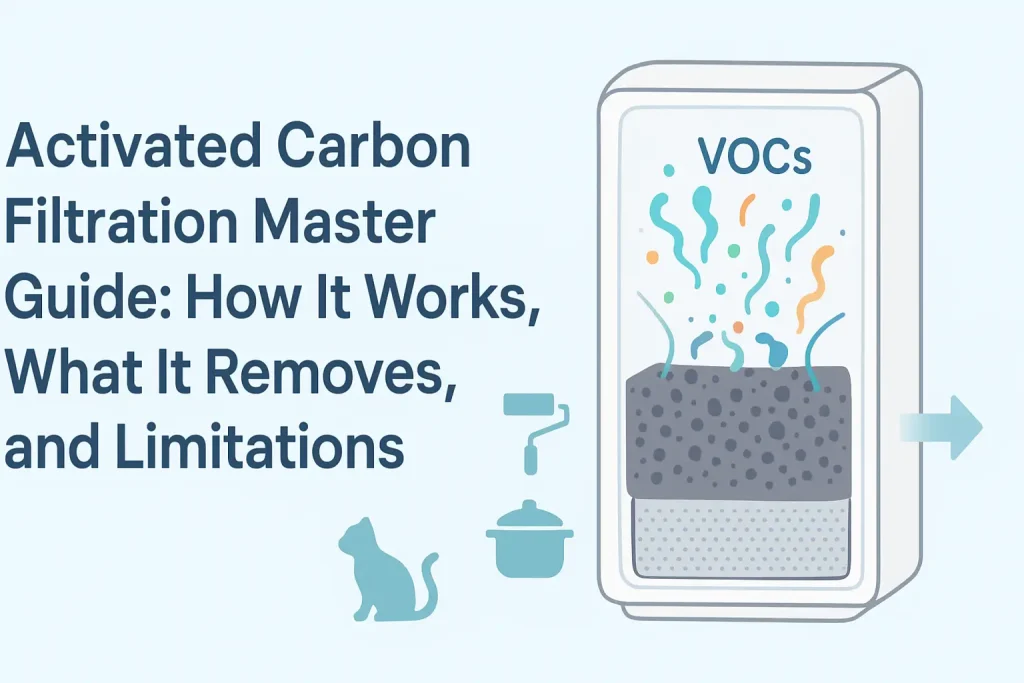
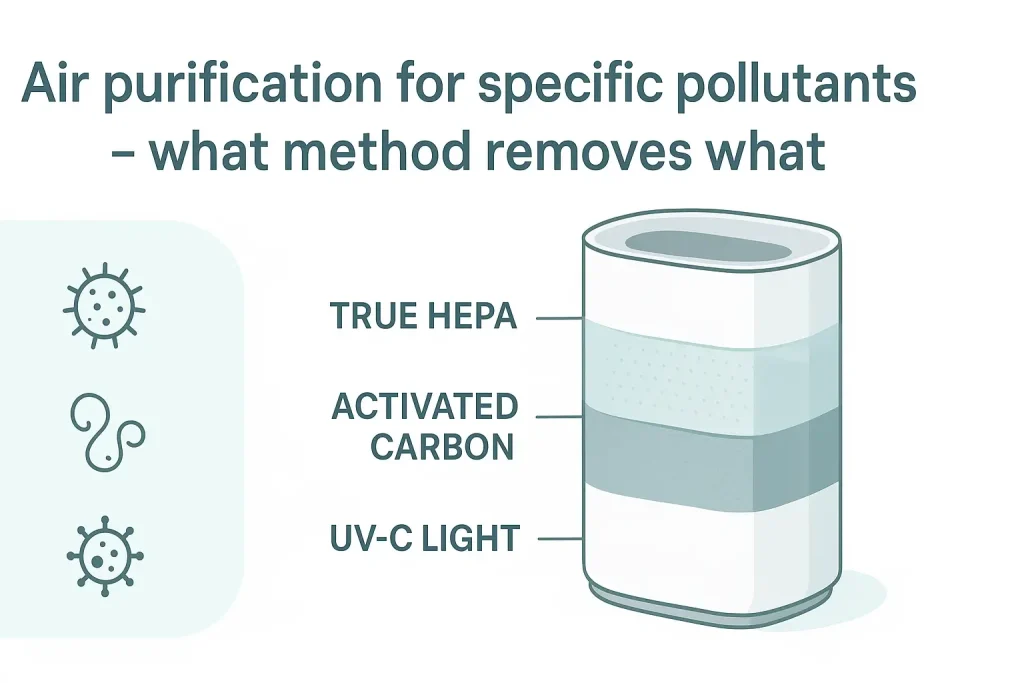
Activated carbon stages are not directly relevant to pollen removal. Pollen is a particulate, not a gas. A carbon filter adds cost and airflow resistance but does nothing for pollen unless the unit also addresses outdoor VOCs that accompany pollen season. Buy the carbon stage if you also have chemical sensitivity or live near a road, not for pollen control alone.
Ionizers, including the PlasmaWave on Winix units, are a separate mechanism. They charge particles so they stick to surfaces, which can include your respiratory tract. For pollen allergy control, mechanical HEPA filtration is the only mechanism with standardized, verifiable, reproducible CADR test results. Turn the ionizer off during pollen season and rely on the fan and filter alone.
Where Should I Place an Air Purifier for Maximum Pollen Capture?
Place the purifier in the center of the room, at least 18 inches from any wall or large furniture piece, with the intake facing the primary pollen source. Pollen enters rooms through open windows, on clothing, and via foot traffic from outdoors. The intake should face the door or window where pollen ingress is highest, and the outlet should direct cleaned air toward the breathing zone where you sit or sleep.
Central placement matters. A PM2.5 air quality monitor placed across the room from a corner-located purifier will show 20 to 30 percent higher particle counts than the same unit placed centrally, because corner placement creates a short-cycle airflow loop that leaves the far side of the room uncleaned. The air moves in a tight circuit instead of sweeping the full volume.
Pollen is only one of the major indoor air pollutants that accumulate in bedrooms and living spaces. It is seasonal, visible on pre-filters, and mechanically easier to capture than submicron PM2.5, which means it also loads filters faster and demands a different maintenance schedule than the same unit would need during winter operation.
Bedroom placement has an additional constraint: noise. A purifier that delivers the required CADR at turbo but runs at 58 dB will disrupt sleep more than the pollen will. Run the unit on medium (typically 35 to 45 dB on most models) during the day and on sleep mode (22 to 30 dB on top-rated units) at night, with the understanding that CADR drops proportionally with fan speed. A unit with 246 CFM at turbo may deliver only 80 to 100 CFM at sleep mode.
For studio apartments and small spaces where placement options are limited, air purifier selection for studio apartments involves different CADR and placement constraints than houses with separate rooms. The same pollen control principle applies, but you may need to prioritize a unit with 360-degree intake so orientation matters less when wall clearance is unavailable.
Pollen Filter Loading: Why You Replace Filters Faster During Peak Season
Pollen loads True HEPA filters faster than any other common indoor particle because the mass loading per grain is orders of magnitude higher than submicron PM2.5. A single pine pollen grain at 40 microns contains roughly 30,000 times the mass of a 0.1-micron combustion particle. During peak tree pollen weeks, a pre-filter that normally lasts two months before visible soiling will be coated in yellow-green residue within two weeks.
This accelerated loading has two consequences. First, CADR drops as the filter loads because airflow resistance increases across both the pre-filter and HEPA stages. A filter at 50 percent of its rated life may deliver only 70 to 80 percent of its clean-filter CADR. Second, the pre-filter becomes the primary pollen capture surface, and a non-washable pre-filter becomes a recurring consumable cost that adds $15 to $40 per season on top of the annual HEPA replacement.
The mechanism is straightforward mechanical loading. Pollen impacts the pre-filter surface, embeds in the fiber matrix, and creates a cake layer that actually improves capture efficiency for subsequent particles but simultaneously raises pressure drop. The fan works harder at the same speed setting, moving less air through a more restrictive filter path. This only stabilizes if the pre-filter is cleaned or replaced at shorter intervals during pollen season.
If you do not shorten the pre-filter cleaning interval during pollen season, the result is a purifier running at 50 to 60 percent of its rated CADR within four to six weeks of peak pollen exposure. Pollen counts stay elevated in the room, and the allergy sufferer assumes the purifier is not working when in fact it is working against a loaded filter. Fix it by washing or vacuuming the pre-filter every two weeks from March through June in most North American regions.
Use the table below to match your pollen season severity to the right filter maintenance schedule.
| Pollen Exposure Level | Pre-Filter Cleaning Interval | HEPA Inspection Interval | HEPA Replacement Interval | Seasonal Filter Cost Impact |
|---|---|---|---|---|
| Low (1-2 trees nearby, windows mostly closed) | Every 4 weeks | Every 3 months | 12 months | +$0 to $15 |
| Moderate (suburban area, windows open occasionally) | Every 2 weeks | Every 6 weeks | 9 to 10 months | +$20 to $40 |
| Heavy (rural or wooded area, windows open, pets) | Weekly | Monthly | 6 to 8 months | +$40 to $70 |
For pollen allergy control in a typical suburban bedroom with a medium CADR unit like the Coway AP-1512HH, clean the pre-filter every two weeks during April and May and expect to replace the HEPA filter once every 10 to 12 months instead of the rated 12 to 14 months under normal conditions.
Levoit Core 300S vs Coway AP-1512HH for Pollen: Side-by-Side Comparison
The Levoit Core 300S costs roughly $100 with a 145 CFM smoke CADR rating. The Coway AP-1512HH costs approximately $180 with a 246 CFM smoke CADR rating. For pollen allergy control at 5 ACH, the Coway covers 148 square feet versus the Levoit’s 88 square feet: a 68 percent larger effective coverage area for about an 80 percent higher purchase price.
The Coway brings a washable pre-filter that cuts ongoing pollen-season maintenance cost significantly. The Levoit uses a non-washable fine pre-filter bonded to the main filter assembly, which means the entire filter unit loads with pollen and the only option is replacement. During heavy pollen months, this can shorten the Levoit’s filter life from the stated six to eight months down to three to four months, effectively tripling the annual filter cost from $25 to approximately $75 if you monitor pressure drop and replace when CADR drops measurably.
Product Comparison
Levoit Core 300S vs Coway AP-1512HH – Pollen Purifier Face-Off
Detailed spec comparison including CADR, coverage at 2 ACH and 5 ACH, noise level, filter cost, and pollen-specific maintenance differences.
| Spec | Levoit Core 300S | Coway AP-1512HH |
|---|---|---|
| Unit price | $100 | $180 |
| Smoke CADR (CFM) | 145 CFM | 246 CFM |
| Coverage at 2 ACH | 219 sq ft | 360 sq ft |
| Coverage at 5 ACH (allergy) | 88 sq ft | 148 sq ft |
| Filter type | True HEPA H13 + carbon pre-filter (non-washable) | True HEPA + washable pre-filter + activated carbon |
| Annual filter cost (normal) | $25/yr | $30/yr |
| Annual filter cost (heavy pollen) | $50 to $75/yr | $40 to $50/yr |
| Noise at sleep mode | 24 dB | 30 dB |
| CARB certified | Yes | Yes |
| Our verdict for pollen | Best for small bedrooms under 90 sq ft with light pollen load | Best all-around pollen bedroom purifier under $200 |
CADR data from AHAM certified database. Coverage area at 5 ACH = smoke CADR x 12 / 5. Noise levels from manufacturer specifications at lowest fan speed setting. Filter costs based on genuine replacement filters at standard replacement intervals, adjusted for pollen-heavy use where noted.
If pollen control in a room over 120 square feet is your primary goal, the Coway’s higher CADR and washable pre-filter make it the right choice regardless of the $80 price difference. If your room is under 100 square feet and you run the purifier on medium during the day and sleep mode at night with windows closed, the Levoit is adequate and costs less up front. The trade-off is the non-washable pre-filter, which makes the Levoit more expensive to maintain during heavy pollen seasons despite its lower purchase price.
For renters who cannot modify window seals or install HVAC upgrades, portable air purifier strategies for rental constraints apply directly here. A renter with a 110-square-foot bedroom and a Levoit Core 300S gets effective pollen control at 5 ACH. The same renter in a 160-square-foot bedroom needs a Coway-level CADR or two smaller units, because they cannot install a whole-house MERV 13 filter or seal the windows with caulk.
Whole-Room Pollen Strategy: One Large Unit vs Two Smaller Units
Two medium-CADR units placed at opposite ends of a large room outperform a single high-CADR unit for pollen control in open-plan spaces because pollen is not perfectly mixed in real rooms. It enters at discrete points (windows and doors), settles on surfaces, and re-entrains when disturbed. Two units with 250 CFM smoke CADR each, placed near the pollen entry points, capture pollen before it disperses across the full room volume.
AHAM testing assumes a perfectly mixed test chamber. Your living room with furniture, curtains, and a kitchen island does not approximate that chamber. A single 500 CFM unit placed in one corner may process the rated volume five times per hour mathematically, but the far corner 25 feet away may only see 2 to 3 effective air changes. Two 250 CFM units cover the same total CADR but distribute the clean air delivery spatially, which matters for a particle that enters at room edges and settles on horizontal surfaces.
Playrooms present a different challenge for pollen control because children bring pollen in on clothing and hair after outdoor play, creating a higher localized pollen load than adult bedrooms. Air purifier placement in playrooms requires managing both airborne and surface-deposited pollen, which means running the unit at medium or high for 30 minutes after playtime ends to re-entrain and capture pollen disturbed from fabrics and carpet.
How to Position an Air Purifier for Pollen When You Only Have One Corner Available
Corner placement is suboptimal, but you can recover most of the lost effective CADR by angling the intake at 45 degrees toward the room center rather than flush against the wall. This creates a diagonal airflow pattern that sweeps more room volume than a unit pointing straight out from a corner. The penalty drops from roughly 25 to 30 percent effective coverage loss to approximately 15 to 20 percent.
Position the unit so the exhaust points toward the center of the room and the intake faces the corner at a 45-degree angle. This pulls air from along both adjacent walls and pushes cleaned air diagonally across the room. Do not place furniture closer than 2 feet in front of the exhaust. A couch or bed directly in the cleaned airstream blocks airflow and reduces effective CADR by another 10 to 15 percent beyond the corner penalty.
Garage-adjacent rooms have an additional pollen ingress pathway through the garage door seal and shared wall penetrations. Air purifier selection for garage spaces addresses coarse particle loading similar to pollen, and the same principle applies: if your bedroom shares a wall with the garage, pollen-laden air enters through electrical outlets, baseboard gaps, and the door frame even with the garage door closed.
Certifications That Matter for Pollen Air Purifiers
AHAM Verifide is the only certification that validates CADR performance through independent laboratory testing. A unit with an AHAM seal has had its smoke, dust, and pollen CADR verified by an accredited third-party lab using the ANSI/AHAM AC-1 test protocol. Without this seal, the manufacturer’s CADR claim is self-reported and may be optimistic by 15 to 30 percent based on comparison testing.
ENERGY STAR certification matters for pollen season because these units run for months continuously. An ENERGY STAR certified purifier uses approximately 40 percent less energy than a non-certified equivalent at the same CADR, which translates to $25 to $60 per year in electricity savings at the current average U.S. rate of 16 cents per kilowatt-hour. The certification also imposes a minimum CADR threshold at specific power consumption levels, so it functions as a loose quality floor.
CARB certification is mandatory for any unit that includes an ionizer, but it applies to all air cleaners sold in California. The CARB CCR Title 17 ozone limit is 0.050 parts per million, tested in a sealed chamber over a standardized time interval. Ozone is a respiratory irritant that worsens allergy and asthma symptoms, and any unit emitting above this threshold is effectively banned from sale in California. For pollen allergy sufferers, buy only CARB-certified units, regardless of whether you live in California.
AAFA (Asthma and Allergy Foundation of America) certification is a consumer-facing endorsement rather than a technical standard, but it signals that the manufacturer submitted the unit for independent review by allergy specialists. An AAFA-certified purifier has been evaluated for filtration efficiency, ozone output, and suitability for allergy and asthma patients. It is a useful filter for narrowing a crowded market, but it does not replace AHAM CADR verification as your primary performance metric.
What Is the Difference Between Pollen CADR and Smoke CADR on the Same Unit?
Pollen CADR is almost always higher than smoke CADR on the same unit at the same fan speed because pollen particles are physically larger and mechanically easier to capture. A unit rated at 246 CFM smoke CADR may carry a pollen CADR of 280 to 320 CFM. The exact ratio depends on the filter media construction and airflow characteristics, but the pattern holds across all True HEPA units: pollen CADR exceeds dust CADR, which exceeds smoke CADR.
AHAM tests each pollutant category separately in a standardized chamber using potassium chloride particles for smoke, Arizona road dust for dust, and paper mulberry pollen for pollen. The test measures the decay rate of particle concentration over 20 minutes with the purifier running, then calculates CADR as the clean air delivery rate in cubic feet per minute. The pollen test uses larger, heavier particles that settle faster and filter more easily, producing higher CADR numbers for the same unit.
This means you can safely size your purifier using smoke CADR as the floor for all three pollutant types. If a unit meets your pollen CADR requirement based on its smoke CADR rating at 5 ACH, the actual pollen CADR will be higher, giving you margin for the real-world inefficiencies of furniture, door gaps, and imperfect placement. Buy for smoke CADR at 5 ACH, and the pollen performance takes care of itself.
Can I Run My Air Purifier on Auto Mode for Pollen, or Should I Set It Manually?
Manual fan speed is more reliable than auto mode for pollen control because most auto-mode algorithms respond to sudden particulate spikes but not to sustained moderate concentrations of coarse particles. Pollen grains are large enough that some optical PM2.5 sensors undercount them, especially in the 10 to 40 micron range. An auto-mode purifier with a laser particle sensor may detect a 50 percent pollen load as only a 10 to 15 percent PM2.5 increase and run at a lower fan speed than needed.
Set the fan speed manually to medium during pollen season daytime hours and to sleep mode at night. The medium setting on a unit like the Coway AP-1512HH or Winix 5500-2 typically delivers 50 to 70 percent of the maximum CADR. For a 246 CFM unit, that is 123 to 172 CFM, which covers a 150-square-foot bedroom at 4 to 5 ACH. Sleep mode CADR on these units is around 30 to 40 percent of maximum, or 74 to 98 CFM, which covers 60 to 80 square feet at 5 ACH.
If you must use auto mode, verify its pollen response by placing a air quality monitor with PM10 channel across the room and checking whether the purifier ramps up when PM10 rises. Many consumer-grade auto modes trigger primarily on PM2.5 or VOC readings and will leave pollen concentrations elevated without the user realizing it because the particle size falls outside the sensor’s primary detection band.
Does Pollen Season Shorten the Lifespan of My Activated Carbon Filter?
Pollen does not directly load activated carbon because carbon adsorbs gases and odors, not particulates. But pollen season does shorten effective carbon filter life indirectly. Pollen loads the pre-filter, which increases pressure drop across the entire filter stack. The fan works harder, pulling more air through the carbon stage, which exhausts the carbon’s adsorption capacity faster as total airflow volume through the carbon bed increases.
A carbon filter rated for 12 months under normal conditions may reach breakthrough at 8 to 10 months if the pre-filter is not maintained during pollen season and the fan runs on medium instead of the usual auto or sleep mode for several hours per day. The carbon is not loaded by pollen: it is loaded by the increased total air volume passing through it as the fan compensates for a dirty pre-filter. Keep the pre-filter clean and the carbon stage lasts its rated interval.
What Went Wrong When My Brand New Purifier Is Not Reducing My Pollen Symptoms?
The most common failure mode for a new pollen purifier is sizing error. The unit was bought based on the manufacturer’s coverage area claim at 2 ACH, but the room needs 5 ACH for allergy-level pollen control. A purifier rated for 300 square feet at 2 ACH with a 200 CFM smoke CADR covers only 120 square feet at 5 ACH. If your bedroom is 180 square feet, that unit is 33 percent undersized for pollen allergy control.
The second most common failure is placement error combined with window and door leakage. A correctly sized purifier placed in a corner with a window cracked open two inches will never bring the room to 5 effective ACH. The outdoor pollen infiltration rate through a two-inch window gap exceeds 200 CFM of unfiltered air on a breezy day, which overwhelms the purifier’s clean air delivery. The unit is working: it is just working against an open infiltration source.
Fix sizing error by checking the actual smoke CADR on the AHAM Verifide database or manufacturer spec sheet, then calculating coverage at 5 ACH as (smoke CADR x 12 / 5). Compare that number to your actual room square footage. Fix placement and infiltration by closing windows, moving the purifier to center-room, and checking for pollen ingress through door gaps, window seals, and bathroom exhaust fans that draw outdoor air in through building leaks.
Laundry rooms near bedrooms can complicate pollen infiltration when dryer vents or makeup air paths pull outdoor air through the building envelope. Air purifier placement strategies for laundry rooms address a similar coarse-particulate problem where lint and outdoor pollen mix in utility spaces that are often adjacent to living areas.
How Many Air Changes Per Hour Are Needed for Pollen Allergy Relief?
Five air changes per hour is the consensus recommendation from the EPA and multiple clinical studies for effective allergy control with portable air cleaners. At 5 ACH, a well-mixed room has 99 percent of the original airborne particles removed within 55 minutes. At 2 ACH (the manufacturer’s typical coverage claim basis), the same room takes over two hours to reach the same clearance. For pollen specifically, which enters continuously during daytime hours, 5 ACH keeps steady-state concentrations low enough that most allergy sufferers report meaningful symptom reduction.
The EPA’s Indoor Air Quality guidance recommends portable air cleaners sized to deliver 2 to 5 ACH depending on room use and occupant sensitivity. Research published in the Journal of Allergy and Clinical Immunology has shown that bedroom HEPA air cleaners running at 4 to 5 ACH reduced nasal symptom scores by 50 to 60 percent in dust mite and pollen allergy patients compared to placebo (non-filtered) operation. The data supports 5 ACH as the practical minimum for allergy relief, not 2 ACH.
You can achieve 5 ACH with a unit that meets the smoke CADR formula: (room square footage x 8-foot ceiling x 5 ACH) / 60. For a 200-square-foot bedroom: (200 x 8 x 5) / 60 equals 133 CFM minimum smoke CADR. Buy the next available CADR tier above 133 CFM, typically 145 to 150 CFM, to account for furniture and imperfect placement. A Cadr rating at or above that number guarantees 5 ACH in the specified room at full fan speed.
What Is a Pollen CADR Rating and Where Do I Find It?
Pollen CADR is one of three Clean Air Delivery Rate measurements tested by AHAM under the ANSI/AHAM AC-1 standard. It measures how many cubic feet of air the purifier cleans of paper mulberry pollen particles (5.0 to 11.0 microns) per minute at the highest fan speed. You find pollen CADR on the AHAM Verifide label affixed to the unit’s packaging or in the AHAM online directory of certified room air cleaners.
If the manufacturer does not list pollen CADR separately but does list AHAM-certified smoke CADR, the pollen CADR is typically 15 to 30 percent higher. For a unit with 246 CFM smoke CADR, expect pollen CADR around 283 to 320 CFM. This relationship is not guaranteed and varies by filter design, but it holds as a practical approximation across the major True HEPA brands tested by AHAM over multiple product generations.
Do not confuse a manufacturer’s self-reported “CADR” with an AHAM Verifide CADR. The AHAM seal means an independent lab tested the unit to AC-1 protocol in a controlled chamber and the results are publicly searchable. A CADR number printed on a box without the AHAM seal is a manufacturer claim that may or may not have been verified by an independent party. Buy AHAM Verifide units for pollen control, because you are trusting that number to size your allergy relief correctly.
Is It Safe to Leave an Air Purifier Running 24/7 During the Entire Pollen Season?
Yes, it is safe and recommended to run a CARB-certified, ozone-free True HEPA purifier continuously throughout pollen season. The fan motor in a properly designed unit is rated for continuous operation at 50,000 to 70,000 hours — roughly six to eight years of 24/7 runtime. The only components that wear during continuous pollen-season operation are the filter media and pre-filter, both of which are consumables designed for replacement.
The safety consideration is not mechanical wear but ozone output on units with ionizers. If the purifier includes an ionizer (even a switchable one like Winix PlasmaWave), confirm it is CARB certified with ozone output below 0.050 ppm. Some ionizers produce ozone as a byproduct of the corona discharge process, and continuous 24/7 ionizer operation in a closed bedroom can raise ozone concentrations above the 0.050 ppm threshold over hours of accumulation in a poorly ventilated room.
For maximum safety and minimum complication, buy a CARB-certified, AHAM Verifide True HEPA purifier with no ionizer or a switchable ionizer that stays off. Run it continuously on medium during the day and sleep mode at night for the duration of pollen season. Change the HEPA filter at the end of pollen season if the pre-filter has been maintained, or earlier if you notice reduced airflow or increased noise indicating filter loading.
Should I Get a Purifier With a Washable Pre-Filter for Pollen Season?
Yes, a washable pre-filter is the single most valuable cost-saving feature for pollen-season operation. Pollen loading on a pre-filter during peak tree or grass pollen weeks is heavy enough that a non-washable pre-filter becomes a consumable, adding $25 to $50 in replacement costs per pollen season for units like the Levoit Core 300S or Blueair models with integrated pre-filter/filter assemblies.
A washable pre-filter can be rinsed under running water, dried, and reinstalled in 10 minutes with zero consumable cost. During heavy pollen weeks, you wash it weekly. During moderate weeks, every two weeks. The Coway AP-1512HH, Winix 5500-2, and Coway Airmega 400 all include washable pre-filters. The Levoit Core series, Blueair Blue Pure series, and Honeywell HPA series do not: the pre-filter is bonded to or integral with the main filter and must be replaced as a unit.
Over a five-year ownership period during which pollen season runs approximately five months per year, a washable pre-filter saves $100 to $250 in replacement pre-filter costs compared to a non-washable design, assuming genuine manufacturer filters at current pricing. This math makes the higher upfront cost of a Coway or Winix unit effectively cheaper over the medium term than a lower-priced unit with non-washable pre-filtration.
For homes with pets where pollen and pet dander combine in the pre-filter layer, air purifiers designed for pet dander and odor capture face the same accelerated pre-filter loading dynamic. The combination of coarse pollen and fine pet dander creates a dense filter cake that raises pressure drop faster than either pollutant alone.