Garage air quality is the most overlooked indoor air pollution problem in American homes.A single car startup in an attached garage can spike carbon monoxide above 100 ppm. Paint cans, solvents, and gasoline containers off-gas volatile organic compounds continuously.
Woodworking dust, fiberglass particles from insulation, pesticide residues, and mold spores accumulate in a space with far less ventilation than the rest of the house. This guide names the best air purifiers for garage use, explains why garage air quality matters, and shows you the exact CADR you need for your specific garage dimensions.
By the Numbers: Garage Air Quality
Most garages have zero mechanical ventilation. The air exchange rate is unpredictable. It depends on leaky door seals, wind direction, and whether the overhead door has been opened recently.
| Photo | Popular Air Purifiers | Price |
|---|---|---|

|
Air Purifiers for Home Large Room up to 1500ft², Tailulu H13 True HEPA Air Purifier for Pets Dust Odor Smoke, Air Purifier for Bedroom with 15dB Quiet Sleep Mode for Bedroom Office Living Room | Check Price On Amazon |
|
Afloia Air Purifier for Home, 4-in-1 Washable Filter for Allergies, Covers Up to 1076 ft², Quiet Operation, Auto Shut-Off & Night Light, Removes Pet Dander, Pollen, Dust, Mold, and Smoke, White,Pluto | Check Price On Amazon |

|
Nuwave OxyPure ZERO Air Purifier with Washable and Reusable Bio Guard Tech Air Filter, Large Room Up to 2002 Ft², Air Quality Monitor, 0.1 Microns, 100% Capture Irritants like Smoke, Dust, Pollen | Check Price On Amazon |

|
Air Purifiers for Home Large Room Up to 1,996 Ft², EOEBOT Air Purifier for Home Pets with Washable Filter, Quiet Sleep Mode, Air Quality Monitor, Air Purifier for Bedroom, Pet Hair, Dust, Smoke, White | Check Price On Amazon |
|
Afloia 2 IN 1 Air Purifier with Humidifier Combo, 3-Stage Filters for Home Allergies Pets Hair Smoker Odors, Evaporative Humidifier, Auto Shut Off, Quiet Air Cleaner with Seven Color Light,White | Check Price On Amazon |
A purifier designed for a sealed 150-square-foot bedroom will fail in a 400-square-foot garage with roll-up door gaps on three sides. The pollutant load is higher. The ceiling height is often taller. The temperature swings are more extreme.
Garage air influences whole-house air quality. Research from Health Canada showed that 85% of attached garages leak air into the living space above or beside them. A contaminated garage fills upstairs bedrooms with benzene and carbon monoxide, even when people never enter the garage.
Every time you open the door between the garage and the kitchen, a pressure differential pushes garage air into the house. The same pollutants that make a garage hazardous follow that pressure gradient inside. This happens even with a sealed door threshold.
A properly sized air purifier in the garage reduces ultrafine particulate matter by 80-90% within 30 minutes when sized at 4 ACH or higher. A purifier that is too small provides almost no benefit. It recirculates dirty air past a saturated filter without enough passes per hour to meaningfully reduce particle counts.
What Pollutants Are in Your Garage Air Right Now?
Garage air contains a different pollutant mix than any other room. The source is different. The chemistry is different. The particle size distribution is different.
Vehicle exhaust introduces carbon monoxide, nitrogen dioxide, benzene, and fine particulate matter below 0.1 microns. These ultrafine particles bypass typical MERV 8 HVAC filters entirely. They stay suspended for hours and travel easily through ductwork.
Stored chemicals create a VOC cocktail. Gasoline containers off-gas benzene and toluene. Paint cans release xylene and formaldehyde. Aerosol products emit propellants and butane. These gases accumulate in an enclosed garage overnight.
Woodworking and hobby dust adds coarse and fine particulate matter. A single sanding project on a woodworking bench creates PM10 in the 500-1,000 μg/m³ range within minutes. Without filtration, those particles settle on every surface.
Attached garages stored with pesticides, herbicides, and fertilizers create a secondary exposure pathway. These chemicals adsorb onto particulate matter and become respirable. A PM2.5 particle carrying glyphosate into a bedroom is a far greater health risk than a particle alone.
Which CADR Do You Need for a Garage?
Garage sizing is not the same as bedroom sizing. The calculation uses the same AHAM formula. The inputs are different because the garage ceiling is taller and the air changes per hour target is higher.
Most garages have 9-12 foot ceilings. A standard 20-by-20-foot two-car garage with a 10-foot ceiling contains 4,000 cubic feet of air. A bedroom of the same floor area with an 8-foot ceiling contains 3,200 cubic feet. That 25% volume increase requires proportionally more CADR to achieve the same air changes per hour.
Car exhaust, chemical fumes, and construction dust require 4-5 ACH minimum for effective filtration. At 4 ACH, a 4,000-cubic-foot garage needs 267 CFM of smoke CADR. At 5 ACH for maximum chemical reduction, you need 333 CFM minimum.
CADR Calculator
Garage Air Purifier CADR Calculator
Enter your garage dimensions and pollution level. Formula: (length x width x ceiling height x ACH) divided by 60.
CADR = (length x width x ceiling height x ACH) / 60. For garages with chemicals, cars, or workshop tools, always calculate at 4-5 ACH. Never rely on the manufacturer’s stated 2 ACH coverage alone.
| Garage Size | CADR at 2 ACH (standard) | CADR at 5 ACH (recommended) | Example Models |
|---|---|---|---|
| 200 sq ft (1-car, 8ft ceiling) | 53 CFM | 133 CFM | Levoit Core 300, Coway AP-1512HH |
| 400 sq ft (2-car, 10ft ceiling) | 107 CFM | 267 CFM | Winix 5500-2, Coway Airmega 400 |
| 600 sq ft (2-car, 12ft ceiling) | 160 CFM | 400 CFM | Blueair Blue Pure 211+, IQAir HealthPro Plus |
| 800 sq ft (3-car, 12ft ceiling) | 213 CFM | 533 CFM | Two units or Blueair 605 |
| 1,000 sq ft (oversized, 14ft ceiling) | 333 CFM | 833 CFM | Multiple commercial units required |
True HEPA Plus Activated Carbon: The Minimum for Garage Use
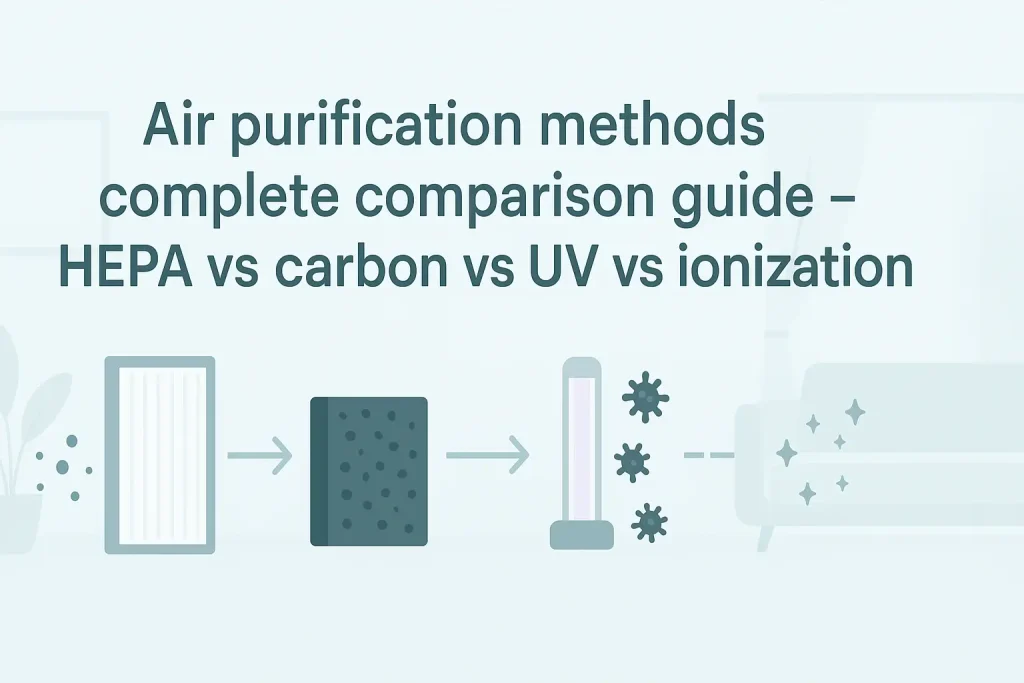
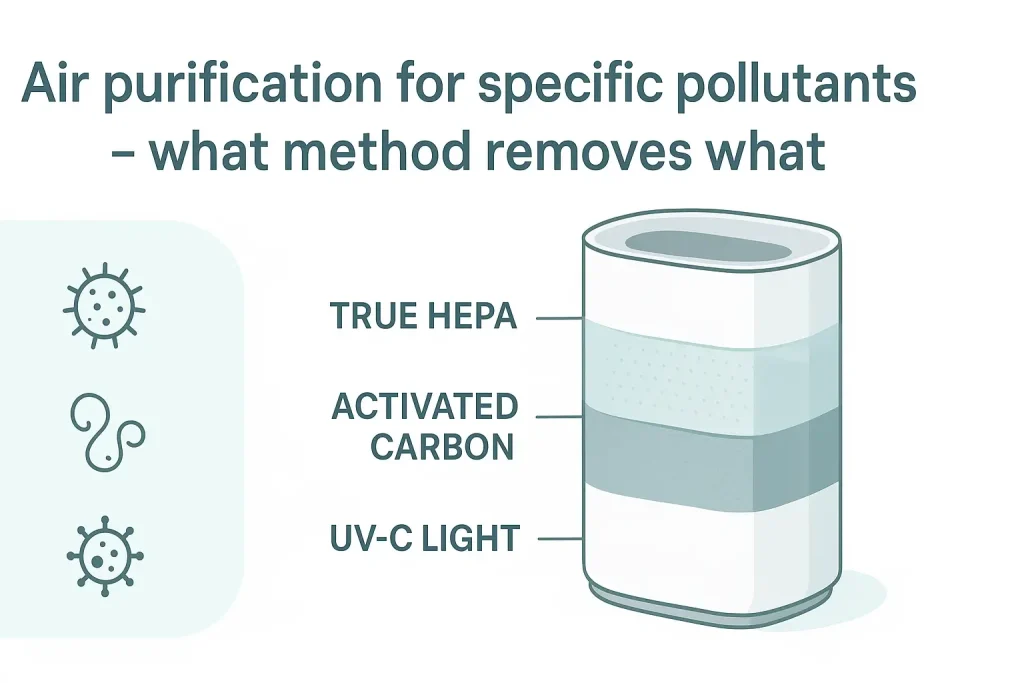
A garage air purifier demands True HEPA plus activated carbon. Particle-only filtration is not enough. Chemical-only filtration is not enough. The garage produces both particle and gas-phase pollutants simultaneously, and both require dedicated filter stages to address.
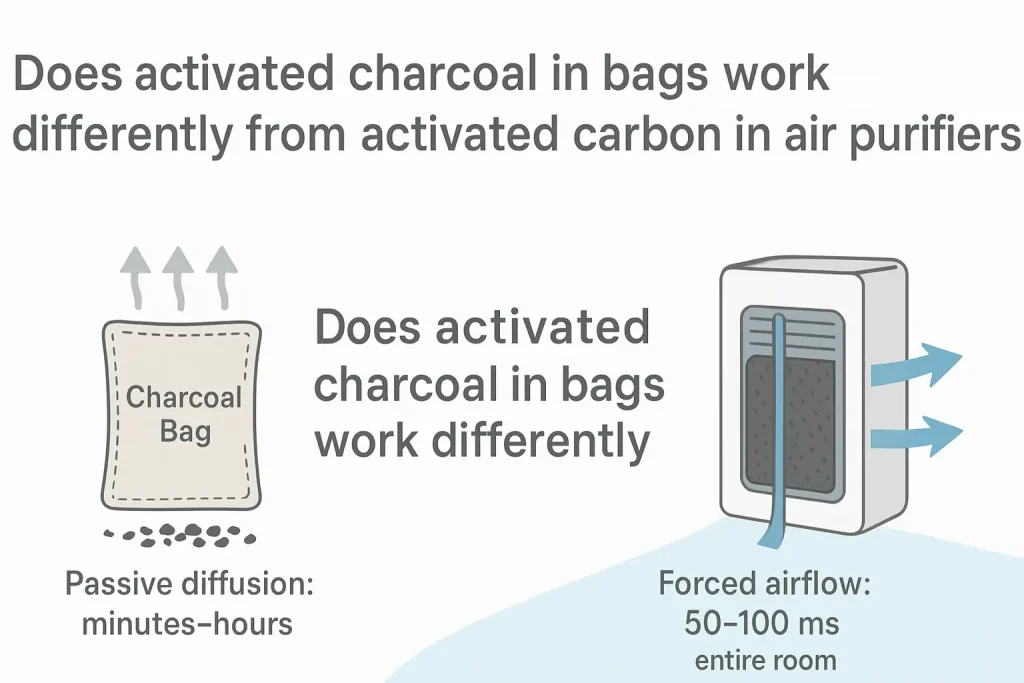
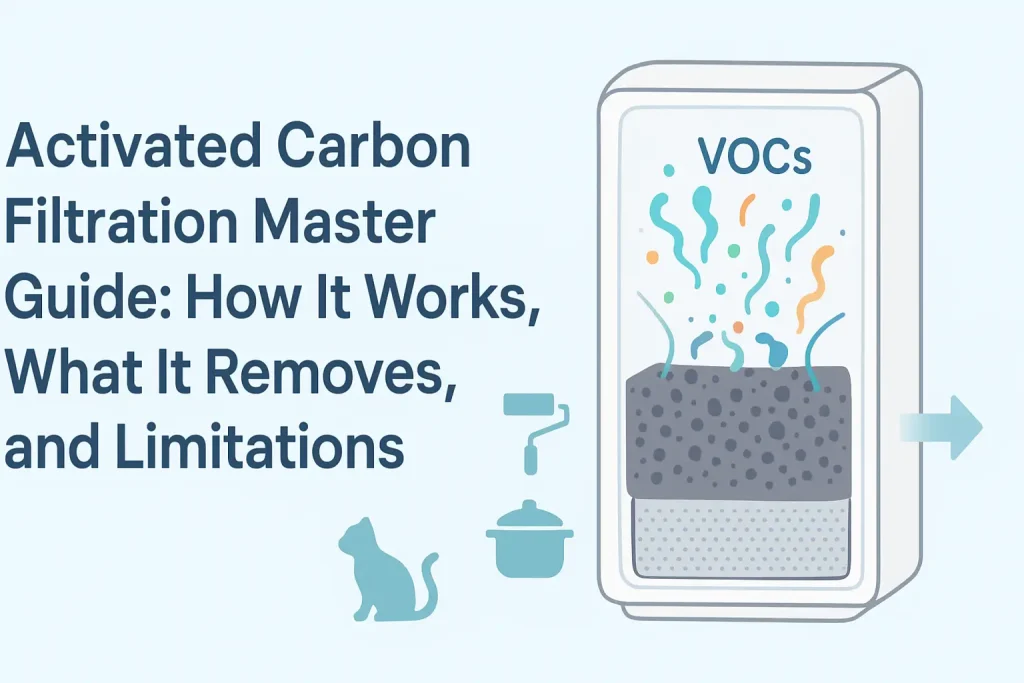
True HEPA captures 99.97% of airborne particles at 0.3 microns, per IEST standards. This includes the fine and ultrafine particulate matter from brake dust, tire wear, sanding, grinding, and combustion. Activated carbon adsorbs the benzene, toluene, xylene, formaldehyde, and VOCs that a HEPA filter cannot capture because these chemicals exist as gases, not particles.
A purifier with only a carbon pre-filter provides negligible VOC removal. The carbon layer is too thin. A pre-filter is meant to protect the HEPA media from large dust loads. It is not a gas-phase filtration stage. You need a purifier with a dedicated activated carbon bed of at least 3-5 pounds for meaningful VOC reduction in a garage.
Ionizers and Ozone Generators Are Not Safe Garage Solutions
Many purifiers marketed for garages and workshops use ionization or electrostatic precipitation without a HEPA filter. These devices produce ozone as a byproduct. The CARB limit of 0.050 ppm applies to all air cleaners sold in California, but many ionizers emit ozone in the 0.030-0.070 ppm range, which can exceed CARB limits during extended operation in an enclosed space.
Ionizers charge airborne particles so they stick to surfaces. This removes them from the air temporarily, but the particles are not captured. They settle on garage shelves, toolboxes, and workbenches. When disturbed again by garage door movement, foot traffic, or ambient airflow, they re-enter the breathing zone. A True HEPA purifier captures particles in a medical-grade filter media that permanently removes them from circulation.
Activated Carbon Weight Matters More Than Any Other Garage Purifier Spec
The weight of activated carbon inside the purifier is the single most important number for garage use. A thin carbon pre-filter layer of 100-200 grams provides almost no gas-phase reduction after the first few weeks of operation. A 5-pound activated carbon bed can adsorb VOCs effectively for 6-12 months in a garage environment.
This is because the adsorption capacity of carbon saturates proportionally to VOC load. A garage with stored gasoline, paint thinners, and vehicle exhaust subjects the carbon to continuous gas exposure. An undersized carbon filter saturates within weeks. You then recirculate contaminated air through an inert filter bed that has no remaining adsorption capacity. The purifier appears to run. It provides particle filtration. It captures zero VOCs.
Air Quality Data
Garage Air Quality – What the Research Shows
Sources: EPA Indoor Environments Division, Health Canada Indoor Air Quality, ASHRAE Journal
How to Position an Air Purifier in Your Garage for Maximum Effectiveness
Garage positioning differs from bedroom positioning. The air purifier should sit on the workbench or a dedicated shelf, not on the floor. Exhaust fumes and gasoline vapors are heavier than air and accumulate near the floor. Carbon monoxide mixes evenly. But the heaviest VOC concentrations stay low.
A purifier placed on the garage floor cycles the dirtiest air nearest the concrete slab. This accelerates pre-filter loading without improving overall garage air quality proportionally because the unit primarily scrubs the lowest 18 inches of air volume. Elevated placement circulates a broader cross-section of garage air.
Ensure the intake and outlet are not blocked on any side. A purifier pushed against a wall or corner reduces effective CADR by 20-30% due to restricted airflow. Give it 12 inches of clearance on all intake and outlet sides. In a garage with ceiling-mounted storage racks, avoid placing the unit under a shelf or enclosed area that creates a recirculation loop.
Garage Air Purifier Maintenance Is Different
Filter loading happens faster in garages than in bedrooms. Expect to replace the pre-filter every 1-2 months during heavy garage use. A workshop producing sawdust, metal shavings, or grinding dust can clog a pre-filter in weeks. Vacuum or wash the pre-filter weekly if accessible.
The True HEPA filter in a garage purifier lasts 6-9 months under normal use instead of the typical 12 months claimed for bedroom units. The activated carbon filter saturates faster in the presence of constant VOC exposure. Replace carbon every 3-6 months if you store gasoline-powered equipment, paints, or solvents in the garage.
Top Air Purifiers for Garage Use: CADR, Carbon Weight, and Total Cost
Use the table below to compare garage-suitable air purifiers across the metrics that matter most: smoke CADR in CFM, activated carbon weight in pounds, coverage area at 5 ACH, noise at medium fan speed, annual filter cost, and total first-year cost. All units listed are True HEPA plus activated carbon. None use ionization or ozone generation.
Product Comparison
Top Garage Air Purifiers Compared: CADR, Carbon Weight, and Total Value
Smoke CADR from AHAM certified database. Coverage at 5 ACH calculated as smoke CADR x 12 / 5. Carbon weight from manufacturer specifications. Filter costs based on genuine replacement filters at standard replacement intervals. Prices verified at time of publication.
| Model | Smoke CADR | Addressable Garage at 5 ACH | Carbon Weight | Noise at Med | Annual Filter Cost | Best For |
|---|---|---|---|---|---|---|
| Austin Air HealthMate | 400 CFM | 160 sq ft (10ft ceiling) | 15 lbs | 45 dB | $290/yr | Maximum VOC garage filtration |
| IQAir HealthPro Plus | 300 CFM | 120 sq ft (10ft ceiling) | 5 lbs | 25 dB | $250/yr | HyperHEPA plus chemicals |
| Coway Airmega 400 | 400 CFM | 160 sq ft (10ft ceiling) | 1 lb | 22 dB | $60/yr | Particle-dominant garage |
| Winix 5500-2 | 243 CFM | 97 sq ft (10ft ceiling) | 0.5 lbs | 28 dB | $50/yr | Budget garage with low VOCs |
| Blueair Blue Pure 211+ | 350 CFM | 140 sq ft (10ft ceiling) | 1.5 lbs | 31 dB | $80/yr | High CADR, moderate carbon |
| Austin Air HealthMate Plus | 400 CFM | 160 sq ft (10ft ceiling) | 15 lbs | 45 dB | $290/yr | Plus potassium iodide for formaldehyde |
All CADR data from AHAM certified product database. Carbon weight from manufacturer technical specifications. Coverage at 5 ACH calculated as smoke CADR x 12 / 5 per AHAM methodology. Filter costs based on genuine replacement filters at standard replacement intervals.
The Austin Air HealthMate: The Best Overall Garage Purifier
The Austin Air HealthMate combines 400 CFM smoke CADR with 15 pounds of activated carbon and zeolite in a single unit. That carbon weight is 10-30 times more than most purifiers in the same CADR class. The filter lasts 5 years under normal conditions before needing replacement.
This combination matters because garages assault filters with both particles and gases simultaneously. Most purifiers handle particles well but offer token carbon layers. The HealthMate’s 15-pound carbon bed handles gasoline vapors, paint solvents, and vehicle exhaust on the same filter pass. The zeolite additive captures formaldehyde, a byproduct of incomplete combustion and off-gassing from engineered wood products stored in garages.
For maximum protection, the HealthMate Plus adds potassium iodide-impregnated carbon to specifically target formaldehyde and other aldehydes. This is the only unit configuration that chemically neutralizes formaldehyde rather than physically adsorbing it.
The Coway Airmega 400: Best for Particle-Dominant Garages
Not every garage stores gasoline and paint thinner. Some are woodworking shops or clean storage spaces. In garages where VOCs are minimal and the primary concern is particulate matter from sanding, grinding, or outdoor infiltration, the Coway Airmega 400 delivers 400 CFM with dual filters and reaches 22 dB at sleep mode.
This unit’s washable pre-filter extends the life of the True HEPA main filter in dusty environments. Instead of replacing a plugged pre-filter monthly, wash it under a tap. For a woodworking garage where fine sawdust accumulates quickly, a washable pre-filter saves $50 or more per year compared to disposable pre-filters under the same dust load.
Electric Garage Air Purifiers vs. Whole-Garage HVAC Filtration
A portable air purifier treats the air in the garage itself, but the pollutants trapped by a well-sealed attached garage can migrate into the home even without purifier coverage in the garage. The solution is layered filtration: the unit handles garage air while the home’s HVAC system handles infiltrated pollutants at the point of entry from the garage door threshold.
If your garage feeds into a laundry room or mudroom, the natural airflow direction carries pollutants inside. A MERV 13 filter in the home HVAC system provides secondary filtration for particles between 1-3 microns. But HVAC systems cycle based on temperature, not air quality. They run when the thermostat calls for heating or cooling. That means HVAC-only filtration is intermittent and can leave hours of unfiltered infiltration between cycles. A continuously running portable purifier in the garage closes that gap and filters the air at the source before it reaches the house.
Running Time: How Long to Run a Garage Air Purifier
Garage purifiers should run continuously at medium fan speed whenever the garage is occupied or recently occupied with vehicle activity. Running a purifier only when you are in the garage misses the point. The pollutants generated during a 30-second engine start persist for hours and infiltrate the house long after you leave the garage.
Run the purifier continuously if your garage holds stored chemicals, gasoline-powered equipment, or vehicles parked inside. For a workshop garage used intermittently, run the purifier for at least 2 hours after the last activity at high fan speed. This purges accumulated pollutants from the air volume before the garage door to the house opens again.
What About the Garage Door? Airflow and Filtration Interactions
Opening the overhead garage door creates an enormous air exchange event. In 30 seconds, a fully open 16-foot-wide door exchanges 30-50% of the garage air volume with outdoor air. A purifier running during this exchange is not filtering garage air. It is filtering ambient outdoor air rushing in. That is fine. The purifier should not be turned off. Just understand that CADR effectiveness dips momentarily during overhead door operation and recovers within 5-10 minutes of the door closing.
You cannot air-seal a garage to improve purifier effectiveness without addressing vehicle exhaust. An airtight garage traps CO and NOx inside. A leaky garage door naturally dilutes pollutants but also allows them to penetrate into the living space because the leak paths work both ways. The solution includes understanding draft management around doors and gaps to balance ventilation with filtration capture rather than to seal indiscriminately.
Garage Sizing When You Vary Ceiling Height
Most garage ceiling heights range from 8 to 14 feet depending on construction era and intended use. A 14-foot ceiling in a garage built for RV storage contains 75% more air volume than an 8-foot ceiling of the same floor area. That volume increase demands a proportional increase in CADR for equivalent filtration performance.
The CADR calculator embedded earlier in this guide handles different ceiling heights. Plug your actual measured ceiling height into the slider. A 24-by-24-foot RV garage with 14-foot ceilings and heavy VOC storage needs vastly different filtration than a 24-by-24-foot parking-only garage with 9-foot ceilings even though the floor area is identical.
Temperature and Humidity Effects on Garage Purifier Performance
Garage temperatures swing more aggressively than any interior room. Most portable purifiers operate optimally between 40°F and 100°F. Below freezing, the fan motor may stall or run slower, reducing effective CADR. Above 110°F, heat from the motor itself risks overheating. In unconditioned garages in northern climates, expect reduced winter performance unless the unit runs continuously, which keeps the motor housing slightly above ambient.
The activated carbon filter adsorbs more VOCs at lower temperatures and desorbs at higher temperatures. A garage that hits 120°F in summer may release previously adsorbed VOCs back into the air from a saturated carbon filter. This is why carbon filter replacement intervals shorten under high-temperature garage storage conditions. Change the carbon every 3 months in unconditioned hot-climate garages regardless of filter indicator status.
Choosing the Right Unit for Garage Dust from Woodworking
Woodworking dust is larger in particle size than combustion particles. Sawdust is primarily PM10 and larger. But sanding at 220 grit or finer produces PM2.5 and ultrafine particles below 1 micron. A True HEPA filter captures all of these particle sizes equally because HEPA efficiency at 0.3 microns is the hardest-to-capture particle size. Larger or smaller particles are captured at higher efficiency than 99.97%.
The greater concern for woodworking garages is pre-filter management. A high-dust environment can erode CADR by 30-50% within 2-3 hours if the pre-filter clogs. The purifier still runs. It still draws rated wattage. But CADR drops because airflow resistance increases as the pre-filter loads up. Clean pre-filters after every heavy workshop session to maintain rated CADR.
Gasoline, Propane, and Combustion Byproducts: Extra Carbon Needed
Gasoline stored in a garage emits benzene, toluene, ethylbenzene, and xylene (BTEX) continuously through the container walls and vapor pressure of small leaks. A lawn mower or snowblower with fuel in its tank off-gases even when not running. These VOCs attach to carbon media and deplete the adsorption capacity rapidly.
The 15-pound carbon filter in an Austin Air unit handles typical garage VOC loads for 3-5 years under moderate conditions. But a garage with 3 gas cans, a generator, and 2 vehicles parked daily will saturate the same carbon bed within 12-18 months. If in doubt, replace carbon annually even if the HEPA indicator claims the filter is clean. Carbon saturation is invisible. The only way to verify is by measuring total VOC reduction with a handheld PID sensor that registers VOC concentrations in real time, which most homeowners do not have.
How Garage Air Quality Affects the Rest of the House
Pollutants generated in the garage move into living spaces through three pathways: the connecting door between garage and house, shared ductwork and floor cavities, and negative pressure differential caused by exhaust fans running inside the house. When the kitchen exhaust fan runs, it depressurizes the house relative to the garage. Air flows from the higher-pressure garage into the lower-pressure kitchen through every seam, crack, and gap.
This pressure-driven transport explains why garage benzene levels correlate strongly with living-space benzene levels in homes with attached garages. Research published in the Journal of Exposure Science and Environmental Epidemiology found that attached garages are a significant source of indoor benzene exposure, and that infiltration through the connecting door is the primary pathway.
Filter Replacement Schedule for Garage Purifiers
The following replacement schedule applies to a garage purifier running 24 hours per day at medium speed. It assumes typical garage conditions: one or two cars parked daily, moderate chemical storage, and occasional light workshop use. Heavy automotive repair, painting, or professional woodwork doubles these frequencies.
Pre-filters: inspect and vacuum biweekly, wash monthly if washable, replace every 2-3 months if disposable. True HEPA filter: replace every 6-9 months (not 12). Activated carbon filter: replace every 6 months for gas and chemical garages, 12 months for clean storage garages. Annual total filter cost budget: $150-$300 depending on model.
Sizing Wildfire Smoke Purifiers vs Garage Purifiers
The smoke CADR needed for a garage in normal operation overlaps substantially with the smoke CADR needed for wildfire protection, because both cases require elevated ACH for effective particle control. The difference is the continuous chemical exposure in garages, which the wildfire smoke purifier does not account for in its daily operation. Understanding sizing your unit for wildfire smoke events informs your garage CADR calculation in a different way because wildfire sizing assumes elevated CADR for a temporary event while garage use requires sustained elevated CADR continuously.
Garage Dust, Pollen, and Allergens: Secondary Benefits
In addition to removing combustion byproducts and VOCs from garage air, a garage purifier will also reduce pollen infiltration into the living space. Pollen enters garages through the overhead door opening and through passive vents. A garage purifier captures airborne pollen before it settles and enters the home, reducing the total load that reaches the HVAC filter and living space.
Dust from the garage also settles on tools, stored boxes, and the vehicle itself. A purifier reduces dust accumulation on garage surfaces. This matters not just for garage cleanliness but because air purifiers demonstrably reduce settling dust indoors, and the garage is the closest equivalent to an indoor settling environment with high particulate loads on every surface. The same principles apply: capturing airborne dust before it falls prevents the need to dust shelves, boxes, and stored items weekly.
Entry-Level Garage Purifiers for Clean Storage Garages
If your garage is clean, dry, and primarily used for parking without pesticides or solvents stored inside, a mid-range True HEPA purifier with 200-250 CFM smoke CADR will handle the particle load from vehicle exhaust and occasional dust with a standard filter replacement interval.
For these lower-risk garages, the Levoit Core 300 and Winix 5500-2 are the entry-level recommendation. Both carry AHAM-certified smoke CADR, True HEPA filtration, and activated carbon pre-filters. They are not industrial-grade units, but for a clean garage with one car and no stored chemicals, they provide meaningful difference in particle reduction relative to no filtration. Their carbon filters are insufficient for chemical-heavy garages.
Carbon Monoxide Detection Is a Separate Need
No air purifier removes carbon monoxide. Carbon monoxide is a gas with a molecular weight close to air. Standard activated carbon does not adsorb CO effectively. CO is a direct health hazard that bypasses every portable filtration technology in a consumer purifier.
Every garage needs a UL-listed carbon monoxide detector mounted at the connecting door to the house, independent of any purifier. A purifier plus a CO detector plus a garage exhaust fan is the correct safety setup. The purifier handles particles and VOCs. The CO detector alerts to CO danger. The exhaust fan provides rapid dilution if CO exceeds safe thresholds. None of these substitutes for the others.
What Is True HEPA and Why Does It Matter in a Garage?
True HEPA is a certified filtration standard that captures 99.97% of airborne particles at the 0.3 micron size, which is the hardest particle size to capture. True HEPA efficiency is verified by independent testing, not a manufacturer claim. In a garage, True HEPA captures diesel particulate, brake dust, pollen, mold spores, and the fine fraction of wood dust that enters the smallest airways of the lungs.
A filter labeled HEPA-type or HEPA-like has no standardized test standard. It filters some particles but no one can tell you the capture efficiency at 0.3 microns. These filters are not acceptable substitutes in a garage where ultrafine combustion particles are present.
CADR, CFM, and ACH Defined
CADR stands for Clean Air Delivery Rate. CADR is measured in cubic feet per minute (CFM) of particle-free air an air purifier delivers for each of three standardized particle types: smoke, dust, and pollen. Smoke CADR is the most meaningful number for garage use because it measures the smallest particle size range, which includes combustion byproducts.
ACH means air changes per hour. It is the number of times the purifier filters the entire air volume of a room in one hour. A CADR specification only converts to a room coverage claim when paired with an ACH target. A 200 CFM purifier provides 2 ACH in a room of 6,000 cubic feet. It provides 5 ACH in a room 40% smaller. The garage must match your purifier at the target ACH, not the minimum 2 ACH on the box.
Ozone from Car Exhaust vs Ozone from Purifier Ionizers
Car exhaust produces ground-level ozone as a secondary pollutant from NOx and VOC reactions in sunlight. An ionizing purifier or ozone generator adds ozone directly to the garage independent of vehicle activity. A CARB-certified purifier limits ozone output to below 0.050 ppm per California Air Resources Board regulations. This is the only legally enforceable standard for ozone emissions from air cleaners in North America.
Any purifier sold as “ozone-free” but without CARB certification listed on the product labeling has not been tested to an enforceable standard. Look specifically for the CARB EO number on the purifier or its manual. If no CARB certification is visible, do not operate the purifier in a garage, where the combination of vehicle emissions plus ionizer ozone can create unsafe ozone levels above regulatory limits rapidly.
Activated Carbon Filters Saturation and Regeneration
Activated carbon adsorbs gas molecules onto its internal surface area. When all available adsorption sites are occupied, the filter saturates. A saturated carbon filter no longer captures gases and may release adsorbed chemicals back into the airstream at high temperatures. A saturated filter in a garage effectively stops working as a VOC filter even though HEPA continues filtering particles.
Desorption risk in hot garages accelerates during summer heat waves and after sunlight exposure through windows. If your garage reaches sustained temperatures above 100°F, replace carbon filters at half the manufacturer’s suggested interval. An overheated saturated carbon filter will release fatigue-load gases that create a worse air quality problem than having no carbon stage at all by re-emitting stored pollutants slowly over weeks.
Can I Run an Air Purifier 24/7 in My Garage?
Yes. Continuous operation at medium speed is the correct way to run a garage air purifier. The garage continuously receives pollutants from vehicle off-gassing even when idle, from stored chemical containers, and from pressure-driven infiltration from the building envelope exchange with outdoors. Running the purifier continuously at medium speed maintains a steady-state reduced pollutant concentration that prevents accumulation episodes when the garage door opens and closes.
Many purifiers are ENERGY STAR certified and draw 5 to 45 watts at medium speed. At 13 cents per kWh, 45 watts continuous for one year costs $51 in electricity. That is less than half the filter replacement cost for most units and is a justifiable expense for reducing infiltration into the living space from an attached garage that shares wall or ceiling cavities with occupied bedrooms and kitchens.
Will a Garage Purifier Remove Vehicle Exhaust Smell That Clings to Clothes?
A garage purifier with sufficient activated carbon capacity reduces the odor-causing VOC load that adsorbs onto fabric, carpet, and upholstery fibers. Exhaust smell that transfers from garage air to stored clothing occurs because fabric acts as a passive VOC sink. It absorbs and later releases odors slowly over hours. Reducing the garage air VOC concentration reduces the fabric loading rate proportionally.
The purifier cannot reverse existing odor in clothing already saturated with exhaust VOCs. But it prevents new adsorption onto clean fabric items stored in the garage or items brought in through the garage entry door on the way into the house. For items already contaminated, wash them and then store them in a garage where the purifier has been running for at least 24 hours to reduce re-contamination.
Is It Safe to Run a Garage Purifier Near Gasoline Cans?
Yes, as long as the purifier does not use ionization, ozone generation, or UV-C with exposed lamps that could ignite vapors. All True HEPA plus carbon purifiers recommended in this guide are flame-resistant designs without exposed ignition sources. Place the purifier at least 3 feet from gasoline cans, paint thinners, or solvent containers. This is a standard safety margin, not an electrical code requirement.
The purifier motor is enclosed and brushless DC in all modern units tested. The spark risk is negligible. Gasoline vapors in the air at concentrations below the lower explosive limit are safe for purifier operation. But vapor pooling near the floor or in an enclosed space during refueling could exceed the lower explosive limit in the immediate area. Never operate any electrical equipment in a garage where gasoline vapors are acutely perceptible to smell without adequate ventilation first.
What Is the Difference Between Single-Filter and Multi-Filter Garage Purifiers?
Single-filter designs use one barrel-shaped filter that combines True HEPA and carbon stages concentrically around a central airflow path. Multi-filter designs use separate flat filters in compartments for pre-filter, HEPA, and carbon stages. For garage use, multi-filter designs have one critical advantage: you can replace a saturated carbon stage without replacing the HEPA filter when carbon capacity depletes before HEPA surface area clogs.
In a single-filter design, VOC capacity is exhausted when HEPA capacity might still have substantial life remaining, but the single integrated filter must be replaced entirely. Multi-filter designs also allow upgrading carbon quantity from a low-weight carbon wrap to a deep-bed carbon canister separately from the HEPA stage for users who start with particle protection and later add VOC capacity as needs increase.
What Is the Most Common Mistake When Installing a Garage Air Purifier?
The most common mistake by far is placing the purifier too low. Garage floors accumulate heavier-than-air vapors from gasoline and solvents near the concrete slab, but the bulk of the 4,000-8,000 cubic feet of garage air volume exists above 18 inches. A purifier placed on the floor filters a thin vapor layer near the slab without affecting the volume of air the occupant breathes most frequently, which is between 3 and 6 feet above the floor.
Place the purifier at workbench height between 36 and 48 inches above the floor. This captures both the rising particle plume from the floor and the breathing zone where the mechanic, woodworker, or vehicle owner stands and inhales. Ceiling-hung units capture the broadest vertical cross-section of stratified garage air but require mounting brackets rated for the unit weight plus a safety factor of 3X minimum.
Why Does Garage Dust Clog Pre-Filters Faster Than Bedroom Dust?
Garage dust is compositionally different from bedroom dust. Bedroom dust is mostly textile fibers, skin cells, and house dust mite allergen. Garage dust contains construction debris, road salt particles, brake dust with metallic components, insect debris, concrete floor dust, silica from grinding wheels, and coarse organic matter brought in on tires. The abrasive, heavier particles pack into pre-filter media with higher efficiency and block airflow faster.
Road salt dust from winter road treatment is particularly aggressive. Mixed with humidity, salt dust hardens on filter media fibers and resists vacuuming. Wet washing of pre-filters immediately after salt exposure prevents this hardening. If you live in an area where winter roads receive salt treatment, budget a higher filter replacement frequency and replace pre-filters at the start and end of winter regardless of visual appearance.
Do You Need a Separate Air Quality Monitor for the Garage?
Yes. The purifier indicator light measures particle accumulation on the filter by sensing back-pressure or optical density. It cannot measure VOC concentration, CO, or relative humidity effects on filter life. A PM2.5 monitor costing $50-$100 placed at breathing height in the garage confirms that the purifier is actually reducing particle counts to the expected level given its CADR and airflow.
Without independent monitoring, you are trusting the purifier to verify itself. The purifier has a financial interest in claiming it is performing well. An independent sensor tells you the garage PM2.5 dropped from 250 μg/m³ to 25 μg/m³ within 20 minutes of turning the purifier on. That is a verified result, not a manufacturer claim. Combine a PM2.5 monitor with a CO detector and optionally a TVOC sensor for complete garage air quality verification independent of any purifier claim.
When Should You Upgrade from a Portable Purifier to a Garage Exhaust Ventilation System?
The limit of portable filtration in a garage is reached when the continuous pollutant load from vehicles, chemicals, or workshop activities exceeds the purifier’s CADR at maximum fan speed. If the purifier runs 24/7 at turbo and the PM2.5 monitor still shows elevated numbers an hour after the garage door closes, the infiltration load from connected spaces or internal sources is overwhelming the unit’s CADR capacity.
At that point, add an exhaust fan with makeup air intake, or accept the higher capital investment of a permanent whole-garage ERV/HRV system. The purifier is a partial filtration approach for garages with moderate pollutant sources. It is not a substitute for code-required ventilation. If vehicles idle in the garage or operations like painting and welding occur routinely, the purifier is supplementary to a mechanical exhaust system, not a replacement for it.
Final Verdict: Which Garage Purifier Should You Buy?
For most garages with moderate chemical storage and one or two cars parked daily, the Austin Air HealthMate provides the best single compromise of CADR, carbon capacity, and filter lifespan. The upfront cost is higher but the 5-year filter replacement interval and industry-maximum activated carbon mass result in a lower total cost per year of effective filtration than cheaper purifiers requiring carbon replacement every 6 months.
For a clean garage with no chemical storage, the Coway Airmega 400 balances True HEPA filtration with a washable pre-filter and quiet operation. For maximum VOC removal with budget flexibility, the IQAir GC MultiGas or Austin Air HealthMate Plus with potassium iodide provides dedicated gas-phase filtration stages unavailable in purifiers below $500. The correct purifier is the one sized above your required CADR at 5 ACH with activated carbon capacity matched to your chemical storage inventory.