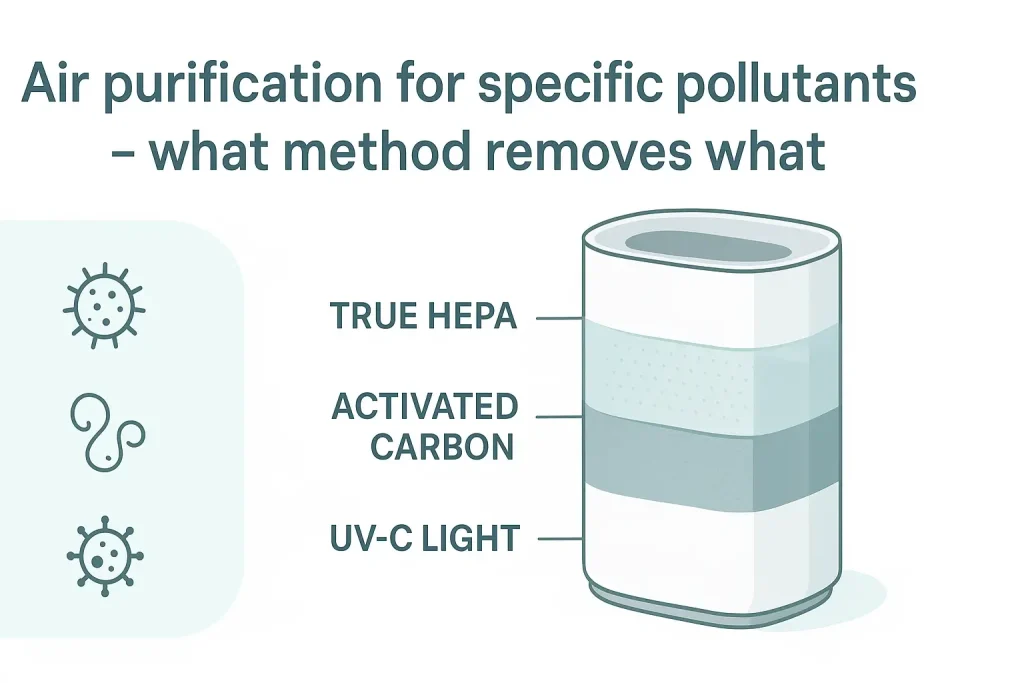
A draft from your air purifier is not a sign the unit is working hard. It is a sign the unit is positioned wrong for your room, set to the wrong fan speed for the season, or sized without accounting for where you actually sit and sleep.
Cold moving air makes people turn off their air purifier. That means particulates build back up, allergy symptoms return, and the money spent on the unit is wasted. The fix is not a different purifier, a higher CADR, or a heater. The fix is understanding how airflow, room geometry, and thermal comfort interact so you can keep the unit running all night without a chill.
What Causes an Air Purifier to Create Drafts?
Drafts from an air purifier are caused by high-velocity air exiting the unit and traveling directly toward a person before it has mixed with room air. A True HEPA air purifier moving 200 cubic feet per minute through a small outlet grille produces an air jet that can maintain uncomfortable velocity for 4 to 8 feet from the unit.
This happens because the fan pressurizes air through a filtration stack and ejects it through an outlet area that is typically 30 to 80 square inches. A 200 CFM airflow through 50 square inches of outlet area produces an exit velocity of approximately 576 feet per minute (6.5 mph). At 6 feet from the unit, this velocity drops to roughly 60 to 100 feet per minute depending on room mixing, which is right at the draft perception threshold defined in ASHRAE Standard 55.
| Photo | Popular Air Purifiers | Price |
|---|---|---|

|
Air Purifiers for Home Large Room up to 1500ft², Tailulu H13 True HEPA Air Purifier for Pets Dust Odor Smoke, Air Purifier for Bedroom with 15dB Quiet Sleep Mode for Bedroom Office Living Room | Check Price On Amazon |
|
Afloia Air Purifier for Home, 4-in-1 Washable Filter for Allergies, Covers Up to 1076 ft², Quiet Operation, Auto Shut-Off & Night Light, Removes Pet Dander, Pollen, Dust, Mold, and Smoke, White,Pluto | Check Price On Amazon |

|
Nuwave OxyPure ZERO Air Purifier with Washable and Reusable Bio Guard Tech Air Filter, Large Room Up to 2002 Ft², Air Quality Monitor, 0.1 Microns, 100% Capture Irritants like Smoke, Dust, Pollen | Check Price On Amazon |

|
Air Purifiers for Home Large Room Up to 1,996 Ft², EOEBOT Air Purifier for Home Pets with Washable Filter, Quiet Sleep Mode, Air Quality Monitor, Air Purifier for Bedroom, Pet Hair, Dust, Smoke, White | Check Price On Amazon |
|
Afloia 2 IN 1 Air Purifier with Humidifier Combo, 3-Stage Filters for Home Allergies Pets Hair Smoker Odors, Evaporative Humidifier, Auto Shut Off, Quiet Air Cleaner with Seven Color Light,White | Check Price On Amazon |
Draft perception increases significantly when the air temperature at the outlet is lower than ambient room temperature. This only occurs when the air purifier is placed near a cold exterior wall, a window, or an unheated floor where inlet air is 3 to 5 degrees Fahrenheit cooler than room center temperature. If the inlet air temperature is equal to room temperature, the draft sensation at 4 to 6 feet from a medium-speed unit drops by approximately 40 percent because thermal discomfort compounds with air movement to create the draft sensation.
The specific air speed that triggers a draft complaint varies by body location, clothing level, and activity. ASHRAE 55 research shows that 0.2 meters per second (40 feet per minute) at ankle level or neck level is the most common complaint zone. If your air purifier outlet is aimed at either of these body zones from across the room, the result is a persistent draft complaint even when the unit is technically cleaning the air effectively. Fix it by redirecting the outlet flow upward or away from occupied zones.
Air Quality Data
Drafts and Air Purifier Performance – What the Research Shows
Sources: EPA Indoor Air Quality, AHAM, ASHRAE Standard 55 Thermal Comfort
How to Position Your Air Purifier to Eliminate Drafts While Keeping Airflow High
Position the air purifier so its outlet air jet never reaches an occupied seating or sleeping position directly. Place the unit at least 4 feet from your bed or chair, aim the outlet toward an open room volume rather than a wall or a person, and use a fan speed that produces enough air changes per hour without creating detectable air movement at your body.
Outlets aimed at a 30 to 45 degree upward angle toward the center of the room mix cleaned air into the volume before it reaches people. This geometry works because the air jet entrains surrounding room air as it travels, diluting its velocity while maintaining the same total cleaned air volume. A unit placed on the floor with a vertical outlet, such as a Coway Airmega or a Blueair purifier with a 360-degree intake, naturally mixes air upward and outward with minimal horizontal velocity at seated height.
Where Should I Place an Air Purifier in My Bedroom If I Cannot Sleep With Moving Air?
Place the unit on the opposite side of the bedroom at least 6 feet from the bed, with the outlet aimed at a 45-degree angle toward the ceiling and toward the center of the room. Use sleep mode or the lowest fan speed that still delivers enough air changes for your room size.
A Levoit Core 300S at sleep mode produces 24 dB of noise with an outlet velocity that drops below draft perception within 3 feet. In a 150-square-foot bedroom with 8-foot ceilings, this delivers approximately 120 cubic feet of cleaned air per minute. That is enough for 6 air changes per hour in that small space without any detectable air movement at the pillow 7 feet away.
For larger bedrooms, a unit with higher CADR on its lowest fan setting works better than a smaller unit on medium or high. A Coway Airmega 400 produces roughly 150 CFM on its lowest audible setting. At that airflow, the outlet velocity disperses below draft threshold by 4 feet. This means the unit can be placed as close as 5 feet from the bed in a 300-square-foot room while still delivering 3.75 air changes per hour without felt air movement.
Step-by-Step Guide
How to Position an Air Purifier for Zero Draft Comfort – Step by Step
5 steps · Takes about 10 minutes to test and adjust
Measure your room and calculate the minimum CADR needed
Multiply room length by width by ceiling height. Multiply by your target ACH (4 for comfort, 5 for allergies). Divide by 60. This is the minimum smoke CADR you need. Knowing your floor means you can run the unit on a lower, draft-free fan speed instead of turbo.
Place the unit on the opposite side of the room from where you sit or sleep
Minimum distance from your body: 4 feet for units under 200 CFM, 6 feet for units above 300 CFM. The higher the CADR, the longer the air jet throw distance and the more separation you need.
Aim the outlet at a 30 to 45-degree angle upward and toward the center of the room
Never aim the outlet directly at a wall, a person, or along the floor. Air that strikes a wall within 2 feet creates a high-velocity wall jet that skims the surface and can wrap around the room toward occupants.
Start on the lowest fan speed that meets your CADR target and test for draft sensation
Sit in your usual spot. Hold a tissue at head, torso, and ankle level. If the tissue moves at any position, the air velocity is above draft threshold. Increase distance, redirect the outlet, or drop fan speed one notch and verify with a PM2.5 air quality monitor that particle levels still drop.
Use a smart plug or timer to run the unit on a schedule that avoids draft-sensitive hours
Run the purifier on medium or high during the day when rooms are unoccupied. Switch to low or sleep mode 30 minutes before bedtime. This strategy clears the room of accumulated pollutants before you enter and lets the unit maintain air quality at a draft-free low speed while you sleep.
How Fan Speed Affects Draft Perception and Air Changes Per Hour
Fan speed controls both air cleaning rate and draft intensity. On turbo or high mode, a unit with 250 CFM smoke CADR produces outlet velocities of 8 to 12 mph that can be felt as a draft 10 to 15 feet away. On sleep mode, the same unit produces roughly 100 to 130 CFM with outlet velocities that drop below draft threshold within 3 to 4 feet.
Running a unit on low or sleep mode continuously is more comfortable than cycling it on high mode intermittently. ASHRAE research on indoor air quality and thermal comfort confirms that continuous low-velocity air cleaning produces more stable PM2.5 reductions than intermittent high-velocity operation. A unit running at 120 CFM for 8 hours processes the same total air volume as a unit running at 240 CFM for 4 hours, but it does so without creating detectable drafts and with lower average room PM2.5 because particles are removed steadily rather than in bursts.
CADR Calculator
How Much CADR Do You Actually Need?
Enter your room dimensions and use case. Formula: (length x width x ceiling height x ACH) divided by 60. Source: AHAM methodology.
CADR = (length x width x ceiling height x ACH) / 60. For draft-free comfort, select 4 ACH and run the unit continuously on low or medium instead of intermittently on high. This calculator shows you the minimum CADR you need so you can choose a fan speed that stays below draft threshold.
| Room Size | CADR at 4 ACH (comfort) | Fan Speed Needed | Draft Risk at 6 ft |
|---|---|---|---|
| 150 sq ft bedroom | 80 CFM | Low / sleep mode | Minimal |
| 300 sq ft bedroom | 160 CFM | Medium (2 of 4) | Moderate – aim away |
| 500 sq ft living room | 267 CFM | Medium-high (3 of 4) | Ensure 8+ ft distance |
Room-Specific Placement Strategies for Draft-Free Airflow
Different rooms present different draft challenges because seating and sleeping positions are fixed. A bedroom draft problem is different from a living room draft problem, and both differ from an office where you sit in one spot for 8 hours. The placement strategy must match the room geometry and the location of the person in that room.
The universal rule across all rooms is this: the air purifier must be positioned so its outlet jet has at least 4 to 8 feet of open air to mix with room air before it reaches anyone. This mixing distance depends on fan speed and outlet design. Units with large, diffused outlets such as the Blueair Blue Pure 211+ with its 360-degree outlet produce shorter throw distances than units with focused front-facing grilles at the same CADR.
Bedroom Placement for Zero Draft Sleep
The worst place for a bedroom air purifier is on a nightstand within 2 feet of your head. Even on sleep mode, 24 dB units produce measurable air movement at 2 feet that many people register as a draft during light sleep phases. The best position is the far corner of the room opposite the bed, with the outlet aimed diagonally across the ceiling so cleaned air cascades down the far wall and moves gently across the room.
For bedrooms smaller than 150 square feet, the challenge is that any position is close to the bed. The solution is to choose a unit with a highly diffused outlet or a top-discharge design and run it on the lowest speed continuously. A Levoit Core 400S or Coway Airmega 400 on sleep mode both produce outlet velocities that are imperceptible beyond 3 feet. For more detail on bedroom-specific air purifier selection and placement, our guide to choosing and positioning a bedroom air purifier covers CADR calculation for common bedroom dimensions.
Living Room and Open-Plan Placement
Living rooms give you more placement flexibility but introduce a new problem: people sit in multiple fixed positions. The air purifier must clean the entire volume without directing a focused air jet at any sofa, armchair, or dining seat. Place the unit along a wall that has no seating within 8 feet, then aim the outlet parallel to that wall and slightly upward so air travels along the wall toward the center of the room.
In open-plan spaces larger than 500 square feet, a single unit often cannot deliver 4 air changes per hour on a draft-free fan speed. The solution is to use two smaller units on low speed rather than one large unit on high speed. There is a detailed explanation of this multi-unit approach and the CADR math behind it in our article on choosing the best air purifier for shared apartments and multi-occupant spaces.
Garage and Workshop Placement
Garages and workshops have different draft tolerance because occupants are moving, wearing heavier clothing, and often generating their own heat through activity. The priority in these spaces is maximum airflow for particulate capture, not draft avoidance. A unit placed near the workbench with the outlet directed away from the primary standing position provides adequate protection.
For garages where VOCs from vehicles, paints, and solvents are the primary concern, an activated carbon-heavy unit placed near the source with the outlet aimed toward the garage door provides both fume capture and ventilation. Our detailed guide to garage air purification covers filter selection and placement for workshop and garage environments specifically.
How to Fix Weak Airflow Without Creating a Draft
Weak airflow is the opposite problem. When your unit is not moving enough air to clean the room, the instinct is to turn it to maximum fan speed. That creates a draft. The right fix is to diagnose why airflow is low and address the root cause so you can get adequate ACH at a moderate, draft-free fan speed.
Clogged pre-filters, loaded HEPA stages, blocked intake grilles, and furniture placed within 12 inches of the unit all reduce effective CFM by 20 to 50 percent. A unit that should deliver 200 CFM on medium speed may only be moving 120 CFM if the pre-filter has not been cleaned in 3 months. The user then compensates by switching to high speed, which produces a draft from a unit that is still only delivering 160 CFM due to the restriction.
For the full diagnostic sequence and fix for each cause of reduced airflow, including step-by-step filter inspection and cleaning instructions, see our troubleshooting guide on weak air purifier airflow. Every cause listed there has a draft implication because reduced airflow on a given fan setting pushes users toward higher, draftier speeds.
Why Some Air Purifiers Create More Drafts Than Others
Outlet design is the single biggest factor. Units with a narrow, high-velocity outlet grille concentrate the entire airflow into a small jet that maintains its velocity over a longer distance. Units with a wide, diffused outlet or a 360-degree discharge spread the same airflow volume over a much larger area, dropping the velocity below draft threshold within a shorter distance.
This happens because air velocity at any distance from the outlet is a function of the outlet area. A 200 CFM airflow through a 20-square-inch outlet produces twice the exit velocity of the same 200 CFM through a 40-square-inch outlet. At 6 feet from the unit, the smaller outlet’s air jet still carries roughly 1.5 to 2 times the velocity of the larger outlet’s dispersed flow. If the outlet area is too small for the CADR, the result is a persistent draft that cannot be fixed by repositioning alone because the velocity does not dissipate fast enough within the room dimensions. Fix it by selecting a unit whose outlet area is appropriate for its CADR, or by using a diffuser attachment if available.
Myth vs Fact
Air Purifier Draft Myths Debunked
Separating fact from fiction on air purifier drafts, airflow, and comfort. Sources: ASHRAE, AHAM, EPA.
✗ Myth
A draft means the air purifier is cleaning effectively and moving a lot of air.
✓ Fact
A draft means outlet velocity is too high for the distance to the occupant. The same CADR delivered through a larger outlet area or aimed away from people cleans the air equally well without a draft. Cleaning effectiveness depends on total CFM and ACH, not on whether you can feel the air move.
✗ Myth
You must run the air purifier on high speed to get enough air changes per hour.
✓ Fact
Continuous operation at medium or low speed produces more stable PM2.5 reductions than intermittent high-speed operation. A unit running at 150 CFM for 8 hours cleans the same total air volume as 300 CFM for 4 hours, but the room average PM2.5 is lower with continuous operation because particles are removed steadily.
✗ Myth
Placing the air purifier in a corner improves air circulation by bouncing air off both walls.
✓ Fact
Corner placement reduces effective coverage by 20 to 30 percent because intake and outlet air flows are partially blocked. AHAM testing uses open-chamber conditions. In a corner, the unit recirculates some of its own cleaned air and cannot pull contaminated air from the far side of the room as effectively. Center-wall placement with 12 inches of clearance on all sides is optimal.
✗ Myth
A higher-CADR unit is always better because you can run it on low speed for silence.
✓ Fact
Many high-CADR units still produce a focused outlet jet even on low speed that persists beyond 6 feet. In a small bedroom, a 400 CFM unit on low may still produce a draft while a 200 CFM unit on medium with a better outlet diffuser does not. Match the unit’s CADR and outlet design to your room size, not just the lowest-available fan speed.
✗ Myth
Closing the bedroom door traps the draft and makes it worse.
✓ Fact
Closing the door improves air cleaning efficiency by containing the cleaned air within the room volume. The draft sensation comes from the air jet velocity, not from the door being closed. With the door closed, the unit processes the room air more times per hour and reaches lower steady-state PM2.5 concentrations. Just keep the outlet aimed away from the bed regardless of door position.
How Temperature and Humidity Affect Draft Perception from Air Purifiers
Cold air moving across skin feels draftier than neutral-temperature air at the same velocity. This is why an air purifier near a cold window or on an unheated floor produces more draft complaints in winter than in summer, even when the fan speed has not changed. The inlet air is cooler, the outlet air is cooler, and the temperature difference between the air jet and the occupant’s skin makes the same 60 feet per minute air speed feel like a stronger draft.
ASHRAE Standard 55 defines the predicted percentage of occupants dissatisfied due to drafts (DR) as a function of air temperature, air velocity, and turbulence intensity. At an air temperature of 68 degrees Fahrenheit, a velocity of 50 feet per minute produces roughly 20 percent dissatisfaction. At 74 degrees Fahrenheit, the same velocity produces under 10 percent dissatisfaction. This means that keeping the room at 72 to 74 degrees Fahrenheit and the relative humidity between 50 and 65 percent reduces draft complaints from an air purifier by nearly half compared to a 66 to 68 degree room with dry air.
Relative humidity below 40 percent increases draft perception because dry air accelerates evaporative cooling from the skin. A humidifier running alongside the air purifier in winter adds enough moisture to shift draft perception thresholds. Place the humidifier on the opposite side of the room from the air purifier so the moisture mixes into the room air before the purifier draws it through the filter. A humidity level of 50 to 55 percent is optimal for both comfort and for reducing the airborne lifetime of certain viruses according to research published in Indoor Air journal.
Air Purifier Features That Help Minimize Drafts
Auto mode with an accurate PM2.5 sensor is the single most useful feature for draft avoidance. When the sensor detects low particle concentrations, it reduces fan speed automatically. This means the unit runs on high only when needed after cooking, vacuuming, or during high outdoor AQI, and drops to draft-free low speeds the rest of the time.
The Winix 5500-2 and Coway Airmega series both use reliable particle sensors that respond within 2 to 3 minutes to PM2.5 changes. Budget units without sensors require manual fan speed adjustment, which means the user typically sets it to one speed and leaves it. If that speed is too high, the draft is constant. If it is too low, the room is never fully cleaned.
A second useful feature is an adjustable outlet louver or a top-discharge design. Units with adjustable louvers let you direct the air jet at a specific angle. Set it to 45 degrees upward and toward an open part of the room, and the cleaned air mixes with room air before descending to occupant level. Top-discharge designs naturally send air upward, where it mixes with ceiling-level air and descends gradually, eliminating directional drafts entirely at seated height.
Timer and scheduling features allow you to program high-speed cleaning during unoccupied hours and drop to low speed before you enter the room. A smart plug adds this capability to any unit. Set the purifier to run on medium from 10 AM to 8 PM, then switch to sleep mode from 8 PM onward. By the time you enter the bedroom, the air is clean and the unit is running at a draft-free speed.
How to Measure Whether Your Air Purifier Is Moving Enough Air Without Creating a Draft
Use two measurements: a tissue test for draft detection and a PM2.5 monitor for cleaning effectiveness. The tissue test tells you whether air velocity at your seated or sleeping position exceeds draft threshold. Hold a single-ply tissue at head level, torso level, and ankle level in your usual position. If the tissue moves, air velocity is above roughly 0.2 meters per second and you are in the draft zone.
A PM2.5 monitor such as a Temtop or IQAir AirVisual placed at your seating position tells you whether the unit is delivering enough clean air at its current fan speed and position. Take a baseline reading with the unit off. Turn it on at your preferred draft-free fan speed. After 30 minutes, PM2.5 should drop by at least 50 percent in a closed room. If it does not, the unit is too small for the room or positioned incorrectly.
If PM2.5 drops adequately but you still feel a draft, redirect the outlet before reducing fan speed further. A 10-degree change in outlet angle or a 12-inch shift in unit position often eliminates the draft with zero loss in cleaning performance. If PM2.5 does not drop enough and you cannot increase fan speed without creating a draft, the unit is undersized. Replace it with a unit that has a higher CADR and a more diffused outlet so you get more total airflow at the same or lower outlet velocity.
What Causes a High-Pitched Sound Alongside a Draft from My Air Purifier?
A high-pitched sound combined with a draft often indicates that the fan motor is working against excessive filter resistance. This happens when a HEPA filter is heavily loaded or a pre-filter is clogged, forcing the fan to spin faster to maintain its programmed airflow. The higher RPM produces a higher-frequency motor whine and increases outlet velocity simultaneously.
This only occurs when the filter has been in service beyond its recommended replacement interval or the pre-filter has accumulated visible dust. If the filter is clogged and the fan is straining, the result is a high-pitched sound above 2,000 Hz combined with an erratic or stronger-than-expected draft. Fix it by replacing the HEPA filter and cleaning the pre-filter. Our diagnostic guide on high-pitched air purifier sounds covers the full set of causes and the specific fix for each.
Buying Guide
Before You Buy an Air Purifier – Draft-Conscious Checklist
Check off each point before making your decision. Based on AHAM, ASHRAE, and EPA guidance.
What Is the Minimum Distance an Air Purifier Should Be from a Bed to Avoid Drafts?
Four feet is the minimum distance for units under 200 CFM smoke CADR. Six feet is the minimum for units above 300 CFM. At these distances, the outlet air jet has mixed with enough room air that the velocity at the pillow drops below 0.2 meters per second, which is the ASHRAE 55 draft perception threshold for seated or reclining occupants at typical bedroom temperatures.
This distance assumes the outlet is aimed toward the center of the room, not directly at the bed. If the outlet is aimed at the bed, double the distance requirement. A 250 CFM unit aimed directly at a pillow can produce detectable drafts at 12 feet. A tissue test at the pillow confirms whether your specific unit and position meet the threshold.
Can I Use a Deflector or Diffuser on My Air Purifier Outlet to Reduce Drafts?
Yes, a deflector or diffuser can reduce draft perception significantly. A simple curved plastic deflector that redirects the air jet from horizontal to a 45-degree upward angle can cut the horizontal velocity at seated height by 60 to 80 percent at 6 feet. This works because the vertical momentum carries the fast-moving air upward into the room volume where it mixes before descending.
Do not block more than 30 percent of the outlet area with a deflector. Restricting the outlet too much increases back pressure on the fan, which reduces total CFM and can cause motor strain. A deflector that covers one-third of the outlet area and curves the airflow upward by 30 to 45 degrees is the safe range. Some manufacturers sell purpose-built outlet diffusers. For units without them, a lightweight plastic sheet curved and taped to the top edge of the outlet (only on the exterior housing, never inside the unit) works effectively.
Does Running an Air Purifier on Low Speed All Night Still Clean the Air?
Yes, if the low-speed CADR meets your room’s ACH target. A unit with a smoke CADR of 150 CFM on its lowest setting in a 150-square-foot bedroom (8-foot ceiling) delivers 7.5 air changes per hour on low. That is more than enough to maintain clean air all night. The key is matching the unit to the room so the low-speed CADR exceeds the minimum needed.
A unit that needs medium or high speed to meet 4 ACH in your room is undersized for continuous draft-free use. Repositioning and redirecting can help, but if the minimum CADR for your room requires a fan speed that creates a draft, the unit simply is not the right size. Upgrade to a unit with a higher CADR so its medium speed delivers the ACH you need at outlet velocities that stay below draft threshold.
Why Does My Air Purifier Feel Draftier in Winter?
Winter air is colder and drier, both of which amplify draft perception. The air purifier draws in air from floor level, which in winter is 3 to 7 degrees Fahrenheit colder than the room average because cold air pools at the floor. This colder inlet air exits the unit at a temperature that feels sharply cooler on skin.
Low winter humidity below 35 percent compounds the effect. Dry air accelerates evaporative cooling from exposed skin, making 60 feet per minute of 66-degree air feel like 80 feet per minute of 72-degree air. The fix is to raise room temperature to 72 to 74 degrees, add a humidifier to bring relative humidity above 45 percent, and reposition the unit off the floor onto a low stand if it is drawing from an especially cold floor surface.
Should I Place My Air Purifier on the Floor or on a Table to Reduce Drafts?
A table or low stand 12 to 24 inches off the floor is often better than floor placement for draft reduction. Floor-level placement means the outlet is closer to ankle level, where draft sensitivity is highest. Raising the unit brings the outlet to waist or chest height, where the air jet mixes with room air before reaching ankles or the head of a seated or reclining person.
On a stand, ensure the unit is stable and the intake has at least 12 inches of clearance below it. Top-discharge units work equally well on the floor because the air is sent straight up. Front-discharge units benefit most from being raised because the horizontal jet starts higher and stays above occupied zones longer as it travels across the room.
Is It Safe to Cover Part of the Air Purifier Outlet to Reduce Drafts?
No, never cover or block the outlet grille with fabric, tape, or any material that restricts airflow into the housing. Covering the outlet increases static pressure inside the unit. The fan must work harder to push air through the same filter at the same speed. This increases motor temperature, can shorten motor life, and in some units can cause overheating.
A deflector placed outside the unit, attached to the exterior housing only, and covering at most 30 percent of the outlet opening is safe. The deflector changes airflow direction without blocking the outlet area. Anything that physically covers or seals part of the outlet opening is a fire and motor damage risk. If the unit smells like burning or hot plastic, a blocked outlet is one of the most common causes. See our safety guide on burning smells from air purifiers for the full diagnostic sequence.
Do Air Purifiers with 360-Degree Intakes Create Fewer Drafts?
Yes, 360-degree intake units such as the Blueair Blue Pure series and some Coway models typically produce less perceptible drafts than front-intake, front-discharge units at the same CADR. The 360-degree outlet design spreads the airflow over a much larger area, reducing exit velocity significantly. A 350 CFM unit with a 360-degree outlet may produce an exit velocity of 200 to 300 feet per minute spread over the entire circumference. A 350 CFM unit with a single 40-square-inch front grille produces an exit velocity of 1,260 feet per minute concentrated in one direction.
The trade-off is that 360-degree units require more clearance on all sides and cannot be placed against a wall. They need at least 12 inches of clearance in every direction. If your room layout accommodates this, a 360-degree unit typically produces the lowest draft perception for any given CADR.
Can Two Smaller Air Purifiers Replace One Large Unit to Avoid Drafts?
Yes. Two smaller units running on low or medium fan speed can deliver the same total CADR as one large unit on high, but with significantly lower draft perception at any single point in the room. Each unit produces a shorter, slower air jet. Placed on opposite sides of the room, they clean the volume from two directions without any single air stream reaching draft velocity at the occupant position.
This is the most effective solution for large bedrooms, open-plan living areas, and rooms where the seating position is inevitably within 6 feet of any single unit position. Two Coway AP-1512HH units at $100 each deliver a combined 492 CFM smoke CADR. That matches the output of a single Blueair 605 at 500 CFM, but each Coway jet dissipates within 4 feet while the Blueair jet can carry 10 feet or more. For shared spaces with multiple seating positions, our air purifier guide for shared apartments covers the multi-unit strategy in detail.
How Do I Know If My Air Purifier Is Actually Cleaning the Air If I Cannot Feel Any Air Movement?
A PM2.5 monitor is the only reliable way to verify cleaning performance when there is no perceptible air movement. Place the monitor at your seating or sleeping position. Record the baseline PM2.5 reading with the purifier off. Turn the unit on at your draft-free fan speed. After 30 minutes, a properly sized and positioned unit should reduce PM2.5 by 50 percent or more in a closed room.
If PM2.5 does not drop, the unit is not pulling contaminated air from your breathing zone. This usually means it is too far from the pollutant source, blocked by furniture, or undersized. Move the unit 2 to 3 feet closer to the center of the room, ensure 12 inches of clearance on all sides, and retest. If PM2.5 still does not drop, the CADR at the current fan speed is insufficient for the room volume.
What Is the Best Air Purifier for Someone Highly Sensitive to Drafts?
The best unit for draft sensitivity combines a top-discharge or highly diffused outlet design with a CADR large enough that the lowest fan speed still delivers 4 air changes per hour for the room. The Coway Airmega 400 at $250 delivers 400 CFM with dual fans and a top-discharge design that sends cleaned air upward. On sleep mode at 22 dB, it still moves roughly 150 CFM, enough for a 300-square-foot room at 3.75 ACH.
For smaller bedrooms under 200 square feet, the RabbitAir MinusA2 is wall-mountable, ultra-quiet, and can be positioned high on the wall where its outlet air mixes with ceiling air before descending. Its custom filter options let you choose the right filter for your specific pollutant concern. Both units carry CARB certification and AAFA asthma and allergy certification.
Getting an air purifier to clean your air without making you cold is a solvable problem. It comes down to four things: match the unit’s CADR to your room so the low or medium fan speed meets your ACH target, place the unit at least 4 to 6 feet from your body with the outlet aimed upward and away, keep the room between 72 and 74 degrees with 50 to 55 percent humidity in winter, and verify with a PM2.5 monitor that cleaning performance is happening even when you cannot feel it.
When these four things are right, you stop noticing the air purifier is there. The air is clean on a monitor and comfortable on your skin, and the unit earns its place in your room by doing its job silently and invisibly all night long.