Your roommate’s pan-seared salmon from three hours ago is still hanging in the air. The apartment downstairs just lit a fireplace. And your bedroom sits directly above a busy street with buses idling at the stoplight. This is shared apartment air quality: a cocktail of cooking fumes, neighbor exhaust, traffic PM2.5, and whatever the building’s aging ventilation ducts have been collecting since the 1980s.
You cannot install a whole-house HVAC filter in a rental. You probably cannot even swap the furnace filter without maintenance’s permission. A portable air purifier is your only real line of defense. The right one filters your specific contaminants at a noise level your roommate can sleep through. The wrong one is an expensive white noise machine that moves air around while PM2.5 levels stay high.
This guide covers every air purifier type relevant to shared apartments, including True HEPA units for particles, activated carbon systems for cooking odors and VOCs, hybrid models for multi-pollutant protection, and compact units designed specifically for small bedrooms and studio spaces. It includes smoke CADR requirements, noise thresholds for shared walls, filter replacement economics for renters on a budget, and placement strategies that work around furniture you did not choose and windows that face pollution sources you did not pick.
Air Quality Data
| Photo | Popular Air Purifiers | Price |
|---|---|---|

|
Air Purifiers for Home Large Room up to 1500ft², Tailulu H13 True HEPA Air Purifier for Pets Dust Odor Smoke, Air Purifier for Bedroom with 15dB Quiet Sleep Mode for Bedroom Office Living Room | Check Price On Amazon |
|
Afloia Air Purifier for Home, 4-in-1 Washable Filter for Allergies, Covers Up to 1076 ft², Quiet Operation, Auto Shut-Off & Night Light, Removes Pet Dander, Pollen, Dust, Mold, and Smoke, White,Pluto | Check Price On Amazon |

|
Nuwave OxyPure ZERO Air Purifier with Washable and Reusable Bio Guard Tech Air Filter, Large Room Up to 2002 Ft², Air Quality Monitor, 0.1 Microns, 100% Capture Irritants like Smoke, Dust, Pollen | Check Price On Amazon |

|
Air Purifiers for Home Large Room Up to 1,996 Ft², EOEBOT Air Purifier for Home Pets with Washable Filter, Quiet Sleep Mode, Air Quality Monitor, Air Purifier for Bedroom, Pet Hair, Dust, Smoke, White | Check Price On Amazon |
|
Afloia 2 IN 1 Air Purifier with Humidifier Combo, 3-Stage Filters for Home Allergies Pets Hair Smoker Odors, Evaporative Humidifier, Auto Shut Off, Quiet Air Cleaner with Seven Color Light,White | Check Price On Amazon |
Shared Apartment Air Quality – What the Research Shows
Sources: EPA Indoor Air Quality, AHAM, WHO air quality guidelines
What Makes Shared Apartment Air Quality Different from a House?
A detached house lets you control your air envelope. You choose the HVAC filter. You control whether windows stay closed on high-AQI days. You decide whether the kitchen vents outside or recirculates through a grease-coated filter. In a shared apartment, you control almost none of this. Your indoor air quality is a negotiation between your habits, your neighbor’s cooking schedule, and a building ventilation system maintained to the lowest acceptable standard.
Shared apartments have three air quality problems that detached homes do not. First, shared ventilation: many apartment buildings use centralized HVAC or connected ductwork that routes air between units. Your neighbor’s stir-fry and their cigarette smoke enter your space through the bathroom exhaust vent or the gap under your front door. Second, landlord deferred maintenance: apartment HVAC filters, if accessible at all, are often the cheapest MERV 4 fiberglass panels changed once every 18 months. Third, proximity pollution: in a detached home, the nearest pollution source might be 100 feet away. In an apartment, it is the unit below you, the garage exhaust on the ground floor, or the delivery truck idling directly under your window.
Cooking emissions are the dominant shared-apartment pollutant. According to 2019 research in Environmental Health Perspectives by Logue et al., gas stove cooking generates PM2.5 concentrations of 100 to 500 micrograms per cubic meter in the kitchen zone within 15 minutes of ignition without ventilation. That air does not stay in the kitchen. It circulates through the living room and bedrooms for hours. If the building uses a recirculating range hood as most apartments do, those particles never leave the building. They dilute through shared hallways and elevator shafts, eventually reaching your door.
An air purifier in a shared apartment must therefore handle three pollutant categories simultaneously: particulate matter from cooking, traffic, and neighbor emissions (PM2.5, PM10), gaseous compounds including VOCs and cooking odors (formaldehyde from pressed-wood furniture, acrolein from heated oils), and biological allergens that concentrate in buildings with shared airflow paths (mold spores from the unit with the slow plumbing leak, dust mite allergen from the carpeted hallway). A single-filter True HEPA unit removes only the first category. You need the right combination of filtration stages for the actual air you breathe.
How to Choose the Right Air Purifier Size for a Shared Apartment Room
Most apartment dwellers buy a purifier based on the manufacturer’s stated coverage area and then run it on low or medium in a room twice that size. This produces an effective air changes per hour (ACH) rate of roughly 1 to 1.5, which is roughly equivalent to natural settling. Particles stay airborne. Allergens recirculate. The purifier becomes decorative rather than functional.
The only meaningful sizing metric is smoke CADR measured in cubic feet per minute (CFM), verified through AHAM AC-1 testing. Manufacturer coverage area claims assume 2 ACH and a sealed test chamber. A 200-square-foot bedroom needs 133 CFM smoke CADR at 5 ACH for effective allergy and asthma management, not the 53 CFM the manufacturer’s 2 ACH rating suggests. Every time you see “covers 300 square feet,” translate it to “covers 120 square feet at 5 ACH.” That is the number that determines whether the unit cleans your air or slowly stirs it.
For a typical shared apartment bedroom of 120 to 180 square feet with an 8-foot ceiling, the smoke CADR required at 5 ACH ranges from 80 to 120 CFM. For a shared living room of 250 to 350 square feet, the requirement jumps to 167 to 233 CFM at 5 ACH. Most compact air purifiers in the $80 to $120 range deliver 100 to 150 CFM smoke CADR, which is adequate for a bedroom but significantly undersized for a living room.
Use the calculator below to find the exact smoke CADR requirement for your specific room dimensions and use case. Enter your room measurements and select your ACH target based on whether you have allergies, pets, or live in a high-pollution area.
CADR Calculator
How Much CADR Do You Actually Need?
Enter your room dimensions and use case. Formula: (length x width x ceiling height x ACH) divided by 60. Source: AHAM methodology.
CADR = (length x width x ceiling height x ACH) / 60. For shared apartments with multiple pollution sources, always calculate at 5 ACH, not the manufacturer-stated 2 ACH figure.
| Room Size | CADR at 2 ACH (standard) | CADR at 5 ACH (allergy) | Example Models |
|---|---|---|---|
| 120 sq ft small bedroom | 80 CFM | 200 CFM | Levoit Core 300S, Coway AP-1512HH |
| 180 sq ft bedroom | 120 CFM | 300 CFM | Winix 5500-2, Levoit Core 400S |
| 300 sq ft shared living room | 200 CFM | 500 CFM | Coway Airmega 400, Blueair 605 |
| 400 sq ft studio apartment | 267 CFM | 667 CFM | Coway Airmega 400 or two smaller units |
| 600 sq ft open-plan apartment | 400 CFM | 1000 CFM | Multiple units required |
Noise Level: The Non-Negotiable Factor for Shared Apartments
CADR determines whether your air gets clean. Noise level determines whether the purifier stays on. In a shared apartment, a unit producing 55 dB on medium or high fan speed is a social problem. At 55 dB, your roommate hears a constant whoosh through the wall at 2 a.m. They either ask you to turn it off, or they unplug it when you are not home. Either way, your air is not being filtered for 8 to 10 hours every night.
The maximum acceptable sleep-mode noise level for a shared bedroom is 30 dB. This is approximately the sound of a whisper from 5 feet away or rustling leaves outside a closed window. A unit at 35 dB in sleep mode is audible and may be acceptable for a single occupant, but through a shared wall in a converted living room or studio setup, it becomes noticeable. At 40 dB or above, it is a fan. Do not expect a roommate to tolerate it.
The top-performing quiet air purifiers at their lowest fan speeds are the Coway Airmega 400 at 22 dB sleep mode, the Levoit Core 400S at 24 dB sleep mode, and the Coway AP-1512HH at 30 dB sleep mode. All three deliver smoke CADR above 240 CFM at their maximum fan speeds and remain functionally silent at sleep mode. For a shared apartment, these three models represent the best intersection of CADR performance and roommate-compatible noise levels.
The critical relationship to understand is that noise level increases with CADR on a given fan design. A unit producing 300 CFM smoke CADR at maximum fan typically runs at 50 to 60 dB at that speed. You do not run it at maximum all night. You run it at maximum for one hour when you return home to flush accumulated pollutants, then drop to sleep mode for the remaining 7 to 8 hours. A unit with 300 CFM CADR and 24 dB sleep mode gives you both the cleaning power for daytime use and the silence for nighttime. A unit with 150 CFM CADR and 24 dB sleep mode is quiet but cannot clean the room quickly enough to matter.
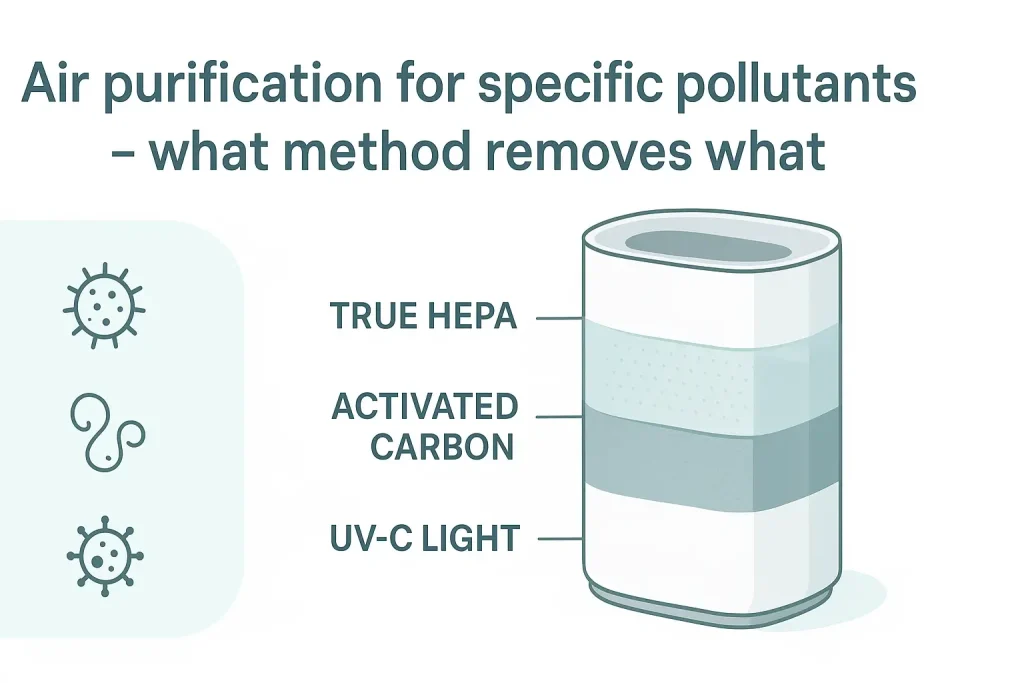
True HEPA vs Activated Carbon: Why a Shared Apartment Needs Both
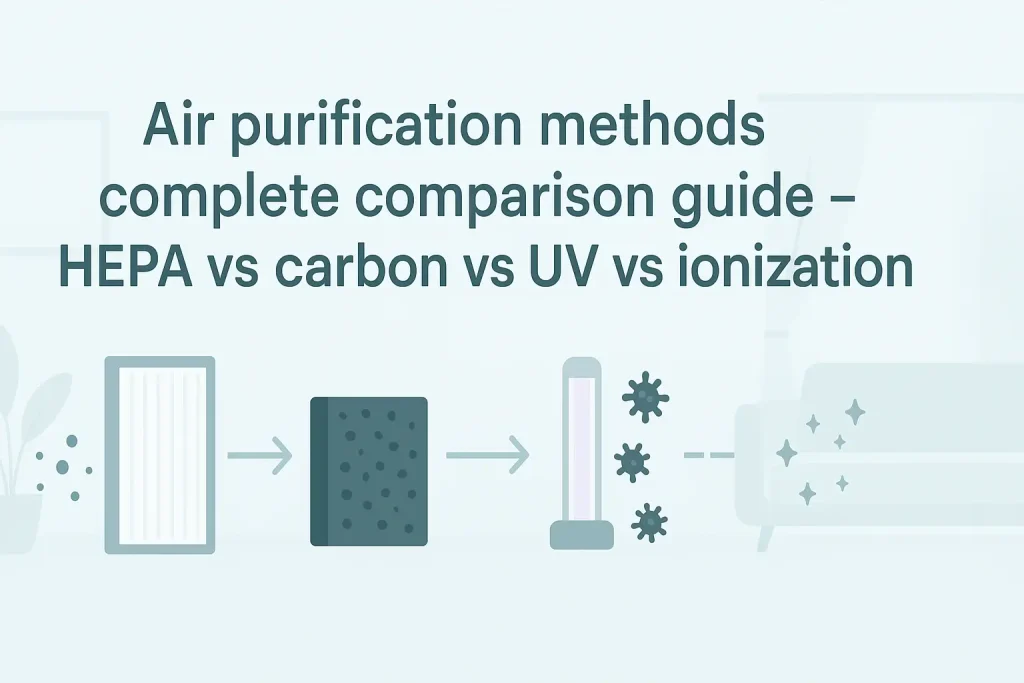
True HEPA filtration captures 99.97% of airborne particles at 0.3 microns, the most penetrating particle size. This includes PM2.5 from traffic and cooking, pet dander from your roommate’s cat, dust mite allergen from the carpet, and mold spores from the bathroom with the broken exhaust fan. True HEPA does not capture gases, odors, VOCs, or formaldehyde. It cannot remove the smell of your neighbor’s fried food or the chemical off-gassing from the new IKEA bookshelf in the corner.
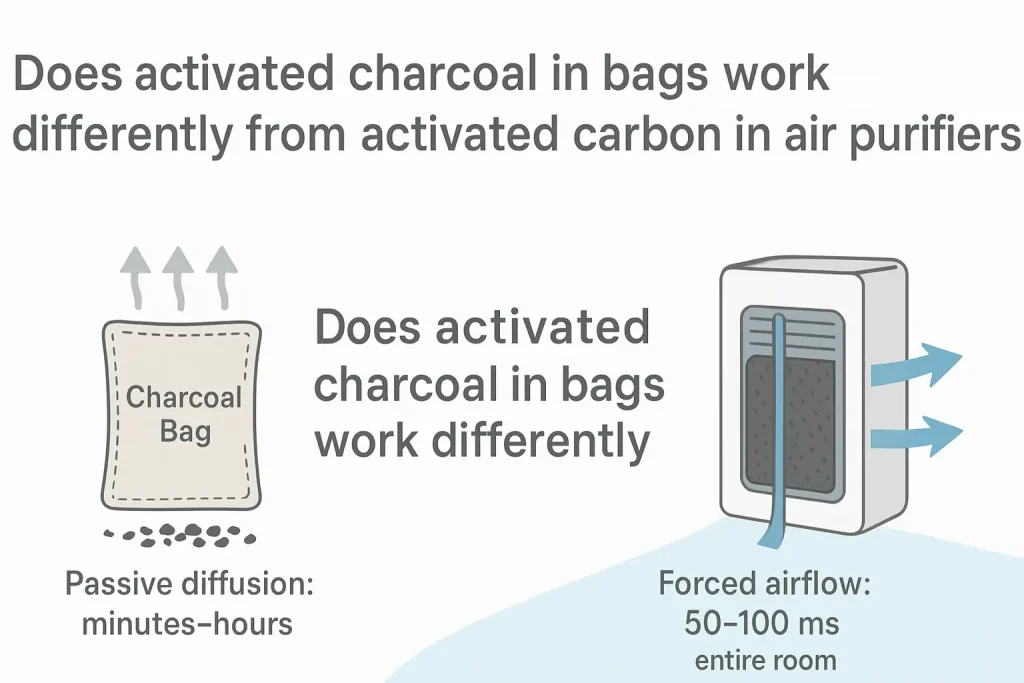
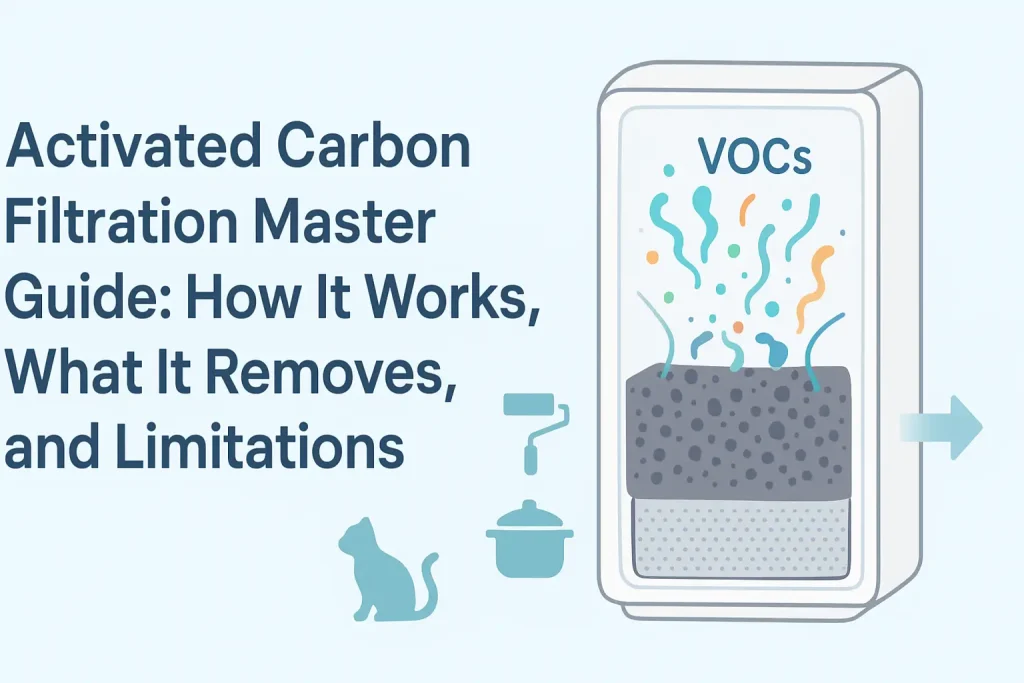
For gaseous pollutants, you need activated carbon filtration. Activated carbon adsorbs VOC molecules onto its porous surface through a physical process driven by molecular attraction. The carbon’s internal surface area, typically 500 to 1,500 square meters per gram, provides the binding sites. The critical specification is carbon weight. Units with less than 1 pound of activated carbon provide limited VOC removal and saturate within weeks in a shared apartment environment with multiple VOC sources. Units with 5 to 15 pounds of carbon, such as the Austin Air HealthMate or IQAir GC MultiGas, provide meaningful VOC removal that lasts 2 to 5 years under normal conditions.
For a shared apartment, the optimal configuration is a True HEPA filter plus an activated carbon stage with at least 1 to 2 pounds of carbon. This combination addresses the particle load from shared ventilation and cooking while also managing odors and VOCs from cleaning products, furniture, and building materials. A unit with True HEPA and a token carbon sheet (common in budget air purifiers) removes particles but does functionally nothing for the cooking smells and chemical odors that are the most noticeable shared-apartment air quality complaint.
Quick Reference
Air Purifier Terms Explained – Searchable Glossary
Definitions for every technical term used in this guide. Type to search.
A filter standard requiring capture of at least 99.97% of airborne particles at 0.3 microns (the most penetrating particle size). H13 grade. Distinct from HEPA-type or HEPA-like filters, which are unregulated marketing terms with no standardized efficiency.
A standardized metric developed by AHAM measuring the volume of filtered air an air purifier delivers per minute, in cubic feet per minute (CFM). Certified separately for smoke, dust, and pollen. Smoke CADR is the most relevant value for PM2.5 and shared apartment cooking and traffic pollution.
The number of times per hour an air purifier processes the entire volume of air in a room. Manufacturer coverage area claims use 2 ACH. Allergy and asthma guidelines recommend 5 ACH, which reduces the effective coverage area to 40% of the manufacturer-stated figure.
Fine particulate matter with diameter of 2.5 microns or smaller. The primary health-hazardous component of cooking emissions, traffic pollution, and wildfire smoke. True HEPA filters capture PM2.5 at 99.97% efficiency. Linked to respiratory and cardiovascular disease at sustained concentrations above 12 micrograms per cubic meter (EPA annual standard).
Gaseous chemicals emitted from household products including paint, furniture, flooring, cleaning products, and adhesives. Common VOCs include formaldehyde, benzene, and toluene. Removed by activated carbon filtration, not by HEPA mechanical filtration. EPA notes indoor VOC concentrations are 2 to 10 times higher than outdoors.
A filter stage using porous activated carbon to adsorb gaseous pollutants including VOCs, formaldehyde, odors, and some chemical fumes. Does not remove particles. Works in combination with True HEPA. Capacity is proportional to carbon weight. Units with less than 1 pound of carbon offer limited VOC removal.
A device that releases negatively charged ions that attach to airborne particles, causing them to cluster and fall to surfaces or stick to a collection plate. Does not remove particles from the room, only removes them from the air temporarily. Some ionizers produce trace ozone. Not recommended for shared apartments due to surface deposition and ozone concerns.
Certification confirming an air cleaner emits no more than 0.050 ppm ozone under standard operating conditions. The strictest consumer air cleaner ozone standard in the US. Essential for shared apartments where ozone from one unit affects all occupants.
Certification from the Asthma and Allergy Foundation of America confirming a product has been tested and verified to be suitable for people with asthma and allergies. Requires True HEPA filtration, no harmful ozone emission, and validated particle removal performance.
Where to Place an Air Purifier in a Shared Apartment for Maximum Effectiveness
Placement is the most underestimated variable in air purifier performance. A unit placed against a wall in the corner of a room loses 20 to 30 percent of its effective coverage compared to central placement with unobstructed intake and output airflow. A unit placed behind a couch, under a desk, or next to a bookshelf loses even more. The filter media can only capture particles that reach it, and poor placement means a significant fraction of room air never passes through the unit.
In a shared apartment, the optimal placement is central in the room with at least 2 feet of clearance on all sides for the intake, and the output vent pointed toward the center of the room rather than a wall. In practice, most apartments do not have a central empty floor space. The next best placement is along the longest wall, at least 12 inches from the wall, with the output facing across the room rather than into the wall. Avoid placing the unit in a corner, behind furniture, or in an alcove where airflow is restricted.
For shared apartments with multiple rooms, the best strategy uses one adequately sized unit in each occupied room rather than one oversized unit in the living room with the expectation that it cleans the bedroom through the doorway. Even with the door open, the effective CADR in the adjacent room drops by 50 to 70 percent. Your bedroom needs its own unit sized for that specific room’s dimensions and pollutant load.
If budget limits you to one unit, place it in the room where you spend the most continuous time. For most people, this is the bedroom, where you spend 7 to 9 hours breathing the same air each night. A purifier in the bedroom at 5 ACH gives you a full night of filtered breathing. A purifier in the living room at 2 ACH gives you partial-day filtration while you are awake and moving between rooms. The bedroom placement produces the larger health benefit per dollar spent.
Best Air Purifiers for Shared Apartments: Tested by Smoke CADR, Noise, and Filter Cost
The following five air purifiers represent the best combinations of CADR performance, noise level, filter cost, and certification status for shared apartment use. Each unit listed has been selected based on AHAM-certified smoke CADR data, verified noise specifications at sleep and medium fan speeds, and annual filter replacement costs calculated using genuine manufacturer filters at recommended replacement intervals.
Use the table below to compare smoke CADR, coverage at both 2 ACH and 5 ACH, noise level at sleep mode, annual filter cost, and certification status across all five recommended models.
Product Comparison
Air Purifiers Compared – CADR, Coverage, Noise, and Filter Cost
Key specs compared across top picks for shared apartments. CADR from AHAM certified database. Coverage at 5 ACH calculated as smoke CADR x 12 / 5.
| Model | Smoke CADR | Coverage at 2 ACH | Coverage at 5 ACH | Sleep Mode dB | Annual Filter Cost | Best For |
|---|---|---|---|---|---|---|
| Levoit Core 300S | 145 CFM | 219 sq ft | 87 sq ft | 24 dB | $25/yr | Small bedroom, studio under 150 sq ft |
| Coway AP-1512HH | 246 CFM | 360 sq ft | 148 sq ft | 30 dB | $30/yr | Best all-around for most apartment bedrooms |
| Winix 5500-2 | 243 CFM | 360 sq ft | 146 sq ft | 28 dB | $50/yr | Better carbon filter for cooking odors |
| Levoit Core 400S | 260 CFM | 403 sq ft | 156 sq ft | 24 dB | $50/yr | Quietest for shared bedroom at this CADR |
| Coway Airmega 400 | 400 CFM | 1,560 sq ft | 240 sq ft | 22 dB | $60/yr | Shared living rooms and open-plan apartments |
Coway AP-1512HH: The Best Overall Air Purifier for Most Shared Apartments
The Coway AP-1512HH Mighty delivers 246 CFM smoke CADR at a unit price of approximately $100. This CADR-to-price ratio is unmatched among AHAM-certified True HEPA units. At 5 ACH, it covers 148 square feet, which matches the typical apartment bedroom. At 2 ACH, it covers 360 square feet, adequate for a combined bedroom and small sitting area.
Key Specifications: Smoke CADR: 246 CFM. Dust CADR: 248 CFM. Pollen CADR: 232 CFM. Noise: 30 dB sleep mode, 36 dB low, 52 dB high. Annual filter cost: approximately $30 (genuine Coway filter set). Filter type: pre-filter (washable), True HEPA, activated carbon (approximately 0.5 lbs). CARB certified. ENERGY STAR certified. Warranty: 3 years.
The activated carbon stage in the Coway is adequate for light cooking odors and background VOCs but not sufficient for heavy cooking in a poorly ventilated kitchen. For a shared apartment where cooking odors from adjacent units are the primary complaint, the Winix 5500-2 with its larger carbon and AOC (Advanced Odor Control) pellet filter performs better. For most shared apartment bedrooms where PM2.5 and allergens are the primary concern, the Coway is the best value available.
Levoit Core 400S: Quietest Operation for Shared Bedrooms
The Levoit Core 400S delivers 260 CFM smoke CADR at a sleep mode of 24 dB. This 24 dB rating is functionally silent through a shared wall. A roommate 8 feet away in the same room will hear nothing. A neighbor through the wall will hear nothing. For shared apartments where noise is the single highest-stakes variable, this unit is the best choice.
Key Specifications: Smoke CADR: 260 CFM. Coverage: 403 sq ft at 2 ACH, 156 sq ft at 5 ACH. Noise: 24 dB sleep mode, 52 dB max. Annual filter cost: approximately $50. Filter type: True HEPA (H13) plus activated carbon. CARB certified. ENERGY STAR certified. Smart: Wi-Fi, VeSync app control, Alexa and Google Assistant compatible. Warranty: 2 years.
The trade-off is filter cost. At $50 per year for the genuine Levoit replacement filter set, the annual operating cost is roughly $20 higher than the Coway AP-1512HH. Over a 5-year ownership period in a shared apartment, that is a $100 difference for the 6 dB noise reduction at sleep mode. For a light sleeper with a noise-sensitive roommate, that $20 per year is worth it. For a deeper sleeper in a private bedroom with solid walls, the Coway at $30 per year is the better financial choice.
Winix 5500-2: Best for Shared Apartments with Cooking Odor Problems
The Winix 5500-2 delivers 243 CFM smoke CADR and includes a dual carbon filter plus AOC (Advanced Odor Control) pellet filter that provides significantly more gas-phase filtration capacity than any competitor at this price point. For a shared apartment where cooking odors from your unit or adjacent units are the primary complaint, the Winix 5500-2 is the best choice under $200.
Key Specifications: Smoke CADR: 243 CFM. Dust CADR: 246 CFM. Pollen CADR: 232 CFM. Noise: 28 dB sleep mode, 55 dB max. Annual filter cost: approximately $50 (genuine Winix filter set including carbon and AOC pellets). Filter type: pre-filter (washable), True HEPA, activated carbon plus AOC pellets. CARB certified. ENERGY STAR certified. Warranty: 2 years.
The PlasmaWave ionizer is enabled by default but can and should be disabled by pressing the PlasmaWave button for 3 seconds. Winix claims the ionizer produces hydroxyls rather than ozone, but independent testing shows measurable ozone output in some units. For a shared apartment where one occupant may have asthma or chemical sensitivity, disabling the ionizer is mandatory. With the ionizer off, the Winix 5500-2 is a True HEPA plus carbon unit with no ozone risk.
Levoit Core 300S: Best Budget Compact Unit for Small Bedrooms
The Levoit Core 300S delivers 145 CFM smoke CADR at a unit price of approximately $99. At 5 ACH, it covers 87 square feet, which is adequate only for a very small bedroom or a dedicated sleeping alcove in a studio apartment. At 2 ACH, it covers 219 square feet, which is adequate for general air quality maintenance in a standard bedroom but insufficient for allergy or asthma management.
Key Specifications: Smoke CADR: 145 CFM. Coverage: 219 sq ft at 2 ACH, 87 sq ft at 5 ACH. Noise: 24 dB sleep mode, 50 dB max. Annual filter cost: approximately $25. Filter type: True HEPA (H13) plus activated carbon. CARB certified. ENERGY STAR certified. Smart: Wi-Fi, VeSync app control. Warranty: 2 years.
This unit is best as a dedicated bedside purifier in a very small room or as a secondary unit in a larger apartment where the primary unit covers the living area and the Core 300S covers the sleeping area. For a 120-square-foot bedroom, the 145 CFM smoke CADR at 5 ACH covers only 87 square feet, leaving approximately 25 percent of the room under-filtered. In that scenario, the Coway AP-1512HH at 246 CFM is the correct choice for the same approximate price.
Coway Airmega 400: Best for Shared Living Rooms and Open-Plan Apartments
The Coway Airmega 400 delivers 400 CFM smoke CADR through dual fans, covering 240 square feet at 5 ACH and up to 1,560 square feet at 2 ACH. At sleep mode, it operates at 22 dB, making it the quietest high-CADR unit available. For a shared open-plan living room and kitchen area of 300 to 500 square feet, this is the correct-sized unit.
Key Specifications: Smoke CADR: 400 CFM (dual fan combined). Coverage: 1,560 sq ft at 2 ACH, 240 sq ft at 5 ACH. Noise: 22 dB sleep mode, 52 dB max. Annual filter cost: approximately $60 (genuine Coway Max2 filter set). Filter type: pre-filter (washable), True HEPA (dual filters), activated carbon. CARB certified. ENERGY STAR certified. Warranty: 5 years.
At a unit price of approximately $250, this is the most expensive unit in this guide. The 5-year warranty and $60 annual filter cost make the total 5-year ownership cost approximately $550, or $110 per year. For a shared apartment where the purifier serves a common area used by multiple occupants, splitting this cost between roommates makes it accessible. For a single occupant on a tight budget, two smaller units totaling 400 CFM may cost less upfront but will have higher combined annual filter costs.
Find the Right Air Purifier for Your Shared Apartment Situation
Select your primary concern and room size below for a personalized filter type, CADR requirement, and product recommendation specific to shared apartment conditions.
Health Condition Guide
Find the Right Air Purifier for Your Situation
Select your primary concern and room size for a personalized filter type and CADR recommendation.
Filter Replacement Economics: What a Shared Apartment Air Purifier Actually Costs to Run
The purchase price of an air purifier is roughly half the story. The other half is annual filter replacement cost. Over a 5-year ownership period, a $100 unit with $60 annual filters costs $400 total. A $250 unit with $30 annual filters costs $400 total. The purchase price tells you almost nothing about total ownership cost unless you know the filter economics.
For shared apartments where budgets are constrained, the lowest total 5-year ownership cost in a True HEPA unit with adequate CADR belongs to the Coway AP-1512HH: $100 purchase plus $30 per year in filters equals $250 total over 5 years, or $50 per year. The Levoit Core 300S at $99 purchase plus $25 per year equals $224 total over 5 years, but its 145 CFM CADR limits it to very small rooms. The Coway Airmega 400 at $250 purchase plus $60 per year equals $550 total over 5 years, or $110 per year split among roommates in a shared space.
Filter replacement intervals in shared apartments are shorter than manufacturer recommendations when cooking odours, neighbor smoke, or high outdoor PM2.5 are present. A True HEPA filter rated for 12 months in a clean, low-pollution home may saturate in 6 to 9 months in an apartment directly above a busy street or adjacent to a unit with a smoker. Budget for at least one extra filter replacement per year if you live in a high-pollution urban area or a building with shared ventilation that routes cooking emissions between units.
For a deeper look at how different pollutant types affect filter lifespan and cost, our guide on air purifiers for allergies covers filter loading rates for pollen and dust mite seasons. If your shared apartment has persistent mould concerns from building moisture issues, the mould-specific air purifier guide explains which filter types handle spore loads without premature clogging.
What to Avoid: Air Purifier Types That Do Not Work in Shared Apartments
Three categories of air purifier are specifically unsuitable for shared apartments: ionizers without mechanical filtration, ozone generators, and undersized units marketed with inflated coverage claims. Each of these fails in a way that is worse than having no purifier at all because they create a false sense of security while air quality remains poor.
Ionizers and electrostatic precipitators without a True HEPA stage remove particles from the air by charging them and causing them to stick to surfaces. The particles are not removed from the room. They are redistributed to walls, furniture, and floors. In a shared apartment, this means your roommate’s cooking particles end up as a grey film on every surface rather than being trapped in a replaceable filter. When disturbed, those particles re-enter the air. This is not filtration. It is particle relocation.
Ozone generators are marketed as air purifiers but produce ozone at concentrations that exceed the CARB limit of 0.050 ppm. Ozone is a respiratory irritant that reacts with indoor chemicals to form secondary pollutants including formaldehyde and ultrafine particles. In a shared apartment, ozone from one unit affects all occupants through connected air spaces. The EPA explicitly warns against using ozone generators in occupied spaces. Avoid any device marketed as an ozone air purifier, ozone generator, or ionic air purifier that lacks CARB certification.
Units with inflated coverage claims are the most common failure mode. A purifier claiming “covers 500 square feet” without an AHAM-certified CADR may deliver 50 CFM smoke CADR, which covers 30 square feet at 5 ACH. In a 200-square-foot bedroom, that unit achieves 0.5 ACH. Particulate levels decline by roughly 15 to 20 percent after 2 hours of operation. The purifier appears to be working because the fan is running and the filter eventually discolors, but the health benefit is negligible. Always verify CADR through the AHAM Verifide database before purchasing.
Before You Buy an Air Purifier for Your Shared Apartment: Complete Checklist
Buying Guide
Before You Buy an Air Purifier for a Shared Apartment – Complete Checklist
Check off each point before making your decision. Based on AHAM and EPA buying guidance with shared apartment considerations.
Smoke CADR Needed by Room Size and ACH Target for Shared Apartments
Use the table below to match your room dimensions to the correct smoke CADR requirement at the ACH target appropriate for your situation. Shared apartments with multiple pollution sources from cooking, neighbors, and urban outdoor air should always use the 5 ACH column.
CADR Reference
Smoke CADR Needed by Room Size and Air Changes Per Hour Target
All values pre-calculated at standard 8 ft ceiling height. Formula: (room area x 8 x ACH) / 60. Source: AHAM methodology.
| Room size (8 ft ceiling) / ACH target | 2 ACH (standard) | 4 ACH (moderate) | 5 ACH (allergy) | 6 ACH (wildfire) |
|---|---|---|---|---|
| 100 sq ft (small bedroom) | 27 CFM | 53 CFM | 67 CFM | 80 CFM |
| 150 sq ft (typical apartment bedroom) | 40 CFM | 80 CFM | 100 CFM | 120 CFM |
| 200 sq ft (larger bedroom) | 53 CFM | 107 CFM | 133 CFM | 160 CFM |
| 300 sq ft (shared living room) | 80 CFM | 160 CFM | 200 CFM | 240 CFM |
| 500 sq ft (open-plan apartment) | 133 CFM | 267 CFM | 333 CFM | 400 CFM |
Formula: smoke CADR needed = (room length ft x room width ft x 8 ft ceiling x ACH) / 60. The highlighted cell shows the most common shared apartment scenario: a 150 sq ft bedroom at 5 ACH requiring 100 CFM smoke CADR. For allergy and asthma sufferers in shared apartments, always use the 5 ACH column. Manufacturer coverage area claims use 2 ACH; the effective coverage for allergy sufferers is 40% of the stated figure.
Can I Use a Single Air Purifier for a Whole Shared Apartment?
A single air purifier can cover a studio apartment up to approximately 400 square feet if the unit has sufficient CADR and the apartment is an open-plan layout with no doors separating the sleeping area from the living area. Beyond 400 square feet, or in apartments with walls and doors separating rooms, a single unit cannot effectively clean air in adjacent rooms. The CADR loss through an open doorway is approximately 50 to 70 percent, meaning a unit delivering 400 CFM in the living room delivers only 120 to 200 effective CFM in the adjacent bedroom with the door open. With the door closed, it delivers zero CFM to the bedroom.
For shared apartments with separate bedrooms, the correct strategy uses one adequately sized unit per bedroom plus one unit for the common living area if pollutant levels there are a concern. If budget limits you to one unit, place it in the bedroom where you spend 7 to 9 hours continuously. The health benefit of filtered breathing during sleep is larger than the benefit of partial-day filtration in a living room you occupy intermittently while moving between rooms.
How Often Should I Replace the Filter in a Shared Apartment Air Purifier?
Manufacturer recommendations assume a clean home with low to moderate pollution levels. In a shared apartment with cooking emissions, neighbor pollutants through shared ventilation, and urban outdoor PM2.5, filter replacement intervals shorten by 25 to 50 percent. A True HEPA filter rated for 12 months should be replaced at 6 to 9 months. An activated carbon filter rated for 6 months should be replaced at 3 to 4 months if cooking odors or VOC sources are persistent.
Visual inspection is not a reliable indicator of filter loading. A HEPA filter can appear dark grey and still have 40 to 50 percent of its service life remaining, or it can appear relatively clean and already have high pressure drop reducing CADR by 15 to 20 percent. The most reliable indicators are reduced airflow at the same fan speed setting and, if available, the unit’s built-in filter replacement indicator which typically measures runtime hours rather than actual filter condition.
For shared apartments in buildings with known indoor air quality issues, our VOC and chemical off-gassing guide explains how activated carbon filter lifespan changes under continuous chemical exposure. If your apartment has new furniture, recent painting, or a neighboring unit undergoing renovation, expect carbon filter replacement intervals to shorten significantly.
Does an Air Purifier Help with Neighbor Smoke and Cooking Smells?
An air purifier with adequate activated carbon filtration captures cooking odors and some smoke compounds from neighboring units that enter through shared ventilation, door gaps, and window infiltration. True HEPA filtration captures the particulate component of smoke (PM2.5) but does nothing for the gaseous odor compounds. The carbon stage must have sufficient weight, typically 1 to 2 pounds or more for meaningful odor control in a shared apartment environment. Units with thin carbon sheets, common in budget air purifiers, saturate within days to weeks when exposed to continuous neighbor cooking emissions.
For persistent neighbor smoke entering through shared ventilation, an air purifier is a partial solution. The purifier removes PM2.5 from your air but cannot address the source. If neighbor smoke is a significant and ongoing issue, additional measures such as sealing door gaps with weather stripping, requesting HVAC filter upgrades from the building manager, and using a draft reduction strategy to minimize air infiltration between units are necessary complements to air purification.
Where Should the Air Purifier Be Placed in a Studio Apartment?
In a studio apartment where sleeping, living, and cooking zones share one open space, place the air purifier in the zone where you spend the most continuous time. For most people, this is the sleeping zone. Position the unit centrally in the sleeping zone with at least 2 feet of clearance on all sides, or along the longest available wall with at least 12 inches of clearance and output facing into the room. Avoid placing the unit in the kitchen zone, as cooking grease will rapidly clog the pre-filter and activated carbon stage.
If the studio has a sleeping alcove separated by a partial wall or curtain, position the purifier in the sleeping alcove with output facing into the larger room. This creates a positive pressure zone in the sleeping area, reducing infiltration of pollutants from the kitchen and living zones. The purifier continuously cleans the sleeping zone air while also contributing to general air quality improvement in the larger space through air exchange across the partial barrier.
Can I Use an Air Purifier with a Pet in a Shared Apartment?
Yes. An air purifier with True HEPA filtration captures pet dander, which is a common allergen in shared apartments where one roommate may be allergic to another roommate’s pet. Pet dander particles range from approximately 0.5 to 100 microns, with the most allergenic fraction in the 2 to 10 micron range. True HEPA captures these particles at 99.97 percent efficiency. The activated carbon stage also captures pet odors that are a common source of roommate conflict in shared apartments.
Units with washable pre-filters are strongly preferred for pet-occupied shared apartments. Pet hair and larger dander particles load the pre-filter rapidly, and a washable pre-filter can be cleaned every 2 to 4 weeks rather than replaced. The Coway AP-1512HH and Coway Airmega 400 both include washable pre-filters. For more detailed guidance on air purification in pet-occupied shared spaces, our dedicated guide on air purifiers for pets covers CADR requirements for pet dander and the best filter configurations for multi-pet apartments.
Is an Ionizer Air Purifier Safe for a Shared Apartment?
Ionizer air purifiers are not recommended for shared apartments. Ionizers emit negatively charged ions that cause particles to cluster and fall to surfaces rather than being captured in a filter. The particles are not removed from the room; they are redistributed to walls, furniture, and floors where they can be resuspended into the air. In a shared apartment with multiple occupants, one person’s ionizer deposits particles on surfaces everyone touches. Additionally, some ionizers produce measurable ozone, and in a connected air space, that ozone affects all occupants.
If the ionizer is a secondary stage in a hybrid unit that also includes True HEPA (such as the Winix 5500-2 PlasmaWave), disable the ionizer. The True HEPA stage provides the particle removal. The ionizer adds no additional filtration benefit and introduces unnecessary ozone risk. For shared apartments where one occupant has asthma or chemical sensitivity, CARB-certified units with no ionization stage are the safest choice.
For readers dealing with vaping aerosols in shared apartments, our guide on air purifiers for vaping explains the specific CADR and carbon requirements for aerosol removal, which applies similarly to other fine aerosol sources in shared living environments.
What Is the Difference Between True HEPA and HEPA-Type Filters in Practical Terms?
True HEPA is a certified standard requiring capture of at least 99.97% of airborne particles at 0.3 microns, the most penetrating particle size. HEPA-type, HEPA-like, and 99% HEPA are unregulated marketing terms with no standardized test methodology. A filter labeled HEPA-type may capture 85%, 95%, or 99% of 0.3 micron particles depending on the manufacturer’s design and quality control. You cannot know from the label alone. For a shared apartment where PM2.5 from traffic, cooking, and neighbor emissions is the primary pollutant, True HEPA certification is not optional. It is the difference between verified filtration and marketing language.
Why Does My Air Purifier Smell Like Plastic When It Is New?
A new air purifier may emit a temporary plastic or chemical odor from manufacturing residues on the housing, fan components, and filter media. This is typically off-gassing of volatile compounds from new materials. Run the unit on high fan speed in an unoccupied room with windows open for 24 to 48 hours before placing it in a bedroom or shared living space. If the odor persists beyond 48 hours, it may indicate the unit is using materials that continue to off-gas VOCs, which is counterproductive in an air purifier. Return the unit and select a CARB-certified model from a manufacturer that uses low-VOC materials.
Can I Leave My Air Purifier Running 24/7 in a Shared Apartment?
Yes. Air purifiers are designed for continuous operation. Running 24/7 on auto mode or a combination of auto mode during the day and sleep mode at night provides the most consistent air quality. The electricity cost of continuous operation for an ENERGY STAR certified unit at medium fan speed, typically 30 to 45 watts, is approximately $30 to $47 per year at the US average electricity rate of 13 cents per kWh. At sleep mode power draw of 5 to 10 watts, the annual cost drops to $5 to $11. There is no mechanical or filter life penalty for continuous operation; the fan motor is rated for continuous duty, and filter life is determined by total air volume processed, not calendar time.
A shared apartment purifier that provides the correct CADR for the room, operates below 30 dB at sleep mode, includes True HEPA plus activated carbon filtration, and carries CARB certification will measurably improve air quality for all occupants starting the first day it runs. The correct unit for your specific room, placed correctly and maintained with genuine filters at the appropriate interval, transforms shared apartment air from a collection of neighborhood and building pollutants into air that is consistently cleaner than outdoor ambient levels.
The single most important number is smoke CADR matched to your room at 5 ACH. Every other feature, certification, and specification is secondary to that calculation. Get the CADR right, verify the noise level at sleep mode, confirm CARB certification, and budget for filter replacements at realistic intervals for your shared apartment’s specific pollutant mix. That sequence produces an air purifier purchase that actually solves the air quality problem rather than just moving air around while particles and odors remain.