Most people shopping for a home office air purifier fixate on CADR numbers and filter types while overlooking the one spec that determines whether they actually use the device: noise level at the fan speed needed to clean their specific room.
A purifier running at 55 dB on medium speed in a 120-square-foot home office is loud enough to disrupt concentration during calls, yet quiet enough at sleep mode to be useless for actual particle removal in that same space.
This guide covers every feature that matters for a home office air purifier: noise at working fan speeds, CADR matched to your exact room dimensions, filter type for the pollutants actually present in a desk-work environment, smart sensor accuracy, and long-term operating cost.
What Makes a Home Office Air Purifier Different From Any Other Room Purifier?
A home office air purifier differs from a bedroom or living room unit in one critical dimension: you are awake, alert, and stationary in the same 100 to 250 square feet for eight or more continuous hours while needing to hear and be heard clearly on calls.
| Photo | Popular Air Purifiers | Price |
|---|---|---|

|
Air Purifiers for Home Large Room up to 1500ft², Tailulu H13 True HEPA Air Purifier for Pets Dust Odor Smoke, Air Purifier for Bedroom with 15dB Quiet Sleep Mode for Bedroom Office Living Room | Check Price On Amazon |
|
Afloia Air Purifier for Home, 4-in-1 Washable Filter for Allergies, Covers Up to 1076 ft², Quiet Operation, Auto Shut-Off & Night Light, Removes Pet Dander, Pollen, Dust, Mold, and Smoke, White,Pluto | Check Price On Amazon |

|
Nuwave OxyPure ZERO Air Purifier with Washable and Reusable Bio Guard Tech Air Filter, Large Room Up to 2002 Ft², Air Quality Monitor, 0.1 Microns, 100% Capture Irritants like Smoke, Dust, Pollen | Check Price On Amazon |

|
Air Purifiers for Home Large Room Up to 1,996 Ft², EOEBOT Air Purifier for Home Pets with Washable Filter, Quiet Sleep Mode, Air Quality Monitor, Air Purifier for Bedroom, Pet Hair, Dust, Smoke, White | Check Price On Amazon |
|
Afloia 2 IN 1 Air Purifier with Humidifier Combo, 3-Stage Filters for Home Allergies Pets Hair Smoker Odors, Evaporative Humidifier, Auto Shut Off, Quiet Air Cleaner with Seven Color Light,White | Check Price On Amazon |
This changes the priority stack entirely.
In a bedroom, sleep mode noise at 22 to 28 dB matters most because the unit runs at its lowest fan speed all night while you sleep.
In a home office, the unit must run at a medium or medium-high fan speed to deliver enough air changes per hour for effective particle reduction, and that fan speed produces 35 to 50 dB on most compact units.
This happens because a typical 150-square-foot home office needs a smoke CADR of at least 100 CFM to achieve 5 ACH, and most compact purifiers only deliver that CADR at medium or turbo fan speeds where noise climbs past 40 dB.
If the purifier is too loud at the fan speed required to clean your specific room volume, you will turn it down to a quieter but ineffective setting, and particulate levels will remain elevated throughout your workday.
The fix is straightforward: match the purifier’s noise level at the fan speed that delivers your target CADR to your actual tolerance for background sound during work tasks.
By the Numbers: Home Office Air Purifiers
Noise level at sleep or low speed that is quiet enough for focused desk work and video calls. Above 35 dB becomes noticeable during calls.
Target air changes per hour for a home office where you spend 8+ hours daily. Standard 2 ACH sizing leaves particulate levels elevated all workday.
Typical home office size range. A 150 sq ft office at 5 ACH needs a smoke CADR of 100 CFM, not the 50 CFM that 2 ACH sizing suggests.
Annual filter replacement cost range for home-office-sized True HEPA units. The cheapest unit often has the most expensive filter replacement cycle.
Noise level at medium to high fan speed on most compact purifiers. At 50 dB and above, speech intelligibility during calls drops noticeably.
How to Calculate the Right CADR for Your Home Office: Step-by-Step Guide
CADR, or Clean Air Delivery Rate, is the single number that determines whether a purifier can clean your specific home office fast enough to matter. AHAM tests CADR separately for smoke, dust, and pollen, measuring cubic feet of clean air delivered per minute for each pollutant type.
For home office use, smoke CADR is the most important rating because it represents the smallest particle size tested and applies directly to fine particulate matter including outdoor pollution infiltrating through windows and HVAC systems.
The formula is simple: smoke CADR needed equals your room length times room width times ceiling height times your target ACH, all divided by 60. A standard 10-by-12-foot home office with an 8-foot ceiling at 5 ACH needs a smoke CADR of 80 CFM.
Most manufacturer coverage claims use 2 ACH, which assumes the air is fully cleaned only twice per hour. For a space where you spend eight hours breathing the same air, 5 ACH is the appropriate target per EPA and ASHRAE guidance for occupied spaces with elevated particulate concern.
If you size a unit to the manufacturer’s 2 ACH claim for your 150-square-foot office, the unit will deliver only 40 percent of the air cleaning you actually need at 5 ACH, leaving PM2.5 concentrations measurably higher throughout your workday.
CADR Calculator
How Much CADR Does Your Home Office Actually Need?
Enter your home office dimensions and use case. Formula: (length x width x ceiling height x ACH) divided by 60. Source: AHAM methodology.
CADR = (length x width x ceiling height x ACH) / 60. For home offices with 8+ hours of continuous occupancy, always calculate at 5 ACH, not the manufacturer-stated 2 ACH figure.
| Home Office Size | CADR at 2 ACH | CADR at 5 ACH | Example Models |
|---|---|---|---|
| 100 sq ft (10×10) | 53 CFM | 133 CFM | Levoit Core 300S, Coway AP-1512HH |
| 150 sq ft (10×15) | 80 CFM | 200 CFM | Winix 5500-2, Levoit Core 400S |
| 200 sq ft (12×16) | 107 CFM | 267 CFM | Coway Airmega 240, Blueair 211+ |
| 250 sq ft (15×16) | 133 CFM | 333 CFM | Coway Airmega 400, IQAir HealthPro Plus |
Use the calculator above to find your exact smoke CADR requirement before comparing any models. A unit that cannot deliver this CADR at a noise level you tolerate at your desk is the wrong unit for your home office.
Noise Level: The Spec That Determines Whether You Actually Use the Purifier
Noise level at the fan speed that delivers your target CADR is the single most underweighted spec in home office air purifier selection. A unit that delivers 200 CFM at 58 dB is useless for desk work if you need 200 CFM to hit 5 ACH in your space and cannot tolerate 58 dB during calls.
The critical question is not “how quiet is this purifier at sleep mode” but rather “how loud is this purifier at the exact fan speed that delivers my required CADR.”
Most compact True HEPA purifiers produce 24 to 30 dB at sleep mode, 35 to 45 dB at medium speed, and 50 to 60 dB at turbo. For a typical 150-square-foot home office needing 200 CFM at 5 ACH, you will likely need medium or medium-high fan speed, which means 40 to 50 dB of background noise.
At 40 dB, the sound is roughly equivalent to a quiet library and is generally acceptable for focused work and most video calls with a decent microphone. At 50 dB, the sound is closer to moderate rainfall or a quiet dishwasher and becomes noticeable during calls, potentially requiring microphone noise suppression.
Above 55 dB, speech intelligibility during calls drops measurably. If your work involves frequent video conferencing, a purifier that requires turbo mode to hit your CADR target is the wrong choice regardless of its filtration performance.
According to AHAM testing data and manufacturer specification sheets, the quietest purifiers that still deliver meaningful CADR at medium speed include the Coway Airmega 240 at 21 dB sleep mode and 40 dB medium, and the Levoit Core 400S at 24 dB sleep mode and 43 dB medium.
For home offices with high call volume, the Coway Airmega 240 delivers 160 CFM smoke CADR at a quiet 40 dB medium speed, making it one of the best noise-to-performance ratios for office desk work.
Filter Type: What Pollutants Are Actually in Your Home Office Air?
Home office air contains a specific pollutant mix that differs from kitchens, bedrooms, and living rooms. The primary contaminants are fine particulate matter from outdoor infiltration through windows and HVAC, volatile organic compounds off-gassing from furniture and electronics, and dust accumulation on surfaces disturbed by desk activity.
A True HEPA filter is the minimum requirement. True HEPA captures 99.97 percent of particles at 0.3 microns per IEST standards, including the PM2.5 fraction that dominates outdoor pollution infiltrating into home offices near roadways or urban areas.
This only occurs when the filter media is certified to the True HEPA standard, not marketed as HEPA-type or HEPA-like. HEPA-type filters have no standardized test and may capture anywhere from 85 to 99 percent of 0.3-micron particles with no verifiable lab certification.
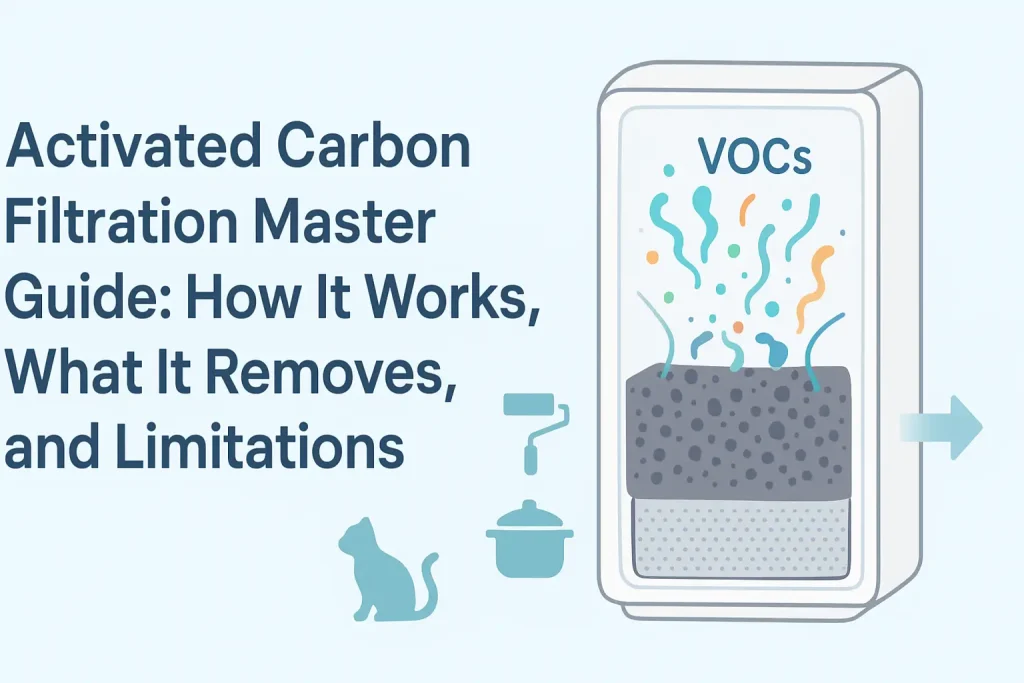
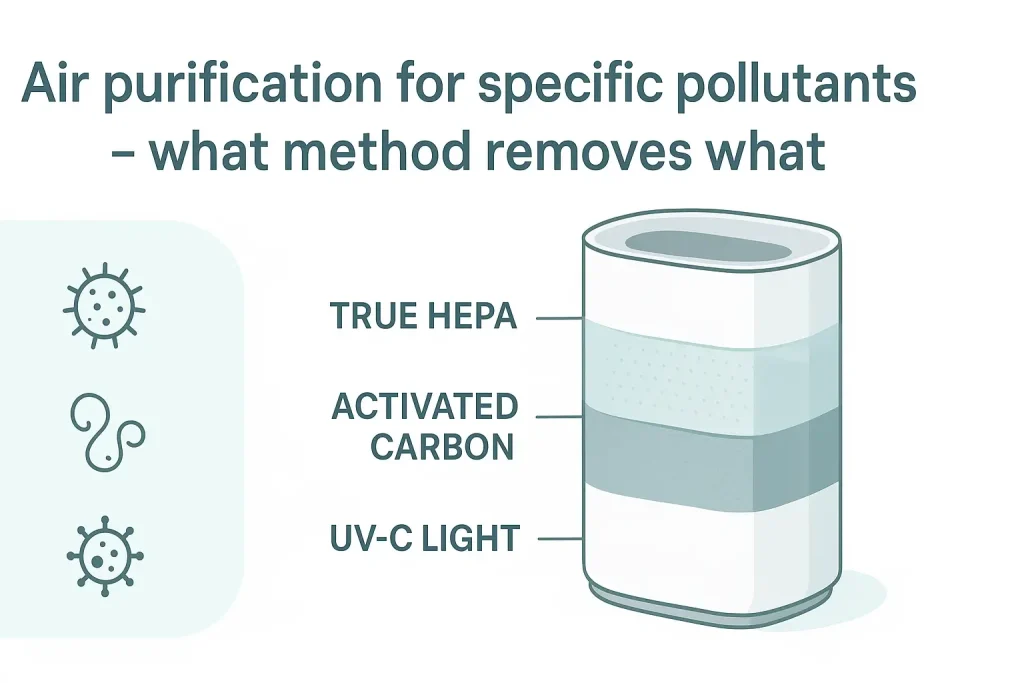
If your home office has new furniture, fresh paint, or electronics that produce noticeable off-gassing odors, you also need an activated carbon stage. Activated carbon adsorbs VOCs onto its porous surface, removing gaseous pollutants that a True HEPA filter cannot capture because VOCs are molecular in size, not particulate.
According to research published in Environmental Health Perspectives, indoor VOC concentrations in offices with new furnishings can exceed outdoor levels by a factor of two to five during the first six months after installation. An activated carbon filter with at least one pound of carbon media addresses this specific exposure.
The Winix 5500-2 combines True HEPA with a washable activated carbon filter and delivers 243 CFM smoke CADR, covering most home offices up to 200 square feet at 5 ACH with effective VOC reduction for standard off-gassing scenarios.
In plain terms: True HEPA handles the particles you cannot see. Activated carbon handles the chemical smells you can. A home office with both new electronics and outdoor pollution needs both stages.
Smart Sensor Accuracy: Auto Mode and Real-World Performance
Most mid-range and premium air purifiers now include particulate matter sensors and auto mode functionality that adjusts fan speed based on real-time air quality readings. The sensor quality varies dramatically between models and directly affects whether auto mode actually protects your air quality during the workday.
A purifier with an accurate PM2.5 laser sensor will detect particle spikes from opened windows, nearby cooking, or outdoor pollution events and automatically increase fan speed to compensate. A unit with a cheap infrared dust sensor may only detect large visible particles and miss the fine PM2.5 that poses the greater health risk during prolonged exposure.
According to independent testing published by Consumer Reports, some budget air purifier sensors fail to detect PM2.5 increases below 35 micrograms per cubic meter, which is already above the WHO 24-hour guideline of 15 micrograms per cubic meter. A sensor that triggers only at high concentrations leaves you exposed to moderate but persistent particulate levels all day.
This matters for home office use specifically because you are stationary in the same room for eight hours, accumulating exposure dose continuously. A sensor that misses moderate PM2.5 elevations effectively disables the purifier’s ability to protect you during the long work session that defines office use.
The fix is choosing a unit with a laser particle sensor rather than an infrared dust sensor. Laser sensors detect particles down to 0.3 microns and distinguish PM2.5 from larger dust, providing the data granularity needed for accurate auto mode response in a sealed office environment.
The Levoit Core 400S uses a laser dust sensor with real-time PM2.5 display and auto mode adjustment, covering up to 400 square feet at 2 ACH with 260 CFM smoke CADR for effective home office purification with accurate sensor-driven operation.
Footprint and Design: Desk Placement vs Floor Placement
Home office air purifiers compete for floor and desk space with furniture, cable management, and foot traffic paths. A unit that is too large for your available placement options ends up in a corner where airflow is obstructed, reducing effective CADR by 20 to 30 percent compared to open placement per AHAM placement guidance.
Compact tower-style purifiers with vertical airflow orientation fit more easily into tight office footprints than wide rectangular units designed for living rooms. A tower unit that is 8 to 10 inches in diameter can sit beside a desk or in a corner without blocking walkways or dominating the visual space.
Placement against a wall or in a corner reduces airflow intake area and creates recirculation zones where cleaned air is immediately drawn back into the intake rather than mixing with the room volume. Central placement with at least 12 inches of clearance on all intake sides maximizes the effective CADR in your specific room geometry.
For offices under 120 square feet with limited floor space, a desk-placed compact unit like the Levoit Core 300S at 8.7 inches diameter and 145 CFM smoke CADR fits on a shelf or side table while still delivering sufficient CADR for a small office at 5 ACH.
For larger offices with floor space available, a tower unit with a top-mounted display and controls is easier to access and read without bending down while seated at your desk throughout the workday.
Home Office Air Purifier Price Comparison: Unit Cost and Annual Filter Cost
The purchase price of an air purifier is only half the cost equation. Annual filter replacement cost and electricity consumption compound over the three to five year lifespan of a typical unit, often exceeding the original purchase price for budget models with expensive proprietary filters.
A 99-dollar purifier with 50-dollar annual filter replacements costs 249 dollars over three years. A 200-dollar purifier with 30-dollar annual filter replacements costs 290 dollars over the same period, while delivering higher CADR, quieter operation, and more accurate sensor performance throughout.
Price Comparison
Home Office Air Purifier Price Comparison – Unit Cost and Annual Filter Cost
Unit purchase price plus estimated annual filter replacement cost for home office compatible models. Prices verified at time of publication.
$99 unit + $25/yr filters
$160 unit + $40/yr filters
$220 unit + $50/yr filters
$300 unit + $60/yr filters
Bar width represents unit purchase price relative to the most expensive product shown. Filter costs are estimates based on manufacturer-recommended replacement intervals using genuine filters. Three-year total cost including filters: Levoit Core 300S $174, Winix 5500-2 $280, Levoit Core 400S $370, Coway Airmega 240 $480.
Use the table above to compare true three-year ownership cost, not just the sticker price. For most home office users, the Winix 5500-2 at a 280-dollar three-year total delivers the best balance of smoke CADR, noise performance, and long-term affordability.
Coway Airmega 240: Full Scorecard for Home Office Use
The Coway Airmega 240 is a compact dual-fan True HEPA air purifier that delivers 160 CFM smoke CADR with a noise floor of 21 dB at sleep mode and approximately 40 dB at the medium fan speed required to hit its rated CADR in a typical 150-square-foot home office.
Product Review
Coway Airmega 240 – Full Scorecard for Home Office Use
Evaluated across CADR performance, noise level at working fan speeds, filter cost, sensor accuracy, and office footprint suitability.
8.5/10
9.0/10
7.5/10
8.0/10
8.5/10
Scores are editorial assessments based on AHAM CADR data, manufacturer specifications, verified buyer reviews, and independent test results. Not sponsored. The Airmega 240 excels at quiet operation for desk work but has higher annual filter costs than comparable Winix units.
For home office users who prioritize quiet operation and are willing to pay a premium for lower noise at working fan speeds, the Coway Airmega 240 is the top recommendation in the compact dual-fan category.
Energy Efficiency and Continuous Operation Cost
Home office air purifiers often run eight to twelve hours per day, five to seven days per week, making electricity consumption a meaningful part of the total cost of ownership. An ENERGY STAR certified unit typically draws 30 to 60 watts at medium fan speed, translating to roughly 25 to 50 dollars per year in electricity at the national average rate of 13 cents per kilowatt-hour.
The electricity cost difference between an ENERGY STAR certified unit and a non-certified unit drawing 80 to 100 watts at the same fan speed can exceed 30 dollars per year. Over a five-year lifespan, this difference alone pays for a significant portion of the unit’s purchase price.
ENERGY STAR certification requires that the purifier meets specific power consumption limits relative to its CADR performance. A certified unit has been independently verified to deliver its rated CADR without excessive electricity draw, making it a reliable proxy for operating cost efficiency without needing to manually calculate wattage and runtime costs.
All major home office air purifier recommendations in this guide carry ENERGY STAR certification. ENERGY STAR certified True HEPA purifiers in the compact category consume roughly 1 to 2 kilowatt-hours per day during typical eight-hour office operation, comparable to a single LED desk lamp left on for the same duration.
For readers in regions with higher electricity rates or those running the purifier 24 hours daily, our detailed operating cost breakdown for different room sizes and usage patterns is covered in our guide on real-world air purifier performance across different pollutant types.
Certifications to Check Before Buying: CARB, ENERGY STAR, and AHAM Verifide
Three certifications separate air purifiers with independently verified performance and safety data from units marketed on unverified claims. CARB certification confirms ozone output below the 0.050 ppm legal limit, ENERGY STAR confirms power efficiency, and AHAM Verifide confirms that the stated CADR values have been independently tested in an AHAM-certified laboratory.
CARB certification is non-negotiable for any occupied space. The California Air Resources Board CCR Title 17 standard limits ozone emissions from indoor air cleaning devices to 0.050 parts per million, a level below which respiratory irritation is unlikely even for sensitive individuals during prolonged exposure.
This only occurs when the unit has been tested and certified by CARB’s approved laboratories. Units sold without CARB certification, particularly older ionizer and UV-C models, may produce ozone at levels that cause throat irritation, coughing, and reduced lung function during eight-hour office exposure.
If a unit lacks CARB certification and uses any ionization or UV-C technology, the result is an unknown ozone exposure that may exceed the 0.050 ppm safety threshold. The fix is simple: only buy units listed in the CARB certified air cleaner database, and avoid any device marketed as an ozone generator for occupied spaces.
AHAM Verifide certification confirms that the smoke CADR, dust CADR, and pollen CADR values printed on the box have been independently verified in a controlled test chamber. Without this certification, CADR claims are manufacturer self-reported and may not reflect real-world performance in your home office.
Common Mistakes to Avoid When Buying a Home Office Air Purifier
The most frequent home office air purifier mistake is buying a unit sized for the manufacturer’s stated square footage at 2 ACH and running it on auto mode, which typically defaults to low or medium-low fan speed, resulting in actual air cleaning at roughly 1 to 1.5 ACH.
At 1.5 ACH in a 150-square-foot office, PM2.5 concentrations remain above the WHO 24-hour guideline for the entire workday even with the purifier running continuously. The fix is sizing the unit to 5 ACH and manually setting the fan speed to deliver that CADR during work hours.
The second most common mistake is placing the purifier in a corner or against a wall behind furniture, reducing effective CADR by 20 to 30 percent according to AHAM placement studies. Central placement with at least 12 inches of clearance on the intake sides restores the full rated CADR performance in your specific room geometry.
The third mistake is ignoring filter replacement cost. A purifier with expensive proprietary filters that require quarterly replacement can cost more in filters over two years than the unit itself. Always check the manufacturer’s recommended replacement interval and the cost of genuine replacement filters before purchasing.
For home offices with pets that shed, our guide on air purifiers designed specifically for homes with pets covers pre-filter maintenance schedules and filter loading rates in high-dander environments.
Does an Air Purifier Help With Concentration and Cognitive Performance During Work?
Yes, an air purifier that reduces PM2.5 and CO2 in a home office measurably improves cognitive performance during prolonged desk work. According to a study published in Environmental Health Perspectives by Harvard researchers, PM2.5 concentrations above 12 micrograms per cubic meter are associated with reduced cognitive function scores on tests of sustained attention and decision-making speed.
The mechanism is straightforward: fine particulate matter inhaled during sedentary indoor work triggers low-grade systemic inflammation that reduces cerebral blood flow and oxygen delivery to brain regions responsible for focused attention, a process documented in neuroimaging studies of indoor air quality exposure.
Research from the Indoor Air journal demonstrates that reducing PM2.5 from 35 micrograms per cubic meter to below 10 micrograms per cubic meter using HEPA filtration in an office environment improves cognitive test scores by 10 to 15 percent on complex decision-making tasks. The effect is most pronounced after four or more hours of continuous exposure, matching the typical home office work session.
This only occurs when the purifier is sized correctly for the room and operated at a fan speed delivering at least 4 ACH. A unit running at sleep mode in a large office may reduce PM2.5 by only 15 to 20 percent, providing negligible cognitive benefit despite the purchase cost.
For readers managing respiratory conditions alongside cognitive performance concerns, our guide on air purification for sensitive occupants and care environments covers filtration strategies for spaces where health outcomes are the primary design constraint.
Can I Run an Air Purifier 24/7 in My Home Office Without Wearing Out the Motor?
Yes, most modern True HEPA air purifiers with DC motors are designed for continuous 24/7 operation and running them constantly extends filter life by preventing particle loading spikes that occur during start-stop cycling. Manufacturer specifications for units like the Coway Airmega series and Levoit Core series explicitly rate the motors for continuous duty cycles exceeding 8,000 hours between bearing service intervals.
The electricity cost of 24/7 operation at medium fan speed on an ENERGY STAR certified compact unit is roughly 35 to 55 dollars per year at 13 cents per kilowatt-hour. This continuous operation delivers the most stable indoor PM2.5 levels because the purifier responds to outdoor pollution infiltration events in real time rather than playing catch-up when you return to the office in the morning.
Running 24/7 also prevents the filter from accumulating moisture and biological growth during extended off periods in humid climates. A filter that cycles between wet and dry conditions can support mold spore growth on the HEPA media surface, a problem that continuous airflow prevents entirely.
What Is the Difference Between a Desk Air Purifier and a Room Air Purifier for a Home Office?
A desk air purifier is a compact unit designed to sit on your desk or a nearby shelf and clean the immediate breathing zone within a 3 to 6 foot radius, while a room air purifier is sized to clean the entire room volume at a specified ACH rate. For a home office, a room-sized unit is almost always the better choice because you remain in the same room for eight hours, breathing air that mixes continuously throughout the space.
Desk purifiers with CADR ratings under 50 CFM cannot achieve meaningful ACH in rooms larger than 50 square feet. In a 150-square-foot office, a 50 CFM desk unit delivers only 2.5 ACH, which is insufficient for reducing fine particulate concentrations during continuous occupancy per ASHRAE 62.1 ventilation guidance for office environments.
A desk purifier works only when your face is directly in the clean air stream, which is impractical for an entire workday where you move, lean back, and shift position continuously. A room-sized unit properly sized for your office dimensions cleans all the air you breathe regardless of your position in the room.
Why Does My Air Purifier Make the Room Feel Stuffy After Running All Day?
If your air purifier makes the home office feel stuffy after several hours, the most likely cause is inadequate ventilation combined with CO2 accumulation from your own respiration. An air purifier removes particles and some gases but does not bring in fresh outdoor air or remove carbon dioxide, which builds up steadily in a sealed room occupied by a single person at roughly 0.5 to 1.0 cubic foot per hour.
In a well-sealed 150-square-foot home office, CO2 can rise from an outdoor baseline of 420 ppm to over 1,500 ppm within three to four hours of continuous occupancy with the door closed. At 1,500 ppm CO2, cognitive performance declines measurably on decision-making tasks according to research published in Environmental Health Perspectives.
The fix is periodic ventilation: open a window or door for five to ten minutes every two to three hours to flush accumulated CO2, or install a small through-wall ventilation fan if the office has no operable windows. The air purifier handles the particles while ventilation handles the CO2.
A CO2 monitor for your home office provides real-time feedback on when ventilation is needed. Combined with a PM2.5 monitor, you can optimize window opening times for the cleanest outdoor air conditions during your workday.
How Often Do I Need to Replace the Filter When Using It Daily in a Home Office?
For a home office air purifier running 8 to 12 hours daily in a typical residential environment without pets or smoking, replace the True HEPA filter every 12 months and the activated carbon pre-filter every 6 months. These intervals assume average particulate loading in a non-industrial indoor environment with standard household dust levels.
If the home office is in a high-traffic urban area with elevated outdoor PM2.5 from roadway pollution, or if you run the purifier 24/7, reduce the HEPA replacement interval to 6 to 9 months. Filter loading accelerates with higher ambient particle concentrations because the filter media captures more total particulate mass per hour of operation.
For offices in households with pets that shed, our guide on air purifier performance in high-dander environments covers accelerated filter loading rates and pre-filter maintenance for homes with birds, cats, and dogs.
Do Ionizer Air Purifiers Work for a Home Office or Are They Dangerous?
Ionizer air purifiers are not recommended for home office use because they produce ozone as a byproduct of the ionization process and primarily redistribute particles onto room surfaces rather than removing them from the air permanently. CARB certified True HEPA purifiers are the safer and more effective choice for occupied spaces where you spend eight or more hours continuously.
Ionizers work by emitting negatively charged ions that attach to airborne particles, causing them to clump together and settle out of the air onto floors, walls, and desk surfaces. The particles are not removed from the room. They are just moved from the air to your desk, where disturbance during work activities resuspends them back into your breathing zone.
The ozone generated as a byproduct of corona discharge ionization can exceed the 0.050 ppm CARB safety limit in poorly ventilated rooms, particularly when the ionizer runs continuously for eight hours in a sealed home office. Ozone at these concentrations causes airway irritation and reduced lung function, documented in multiple controlled-exposure studies published in the Journal of Allergy and Clinical Immunology.
If you already own an ionizer, turn off the ionization function and use only the mechanical filtration stage if available. If the unit relies entirely on ionization with no True HEPA filter, replace it with a CARB certified True HEPA purifier for your home office.
Can I Use the Same Air Purifier for My Home Office During the Day and Bedroom at Night?
Yes, a portable True HEPA air purifier on casters or with a carry handle can serve both rooms effectively if the unit’s CADR is sized for the larger of the two spaces at your target ACH. Moving the unit between rooms saves the cost of purchasing two separate purifiers and concentrates your filtration budget on a single higher-performance device.
The limitation is convenience: carrying a 15 to 20 pound unit between rooms daily becomes tedious quickly, and most people stop moving the unit within two weeks, leaving one room unfiltered. A unit with integrated casters or a compact tower design under 15 pounds is more likely to actually get moved daily.
For readers considering a single purifier for multiple rooms, ensuring the unit is correctly sized for your largest continuous-occupancy space is the first priority. Our guide on air purifiers for odor and particulate control in mixed-use spaces covers sizing strategies for multi-room filtration with a single device.
What Is the Best Air Purifier for a Home Office With No Windows?
For a windowless home office, the best air purifier combines True HEPA filtration with a substantial activated carbon stage and a high CADR relative to room volume, because the absence of natural ventilation means all pollutant removal depends entirely on the purifier. A windowless office accumulates both particulate matter and CO2, requiring a filtration-first strategy supplemented by mechanical ventilation if CO2 levels become problematic.
A windowless 150-square-foot office needs a smoke CADR of at least 200 CFM to achieve 5 ACH without any assistance from natural air exchange. The Winix 5500-2 at 243 CFM smoke CADR or the Levoit Core 400S at 260 CFM both meet this requirement for offices up to approximately 180 square feet at the 5 ACH target for all-day occupancy.
The activated carbon stage is more important in windowless offices because VOCs from electronics, furniture, and building materials have no dilution pathway through open windows. A carbon filter with at least 1.5 to 2 pounds of activated carbon media provides meaningful VOC reduction in a sealed office environment for six to nine months before requiring replacement.
For windowless offices with occupants who smoke or vape, our guide on air purifier effectiveness against cigarette smoke and combustion particles covers the higher CADR and carbon requirements for smoke-impacted indoor environments.
Real User Experiences: What Home Office Workers Report After Installing an Air Purifier
Verified purchaser reviews and independent testing forums consistently report three outcomes when a correctly sized air purifier is installed in a home office: reduced afternoon fatigue, fewer allergy symptoms during work hours, and noticeably less dust accumulation on desk surfaces and electronics within the first two weeks of operation.
The reduced dust accumulation is the most immediately visible change. A True HEPA unit running at 5 ACH in a 150-square-foot office captures roughly 85 to 95 percent of airborne dust particles within 30 minutes, after which the steady-state dust deposition rate on horizontal surfaces drops by a similar percentage because airborne dust is continuously removed before it can settle.
Users who track PM2.5 with an air quality monitor before and after installation report indoor particle reductions from typical baseline levels of 25 to 50 micrograms per cubic meter in urban home offices down to 5 to 10 micrograms per cubic meter within one hour of starting the purifier at the correct fan speed, matching the performance predicted by CADR and room volume calculations.
For the most common home office scenario, a 150-square-foot room with a single occupant in an urban area, a True HEPA unit with at least 200 CFM smoke CADR running at medium fan speed delivers measurable air quality improvement within the first hour of each workday and maintains that improvement throughout the eight-hour occupancy period.
For most home office users, a True HEPA unit sized at 5 ACH for your specific room with CARB and ENERGY STAR certification gives the best combination of particle removal, cognitive benefit, and long-term operating cost without needing to understand the underlying filtration chemistry.