Most air purifier buying guides treat a 500-square-foot living room the same as a 300-square-foot studio. They are not the same problem. In a studio apartment, your air purifier sits six feet from your bed, runs while you sleep, and shares air with your kitchen, your closet, and your front door all at once.
A unit that is too loud ruins your sleep. A unit that is too weak leaves cooking particles and dust hanging in the air all night. The right studio air purifier balances CADR, noise level, footprint, and filter cost for a single open space where every square foot matters.
What Makes Studio Apartment Air Purification Different from Standard Room Sizing?
A studio apartment is not just a small room. It is one open volume serving as bedroom, living room, kitchen, and entryway simultaneously. Every pollutant source shares air with every breathing zone.
Cooking particulates from dinner drift into your sleeping area within minutes. Dust from your entryway shoes circulates past your pillow. A single air purifier must handle all of these pollutant sources in one continuous air volume with no door separation.
| Photo | Popular Air Purifiers | Price |
|---|---|---|

|
Air Purifiers for Home Large Room up to 1500ft², Tailulu H13 True HEPA Air Purifier for Pets Dust Odor Smoke, Air Purifier for Bedroom with 15dB Quiet Sleep Mode for Bedroom Office Living Room | Check Price On Amazon |
|
Afloia Air Purifier for Home, 4-in-1 Washable Filter for Allergies, Covers Up to 1076 ft², Quiet Operation, Auto Shut-Off & Night Light, Removes Pet Dander, Pollen, Dust, Mold, and Smoke, White,Pluto | Check Price On Amazon |

|
Nuwave OxyPure ZERO Air Purifier with Washable and Reusable Bio Guard Tech Air Filter, Large Room Up to 2002 Ft², Air Quality Monitor, 0.1 Microns, 100% Capture Irritants like Smoke, Dust, Pollen | Check Price On Amazon |

|
Air Purifiers for Home Large Room Up to 1,996 Ft², EOEBOT Air Purifier for Home Pets with Washable Filter, Quiet Sleep Mode, Air Quality Monitor, Air Purifier for Bedroom, Pet Hair, Dust, Smoke, White | Check Price On Amazon |
|
Afloia 2 IN 1 Air Purifier with Humidifier Combo, 3-Stage Filters for Home Allergies Pets Hair Smoker Odors, Evaporative Humidifier, Auto Shut Off, Quiet Air Cleaner with Seven Color Light,White | Check Price On Amazon |
Standard room sizing guides assume one function per room. A bedroom purifier handles dust and allergens from bedding and clothing. A living room purifier handles foot traffic dust and outdoor infiltration. A studio air purifier handles both, plus cooking emissions, in the same air mass.
Noise tolerance is also fundamentally different. In a separate bedroom, a purifier at 35 dB on medium speed is barely noticeable across the room. In a studio, that same unit sits eight feet from your head while you sleep. The noise level that works in a dedicated bedroom fails in a studio.
Footprint constraints are tighter too. A unit with a 15-by-15-inch base consumes over 1.5 square feet of floor space. In a 300-square-foot studio, that is a meaningful fraction of your usable area. Wall-mounted or tower-form units solve this, but at different price points and CADR trade-offs.
By the Numbers: Studio Apartment Air Purification
Typical studio apartment size range. Most units rated for “small rooms” under-deliver in this footprint.
Maximum sleep-mode noise level acceptable when the purifier sits within 8 feet of your bed.
Recommended air changes per hour for studio apartments where cooking, sleeping, and living share one air volume.
Minimum clearance needed on all sides of the unit. In a studio, furniture placement must account for this.
Effective coverage reduction when an air purifier is placed in a corner versus center-room. Every inch matters.
How Much CADR Do You Need for a Studio Apartment?
CADR, or Clean Air Delivery Rate, is the only number that tells you how fast an air purifier cleans your specific room size. It is measured by AHAM in cubic feet per minute (CFM) separately for smoke, dust, and pollen. For studio apartments, smoke CADR is the most important rating because it represents the smallest, hardest-to-capture particles that dominate urban indoor air.
The formula is straightforward: multiply your room area by your ceiling height, then multiply by your target air changes per hour (ACH), and divide by 60. For a 300-square-foot studio with 8-foot ceilings at 5 ACH, the math is (300 x 8 x 5) / 60 = 200 CFM smoke CADR needed. At the standard 2 ACH that manufacturers use for coverage claims, the same room only needs 80 CFM. That is why manufacturer coverage numbers mislead studio buyers.
A studio apartment combines living, cooking, and sleeping functions in one air volume. This means pollutant load is higher per square foot than in a single-function bedroom of the same size. The EPA and multiple indoor air quality researchers recommend 4 to 5 ACH for spaces with mixed-use occupancy and active pollutant sources. For a studio, target 5 ACH as your baseline, not 2 ACH.
Use the reference table below to find the minimum smoke CADR for your specific studio size at different ACH targets. All values assume 8-foot ceilings, which is standard in most apartment buildings built after 1980.
CADR Reference
Smoke CADR Needed by Studio Size and Air Changes Per Hour Target
All values pre-calculated at standard 8 ft ceiling height. Formula: (room area x 8 x ACH) / 60. Source: AHAM methodology.
| Studio size (8 ft ceiling) / ACH target | 2 ACH (standard) | 4 ACH (moderate) | 5 ACH (recommended) | 6 ACH (high-pollution) |
|---|---|---|---|---|
| 150 sq ft (micro studio) | 40 CFM | 80 CFM | 100 CFM | 120 CFM |
| 250 sq ft (typical studio) | 67 CFM | 133 CFM | 167 CFM | 200 CFM |
| 350 sq ft (large studio) | 93 CFM | 187 CFM | 233 CFM | 280 CFM |
| 450 sq ft (extra-large studio) | 120 CFM | 240 CFM | 300 CFM | 360 CFM |
| 550 sq ft (studio loft) | 147 CFM | 293 CFM | 367 CFM | 440 CFM |
Formula: smoke CADR needed = (room area x 8 ft ceiling x ACH) / 60. The highlighted cell shows the most common studio scenario: a 150 sq ft micro studio at the recommended 5 ACH for combined living and sleeping spaces. Always use the 5 ACH column for studios. Manufacturer coverage area claims use 2 ACH. The effective coverage for studio apartments at 5 ACH is 40% of the stated figure.
Now use the interactive calculator below to find your exact CADR requirement. Enter your specific studio dimensions and select your use case. The calculator applies the correct ACH target automatically and shows you the minimum smoke CADR to look for when comparing units.
CADR Calculator
How Much CADR Do You Actually Need for Your Studio?
Enter your studio dimensions and use case. Formula: (length x width x ceiling height x ACH) divided by 60. Source: AHAM methodology.
CADR = (length x width x ceiling height x ACH) / 60. For studio apartments, always calculate at 5 ACH. The manufacturer-stated 2 ACH figure assumes a single-function room without cooking or mixed occupancy.
| Studio Size | CADR at 2 ACH (standard) | CADR at 5 ACH (recommended) | Example Models |
|---|---|---|---|
| 180 sq ft micro studio | 48 CFM | 120 CFM | Levoit Core 300S, Levoit Core 400S |
| 300 sq ft studio | 80 CFM | 200 CFM | Coway AP-1512HH, Winix 5500-2 |
| 400 sq ft studio | 107 CFM | 267 CFM | Coway Airmega 400, Blueair 211+ |
| 500 sq ft studio loft | 133 CFM | 333 CFM | Blueair 605 or two smaller units |
| 600 sq ft open studio | 160 CFM | 400 CFM | Two Coway AP-1512HH units or one IQAir HealthPro Plus |
Noise Level Is the Make-or-Break Spec for Studio Air Purifiers
In a traditional bedroom, an air purifier sits across the room from your bed. A sleep-mode noise level of 35 dB is barely audible at that distance. In a studio, the same unit sits six to eight feet from your pillow because there is no other wall to place it against. Every decibel matters.
The threshold for uninterrupted sleep is 30 dB at the position of your head on the pillow. According to the World Health Organization nighttime noise guidelines, sustained noise above 30 dB increases sleep fragmentation and reduces deep-sleep duration. A purifier rated at 30 dB at the unit may measure 26 to 28 dB at an eight-foot distance, which is acceptable. A unit rated at 35 dB at the unit will measure 31 to 33 dB at pillow distance, crossing the threshold.
This is the reason the Coway Airmega 400 is a top studio recommendation despite its larger footprint. Its sleep mode operates at 22 dB, which is effectively silent at any distance in a studio. The Levoit Core 400S reaches 24 dB at sleep mode, which also clears the studio quiet threshold comfortably.
Units that exceed 35 dB at their lowest setting are not suitable for studio use unless you plan to turn them off at night. That defeats the purpose because nighttime is when you spend the most continuous hours breathing the same air. If you cannot run the purifier while you sleep, you lose roughly one-third of your daily clean air exposure.
Placement Constraints in a Studio: Why Position Determines Performance
The most common mistake in studio apartment air purification is placing the unit in a corner or against a wall to save floor space. An air purifier needs 8 to 12 inches of clearance on all intake and output sides to achieve its rated CADR. Placing it in a corner reduces effective airflow by 20 to 30 percent according to AHAM placement studies. The same unit covers meaningfully less area when its intake is partially blocked.
The ideal placement in a studio is along the longest open wall, at least 12 inches from the wall surface, with the clean air output pointed toward the center of the room. If your studio layout forces corner placement, size your CADR requirement 25 percent higher to compensate for the airflow restriction. A studio that needs 200 CFM with ideal placement needs 250 CFM with corner placement.
Also consider the relationship between your air purifier placement and your kitchen area. In a studio, cooking particulates travel across the entire open volume within 10 to 15 minutes of starting to cook. Place the purifier between the kitchen area and your bed, not on the far side of the kitchen where clean air must travel back across the cooking zone to reach your sleeping area.
If your studio has a single window that you open for ventilation, position the purifier on the opposite side of the room from that window. This creates a cross-flow pattern where outdoor air entering the window is drawn across the room toward the purifier intake, maximizing the fraction of infiltrating air that gets filtered before reaching your breathing zone. For more detailed guidance on purifier speed settings in different conditions, our guide on when to run your air purifier on high versus low speed covers the logic for different pollution scenarios.
Best Air Purifiers for Studio Apartments: Top Picks by Studio Size
The table below compares the five best air purifiers for studio apartments across the metrics that matter most in a single open living space: smoke CADR, noise at sleep mode, footprint dimensions, annual filter cost, and CARB certification status. Every unit listed meets the 5 ACH requirement for its target studio size range.
Use the table below to match your specific studio square footage to the unit with sufficient CADR at the 5 ACH target and acceptable sleep-mode noise for a combined living and sleeping space.
| Model | Smoke CADR | Coverage at 5 ACH | Sleep Mode dB | Footprint | Annual Filter Cost | CARB Certified | Best Studio Size |
|---|---|---|---|---|---|---|---|
| Levoit Core 300S | 145 CFM | 218 sq ft | 24 dB | 8.7 x 8.7 in | $25/yr | Yes | Up to 200 sq ft |
| Coway AP-1512HH | 246 CFM | 369 sq ft | 30 dB | 9.6 x 16.8 in | $30/yr | Yes | 200-350 sq ft |
| Winix 5500-2 | 243 CFM | 365 sq ft | 28 dB | 8.2 x 15 in | $40/yr | Yes | 200-350 sq ft |
| Levoit Core 400S | 260 CFM | 390 sq ft | 24 dB | 10.8 x 10.8 in | $50/yr | Yes | 250-400 sq ft |
| Coway Airmega 400 | 400 CFM | 600 sq ft | 22 dB | 14.8 x 14.8 in | $60/yr | Yes | 350-600 sq ft |
For most studio apartments between 200 and 350 square feet, the Coway AP-1512HH at 246 CFM smoke CADR and 30 dB sleep mode is the best balance of performance, noise, and footprint. The Blueair Blue Pure 211+ with 350 CFM smoke CADR is the best choice for studios over 350 square feet or for renters in high-pollution urban corridors who need the extra CADR headroom.
Price and Total Ownership Cost: What Studio Air Purifiers Actually Cost
The purchase price of an air purifier is only about half the story. Filter replacements, electricity consumption, and replacement frequency determine what you actually spend over the life of the unit. In a studio where the purifier runs 24 hours a day, electricity cost adds up faster than in a unit that only runs during waking hours.
The price comparison below shows unit purchase price alongside annual filter replacement cost for the top studio-suitable air purifiers. The bar widths represent unit price relative to the most expensive model shown. Filter costs assume standard replacement intervals as recommended by each manufacturer.
Price Comparison
Studio Air Purifier Price Comparison – Unit Cost and Annual Filter Cost
Unit purchase price plus estimated annual filter replacement cost. Prices verified at time of publication.
$99 unit + $25/yr filters
$160 unit + $40/yr filters
$180 unit + $30/yr filters
$220 unit + $50/yr filters
$400 unit + $60/yr filters
Bar width represents unit purchase price relative to the most expensive product shown (Coway Airmega 400). Filter costs are estimates based on manufacturer-recommended replacement intervals of 6 to 12 months depending on runtime. Genuine replacement filters used for all cost estimates. Five-year total cost including electricity at 13 cents/kWh and 24-hour operation favors the Coway AP-1512HH at approximately $330 total.
The Coway AP-1512HH has the lowest five-year total cost of any studio-suitable air purifier with a smoke CADR above 200 CFM. Its $30 annual filter cost and ENERGY STAR certified 45-watt maximum power draw combine for roughly $66 per year in total operating cost at 24-hour daily runtime. For studios under 350 square feet, it is the best value proposition in the current market.
Filter Types for Studio Apartments: What Combination Actually Works?
A studio apartment generates three distinct pollutant categories that a single air purifier must handle: particulate matter from cooking, dust, and outdoor infiltration; gaseous pollutants from cooking odors and off-gassing furniture; and biological particles including bacteria and mold spores from the bathroom area if your studio has an attached bath. No single filter stage addresses all three.
True HEPA is the non-negotiable foundation. It captures 99.97 percent of particles at 0.3 microns, including PM2.5 cooking particulates, dust mite allergen, pet dander, and mold spores. Every studio air purifier should have a genuine True HEPA stage with an AHAM-certified smoke CADR rating. HEPA-type or HEPA-like filters without AHAM certification do not meet this standard and should be avoided for studio use where particle load is higher per square foot than in a single-function room.
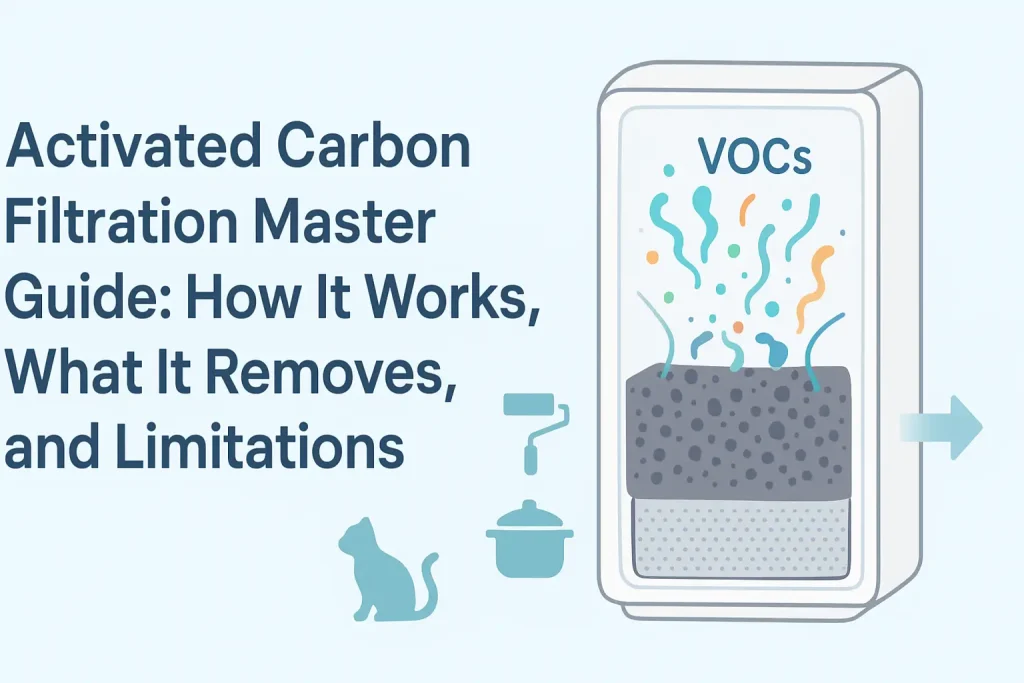
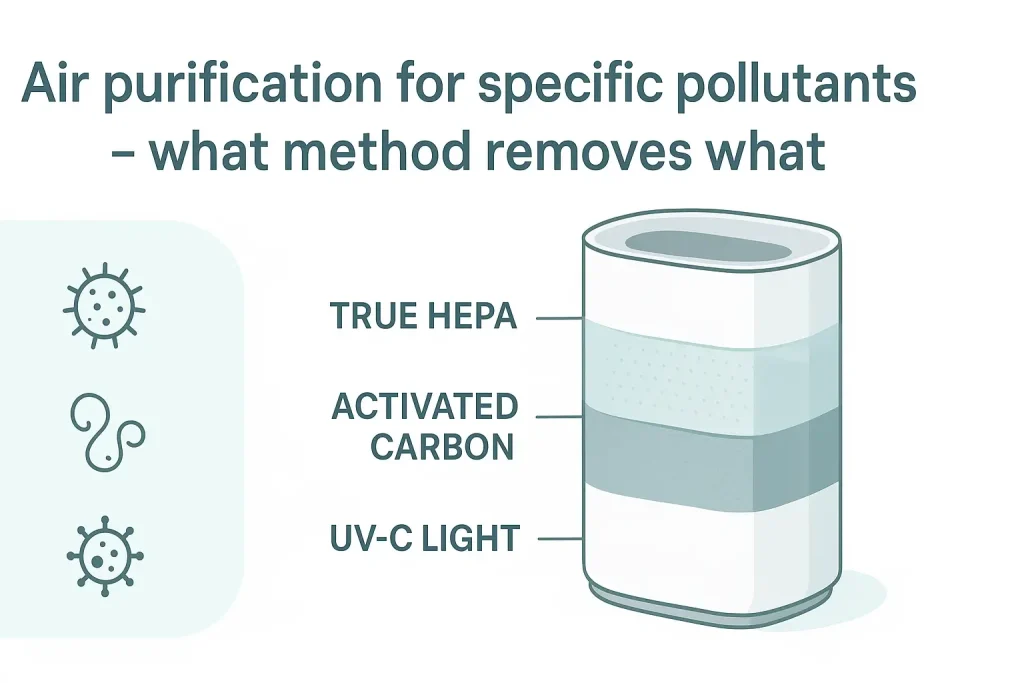
Activated carbon is the second essential stage for studios. Cooking produces volatile organic compounds (VOCs) and odor molecules that True HEPA cannot capture because they are gases, not particles. An activated carbon pre-filter or dedicated carbon stage adsorbs these gaseous pollutants. The carbon stage in budget units like the Levoit Core 300S is thin and saturates within 2 to 3 months with daily cooking. The carbon stage in the Austin Air HealthMate contains 15 pounds of activated carbon and zeolite, lasting up to 5 years under normal studio conditions. For renters with significant cooking odor concerns or chemical sensitivity, the carbon quantity in the unit matters as much as the CADR rating.
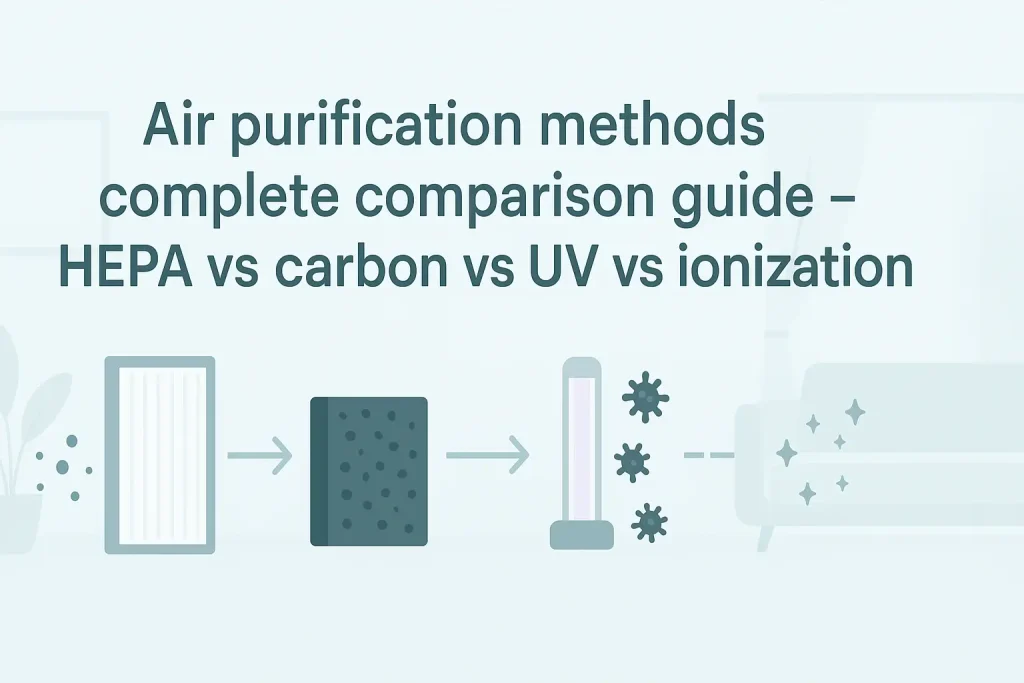
Ionizers and UV-C stages are not recommended for studio apartments. Ionizers produce ozone as a byproduct. In a small enclosed space like a studio, ozone concentration can exceed the CARB limit of 0.050 ppm faster than in a larger home with multiple rooms. UV-C lamps add cost without addressing the primary studio pollutants of cooking particulates and dust. If a unit includes an ionizer, confirm it can be permanently turned off. The Winix 5500-2 has an ionizer that defaults to off when the unit is in sleep mode, which is the correct design for studio use.
What About Air Quality Monitors for Studio Apartments?
An air quality monitor gives you real-time PM2.5 readings that tell you whether your air purifier is adequately sized for your actual pollution load. In a studio, where you cannot close a door to isolate a problem, a monitor is more valuable than in a multi-room home. It tells you within 10 to 15 minutes whether your purifier is reducing particulate levels or just moving air around.
A PM2.5 air quality monitor placed on your nightstand gives you a direct reading of what you are actually breathing. Run the purifier on its highest speed for 20 minutes after cooking. If PM2.5 does not drop by at least 70 percent in that time, your unit is undersized for your studio’s pollutant load. The monitor removes the guesswork from the CADR sizing calculation.
The IQAir AirVisual Pro measures PM2.5, PM10, CO2, temperature, and humidity. It is the most accurate consumer-grade monitor available. For a budget option, the Awair Element tracks PM2.5, VOCs, CO2, humidity, and temperature for under $100. Either unit paired with any of the air purifiers recommended above gives you a complete studio air quality system: a purifier that cleans the air and a monitor that confirms it is working.
How to Position an Air Purifier in a Studio Apartment for Maximum Effectiveness
Start by identifying the longest uninterrupted wall section in your studio. This is almost always the wall opposite your kitchen area. Place the air purifier along this wall with a minimum of 12 inches of clearance on the intake side and nothing blocking the output vent. The clean air should discharge toward the center of the room, not toward a wall or piece of furniture.
If your bed is along one wall, position the purifier on the opposite wall so that clean air flows across your sleeping area rather than away from it. In a studio with a single window, position the purifier as far from that window as the room layout allows. Outdoor air entering through the window carries PM2.5, pollen, and street-level particulates. You want that infiltrating air to travel across the room toward the purifier intake, getting filtered before it reaches your breathing zone.
If your studio layout includes a partial wall or room divider, do not place the purifier behind it. Physical barriers reduce effective coverage area because the clean air output cannot circulate freely through the entire open volume. The purifier needs line-of-sight airflow to the farthest corner of the studio from its position. Any obstacle between the purifier and that farthest corner reduces the effective coverage area.
For studios with lofted sleeping areas, the purifier should be placed on the lower level where pollutant sources like the kitchen and entry door are located. Clean air rises naturally with the thermal plume from the unit’s fan output. Placing the purifier on the loft level leaves the lower-level cooking and entry particulates unfiltered for longer periods. For more on how different room configurations affect purifier performance, our guide on choosing the right air purifier placement for allergen reduction covers positioning strategies for pollen and particulate control.
Common Mistakes Studio Renters Make When Buying Air Purifiers
The first mistake is buying a unit rated for the manufacturer’s stated coverage area without checking the ACH assumption. A purifier rated for 300 square feet at 2 ACH only delivers 120 square feet of coverage at 5 ACH. In a 300-square-foot studio, that unit is undersized by more than half. Always convert manufacturer coverage claims to the 5 ACH column using the CADR reference table above before comparing units.
The second mistake is prioritizing a small footprint over sufficient CADR. A compact unit with a 7-by-7-inch base and 80 CFM smoke CADR fits nicely on a nightstand but cannot clean a 250-square-foot studio at anything above 2.4 ACH. You will run it on maximum speed constantly, producing 50 to 55 dB of noise, and still not achieve clean air. A slightly larger unit with 200-plus CFM running on medium speed at 35 dB cleans the air faster and runs quieter.
The third mistake is ignoring filter replacement cost in the purchase decision. The Levoit Core 300S costs $99 upfront with $25 annual filter replacements. Over five years, total cost is approximately $224 plus electricity. The Winix 5500-2 costs $160 upfront with $40 annual filter replacements. Over five years, total cost is approximately $360 plus electricity. The cheaper unit is genuinely cheaper over its lifetime. But if the Levoit is undersized for your studio, you will run it on high speed constantly, consume more electricity, and replace filters more frequently, narrowing or reversing the cost advantage.
The fourth mistake is buying an ozone-generating ionizer for a small enclosed space. Ozone concentration is a function of ozone output rate divided by room volume. The same ionizer that produces 0.030 ppm in a 500-square-foot room with open doors produces 0.060 ppm in a sealed 250-square-foot studio, exceeding the CARB limit. Any air purifier with an ionizer must have the ionizer permanently disabled for studio use, or the unit must be CARB certified with measured ozone output below 0.050 ppm under worst-case conditions.
How Cooking Affects Studio Air Quality and What Your Purifier Must Handle
Cooking on a gas or electric stovetop in a studio releases PM2.5 particulates at concentrations that can exceed 200 micrograms per cubic meter within 10 minutes. According to research published in Environmental Health Perspectives, gas stove cooking produces peak PM2.5 levels 2 to 5 times higher than the EPA 24-hour standard of 35 micrograms per cubic meter. In a studio with no kitchen door, those particulates distribute through the entire living space within 15 minutes.
Your air purifier must handle this daily particulate spike without running on maximum speed for hours. A unit with a smoke CADR of 200 CFM in a 300-square-foot studio at 5 ACH will reduce cooking PM2.5 by approximately 85 percent within 30 minutes of the cooking event ending. A unit with only 100 CFM in the same space will take over an hour to achieve the same reduction because it is cycling the room air at only 2.5 ACH instead of 5 ACH.
Activated carbon also matters for cooking. The carbon stage adsorbs odor molecules from cooking oils, spices, and proteins that True HEPA passes right through. A thin carbon sheet in a budget purifier saturates quickly with daily cooking. If cooking odor control is important to you, look for a unit with at least 1 to 2 pounds of activated carbon, not just a carbon-coated fiber sheet. The Austin Air HealthMate Junior and the Alen BreatheSmart 45i with Carbon filter are the two best options under $400 for combined particulate and odor control in a studio kitchen environment.
What Is the Difference Between CADR for Smoke, Dust, and Pollen When Sizing for a Studio?
CADR is measured separately for smoke (0.09 to 1.0 micron particles), dust (0.5 to 3.0 micron particles), and pollen (5.0 to 11.0 micron particles) according to the AHAM AC-1 test standard. The smoke CADR is always the lowest of the three because smaller particles are hardest to capture. For studio apartments, always size your unit based on smoke CADR. If a unit meets your smoke CADR requirement at 5 ACH, it will exceed the requirement for dust and pollen by a comfortable margin.
Smoke CADR is the relevant number for studio apartments because cooking particulates, urban PM2.5 infiltration, and wildfire smoke all fall into the sub-micron particle range that the smoke CADR test measures. A unit rated at 200 CFM smoke CADR and 250 CFM dust CADR in a 300-square-foot studio delivers 5 ACH for smoke particles and 6.25 ACH for dust particles. The dust and pollen numbers are bonuses. The smoke number is the constraint that determines whether the unit is adequate for your studio.
Does an Air Purifier in a Studio Help with Noise from Outside?
An air purifier running on medium or high speed produces 35 to 55 dB of broadband white noise. This can partially mask intermittent outdoor noise like traffic, sirens, or hallway conversation. However, this is a secondary benefit, not a primary function. Do not buy an air purifier as a white noise machine. Buy it for clean air delivery, and if the fan noise happens to reduce the audibility of street noise by a few decibels, that is a bonus.
If noise masking is a priority, a dedicated white noise machine or a purifier with a specifically quiet sleep mode is a better choice than running a purifier on medium or high speed all night for the noise benefit. The Coway Airmega 400 at 22 dB sleep mode is effectively silent and provides zero masking benefit. If you want both clean air and noise masking, the Coway AP-1512HH at 30 dB sleep mode offers a slight audible hum that some sleepers find soothing without crossing the 30 dB sleep disruption threshold.
Can I Use a Small Desk Air Purifier in a Studio Apartment?
Small desk or personal air purifiers with CADR ratings below 80 CFM cannot clean the air volume of even a 150-square-foot micro studio at 5 ACH. They are designed for a personal breathing zone of 30 to 50 square feet, not for whole-room air cleaning. In a studio, where you move between your bed, desk, kitchen, and sitting area throughout the day, a personal purifier only cleans the air within 3 to 4 feet of the unit. The rest of your studio remains unfiltered.
If you already own a desk purifier and cannot upgrade immediately, place it on your nightstand pointed toward your pillow. This gives you a clean breathing zone for the 7 to 8 hours you spend sleeping. During waking hours, supplement with the highest-MERV furnace filter your building’s HVAC system can accommodate. A MERV 13 pleated filter in a standard 1-inch slot captures 75 percent or more of particles in the 0.3 to 1 micron range, providing whole-studio filtration whenever the HVAC fan runs. This is a partial solution, not a replacement for a properly sized portable unit, but it is better than relying on a desk purifier alone.
Is It Safe to Run an Air Purifier 24/7 in a Studio Apartment?
Yes, running a CARB-certified True HEPA air purifier 24 hours a day in a studio is safe and recommended. True HEPA filtration is a purely mechanical process with no chemical emissions. The fan motor is rated for continuous operation on all units recommended in this guide. The only safety consideration is ozone output from any ionizer stage, which must be measured below 0.050 ppm per CARB CCR Title 17. All units in the comparison table above are CARB certified with ionizers either absent or permanently defeatable.
Continuous operation is actually more important in a studio than in a multi-room home because pollutant sources are never isolated. Cooking particulates, outdoor PM2.5 infiltration, dust from clothing and bedding, and bathroom humidity all enter the same air volume at different times of day. Running the purifier 24/7 ensures that each pollutant spike is addressed as it happens rather than accumulating overnight. Set the unit to auto mode if available. It will run on low or sleep speed during clean-air periods and ramp up when the particle sensor detects a spike from cooking or outdoor infiltration.
What Is the Best Air Purifier for a Studio Apartment with Pets?
Pet dander ranges from 2.5 to 10 microns, which is within the dust and pollen CADR range, not the harder-to-capture smoke range. Any of the studio-suitable air purifiers in the comparison table above will capture pet dander effectively. The more important factor for pet owners is pre-filter design. A washable pre-filter captures visible pet hair and larger dander particles before they reach the True HEPA stage, extending HEPA filter life by 2 to 3 months in a pet household.
The Coway AP-1512HH and Winix 5500-2 both have washable pre-filters that are easily removed and rinsed under a faucet. Clean the pre-filter every 2 to 3 weeks in a studio with a shedding pet. The Levoit Core 400S has a fine mesh pre-filter that captures pet fur effectively and is also washable. For renters with pets, the combination of a True HEPA purifier with a washable pre-filter and a MERV 13 HVAC filter provides two-stage filtration that keeps both airborne dander and settled fur under control. For more on air purifiers in homes with pets and infants, our guide on air purifiers safe for babies and pets covers the specific filter and certification requirements for households with vulnerable occupants.
How Often Should I Replace Filters in a Studio Air Purifier?
Filter replacement intervals are shorter in a studio than in a multi-room home because the purifier handles all pollutant sources for the entire living space. The True HEPA stage in a studio purifier running 24/7 should be replaced every 6 to 9 months rather than the manufacturer-stated 12 months. Cooking particulates, skin cells, clothing fibers, and outdoor PM2.5 load the filter faster when all sources are concentrated in one air volume.
The activated carbon pre-filter or stage saturates even faster, typically within 3 to 4 months in a studio with daily cooking. You will know the carbon is saturated when cooking odors linger longer than they did when the filter was new. Some units like the Winix 5500-2 use replaceable carbon pre-filter sheets that cost approximately $10 each and can be swapped independently of the HEPA filter. This is a cost advantage for studio use because you can replace the carbon frequently without discarding a still-usable HEPA stage.
The Levoit Core 300S replacement filter combines HEPA and carbon in a single cartridge, so both stages are replaced simultaneously. In a studio with daily cooking, budget for filter replacement every 6 months rather than the 12-month rating on the packaging. The annual filter cost estimate of $25 in the comparison table above assumes one replacement per year. For studio use, double that to $50 per year for the Levoit Core 300S. This still makes it the lowest total-cost option for studios under 200 square feet.
Do I Need a Humidifier Along with an Air Purifier in a Studio?
An air purifier does not change room humidity. It moves air through a filter and returns it to the room at the same moisture content. If your studio air is dry due to building HVAC systems or winter heating, an air purifier will not make it drier or more humid. The two devices serve completely independent functions and can run simultaneously without interference.
However, placing a humidifier too close to an air purifier can cause the HEPA filter to absorb moisture, reducing its efficiency and potentially supporting mold growth on the filter media. Keep a minimum of 4 feet between a humidifier output and an air purifier intake. If your studio layout makes this separation impossible, run the humidifier during the day and the purifier at night, or position them on opposite sides of the room. For more detailed guidance on using humidifiers and purifiers together, our guide on how humidifiers affect indoor air quality explains the interaction between humidity levels and particulate behavior.
What If My Studio Has a Fresh Coat of Paint or New Furniture?
Fresh paint and new furniture off-gas volatile organic compounds including formaldehyde, benzene, and toluene for weeks to months after application or unboxing. In a studio with limited ventilation, these VOC concentrations can reach levels that cause eye irritation, headache, and respiratory discomfort. A standard True HEPA air purifier with a thin carbon sheet will not meaningfully reduce VOC levels because the carbon mass is too small to adsorb the continuous off-gassing load.
For a studio with fresh paint or significant new furniture, you need an air purifier with a substantial activated carbon stage containing at least 5 to 10 pounds of carbon. The Austin Air HealthMate with 15 pounds of activated carbon and zeolite is the best standalone unit for this scenario. The IQAir GC MultiGas is a higher-cost option with multi-stage gas-phase filtration used in hospital and chemical-sensitive environments. For budget-constrained renters, increase ventilation by running bathroom and kitchen exhaust fans continuously for the first 2 to 3 weeks after painting or furniture delivery, and supplement with a True HEPA unit with the best available carbon stage your budget allows. Our guide on choosing an air purifier for paint fumes and off-gassing covers the specific carbon requirements and product recommendations for renovation-related VOC exposure.
How Does Wildfire Smoke Change Studio Air Purifier Requirements?
During wildfire smoke events, outdoor PM2.5 concentrations can exceed 150 micrograms per cubic meter, which is more than 10 times the WHO 24-hour guideline of 15 micrograms per cubic meter. In a studio with typical apartment building infiltration, indoor PM2.5 will reach 50 to 70 percent of outdoor levels within 2 to 3 hours without an air purifier running. Your studio purifier must handle a continuous infiltration load, not just a one-time cooking spike.
The CADR sizing formula changes during wildfire events. Instead of 5 ACH, target 6 ACH to account for the continuous infiltration of new particulates through window seals, door gaps, and building ventilation. A 300-square-foot studio that needs 200 CFM at 5 ACH needs 240 CFM at 6 ACH during wildfire conditions. If your purifier cannot meet this higher CADR requirement, supplement by sealing window and door gaps with removable weatherstripping tape and running the purifier on maximum speed during the highest-AQI hours of the day.
The Blueair Blue Pure 211+ at 350 CFM smoke CADR and the Coway Airmega 400 at 400 CFM are the two best single-unit options for wildfire smoke in studios up to 500 square feet. For studios over 500 square feet in wildfire-prone regions, two smaller units running on opposite sides of the room provide more even particle reduction than one large unit with limited airflow reach. For a complete guide to sizing air purifiers for wildfire smoke events, see our article on calculating the CADR you need for wildfire smoke protection.
Can I Use a Corsi-Rosenthal Box in a Studio Apartment?
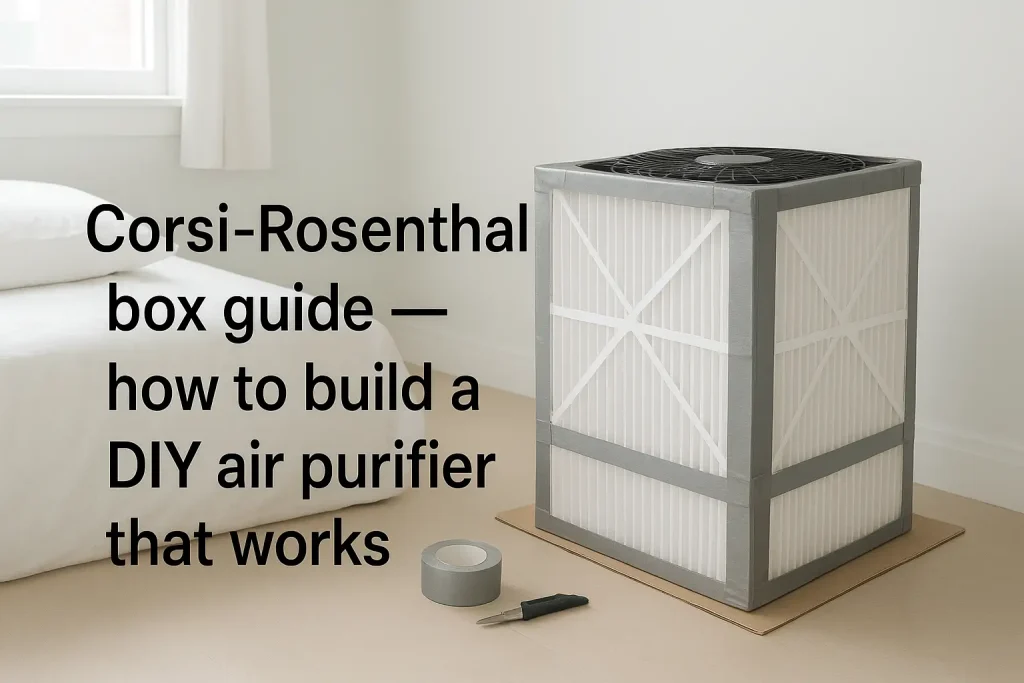
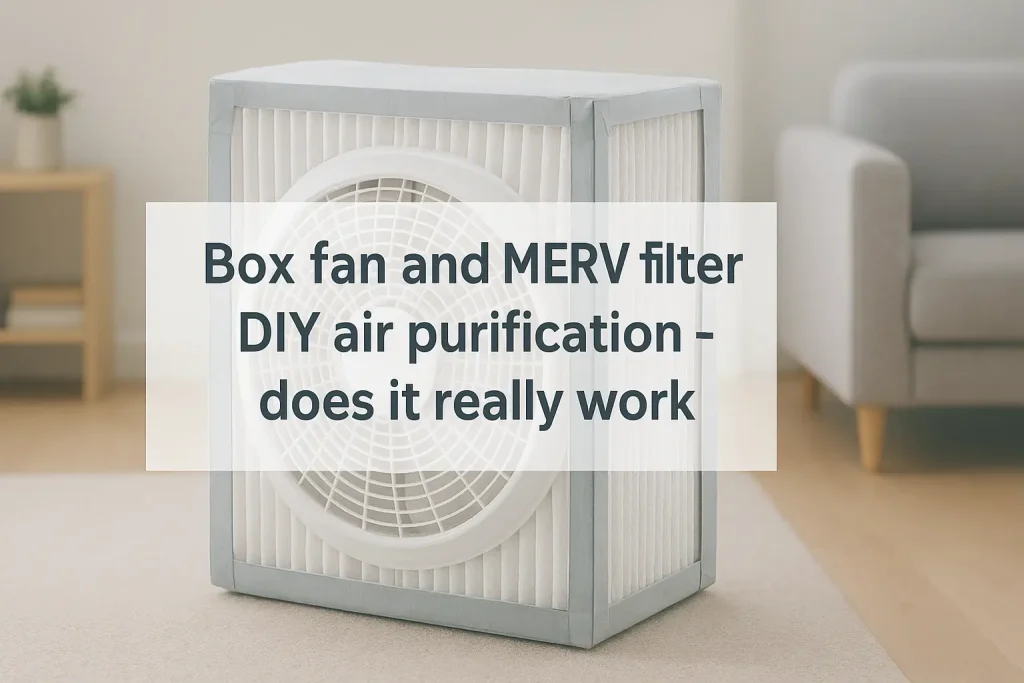
A Corsi-Rosenthal box is a DIY air purifier made from a 20-inch box fan and four MERV 13 furnace filters taped into a cube. It delivers 400 to 600 CFM of clean air at a fraction of the cost of a commercial unit. The build cost is approximately $60 to $80 for the fan and filters. The filtration performance is excellent for particulate matter because MERV 13 filters capture 75 percent or more of particles in the 0.3 to 1 micron range per ASHRAE 52.2 testing.
The trade-off in a studio is noise and footprint. A box fan on medium speed produces 50 to 55 dB, which is too loud for sleep at close range. The filter cube measures approximately 20 by 20 by 20 inches, consuming over 2.7 square feet of floor space. In a 250-square-foot studio, that is a noticeable fraction of your usable area. A Corsi-Rosenthal box is a better solution for daytime use in a studio with a dedicated floor corner, paired with a quiet commercial unit for nighttime use. If you can only have one device, a commercial unit with a sleep mode under 30 dB is the better choice for a space where you both live and sleep.
For the 20-inch box fan rated at 1,000-plus CFM and MERV 13 20×20 filters in a 4-pack, the total build comes to approximately $55. This is the lowest cost per CFM of clean air delivery of any air purification method. For studio renters on a tight budget who can tolerate the noise and footprint, it is a valid and effective option for daytime particulate control.
What Is the Quietest Air Purifier for a Studio Apartment?
The quietest air purifiers suitable for studio apartments are the Coway Airmega 400 at 22 dB in sleep mode and the Levoit Core 400S at 24 dB in sleep mode. Both are effectively inaudible at distances greater than 6 feet. The RabbitAir MinusA2, a wall-mountable unit, operates at 21 dB on its lowest setting and has the additional studio advantage of consuming zero floor space. It is CARB certified, AAFA asthma and allergy certified, and covers up to 700 square feet at 2 ACH with its custom filter configuration.
The noise floor in a typical urban studio at night is 25 to 30 dB from building HVAC, refrigerator compressor cycles, and street noise. An air purifier at 22 to 24 dB falls below this ambient noise floor and contributes nothing audible. At 30 dB, the Coway AP-1512HH is just at the edge of audibility in a quiet studio. For the most noise-sensitive sleepers, the Coway Airmega 400 or the Levoit Core 400S are the right choices. For most people, anything at or below 30 dB at the unit is quiet enough for studio sleep at a 6-to-8-foot distance.
For most studio renters, the best air purifier is the one with sufficient smoke CADR at 5 ACH for your specific square footage, sleep-mode noise at or below 30 dB, a washable pre-filter, and a footprint you can place with proper clearance. The Coway AP-1512HH at 246 CFM and 30 dB is the right answer for studios between 200 and 350 square feet. The Levoit Core 400S at 260 CFM and 24 dB is the right answer if noise is your primary constraint. The Coway Airmega 400 at 400 CFM and 22 dB is the right answer for larger studios or if you want the quietest operation available. Choose based on your square footage first, your noise tolerance second, and your budget third.