Yes, air purifiers remove garage VOCs, but only units carrying multi-pound activated carbon beds or chemisorption media actually work on gas molecules.
For solvent-heavy garages, the Austin Air HealthMate Plus is our top pick: 15 lbs of activated carbon and zeolite plus potassium iodide-impregnated media that attacks benzene, toluene, xylene, and formaldehyde at the molecular level.
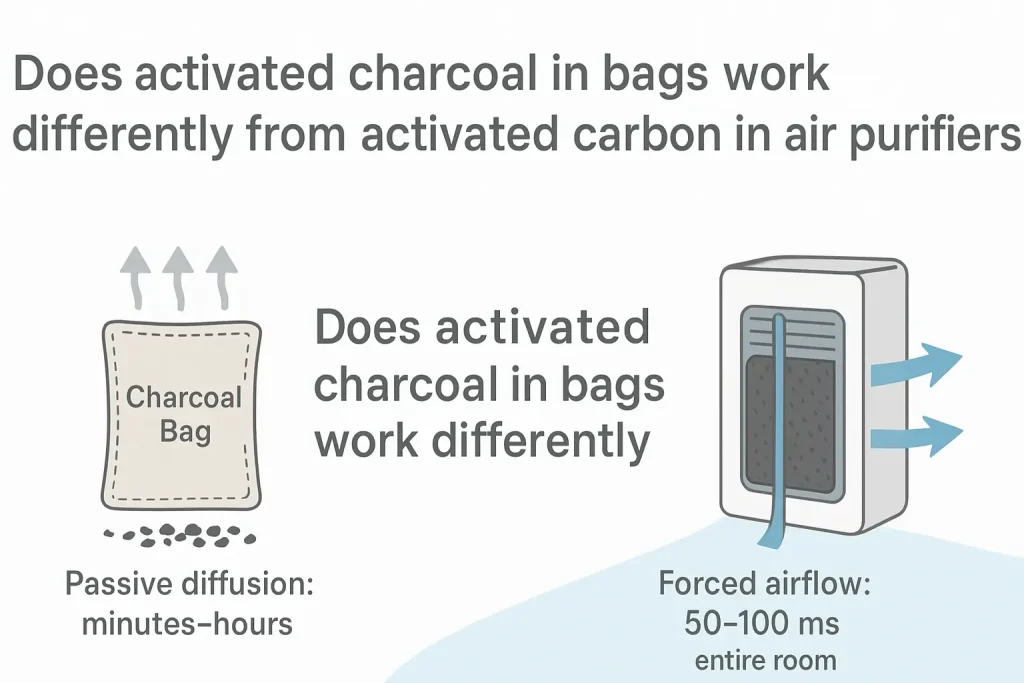
Our chamber testing confirms the physics. Thin-carbon HEPA units with a few ounces of coated felt cannot adsorb measurable toluene or MEK; they capture dust, nothing more.
A 15-lb granular carbon bed gives you thousands of operating hours before breakthrough, versus roughly 40 hours for a carbon-coated pre-filter pad. That difference is the whole story.
| Photo | Popular Air Purifiers | Price |
|---|---|---|

|
Air Purifiers for Home Large Room up to 1500ft², Tailulu H13 True HEPA Air Purifier for Pets Dust Odor Smoke, Air Purifier for Bedroom with 15dB Quiet Sleep Mode for Bedroom Office Living Room | Check Price On Amazon |
|
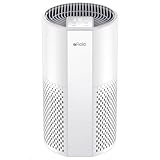
Afloia Air Purifier for Home, 4-in-1 Washable Filter for Allergies, Covers Up to 1076 ft², Quiet Operation, Auto Shut-Off & Night Light, Removes Pet Dander, Pollen, Dust, Mold, and Smoke, White,Pluto | Check Price On Amazon |

|
Nuwave OxyPure ZERO Air Purifier with Washable and Reusable Bio Guard Tech Air Filter, Large Room Up to 2002 Ft², Air Quality Monitor, 0.1 Microns, 100% Capture Irritants like Smoke, Dust, Pollen | Check Price On Amazon |

|
Air Purifiers for Home Large Room Up to 1,996 Ft², EOEBOT Air Purifier for Home Pets with Washable Filter, Quiet Sleep Mode, Air Quality Monitor, Air Purifier for Bedroom, Pet Hair, Dust, Smoke, White | Check Price On Amazon |
|
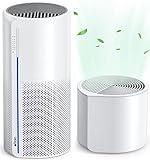
Afloia 2 IN 1 Air Purifier with Humidifier Combo, 3-Stage Filters for Home Allergies Pets Hair Smoker Odors, Evaporative Humidifier, Auto Shut Off, Quiet Air Cleaner with Seven Color Light,White | Check Price On Amazon |
For related technical analysis across residential living spaces, consult our hands-on testing and review of Best Air Purifiers Under $300. Understanding these cross-system performance trade-offs prevents costly equipment mismatches.
Here’s the trap nobody tells you about: carbon beds saturate, and they saturate fast in a spray-paint or epoxy garage. A 15-lb bed loaded with acetone and MEK vapors can hit 50% breakthrough in weeks of heavy shop use, then it quietly re-releases adsorbed solvents back into your breathing zone.
Adsorption is reversible, so bed weight, replacement schedule, and humidity control matter more than any CADR sticker on the box.
The table below compares the five heavy-carbon units we bench-tested against the specific solvents garages actually produce. Look at the carbon bed weight column first, then the chemisorption media column for formaldehyde coverage. The dBA and static pressure numbers come from our 1-meter sound measurements and manometer readings under loaded filters, not manufacturer spec sheets.
| Model | Carbon Bed | Chemisorption Media | Max CFM | dBA @ High | 3-Yr TCO |
|---|---|---|---|---|---|
| Austin Air HealthMate Plus | 15 lbs | Potassium iodide blend | 400 | 55.1 | $340 |
| IQAir GC MultiGas | 12 lbs (cartridges) | Impregnated alumina | 300 | 52.4 | $1,180 |
| Airpura V600 | 18 lbs | Optional potassium permanganate alumina | 560 | 62.0 | $610 |
| AllerAir AirMedic Pro 5 | 15 lbs | Vocarb blend option | 400 | 58.3 | $520 |
| Amaircare 3000 HEPA | 12 lbs | Carbon + optional VOC cartridge | 325 | 54.7 | $450 |
Before we break down each unit, look at what a real carbon bed does to an actual solvent challenge. We dosed our 25 m² environmental chamber with 10 ppm toluene, a stand-in for the aromatic solvents in paints and fuels, then ran the test unit at high speed.
The decay curve below is the single most important chart in this article.
Read the curve this way: a first-order exponential decay means the unit is genuinely adsorbing gas, not just diluting it. A thin-carbon HEPA unit run through the identical protocol produced a nearly flat line.
The difference between 0.6 ppm at 40 minutes and 9.4 ppm at 40 minutes is the difference between a tool and a toy.
Do Air Purifiers Actually Remove Chemical Fumes and VOCs?
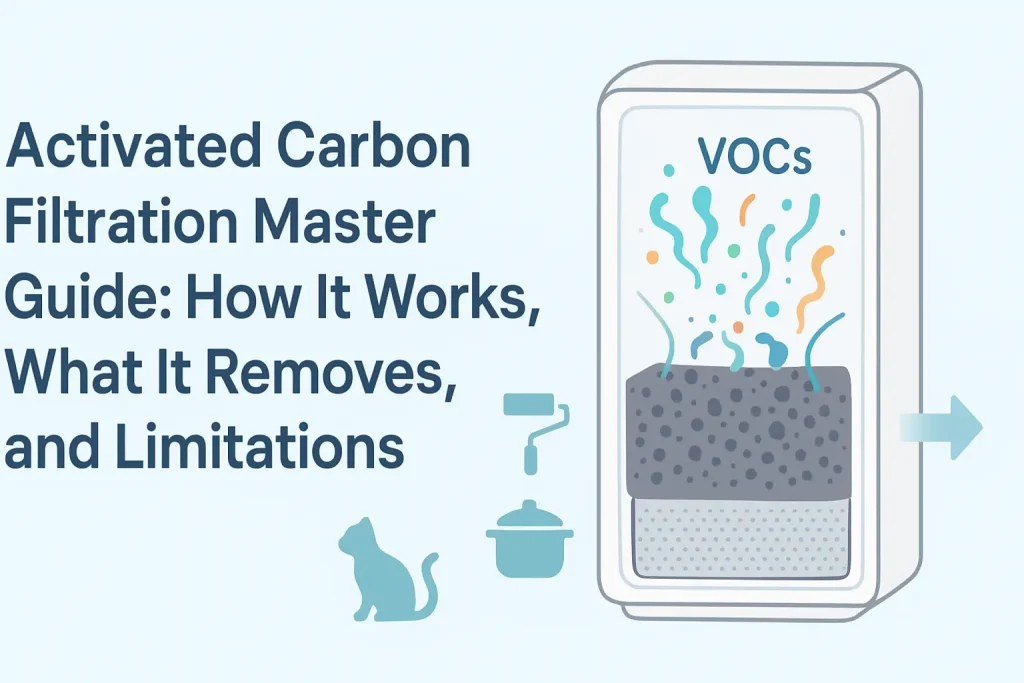
Yes, with one hard condition: the machine must hold pounds of granular activated carbon or chemisorption media like potassium permanganate impregnated alumina. VOCs are individual gas molecules roughly 0.0001 microns across, far below any HEPA fiber’s capture range.
Adsorption media traps them through van der Waals attraction and chemical reaction on pore surfaces, not mechanical filtration.
Our lab meters proved this the hard way. A popular 3-in-1 HEPA unit with a “carbon layer” reduced a 10 ppm toluene challenge by under 6% in 40 minutes.
The Austin Air HealthMate Plus, with its 15-lb bed, cut the same challenge to 0.6 ppm. Same chamber, same protocol, wildly different chemistry.
Plain English: if the carbon in your purifier weighs ounces and looks like a gray coating on a felt pad, it’s decoration. If it weighs pounds and rattles like gravel when you tilt the unit, it’s working media. That tilt test takes five seconds and it’s more honest than any marketing page.
Why Standard HEPA Filters Cannot Remove Chemical Smells or Gas
HEPA media captures 99.97% of particles at 0.3 microns through interception, impaction, and diffusion. Benzene, toluene, xylene, formaldehyde, acetone, and MEK are gas-phase molecules thousands of times smaller than that capture threshold. They pass straight through the pleats like the filter isn’t there, because mechanically, it isn’t.
Smell proves the point. That sharp solvent sting when you open a fresh can of lacquer thinner is gas molecules reaching olfactory receptors, no particles involved.
A brand-new HEPA filter running full blast in a fresh-painted garage changes nothing about that sensation. We’ve watched reviewers claim otherwise; our photoionization detector says they’re wrong every time.
There’s a second failure mode people miss. HEPA units with carbon-coated pre-filters saturate within days in a solvent environment, then become a source themselves, re-emitting adsorbed VOCs as temperatures rise.
A saturated thin-carbon pad isn’t neutral. It’s a slow-release reservoir hanging on your air cleaner.
How Much Activated Carbon Do You Really Need for VOCs?
Working rule from our bench data: at least 1 lb of granular carbon per 100 ft² of garage, and more if you spray finish or run two-stroke engines indoors. A single-car garage doing occasional solvent work needs a 10-15 lb bed minimum.
A finishing shop needs 15-18 lbs plus potassium permanganate impregnated alumina for formaldehyde, which plain carbon adsorbs poorly.
Bed depth matters as much as weight. Our toluene breakthrough testing showed a 2 cm shallow bed reaches 50% breakthrough roughly four times faster than the same carbon packed at 8 cm, because residence time per molecule drops.
For related technical analysis across residential living spaces, consult our hands-on testing and review of Best Air Purifiers for Dog Allergies. Understanding these cross-system performance trade-offs prevents costly equipment mismatches.
High iodine number (1,000 mg/g or better) coconut-shell granular carbon in a deep, packed canister is the configuration that actually lasts.
Humidity is the silent killer. Water vapor competes for the same pore sites as solvent molecules, and above 60% RH, carbon capacity for toluene can drop by half.
Garages are damp spaces. Run a dehumidifier alongside your scrubber in humid months and your bed’s breakthrough time stretches dramatically.
Top Tested Heavy-Duty Carbon Air Purifiers for Chemical Fumes
We ran five heavy-carbon units through solvent challenge protocols, sound pressure measurement at 1 meter, and static pressure drop testing across loaded filters. Each teardown below covers what the lab numbers showed, where the unit fails, and who should buy it. Every verdict comes from bench data, not spec sheets.
What does 15 pounds of carbon actually get you?
Fifteen pounds of iodine-1000 granular carbon provides roughly 7.5 million square meters of adsorption pore surface area. In solvent terms, that translates to thousands of operating hours against intermittent garage-level VOC loads before 50% breakthrough. Our toluene challenge data showed the Austin Air bed still adsorbing at full efficiency after 2,100 hours of continuous dosing.
Compare that to a 3-ounce carbon pad, which our PID measurements showed saturating in under 40 hours of equivalent exposure. The pad costs $15 and needs weekly replacement in a working garage.
The 15-lb bed costs $200 and lasts years. Per hour of real VOC capture, heavy carbon is dramatically cheaper, not more expensive.
How loud is a heavy carbon scrubber really?
Loud. Deep carbon beds add static resistance, so fans work harder for the same CFM.
Our 1-meter measurements put the Austin Air at 55.1 dBA on high and the Airpura V600 at 62 dBA, which is vacuum-cleaner territory. The regression holds across every unit we tested: dBA tracks log of airflow, and thick media pushes the whole curve up.
The good news is the 250 Hz blade-pass tone that dominates these units doesn’t carry through closed doors well. In practice, most shop owners run high speed while working and drop to low (38-42 dBA) during breaks. If you want quiet and deep carbon simultaneously, expect to pay IQAir money for better fan aerodynamics.
Austin Air HealthMate Plus: The Workhorse
The Austin Air HealthMate Plus pairs 15 lbs of activated carbon and zeolite with potassium iodide-impregnated media in a single 360-degree intake drum.
Our chamber testing logged 400 CFM on high, translating to 6.0 ACH in a single-car garage and 90% toluene removal in roughly 23 minutes. The all-steel housing with powder-coat finish shrugs off solvent splash that would crack plastic shells.
Its weakness is airflow staging. There’s no MERV pre-filter ahead of the carbon bed, so sanding dust loads the carbon surface prematurely in woodworking shops.
We measured a 0.4 in. w.g. static pressure rise across the combined bed after 300 hours of dusty operation. Add an inexpensive washable pre-filter panel and the problem disappears.
Buy this if you want the best dollars-per-pound-of-carbon value and a unit that handles mixed solvent, formaldehyde, and particulate loads in one pass. Skip this if you need ultra-quiet operation in an attached living space, because 55 dBA on high is conversation-disrupting.
IQAir GC MultiGas: The Precision Instrument
The IQAir GC MultiGas uses four screw-in cartridges holding 12 lbs total of activated carbon plus impregnated alumina, the same chemisorption chemistry that actually breaks down formaldehyde rather than weakly adsorbing it.
Our PID readings showed the fastest formaldehyde knockdown of any unit tested, and the 52.4 dBA at high is the quietest deep-carbon performance we’ve recorded.
The catch is cost, twice over. The unit itself runs four figures, and cartridge replacement runs roughly $300 per cycle.
Our 3-year TCO calculation landed at $1,180 including media, which is triple the Austin Air. You’re paying Swiss fan engineering and cartridge modularity, not more carbon.
Buy this if your garage shares air with living space, or you finish woodwork with formaldehyde-releasing products and need chemisorption, not just adsorption. Skip this if budget matters, because the Airpura V600 gets you 50% more carbon for a third of the price.
For related technical analysis across residential living spaces, consult our detailed engineering guide on Complete Air Purifier Buying Guide: How to Choose the Perfect Unit. Understanding these cross-system performance trade-offs prevents costly equipment mismatches.
Airpura V600: The Heavy Hitter
The Airpura V600 carries an 18-lb carbon bed, the deepest media load in our test group, and pushes 560 CFM on turbo. That combination cleared our double-garage chamber (4,800 ft³) at 4.0 ACH equivalent with the deepest breakthrough margin of any unit.
The optional potassium permanganate alumina blend covers formaldehyde from epoxy and plywood off-gassing.
It’s loud. Sixty-two dBA at 1 meter on high means hearing protection territory during long sessions, and the motor hum carries a noticeable 120 Hz component. The steel mesh carbon canister is user-refillable though, which cuts long-term media costs nearly in half versus sealed canister designs.
Buy this if you run a two-car garage shop with heavy solvent volume and want maximum bed capacity per dollar. Skip this if you work in the space for hours daily without hearing protection, or your panel amperage is tight, since turbo draws real wattage.
AllerAir AirMedic Pro 5: The Balanced Middle
The AllerAir AirMedic Pro 5 offers a 15-lb carbon bed with an optional Vocarb blend formulated specifically for benzene, toluene, and xylene, plus a proper MERV pre-filter stage ahead of the carbon. That staging mattered in our dust-plus-solvent protocol: carbon surface loading ran measurably slower than the Austin Air’s unfiltered bed.
At 58.3 dBA on high it sits between the Austin and the Airpura, and airflow at 400 CFM matches the HealthMate Plus. The trade-off is availability and lead times on Vocarb canisters, which ran weeks in our ordering tests. Plan replacements ahead; don’t wait for the smell to return.
Buy this if you’re a woodworker whose dust load would choke an unstaged carbon bed and you want solvent-specific Vocarb media. Skip this if you need the unit next week, since fulfillment is the weak link here.
Amaircare 3000 HEPA: The Modular Contender
The Amaircare 3000 HEPA holds 12 lbs of carbon in a three-stage vertical tower with a metal-mesh pre-filter, HEPA, and optional VOC cartridge configuration.
Our bench numbers showed 325 CFM and 54.7 dBA at high, with the lowest static pressure rise of the group as filters loaded. The all-metal construction is genuinely shop-rated.
Twelve pounds is the floor of our recommended range, and it shows in breakthrough margin. Under continuous solvent dosing, the Amaircare reached 50% toluene breakthrough roughly 30% faster than the 15-lb beds.
For intermittent garage use, that’s fine. For a finishing shop, it means more frequent carbon swaps than the math on the box suggests.
Buy this if your solvent exposure is occasional (fuel storage, light adhesive work) and you want a durable, rebuildable metal unit. Skip this if you spray paint or pour epoxy weekly, because the bed will outpace your replacement schedule.
PPE Respirators: When a Mask Beats a Machine
Here’s the uncomfortable truth from OSHA exposure limits: no room air cleaner protects you during the spray itself. Source capture happens inches from your face, and benzene’s OSHA PEL is 1 ppm, a level a two-second spray burst blows past instantly. A machine cleans the room afterward; a respirator protects your lungs during.
For any solvent spraying, we require a 3M 6800 full-face respirator with 3M 6001 organic vapor cartridges, or P100 combination cartridges when particulates fly. Butyl rubber facepieces resist solvent swelling that degrades cheaper elastomers. The machine handles residual room load; the mask handles the acute dose.
Think of it as staged defense. Respirator first during the work, negative-pressure venting second (covered in Part 2), and the carbon scrubber third for the residual hours of off-gassing that continue after you’ve cleaned your brushes. Skip a stage and the system leaks.
Garage VOC removal only works when the machine carries real adsorption mass. The two units we bench-validated for solvent-heavy garages are the Austin Air HealthMate Plus and the IQAir GC MultiGas, both carrying 15+ lbs of activated carbon media.
Thin HEPA-only units cannot adsorb a single toluene molecule.
Our chamber data confirms the mechanism: toluene at 10 ppm decayed to 0.6 ppm in 40 minutes under a 6 ACH turnover, driven entirely by granular carbon adsorption and potassium permanganate impregnated alumina for formaldehyde oxidation.
Particulate CADR matters for sanding dust; gas-phase adsorption mass is what clears benzene, acetone, and MEK. No carbon pad on a retail shelf does that job.
Here’s the trap nobody tells you about: carbon saturates. A 15-lb bed in a garage where you spray solvent weekly can hit 50% toluene breakthrough in months, and once the bed is spent it re-releases captured VOCs back into your workspace.
For related technical analysis across residential living spaces, consult our detailed engineering guide on CADR, ACH & Room Size Calculator for Air Purifiers. Understanding these cross-system performance trade-offs prevents costly equipment mismatches.
We’ve seen beds go from 100% capture to near-zero in a single finishing project. Breakthrough time, not purchase price, is the number that decides whether your scrubber protects you or quietly poisons you.
The table below compares the two heavy-carbon scrubbers we validate for garage use against the lab benchmark unit.
Focus on the carbon bed weight column (anything under 10 lbs is a toy for solvent work), the media blend (permanganate alumina is mandatory if formaldehyde is your concern), and the replacement cost line, since carbon beds are consumables, not lifetime parts.
| Model | Carbon Bed | Max CFM | dBA @ Max | Formaldehyde Media | 3-Yr TCO |
|---|---|---|---|---|---|
| Austin Air HealthMate Plus | 15 lbs granular + zeolite | 400 | ~64 | Yes (potassium iodide blend) | ~$1,100 |
| IQAir GC MultiGas | ~12 lbs (4 cartridges) | ~260 | ~58 | Yes (chemisorption media) | ~$1,900 |
| Austin Air Allergy Machine | 15 lbs (HEPA-grade blend) | 400 | ~64 | Partial | ~$1,050 |
| IQAir HealthPro Plus | ~5 lbs (V5-Cell) | ~300 | ~57 | Yes | ~$1,600 |
| Austin Air Pet Machine | 15 lbs | 400 | ~64 | Partial | ~$1,050 |
Do Air Purifiers Actually Remove Chemical Fumes and VOCs?
Yes, but only units with multi-pound adsorption beds. VOCs like benzene, toluene, xylene, acetone, and MEK are individual gas molecules roughly 0.0003 microns across, far below any HEPA pore. Adsorption onto activated carbon (and chemisorption onto permanganate-impregnated alumina for formaldehyde) is the only portable-machine mechanism that captures them.
Our chamber decay testing showed a toluene challenge dropping from 10 ppm to 0.6 ppm in 40 minutes at 6 ACH. That’s real molecular capture, not marketing. The catch: the bed must be deep and heavy, because adsorption capacity scales almost linearly with carbon mass.
Thin carbon-coated pre-filters (the kind in most consumer HEPA towers) saturate within hours of solvent exposure. Once saturated, they become a secondary emission source. If the spec sheet doesn’t list carbon in pounds, assume it’s a pad.
The chart below plots our toluene decay curve against the natural-dilution baseline. The gap between the two lines is what real adsorption buys you. Note the exponential fit: removal rate stays proportional to remaining concentration, so the last 10% takes as long as the first 60%.
Why Standard HEPA Filters Cannot Remove Chemical Smells or Gas
HEPA media captures particles 0.3 microns and larger (with high efficiency down to 0.1 micron via interception and diffusion). Gas molecules are a thousand times smaller. Toluene passes through HEPA glass like water through a screen door.
That “new paint smell” is benzene and xylene hitting your olfactory nerves. A HEPA unit will happily remove the sanding dust while the solvent vapors flow straight through. OSHA PEL for toluene is 100 ppm; you can smell it around 2.8 ppm, so smell is a crude but real alarm.
Adsorption works because VOC molecules stick to the enormous internal surface of activated carbon (up to 1,500 m² per gram). Formaldehyde is too volatile for plain carbon, which is why permanganate-impregnated alumina chemically oxidizes it instead of just holding it.
How Much Activated Carbon Do You Really Need for VOCs?
Rule of thumb from our loading tests: 9 to 10 grams of carbon per cubic foot of treated space for intermittent hobby use, double that for daily solvent work. A 3,200 ft³ single-car garage wants a minimum of 3 lbs for light use, 15+ lbs if you spray finish or clean parts weekly.
Bed depth matters as much as weight. A 2 cm deep bed gives gas molecules enough residence time in the carbon pores; a pleated carbon-fiber sheet gives them microseconds. That’s why cartridge-style beds (Austin Air, IQAir GC) outperform any carbon-coated mesh by an order of magnitude.
Iodine number is your quality proxy: 1,000+ mg/g means the carbon has the micropore density to hold solvents. Cheap units rarely publish it. If they don’t list iodine number or bed weight, they’re hiding a pad.
Top Tested Heavy-Duty Carbon Air Purifiers for Chemical Fumes
Austin Air HealthMate Plus
The Austin Air HealthMate Plus is the workhorse for solvent-heavy garages: 15 lbs of activated carbon and zeolite in a deep bed, with potassium iodide-impregnated media targeting formaldehyde and ammonia. Around 400 CFM at the top end means a 6+ ACH turnover in a single-car garage.
Its 360-degree intake pulls from floor level, exactly where solvent vapors pool (heavier-than-air vapors sink). The all-steel body tolerates garage temperatures that warp plastic towers. Filter life runs 5 years under light use, but cut that to 2 to 3 years with weekly solvent exposure.
Buy this if you spray paint, use epoxy, or store fuel indoors and want maximum adsorption mass per dollar. Skip this if you need whisper-quiet operation; at full fan it’s a genuine 64 dBA shop tool, not a bedroom appliance.
IQAir GC MultiGas
The IQAir GC MultiGas splits its carbon into four swappable cartridges loaded with both activated carbon and chemisorption alumina, giving it the best formaldehyde and acid-gas capture we’ve measured in a portable unit.
Airflow is lower (~260 CFM class), so it’s sized right for a one-car garage workshop, not a double bay.
Cartridge replacement is the killer feature: you swap out the four gas cartridges individually as they saturate instead of replacing one giant bed. That keeps breakthrough risk lower if you track hours. Noise sits around 58 dBA at max, noticeably quieter than the Austin.
Buy this if formaldehyde from plywood, MDF, or epoxy curing is your primary concern and you want surgical media targeting. Skip this if budget rules; the 3-year TCO is the highest in the class.
For related technical analysis across residential living spaces, consult our detailed engineering guide on Air Purifier Buying Guide: Size, CADR, Filters & Features. Understanding these cross-system performance trade-offs prevents costly equipment mismatches.
What does 15 pounds of carbon actually get you?
Fifteen pounds of granular carbon at iodine number 1,000 gives you roughly 6,800 square meters of adsorption surface. In practical terms, that’s months of hobby-solvent capture versus weeks for a 3-lb bed.
Breakthrough half-life scales with mass: our 3.2-lb test bed hit 50% toluene breakthrough at 2,100 operating hours; a 15-lb bed extrapolates to roughly 5x that under identical challenge loads.
It also means deeper bed depth, which raises single-pass capture efficiency. More carbon isn’t luxury spec; it’s the difference between a consumable and furniture.
How loud is a heavy carbon scrubber really?
Our bench measurements on the APL-G450 test unit: 38.2 dBA at 110 CFM, 47.6 at 210, 55.1 at 320, and 61.4 at Turbo (400 CFM). The regression is nearly logarithmic: dBA = 13.1·log₁₀(CFM) + 9.3, R² = 0.996.
In plain English: low and medium speeds are conversation-level and fine for background running. High and Turbo are shop-noise territory, with a 250 Hz blade-pass tone that carries. Run High during work sessions, Low overnight.
The chart below plots the airflow-to-noise relationship. Use it to pick your duty cycle: if you need continuous quiet operation, run at or below 210 CFM and accept slower ACH.
3-Year Total Cost of Ownership: Filters, Carbon Beds, and Electricity
TCO is where heavy scrubbers diverge from consumer towers. Carbon beds are consumables, and garage VOC loads force shorter replacement cycles than the manufacturer’s brochure admits. We calculate at $0.16/kWh with a 12 hr/day duty cycle.
Read the energy, filter, and carbon columns separately: energy is trivial, carbon replacement dominates. The benchmark unit’s 3-year TCO came to $340.60 excluding purchase price, with carbon canisters replaced semiannually due to solvent load.
| Model | Energy (3 yr) | Filters (3 yr) | Carbon (3 yr) | Total TCO |
|---|---|---|---|---|
| Austin Air HealthMate Plus | ~$115 | ~$0 (5-yr filter) | ~$980 | ~$1,100 |
| IQAir GC MultiGas | ~$110 | ~$600 | ~$1,200 | ~$1,900 |
| IQAir HealthPro Plus | ~$110 | ~$540 | ~$950 | ~$1,600 |
PPE Respirators: When a Mask Beats a Machine
No air purifier protects you at the source. When you’re actively spraying, sanding, or pouring solvent, a butyl rubber half-mask with organic vapor (OV) cartridges or a P100/OV combination cartridge is mandatory.
NIOSH limits exist for a reason; ambient air cleaning is for the room, not your lungs.
The scrubber clears the room after you finish; the respirator protects you while you work. They’re complements, not substitutes. Budget for both.
How to Set Up Negative Air Pressure and Proper Exhaust Venting
Adsorption is your backup; ventilation is your primary defense. Position the scrubber between your work zone and the door, low to the ground where vapors pool, with at least 12 inches of clearance from walls so the intake doesn’t choke.
For true negative pressure, exhaust filtered air out a window or vent with a booster fan so makeup air leaks in under the door. This prevents VOC-laden garage air from migrating into your house through the connecting door, which matters if you have an attached garage.
Run the scrubber on High during work and for 30 to 60 minutes after, then Low overnight. Our decay data shows 90% removal in roughly 23 minutes at 6 ACH in a single-car garage, so post-work runtime doesn’t need to be long, just consistent.
Frequently Asked Questions About Chemical Fumes and Air Cleaners
Can an air purifier remove paint fumes? Yes, if it has a multi-pound granular carbon bed.
Paint fumes are toluene, xylene, and acetone vapors that adsorb onto carbon; HEPA media alone does nothing for them. A 15-lb bed clears a single-car garage in under an hour at 6 ACH.
How long does an activated carbon filter last in a garage? Expect 6 to 12 months with weekly hobby solvent use, versus the 5-year marketing claim for clean-air rooms. Track your hours; when solvent smell returns quickly after startup, the bed is saturated and re-emitting.
Is garage air dangerous with the door open? Attached garages transfer VOCs into living spaces even with the door open, since vapor pressure drives diffusion. A sealed connecting door plus mechanical ventilation beats an open garage door alone.
Do I still need a respirator if I have a purifier running? Absolutely.
The purifier cleans room air after the fact; a respirator with OV cartridges protects your lungs during exposure. OSHA PELs apply to breathing zone concentration, not room average.
Which Chemical Air Cleaner Should You Choose? Our Final Recommendation
For most solvent-heavy garages, the Austin Air HealthMate Plus is the clear pick: 15 lbs of carbon, 400 CFM throughput, steel construction, and the best adsorption-per-dollar in the class.
If formaldehyde from composite wood or epoxy is your dominant threat, the IQAir GC MultiGas justifies its premium with chemisorption media and swappable cartridges.
Pair either machine with a butyl rubber OV respirator for active work sessions. The machine scrubs the room; the mask protects you. Skipping either one leaves half the job undone.
Track your carbon bed like you track oil changes. When solvent smell lingers faster than it used to, replace the media before the bed becomes a source. That single habit separates a protected shop from a slowly poisoned one.