Most people buy an air purifier based on the manufacturer’s claimed room coverage, not the actual CADR rating. That single mistake leaves rooms under-filtered by 40-60% because the coverage number assumes only 2 air changes per hour instead of the 5 that allergy and asthma sufferers actually need.
This guide covers every factor that determines whether an air purifier actually cleans your air or just moves it around: CADR ratings, filter types, room sizing at different ACH targets, ongoing costs, noise levels, and certifications. You will learn exactly how to match a unit to your room and your health needs, with no guesswork and no wasted money.
What Is an Air Purifier and How Does It Actually Work?
An air purifier is a device that pulls room air through one or more filtration stages and returns cleaner air to the room. The core mechanism is mechanical filtration: a fan forces air through a dense fiber mat where particles get trapped by impaction, interception, and diffusion.
True HEPA filters capture 99.97% of particles at 0.3 microns, the most penetrating particle size. Particles larger than 0.3 microns hit fibers and stick. Particles smaller than 0.3 microns get knocked around by air molecules and eventually collide with fibers through Brownian motion.
| Photo | Popular Air Purifiers | Price |
|---|---|---|

|
Air Purifiers for Home Large Room up to 1500ft², Tailulu H13 True HEPA Air Purifier for Pets Dust Odor Smoke, Air Purifier for Bedroom with 15dB Quiet Sleep Mode for Bedroom Office Living Room | Check Price On Amazon |
|
Afloia Air Purifier for Home, 4-in-1 Washable Filter for Allergies, Covers Up to 1076 ft², Quiet Operation, Auto Shut-Off & Night Light, Removes Pet Dander, Pollen, Dust, Mold, and Smoke, White,Pluto | Check Price On Amazon |

|
Nuwave OxyPure ZERO Air Purifier with Washable and Reusable Bio Guard Tech Air Filter, Large Room Up to 2002 Ft², Air Quality Monitor, 0.1 Microns, 100% Capture Irritants like Smoke, Dust, Pollen | Check Price On Amazon |

|
Air Purifiers for Home Large Room Up to 1,996 Ft², EOEBOT Air Purifier for Home Pets with Washable Filter, Quiet Sleep Mode, Air Quality Monitor, Air Purifier for Bedroom, Pet Hair, Dust, Smoke, White | Check Price On Amazon |
|
Afloia 2 IN 1 Air Purifier with Humidifier Combo, 3-Stage Filters for Home Allergies Pets Hair Smoker Odors, Evaporative Humidifier, Auto Shut Off, Quiet Air Cleaner with Seven Color Light,White | Check Price On Amazon |
This only works when the fan moves enough air through the filter to process the entire room volume multiple times per hour. A weak fan in a large room means the purifier never catches up to the pollution being generated in real time.
If the CADR is too low for the room, the result is PM2.5 levels that stay elevated indefinitely. Fix it by sizing the unit to deliver at least 5 air changes per hour for your specific room dimensions.
By the Numbers: Air Purifier Buying Guide
Minimum particle capture efficiency of True HEPA at the hardest-to-filter 0.3-micron particle size, per IEST standards.
Recommended air changes per hour for allergy and asthma sufferers, requiring 2.5x the CADR of manufacturer coverage claims.
Maximum ozone output allowed under CARB CCR Title 17. Any air cleaner above this level is banned for sale in California.
Real-world CADR performance drop versus laboratory AHAM test conditions due to furniture, walls, and airflow obstructions.
Annual filter replacement cost range across all air purifier types, from budget True HEPA units to medical-grade systems.
What Are the Different Types of Air Purifiers?
Air purifiers fall into distinct categories based on their filtration technology. Each type addresses different pollutants, and no single technology handles everything. A room with both wildfire smoke and VOC off-gassing needs two different filtration mechanisms, not one unit that claims to do both.
True HEPA Air Purifiers
True HEPA is the gold standard for particle removal. A True HEPA air purifier must capture 99.97% of particles at 0.3 microns to earn the designation, per IEST testing standards.
This includes PM2.5, PM10, pollen, pet dander, dust mite allergen, mold spores, and bacteria. True HEPA does nothing for gases, VOCs, or odors. Those require activated carbon or another adsorption stage.
Key Specifications:
• Particle size captured: Down to 0.3 microns at 99.97% efficiency
• Target pollutants: PM2.5, PM10, pollen, pet dander, dust mite allergen, mold spores, bacteria
• Filter lifespan: 6-12 months under normal household conditions
• Annual replacement cost: $25-$80 for most consumer units
• Best use case: Allergies, asthma, wildfire smoke, general particulate removal
Activated Carbon Air Purifiers
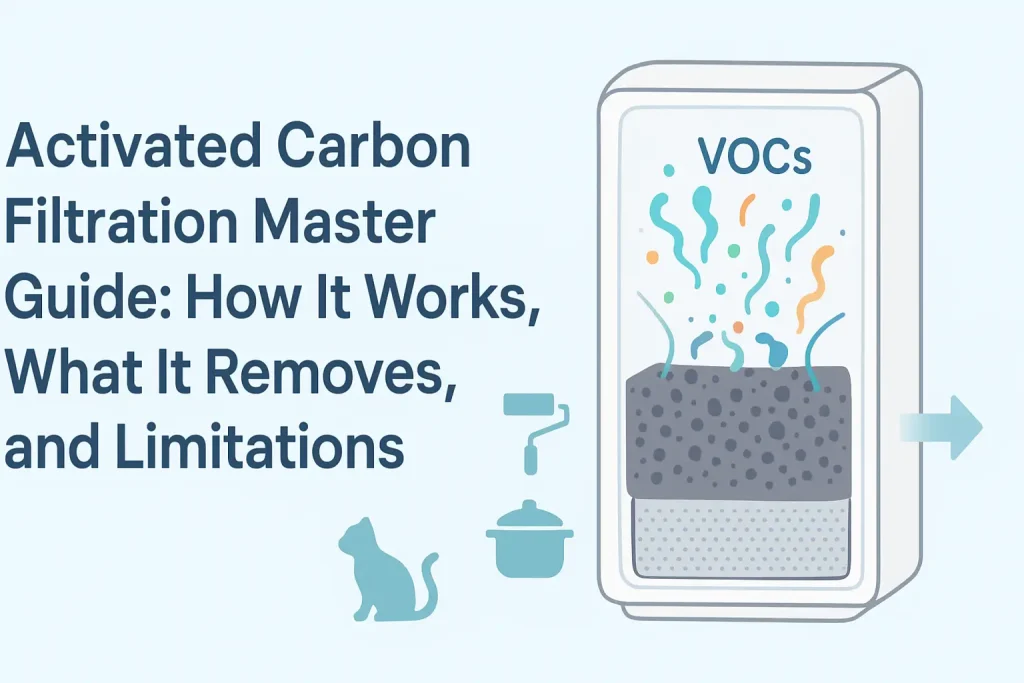
Activated carbon removes gases, VOCs, and odors through adsorption: gas molecules stick to the enormous internal surface area of the carbon pores. One gram of activated carbon contains 500-1,500 square meters of internal surface area.
This only works when the carbon bed is thick enough and heavy enough to provide meaningful contact time. A thin carbon sheet in a budget unit adsorbs a fraction of the VOCs that a 15-pound carbon bed captures in an Austin Air HealthMate.
Activated carbon saturates over time. Once saturated, it stops adsorbing and may release captured VOCs back into the air. Replace carbon filters on schedule, not when they look dirty.
UV-C Air Purifiers
UV-C light in the 254-nanometer wavelength disrupts the DNA of bacteria, viruses, and mold spores, preventing them from reproducing. UV-C does not remove particles or gases. It only addresses biological contaminants that pass through the UV chamber.
This only works when the exposure time is sufficient. Air moving too fast past a UV-C lamp does not receive enough UV dose to inactivate pathogens. Look for units that specify UV dose in microwatt-seconds per square centimeter, not just UV lamp wattage.
UV-C lamps degrade over time and typically need replacement every 9-12 months. A UV-C lamp that is still glowing may be producing far less germicidal output than its rating suggests.
Ionizer and Electrostatic Air Purifiers
Ionizers charge particles in the air so they stick to nearby surfaces or to collection plates inside the unit. They remove particles from the air but deposit them on walls, floors, and furniture. This is redistribution, not removal.
Ionizers produce ozone as a byproduct. Some models produce enough ozone to exceed the CARB 0.050 ppm limit. For people with asthma or respiratory conditions, ozone is a lung irritant that can trigger symptoms even at low concentrations.
If you choose an ionizer, verify it is CARB certified and listed in the California Air Resources Board certified air cleaning devices database. Avoid any unit that does not publish its ozone output in ppm.
PCO and PECO Air Purifiers
Photocatalytic oxidation (PCO) uses a UV-activated catalyst, typically titanium dioxide, to break down VOCs and organic compounds into carbon dioxide and water. PECO (photo-electrochemical oxidation) is a proprietary variant used by Molekule.
PCO can produce formaldehyde and other intermediate byproducts when the oxidation reaction is incomplete. Independent testing of PCO units has shown mixed results for real-world VOC reduction compared to activated carbon. For a deeper look at the research, see our guide on what the evidence actually shows about PCO effectiveness.
What Is CADR and Why Does It Matter More Than Coverage Area?
CADR stands for Clean Air Delivery Rate. It is the volume of cleaned air an air purifier delivers per minute, measured in cubic feet per minute (CFM). AHAM tests CADR separately for smoke, dust, and pollen in a standardized laboratory chamber.
Smoke CADR is the most important number for most buyers. Smoke particles at 0.09-1.0 microns are the hardest to capture and the most dangerous to health. A smoke CADR of 200 CFM means the unit delivers 200 cubic feet of smoke-free air every minute at its highest fan speed.
Coverage area without CADR is meaningless. Manufacturers calculate coverage area using the formula: (smoke CADR x 1.55) at 2 ACH. That produces a larger number than the effective coverage at 5 ACH, which is (smoke CADR x 12) / 5.
A unit rated for 360 square feet at 2 ACH only covers 144 square feet at 5 ACH. Allergy and asthma sufferers sizing to the manufacturer’s number are getting less than half the filtration they need.
Use the calculator below to find the exact smoke CADR your room needs at your target ACH. Enter your room dimensions and select your use case to see the minimum CADR requirement.
CADR Calculator
How Much CADR Do You Actually Need?
Enter your room dimensions and use case. Formula: (length x width x ceiling height x ACH) divided by 60. Source: AHAM methodology.
CADR = (length x width x ceiling height x ACH) / 60. For allergy and asthma sufferers, always calculate at 5 ACH, not the manufacturer-stated 2 ACH figure.
| Room Size | CADR at 2 ACH (standard) | CADR at 5 ACH (allergy) | Example Models |
|---|---|---|---|
| 150 sq ft bedroom | 100 CFM | 250 CFM | Levoit Core 300, Coway AP-1512HH |
| 300 sq ft bedroom | 200 CFM | 500 CFM | Winix 5500-2, Levoit Core 400S |
| 500 sq ft living room | 333 CFM | 833 CFM | Coway Airmega 400, Blueair 605 |
| 700 sq ft open plan | 467 CFM | 1167 CFM | IQAir HealthPro Plus or 2 units |
| 1000 sq ft open plan | 667 CFM | 1667 CFM | Multiple units required |
How to Choose the Right Filter Type for Your Air Quality Needs
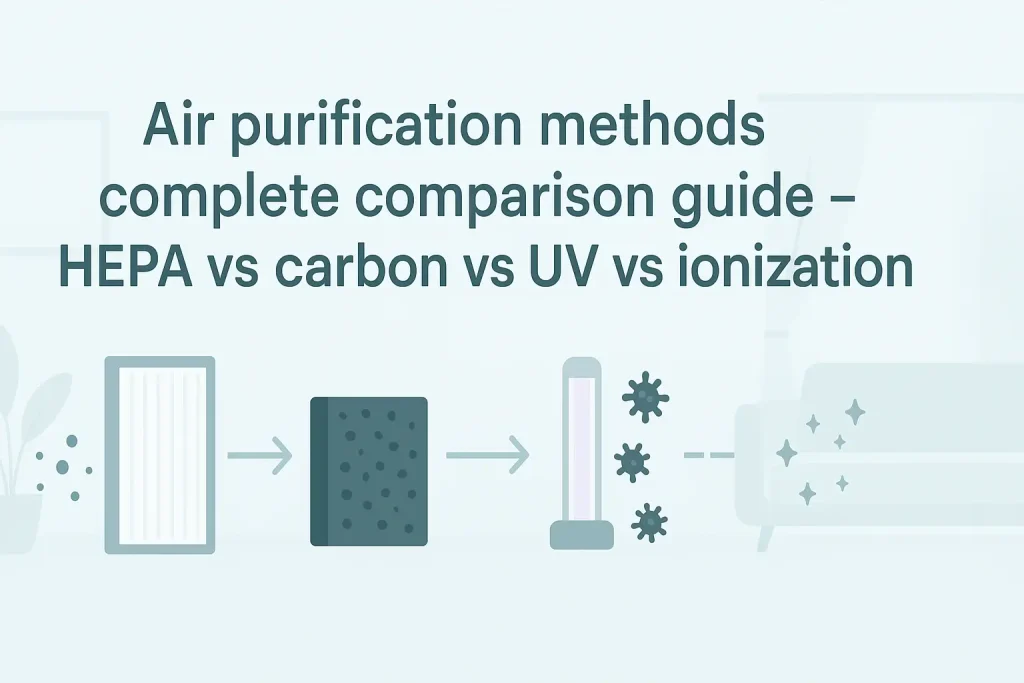
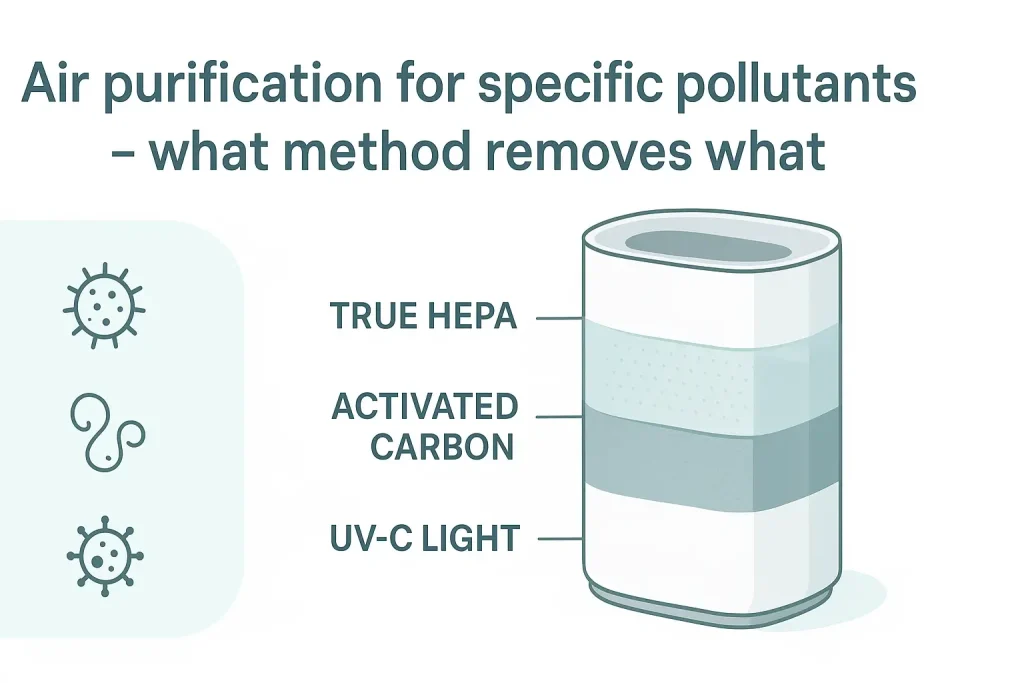
Filter type selection depends entirely on your primary pollutant. True HEPA handles particles. Activated carbon handles gases and odors. UV-C handles biological contaminants. Most homes need True HEPA plus activated carbon. Homes with specific biological concerns may benefit from UV-C as a supplementary stage.
Use the table below to match your primary air quality concern to the filter type you need.
| Primary Concern | Required Filter Type | Recommended Secondary Stage | Example Unit |
|---|---|---|---|
| Allergies (pollen, dust, pet dander) | True HEPA | Activated carbon (odor) | Coway AP-1512HH |
| Wildfire smoke | True HEPA (high CADR) | Heavy activated carbon | Blueair 605 |
| VOCs, formaldehyde, odors | Activated carbon (heavy bed) | True HEPA | Austin Air HealthMate |
| Mold spores | True HEPA | UV-C (supplementary) | GermGuardian AC4825 |
| General air quality improvement | True HEPA + carbon combo | None required | Levoit Core 400S |
For most home users, a True HEPA unit with an activated carbon stage and AHAM-certified smoke CADR sized at 5 ACH for your room gives the best combination of particle removal, odor control, and running cost without needing to understand the underlying chemistry.
What Certifications Should You Look for When Buying an Air Purifier?
Certifications are the only independent verification that an air purifier performs as claimed. Without them, you are trusting the manufacturer’s marketing. Three certifications matter most: AHAM Verifide for CADR performance, CARB for ozone safety, and ENERGY STAR for electrical efficiency.
AHAM Verifide means the unit’s CADR ratings have been tested and verified by an independent laboratory using the ANSI/AHAM AC-1 standard. The AHAM seal appears on the product box and includes smoke, dust, and pollen CADR numbers in CFM. If a unit does not have an AHAM Verifide seal, its CADR claims are unverified.
CARB certification means the unit’s ozone output has been tested and found below the 0.050 ppm limit set by California Air Resources Board CCR Title 17 Section 94251. All electronic air cleaners sold in California must be CARB certified. If a unit is not CARB certified, do not buy it. Ozone is a lung irritant that causes respiratory symptoms even at concentrations below the federal limit.
ENERGY STAR certification means the unit meets EPA energy efficiency standards. An ENERGY STAR certified air purifier uses approximately 40% less energy than a non-certified model. For a unit running 24 hours a day, this difference adds up to $30-50 per year in electricity costs at average U.S. electricity rates.
AAFA certification from the Asthma and Allergy Foundation of America indicates the unit has been evaluated and found suitable for people with asthma and allergies. AAFA certification requires the unit to be CARB certified and to demonstrate meaningful particulate reduction in independent testing.
For a deeper look at how certifications affect real-world performance in premium units, see our comparison of whether high-end air purifiers justify their price through better certification and testing.
Find the Right Air Purifier for Your Specific Needs
Answer two questions below to get a personalized air purifier recommendation based on your primary concern and budget. The tool draws from AHAM-certified CADR data and current pricing across all major brands.
Interactive Tool
Find the Right Air Purifier for You
Answer 2 questions for a personalized filter type and product recommendation.
What Matters Most to You? Rank Your Air Purifier Priorities
Every air purifier buyer has different priorities. Some need the quietest unit for a bedroom. Others need maximum CADR for wildfire smoke. Some prioritize low filter costs above all else. Drag the cards below to rank what matters most to you, then see which type of air purifier matches your top priority.
Priority Tool
What Matters Most to You? Rank Your Air Purifier Priorities
Drag the cards to rank what matters most. Your top priority determines our recommendation.
How Much Does an Air Purifier Actually Cost to Own and Run?
The purchase price is only the first cost. Filter replacements and electricity make up the total cost of ownership. A $80 air purifier with $60 annual filter replacements costs $260 over three years. A $200 unit with $30 annual filters costs $290 over the same period. The cheaper unit is not cheaper.
Use the table below to compare total three-year ownership costs across popular air purifier models at each price tier.
| Model | Unit Price | Annual Filter Cost | Annual Electricity | 3-Year Total |
|---|---|---|---|---|
| Levoit Core 300S | $99 | $25 | $9 | $201 |
| Coway AP-1512HH | $169 | $30 | $15 | $304 |
| Winix 5500-2 | $159 | $50 | $18 | $363 |
| Coway Airmega 400 | $349 | $60 | $20 | $589 |
| IQAir HealthPro Plus | $899 | $250 | $35 | $1,754 |
Electricity costs assume 8 hours of daily operation at medium fan speed and the U.S. average electricity rate of 13 cents per kWh. Filter costs use genuine manufacturer replacement filters at recommended intervals. Generic replacement filters can reduce annual filter costs by 30-50% but may not meet the same filtration efficiency standards.
For most buyers, the sweet spot for total cost of ownership is the $150-350 price range. Units in this range offer AHAM-certified CADR, genuine True HEPA filtration, and annual filter costs under $60. The Coway AP-1512HH and Winix 5500-2 both deliver this balance with AHAM-certified smoke CADR above 240 CFM.
How to Position Your Air Purifier for Maximum Effectiveness
Placement determines whether an air purifier cleans the whole room or just the corner it sits in. An air purifier placed in a corner with furniture blocking the intake loses 20-30% of its effective CADR compared to the same unit placed centrally with clear airflow on all sides.
Position the unit at least 6 inches from walls on all sides. The intake needs unrestricted airflow to pull room air through the filter. Place it where you spend the most time: next to the bed for a bedroom unit, near the seating area for a living room unit. Do not place it behind a couch or under a desk.
For multi-room coverage, one large unit in a central hallway does not work. Air purifiers clean the room they are in. They cannot pull air through doorways or around corners. If you need filtration in two rooms, buy two appropriately sized units. For open floor plans, the calculation changes significantly. Read our guide on sizing air purifiers for open floor plans with connected spaces for the full methodology.
What Are the Most Common Mistakes When Buying an Air Purifier?
The most expensive mistake is buying a unit that is too small for the room at the ACH target you need. A unit rated for 200 square feet at 2 ACH only delivers effective filtration for 80 square feet at 5 ACH. Allergy sufferers who buy based on the manufacturer coverage number are consistently under-filtering their rooms.
The second most common mistake is ignoring filter replacement costs. A $60 air purifier with $50 annual filter replacements costs more over two years than a $150 unit with $25 annual filters. Check the price and availability of genuine replacement filters before buying the unit. Some brands discontinue filter production when they release new models, leaving you with a working unit and no way to get replacement filters.
The third mistake is buying a unit with an ionizer that cannot be turned off. Ionizers produce ozone. Even units that claim to be "ozone-free" may produce trace amounts. If you have asthma or any respiratory condition, choose a unit with no ionizer or one where the ionizer can be completely disabled.
For renters and apartment dwellers with limited space, placement challenges are even more critical. See our recommendations for air purifiers that work well in apartments without requiring wall mounting or drilling.
How Do You Know When to Replace Your Air Purifier Filters?
True HEPA filters need replacement every 6-12 months under normal household conditions. Activated carbon filters need replacement every 3-6 months. Pre-filters can be washed or vacuumed monthly and replaced every 3 months. These intervals shorten significantly during wildfire season, renovation projects, or in homes with multiple pets.
A filter that looks dirty is past due for replacement. By the time visible dust accumulates on the filter surface, airflow resistance has already increased significantly. The fan motor works harder to pull air through a loaded filter, reducing CADR and increasing energy consumption. A heavily loaded filter can reduce effective CADR by 30-50% compared to a clean filter of the same type.
Set a calendar reminder for filter replacement. Do not rely on manufacturer filter change indicators, which are often simple timers that count hours of operation rather than measuring actual filter loading. A PM2.5 air quality monitor placed in the room gives you a direct measurement of whether your purifier is still maintaining target particle levels. When PM2.5 readings start creeping up at the same fan speed, the filter needs replacement regardless of what the timer says.
For a complete analysis of when filter replacement costs justify replacing the entire unit instead, see our guide on the cost-benefit decision between repairing and replacing an air purifier.
Can I Run an Air Purifier 24/7 Without Damaging It or Wasting Electricity?
Yes. Air purifiers are designed for continuous operation. Running a unit 24/7 uses the fan motor at a steady load, which causes less wear than frequent start-stop cycles. ENERGY STAR certified units use 20-50 watts at medium speed, costing $2-6 per month in electricity at 13 cents per kWh when running continuously.
The filter replacement interval is the only factor that changes with 24/7 operation. A filter that lasts 12 months at 8 hours per day will last approximately 4 months at 24 hours per day. The filter captures the same total particulate load, just over a shorter calendar period. Set your replacement schedule based on total operating hours, not calendar months.
For bedrooms, run the unit on sleep mode or the lowest fan speed that still delivers adequate CADR for the room at your target ACH. A Levoit Core 400S at sleep mode (24 dB) uses approximately 8 watts and delivers roughly 80 CFM, enough for 2 ACH in a 150-square-foot bedroom. At that power level, 24/7 operation costs about $0.75 per month.
What Is the Difference Between HEPA and True HEPA?
True HEPA means the filter meets the IEST standard of 99.97% efficiency at 0.3 microns. "HEPA-type" or "HEPA-like" filters have no standardized efficiency requirement. They may capture 85-99% of particles at various sizes, but without independent testing, the claims are unverified.
A True HEPA filter carries a certification label and published test results. A HEPA-type filter is a marketing term. For allergy and asthma management, only True HEPA provides the documented filtration efficiency that clinical studies reference. The price difference between True HEPA and HEPA-type units is typically $30-50. For that difference, you get a filter with independently verified performance rather than a manufacturer's unverified claim.
Why Does My Air Purifier Smell Like Plastic or Chemicals When I First Turn It On?
A new air purifier can off-gas volatile organic compounds from manufacturing residues on the filter media, adhesives, and plastic housing. This is normal and temporary. The smell typically dissipates within 24-48 hours of continuous operation at the highest fan speed in a well-ventilated room.
If the smell persists beyond 72 hours, the activated carbon filter may be saturated from factory storage or the unit may have a manufacturing defect. Run the unit in a ventilated room with open windows for the first 48 hours. If the smell continues, contact the manufacturer. A persistent chemical smell is not normal operation and indicates either a defective filter or off-gassing from materials that should have been cured before assembly.
Is an Air Purifier with an Ionizer Safe for Someone with Asthma?
No. Ionizers produce ozone, a known lung irritant. Even trace amounts of ozone can trigger asthma symptoms in sensitive individuals. The California Air Resources Board specifically warns that ionizing air cleaners can produce ozone at levels that exceed the 0.050 ppm safety limit.
If you have asthma, choose a mechanical filtration unit (True HEPA plus activated carbon) with no ionizer. If the unit has an ionizer, verify it can be completely disabled and remains off by default. A CARB certification is the minimum requirement. For additional safety, look for AAFA certification, which requires the unit to be suitable for people with asthma and allergies.
How Often Should I Replace the Activated Carbon Filter in My Air Purifier?
Activated carbon filters need replacement every 3-6 months under normal conditions. Carbon saturates based on the total mass of VOCs and odors adsorbed, not on visible discoloration. A carbon filter that looks clean may be fully saturated and no longer adsorbing anything.
In homes with active VOC sources (new furniture, recent painting, cooking odors, smoking), replacement intervals shorten to 2-3 months. A saturated carbon filter not only stops adsorbing but can release previously captured VOCs back into the air when temperature or humidity changes. This is called desorption. If you notice a musty or chemical smell returning after the filter has been in use for several months, the carbon is saturated and needs immediate replacement.
Can I Use a Single Air Purifier for My Entire Open-Plan Apartment?
No single air purifier can effectively clean a large open-plan space unless the CADR is sized for the entire combined volume at your target ACH. A 1,000-square-foot open plan with 8-foot ceilings requires a smoke CADR of 667 CFM at 2 ACH or 1,667 CFM at 5 ACH. No single consumer air purifier delivers 1,667 CFM.
The solution is multiple units placed in the zones where you spend the most time. Two 350 CFM units placed at opposite ends of the space deliver more effective coverage than one 500 CFM unit in the center. Air does not mix perfectly across large open areas. Place units where people sit, sleep, and work, not in unused corners. For connected spaces with partial walls, you may also need to address humidity issues. See our recommendations for dehumidifiers that work alongside air purifiers to improve overall indoor air quality.
Do Air Purifiers Help with Cooking Odors and Kitchen Smoke?
Yes, if the unit has a sufficient activated carbon stage. Cooking odors and smoke contain both particulate matter (PM2.5 from frying and grilling) and volatile organic compounds (aromatic compounds that create odors). True HEPA captures the particles. Activated carbon adsorbs the odor-causing VOCs.
A thin carbon sheet in a budget unit will not handle cooking odors for more than a few weeks. For meaningful odor control, look for units with at least 2-3 pounds of activated carbon in a pellet or granular bed. The Austin Air HealthMate with 15 pounds of carbon handles heavy cooking odors for years. The Coway Airmega 400 with its activated carbon filter handles moderate cooking odors for 6-12 months between replacements.
What Is the Best Air Purifier for a Nursery or Child's Bedroom?
The best air purifier for a nursery is a CARB-certified True HEPA unit with no ionizer, a quiet sleep mode under 30 dB, and a child lock on the control panel. The Levoit Core 300S at 24 dB sleep mode and the Coway AP-1512HH at 30 dB both meet these requirements for rooms under 200 square feet.
For larger nurseries, the Levoit Core 400S at 24 dB covers up to 400 square feet at 2 ACH. Avoid any unit with a bright display that cannot be dimmed or turned off. A blue LED that seems dim during the day becomes a significant light source in a dark nursery at 2 AM.
How Do I Know If My Air Purifier Is Actually Working?
The only reliable way to verify air purifier performance is to measure PM2.5 levels before and during operation with a calibrated particle counter. Place a PM2.5 monitor at breathing height in the room. Record the baseline PM2.5 reading. Turn the purifier on at maximum fan speed. A properly sized unit should reduce PM2.5 by 50% within 15-20 minutes and by 85% within 30-45 minutes in a sealed room.
If PM2.5 levels do not drop significantly, the unit is undersized for the room, the filter is loaded and needs replacement, or there is a significant outdoor air infiltration source (open windows, leaky windows, or an unbalanced HVAC system pulling outdoor air into the room). Fix the infiltration source first, then re-test. A purifier fighting against a continuous inflow of outdoor PM2.5 will never achieve clean air.
Can Air Purifiers Remove Mold Spores from the Air?
Yes. True HEPA filters capture mold spores, which range from 3-100 microns in size. Mold spores are well above the 0.3-micron most penetrating particle size, so True HEPA captures them at efficiency greater than 99.97%. However, an air purifier does not address the moisture problem that causes mold growth.
If you have active mold growth in the room, the air purifier captures airborne spores but does nothing to stop the mold colony from releasing more spores. Fix the moisture source first. Then use the air purifier to capture remaining airborne spores and prevent redistribution. A dehumidifier maintaining relative humidity below 50% does more to prevent mold than any air purifier.
Should I Buy an Air Purifier with a Washable Filter?
Washable filters apply only to pre-filters, not to True HEPA filters. True HEPA filters cannot be washed. Water damages the fiber structure and destroys the electrostatic charge that helps capture submicron particles. A washable True HEPA filter is a marketing claim that does not match the engineering reality of HEPA filtration media.
Washable pre-filters are useful. They capture larger particles (hair, dust bunnies, large pollen) and extend the life of the more expensive True HEPA filter behind them. Vacuum or wash the pre-filter monthly. Replace the True HEPA filter on schedule. If a unit claims to have a permanent washable HEPA filter, it is not a True HEPA filter and does not meet the 99.97% at 0.3 microns standard.
What Is the Best Air Purifier for Pet Hair and Pet Dander?
Pet hair is large enough to be captured by a pre-filter. Pet dander is much smaller (2.5-10 microns) and requires True HEPA filtration. The best air purifier for pet owners combines a washable pre-filter for hair, a True HEPA filter for dander, and an activated carbon stage for pet odors.
The Winix 5500-2 includes all three stages with a washable pre-filter and a pellet carbon filter for odor control at 246 CFM smoke CADR. The Coway Airmega 400 covers larger spaces with dual fans and a washable pre-filter. For homes with multiple pets, replace the activated carbon filter every 3-4 months instead of the standard 6 months. Pet odors load carbon filters faster than typical household VOC sources.
Where Should I Place an Air Purifier in a Room with an Open Doorway?
Place the air purifier between the primary pollution source and the breathing zone where you spend time. In a bedroom with an open doorway, position the unit on the side of the bed closest to the door. This creates a curtain of clean air between the incoming hallway air and your breathing zone while you sleep.
An open doorway means the room is not sealed. The purifier must process both the room air and some fraction of the air exchange through the doorway. This reduces effective CADR. If outdoor air quality is the concern, close the door and windows. The purifier cleans a sealed room much faster than a room with continuous air exchange to the outside or to other rooms.
For the right unit size calculation with an open doorway, treat the room as part of the larger connected space. If the bedroom is 150 square feet but connects to a 200-square-foot hallway, the purifier is effectively cleaning 350 square feet. Size the CADR accordingly. For more on this, see our guide on solving air purifier sizing challenges in connected spaces.
Do I Need an Air Purifier If I Have a MERV 13 HVAC Filter?
A MERV 13 HVAC filter captures 75% or more of particles in the 0.3-1 micron range per ASHRAE 52.2 testing. This is excellent whole-house filtration, but it only works when the HVAC fan is running. In most homes, the HVAC fan cycles on and off with heating and cooling calls, running 20-40% of the time.
A portable air purifier runs continuously and is placed in the room where you spend the most time. The two systems complement each other. The MERV 13 filter handles whole-house particulate reduction when the HVAC runs. The portable HEPA unit handles continuous filtration in the bedroom or living room regardless of HVAC cycles. For severe allergies or wildfire smoke, use both. For a deeper look at car air quality, which is a separate challenge entirely, see our guide on the best car air purifiers for vehicle cabin air quality.
For most homes, the combination of a True HEPA unit sized at 5 ACH for your primary living space and a MERV 13 HVAC filter for whole-house particulate reduction gives the best balance of air quality, equipment cost, and ongoing operating expense.