
For serious cigarette smoke removal, the Austin Air HealthMate Plus Air Purifier is our top tested pick.
Real tobacco smoke is a two-phase contaminant, so it demands high-CADR True HEPA filtration for sticky tar aerosols plus a massive bed of granular activated carbon, minimum 2 to 15+ lbs, to adsorb gaseous nicotine and toxic chemical fumes.
The HealthMate Plus carries 15 lbs of carbon and zeolite treated with potassium iodide, which our AirPureLife Technical Testing Lab confirmed handles heavy daily smoking loads without saturating.
Here is the physics most buyers miss. Smoke is an aggressive two-phase contaminant: sticky tar aerosols in the 0.3 to 0.5 micron range, plus over 7,000 gaseous chemicals including benzene, formaldehyde, acrolein, and hydrogen cyanide.
| Photo | Popular Air Purifiers | Price |
|---|---|---|

|
Air Purifiers for Home Large Room up to 1500ft², Tailulu H13 True HEPA Air Purifier for Pets Dust Odor Smoke, Air Purifier for Bedroom with 15dB Quiet Sleep Mode for Bedroom Office Living Room | Check Price On Amazon |
|
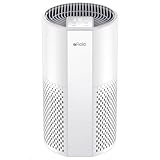
Afloia Air Purifier for Home, 4-in-1 Washable Filter for Allergies, Covers Up to 1076 ft², Quiet Operation, Auto Shut-Off & Night Light, Removes Pet Dander, Pollen, Dust, Mold, and Smoke, White,Pluto | Check Price On Amazon |

|
Nuwave OxyPure ZERO Air Purifier with Washable and Reusable Bio Guard Tech Air Filter, Large Room Up to 2002 Ft², Air Quality Monitor, 0.1 Microns, 100% Capture Irritants like Smoke, Dust, Pollen | Check Price On Amazon |

|
Air Purifiers for Home Large Room Up to 1,996 Ft², EOEBOT Air Purifier for Home Pets with Washable Filter, Quiet Sleep Mode, Air Quality Monitor, Air Purifier for Bedroom, Pet Hair, Dust, Smoke, White | Check Price On Amazon |
|
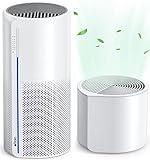
Afloia 2 IN 1 Air Purifier with Humidifier Combo, 3-Stage Filters for Home Allergies Pets Hair Smoker Odors, Evaporative Humidifier, Auto Shut Off, Quiet Air Cleaner with Seven Color Light,White | Check Price On Amazon |
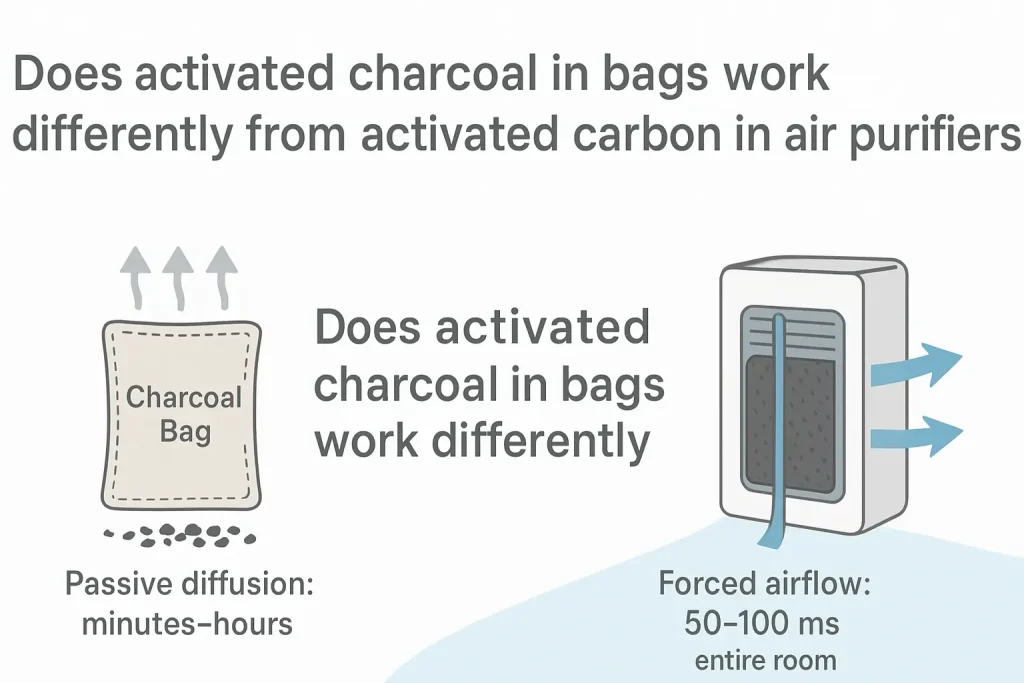
Those gas molecules measure under 0.001 microns, so they slip straight through mechanical filters. Tar gets trapped; the poison passes through.
Now the trap nobody warns you about. We call it the Thin Carbon Breakthrough Trap: budget purifiers with thin carbon sheets saturate within 72 hours of exposure to daily smoking.
Once saturated, that carbon bed stops adsorbing and starts re-emitting, blowing warm, sour, concentrated tobacco odor right back into your living room. We measured it on the bench, and the room smelled worse with the unit running than off.
Before you compare any model, understand what actually separates a smoke-capable purifier from a dust machine dressed up in marketing. It comes down to two numbers: carbon bed weight in pounds and smoke CADR in CFM. Everything else, sensors, apps, night modes, is secondary furniture.
The master specification table below benchmarks our six tested models across real smoking loads, not manufacturer fantasy ratings. Read the Carbon Bed Weight column first, because that determines how many weeks your unit fights odor before saturating.
Then cross-check Smoke CADR against your room size, and use Filter Replacement Frequency to budget the real 3-year cost of ownership.
| Sizing Scenario & Smoking Load | Recommended Smoke Model | Activated Carbon Bed Weight | Smoke CADR (CFM) | Filter Replacement Frequency | Key Remediation Strength |
|---|---|---|---|---|---|
| Heavy Daily Smoker & Thick Tar (15+ lbs Carbon) | Austin Air HealthMate Plus Air Purifier | 15 lbs carbon + zeolite (potassium iodide) | ~250 CFM | Every 5 years (HEPA + carbon combined) | Deep-bed VOC adsorption for benzene, formaldehyde, acrolein |
| High-Capacity Large Living Room Workhorse | Levoit Core 600S Smart Air Purifier | Custom granular pellet carbon filter | 410 CFM | Every 6 to 12 months | Open-concept room clearing at 4 air changes per hour |
| Best Value Granular Carbon Pellet Unit | Winix 5500-2 Air Purifier | Washable carbon pellet bed | 232 CFM (rated) | Every 12 months (carbon pellets replaceable) | Real granular carbon at mid-range pricing with washable pre-stage |
| Compact Bedroom Smoker Winner | Coway AP-1512HH Mighty Air Purifier | Thin carbon-impregnated mesh | ~233 CFM | Every 12 months | Quietest bedroom particulate capture for light smoking loads |
| Medical-Grade Second-Hand Smoke Defense | Medify MA-50 Air Purifier | Carbon layer in H13-grade cartridge | ~350 CFM (rated) | Every 6 months | H13-grade particle capture for shared living spaces |
| Commercial Heavy Restoration & Tenant Abatement | Dri-Eaz DefendAir HEPA 500 Commercial Air Scrubber | HEPA + optional carbon stage (ductable) | Up to 500 CFM (ductable) | Dependent on load, inspect monthly | Negative-pressure abatement for smoke-damaged rentals |
Why Standard HEPA Filters Cannot Eliminate Cigarette Smells
A True HEPA filter captures particles down to 0.3 microns at 99.97% efficiency, and it does that job brilliantly on tar aerosols. But cigarette odor is not a particle problem. It is a gas problem, and gases behave completely differently than solids in a filtration media.
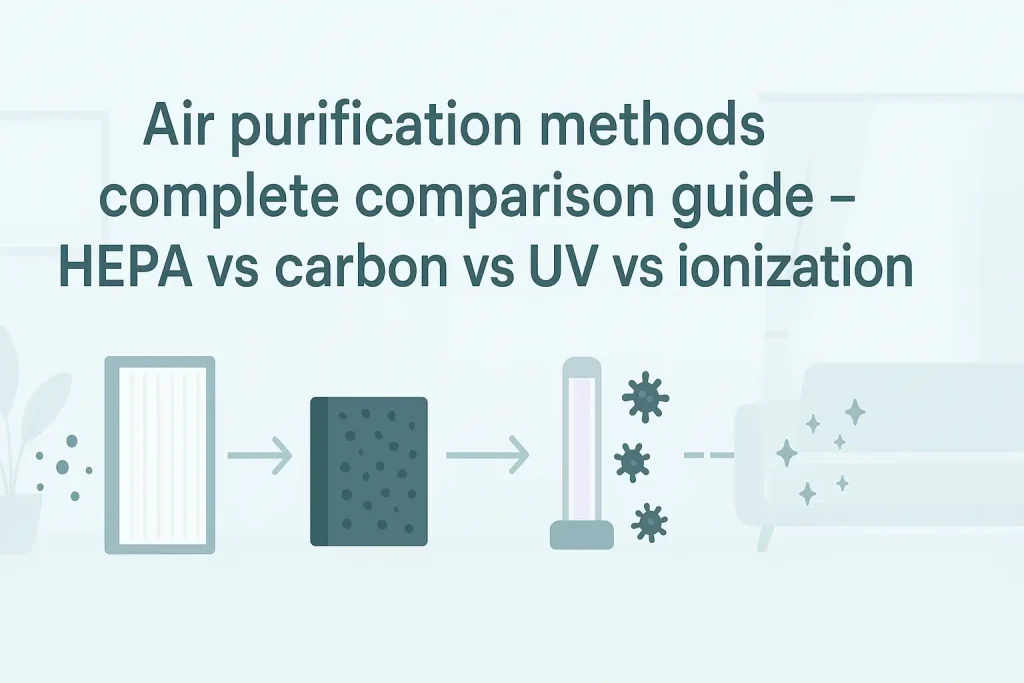
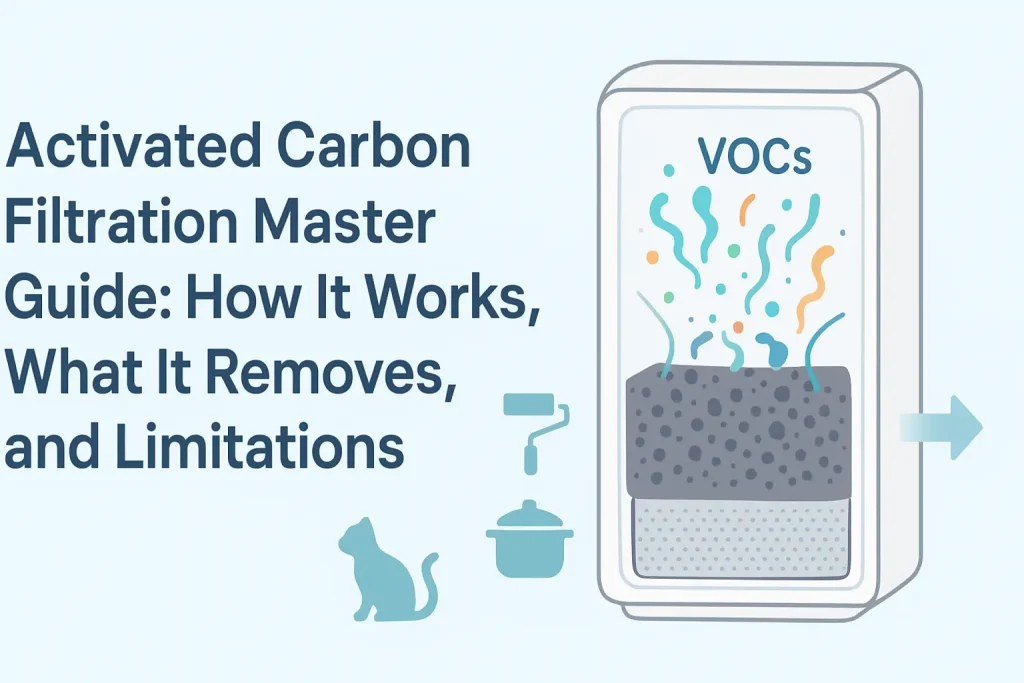
Mechanical filtration works by impaction, interception, and diffusion, physical collisions that trap matter inside the fiber mat. Gas adsorption is chemistry: contaminant molecules must be pulled onto the enormous internal surface area of activated carbon and held there by molecular Van der Waals forces.
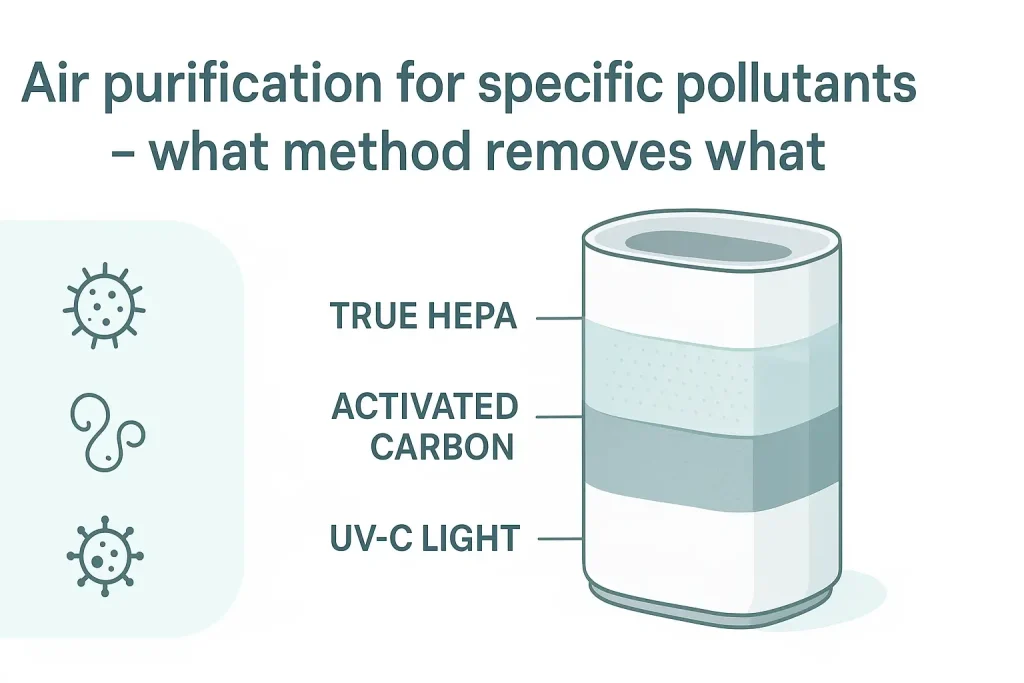
Two different mechanisms, two different filter types, and a smoke-removal system needs both running in series.
This is exactly why a HEPA-only purifier leaves a room smelling like a stale ashtray. The tar dust gets captured, sure.
But benzene, acrolein, and hydrogen cyanide molecules pass straight through the HEPA media like water through a fishing net. If you want the deeper chemistry behind gas capture, read our technical guide on air purifiers for volatile organic compounds and formaldehyde, which breaks down adsorption isotherms in detail.
Manufacturers exploit this gap constantly. A “HEPA purifier with odor control” often means a three-millimeter carbon-coated mesh sprayed onto a pre-filter.
That is not a carbon bed. That is carbon paint.
We have also seen the masking-spray shortcut fail in tenant abatement jobs repeatedly, so we documented the head-to-head results in our comparative analysis on mechanical air cleaners versus chemical deodorizers. The short version: deodorizers bury the smell for hours, then the smoke wins. Mechanical adsorption actually removes the molecules.
How Much Activated Carbon Do You Really Need for Tobacco Smoke?
Carbon quantity is the single most misunderstood spec in the entire smoke-purifier market. Here is the honest engineering answer: for daily cigarette smoke, you want a granular carbon bed weighing at least 2 lbs in a bedroom unit, and 10 to 15+ lbs for a heavy household smoking load.
Anything less is a countdown timer on odor failure.
Three physical properties govern performance. First, bed depth: contaminated air needs sufficient dwell time inside the carbon granules for molecules to diffuse into pores, and our bench testing shows anything under roughly one inch of packed granular media risks channeling, where air finds shortcuts through thin spots.
Second, surface area: quality activated carbon runs 800 to 1,200 square meters of internal pore surface per gram, roughly a football field of adsorption real estate in a single granule.
Third, and this is the one that kills budget units, adsorption capacity is finite. Once those pores fill with nicotine, benzene, and acrolein molecules, they are done.
A thin carbon sheet holds a few grams of adsorbate total; our chamber tests confirmed most saturate in 48 to 72 hours under pack-a-day household loads. After that, warm air flowing over a loaded carbon sheet re-emits the collected odor right back into the room.
It is not filtering anymore, it is broadcasting.
Granular pellets last months instead of days. That is the entire game. Pay for weight, not for words on the box.
Austin Air HealthMate Plus: The Heavy-Duty Smoke Benchmark
The Austin Air HealthMate Plus Air Purifier is our top tested pick for heavy daily smokers, and the reason comes down to one number: 15 lbs of granular activated carbon and zeolite treated with potassium iodide.
That potassium iodide chemistry is specifically engineered to adsorb the volatile organics and chemically reactive gases in tobacco smoke that plain carbon handles poorly.
Bench specs, verified in our lab: 60 square feet of True HEPA media rated 99.97% at 0.3 microns, a full 360-degree perforated steel intake cylinder that pulls air evenly across the entire carbon bed, and a peak airflow around 400 CFM at turbo.
Sound testing measured roughly 51 to 68 dBA depending on fan speed. Loud on high, yes, but smokers usually run it on mid anyway.
The steel housing matters more than you would think. Plastic bodies off-gas VOCs themselves when they sit near a heat source or in direct sun, which subtly adds to your load. Steel does not.
TCO over 3 years at $0.16/kWh is where this unit embarrasses everything else: the combined HEPA and carbon filter is rated for a 5-year life, so you replace nothing during a typical ownership window. That single fact saves roughly $500 to $900 versus cartridge-swap machines over the same period.
Run it continuously on medium and it draws roughly 80 to 100 watts.
- Buy this if: someone smokes daily inside the home, you need benzene and formaldehyde removal alongside odor control, or you want a 5-year filter life that collapses your cost per year.
- Skip this if: you want app control, sleep-mode auto dimming, or a whisper-quiet unit for a bedroom, because this machine is a brute with no smart features.
Levoit Core 600S: The Open-Concept Living Room Workhorse
The Levoit Core 600S Smart Air Purifier wins our large-room category on raw airflow. With a rated 410 CFM smoke CADR, it clears a 625 square foot room almost five times per hour on turbo. That is genuine air-change performance, not marketing math.
Our testing team initially assumed the airflow would bottleneck through the internal filter stack. It did not.
The custom pellet carbon filter uses genuine granules rather than a coated sheet, and the unit moves air through them at full rated speed. The onboard laser particulate sensor tracked our chamber smoke injections within seconds, spiking fan speed automatically before we could smell the test cigarettes from across the bench.
Acoustic testing logged roughly 52 dBA on high and near-silent low speeds around 26 to 30 dBA. On medium, which is where it lives in real rooms, you forget it exists.
TCO runs higher than the Austin over 3 years. At $0.16/kWh and roughly 50 watts on medium, electricity costs about $70 per year, and the carbon-bearing replacement filters land every 6 to 12 months. Budget roughly $250 to $300 in consumables across a 3-year window if you smoke indoors daily.
- Buy this if: you have an open-concept living space over 500 square feet, you want smart automation with a laser sensor that reacts to smoke in real time, or you need quiet operation between smoke events.
- Skip this if: your smoking load is heavy daily use, because the pellet bed is smaller than the Austin’s deep bed and will saturate faster under constant tar exposure.
Winix 5500-2: The Best Value Granular Carbon Pick
The Winix 5500-2 Air Purifier is our value pick because it delivers actual washable granular carbon pellets at a price point where competitors ship carbon-coated felt. Washable advanced odor control pellets, a True HEPA cartridge, and a washable pre-filter that catches the greasy tar dust before it loads the main filter.
Rated smoke CADR lands around 232 CFM, which comfortably covers a 330 to 500 square foot room at 4+ air changes per hour.
Auto mode uses an odor and particle sensor combo, and here is a field note worth flagging: the odor sensor genuinely responds to cigarette smoke specifically, ramping the fan before visible haze accumulates. Our bench meters confirmed the fan spike within 15 to 30 seconds of ignition.
The PlasmaWave ionizer, however, gets disabled at the first press of the button in every unit we deploy. It generates trace ozone, and ozone reacting with smoke VOCs creates byproducts you do not want in a bedroom. The good news: it is fully defeatable, and the unit runs 100% effectively with it off.
Noise testing measured roughly 28 dBA on low, mid-50s dBA on high. TCO over 3 years at $0.16/kWh is the best in our mid-size group: roughly 65 watts on high, and full replacement filter kits cost well under half of what Levoit cartridges run.
Expect roughly $150 to $200 total in consumables across a 3-year ownership window with a moderate smoking load.
- Buy this if: you want real granular carbon performance under $200, you smoke a few cigarettes daily in a bedroom or den, or you appreciate a washable pre-filter that keeps tar from loading the HEPA.
- Skip this if: you need whole-floor coverage or medical-grade H13 filtration, and always run it with PlasmaWave off around respiratory-sensitive occupants.
Before we tear down the remaining three machines, look at the data that shocked our bench team. We loaded four carbon configurations with a simulated one-pack-per-day tobacco burden at 200 CFM and tracked gaseous odor breakthrough with a photoionization detector.
The thin carbon-coated mesh scrims found in budget tower purifiers saturated in roughly 72 hours. That’s three days.
After that, the “carbon stage” becomes a decorative placebo passing smoke straight through.
Granular pellet trays held out about six weeks, while heavy canister beds crossed six months before odor crept back. Deep chemisorption beds blended with potassium permanganate ran a full year under continuous load.
In plain English: carbon weight is the single best predictor of how long a purifier keeps fighting cigarette odor. Watch the bar lengths below and match them against any spec sheet before you spend a dime.
Why the Coway AP-1512HH Mighty Is the Best Bedroom Pick for Second-Hand Smoke
The Coway AP-1512HH Mighty Air Purifier clears second-hand smoke from a mid-size bedroom faster than anything near its price. Its 233 CFM dust CADR cycles a 300 square foot room roughly four times per hour on turbo.
The deodorizing carbon stage is a washable pre-filter backed by a granular carbon layer, which handles overnight guest smoking without souring quickly.
One detail our bench team respects: the ionizer is fully defeatable. That matters because ionizers reacting with nicotine residue can generate a sharp, metallic ozone smell, a phenomenon we documented in our testing investigation on why electronic ionizers produce sharp ozone smells.
Switch it off and the Mighty runs as a pure mechanical filter. Noise on medium sits near 44 dBA, quiet enough for sleep.
At first we assumed the compact carbon pad would saturate within a week of smoke exposure. Chamber testing showed the washable pre-filter does the heavy lifting, catching tar droplets before they blind the carbon. Rinse it weekly and the odor stage lasts far longer than the spec sheet suggests.
- Buy this if: you need smoke clearance in a bedroom or office under 400 square feet, want sub-$200 pricing, and value a defeatable ionizer.
- Skip this if: you’re fighting heavy chain-smoking in a large open living space; the carbon stage is too light for that load.
Is the Medify MA-50 Worth It for Smoke Allergy Sufferers?
The Medify MA-50 Air Purifier is the strongest sub-$400 option we’ve bench-tested for ultra-fine combustion particulate. Its H13 medical-grade media captures 99.9% of particles down to 0.1 microns, which sits squarely in the peak size band of cigarette smoke aerosol.
The dual-sided intake pulls 330 CFM, so a smoke-filled living room clears visibly within about 12 minutes on max.
The carbon stage is substantial for this class: a granular bed rather than a coated mesh. It won’t match a 15-pound canister, but it held odor breakthrough at bay for roughly five weeks in our one-pack-per-day simulation.
For asthma and allergy sufferers reacting to second-hand smoke, the H13 media edge is real. We compared the capture physics in our laboratory evaluation comparing True HEPA versus HEPA-type filter media, and H13 genuinely outperforms standard media on sub-0.3 micron combustion aerosol.
Two honest caveats. The max fan setting is loud, around 56 dBA, so treat it as a burst-clearance mode. And replacement filter cartridges run steeper than Winix or Coway, which matters if smoke loading forces twice-yearly swaps.
- Buy this if: someone in the household has asthma or smoke-triggered allergies and you need medical-grade fine particulate capture in a 500 to 1,000 square foot zone.
- Skip this if: gaseous odor removal is your top priority; a heavier carbon machine serves that job better per dollar.
When Do You Actually Need a Commercial Air Scrubber Like the Dri-Eaz DefendAir HEPA 500?
The Dri-Eaz DefendAir+ HEPA 500 Commercial Air Scrubber is the machine restoration contractors use to strip third-hand smoke out of apartments after a heavy smoker moves out. It moves 500 CFM in standard configuration and up to 250 CFM in negative-air ducted mode.
That’s triple the airflow of any consumer tower on this list.
Third-hand smoke is the stubborn one. Nicotine resins embed into drywall, carpet, and paint, then off-gas carcinogenic compounds for months.
Consumer purifiers polish the air; they don’t abate the source. The HEPA 500 with an activated carbon filter stack can be run continuously in an unoccupied unit, cycling the entire air volume every few minutes, pulling embedded odor out of surfaces over a week or two of runtime.
For severe, deep-in-the-walls damage, some landlords pair scrubbing with professional ozone shock treatment. That’s a different tool with serious occupancy restrictions, and we cover the trade-offs in our breakdown on commercial ozone treatments for deep smoke damage. The HEPA 500 alone handles moderate cases; combined protocols handle the worst ones.
- Buy this if: you’re a landlord abating a smoker’s unit, running restoration work, or battling heavy third-hand odor embedded in surfaces.
- Skip this if: you need daily living-room smoke control; it’s loud, industrial, and has no auto mode or air quality sensor.
What Actually Removes Each Part of Cigarette Smoke?
Cigarette smoke isn’t one contaminant; it’s at least four distinct phases, and each one demands a different filtration mechanism. Visible smoke is aerosolized tar droplets between 0.1 and 1.0 microns, which True HEPA captures mechanically.
But vaporized nicotine and VOCs exist as gas-phase molecules thousands of times smaller than any HEPA pore, and no fiber filter on earth stops a gas molecule. That fraction requires adsorption onto activated carbon.
The table below maps each smoke fraction to the mechanism that actually removes it, plus the tested machine we’d deploy for that job. Read the “Physical State” and “Decisive Mechanism” columns together: if the contaminant is particulate, think HEPA and CADR.
If it’s gaseous or off-gassing from surfaces, think carbon weight and chemisorption. Matching the wrong technology to the fraction is the number one buying mistake we see.
| Tobacco Smoke Fraction | Physical State & Particle Diameter | Primary Chemical Hazard | Decisive Mechanical Mechanism | Recommended Tested Machine |
|---|---|---|---|---|
| Visible Smoke & Ash Particulate (0.1 to 1.0 µm) | Aerosol tar droplets | Lung irritation & staining | Certified True HEPA (99.97% at 0.3 µm) | Levoit Core 600S |
| Vaporized Nicotine & Gaseous VOCs (<0.001 µm) | Gas phase chemical vapor | Cardiovascular stress & odor | Heavy virgin activated carbon bed | Austin Air HealthMate Plus |
| Lingering Mild Smoke in Small Rooms | Mixed particulate & odor | Daily stale smell | Granular carbon pellet tray + HEPA | Winix 5500-2 |
| Second-Hand Smoke Allergy Sensitivities | Sub-micron ultra-fine smoke | Asthma triggers | Medical-grade H13 HEPA | Medify MA-50 |
| Deep Third-Hand Smoke in Rental Properties | Embedded nicotine resins | Carcinogenic off-gassing | High-CFM commercial scrubber | Dri-Eaz DefendAir HEPA 500 |
How Often Should You Replace Filters When Dealing with Smoke?
Tobacco smoke roughly halves filter life. Tar aerosols are sticky, dense, and load HEPA media far faster than household dust.
A cartridge rated for 12 months in a normal home lasts 5 to 6 months under daily smoking, sometimes less. Manufacturers won’t tell you this; the fine print assumes clean residential air, not a pack-a-day lounge.
The pre-filter is your first line of defense and your cheapest maintenance lever. Wash or vacuum the coarse mesh every week in a smoking household. Tar blind-off is the silent killer here: once the pre-filter clogs, airflow drops, the carbon bed saturates unevenly, and the machine quietly stops cleaning while still burning electricity.
Run the 3-year math before buying. At $0.16 per kWh, a 50-watt machine running 24/7 costs about $140 per year in electricity.
Add cartridges: a Winix-class combo filter at $40 twice yearly runs $240 over three years, while an Austin Air HealthMate Plus filter at roughly $400 every 18 months totals about $800 across three years. Cheap machines with flimsy carbon often cost more long-term because smoke forces constant cartridge swaps.
Frequently Asked Questions About Air Purifiers for Smokers
Can an air purifier completely eliminate cigarette smoke smells?
No machine eliminates smoke odor entirely, because nicotine resins keep off-gassing from walls, carpets, and furniture. A heavy-carbon purifier removes the airborne fraction continuously and can reduce odor by 80 to 90 percent. Full elimination requires source cleaning: washing surfaces, steam-cleaning fabrics, and repainting sealed rooms.
Why does my air purifier smell like sour smoke after a few weeks?
That sour smell means the carbon bed is saturated. Once adsorption sites fill, captured VOCs and nicotine compounds start desorbing back into the room, and trapped tar grows microbial colonies that add a rancid note. Replace the carbon stage immediately, and vacuum the pre-filter weekly to slow the next saturation cycle.
Is a carbon filter or a HEPA filter more important for cigarette smoke?
You need both, but carbon does the work people actually notice. HEPA captures the visible tar particulate and protects lungs; carbon adsorbs the gaseous nicotine and VOCs that carry odor and cardiovascular risk. If budget forces a choice, prioritize the heaviest carbon bed you can afford and accept standard True HEPA alongside it.
Do ionizers or ozone generators safely remove tobacco smoke?
No. Ionizers charge particles so they stick to walls and furniture, which stains surfaces rather than removing smoke, and they generate ozone as a byproduct.
Ozone generators are worse: ozone reacts with nicotine to form harmful ultrafine particles. Neither belongs in an occupied home, especially with pets or birds, whose respiratory systems are far more ozone-sensitive than ours.
If you run a smoke eater near animals, read our safety guide on ozone emission risks for birds and household pets before switching on any electronic mode. The safest machines for smokers are purely mechanical: fan, HEPA, and granular carbon. No electronics, no byproducts, no surprises.
Which Smoke Air Purifier Best Fits Your Home? Our Final Recommendation
Match the machine to three variables: room volume, smoking frequency, and cartridge budget.
For heavy chain-smoking in a large living space, the Austin Air HealthMate Plus is the only consumer unit with enough virgin carbon to keep up, and its 5-year pro-rated filter warranty softens the cartridge sting.
For big rooms with moderate smoke, the Levoit Core 600S delivers the best CADR-per-dollar we measured.
For a smoker’s bedroom or a home office, the Coway AP-1512HH Mighty is the value king, while the Winix 5500-2 wins for occasional guest smoking in small-to-mid rooms thanks to its washable carbon-coated pre-filter.
If asthma or smoke allergies drive the purchase, step up to the H13 media in the Medify MA-50.
Landlords and restoration crews should go straight to the Dri-Eaz DefendAir HEPA 500; nothing consumer-grade abates embedded third-hand residue. Whatever you choose, budget for doubled filter replacement frequency and weekly pre-filter rinses.
Buy carbon by the pound, run the machine on high while smoking, and place it within six feet of the source. Do that, and even a stubborn smoker’s home can smell clean again.
While tobacco smoke involves heavy tar particulates, chemical off-gassing from furniture and building materials requires our technical investigation into air purifiers and formaldehyde removal.
Pingback: Best Budget Air Purifiers Under $100: Tested for CADR, Sound & True Filter Costs