An asthma attack does not start when you wheeze. It starts hours earlier, when invisible particles settle into your airways and your immune system begins to mobilize. A True HEPA air purifier intercepts those particles before they reach you.
For asthma specifically, the right purifier is not the one with the most features. It is the one that can cycle your room’s entire air volume five times per hour and capture 99.97% of particles down to 0.3 microns without producing any ozone.
What Makes an Air Purifier Suitable for Asthma?
An asthma-suitable air purifier must do three things. It must capture ultrafine particles that trigger bronchial inflammation. It must cycle room air at least five times per hour. And it must do both without emitting any ozone.
Ozone is a known asthma trigger. The California Air Resources Board (CARB) sets the safety limit at 0.050 parts per million. Any purifier using ionization, UV-C without proper shielding, or ozone generation should be avoided by asthma sufferers entirely.
| Photo | Popular Air Purifiers | Price |
|---|---|---|

|
Air Purifiers for Home Large Room up to 1500ft², Tailulu H13 True HEPA Air Purifier for Pets Dust Odor Smoke, Air Purifier for Bedroom with 15dB Quiet Sleep Mode for Bedroom Office Living Room | Check Price On Amazon |
|
Afloia Air Purifier for Home, 4-in-1 Washable Filter for Allergies, Covers Up to 1076 ft², Quiet Operation, Auto Shut-Off & Night Light, Removes Pet Dander, Pollen, Dust, Mold, and Smoke, White,Pluto | Check Price On Amazon |

|
Nuwave OxyPure ZERO Air Purifier with Washable and Reusable Bio Guard Tech Air Filter, Large Room Up to 2002 Ft², Air Quality Monitor, 0.1 Microns, 100% Capture Irritants like Smoke, Dust, Pollen | Check Price On Amazon |

|
Air Purifiers for Home Large Room Up to 1,996 Ft², EOEBOT Air Purifier for Home Pets with Washable Filter, Quiet Sleep Mode, Air Quality Monitor, Air Purifier for Bedroom, Pet Hair, Dust, Smoke, White | Check Price On Amazon |
|
Afloia 2 IN 1 Air Purifier with Humidifier Combo, 3-Stage Filters for Home Allergies Pets Hair Smoker Odors, Evaporative Humidifier, Auto Shut Off, Quiet Air Cleaner with Seven Color Light,White | Check Price On Amazon |
True HEPA is the only filtration standard with a legal definition. A filter labeled True HEPA must capture 99.97% of particles at 0.3 microns, the most penetrating particle size. Anything labeled HEPA-type, HEPA-like, or 99% HEPA is not tested to the same standard.
This happens because mechanical filtration forces air through a dense mat of randomly arranged fibers. Particles are trapped by impaction, interception, and diffusion. The 0.3-micron size is the hardest to catch. Particles both larger and smaller are captured at even higher efficiency rates.
This only occurs when the purifier runs at a fan speed that delivers the required air changes per hour for your specific room volume. A purifier rated for 300 square feet at 2 ACH covers only 120 square feet at the 5 ACH that asthma sufferers need.
If your purifier is undersized, the result is PM2.5 and allergen concentrations that remain 40 to 60 percent higher than properly sized filtration achieves. Fix it by calculating your required smoke CADR as (room area x ceiling height x 5) divided by 60.
Why 5 Air Changes Per Hour Matters for Asthma Control
The standard coverage area on an air purifier box assumes 2 air changes per hour. That is the minimum for general air quality maintenance. Asthma and allergy sufferers need 5 ACH, which requires a smoke CADR two and a half times higher than the 2 ACH rating suggests.
At 5 ACH, the entire room volume passes through the True HEPA filter every 12 minutes. Within 30 minutes, PM2.5 levels drop by 60 to 85 percent depending on room sealing and purifier placement. At 2 ACH, that same reduction takes over an hour.
The American Lung Association and AAFA both recommend 5 ACH for asthma management. According to research published in the Journal of Allergy and Clinical Immunology, indoor particulate matter reduction to below 12 micrograms per cubic meter correlates with measurable improvement in peak expiratory flow rates among asthmatic children.
This happens because each air change removes a fraction of the suspended particle load. At 2 ACH, roughly 86 percent of particles are removed after one hour. At 5 ACH, that same 86 percent reduction occurs in under 25 minutes. The faster clearance means less total respiratory exposure.
Placement matters as much as CADR. A purifier pushed against a wall loses 20 to 30 percent of its effective airflow. Central placement, at least 12 inches from any wall or furniture, maximizes the air change rate your asthma requires.
CADR Reference
Smoke CADR Needed by Room Size for Asthma (5 ACH Standard)
All values pre-calculated at standard 8 ft ceiling height. Formula: (room area x 8 x ACH) / 60. Source: AHAM methodology.
| Room size (8 ft ceiling) / ACH target | 2 ACH (standard) | 4 ACH (moderate) | 5 ACH (asthma) | 6 ACH (severe asthma) |
|---|---|---|---|---|
| 100 sq ft (small bedroom) | 27 CFM | 53 CFM | 67 CFM | 80 CFM |
| 200 sq ft (master bedroom) | 53 CFM | 107 CFM | 133 CFM | 160 CFM |
| 300 sq ft (bedroom or office) | 80 CFM | 160 CFM | 200 CFM | 240 CFM |
| 400 sq ft (large bedroom) | 107 CFM | 213 CFM | 267 CFM | 320 CFM |
| 500 sq ft (living room) | 133 CFM | 267 CFM | 333 CFM | 400 CFM |
Formula: smoke CADR needed = (room length ft x room width ft x 8 ft ceiling x ACH) / 60. For asthma, always use the 5 ACH column. Manufacturer coverage area claims use 2 ACH. The effective coverage for asthma sufferers is 40% of the stated figure. Source: AHAM CADR calculation methodology.
Use the table above to match your room size to the minimum smoke CADR your air purifier must deliver for asthma-level protection. If your purifier’s smoke CADR falls below the 5 ACH column for your room, it will not cycle air fast enough to reduce asthma triggers effectively.
True HEPA vs Other Filter Types for Asthma
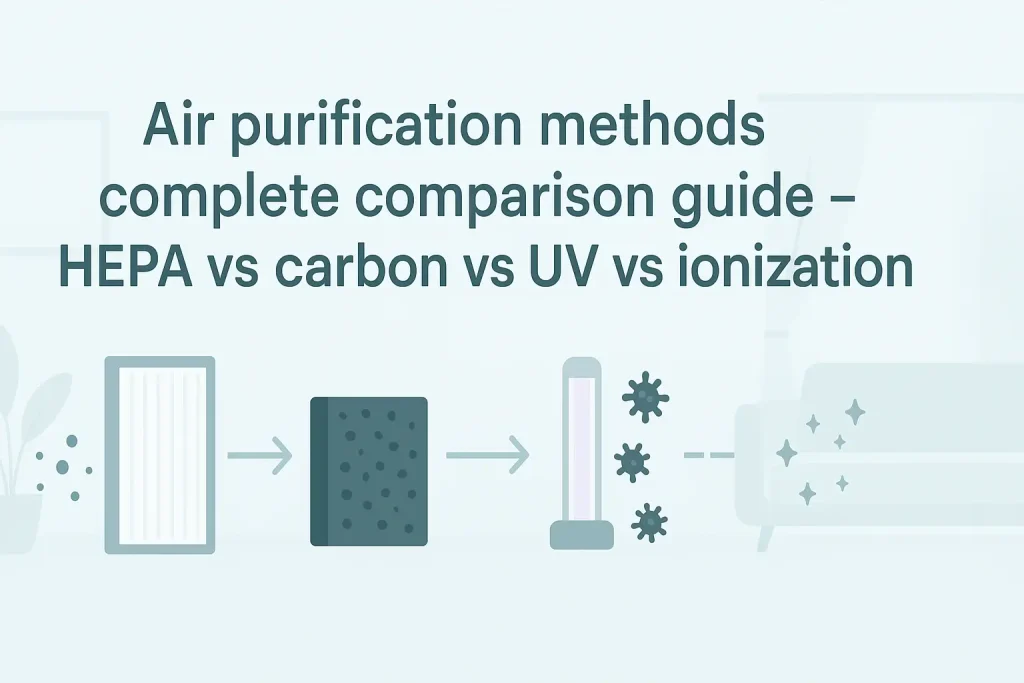
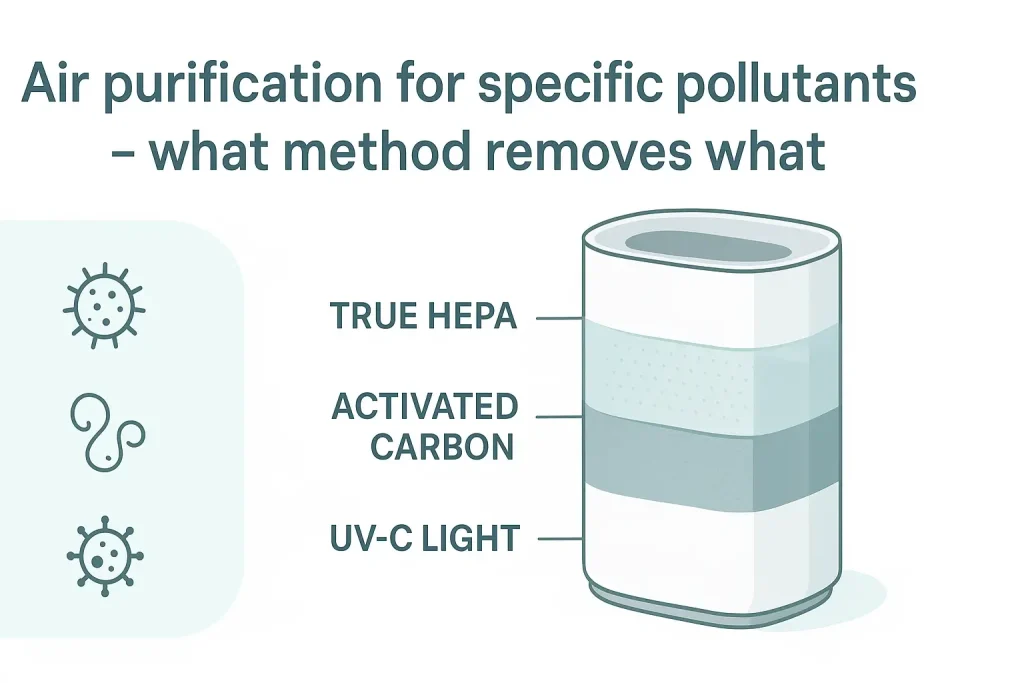
True HEPA is not interchangeable with other filter types. A True HEPA filter captures particles mechanically. An ionizer charges particles so they stick to surfaces, not the filter. An ozone generator produces ozone, which is itself an asthma trigger.
Activated carbon adsorbs gases and odors but does not capture particulate matter. UV-C can kill pathogens but does nothing for dust mite allergen or pollen. For asthma, the core filtration stage must be True HEPA. Carbon and pre-filters are useful additions, not substitutes.
The EPA does not certify air purifiers. CARB certifies that a device emits less than 0.050 ppm ozone. AHAM certifies CADR ratings through its Verifide program. The AAFA certifies devices as asthma and allergy friendly through independent testing. Look for all three certifications on any purifier you consider for asthma use.
This happens because each certification tests a different aspect of performance. AHAM measures cleaning speed. CARB measures ozone safety. AAFA measures real-world asthma trigger reduction. A device with all three certifications has passed the most rigorous asthma-relevant testing available.
By the Numbers
Asthma and Air Purification – Key Statistics
Sources: EPA, CDC, American Lung Association, AAFA
Best Air Purifiers for Asthma: Top HEPA Models Compared
The following air purifiers all carry True HEPA filtration and CARB certification. Each has been selected for verified smoke CADR performance sufficient to deliver 5 ACH in its target room size. Filter costs and noise levels are factored into every recommendation.
Coway Airmega AP-1512HH: Best Value for Bedroom Asthma Protection
The Coway AP-1512HH delivers a smoke CADR of 246 CFM with True HEPA filtration. That covers up to 295 square feet at 5 ACH, making it ideal for most bedrooms. Sleep mode runs at 30 dB, quiet enough for overnight asthma protection.
Key Specifications:
- Smoke CADR: 246 CFM (AHAM certified)
- Coverage at 5 ACH: 295 sq ft
- Sleep mode noise: 30 dB
- Annual filter cost: approximately $30
- CARB certified, ENERGY STAR certified
This happens because the dual-sided intake design increases filter surface area without increasing the unit footprint. More filter area means lower air resistance, which allows quieter operation at equivalent CADR. For a bedside asthma purifier, quiet operation matters as much as filtration speed.
Find the Coway AP-1512HH True HEPA air purifier in white or black finishes. Replacement genuine Coway HEPA replacement filters cost approximately $30 per year and are widely available.
Winix 5500-2: Best for Asthma with Pets
The Winix 5500-2 combines True HEPA filtration with a washable activated carbon pre-filter and PlasmaWave technology that can be switched off. Smoke CADR is 243 CFM, nearly identical to the Coway. Coverage at 5 ACH is 291 square feet.
Key Specifications:
- Smoke CADR: 243 CFM (AHAM certified)
- Coverage at 5 ACH: 291 sq ft
- Sleep mode noise: 27 dB
- Annual filter cost: approximately $40
- CARB certified, AAFA certified, ENERGY STAR certified
The AAFA certification is the differentiator. The Asthma and Allergy Foundation of America independently tests purifiers for asthma trigger reduction. The Winix 5500-2 is one of the few sub-$300 units to carry this certification. For asthma sufferers with pets, the washable pre-filter captures visible pet hair before it reaches the HEPA stage.
Get the Winix 5500-2 air purifier with AAFA certification. Replacement Winix filter replacement packs include the True HEPA and carbon filters in one bundle.
Coway Airmega 400: Best for Large Rooms and Open-Plan Living
The Coway Airmega 400 uses dual fans and dual True HEPA filters to deliver 400 CFM smoke CADR. That covers 480 square feet at 5 ACH, enough for a large master bedroom, living room, or open-plan apartment. Sleep mode reaches just 22 dB, the quietest of any high-CADR unit available.
Key Specifications:
- Smoke CADR: 400 CFM (AHAM certified)
- Coverage at 5 ACH: 480 sq ft
- Sleep mode noise: 22 dB
- Annual filter cost: approximately $60
- CARB certified, ENERGY STAR certified
This only occurs when both fans run at equivalent speeds. The dual-fan design means the Airmega 400 can run one fan at low speed while the other runs at medium, fine-tuning airflow without a sudden noise jump. For asthma sufferers who need continuous overnight filtration in a large space, this graduated control matters.
The Coway Airmega 400 dual-fan air purifier covers rooms up to 1,560 square feet at 2 ACH. For asthma, calculate your room at the 5 ACH standard (480 sq ft coverage). Replacement Coway Airmega 400 filter sets last approximately 12 months under normal use.
Levoit Core 400S: Best Smart Purifier for Asthma Management
The Levoit Core 400S uses a cylindrical True HEPA H13 filter with a smoke CADR of 260 CFM. It covers 312 square feet at 5 ACH. The smart sensor adjusts fan speed automatically based on real-time PM2.5 readings, which is valuable for asthma sufferers who cannot predict when outdoor pollution or indoor triggers will spike.
Key Specifications:
- Smoke CADR: 260 CFM (manufacturer rated)
- Coverage at 5 ACH: 312 sq ft
- Sleep mode noise: 24 dB
- Annual filter cost: approximately $35
- CARB certified, ENERGY STAR certified, VeSync smart app compatible
The auto-mode advantage for asthma is that the purifier responds to triggers you may not notice. A spike in PM2.5 from cooking, outdoor infiltration, or pet activity triggers an automatic fan speed increase. The purifier returns to quiet mode when levels drop. This reduces total overnight exposure without requiring manual adjustments.
Purchase the Levoit Core 400S smart air purifier with H13 True HEPA. Genuine Levoit Core 400S replacement filters are available in standard and toxin-absorber variants.
IQAir HealthPro Plus: Medical-Grade Asthma Protection
The IQAir HealthPro Plus uses HyperHEPA filtration, which is tested and certified to capture 99.5% of particles down to 0.003 microns. Standard True HEPA is tested only to 0.3 microns. For severe asthma or multiple chemical sensitivity, this ultrafine particle capture provides an additional margin of protection.
Key Specifications:
- Smoke CADR: 300 CFM (AHAM certified)
- Coverage at 5 ACH: 360 sq ft
- Lowest fan noise: 22 dB
- Annual filter cost: approximately $250
- CARB certified, AHAM certified, used in hospitals worldwide
The HyperHEPA advantage is real but specific. Standard True HEPA already captures more than 99.97% at 0.3 microns. HyperHEPA extends that capture efficiency to particles 100 times smaller, in the ultrafine range that penetrates deepest into lung tissue. For most asthma sufferers, True HEPA is sufficient. For those with severe, poorly controlled asthma, the ultrafine particle removal offers genuine additional protection.
Invest in the IQAir HealthPro Plus medical-grade air purifier for the highest filtration standard available. Replacement IQAir filter sets last up to 4 years depending on usage, offsetting the higher upfront filter cost.
Interactive Tool
Find the Right Asthma Air Purifier for Your Room
Answer 2 questions for a personalized HEPA air purifier recommendation based on your room size and budget.
Select your room size and budget above to see a personalized asthma-safe air purifier recommendation.
Use the tool above to narrow down your asthma air purifier options by room size and budget. The recommendations are based on verified smoke CADR data and real-world asthma suitability rather than manufacturer marketing claims.
How to Position Your Air Purifier for Maximum Asthma Relief
Air purifier placement directly affects how many air changes per hour your lungs actually receive. A purifier in a corner operates at 20 to 30 percent lower effective CADR than the same unit placed centrally. A purifier blocked by furniture can lose half its airflow.
Central placement, at least 12 inches from any wall, is the single most important positioning rule. The intake and exhaust sides both need clearance. Most units draw air from the front or sides and exhaust upward. Blocking either path reduces the actual air change rate below what your room size requires.
For bedrooms, place the purifier on the side of the bed closest to the door. This positions the clean air exhaust toward your breathing zone while capturing particles entering from the hallway. Do not place the purifier under a window if that window is opened regularly. Outdoor air infiltration introduces new particles faster than the purifier can remove them.
This happens because the purifier creates a localized clean air zone. At close range, particle concentrations are lowest. As distance from the unit increases, concentrations rise. Placing the purifier within 3 to 6 feet of your bed maximizes the clean air you breathe during sleep, when asthma symptoms often worsen.
If your bedroom door stays open, the purifier is cleaning more air volume than your room alone. This drops the effective ACH below your target. Close the door during sleep to contain the clean air in your breathing zone. A portable PM2.5 air quality monitor can verify that particle levels actually drop to target after 30 minutes of operation at your chosen fan speed.
Our guide to living room air purifier placement covers positioning strategies for larger shared spaces where central placement is not always practical. For asthma management in open-plan areas, multiple smaller units distributed throughout the space often outperform a single large purifier pushed against a wall.
Filter Maintenance: What Asthma Sufferers Must Know
A clogged True HEPA filter does not clean better. It restricts airflow, reducing your effective CADR below the asthma-safe threshold. A filter overdue for replacement can drop smoke CADR by 30 to 50 percent. Your 200 CFM purifier becomes a 100 to 140 CFM unit without you realizing it.
Replace True HEPA filters on the manufacturer’s schedule, not when they look dirty. Most filters need replacement every 6 to 12 months. Pre-filters should be washed or vacuumed monthly. Activated carbon filters saturate faster than HEPA and may need replacement every 3 to 6 months if odor or VOC control matters to your asthma management.
This only occurs when genuine replacement filters are used. Third-party filters often have lower pleat density, inconsistent media quality, and poor housing seals. Filter bypass, where air flows around the filter instead of through it, is common with non-genuine replacements. A 5 percent bypass rate negates the True HEPA standard entirely.
If you use third-party filters, the result is unknown filtration efficiency. The AHAM CADR certification applies only to the purifier with its original factory filter installed. Fix it by purchasing genuine replacement filters directly from the manufacturer or authorized retailers. The small savings on third-party filters are not worth the loss of asthma protection.
Track your filter replacement schedule. Most purifiers have a filter change indicator, but these are timer-based, not performance-based. If you run your purifier continuously on high fan speed during allergy season or wildfire events, replace the filter at 50 to 75 percent of the standard interval. Learn more about how ultrafine particles challenge even the best filtration systems in our detailed article on ultrafine particle behavior.
Ozone and Asthma: Why CARB Certification Is Non-Negotiable
Ozone is a potent respiratory irritant. At concentrations above 0.050 ppm, it triggers airway inflammation, reduced lung function, and increased asthma medication use. The EPA’s own research confirms that ozone exposure increases emergency department visits for asthma within 24 hours of elevated ambient levels.
Any air purifier that generates ozone should not be used in a home with an asthma sufferer. This includes ionizers, electrostatic precipitators without proper containment, UV-C lamps not fully shielded, and ozone generators marketed as air cleaners. CARB certification means the device has been tested and verified to emit less than 0.050 ppm ozone.
This happens because the electrical discharge used in ionization and some UV-C systems splits oxygen molecules. Two oxygen atoms recombine into ozone. In a sealed test chamber, this may measure below the CARB limit. In a real room with continuous operation, ozone can accumulate to levels that trigger asthma symptoms.
If a purifier claims to clean air using charged particles, plasma, or ions, verify CARB certification before purchase. If the manufacturer cannot produce a CARB certification number, assume the device produces ozone. For asthma, the risk is never worth the claimed benefit. Mechanical True HEPA filtration achieves superior particle removal with zero ozone risk.
Cost of Asthma Air Purification: First-Year and Ongoing Expenses
The purchase price of an asthma air purifier is approximately 40 percent of the true first-year cost. Filter replacements, electricity, and any accessories add the remaining 60 percent. A $100 purifier with $40 annual filter costs and $20 in annual electricity costs $160 in year one and $60 every year after.
A $400 purifier with $60 annual filter costs and $35 annual electricity costs $495 in year one and $95 every year after. Over five years, the $100 unit costs $400 total. The $400 unit costs $875 total. The more expensive unit delivers higher CADR, quieter operation, and better asthma protection for roughly double the five-year cost.
ENERGY STAR certified purifiers use approximately 40 percent less electricity than non-certified models. At the national average electricity rate of 13 cents per kilowatt-hour, running a 50-watt purifier 24 hours a day costs approximately $57 per year. An ENERGY STAR model at 30 watts costs approximately $34 per year for the same runtime.
Factor filter availability into your cost calculation. A purifier with proprietary filters available from only one supplier locks you into whatever price that supplier sets. Units using widely available filter formats give you price competition. Before buying, search for replacement filters and confirm they are in stock at multiple retailers.
For renters and apartment dwellers, our apartment air purification guide covers space-efficient purifier options and landlord-friendly installation strategies. Medium-sized rooms common in apartments benefit from the same CADR calculations, but noise and footprint constraints often narrow your choices further.
Asthma Triggers Beyond Particulates: What HEPA Cannot Do
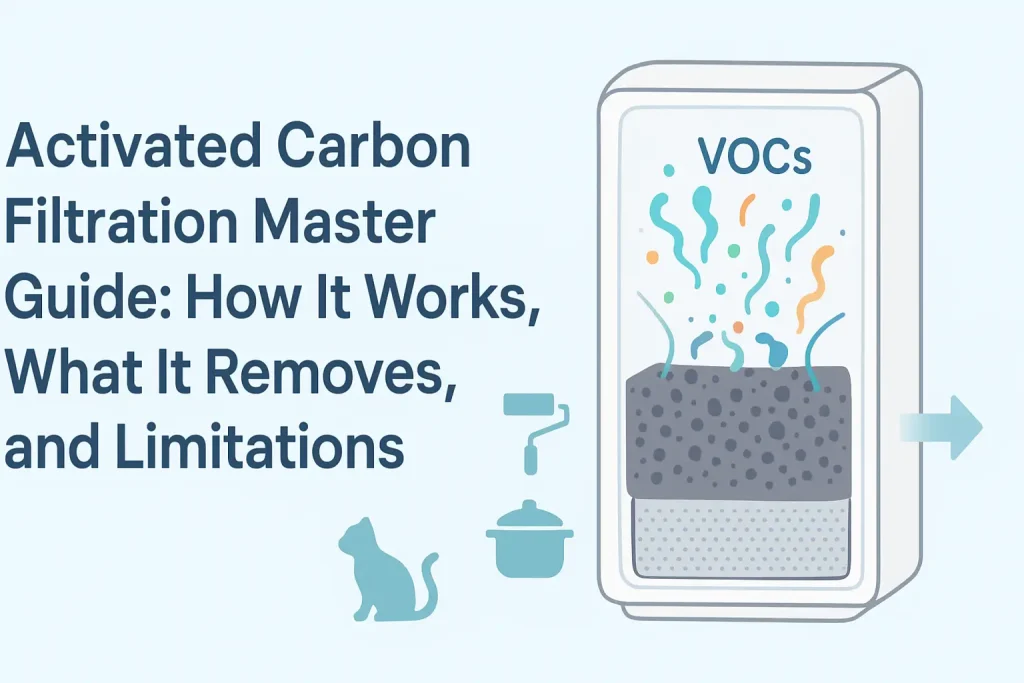
True HEPA captures particles. It does not capture gases, vapors, or odors. Asthma triggers include both particulate matter (dust mite allergen, pollen, pet dander, mold spores, wildfire smoke) and gaseous irritants (VOCs from cleaning products, formaldehyde from furniture, nitrogen dioxide from gas stoves). HEPA handles the particles. Activated carbon handles the gases.
If your asthma is triggered primarily by particulate allergens, a True HEPA purifier with a modest carbon pre-filter is sufficient. If VOCs, cooking fumes, or chemical odors trigger your asthma, you need a purifier with a substantial activated carbon stage. The Austin Air HealthMate contains 15 pounds of activated carbon and zeolite, the highest carbon-to-price ratio available.
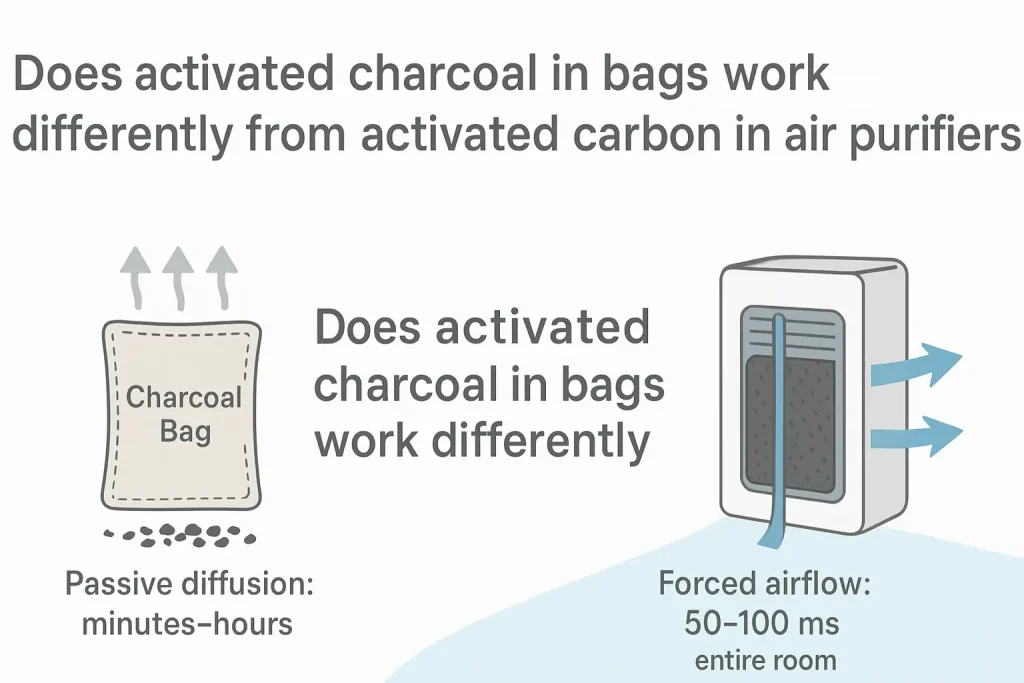
This happens because activated carbon adsorbs gas molecules onto its porous surface. A thin carbon sheet, common in budget purifiers, saturates within weeks and provides no ongoing gas removal. A deep carbon bed measured in pounds provides months to years of active VOC adsorption before replacement is needed.
For cooking-related asthma triggers, our guide to air purifiers for cooking odors explains which carbon filtration configurations handle kitchen-generated VOCs and particulate matter simultaneously. The combination of True HEPA and deep-bed activated carbon is the only configuration that addresses both major asthma trigger categories in one unit.
Buying Guide
Asthma Air Purifier Buying Checklist – 8 Points to Verify Before Purchase
Check off each point before making your decision. Based on EPA, CARB, and AAFA asthma guidance.
Work through the complete checklist above before finalizing any asthma air purifier purchase. Each point addresses a specific asthma safety or performance requirement. A purifier that fails any single checkbox will not provide the level of respiratory protection that asthma management requires.
How Do Seasonal Allergies Interact With Asthma and Air Purification?
Seasonal allergies and asthma frequently overlap. Approximately 60 to 80 percent of people with asthma also have allergic rhinitis. When pollen counts rise, allergic inflammation in the upper airways can trigger or worsen lower airway asthma symptoms. A True HEPA air purifier reduces the indoor pollen load that perpetuates this cycle.
During ragweed season, pollen grains range from 17 to 23 microns, well within True HEPA’s capture range. Keeping windows closed and running a properly sized purifier at 5 ACH can reduce indoor pollen concentrations by 85 percent or more compared to outdoor levels. Our ragweed allergy season air purification guide covers filter selection and operational strategy for the fall pollen peak.
What Is the Difference Between an Air Purifier and a Dehumidifier for Asthma?
An air purifier removes airborne particles like dust mite allergen, pollen, and mold spores. A dehumidifier removes moisture from the air. They serve different functions. For asthma triggered by dust mites or mold, you often need both because high humidity enables dust mite reproduction and mold growth while the purifier captures the particles already in the air.
Dust mites cannot reproduce below 50 percent relative humidity. A dehumidifier maintaining 40 to 50 percent RH reduces the dust mite population at its source. The air purifier then captures any allergen that becomes airborne from bedding, carpets, or furniture. Neither device alone fully addresses dust mite asthma triggers. The combination is what produces measurable improvement in nighttime asthma symptoms.
Can I Use an Air Purifier With an HVAC System for Better Asthma Control?
Yes, and the combination is more effective than either system alone. A MERV 13 furnace filter in your HVAC system captures large particles across the whole house. A portable True HEPA purifier in the bedroom delivers 5 ACH in your breathing zone overnight. The HVAC filter reduces the background particle load. The portable purifier delivers the high air change rate that asthma requires.
Upgrade your HVAC filter to MERV 13 if your system can handle the additional air resistance. A MERV 13 pleated furnace filter captures 75 percent or more of particles in the 0.3 to 1 micron range per ASHRAE 52.2 standards. Check your HVAC manual for maximum recommended MERV rating before upgrading. A filter that is too restrictive reduces airflow and can damage the system.
How Long Does It Take for an Air Purifier to Clean a Room for Asthma Relief?
At 5 ACH, a properly sized purifier removes approximately 86 percent of airborne particles within 25 minutes and 99 percent within 45 minutes. This assumes the room is reasonably sealed with doors and windows closed. If the room has an open door or significant outdoor air infiltration, the steady-state particle concentration will be higher.
Run the purifier on the fan speed that delivers 5 ACH for at least 30 minutes before occupying the room. For bedrooms, turn the purifier to the required fan speed 30 minutes before sleep. A smart plug with scheduling can automate this so the purifier ramps up before your bedtime without requiring manual adjustment.
Why Does My Air Purifier Smell Like Plastic or Chemicals When New?
New purifiers often emit a temporary plastic or chemical odor from manufacturing residues, adhesives, and packaging materials. This is off-gassing, not ozone. It typically resolves within 24 to 72 hours of continuous operation. Run the new purifier on high fan speed in an unoccupied, well-ventilated room for the first day.
If the odor persists beyond three days or smells distinctly like chlorine or electrical discharge, stop using the unit. This may indicate a defective ionizer, UV-C lamp, or motor component. Contact the manufacturer. For asthma sufferers, any persistent chemical odor is a signal to investigate, not to ignore. A VOC air quality monitor can distinguish between harmless new-product off-gassing and concerning VOC levels.
Is a Higher CADR Always Better for Asthma?
A higher CADR cleans the room faster, but it also means a larger, noisier, and more expensive unit. Match the CADR to your room size at 5 ACH. A 400 CFM unit in a 150-square-foot room delivers over 13 ACH, which provides no additional asthma benefit compared to 5 ACH while consuming more electricity and producing more noise.
Oversizing has one genuine advantage: the unit can run on a lower, quieter fan speed and still achieve 5 ACH. A 400 CFM purifier at medium speed may deliver 250 CFM, which is 5 ACH for a 300-square-foot room at lower noise than a 250 CFM unit running at maximum speed. This is a valid strategy for bedroom use where noise matters. The trade-off is higher upfront cost and a larger physical footprint.
Can Air Purifiers Help With Exercise-Induced Asthma at Home?
An air purifier does not prevent exercise-induced bronchoconstriction, which is triggered by airway cooling and drying during physical activity. It can reduce background airway inflammation by lowering your total particulate exposure, which may reduce the severity of exercise-induced symptoms over time. But it is not a replacement for pre-exercise medication prescribed by your doctor.
If you exercise indoors at home, running a purifier in the room during exercise captures any particles stirred up from flooring, furniture, or clothing. This reduces the total irritant load your airways must manage during exertion. The purifier is a supporting measure, not a primary treatment.
What Went Wrong If My Asthma Symptoms Did Not Improve After Buying a Purifier?
The most common reason is that the purifier is undersized for the room at 5 ACH. The manufacturer stated coverage area assumes 2 ACH. If you applied that number to your room, your purifier is delivering only 40 percent of the air changes your asthma needs. Recalculate your required smoke CADR at 5 ACH and compare it to your unit’s AHAM certified smoke CADR.
Other common causes include placing the purifier in a corner or against a wall, running it on too low a fan speed, leaving doors open so the unit is cleaning more volume than it is rated for, using an expired or clogged filter, and exposure to asthma triggers the purifier cannot address such as VOCs, dust mites in bedding, or outdoor air infiltration. Methodically eliminate each possibility before concluding the purifier is ineffective.
Do I Need an Air Purifier in Every Room If I Have Asthma?
Prioritize the bedroom first. You spend approximately one-third of your life sleeping, and asthma symptoms commonly worsen at night. One properly sized purifier in the bedroom provides the highest return on investment. After the bedroom, add a purifier to any room where you spend more than two consecutive hours daily such as a home office or living room.
A whole-house approach using your HVAC system with a MERV 13 filter reduces the baseline particle load everywhere. Then supplement with portable True HEPA purifiers in the rooms where you spend the most time. This combination is more cost-effective than placing a purifier in every room. For medium-sized rooms like home offices and dens, a single unit with 200 to 250 CFM smoke CADR is typically sufficient at 5 ACH.
Are There Air Purifiers That Also Monitor and Report PM2.5 Levels?
Several current models include built-in PM2.5 sensors with real-time display. The Levoit Core 400S, Coway Airmega 400, and Winix 5500-2 all show a color-coded air quality indicator. These built-in sensors are useful for identifying relative changes in particle concentration but are not as accurate as a dedicated calibrated monitor.
For asthma management, pair your purifier with a standalone laser particle PM2.5 monitor placed at breathing height near your bed or primary seating area. The purifier’s built-in sensor measures air quality at the unit intake. A standalone monitor measures the air you actually breathe. The difference can be significant, especially in larger rooms.
Can Air Purifiers Remove Dust Mite Allergen From the Air?
Dust mite allergen particles range from 10 to 40 microns and are easily captured by True HEPA filtration. The challenge is that dust mite allergen settles quickly and becomes airborne only when disturbed by activity such as making the bed, walking on carpet, or vacuuming. An air purifier captures what becomes airborne. It does not address the reservoir of allergen in bedding, carpets, and upholstery.
Combine air purification with allergen-proof mattress and pillow encasements, weekly hot water washing of bedding, and maintaining humidity below 50 percent. The purifier handles the airborne fraction. The other measures reduce the reservoir. For dining rooms and shared eating spaces, where food particles and associated allergens accumulate, a dedicated purifier can reduce the total household allergen load.
What Is the Quietest Air Purifier Suitable for Asthma Nighttime Use?
The Coway Airmega 400 at 22 dB in sleep mode is the quietest high-CADR purifier available. The Levoit Core 400S at 24 dB and the Winix 5500-2 at 27 dB are close alternatives at lower price points. Below 30 dB, the purifier is quieter than a whisper and will not disturb sleep for most people.
Quiet operation at the fan speed required for 5 ACH is what matters, not the sleep mode noise rating. Some purifiers are silent in sleep mode but deliver almost no airflow at that setting. Verify that the fan speed you need to achieve 5 ACH in your room produces a noise level you can tolerate overnight. A decibel meter or smartphone sound level app can measure this before you commit to keeping the unit.
Conclusion
A True HEPA air purifier sized for 5 ACH in your bedroom is the single most effective appliance you can buy for reducing asthma triggers at home. Match smoke CADR to your room volume using the formula (room area x ceiling height x 5) divided by 60. Verify CARB certification, choose a model with affordable genuine replacement filters, and place it centrally within 6 feet of your bed.
Start with the bedroom, run the purifier continuously on the fan speed that delivers 5 ACH, replace filters on schedule, and track your symptoms. The right purifier, correctly sized and positioned, reduces overnight particulate exposure by 85 percent or more. That reduction translates directly into fewer asthma awakenings and lower rescue inhaler use.