Cooking odors do not just smell bad. They signal that volatile organic compounds and fine particulate matter are circulating through your home right now.
Home cooking, especially frying, grilling, and roasting, releases acrolein, formaldehyde, and polycyclic aromatic hydrocarbons into indoor air at concentrations that can exceed outdoor urban pollution levels by a factor of ten or more.
A standard range hood captures only 15 to 40 percent of cooking emissions in real-world use. The rest spreads into adjoining rooms and lingers for hours.
Burning food on the stovetop produces particle concentrations comparable to a heavy wildfire smoke day. But you have a solution within arm’s reach: a properly selected air purifier designed to capture both particles and gaseous cooking pollutants.
| Photo | Popular Air Purifiers | Price |
|---|---|---|

|
Air Purifiers for Home Large Room up to 1500ft², Tailulu H13 True HEPA Air Purifier for Pets Dust Odor Smoke, Air Purifier for Bedroom with 15dB Quiet Sleep Mode for Bedroom Office Living Room | Check Price On Amazon |
|
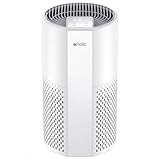
Afloia Air Purifier for Home, 4-in-1 Washable Filter for Allergies, Covers Up to 1076 ft², Quiet Operation, Auto Shut-Off & Night Light, Removes Pet Dander, Pollen, Dust, Mold, and Smoke, White,Pluto | Check Price On Amazon |

|
Nuwave OxyPure ZERO Air Purifier with Washable and Reusable Bio Guard Tech Air Filter, Large Room Up to 2002 Ft², Air Quality Monitor, 0.1 Microns, 100% Capture Irritants like Smoke, Dust, Pollen | Check Price On Amazon |

|
Air Purifiers for Home Large Room Up to 1,996 Ft², EOEBOT Air Purifier for Home Pets with Washable Filter, Quiet Sleep Mode, Air Quality Monitor, Air Purifier for Bedroom, Pet Hair, Dust, Smoke, White | Check Price On Amazon |
|
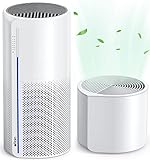
Afloia 2 IN 1 Air Purifier with Humidifier Combo, 3-Stage Filters for Home Allergies Pets Hair Smoker Odors, Evaporative Humidifier, Auto Shut Off, Quiet Air Cleaner with Seven Color Light,White | Check Price On Amazon |
This guide ranks the top 5 air purifiers for cooking odors by carbon filter weight, smoke CADR, noise level, and annual operating cost. Each recommendation targets a different kitchen size and budget.
Air Quality Data
Cooking Odors and Indoor Air Quality – What the Research Shows
Sources: Lawrence Berkeley National Laboratory, EPA Indoor Air Quality, California Air Resources Board
What Makes Cooking Odors Different from Other Indoor Air Pollutants?
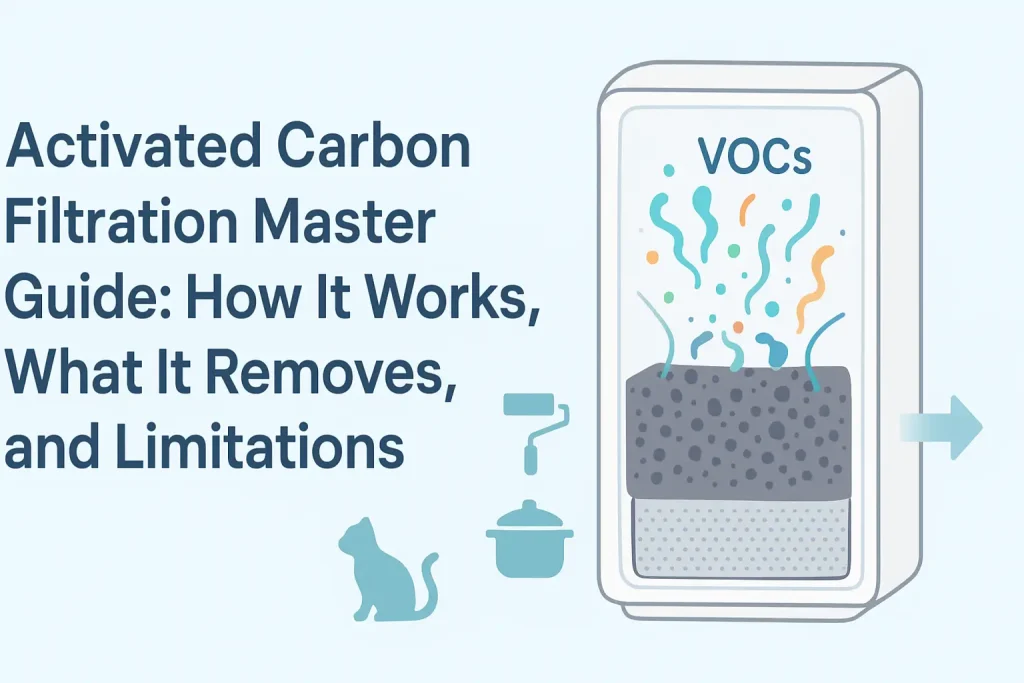
Cooking emissions are a dual-phase pollutant. You are dealing with solid particles (grease droplets, soot, PM2.5) and gas-phase molecules (volatile organic compounds, odorants, formaldehyde) simultaneously.
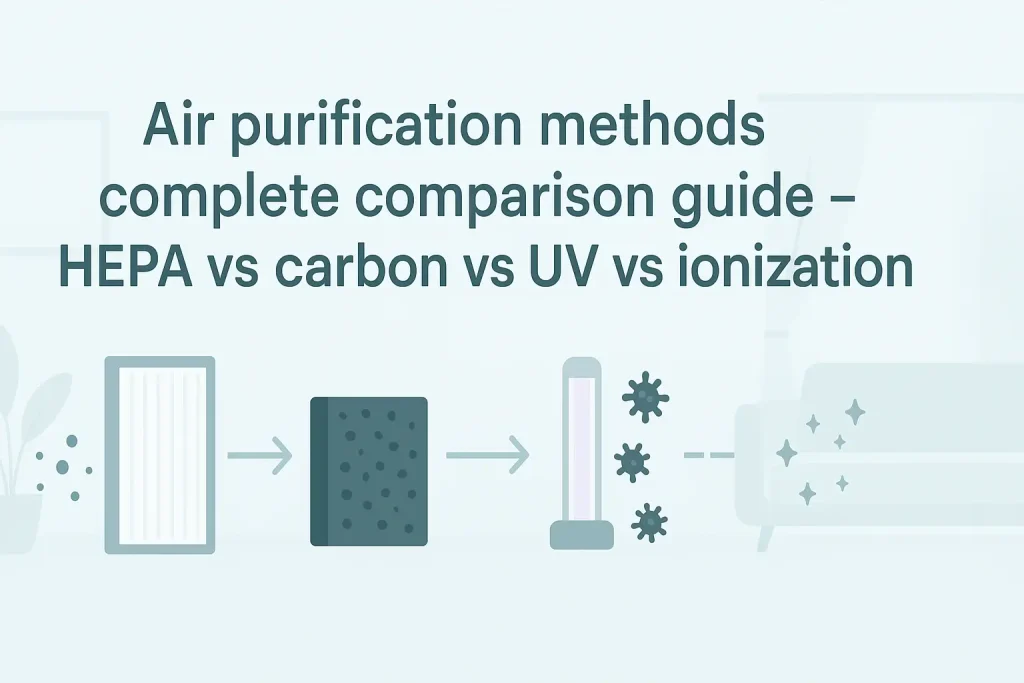
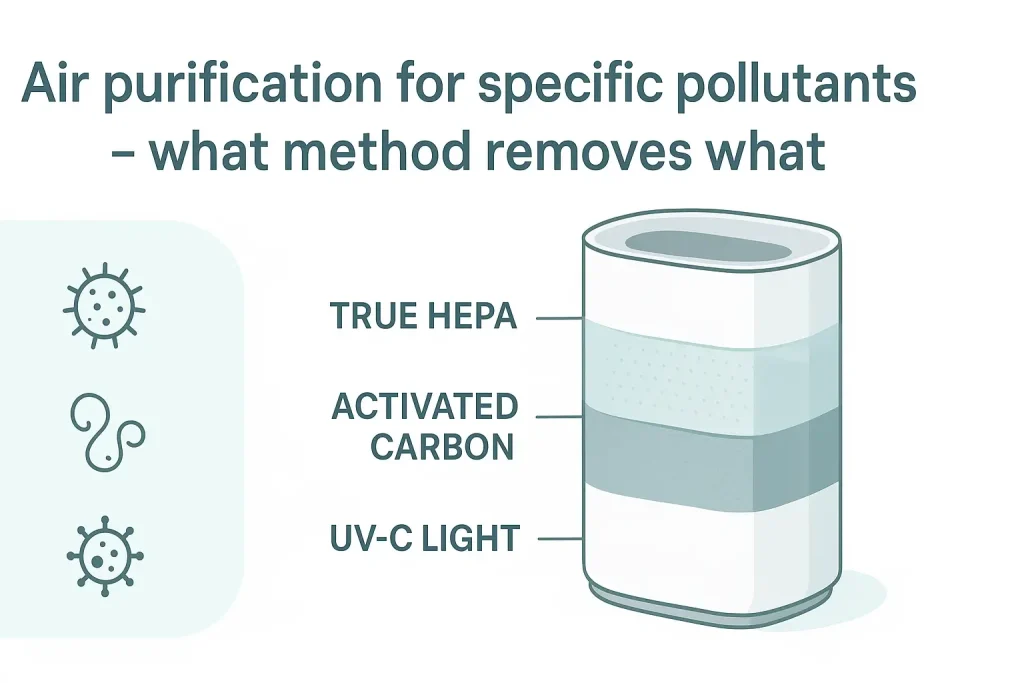
A standard True HEPA filter captures 99.97 percent of particles at 0.3 microns but does absolutely nothing to gas molecules. Odor molecules pass straight through HEPA media like water through a sieve.
This is why many air purifiers fail at cooking odor removal. They lack sufficient activated carbon or other sorbent media to adsorb gas-phase pollutants.
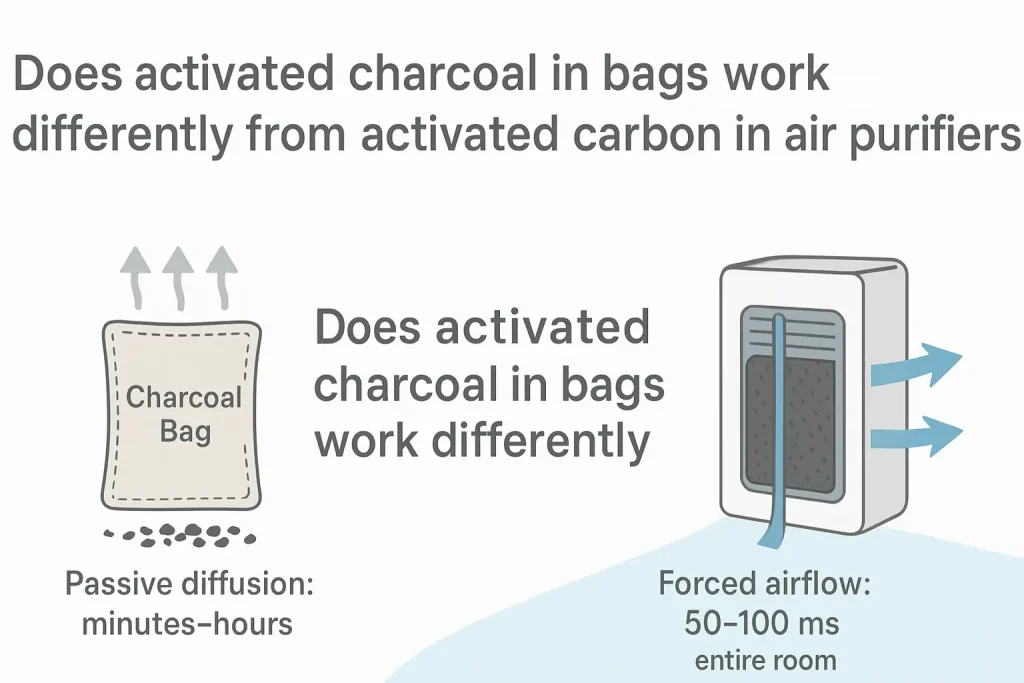
The mechanism is straightforward. Activated carbon traps VOC molecules through physical adsorption: gas molecules adhere to the vast internal surface area of the carbon pores, which can exceed 1,000 square meters per gram of carbon.
This process only works when two conditions are met. The carbon filter must contain enough media mass (minimum 1 pound for a kitchen, ideally 3 or more pounds for frequent cooking) and the air must pass through the carbon bed at a dwell time sufficient for adsorption.
If the carbon filter is too thin or the fan speed too high, VOC molecules exit before they can bond. The result is air that smells clean but still carries odor compounds. Fix this by selecting a purifier with a dedicated, substantial carbon stage, not a token carbon sheet.
A purifier that smells like recirculated cooking odor is telling you its carbon is saturated or insufficient. Replace the carbon stage or upgrade to a unit with greater carbon capacity.
How to Choose an Air Purifier for Cooking Odors: The Complete Buying Framework
Selecting the right purifier for your kitchen requires evaluating five specifications in sequence. Skip any one and you risk owning a machine that moves air but does not solve your odor problem.
Start with carbon weight. This is the single most important variable for cooking odor removal. Carbon filters range from a few ounces of sprayed-on carbon dust to over 15 pounds of granular activated carbon in a dedicated canister.
For light cooking (boiling, steaming, occasional sauteing) in a small kitchen, 1 to 2 pounds of carbon is adequate. For frequent frying, grilling, or wok cooking, target 3 to 6 pounds minimum. For open-plan kitchens where odors spread to living areas, 6 to 15 pounds provides meaningful protection.
Buying Guide
Cooking Odor Air Purifier – Decision Checklist
Check each box as you evaluate potential air purifiers for your kitchen.
Next, verify smoke CADR. Smoke particles from cooking are predominantly submicron (0.1 to 1.0 micron), identical in size range to the smoke particles used in AHAM AC-1 CADR testing. A smoke CADR of 200 CFM means the purifier can clean a 300 sq ft room at 2 air changes per hour or a 120 sq ft kitchen at 5 ACH.
Then check noise levels. Kitchen purifiers run during cooking and conversation. A unit producing 65 dB at the speed required for your room size is functionally useless because you will not tolerate it.
Finally, confirm filter replacement cost and frequency. Carbon filters for heavy cooking environments saturate faster than in typical bedroom use. Budget $60 to $120 per year if you cook daily with oil or high heat.
Top 5 Air Purifiers for Cooking Odors: Ranked and Reviewed
Use the table below to compare the top five air purifiers across the specifications that matter most for cooking odor removal: carbon weight, smoke CADR, noise, and annual filter cost.
Product Comparison
Top 5 Air Purifiers for Cooking Odors – Head-to-Head Comparison
Carbon weight, CADR, noise, and annual cost compared. Sources: manufacturer specifications and AHAM Verifide database.
| Model | Carbon Weight | Smoke CADR | Noise (Low/High) | Annual Filter Cost | Best For |
|---|---|---|---|---|---|
| IQAir HealthPro Plus | 5.5 lbs (V5-Cell) | 300 CFM | 22 / 57 dB | ~$200 | Heavy daily cooking |
| Austin Air HealthMate | 15 lbs | 250 CFM | 30 / 62 dB | ~$115 | Maximum odor control |
| Coway Airmega 400 | 1.5 lbs | 258 CFM | 21 / 47 dB | ~$100 | Open-plan kitchen |
| Levoit Core 600S | 0.8 lbs | 240 CFM | 26 / 55 dB | ~$70 | Budget-conscious |
| Blueair Blue Pure 211+ | 0.5 lbs | 270 CFM | 31 / 56 dB | ~$60 | Light cooking, small kitchen |
Carbon weights are manufacturer-reported for the dedicated carbon stage. Smoke CADR values from AHAM Verifide where available. Annual filter cost assumes one full filter replacement per year at MSRP.
1. IQAir HealthPro Plus – Best Overall for Heavy Cooking Odors
The IQAir HealthPro Plus is the benchmark for gas-phase filtration in a residential air purifier. Its V5-Cell gas filter contains 5.5 pounds of granular activated carbon and impregnated alumina, specifically designed for VOCs, formaldehyde, and odor compounds.
Check the IQAir HealthPro Plus on Amazon for current pricing and availability.
Key Specifications:
- Carbon stage: 5.5 lbs granular activated carbon plus impregnated alumina (V5-Cell)
- Smoke CADR: 300 CFM (covers 450 sq ft at 2 ACH, 180 sq ft at 5 ACH)
- Noise: 22 dB at lowest speed, 57 dB at maximum
- Annual filter cost: approximately $200 (PreMax pre-filter every 12-18 months, V5-Cell every 2 years, HyperHEPA every 4 years)
- Certifications: AHAM Verifide, no ozone emission
The V5-Cell is the differentiator. Most competitors use a thin carbon-impregnated felt weighing a few ounces. IQAir uses a sealed canister with 5.5 pounds of pelletized media that the air must pass through, not around. This forces meaningful contact time between VOCs and the carbon surface.
The HyperHEPA stage captures particles down to 0.003 microns with 99.5 percent efficiency, exceeding standard True HEPA specifications. For cooking, this means ultrafine particles from gas combustion and oil vaporization are trapped rather than recirculated.
The downside is cost. A new V5-Cell runs about $130 and the full filter set exceeds $300. But for a household that fries, grills, or uses a wok multiple times per week, no other residential unit matches its gas-phase performance.
2. Austin Air HealthMate – Maximum Carbon Capacity for Persistent Odors
The Austin Air HealthMate contains 15 pounds of activated carbon and zeolite in a dedicated canister, the largest carbon payload of any residential air purifier on the market. This is a commercial-grade gas filter in a home unit.
Check the Austin Air HealthMate on Amazon for current pricing.
Key Specifications:
- Carbon stage: 15 lbs activated carbon plus zeolite
- Smoke CADR: 250 CFM (covers 375 sq ft at 2 ACH, 150 sq ft at 5 ACH)
- Noise: 30 dB at low, 62 dB at high
- Annual filter cost: approximately $115 (5-year filter life, single replacement element)
- Certifications: CARB certified, no ozone
Fifteen pounds of carbon changes the economics of odor removal. Where a 1-pound carbon filter saturates in weeks under heavy cooking load, the HealthMate’s carbon bed lasts years. The zeolite additive specifically targets ammonia and hydrogen sulfide, compounds produced when cooking meat and seafood.
The trade-off is aesthetic. This is a large, utilitarian metal box with no smart features, no auto mode, and a single analog dial control. It is loud at maximum speed. But for raw filtration capacity per dollar, nothing else comes close.
For homes with frequent high-heat cooking, Indian cuisine with extensive spice tempering, or anyone who has tried multiple purifiers and found them ineffective against persistent odors, the HealthMate is the answer.
3. Coway Airmega 400 – Best for Open-Plan Kitchens and Living Areas
The Coway Airmega 400 balances carbon capacity, particle CADR, and noise level better than any unit in its price range. Its dual Green True HEPA filters and 1.5-pound carbon stage handle both the particulate and gaseous components of cooking emissions.
Check the Coway Airmega 400 on Amazon for current pricing.
Key Specifications:
- Carbon stage: 1.5 lbs activated carbon (dual filters)
- Smoke CADR: 258 CFM (covers 387 sq ft at 2 ACH, 155 sq ft at 5 ACH)
- Noise: 21 dB at sleep mode, 47 dB at maximum
- Annual filter cost: approximately $100 (HEPA plus carbon set every 12 months)
- Certifications: AHAM Verifide, ENERGY STAR
The Airmega 400 is exceptionally quiet at 47 dB maximum. This matters in an open-plan kitchen where the purifier runs during conversation and television watching. Most units at this CADR level produce 55 to 65 dB at full speed.
Its dual-fan design allows the unit to clean large open spaces effectively. In an open kitchen-living-dining area of 400 to 500 square feet, the Airmega 400 can maintain 3 to 4 ACH without sounding like a jet engine.
The carbon load is adequate, not exceptional. For light to moderate cooking it performs well. For daily deep-frying or wok cooking, the carbon will saturate within 4 to 6 months rather than the rated 12 months. Budget for more frequent carbon replacement if you cook heavily.
4. Levoit Core 600S – Best Budget Option with Smart Features
The Levoit Core 600S delivers 240 CFM smoke CADR and a competent, if modest, carbon stage at roughly half the price of the IQAir or Austin Air units. For apartments and smaller kitchens, it represents the best value proposition.
Check the Levoit Core 600S on Amazon for current pricing.
Key Specifications:
- Carbon stage: 0.8 lbs activated carbon (proprietary ARC Formula)
- Smoke CADR: 240 CFM (covers 360 sq ft at 2 ACH, 144 sq ft at 5 ACH)
- Noise: 26 dB at sleep, 55 dB at maximum
- Annual filter cost: approximately $70 (single combo filter every 6-12 months)
- Certifications: CARB certified, ENERGY STAR, VeSync smart app control
The carbon stage uses Levoit’s ARC Formula, a chemical treatment that enhances formaldehyde capture beyond what plain carbon provides. This is useful for gas stove emissions, which produce formaldehyde as a combustion byproduct.
The smart features add practical value for kitchen use. You can schedule the purifier to ramp up 10 minutes before cooking starts and run for an hour afterward, then return to quiet background mode. The PM2.5 sensor triggers auto-mode boost when particulate levels spike during searing or frying.
The 0.8-pound carbon load is the limiting factor. For a small apartment kitchen used for light cooking, it works well. For a family kitchen with daily heavy cooking, the carbon saturates quickly and the filter costs, while low individually, add up with 6-month replacement cycles.
5. Blueair Blue Pure 211+ – Best for Light Cooking in Small Kitchens
The Blueair Blue Pure 211+ uses electrostatic HEPASilent filtration combined with a carbon layer to achieve high CADR at moderate noise. It is best suited for kitchens under 200 square feet with light to moderate cooking.
Check the Blueair Blue Pure 211+ on Amazon for current pricing.
Key Specifications:
- Carbon stage: 0.5 lbs activated carbon (integrated in particle filter)
- Smoke CADR: 270 CFM (covers 405 sq ft at 2 ACH, 162 sq ft at 5 ACH)
- Noise: 31 dB at low, 56 dB at high
- Annual filter cost: approximately $60 (single combo filter every 6 months)
- Certifications: AHAM Verifide, CARB certified, ENERGY STAR
Blueair’s HEPASilent technology uses electrostatic charging of filter fibers to increase particle capture efficiency without increasing air resistance. This produces high CADR per watt and per decibel. The 270 CFM smoke CADR is impressive for a unit in this price tier.
The carbon stage is the weakest of the five units reviewed. At 0.5 pounds integrated into the particle filter, it provides light odor reduction but saturates quickly under real cooking loads. Blueair sells a separate SmokeBlock filter with additional carbon for about $10 more per replacement.
For a studio apartment or small kitchen where cooking is primarily boiling, steaming, and light sauteing, the Blue Pure 211+ is an excellent, affordable choice. For heavy frying or persistent curry and fish odors, consider the Coway or Austin Air instead.
What Specifications Actually Matter for Cooking Odor Removal?
Air purifier marketing emphasizes room coverage, CADR, and filter type. For cooking odors specifically, some specs matter far more than the sales page suggests. Others are nearly irrelevant.
Critical specifications: Carbon weight in pounds, smoke CADR in CFM, and noise at the fan speed needed to achieve your target ACH. These three numbers determine whether the unit will actually reduce cooking odors in your specific space.
Useful but secondary: Filter replacement cost, pre-filter presence (catches grease before it fouls the HEPA), and smart sensor responsiveness to rapid PM2.5 spikes from searing and frying.
Mostly irrelevant for cooking: Pollen CADR, dust CADR, UV-C lights, ionizer functions, and app features that do not affect filtration performance. A purifier with excellent pollen CADR and a weak carbon stage will disappoint in the kitchen.
Some manufacturers quote total CADR for all three particle types (smoke, dust, pollen) averaged together as a single number. This inflates the figure because pollen and dust CADR are typically higher than smoke CADR. For cooking, you need smoke CADR specifically, not an average.
For homes with sensitive occupants, consider how cooking emissions interact with other indoor air quality challenges. We have covered specialized air purification strategies in our guide to air purifiers for multiple chemical sensitivity, where gas-phase filtration requirements overlap significantly with cooking odor removal needs.
Where to Place Your Air Purifier for Maximum Cooking Odor Removal
Placement determines whether your purifier captures cooking emissions at the source or chases them around the house after they have already spread. The difference in effectiveness is 2x to 3x between optimal and poor placement.
The ideal location is 3 to 6 feet from the stove, positioned between the cooking surface and the primary doorway where odors escape to other rooms. This creates a capture zone that intercepts the plume before it disperses.
Do not place the purifier directly next to the stove. Heat, grease splatter, and high humidity will damage the filter media and motor. Maintain a minimum 3-foot clearance from the cooking surface.
If the kitchen is enclosed, position the purifier near the doorway leading to the rest of the home. This catches odors attempting to exit. For open-plan kitchens, place the unit at the boundary between the kitchen zone and the living or dining area.
Avoid corners. Placing an air purifier in a corner reduces its effective coverage by 20 to 30 percent compared to central placement along a wall, due to restricted airflow on two sides of the intake.
If you have a range hood, use both the hood and the air purifier simultaneously. The hood captures the initial, hottest plume directly above the cooktop. The purifier handles the dispersed particles and gases that escape the hood’s limited capture area.
For those in compact living spaces, placement becomes even more critical since cooking odors have nowhere to go. Our article on air purifiers for tiny homes covers specific strategies for maximizing filtration effectiveness in small, open layouts where kitchen and living areas overlap completely.
How Cooking Odor Filtration Differs from Wildfire Smoke and Allergy Purification
Cooking odors present a fundamentally different filtration challenge than wildfire smoke or seasonal allergens. Understanding these differences prevents you from buying the wrong type of purifier.
Wildfire smoke is almost entirely particulate matter. Fine and ultrafine particles between 0.1 and 2.5 microns dominate. A high-CADR True HEPA purifier solves this problem almost completely because particles are mechanically captured by the filter media. Carbon is a bonus, not a necessity.
We explain this particle size dynamic in detail in our guide to wildfire smoke particle size and HEPA filter effectiveness. The same HEPA mechanism that captures smoke particles also captures the particulate fraction of cooking emissions, but the gas-phase odor molecules require different technology entirely.
Cooking emissions contain a large gas-phase fraction that HEPA cannot address. Acrolein (the sharp smell from burning oil), formaldehyde (from gas combustion), and hundreds of aroma compounds are individual molecules 1,000 times smaller than the smallest particle a HEPA filter can capture. Carbon adsorption is the only effective residential technology for these.
Allergy-focused purifiers prioritize pollen and dust CADR over smoke CADR and rarely include meaningful carbon stages. These units will fail at cooking odor removal because their design brief never considered gas-phase pollutants.
For wildfire-prone areas where cooking odors are also a concern, you need a unit that excels at both. Our comparison of portable versus whole-house air purifiers for wildfire smoke covers units that also perform well for cooking emissions when they include adequate carbon stages.
Filter Maintenance for Cooking Environments: What Changes
Cooking environments accelerate filter degradation in ways that bedroom or living room use does not. Grease aerosol, elevated humidity, and high VOC concentrations all reduce filter lifespan compared to manufacturer estimates based on standard household conditions.
The pre-filter is your first line of defense. In a kitchen, the pre-filter loads with visible grease within 2 to 4 weeks. Wash or vacuum the pre-filter every 2 weeks minimum. A grease-clogged pre-filter starves the HEPA stage of airflow and forces the fan to work harder.
Carbon filters in cooking environments saturate 2 to 3 times faster than manufacturer ratings suggest. A carbon filter rated for 12 months in a bedroom may be spent in 4 months when exposed to daily frying emissions. Replace carbon when you notice cooking odors lingering more than 30 minutes after cooking ends.
HEPA filters in kitchens last roughly their rated lifespan because the particle load from cooking is episodic rather than continuous. But inspect the HEPA every 3 months for grease discoloration. If the filter media appears yellow or feels tacky, replace it regardless of the rated lifespan.
For a complete strategy on air purification during high-pollution events that also applies to intensive cooking sessions, our guide on how to purify air during a wildfire covers layered approaches including pre-filtration, room sealing, and multi-unit deployment that work equally well for heavy cooking days.
For households managing both cooking odors and respiratory conditions, filter maintenance becomes a health issue, not just a performance issue. Our resource on air purifiers for asthma details the specific maintenance schedules required when filter performance directly affects breathing outcomes.
Common Mistakes When Buying an Air Purifier for Cooking Odors
Most people buy the wrong air purifier for their kitchen on the first attempt. These are the five most frequent mistakes and how to avoid them.
Mistake 1: Buying based on room coverage without checking carbon weight. A purifier rated for 500 square feet with 0.3 pounds of carbon will move air through a large space but remove almost no odors. Room coverage ratings are based on particle CADR, not gas removal capacity.
Mistake 2: Assuming all carbon filters are equivalent. A thin carbon-impregnated fiber sheet with 2 ounces of carbon dust looks similar to a 5-pound granular carbon canister in product photos. They are not remotely equivalent. Always check the carbon weight specification in the manual or on the manufacturer’s website.
Mistake 3: Placing the purifier too far from the kitchen. A purifier in the living room will eventually clean cooking odors, but only after they have diffused through the entire home. Place the unit in or immediately adjacent to the kitchen for source capture.
Mistake 4: Running the purifier only during cooking. PM2.5 and VOCs remain elevated for hours after cooking stops. Run the purifier on high for 30 minutes before cooking, throughout the cooking period, and for at least 2 hours afterward.
Mistake 5: Selecting an ionizer-based purifier for odor removal. Ionizers produce ozone, which reacts with terpenes and other cooking VOCs to create secondary ultrafine particles and formaldehyde. The outcome is often worse air quality than doing nothing at all.
Quick Comparison
Cooking Odor Air Purifier – At-a-Glance Matrix
Quick reference for selecting the right purifier based on your cooking habits and kitchen size.
| Your Situation | Minimum Carbon | Smoke CADR | Best Pick |
|---|---|---|---|
| Small kitchen, light cooking | 0.5 lbs | 200+ CFM | Blueair Blue Pure 211+ |
| Apartment, moderate cooking | 0.8 lbs | 240+ CFM | Levoit Core 600S |
| Open-plan, daily cooking | 1.5 lbs | 250+ CFM | Coway Airmega 400 |
| Heavy frying, spices, wok | 5+ lbs | 250+ CFM | IQAir HealthPro Plus |
| Maximum odor control, any cooking | 15 lbs | 250+ CFM | Austin Air HealthMate |
Can an Air Purifier Replace a Range Hood?
No. An air purifier cannot replace a properly installed and vented range hood. The two devices serve complementary roles and work best when used together.
A range hood captures the high-temperature, high-concentration cooking plume directly above the cooktop before it disperses. The hood removes the most concentrated pollutants at the source and vents them outdoors. An air purifier recirculates indoor air through filters but cannot match the source-capture efficiency of a hood operating at 200 to 400 CFM directly above the cooking surface.
However, most residential range hoods in the United States are recirculating types that filter through a thin grease screen and blow air back into the kitchen. These remove large grease droplets but capture almost no fine particles or VOCs. In this common scenario, an air purifier is essential because the hood provides no meaningful gas or fine particle removal.
Even a vented hood loses effectiveness when the cook uses front burners or when cooking generates plume velocities that exceed the hood’s capture velocity. The purifier acts as a secondary line of defense, capturing what the hood misses.
Do Air Purifiers Help with Lingering Food Smells in Adjacent Rooms?
Yes, when they contain sufficient activated carbon and are positioned strategically. Cooking odors travel through doorways, hallways, and open floor plans via air currents and pressure differentials.
A single purifier in the kitchen reduces odor spread to adjacent rooms by capturing VOCs before they migrate. For multi-room odor control, place a second unit in the room most affected by cooking odors, typically the living room or master bedroom.
Carbon saturation is the limiting factor. A small carbon filter in the kitchen saturates quickly and then recirculates partially cleaned air that still carries odor compounds to other rooms. Adequate carbon mass prevents this by maintaining adsorption capacity through multiple cooking cycles.
Why Does My Air Purifier Smell Like Cooking After Running During Meals?
This happens when the carbon filter is saturated and can no longer adsorb new VOC molecules. A spent carbon filter reaches equilibrium with the surrounding air. It stops capturing odors and may release previously trapped compounds when temperature or humidity changes.
The mechanism is physical adsorption, not chemical destruction. Carbon pores fill with VOC molecules over time. When all available adsorption sites are occupied, new odor molecules pass through unaffected. The filter becomes a net zero for odor removal.
Replace the carbon filter when you notice cooking smells persisting or the exhaust air smelling stale. In heavy cooking environments, this may be every 3 to 6 months rather than the manufacturer’s 12-month estimate. For units with washable carbon pre-filters, monthly washing extends the main carbon filter’s life but does not restore full adsorption capacity indefinitely.
Is an Ionizer Air Purifier Effective for Cooking Odors?
No. Ionizer air purifiers are ineffective for cooking odor removal and may actively worsen air quality when used in kitchens. Ionizers work by electrically charging airborne particles so they stick to surfaces or each other and fall out of the air.
This mechanism does nothing to gas-phase odor molecules. VOCs remain in the air regardless of ionization. Simultaneously, ionizers produce ozone as a byproduct, typically at levels below the CARB limit of 0.050 ppm but still chemically reactive.
Ozone reacts with terpenes, limonene, and other unsaturated VOCs abundant in cooking emissions. These reactions create secondary organic aerosols: ultrafine particles and formaldehyde. A 2013 study by researchers at the University of Texas found that ionizer operation during cooking increased ultrafine particle concentrations by 20 to 50 percent compared to cooking alone, due to ozone-VOC reactions.
Avoid any purifier marketed primarily as an ionizer or electrostatic precipitator for kitchen use. Mechanical filtration with HEPA plus carbon is the only proven effective technology for cooking emissions.
How Much Should I Spend on an Air Purifier for Cooking Odors?
Effective cooking odor air purifiers range from $150 to $900 depending on kitchen size and cooking intensity. The budget tier ($150 to $300) covers small kitchens with light cooking. Mid-range units ($300 to $600) handle open-plan kitchens and moderate daily cooking. Premium units ($600 to $900) provide heavy carbon loads for frequent high-heat cooking and persistent odor problems.
Budget options like the Levoit Core 600S deliver adequate performance for apartments and small kitchens with light to moderate use. Mid-range picks like the Coway Airmega 400 balance carbon capacity, CADR, and noise for open-plan living.
Premium units like the IQAir HealthPro Plus and Austin Air HealthMate justify their cost through carbon filter weight and longevity. Spending $800 on a purifier that lasts 10 years with effective odor control costs $80 per year, comparable to a $300 unit requiring $70 annual filter replacements that still leaves odor problems.
Annual operating cost often exceeds the purchase price within 3 to 5 years. Calculate total cost of ownership: purchase price plus 5 years of filter replacements plus electricity at your local rate. An efficient $500 unit may cost less over 5 years than a $200 unit with expensive, frequently replaced filters.
What Is the Difference Between Activated Carbon and Carbon-Impregnated Filters?
Activated carbon filters contain granular or pelletized carbon media in a bed or canister, typically weighing 1 to 15 pounds. Carbon-impregnated filters are nonwoven fiber sheets sprayed or coated with carbon dust, weighing a few ounces at most.
The performance difference is enormous. Granular activated carbon provides thousands of times more surface area for VOC adsorption because the entire filter volume consists of porous carbon. A carbon-impregnated sheet has a thin surface coating that saturates rapidly and provides negligible gas removal after the first days or weeks of use.
For cooking odors, always choose granular activated carbon. Carbon-impregnated prefilters help extend the life of a downstream carbon canister by trapping larger molecules, but they cannot replace a dedicated carbon stage.
Do I Need a Dedicated Kitchen Air Purifier or Can One Unit Serve the Whole Home?
One large unit can serve a kitchen and adjacent living space if the floor plan is open and the purifier’s CADR is sized for the combined square footage at 4 to 5 ACH. For closed floor plans where the kitchen is a separate room with a doorway, a dedicated kitchen unit plus a second unit in the primary living area works better.
Whole-house air purification through the HVAC system addresses particles but does not effectively remove cooking odors. HVAC filters are almost exclusively particle filters without meaningful carbon stages. Odor compounds pass through the return duct, through the filter, and are redistributed to every room.
How Often Should I Replace the Carbon Filter in a Kitchen Air Purifier?
Replace carbon filters every 3 to 12 months depending on cooking frequency, cooking methods, and carbon filter weight. Light cooking (boiling, steaming) with a 3-pound or larger carbon filter may allow 12-month replacement intervals. Daily frying or wok cooking with a 1-pound carbon filter may require replacement every 3 to 4 months.
You will know the carbon is spent when cooking odors linger more than 30 to 60 minutes after cooking ends despite the purifier running on high. This is a more reliable indicator than manufacturer time estimates, which assume moderate particle loading rather than heavy VOC exposure.
Can I Use an Air Purifier with a Gas Stove?
Yes, and you should. Gas stoves produce nitrogen dioxide, carbon monoxide, formaldehyde, and ultrafine particles as combustion byproducts. A 2022 study published in Environmental Science and Technology found that gas stove use in homes without ventilation produced nitrogen dioxide concentrations exceeding EPA outdoor air quality standards within 25 minutes.
A purifier with True HEPA and activated carbon addresses both the particulate and gaseous components of gas stove emissions. The carbon stage captures formaldehyde and other combustion VOCs. The HEPA stage captures ultrafine particles from incomplete combustion.
Run the purifier on high during and for 2 hours after gas stove use. This is especially important in homes with asthmatic occupants, as nitrogen dioxide is a potent respiratory irritant.
What Room Size Air Purifier Do I Need for My Kitchen?
Calculate your kitchen’s square footage (length times width) and multiply by 1.5 if the kitchen opens to other rooms without a door. Then select a purifier with smoke CADR that delivers 4 to 5 ACH at that effective square footage.
Formula: Required smoke CADR = (effective square footage times ceiling height times 5) divided by 60. For a 150 sq ft kitchen with 9-foot ceilings at 5 ACH: (150 times 9 times 5) divided by 60 equals 112.5 CFM minimum smoke CADR. For a 300 sq ft open kitchen-living area: (300 times 9 times 5) divided by 60 equals 225 CFM.
Are Expensive Air Purifiers Worth It for Cooking Odors?
Yes, if you cook frequently with oil or high heat. The price difference between a $200 purifier and an $800 purifier almost always reflects carbon filter weight and build quality, not brand markup alone.
A $200 purifier with 0.3 pounds of carbon provides perceptible odor reduction for a few weeks, then becomes a particle-only device once the carbon saturates. An $800 purifier with 5 to 15 pounds of carbon provides consistent odor control for years. Over a 5-year ownership period, the expensive unit often costs less per year of effective odor control than repeatedly buying and being disappointed by budget units.
Conclusion
Cooking odors are a dual-phase pollutant problem that demands both True HEPA for particles and granular activated carbon for VOCs. A purifier with less than 1 pound of carbon will disappoint you within weeks of daily cooking use.
The IQAir HealthPro Plus leads for heavy cooking with its 5.5-pound V5-Cell. The Austin Air HealthMate provides unmatched carbon mass at 15 pounds. The Coway Airmega 400 offers the best balance of performance and livability for open-plan homes.
Place your purifier 3 to 6 feet from the stove. Run it before, during, and after cooking. Replace carbon filters when odors linger, not when the calendar says to. These three habits combined with the right machine will keep your home smelling clean no matter what is on the menu tonight.