Most apartment dwellers assume clean air requires owning a home with a $10,000 HVAC retrofit or landlord permission to drill into walls. That assumption is wrong. A properly sized portable air purifier running at 5 air changes per hour in a 200-square-foot bedroom removes 85% of airborne particles within 30 minutes, with no lease violation, no permanent installation, and no landlord conversation required.
Renters face air quality challenges that homeowners do not: shared ventilation shafts recirculating cooking fumes from adjacent units, limited window access, restrictions on HVAC modifications, and thin walls transmitting both noise and airborne pollutants. This guide covers every apartment-compatible air purification method, ranked by effectiveness, cost, and how much your landlord needs to know about it.
What Makes Apartment Air Purification Different from Whole-House Filtration?
Apartment air purification operates under constraints that whole-house systems ignore entirely. A whole-house MERV 13 HVAC filter processes air through a ducted system at 800 to 2,000 CFM across the entire floor plan. In an apartment, you cannot touch the HVAC system. You get one portable unit per room, running 50 to 400 CFM, placed wherever the outlet allows it. The air changes per hour calculation changes because apartments have fewer cubic feet to process but more air exchange with neighboring units through shared walls, plumbing penetrations, and corridor doors.
This happens because apartment construction creates a condition called inter-unit air transfer. According to a 2019 study published in Indoor Air journal by Underhill et al., tracer gas tests in multi-unit residential buildings showed that 10 to 30 percent of the air in one apartment originated from adjacent units within two hours. This means your neighbor’s cooking fumes, their cigarette smoke, and their renovation dust enter your space regardless of how tightly you seal your own windows.
| Photo | Popular Air Purifiers | Price |
|---|---|---|

|
Air Purifiers for Home Large Room up to 1500ft², Tailulu H13 True HEPA Air Purifier for Pets Dust Odor Smoke, Air Purifier for Bedroom with 15dB Quiet Sleep Mode for Bedroom Office Living Room | Check Price On Amazon |
|
Afloia Air Purifier for Home, 4-in-1 Washable Filter for Allergies, Covers Up to 1076 ft², Quiet Operation, Auto Shut-Off & Night Light, Removes Pet Dander, Pollen, Dust, Mold, and Smoke, White,Pluto | Check Price On Amazon |

|
Nuwave OxyPure ZERO Air Purifier with Washable and Reusable Bio Guard Tech Air Filter, Large Room Up to 2002 Ft², Air Quality Monitor, 0.1 Microns, 100% Capture Irritants like Smoke, Dust, Pollen | Check Price On Amazon |

|
Air Purifiers for Home Large Room Up to 1,996 Ft², EOEBOT Air Purifier for Home Pets with Washable Filter, Quiet Sleep Mode, Air Quality Monitor, Air Purifier for Bedroom, Pet Hair, Dust, Smoke, White | Check Price On Amazon |
|
Afloia 2 IN 1 Air Purifier with Humidifier Combo, 3-Stage Filters for Home Allergies Pets Hair Smoker Odors, Evaporative Humidifier, Auto Shut Off, Quiet Air Cleaner with Seven Color Light,White | Check Price On Amazon |
Three factors make apartment air purification unique. First, you cannot install permanent duct-mounted equipment. Second, space constraints limit you to one or two portable units, so placement becomes critical. Third, noise matters more in an apartment because the unit may run in your bedroom 24 hours a day, 8 feet from where you sleep. If the sleep mode exceeds 30 dB, you will wake up. If you select a unit without verifying its sleep-mode dB rating, the result is a purifier that gets turned off at night, the exact period when PM2.5 exposure matters most for long-term health outcomes.
For most renters, a True HEPA portable air purifier with CARB certification, placed centrally in the primary living space and run continuously, delivers the best combination of effectiveness, zero landlord interaction, and move-out portability.
Portable Air Purifiers: The Rental-Friendly Gold Standard
Air Quality Data
Apartment Air Quality – What the Research Shows
Sources: EPA Indoor Air Quality, American Lung Association, peer-reviewed indoor air studies
A portable True HEPA air purifier is a mechanical filtration device that captures 99.97 percent of airborne particles at 0.3 microns without any installation, drilling, duct modification, or lease violation. It plugs into a standard 120V outlet. It sits on the floor or a table. When your lease ends, you unplug it and take it with you.
True HEPA is not a generic descriptor. It is a specific standard defined by IEST (Institute of Environmental Sciences and Technology) requiring efficiency of 99.97 percent at the most penetrating particle size of 0.3 microns. Filters labeled “HEPA-type,” “HEPA-like,” or “99% HEPA” have no standardized testing behind those claims. In a sealed apartment bedroom, the difference between 99.97 percent efficiency and 90 percent efficiency at 0.3 microns compounds across thousands of air passes over an eight-hour sleep period. The outcome is meaningful: a True HEPA unit keeps PM2.5 below 12 micrograms per cubic meter (the EPA annual standard), while a HEPA-type unit may allow PM2.5 to remain at 25 to 35 micrograms per cubic meter.
This only occurs when the unit’s smoke CADR is correctly matched to the room volume at the appropriate ACH target. If the smoke CADR is too low, the unit cannot process the room’s total air volume quickly enough to outpace new pollutant infiltration from adjacent units and window leakage. The fix is simple: calculate the required smoke CADR before buying, not after.
CADR Calculator
How Much CADR Do You Actually Need for Your Apartment?
Enter your room dimensions and use case. Formula: (length x width x ceiling height x ACH) divided by 60. Source: AHAM methodology.
CADR = (length x width x ceiling height x ACH) / 60. For allergy and asthma sufferers, always calculate at 5 ACH — not the manufacturer-stated 2 ACH figure.
| Apartment Room Size | CADR at 2 ACH (standard) | CADR at 5 ACH (allergy) | Best Portable Units |
|---|---|---|---|
| 120 sq ft studio alcove | 80 CFM | 200 CFM | Levoit Core 300S, Coway AP-1512HH |
| 200 sq ft bedroom | 133 CFM | 333 CFM | Winix 5500-2, Levoit Core 400S |
| 350 sq ft studio/living room | 233 CFM | 583 CFM | Coway Airmega 400, Blueair 605 |
| 500 sq ft open-plan apartment | 333 CFM | 833 CFM | IQAir HealthPro Plus or 2 Levoit Core 400S |
| 700 sq ft two-bedroom apartment | 467 CFM | 1167 CFM | Multiple units: one per bedroom + living area |
What Is CADR and Why Does It Matter More in a Rental?
CADR (Clean Air Delivery Rate) is a standardized metric developed by AHAM (Association of Home Appliance Manufacturers) that measures the volume of filtered air a unit delivers per minute, expressed in cubic feet per minute specifically for smoke, dust, and pollen. Smoke CADR is the most relevant number for apartments because it represents fine particulate matter (PM2.5), the pollutant class that penetrates most easily from neighboring units, traffic, and cooking.
A manufacturer-stated coverage area of 300 square feet assumes 2 air changes per hour. For an apartment where you need 5 ACH to outpace inter-unit transfer, the effective coverage drops to 120 square feet (40 percent of the stated figure). This is the single most common mistake renters make: buying a unit based on the box coverage number rather than calculating the required CADR from the actual room volume multiplied by the appropriate ACH target.
If the smoke CADR is too low for the room volume at 5 ACH, the result is PM2.5 concentrations that remain at 60 to 70 percent of outdoor or adjacent-unit levels throughout the night. The fix: use the CADR calculator above to determine the minimum smoke CADR before comparing models.
True HEPA vs HEPA-Type: The Label That Determines Whether Your Filter Actually Works
A True HEPA filter meets the IEST standard of 99.97 percent efficiency at 0.3 microns, the most penetrating particle size. A HEPA-type filter has no standardized efficiency and may capture anywhere from 85 to 99 percent of particles at 0.3 microns, depending on the manufacturer’s internal specification. HEPA-type is a marketing term, not a certification.
In an apartment bedroom with a neighbor who smokes, the PM2.5 infiltration rate through shared walls can exceed 5 micrograms per cubic meter per hour. A True HEPA unit running at 5 ACH in a 200-square-foot room brings PM2.5 from 35 micrograms per cubic meter to below 12 within 20 minutes. A HEPA-type unit may only bring it to 18 to 22 micrograms per cubic meter. The difference is the difference between meeting and exceeding the EPA annual PM2.5 standard of 12 micrograms per cubic meter during overnight exposure.
A True HEPA air purifier for bedroom apartments with a smoke CADR of at least 200 CFM and a verified sleep-mode noise level below 30 dB is the minimum standard for a rental sleeping space. Units that meet this specification include the Coway AP-1512HH (246 CFM smoke CADR, 30 dB sleep mode) and the Levoit Core 400S (260 CFM smoke CADR, 24 dB sleep mode).
Where to Place an Air Purifier in an Apartment for Maximum Performance
Placement determines whether a correctly sized purifier delivers 5 ACH or effectively delivers 2 ACH in the breathing zone. Air purifiers create a localized air circulation pattern. Placed in a corner behind furniture, they recirculate a narrow column of already-filtered air rather than drawing in room-wide contaminated air.
The optimal placement for an apartment is 12 to 18 inches from any wall, with at least 3 feet of clearance in front of the air intake and outlet grille, positioned on the side of the room closest to the dominant pollution source. In apartments, the dominant source is usually the door to the shared corridor (inter-unit transfer), the window facing a street (traffic PM2.5), or the shared wall with the neighboring kitchen (cooking fumes).
This placement logic only works when furniture does not obstruct airflow paths. A purifier placed behind a sofa or bed frame loses 30 to 50 percent of its effective CADR because the intake plenum cannot access room air at design velocity. If your apartment layout forces corner placement, the fix is to angle the unit 30 to 45 degrees toward the center of the room rather than running it parallel to the wall. This reorients the discharge plume into the open room volume rather than along the wall boundary layer.
For open-plan apartments, do not place the purifier in the center of the open space. Place it at the midpoint of the longer wall and aim the discharge toward the kitchen area if cooking smoke is the dominant pollutant, or toward the window wall if traffic PM2.5 is the primary concern. The airflow carries filtered air across the pollutant entry point, creating a positive-pressure displacement effect that pushes contaminants away from the breathing zone.
Corsi-Rosenthal Box: The $80 DIY Air Purifier That Matches $300+ Units
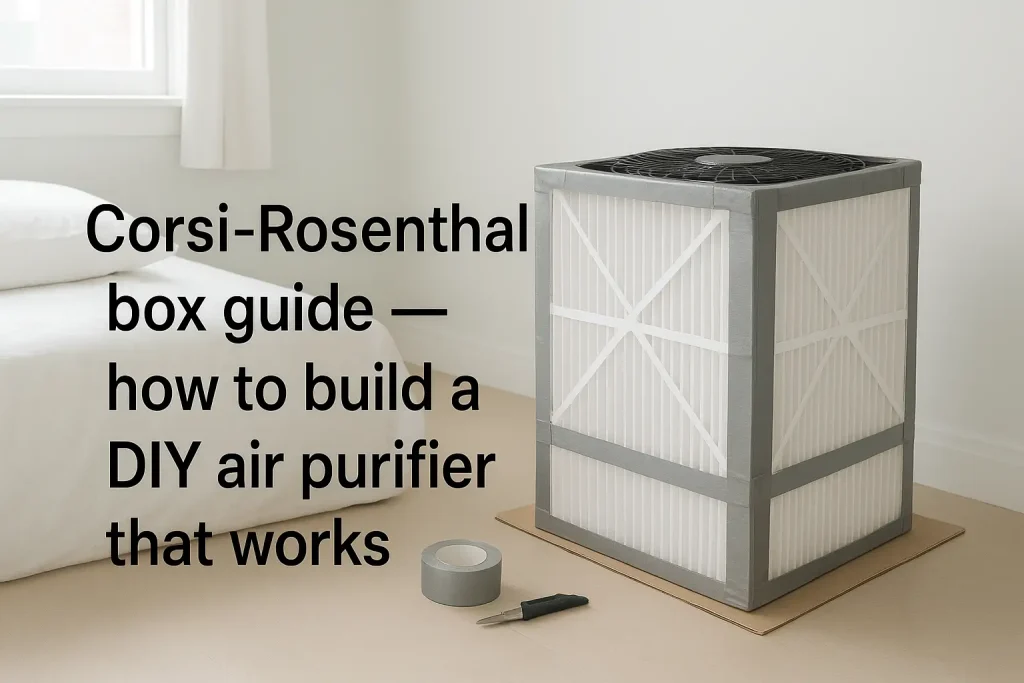
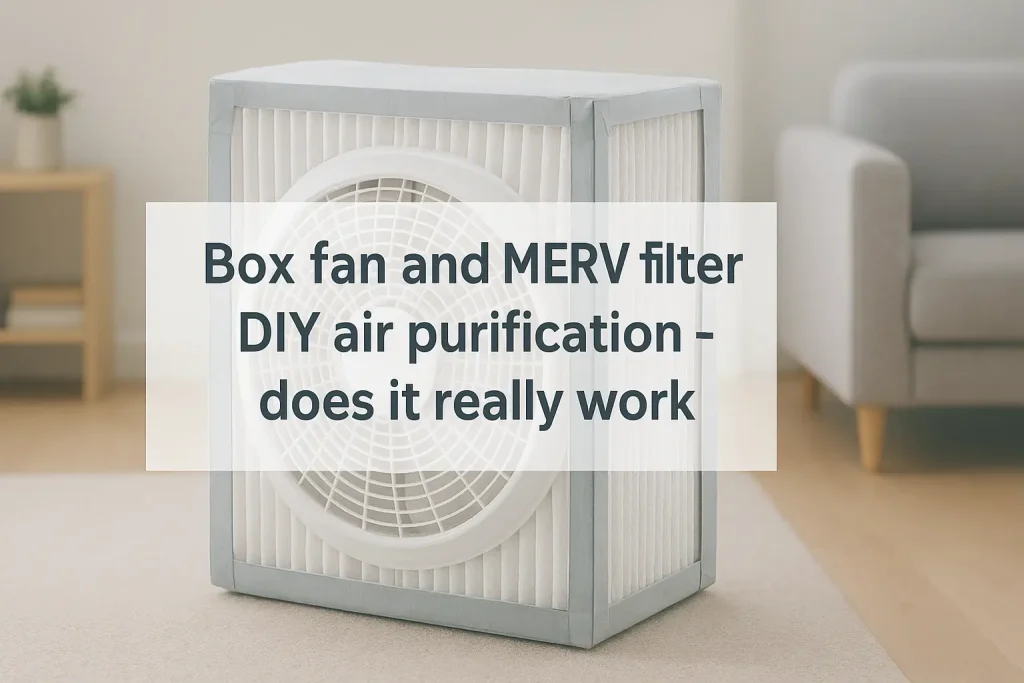
A Corsi-Rosenthal box is a DIY air purifier made from a 20-inch box fan rated 1,000+ CFM and four MERV 13 20×20 filters, taped together into a cube with the fan mounted on top pulling air through the filters and exhausting upward. Total build cost is approximately $80. Total build time is 15 minutes. No landlord permission is required because no surfaces are modified.
This happens because four MERV 13 filters, each with a surface area of 3.8 square feet, combine to create 15.2 square feet of total filter area. The box fan pulls air through this large filter surface at low face velocity, which reduces pressure drop and allows the fan to maintain high airflow. According to testing by UC Davis researchers published in 2022, a Corsi-Rosenthal box with 2-inch MERV 13 filters achieves a smoke CADR of approximately 300 to 400 CFM, which is comparable to a $300 to $400 commercial air purifier.
This only occurs when the box fan is a high-velocity model rated at minimum 1,000 CFM on the highest setting and the filters are genuine MERV 13 with a 2-inch depth. If a low-velocity fan or 1-inch filters are substituted, the CADR drops to approximately 100 to 150 CFM, comparable to a budget $60 to $80 commercial unit, and the cost advantage disappears.
The Corsi-Rosenthal box has specific advantages for apartments. It is loud at full speed (approximately 55 dB, comparable to a window air conditioner) so it is best for daytime use in living areas rather than bedrooms. It is visually industrial and takes up roughly 20 x 20 inches of floor space. It produces no ozone, uses no ionization, and the filter replacement cost is $40 to $60 every 6 to 12 months using standard 4-pack MERV 13 filters.
The box has one major apartment-specific limitation: the noise level at full speed. In a studio apartment with no separate bedroom, a Corsi-Rosenthal box on high is too loud for sleep. The solution is to run the box on medium speed during waking hours in the living area and use a quiet True HEPA purifier like the Levoit Core 300S (24 dB sleep mode) in the sleeping zone at night.
HVAC Filter Upgrades: What Renters Can (and Cannot) Do
Most apartments have a furnace or HVAC air handler with a standard 1-inch filter slot accessible through a return grille or the air handler cabinet itself. If the filter slot is accessible without tools or panel removal, you can upgrade the filter to a higher MERV rating without violating any lease terms. This is the single highest-impact upgrade available to renters at the lowest cost: approximately $15 to $25 per filter replacement.
A standard apartment HVAC filter is MERV 4 to MERV 6, a disposable fiberglass or low-efficiency pleated filter that captures 20 to 40 percent of particles in the 3 to 10 micron range and essentially nothing below 1 micron. Upgrading to a MERV 13 pleated filter increases capture efficiency to 75 percent or higher for particles in the 0.3 to 1 micron range per ASHRAE Standard 52.2 testing. This is the same particle size range as wildfire smoke and traffic PM2.5.
Two limitations apply to apartment HVAC filter upgrades. First, the filter slot must actually be accessible. If the air handler is in a locked utility closet or the return grille requires a screwdriver to open, replacing the filter may violate your lease. Check your lease terms or ask the landlord before opening any panel. Second, MERV 13 filters have higher pressure drop than MERV 4 filters. If the HVAC blower is old or the ductwork is undersized, a MERV 13 filter can reduce airflow enough to cause freeze-up on the air conditioning coil in summer or overheat the heat exchanger in winter. If you notice reduced airflow, a whistling sound from the return, or longer heating and cooling cycle times after upgrading, drop back to MERV 11.
For the majority of apartments with accessible filter slots, upgrading from MERV 4 to MERV 13 and replacing the filter every 90 days is the most cost-effective single action a renter can take to reduce whole-apartment PM2.5 levels. Combined with one portable True HEPA unit in the bedroom, this two-layer approach delivers PM2.5 reductions of 80 to 90 percent compared to no filtration.
Filter Guide
MERV Filter Comparison for Apartment HVAC Upgrades
Use the table below to match your apartment’s filter slot type and air quality concern to the correct MERV rating.
| Filter Type | MERV 4-6 (Standard Apartment) | MERV 8-11 (Upgrade) | MERV 13 (Maximum Recommended) |
|---|---|---|---|
| Particle capture at 0.3-1 micron | Less than 20% | 20-50% | 75%+ |
| Cost per filter | $3-$8 | $10-$18 | $15-$25 |
| Pressure drop risk | None | Low | Moderate — check airflow after install |
| Replacement interval | Every 90 days | Every 90 days | Every 90 days (60 during wildfire season) |
| Best for | Low-pollution areas, no allergies | Pets, moderate allergies, urban dust | Wildfire smoke, traffic PM2.5, severe allergies |
MERV efficiency data per ASHRAE Standard 52.2 test methodology. Always check that your apartment HVAC filter slot is accessible before upgrading — do not open sealed or locked panels without landlord permission.
Ventilation Strategies for Apartment Air Quality
Ventilation is the fastest way to reduce indoor-generated pollutants such as cooking smoke, VOCs from new furniture off-gassing, and accumulated CO2 from occupancy. Opening windows on opposite sides of the apartment creates cross-ventilation that can achieve 10 to 20 air changes per hour, far exceeding any portable purifier’s capacity. The trade-off is that ventilation introduces outdoor pollutants directly into the apartment.
This approach only works when outdoor PM2.5 is low (AQI below 50, or green on the EPA scale). If you open windows during an AQI 100+ event, you introduce PM2.5 at concentrations higher than the indoor air you are trying to clean. The result is a purifier running at maximum speed attempting to clean air faster than the open window can contaminate it. The fix: check your local AQI at AirNow.gov or with a PM2.5 air quality monitor before opening windows for ventilation. If outdoor AQI is above 50, use the purifier on recirculate mode with windows closed.
For apartments with only one window or windows on one wall only, cross-ventilation is physically impossible regardless of how many windows are open. In this scenario, a window fan set to exhaust mode combined with a purifier running on high creates a directional airflow pattern: the fan exhausts stale air, the door undercut provides makeup air from the corridor, and the purifier scrubs that incoming air before it reaches the breathing zone.
The specific steps for single-window apartment ventilation during good AQI conditions: place a reversible window fan set to exhaust mode in the window. Close all other exterior openings. The fan creates negative pressure that pulls air from the corridor through the door undercut. Position the air purifier between the entry door and the primary living area. Run the purifier on medium speed. This setup exchanges room air at 5 to 8 ACH while filtering the incoming corridor air before it circulates through the apartment.
Natural and Low-Cost Air Purification Methods: What Actually Works
Several natural and passive air purification strategies circulate in renter communities. Some work. Most do not. The critical distinction is whether the method removes pollutants from the air or merely masks them.
Houseplants: Limited and Slow VOC Removal Only
A frequently cited 1989 NASA study by Wolverton demonstrated that certain houseplants remove VOCs such as benzene, formaldehyde, and trichloroethylene from sealed chambers. The study conditions involved a sealed 1-cubic-meter chamber with a single plant over a 24-hour period. Scaling these results to an apartment shows that a 500-square-foot apartment would require approximately 680 plants to achieve the same VOC removal rate as one portable purifier with a 2-pound activated carbon filter operating continuously.
Houseplants do not remove particulate matter (PM2.5, dust, pollen) from the air in any measurable quantity. Their root-zone microorganisms can process some VOCs, but at rates far too slow for meaningful indoor air quality improvement in realistic apartment conditions. A 2019 meta-analysis in the Journal of Exposure Science and Environmental Epidemiology by Cummings and Waring concluded that “potted plants do not significantly improve indoor air quality” under normal ventilation conditions. Plant soil can also harbor mold spores if overwatered, potentially worsening air quality in a damp apartment.
Beeswax Candles and Salt Lamps: No Measurable Air Cleaning Effect
Beeswax candles produce negative ions when burned, according to claims circulated in natural health communities. The concentration of negative ions produced by a single beeswax candle in a room is several orders of magnitude below the levels shown to have any particle agglomeration effect in published ionizer research. Salt lamps warmed by a low-wattage bulb do not produce measurable ion concentrations at all. Neither method has been demonstrated in peer-reviewed research to reduce PM2.5, PM10, or VOC concentrations in a room of any size.
Both are harmless decorations. Neither is an air purification method. The only passive strategy with demonstrated particle-reduction effects in peer-reviewed literature is electrostatic attraction to grounded surfaces, and this effect is too weak in a typical apartment to meaningfully reduce PM2.5 without an active mechanical or electrostatic air cleaner running alongside it.
Baking Soda and Vinegar: Odor Absorption Only
An open box of baking soda absorbs some volatile acid gases and organic odor molecules through surface adsorption. It does not capture particulate matter, does not remove VOCs at meaningful rates, and saturates within days. White vinegar neutralizes ammonia-based odors but introduces acetic acid vapor into the air, which is itself a mild respiratory irritant. Neither is a substitute for activated carbon filtration.
For renters on a zero-dollar budget, the most effective no-cost actions are: vacuum carpets and rugs with a HEPA-filtered vacuum twice weekly, use the kitchen and bathroom exhaust fans during and after cooking and showering, wipe down surfaces with a damp microfiber cloth to capture settled dust rather than dry-dusting which resuspends it, and keep the HVAC fan running in “on” mode (not “auto”) during high-pollen or high-AQI days if the thermostat allows it.
What to Avoid: Air Purification Methods That Make Apartment Air Worse
Some products marketed for air purification actively worsen apartment air quality through ozone generation, pollutant redistribution, or false filtration claims. These are particularly dangerous in apartments because the smaller room volume and lower ventilation rates concentrate both the pollutants and the byproducts.
Ozone Generators: Never Use in an Occupied Apartment
Ozone generators intentionally produce ozone at concentrations of 0.100 to 0.500 ppm or higher, well above the CARB 0.050 ppm limit and the EPA 8-hour National Ambient Air Quality Standard of 0.070 ppm. Ozone is a potent respiratory irritant that reacts with lung tissue and, paradoxically, reacts with common indoor VOCs such as limonene (from citrus cleaners and air fresheners) to produce formaldehyde and ultrafine secondary organic aerosol particles.
According to the EPA, “available scientific evidence shows that at concentrations that do not exceed public health standards, ozone has little potential to remove indoor air contaminants.” The California Air Resources Board explicitly warns that “ozone generators are not effective at cleaning indoor air and can produce dangerous levels of ozone.” These devices are banned for sale as air purifiers in California and several other states. In a 500-square-foot apartment, an ozone generator can raise ozone to 0.200 to 0.500 ppm within 30 minutes, which exceeds the EPA hazardous threshold.
Ionizers Without Collection Plates: Particle Redistribution
Ionizers emit negatively charged ions that attach to airborne particles, causing them to cluster and fall onto surfaces (floors, walls, furniture, bedding) rather than remaining airborne. The particles are not removed from the room. They are simply relocated from the air to every surface. When you walk across the carpet, sit on the sofa, or pull back the bedsheet, those particles are mechanically resuspended back into the air.
Some ionizers also produce trace ozone as a byproduct of corona discharge. Non-CARB-certified ionizers can produce ozone above the 0.050 ppm limit, particularly in small apartment bedrooms with limited air exchange. If an air purifier has an ionizer that cannot be turned off, and the unit is not CARB certified, do not use it in an apartment. For apartments where the ionizer can be disabled, always turn it off. Mechanical filtration through True HEPA achieves better particle removal with no ozone risk.
Myth vs Fact
Apartment Air Purifier Myths Debunked
Separating fact from fiction on the most common air purifier misconceptions among renters. Sources: EPA, CARB, AHAM, peer-reviewed research.
✗ Myth
A small purifier rated for 200 square feet will clean a 400-square-foot apartment if I run it longer.
✓ Fact
An air purifier’s coverage area is tied to its CADR. A unit with a smoke CADR of 100 CFM in a 400-square-foot room (8-foot ceiling) achieves only 1.9 ACH running continuously. New pollutants enter the room faster than the purifier can remove them. PM2.5 concentrations stabilize at a higher equilibrium level. The correct CADR for a 400-square-foot apartment at 5 ACH is 267 CFM — requiring a mid-sized or larger unit, not a small bedroom purifier.
✗ Myth
I should seal my apartment completely and never open windows to keep pollution out.
✓ Fact
Completely sealed apartments accumulate CO2 from occupant respiration, raising concentrations from the outdoor ambient of 420 ppm to 1,500 to 3,000 ppm within hours. At these levels, cognitive performance measurably declines per research from the Harvard T.H. Chan School of Public Health. Indoor-generated VOCs from furniture and cleaning products also accumulate with no dilution air. The correct strategy is intermittent ventilation during low-AQI periods (outdoor AQI below 50) combined with continuous air purifier operation. Ventilate for 10 to 15 minutes with cross-flow if possible, then close windows and resume purifier operation.
✗ Myth
Air purifiers with UV-C lights are better because they kill germs.
✓ Fact
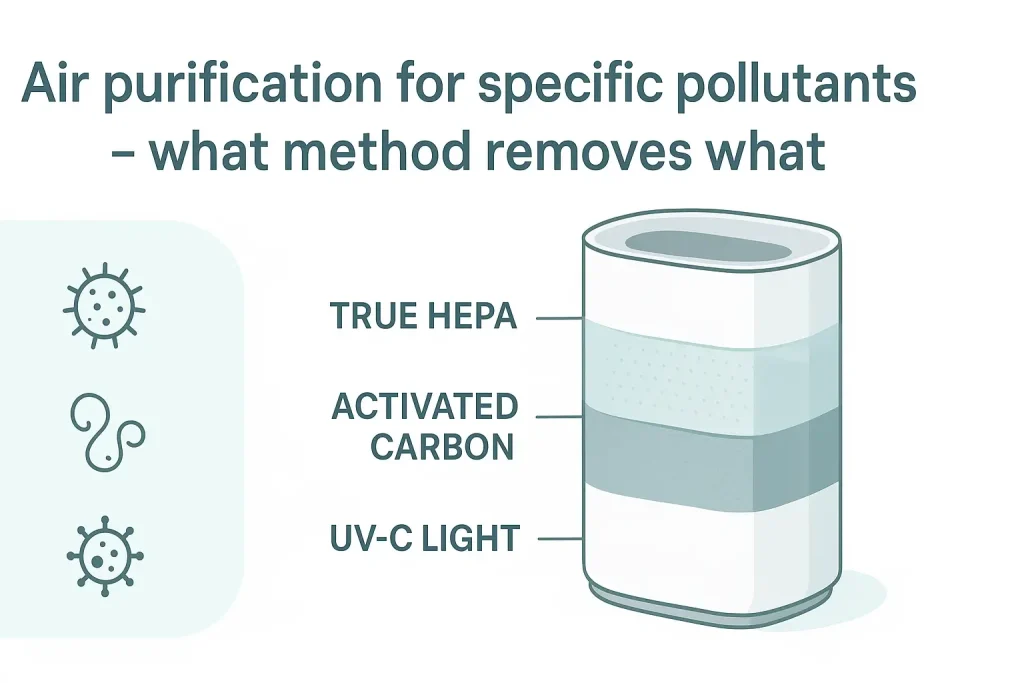
Portable air purifier UV-C lamps are underpowered for meaningful pathogen inactivation. A study in the Journal of Applied Microbiology found that UV-C exposure times of less than 1 second (typical for air passing through a portable purifier at 200 CFM) achieve less than 50 percent inactivation of most bacteria and viruses. UV-C is effective in upper-room germicidal fixtures and in-duct systems with dwell times of several seconds. In a portable unit, it is primarily a marketing feature that adds cost and bulb replacement expense without meaningful disinfection benefit. True HEPA filtration alone captures bacteria and virus-carrying particles at 99.97 percent efficiency.
✗ Myth
If my landlord provides an air filter, it is good enough.
✓ Fact
Most apartment-provided HVAC filters are MERV 4 fiberglass filters costing $1 to $3 wholesale. These capture less than 20 percent of PM2.5 and essentially zero sub-micron particles. They are installed for equipment protection (keeping the coil clean), not for occupant health. Landlords have no obligation to provide health-grade filtration. For renters, the upgrade from MERV 4 to MERV 13 in an accessible filter slot represents the single largest PM2.5 reduction per dollar ($15 to $25 per replacement) of any apartment air quality intervention.
✗ Myth
An air purifier eliminates the need to dust and vacuum.
✓ Fact
An air purifier captures airborne particles. It does not capture settled particles on floors, furniture, and bedding. Larger particles (over 10 microns) settle out of the air within minutes and become part of the dust load on surfaces. Walking, sitting, and vacuuming without HEPA filtration resuspend these particles. Without regular surface cleaning with damp methods, settled dust becomes a continuous reservoir that re-enters the air faster than the purifier can remove it. Vacuum with a HEPA-filtered vacuum, damp-mop hard floors, and wash bedding weekly in hot water.
Wildfire Smoke in Apartments: Emergency Protocol for Renters
Wildfire smoke is the most severe PM2.5 challenge an apartment dweller faces. Outdoor AQI during wildfire events can exceed 300 to 500 in affected areas. PM2.5 infiltrates apartments through window seals, door gaps, bathroom exhaust vents, and the HVAC fresh air intake. Without active air purification, indoor PM2.5 concentrations typically reach 70 to 80 percent of outdoor levels within 4 to 6 hours in standard apartment construction.
This happens because apartment construction contains numerous unsealed penetrations. Plumbing risers, electrical conduit chases, and the gap under the entry door all provide pathways for outdoor air to enter the apartment driven by wind pressure and the stack effect in multi-story buildings. The only way to prevent this infiltration is active pressurization of the apartment with filtered air, which requires a purifier producing enough airflow to overcome the natural infiltration rate.
During a wildfire smoke event with outdoor AQI above 150, the apartment-specific protocol is: close and latch all windows. If window seals are loose or single-pane, apply painter’s tape along the seal edges (removable without damage, landlord-safe). Place a rolled towel along the bottom of the entry door. Close bathroom exhaust fan dampers with tape if the fan vents directly outside. Set the HVAC fan to “on” (not “auto”) with a MERV 13 filter installed. Run the highest-CADR portable purifier on maximum speed in the primary living area. Run a second purifier in the bedroom at medium to high speed. Monitor indoor PM2.5 with a PM2.5 monitor like the IQAir AirVisual and target indoor PM2.5 below 12 micrograms per cubic meter.
If indoor PM2.5 cannot be maintained below 35 micrograms per cubic meter (the EPA 24-hour standard) with all purifiers running on maximum, the apartment’s infiltration rate exceeds the purifiers’ combined CADR. In this scenario, create a clean room by moving the highest-CADR purifier into the smallest room with the fewest windows, sealing that room with towels at the door gap, and staying in that room until outdoor AQI improves. This approach was validated by the EPA’s Wildfire Smoke Guide for reducing exposure during extreme smoke events.
Air Quality Guide
Apartment Air Purifier Settings by AQI Level
What to do with your air purifier at each outdoor AQI level. Based on EPA AQI scale and American Lung Association guidance.
| Outdoor AQI | EPA Category | Apartment Ventilation | Air Purifier Setting | Filter Check |
|---|---|---|---|---|
| 0-50 Good | No health concern | Open windows for 15-30 min for fresh air exchange | Auto mode or sleep mode | Standard 90-day interval |
| 51-100 Moderate | Acceptable for most | Brief ventilation OK. Keep windows closed if sensitive. | Medium fan if sensitive. Auto mode for general population. | Standard interval |
| 101-150 USG | Sensitive groups at risk | Windows closed. Seal obvious gaps. | Medium to high fan continuously. Run in bedroom and living area. | Check filter at 30 days sustained exposure |
| 151-200 Unhealthy | Everyone affected | Windows sealed. Towel under entry door. | Maximum fan speed in all occupied rooms. HVAC fan on with MERV 13. | Replace at 50% of normal interval |
| 201-300 Very Unhealthy | Health alert — serious risk | Create a clean room. Seal one room completely. | Maximum speed. Move into clean room. Run highest-CADR unit there. | Replace filters after event ends |
| 301+ Hazardous | Emergency conditions | Clean room mandatory. Follow local emergency guidance. | Maximum speed. Consider N95 mask indoors. Evacuation may be required. | Treat filters as single-use. Replace immediately after event. |
AQI categories from EPA AirNow. Apartment-specific guidance based on EPA Wildfire Smoke Guide and field experience in multi-unit residential buildings. Source: EPA, American Lung Association.
Noise Constraints: Choosing a Purifier You Can Actually Sleep Next To
In an apartment, the air purifier is usually in the bedroom because that is where people spend 7 to 9 hours continuously. A purifier that exceeds 30 dB at its lowest fan speed will disrupt sleep onset and reduce deep sleep duration. This is not subjective preference. Research published in the Journal of the Acoustical Society of America by Basner et al. demonstrated that nocturnal noise above 30 dB equivalent level increases cortisol secretion and reduces slow-wave sleep even when subjects do not consciously wake.
Sleep-mode noise levels for common apartment-suitable purifiers range from 22 dB (Coway Airmega 400, nearly inaudible) to 24 dB (Levoit Core 300S and 400S) to 30 dB (Coway AP-1512HH, a faint hum) to 40 dB (older budget models, clearly audible in a quiet bedroom). The difference between 24 dB and 40 dB is the difference between silent operation and a constant fan noise that will wake light sleepers. When comparing units, always check the sleep-mode or lowest-fan-speed dB specification, not the maximum-speed noise level.
For studio apartments where the sleeping area and living area are the same room, noise is the binding constraint on purifier selection. The unit must be quiet enough for sleep at its lowest setting while still delivering enough CADR at that setting to maintain ACH above 2. Some units maintain high CADR at low fan speeds (Coway Airmega 400 maintains approximately 150 CFM at sleep mode at 22 dB). Others drop CADR significantly at their quietest setting. Check independent test data rather than manufacturer claims.
For the budget-constrained renter, the Levoit Core 300S at 24 dB sleep mode and $99 purchase price is the optimal balance of noise, CADR (145 CFM smoke), and cost. For those with more budget who prioritize silence, the Coway Airmega 400 at 22 dB is the quietest True HEPA unit with meaningful CADR available at the time of writing.
Apartment Air Purifier Buying Guide: A Decision Framework for Renters
Renters need a different decision framework than homeowners. The three constraints unique to apartment air purification are space footprint, noise tolerance, and portability obligations. Budget is often tighter for renters, but the long operating life of a quality purifier (5 to 8 years for a well-maintained unit) means that the annualized cost of a $150 unit ($30 per year over 5 years) is close to that of an $80 unit ($16 per year) when filter availability and motor longevity are factored in.
Use the table below to match your apartment type and primary air quality concern to the correct purifier category before diving into specific models.
Buying Guide
Apartment Air Purifier Selection Matrix
Match your apartment type and primary concern to find the right purifier category. Smoke CADR values are the minimum recommended for effective 5 ACH cleaning.
| Apartment Type | Typical Room Size | Min Smoke CADR | Key Constraint | Recommended Category | Price Range |
|---|---|---|---|---|---|
| Studio (under 350 sq ft) | 200-300 sq ft | 200-250 CFM | Noise (sleeps in same room) | Quiet True HEPA, sub-30 dB sleep mode | $80-$250 |
| 1-bedroom (400-600 sq ft) | 150-200 sq ft (bedroom) | 250-350 CFM (total across units) | Need 2 units or 1 plus HVAC upgrade | 1 mid-sized bedroom unit + HVAC filter upgrade | $150-$350 |
| 2-bedroom (700-900 sq ft) | 120-180 sq ft (each bedroom) | 400-550 CFM (total across units) | Budget for multiple units | 2-3 small/medium units + HVAC filter | $250-$500 |
| Open-plan loft (500-800 sq ft) | Single room | 350-550 CFM | High CADR required, noise across whole space | 1 high-CADR unit or 2 medium units | $250-$600 |
| Garden/basement apartment | 300-500 sq ft | 200-350 CFM | Humidity and mold spores | True HEPA + dehumidifier (50% RH target) | $150-$350 plus dehumidifier |
CADR values calculated for 5 ACH in the stated room size at 8 ft ceiling height. For allergy and asthma sufferers, always use the 5 ACH column. For general air quality improvement only, 2 ACH CADR values are 40% of the figures shown.
Calculate Total Cost: Unit Price Plus Three Years of Filters
The purchase price of the air purifier is approximately 40 to 60 percent of the total three-year cost. Filter replacements represent the largest ongoing expense. A $99 Levoit Core 300S with a $25 annual filter costs $174 over three years. A $300 Coway Airmega 400 with a $60 annual filter costs $480 over three years. The gap narrows when filter cost is included, but the CADR and coverage gap remains proportional.
Calculate the three-year total cost for any unit you consider: unit price plus (annual filter cost multiplied by 3). Use this number for budget comparison, not the unit price alone. A $60 budget unit that requires $40 proprietary filters replaced every 6 months costs $300 over three years and may have a smoke CADR under 100 CFM, making it functionally inadequate for most apartment rooms above 150 square feet.
Price Comparison
3-Year Total Cost: Apartment-Sized Air Purifiers Compared
Unit purchase price plus 3 years of genuine filter replacements and estimated electricity at 13 cents per kWh, 12 hours daily operation.
$80 build + $120 filters over 3 yrs
$99 unit + $75 filters + $15 electricity = $189
$170 unit + $90 filters + $20 electricity = $280
$150 unit + $120 filters + $22 electricity = $292
$300 unit + $180 filters + $50 electricity = $530
Bar width represents total 3-year cost relative to the most expensive option shown ($530). Filter costs based on manufacturer-recommended replacement intervals using genuine filters. Electricity estimated at 13 cents/kWh, 12 hours daily at medium fan speed. Prices verified at time of publication.
Best Portable Air Purifiers for Apartments by Room Size and Budget
The following recommendations are organized by apartment room size and noise constraints, not by price alone. Every unit listed is True HEPA (H13 or higher), CARB certified or confirmed below 0.050 ppm ozone, and has verified CADR from AHAM or independent testing.
Under $100: Best Budget Apartment Air Purifiers
The Levoit Core 300S delivers 145 CFM smoke CADR, True HEPA H13 filtration, and 24 dB sleep mode for $99. Key Specifications: Smoke CADR: 145 CFM. Coverage: 219 sq ft at 2 ACH / 87 sq ft at 5 ACH. Noise: 24 dB sleep mode. Filter cost: $25 per year. Best use case: Studio apartments under 200 square feet or as a nightstand bedroom unit in larger apartments.
The Coway AP-1512HH at approximately $100 offers 246 CFM smoke CADR, the highest CADR-to-price ratio among all apartment-suitable purifiers. Key Specifications: Smoke CADR: 246 CFM. Coverage: 360 sq ft at 2 ACH / 144 sq ft at 5 ACH. Noise: 30 dB sleep mode. Filter cost: $30 per year. Note: The ionizer feature can and should be disabled for apartment use. Best use case: Primary purifier for a studio or small one-bedroom where higher CADR is needed within a tight budget.
$100-$250: Best Mid-Range Apartment Air Purifiers
The Winix 5500-2 at approximately $150 provides 243 CFM smoke CADR, True HEPA, a washable activated carbon pre-filter, and AAFA asthma and allergy certification. Key Specifications: Smoke CADR: 243 CFM. Coverage: 360 sq ft at 2 ACH / 145 sq ft at 5 ACH. Noise: 27 dB sleep mode. Filter cost: $40 per year (HEPA filter only, carbon pre-filter is washable). Best use case: Apartments with both particle and odor concerns where the washable carbon pre-filter reduces annual filter costs.
The Levoit Core 400S at approximately $130 delivers 260 CFM smoke CADR with 24 dB sleep mode in a compact tower form factor. Key Specifications: Smoke CADR: 260 CFM. Coverage: 400 sq ft at 2 ACH / 160 sq ft at 5 ACH. Noise: 24 dB sleep mode. Filter cost: $40 per year. Best use case: One-bedroom apartments where the unit serves both the bedroom (sleep mode) and living area (medium/high during day).
$250-$500: Best Premium Apartment Air Purifiers
The Coway Airmega 400 at approximately $300 delivers 400 CFM total smoke CADR via dual fans, covering large open-plan apartments and two-bedroom units with a single device. Key Specifications: Smoke CADR: 400 CFM combined. Coverage: 1,560 sq ft at 2 ACH / 624 sq ft at 5 ACH. Noise: 22 dB sleep mode (quietest True HEPA unit available). Filter cost: $60 per year. Best use case: Open-plan apartments and lofts where a single quiet unit must cover the entire space.
The Blueair 605 at approximately $400 offers 500 CFM smoke CADR, the highest single-unit CADR for apartments where maximum airflow is the priority and noise at higher speeds is acceptable. Key Specifications: Smoke CADR: 500 CFM. Coverage: 775 sq ft at 2 ACH / 310 sq ft at 5 ACH. Noise: 32 dB lowest speed. Filter cost: $100 per year. Best use case: Large apartments in high-pollution urban areas where maximum CADR matters more than the lowest possible sleep noise.
Apartment Air Purifier Placement, Maintenance, and Long-Term Performance
Proper maintenance determines whether a purifier maintains its rated CADR over years of operation or declines to half its original performance within 12 months. Three maintenance tasks are mandatory for apartment purifiers. Replace the HEPA filter on schedule, not when it looks dirty (a filter that looks dirty is already 2 to 3 months past its effective life). Clean the pre-filter every 2 to 4 weeks (apartment dust loads are higher than single-family homes due to shared ventilation and higher occupancy density per square foot). Vacuum the intake grille and sensor ports monthly to prevent dust buildup from restricting airflow and causing inaccurate auto-mode sensor readings.
A genuine manufacturer HEPA replacement filter costs $25 to $100 per year depending on the unit. Generic or third-party filters frequently have lower packing density, inconsistent pleat spacing, and bypass leakage at the filter frame gasket. A third-party filter that allows 5 to 10 percent bypass leakage negates the True HEPA certification of the unit itself because unfiltered air passes around the filter and re-enters the room. For a $25 annual filter on a Levoit Core 300S, the cost difference between genuine and third-party is approximately $10 per year. The performance difference is measurable and meaningful.
Pre-filter maintenance is the single most neglected step in apartment air purifier upkeep. A clogged pre-filter increases pressure drop across the unit, reducing total airflow and effective CADR by 20 to 30 percent before the user notices any change. In apartments with pets, the pre-filter loads with hair and dander within 2 weeks. Vacuum the pre-filter surface with a brush attachment every 2 weeks, or wash it if the manufacturer specifies it as washable. A clean pre-filter extends HEPA filter life by 3 to 6 months.
The Science of Apartment Air Exchange: Why Two Purifiers May Be Better Than One
Air does not mix instantly or perfectly across apartment rooms separated by doorways. A purifier in the living room of a one-bedroom apartment has limited effect on the bedroom if the bedroom door is closed. Air exchange between rooms occurs through the door gap (typically 0.5 to 1 inch undercut) and through the shared hallway or corridor if both room doors are open. At apartment-typical temperature differentials (68 to 72 degrees Fahrenheit interior), air exchange between adjacent rooms with closed doors is approximately 0.5 to 1 ACH driven by thermal buoyancy and pressure differentials created by the HVAC system.
This means a living-room purifier running at 5 ACH in a 300-square-foot living room reduces PM2.5 in an adjacent 150-square-foot bedroom with a closed door by approximately 20 to 30 percent, not 85 percent. The bedroom’s PM2.5 is dominated by its own infiltration sources (window leakage, wall penetrations) and internal sources (dust from bedding, resuspension from movement). For meaningful bedroom PM2.5 reduction, the bedroom needs its own purifier or the door must remain open with the purifier positioned to create cross-room airflow.
The practical implication for apartments: if you have a one-bedroom apartment with a living room and a separate bedroom, and you can only afford one purifier, place it in the bedroom and run it on medium speed for 8 to 10 hours while sleeping. This targets the period of longest continuous exposure. For daytime hours, move the purifier to the living area or keep it in the bedroom with the door open and aim the discharge toward the doorway. A single purifier in a two-bedroom apartment is inadequate for whole-apartment coverage unless the purifier’s smoke CADR exceeds 400 CFM and all interior doors remain open.
Bottom-Line Recommendations for Every Apartment Scenario
Use the table below to find the specific air purification solution that matches your apartment type, budget, and primary air quality concern.
Recommendations
Apartment Air Purification Solutions by Scenario
Specific recommendations for the most common apartment air quality situations.
| Scenario | Best Solution | Approx. Cost | Key Action |
|---|---|---|---|
| Studio, tight budget, general use | Levoit Core 300S (145 CFM) | $99 + $25/yr | Place centrally, run in sleep mode 24/7 |
| Studio, allergies or asthma | Coway AP-1512HH (246 CFM) + HVAC MERV 13 | $100 + $30/yr + $25 filter | Disable ionizer. Upgrade HVAC filter if accessible. |
| 1-bedroom, moderate budget | Winix 5500-2 (243 CFM) in bedroom + HVAC MERV 13 | $150 + $40/yr + $25 filter | Run purifier in bedroom at night, living area during day. |
| 1-bedroom, wildfire smoke region | Blueair 605 (500 CFM) or Corsi-Rosenthal box (300+ CFM) | $80-$400 + filters | Seal windows during events. Create clean room if needed. |
| Open-plan loft, quiet operation | Coway Airmega 400 (400 CFM, 22 dB) | $300 + $60/yr | Position on longer wall, discharge toward kitchen. |
| 2-bedroom, shared with roommate | 2x Levoit Core 300S (one per bedroom) + HVAC MERV 13 | $198 + $50/yr + $25 filter | One purifier in each bedroom. Upgrade common HVAC filter. |
| Basement apartment, damp | Levoit Core 400S (260 CFM) + dehumidifier (50% RH target) | $130 + $40/yr + dehumidifier | Address moisture first. Purifier alone cannot resolve mold. |
| Any apartment, zero budget | Corsi-Rosenthal box (DIY, ~$80) | $80 build + $40-60/yr | Build in 15 minutes. Use during day. Loud for bedroom sleep. |
Buying Guide
Before You Buy an Air Purifier for Your Apartment – Complete Checklist
Check off each point before making your decision. Based on AHAM and EPA buying guidance adapted for apartment constraints.
How Often Should You Replace an Air Purifier Filter in an Apartment?
True HEPA filters in apartments need replacement every 6 to 12 months depending on pollution load, not every 12 to 18 months as manufacturer marketing often claims. Apartment-specific factors that shorten filter life include higher dust loading from shared ventilation, more frequent cooking in smaller spaces, and pet occupancy at higher density per square foot than single-family homes.
A pre-filter clogged with visible grey dust after 4 weeks of operation in an urban apartment is a signal that the HEPA filter is loading at approximately double the rate assumed by the manufacturer’s replacement schedule. If you can see visible accumulation on the pre-filter surface at 30 days, the HEPA filter will reach its particulate holding capacity at 6 to 7 months, not 12. Running a loaded filter past its capacity increases pressure drop, reduces airflow and effective CADR, and forces the fan motor to work harder at higher electrical consumption for less cleaning output.
Activated carbon filters in apartments with cooking, smoking neighbors, or new furniture off-gassing saturate faster than in other environments. A standard 0.5 to 1 pound carbon sheet in a mid-range purifier saturates in 3 to 4 months of continuous operation in a studio apartment with daily cooking. Once saturated, the carbon releases previously adsorbed VOCs back into the airstream during temperature or humidity swings. Carbon filters for VOC-sensitive renters should be sized at 2 pounds or more of activated carbon (Austin Air HealthMate, IQAir GC MultiGas) or replaced every 3 months at minimum for units with thin carbon sheets.
Can You Run an Air Purifier 24/7 in an Apartment?
Yes. Running a True HEPA air purifier continuously 24 hours per day in an apartment is both safe and recommended. ENERGY STAR certified purifiers consume 40 watts or less at medium fan speed, costing approximately $45 to $50 per year in electricity at the national average rate of 13 cents per kilowatt-hour when run 24/7. The fan motor in a quality purifier is rated for 40,000 to 60,000 hours of continuous operation (5 to 7 years at 24/7), which exceeds the typical HEPA filter replacement interval.
The reason to run continuously rather than intermittently is that PM2.5 infiltration into apartments is constant, not episodic. When the purifier is off, PM2.5 concentrations rise from the infiltration baseline. When turned back on, the purifier must re-clean the accumulated pollution load from the entire room volume before achieving the target PM2.5 level. Intermittent operation (timer-based, 8 hours on, 16 hours off) results in an average PM2.5 exposure approximately 40 to 60 percent higher than continuous operation at the same fan speed, because the re-cleaning period after each off-cycle consumes 20 to 30 minutes at 5 ACH before the room reaches the target concentration.
What Is the Difference Between an Air Purifier and a Humidifier in an Apartment?
An air purifier removes airborne particles (PM2.5, dust, pollen, mold spores, pet dander) and gases (VOCs, odors, chemicals). A humidifier adds water vapor to the air to raise relative humidity. They serve opposite functions and are not interchangeable. An air purifier does not affect humidity. A humidifier does not remove particles and can worsen air quality if not cleaned properly (ultrasonic humidifiers using tap water disperse mineral dust as PM2.5 into the air, and dirty humidifier tanks aerosolize bacteria and mold).
In an apartment, the optimal combination is an air purifier running continuously plus a hygrometer to monitor relative humidity, adding a humidifier only when RH drops below 30 percent or a dehumidifier when RH exceeds 60 percent. Relative humidity between 40 and 50 percent minimizes both dust mite proliferation (requires RH above 50 percent) and respiratory irritation from excessively dry air (below 30 percent). For basement apartments where humidity is the dominant concern, address the moisture source with a dehumidifier first before adding air purification.
Why Does My Apartment Air Purifier Smell Like Burning or Chemicals?
A new air purifier sometimes emits a faint plastic or chemical odor during the first 24 to 48 hours of operation. This is off-gassing from adhesives, plastic housing, and packaging residue and is generally harmless and temporary. If the odor persists beyond 48 hours or smells like burning, the fan motor may be overheating or a manufacturing defect may be present. Turn the unit off and contact the manufacturer.
An ozone smell (chlorine-like, sharp, similar to the odor after a thunderstorm) indicates the unit is producing ozone above the CARB 0.050 ppm limit. This is most common with ionizers, electrostatic precipitators, and non-CARB-certified purifiers. In an apartment, ozone accumulates faster because the room volume is smaller and ventilation is lower. If the unit is not CARB certified and produces a detectable ozone odor, discontinue use immediately. The EPA and CARB both state that ozone at concentrations above 0.050 ppm is a respiratory hazard, not an air cleaning benefit.
Does Opening Windows Help Air Purifier Performance in an Apartment?
Only when outdoor AQI is below 50 (green on the EPA scale). When outdoor AQI is 51 or above, opening windows introduces outdoor PM2.5, ozone, and pollen faster than most portable purifiers can remove them. A purifier running at 5 ACH in a 200-square-foot room with a single open window during an AQI 100 event may never achieve PM2.5 below the EPA annual standard of 12 micrograms per cubic meter because the infiltration rate exceeds the cleaning rate.
The correct protocol is to ventilate during low-AQI windows (early morning is often the cleanest time of day in urban areas), close windows before AQI rises, and run the purifier continuously. Use a PM2.5 monitor to measure indoor PM2.5 before and during ventilation. If indoor PM2.5 rises by more than 5 micrograms per cubic meter within 5 minutes of opening windows, close them and rely on the purifier for air cleaning.
What Is Better for an Apartment: One Large Air Purifier or Multiple Small Ones?
Multiple small purifiers distributed across rooms are more effective than one large purifier for apartments with separate bedrooms and living areas separated by doorways. Air does not mix effectively between rooms with closed or partially closed doors. A 400 CFM purifier in the living room of a one-bedroom apartment reduces PM2.5 in the living room by 85 percent but reduces PM2.5 in a closed-door bedroom by only 20 to 30 percent.
The optimal strategy for a one-bedroom apartment is one medium purifier in the bedroom (running 24/7 at low to medium speed, targeting 5 ACH in the bedroom volume) and either a second medium purifier in the living area or one high-CADR purifier that is moved between rooms. For a two-bedroom apartment, the minimum effective configuration is one purifier per bedroom plus either a living-area purifier or an HVAC filter upgrade to MERV 13 for common-area coverage.
Can I Use an Air Purifier in an Apartment With a Baby or Infant?
Yes, with specific constraints. Use only CARB-certified purifiers with zero ozone output. Do not use ionizers, even if they can be disabled (disable them permanently). Place the purifier at least 3 feet from the crib or bassinet to avoid direct airflow on the infant. Choose a unit with verified sleep-mode noise below 30 dB to avoid disrupting infant sleep. The Levoit Core 300S (24 dB, CARB certified, no ionizer) and RabbitAir MinusA2 (wall-mountable, AAFA certified, CARB certified) are the most frequently recommended units for infant room use by pediatric environmental health specialists.
Avoid purifiers that produce odor from new plastic off-gassing in the first 48 hours by running the unit in another room for 2 days before placing it in the nursery. The primary pollutants of concern in infant rooms are PM2.5 (from outdoor infiltration and household dust), VOCs from new furniture and paint, and mold spores in damp apartments. True HEPA addresses PM2.5 and mold spores. Activated carbon addresses VOCs but must be sufficient in quantity (at least 1 pound of carbon) to provide meaningful VOC reduction beyond the first week of operation.
Do Air Purifiers Help With Neighbor Cigarette Smoke in Apartments?
Yes, a correctly sized True HEPA purifier with sufficient activated carbon reduces both the particulate and gaseous components of secondhand smoke that infiltrates from adjacent units. Cigarette smoke contains both PM2.5 particles (0.1 to 1 micron, captured by True HEPA) and gaseous VOCs including benzene, formaldehyde, and acrolein (adsorbed by activated carbon). For smoke infiltration through shared walls, the purifier must run continuously at medium to high speed because the infiltration is constant when the neighbor is smoking.
The required activated carbon mass for meaningful cigarette smoke odor and VOC reduction is 2 pounds or more. Purifiers with thin carbon sheets (under 0.5 pounds) saturate within weeks and provide no ongoing VOC removal. For apartments with severe neighbor smoke infiltration, the best air purifiers for cigarette smoke combine True HEPA with substantial activated carbon beds of 5 to 15 pounds. The Austin Air HealthMate (15 pounds carbon plus zeolite, 5-year filter life) and IQAir HealthPro Plus with V5-Cell gas filter provide the highest carbon capacity in portable units.
If smoke infiltration persists despite a carbon-equipped purifier, the infiltration pathways (shared wall electrical outlets, baseboard gaps, plumbing penetrations) may need sealing. Use removable caulk or foam gaskets behind outlet cover plates and apply removable weatherstripping to baseboard gaps. These modifications are landlord-compatible and reversible at move-out.
Are Air Purifiers Covered Under Renters Insurance?
Air purifiers are covered under the personal property section of standard renters insurance policies, typically up to the policy limit (commonly $20,000 to $30,000 for personal property) minus the deductible (commonly $500 to $1,000). Because most air purifiers cost $100 to $500, the unit cost is below the deductible for most policies, making a claim impractical. Document the purchase with a receipt and photograph, include the purifier in your home inventory list, and rely on the manufacturer’s warranty for defects rather than renters insurance for damage or loss.
How Do I Convince My Landlord to Upgrade the HVAC Filter?
Frame the request as equipment protection, not personal health. A MERV 13 filter protects the HVAC coil and blower from dust accumulation that reduces efficiency and shortens equipment life. Provide the landlord with the filter size and a link to a MERV 13 replacement. Offer to cover the cost difference between the standard MERV 4 filter ($3 to $5) and the MERV 13 filter ($15 to $25). The annual cost difference for quarterly replacements is approximately $40 to $80. Most landlords will agree to a tenant-funded filter upgrade when presented as equipment maintenance rather than a health demand.
If the landlord refuses and the filter slot is accessible, you can replace the filter yourself with a MERV 13 filter of the correct size, keeping the original filter to reinstall at move-out. This is a grey area in lease terms (most leases prohibit modifications to appliances; replacing a consumable filter is arguably maintenance, not modification). The safest approach is to get written permission via email before replacing any HVAC component you did not purchase.
What Is the Best Air Purifier for a Studio Apartment Under 300 Square Feet?
The Levoit Core 300S provides 145 CFM smoke CADR, True HEPA H13 filtration, 24 dB sleep mode, and CARB compliance for $99. In a 250-square-foot studio with 8-foot ceilings, this delivers 4.4 ACH on maximum fan speed, sufficient for allergy and asthma management. The unit’s 24 dB sleep mode is quiet enough for studio use where the bed is 6 to 10 feet from the purifier.
For studios where noise is the absolute priority, the Coway Airmega 400 at 22 dB sleep mode is the quietest True HEPA unit available, but at $300 it costs three times as much and its 400 CFM CADR is more than a 250-square-foot studio needs. The value sweet spot for studios is the Levoit Core 300S at $99. For those who need slightly more CADR for a 300-square-foot studio, the Coway AP-1512HH at 246 CFM and 30 dB provides a meaningful CADR improvement with only a 6 dB noise penalty at sleep mode.
How Do I Reduce Dust in My Apartment Without an Air Purifier?
Vacuum carpets, rugs, and upholstery twice weekly with a HEPA-filtered vacuum. Damp-mop hard floors weekly. Replace HVAC filter with MERV 13 if the filter slot is accessible. Wipe surfaces with a damp microfiber cloth instead of dry dusting. Wash bedding in hot water weekly. Use zippered allergen-proof covers on pillows and mattresses. Keep windows closed when outdoor AQI exceeds 50. Place a high-quality doormat at the entry and remove shoes indoors. These source-control and surface-cleaning measures reduce the baseline dust load that an air purifier must process. Without these measures, even the best purifier operates against a continuously replenished dust reservoir that outpaces its particle capture rate.
For renters who cannot afford a purifier immediately, this dust-reduction protocol combined with one Corsi-Rosenthal box running during waking hours provides meaningful PM2.5 reduction at the lowest possible cost. The Corsi-Rosenthal box costs approximately $80 to build and $40 to $60 per year in filter replacements, making it the most cost-effective entry point for apartment air purification.
What Is the Difference Between MERV, HEPA, and CADR Ratings?
MERV (Minimum Efficiency Reporting Value) rates HVAC filter efficiency from 1 to 16 per ASHRAE Standard 52.2. MERV 13 captures 75 percent or more of particles in the 0.3 to 1 micron range. HEPA is a specific filter standard requiring 99.97 percent capture at 0.3 microns, equivalent to MERV 17 or higher (above the ASHRAE 52.2 scale for residential filters). CADR (Clean Air Delivery Rate) measures filtered air delivered per minute in cubic feet per minute for specific pollutants: smoke, dust, and pollen. MERV describes filter efficiency. HEPA describes a filter certification. CADR describes the system’s overall cleaning speed.
A MERV 13 HVAC filter captures 75 percent of PM2.5 per pass with airflow of 800 to 1,200 CFM through a central system. A True HEPA portable purifier captures 99.97 percent per pass with airflow of 100 to 400 CFM. The HVAC system moves more air at lower efficiency. The portable unit moves less air at higher efficiency. In an apartment where the HVAC filter slot is accessible, upgrading to MERV 13 provides whole-apartment baseline filtration, while a portable True HEPA unit in the bedroom provides targeted high-efficiency cleaning for the space where exposure duration is longest.
Do I Need a Smart Air Purifier With App Control for My Apartment?
Smart features (Wi-Fi connectivity, app control, air quality sensor display, auto mode, scheduling) are convenient but non-essential for effective air purification. The core function of particle removal depends on CADR and filter quality, not app connectivity. Auto mode, the most useful smart feature, adjusts fan speed based on a built-in PM2.5 or VOC sensor reading. In apartments, auto mode is particularly useful because pollutant levels change rapidly with cooking, neighbor activities, and outdoor AQI fluctuations.
If budget is tight, skip smart features and buy a unit with manual controls and higher CADR. A $100 manual purifier with 246 CFM CADR cleans air better than a $150 smart purifier with 145 CFM CADR. The Levoit Core 300S includes smart features at the $99 price point and is the rare unit where smart connectivity does not add a significant price premium. For apartments where the purifier runs 24/7 on medium speed regardless, smart features add no value and should not influence the purchase decision.
For apartments with both high PM2.5 from outdoor sources and high VOC loading from indoor sources such as cooking or new furniture, a purifier that addresses both particle and gas-phase filtration matters more than the specific purifier technology used. True HEPA plus at least 1 pound of activated carbon in a single unit is the minimum for apartments with multiple pollution sources. If the apartment has a specific dominant pollutant, the right filter technology is clear. Air purifiers for PM2.5 and dust require high smoke CADR as the primary specification. Air purifiers for allergies need True HEPA and AAFA certification. Air purifiers for asthma must be CARB certified with zero ozone output and no ionizer. Air purifiers for pet owners need thick activated carbon for odor and a washable pre-filter for hair and dander. Air purifiers for vaping require substantial activated carbon for the aerosolized propylene glycol and glycerin particles that standard HEPA filters alone cannot fully address.
For most apartment renters, the single best action is to buy a True HEPA purifier with smoke CADR matched to the primary room volume at 5 ACH, place it correctly, run it continuously, and replace the filters on schedule. The difference between breathing unfiltered apartment air for 8 hours of sleep versus breathing air filtered at 5 ACH through a verified True HEPA unit is approximately 85 percent less PM2.5 reaching the lungs during the hours when respiratory recovery and cardiovascular rest occur. That is not a marginal improvement. It is the difference between chronic low-grade airway inflammation and a respiratory system that recovers fully each night.