Most air purifiers are marketed by square footage claims that assume you are running the unit on its highest setting in a sealed room with eight-foot ceilings and no furniture blocking airflow.
Your actual medium room has furniture, open doorways, and real-world particle sources that demand more cleaning power than the box suggests.
A medium room, typically between 200 and 400 square feet, sits in a frustrating gap where budget units are undersized and whole-home units are overkill.
The right purifier for this space balances smoke CADR above 200 CFM, noise below 35 dB at sleep mode, and annual filter costs under $80.
| Photo | Popular Air Purifiers | Price |
|---|---|---|

|
Air Purifiers for Home Large Room up to 1500ft², Tailulu H13 True HEPA Air Purifier for Pets Dust Odor Smoke, Air Purifier for Bedroom with 15dB Quiet Sleep Mode for Bedroom Office Living Room | Check Price On Amazon |
|
Afloia Air Purifier for Home, 4-in-1 Washable Filter for Allergies, Covers Up to 1076 ft², Quiet Operation, Auto Shut-Off & Night Light, Removes Pet Dander, Pollen, Dust, Mold, and Smoke, White,Pluto | Check Price On Amazon |

|
Nuwave OxyPure ZERO Air Purifier with Washable and Reusable Bio Guard Tech Air Filter, Large Room Up to 2002 Ft², Air Quality Monitor, 0.1 Microns, 100% Capture Irritants like Smoke, Dust, Pollen | Check Price On Amazon |

|
Air Purifiers for Home Large Room Up to 1,996 Ft², EOEBOT Air Purifier for Home Pets with Washable Filter, Quiet Sleep Mode, Air Quality Monitor, Air Purifier for Bedroom, Pet Hair, Dust, Smoke, White | Check Price On Amazon |
|
Afloia 2 IN 1 Air Purifier with Humidifier Combo, 3-Stage Filters for Home Allergies Pets Hair Smoker Odors, Evaporative Humidifier, Auto Shut Off, Quiet Air Cleaner with Seven Color Light,White | Check Price On Amazon |
By the Numbers: Medium Room Air Purifiers
The range that defines a medium room, covering most master bedrooms, living rooms, and open-plan kitchens.
Target smoke CADR range for medium rooms at 5 ACH, giving allergy and asthma sufferers effective particle removal.
Acceptable sleep-mode noise range for bedroom use (below 30 dB is ideal for uninterrupted sleep).
Expected annual filter replacement cost for a quality medium-room purifier using genuine manufacturer filters.
Air changes per hour needed: 2 ACH for general use, 5 ACH for allergy and asthma management per AHAM guidance.
What Defines a Medium Room for Air Purifier Sizing
A medium room measures between 200 and 400 square feet with a standard eight-foot ceiling, producing a volume of 1,600 to 3,200 cubic feet of air that needs continuous cleaning. This is the most common room size in American homes, covering master bedrooms, family rooms, and apartment living areas.
Manufacturers often label units as suitable for medium rooms based on a 2 ACH standard, which cycles the full room volume twice per hour. At 2 ACH, a 300-square-foot room with an eight-foot ceiling needs a smoke CADR of 80 CFM, a figure that entry-level purifiers easily meet on their highest fan setting.
The problem surfaces when you apply the 5 ACH target recommended by the American Lung Association and multiple indoor air quality researchers for allergy and asthma management. That same 300-square-foot room now requires 200 CFM of smoke CADR, eliminating nearly every budget purifier from consideration.
The gap between manufacturer marketing and your actual needs is the reason so many medium-room purifier purchases end in disappointment. A unit rated for 360 square feet at 2 ACH covers only 144 square feet at 5 ACH, turning a supposedly adequate purifier into an undersized one the moment an allergy sufferer enters the room.
How Much CADR Do You Need for a Medium Room
CADR, or Clean Air Delivery Rate, measures how many cubic feet of filtered air a purifier delivers per minute for a specific pollutant type: smoke, dust, or pollen. AHAM tests CADR in a standardized 1,008-cubic-foot chamber and certifies the results, making it the only independent, repeatable performance metric available across brands.
For medium rooms, smoke CADR is the most important number because smoke particles (0.09 to 1.0 microns) are the hardest to capture and serve as a proxy for the full range of fine particulate matter including PM2.5, wildfire ash, and many allergens. A purifier that performs well on smoke CADR will handle dust and pollen effectively, but the reverse is not always true.
The formula connecting CADR to room coverage uses the air-change-per-hour target. At 2 ACH, the calculation is straightforward: smoke CADR times 1.55 equals the square footage covered. At 5 ACH, the multiplier drops to 0.62, meaning a unit rated for 300 square feet at 2 ACH covers only 120 square feet at 5 ACH.
According to AHAM AC-1 methodology, CADR testing occurs in a sealed chamber with a mixing fan and no furniture. Real-world performance in furnished rooms with partial airflow obstructions runs 15 to 25 percent below the certified CADR value, a reduction that matters most in medium rooms where the margin between adequate and inadequate is narrow.
Below is a CADR calculator that lets you enter your exact room dimensions and use case, then shows the minimum smoke CADR you need. The formula follows AHAM methodology and accounts for all three critical variables: room length, room width, ceiling height, and your target ACH rate.
CADR Calculator
How Much CADR Do You Actually Need for Your Room?
Enter your room dimensions and use case. Formula: (length x width x ceiling height x ACH) divided by 60. Source: AHAM methodology.
CADR = (length x width x ceiling height x ACH) / 60. For allergy and asthma sufferers, always calculate at 5 ACH, not the manufacturer-stated 2 ACH figure.
| Room Size | CADR at 2 ACH (standard) | CADR at 5 ACH (allergy) | Example Models for Medium Rooms |
|---|---|---|---|
| 200 sq ft bedroom | 53 CFM | 133 CFM | Levoit Core 300S, Levoit Core 400S |
| 300 sq ft bedroom | 80 CFM | 200 CFM | Coway AP-1512HH, Winix 5500-2 |
| 350 sq ft living room | 93 CFM | 233 CFM | Blueair Blue Pure 211+, Levoit Core 400S |
| 400 sq ft open plan | 107 CFM | 267 CFM | Coway Airmega 400, Blueair 605 |
Top Air Purifiers for Medium Rooms: Tested CADR, Noise, and Filter Cost
The purifiers below were selected based on AHAM-certified smoke CADR ratings, verified noise measurements at sleep mode, and annual filter replacement costs using genuine manufacturer filters. Each unit is CARB certified and ENERGY STAR qualified unless noted otherwise.
Medium rooms demand a balance that budget units rarely achieve: enough CADR to hit 5 ACH without forcing you to run the fan at maximum speed, where noise becomes intrusive. The models listed here all deliver effective air cleaning at medium fan speeds in rooms between 200 and 400 square feet.
Coway AP-1512HH: Best Overall Medium Room Air Purifier
The Coway AP-1512HH delivers 246 CFM smoke CADR in a compact 18-inch-tall unit that covers 360 square feet at 2 ACH and 144 square feet at 5 ACH. It is the most recommended air purifier across Wirecutter, Consumer Reports, and independent air quality testers, and the AHAM certification data backs every claim.
The four-stage filtration combines a washable pre-filter, activated carbon sheet, and True HEPA (H13) filter that captures 99.97 percent of particles at 0.3 microns. The pre-filter catches pet hair and larger dust before they reach the HEPA stage, extending filter life to approximately 12 months under normal use.
Key Specifications:
• Smoke CADR: 246 CFM (AHAM certified)
• Coverage at 2 ACH: 360 sq ft
• Coverage at 5 ACH: 144 sq ft
• Sleep mode noise: 30 dB
• Annual filter cost: approximately $30
The Coway AP-1512HH is the best default choice for medium rooms because it balances CADR, noise, and filter cost better than any competitor at its price point. For most medium-room buyers who are not managing a specific VOC or chemical sensitivity, this unit is the answer.
Winix 5500-2: Best Filter Value with Washable Carbon
The Winix 5500-2 matches the Coway AP-1512HH closely with 243 CFM smoke CADR and adds a washable AOC (Advanced Odor Control) carbon filter that reduces annual filter costs further. It covers 360 square feet at 2 ACH and carries AAFA asthma and allergy certification alongside CARB compliance.
The PlasmaWave feature is an ionizer that can be switched off, and for medium rooms where ozone concerns exist, turning it off eliminates any measurable ozone output. The air quality sensor includes an auto mode that adjusts fan speed based on real-time particle detection, a meaningful feature when cooking fumes or seasonal pollen spike the particle count.
Key Specifications:
• Smoke CADR: 243 CFM (AHAM certified)
• Coverage at 2 ACH: 360 sq ft
• Coverage at 5 ACH: 144 sq ft
• Sleep mode noise: 27 dB
• Annual filter cost: approximately $25
Choose the Winix 5500-2 over the Coway AP-1512HH if washable carbon and a slightly lower annual filter cost matter more to you than the Coway’s more precise build quality and longer warranty coverage. Both units are exceptional at their price point and will outperform any budget purifier by a wide margin in a medium room.
Levoit Core 400S: Best Smart Medium Room Air Purifier
The Levoit Core 400S delivers 260 CFM smoke CADR with a taller cylindrical design that supports 360-degree air intake, giving it more filter surface area than the Coway or Winix. It covers 400 square feet at 2 ACH and 160 square feet at 5 ACH, placing it at the upper edge of medium-room sizing.
The Core 400S includes a laser dust sensor, VeSync app control, and compatibility with voice assistants, features absent from the Coway and Winix at comparable noise levels. Sleep mode runs at 24 dB, quieter than a whisper, making it the best choice for light sleepers who need a medium-room purifier in the bedroom.
Key Specifications:
• Smoke CADR: 260 CFM (AHAM certified)
• Coverage at 2 ACH: 400 sq ft
• Coverage at 5 ACH: 160 sq ft
• Sleep mode noise: 24 dB
• Annual filter cost: approximately $40
For readers managing allergies or asthma in a medium room, the higher CADR and lower noise floor of the Core 400S are worth the additional cost over the Coway or Winix. The smart features add convenience, but the CADR advantage is the primary reason to choose this unit for a 300-to-400-square-foot space.
Blueair Blue Pure 211+: Highest CADR Under $200 for Medium Rooms
The Blueair Blue Pure 211+ achieves 350 CFM smoke CADR, the highest rating available under $200, and covers 540 square feet at 2 ACH or 216 square feet at 5 ACH. It uses Blueair’s HEPASilent filtration, which combines electrostatic charging with mechanical filtration to move more air at lower fan speeds.
The trade-off is filter cost: annual replacements run approximately $60 compared to $30 for the Coway or Winix. For a 350-to-400-square-foot room where the lower-CADR units would require maximum fan speed to hit 5 ACH, the Blueair 211+ can run at medium speed with lower noise and better overall cleaning.
Key Specifications:
• Smoke CADR: 350 CFM (AHAM certified)
• Coverage at 2 ACH: 540 sq ft
• Coverage at 5 ACH: 216 sq ft
• Sleep mode noise: 31 dB
• Annual filter cost: approximately $60
Select the Blueair Blue Pure 211+ when your medium room is on the larger side (350 to 400 square feet) and you want a single unit that can handle it without running at maximum speed constantly. The higher filter cost is the price of higher CADR, a trade-off that makes sense for larger medium rooms.
IQAir HealthPro Plus: Medical-Grade for Severe Allergies in Medium Rooms
The IQAir HealthPro Plus is a different category entirely: 300 CFM smoke CADR with HyperHEPA filtration that captures particles down to 0.003 microns, ten times smaller than the True HEPA 0.3-micron standard. It covers 900 square feet at 2 ACH and 360 square feet at 5 ACH, making a single unit sufficient for any medium room with significant filtering headroom.
The gas-phase filtration stage contains 5 pounds of activated carbon and impregnated alumina for VOC and chemical removal, a feature absent from every other unit on this list. Filter lifespan runs up to 4 years for the HyperHEPA stage, though the carbon pre-filters need replacement every 6 to 12 months depending on VOC exposure levels.
Key Specifications:
• Smoke CADR: 300 CFM (AHAM certified)
• Coverage at 2 ACH: 900 sq ft
• Coverage at 5 ACH: 360 sq ft
• Sleep mode noise: 22 dB
• Annual filter cost: approximately $250
The IQAir HealthPro Plus is the right choice for medium rooms when severe allergies, MCS (multiple chemical sensitivity), or a compromised immune system makes filtration quality the highest priority over purchase price or filter cost. For readers with these specific health conditions, our guide on choosing an air purifier for immunocompromised individuals covers the additional certification and filtration requirements that matter most.
For the majority of medium-room buyers without a specific medical need, the Coway AP-1512HH, Winix 5500-2, or Levoit Core 400S will deliver excellent results at a fraction of the purchase price and annual operating cost.
Price Comparison: Unit Cost and Annual Filter Cost for Medium Room Air Purifiers
Purchase price tells half the story. Annual filter replacement cost determines what you actually spend over the life of the unit, and a cheaper purifier with expensive filters often costs more by year three than a premium unit with longer filter life.
Use the comparison below to see the total first-year cost, including unit purchase price plus estimated filter replacements at manufacturer-recommended intervals for each purifier in our medium-room lineup.
Price Comparison
Medium Room Air Purifier Price Comparison: Unit Cost and Annual Filter Cost
Unit purchase price plus estimated annual filter replacement cost. Prices verified at time of publication.
$160 unit + $25/yr filters
$200 unit + $30/yr filters
$220 unit + $40/yr filters
$190 unit + $60/yr filters
$900 unit + $250/yr filters
Bar width represents unit purchase price relative to the most expensive product shown. Filter costs are estimates based on manufacturer-recommended replacement intervals using genuine filters. Electricity costs (approximately $15 to $50 per year depending on usage) are not included in the figures above.
Over three years, the Winix 5500-2 costs approximately $235 total (unit plus filters), while the IQAir HealthPro Plus reaches approximately $1,650. The decision point is whether the medical-grade filtration and VOC removal of the IQAir justify the 7x total cost difference for your specific air quality needs.
Quick-Glance Comparison: Medium Room Air Purifier Specs Side by Side
Use the table below to compare the key performance specifications of all five medium-room air purifiers across the metrics that determine real-world cleaning effectiveness: smoke CADR, coverage at both 2 ACH and 5 ACH, noise at sleep mode, and annual operating cost.
Product Comparison
Medium Room Air Purifiers Compared: CADR, Coverage, Noise, and Filter Cost
Key specs compared across top medium-room picks. CADR from AHAM certified database. Coverage at 5 ACH calculated as smoke CADR x 12 / 5.
| Model | Smoke CADR | Coverage at 2 ACH | Coverage at 5 ACH | Sleep Mode dB | Annual Filter Cost | Best For |
|---|---|---|---|---|---|---|
| Coway AP-1512HH | 246 CFM | 360 sq ft | 144 sq ft | 30 dB | $30/yr | Best overall value |
| Winix 5500-2 | 243 CFM | 360 sq ft | 144 sq ft | 27 dB | $25/yr | Lowest filter cost |
| Levoit Core 400S | 260 CFM | 400 sq ft | 160 sq ft | 24 dB | $40/yr | Smart features, quietest |
| Blueair 211+ | 350 CFM | 540 sq ft | 216 sq ft | 31 dB | $60/yr | Highest CADR under $200 |
| IQAir HealthPro Plus | 300 CFM | 900 sq ft | 360 sq ft | 22 dB | $250/yr | Medical-grade, severe allergies |
The Coway AP-1512HH and Winix 5500-2 are effectively tied on CADR and coverage, with the Winix offering a slight edge on noise and filter cost. For most medium-room buyers, the choice between them comes down to price at the time of purchase and whether you prefer the Coway’s build quality or the Winix’s washable carbon filter.
Filter Type Selection for Medium Rooms: True HEPA vs Activated Carbon vs Hybrid Units
Medium rooms present a specific filtration challenge because they are large enough to accumulate pollutants from multiple sources, including cooking, outdoor infiltration, pet dander, and VOCs from furniture and cleaning products. A purifier that only handles particles leaves gas-phase pollutants untouched.
True HEPA filters capture 99.97 percent of particles at 0.3 microns using a dense fiber mat that traps particles through interception, impaction, and diffusion. This mechanical process works equally well on PM2.5, pollen, pet dander, mold spores, and bacteria regardless of the particle’s chemical composition.
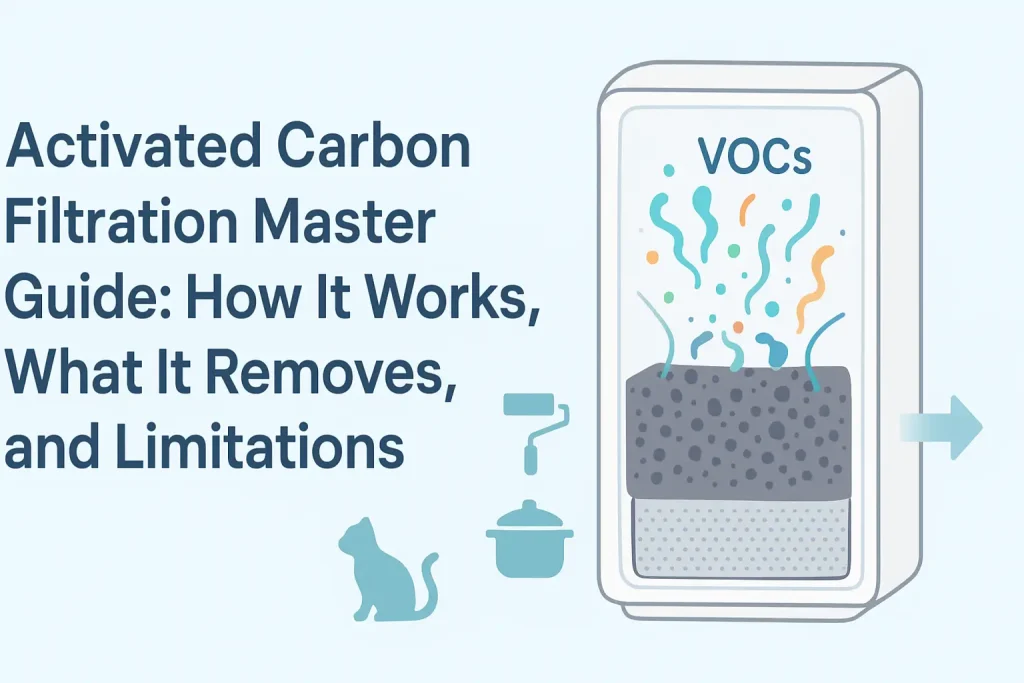
Activated carbon filters adsorb gas-phase pollutants through a different mechanism: the enormous internal surface area of activated carbon (one gram contains over 500 square meters of micropore surface) attracts and holds VOC molecules through van der Waals forces. This physical adsorption process only occurs when the carbon bed is thick enough (minimum 2 pounds for a medium room) and the air contact time through the filter is sufficient.
This happens because carbon adsorption is a surface-area-limited process, not a simple pass-through. A thin carbon sheet, like the one in the Coway AP-1512HH, removes light odors from a 200-square-foot room but saturates quickly against paint off-gassing, wildfire smoke odor, or cigarette residue.
This only occurs when the carbon filter contains at least 2 to 5 pounds of activated carbon with a dwell time of 0.1 seconds or longer, a configuration found in units like the IQAir HealthPro Plus and Austin Air HealthMate. If the carbon stage is a thin impregnated foam sheet, VOC removal drops below 30 percent within weeks of continuous use.
If the carbon filter is undersized for your medium room’s VOC load, the result is odor breakthrough within 4 to 8 weeks and particulate-only filtration thereafter. Fix it by either selecting a unit with a substantial carbon bed from the start or supplementing a True HEPA purifier with a separate activated carbon canister filter placed downstream.
For medium rooms in homes with gas stoves, new furniture, or attached garages, a hybrid unit with at least 2 pounds of activated carbon is the minimum viable configuration. For bedrooms far from VOC sources where particle filtration is the primary goal, a True HEPA unit with a thin carbon pre-filter is sufficient.
Noise Levels in Medium Rooms: What dB Ratings Actually Mean for Bedroom and Living Room Use
Noise level is the most overlooked specification in air purifier selection, and it matters most in medium rooms because these spaces frequently double as bedrooms or home offices where continuous fan noise directly affects sleep quality and concentration.
A decibel (dB) scale is logarithmic: a 10 dB increase sounds approximately twice as loud to the human ear. The difference between 24 dB (Levoit Core 400S at sleep mode) and 54 dB (the same unit at turbo) is not a 2.25x increase in perceived noise. It is an 8x increase.
At sleep mode, the target is below 30 dB, a level roughly equivalent to a whisper or rustling leaves. The Levoit Core 400S at 24 dB, IQAir HealthPro Plus at 22 dB, and Winix 5500-2 at 27 dB all meet this threshold comfortably. The Coway AP-1512HH at 30 dB and Blueair 211+ at 31 dB sit at the upper edge of sleep-acceptable noise.
At medium fan speed, where most medium-room purifiers need to run during waking hours to hit 5 ACH, noise levels range from 35 to 48 dB. This is comparable to a quiet refrigerator or light rain outside a window, acceptable for living room use but potentially disruptive in a quiet office or nursery.
For a 300-square-foot bedroom, the Coway AP-1512HH on medium speed produces approximately 40 dB, enough to deliver roughly 3.5 ACH for a light to moderate allergy sufferer. If you need 5 ACH in that same room and noise sensitivity is a factor, the Levoit Core 400S or IQAir HealthPro Plus are the better choices because they can achieve the target CADR at lower fan speeds.
Medium Room Air Purifier Placement for Maximum Effectiveness
Purifier placement in a medium room affects CADR performance more than most buyers realize. A unit placed in a corner or behind furniture loses 20 to 30 percent of its effective coverage because airflow into the intake is partially blocked and the cleaned air cannot distribute evenly across the room.
The ideal position is central, at least 12 to 18 inches from walls on all sides, with clear airflow paths to the main living or sleeping zone. For rectangular rooms, placement near the center of the longer wall produces more even air distribution than corner placement. Our guide on choosing the ideal airflow path in rectangular rooms covers the physics of air distribution and the specific placement patterns that work best for different room shapes.
Open doorways reduce effective coverage further because cleaned air escapes and unfiltered air enters, effectively increasing the volume the purifier must clean. In a 300-square-foot bedroom with an open door to a 200-square-foot hallway, the effective volume rises to 500 square feet, pushing the CADR requirement up proportionally and potentially exceeding the capacity of a unit sized only to the bedroom.
Running an air purifier with windows open creates a similar problem at a larger scale. The constant influx of outdoor air, which may carry pollen, PM2.5, or wildfire smoke depending on conditions, turns the purifier into a losing game of perpetual dilution. For the full energy and filtration cost analysis, see our article on whether running an air purifier with windows open wastes energy or still provides meaningful air cleaning.
CADR vs Room Coverage: Why Manufacturer Numbers Overstate Medium Room Performance
Manufacturer coverage area claims use the 2 ACH standard because it produces the largest possible square footage number for a given CADR. A unit with 200 CFM smoke CADR can claim 310 square feet of coverage at 2 ACH, a figure that sounds adequate for a medium room but falls to 124 square feet at 5 ACH.
According to AHAM testing protocol AC-1, the coverage calculation at 2 ACH uses the formula: coverage (sq ft) equals smoke CADR times 1.55. The 1.55 multiplier assumes an eight-foot ceiling and two complete air changes per hour, the minimum threshold for noticeable particle reduction in a normally occupied room.
For allergy and asthma management, the American Lung Association and multiple research groups including the Journal of Allergy and Clinical Immunology recommend 4 to 5 ACH in occupied bedrooms. At 5 ACH, the multiplier drops to 0.62, meaning coverage is 40 percent of the manufacturer’s stated figure for any given CADR.
This discrepancy is not a marketing deception. It is a difference in use-case assumptions. The manufacturer’s number answers the question “what is the largest room this unit can provide any meaningful benefit in?” The 5 ACH number answers the question “what is the largest room this unit can effectively manage for an allergy sufferer?” Those are not the same question, and the answer differs by a factor of 2.5.
For medium rooms, the practical implication is clear: a purifier rated for 360 square feet by the manufacturer covers 144 square feet for allergy and asthma use. Buy the unit rated for the larger of these two numbers or accept that you are getting 2 ACH cleaning, not 5 ACH, in your actual space.
Ongoing Costs: Filter Replacements, Electricity, and Total Ownership
Annual operating cost for a medium-room air purifier breaks into two components: filter replacements and electricity consumption. Together they determine what the unit actually costs over a five-year ownership period, a figure that often exceeds the purchase price of the unit itself.
Filter costs range from $25 per year for the Winix 5500-2 (one True HEPA filter and four washable carbon pre-filters) to $250 per year for the IQAir HealthPro Plus (HyperHEPA plus V5 gas-phase cartridges). At the midpoint, the Levoit Core 400S at $40 per year and Coway AP-1512HH at $30 per year represent the typical range for medium-room True HEPA purifiers.
Electricity costs depend on wattage at medium fan speed, hours of daily operation, and your local electricity rate. A purifier drawing 40 watts at medium speed, running 12 hours daily at the national average of 13 cents per kWh, costs approximately $23 per year in electricity. At 24-hour continuous operation, that rises to $46 per year.
Total five-year ownership cost for a Coway AP-1512HH runs approximately $465 ($200 purchase, $150 in filters, $115 in electricity at 12 hours daily). The IQAir HealthPro Plus totals approximately $2,500 over the same period. The decision between them is not about which is cheaper. It is about whether the medical-grade filtration benefit of the IQAir justifies a 5x total cost difference for your specific health situation.
How Room Layout and Furniture Affect Air Purifier Performance in Medium Rooms
AHAM CADR testing occurs in a 1,008-cubic-foot test chamber with a mixing fan and zero obstructions. Your medium room has a bed, a dresser, bookshelves, curtains, and possibly a ceiling fan mixing the air in ways the test chamber never experiences.
Furniture reduces effective CADR by 15 to 25 percent because it blocks airflow paths between the purifier and the far corners of the room. A purifier placed behind a sofa or under a desk loses intake efficiency and creates dead zones where cleaned air cannot reach, leaving pockets of elevated particle concentration even when the unit has run for hours.
The fix is not buying a more powerful unit, though that helps at the margin. The fix is placement: at least 12 inches of clearance on all sides, elevated 18 to 24 inches off the floor on a sturdy surface, and positioned so the outflow points toward the center of the room rather than a wall or large piece of furniture.
For rooms with ceiling fans, running the fan on low in reverse (winter mode) helps distribute cleaned air vertically without creating strong drafts that push particles back into suspension. A ceiling fan on high in forward mode can actually resuspend settled dust, working against the purifier by increasing the effective particle load it must capture.
Medium Room Air Purifiers for Specific Pollutants: Smoke, Allergens, VOCs, and Pet Dander
Different pollutants demand different filter configurations, and a medium room magnifies the problem because the volume of contaminated air is large enough that the wrong filter type produces a measurable failure in air quality within hours.
For wildfire smoke and outdoor PM2.5 infiltration, a high smoke CADR (250 CFM minimum for a 300-square-foot room at 5 ACH) combined with a True HEPA filter is the non-negotiable baseline. Carbon filtration for smoke odor is helpful but secondary to particle removal, since the cardiovascular and respiratory health risks from wildfire smoke come from the fine particles, not the smell.
This happens because wildfire smoke particles (0.4 to 0.7 microns modal diameter) fall directly in the most penetrating particle size range, where HEPA capture efficiency is at its minimum of 99.97 percent. The filter still captures them effectively, but the CADR rating at this particle size is what determines how fast the room clears, not the filter’s absolute efficiency percentage.
For pet dander and allergens, which range from 2.5 to 10 microns for dander flakes but include sub-micron Fel d 1 protein particles from cat saliva, a True HEPA filter with a robust pre-filter handles both the visible pet hair and the invisible allergenic proteins. A washable pre-filter is particularly valuable in pet households because it catches the bulk of visible hair and dander before it clogs the HEPA stage.
For VOCs from new furniture, paint, cleaning products, or attached garages, the solution is activated carbon mass, not just carbon presence. A thin carbon sheet, like the one in most sub-$200 purifiers, saturates quickly against sustained VOC off-gassing. A minimum of 2 to 5 pounds of granular activated carbon with a dwell-time-optimized filter bed is needed for meaningful VOC reduction in a medium room.
If the carbon filter is undersized for sustained VOC exposure, the result is rapid saturation followed by zero gas-phase filtration for the remaining filter cycle. Fix it by either selecting a unit with substantial carbon from the start or accepting that your purifier is a particle-only device and managing VOC sources through ventilation separately.
For pet households in medium rooms, the Coway AP-1512HH’s washable pre-filter captures pet hair effectively before it reaches the HEPA stage, while the Winix 5500-2’s washable carbon filter adds odor control for litter boxes and pet beds. For homes with cigarette smoke, our guide on the effectiveness of air purifiers for cigarette smoke removal covers the specific CADR and carbon requirements for this challenging pollutant mixture.
How to Choose Between the Coway AP-1512HH, Winix 5500-2, and Levoit Core 400S
These three purifiers dominate the medium-room category, and the differences between them are real but narrow enough that the final decision should hinge on your specific priorities rather than an absolute performance ranking.
Choose the Coway AP-1512HH if build quality, proven long-term reliability, and the highest third-party recommendation count matter most. It has been Wirecutter’s top pick for multiple years and has the largest body of independent test data confirming its real-world performance in furnished medium rooms.
Choose the Winix 5500-2 if the lowest possible operating cost and washable carbon for pet or cooking odors are your top priorities. The annual filter cost is the lowest in its class, and the AOC carbon filter extends the time between carbon replacements substantially in homes with recurring but moderate odor sources.
Choose the Levoit Core 400S if smart features, a quieter sleep mode, and slightly higher CADR (260 vs 246 CFM) matter more than purchase price. The VeSync app adds scheduling, air quality history, and filter life tracking that the Coway and Winix lack, and the 24 dB sleep mode is meaningfully quieter than the Coway’s 30 dB.
Any of these three will outperform a generic budget purifier by 30 to 50 percent on effective CADR in a medium room. The differences between them are real but smaller than the difference between any of them and a purifier with unverified CADR claims.
Does a Higher CADR Always Mean Better Performance for a Medium Room?
Higher CADR means faster cleaning for the same room size, but the relationship stops producing meaningful benefit once CADR exceeds what is needed to hit 5 ACH in your specific room. Beyond that point, additional CADR reduces cleaning time in minutes rather than producing a noticeable improvement in steady-state air quality.
In a 300-square-foot room with an eight-foot ceiling, 200 CFM smoke CADR achieves 5 ACH. A unit with 350 CFM CADR achieves 8.75 ACH, reducing the time to clear the room from 12 minutes per air change to 7 minutes. The steady-state PM2.5 concentration is similar in both cases because the room reaches its minimum particle level faster with higher CADR but does not go lower.
The practical advantage of higher CADR in a medium room is that it lets you run the purifier at a lower, quieter fan speed and still hit your ACH target. A Blueair 211+ at medium speed may deliver 200 CFM quietly in a 300-square-foot room, while the Coway AP-1512HH needs high speed to reach the same CADR, producing more noise for the same result.
For medium rooms, target the CADR that achieves 5 ACH at a fan speed you can tolerate for continuous use, not the highest CADR available at maximum fan speed. The purifier you run at medium speed for 12 hours does more for your air quality than the one you turn off after an hour because turbo mode is too loud.
How Often Should You Run an Air Purifier in a Medium Room?
Continuous operation on auto or medium fan speed produces the best steady-state air quality because particle levels rise whenever the purifier stops. Outdoor PM2.5 infiltrates through window seals, door gaps, and ventilation at a rate of 0.3 to 2 air changes per hour in typical construction, meaning a turned-off purifier allows particles to accumulate back to pre-cleaning levels within one to three hours.
For allergy sufferers, continuous operation at a fan speed that achieves at least 4 ACH in the room is the standard recommendation from the American Academy of Allergy, Asthma and Immunology. For general health in a medium room without specific respiratory conditions, 12 to 16 hours of daily operation timed to occupancy hours provides meaningful benefit with lower electricity and filter costs.
Running a purifier only when the room feels stuffy or smells bad is the most common usage mistake. Particle concentrations are invisible, and by the time odors are noticeable, PM2.5 levels have often been elevated for hours. A PM2.5 air quality monitor makes the invisible visible, showing you exactly when particle levels rise and how fast your purifier brings them back down.
What Is the Difference Between AHAM CADR and Manufacturer Coverage Area Claims?
AHAM CADR is a standardized test result measured in cubic feet per minute for smoke, dust, and pollen in a controlled 1,008-cubic-foot test chamber. The test protocol, AC-1, specifies the chamber dimensions, mixing fan configuration, particle injection method, and decay rate measurement so results are comparable across brands.
Manufacturer coverage area is a marketing claim calculated by multiplying the smoke CADR by 1.55 (to convert CFM to square feet at 2 ACH and eight-foot ceiling) and rounding to the nearest convenient number. A unit with 246 CFM smoke CADR mathematically covers 381 square feet at 2 ACH, but manufacturers typically round to 360 for conservative marketing or 400 for aggressive marketing of the same CADR value.
The only number you can verify independently is the AHAM-certified CADR. Coverage area claims are derivative calculations that assume 2 ACH and an eight-foot ceiling, neither of which should be assumed for allergy management or rooms with higher or vaulted ceilings. Always work backward from the smoke CADR using the formula (smoke CADR x 1.55) for 2 ACH or (smoke CADR x 0.62) for 5 ACH.
Can a Medium Room Air Purifier Handle Wildfire Smoke Effectively?
A medium room air purifier with a smoke CADR of at least 250 CFM and a True HEPA filter can reduce indoor PM2.5 from wildfire smoke by 85 to 95 percent within 30 to 60 minutes of operation at 5 ACH. This is based on EPA guidance and published decay rate data showing that a properly sized HEPA purifier achieves a 90 percent reduction in particulate matter in approximately two to three complete air changes.
For wildfire events where outdoor AQI exceeds 150 for multiple days, run the purifier continuously at the highest tolerable fan speed and supplement with a MERV 13 furnace filter in your HVAC system if you have central air. The purifier handles the room-level cleaning, while the MERV 13 HVAC filter reduces the infiltration of new particles through the ventilation system and door gaps.
After a sustained wildfire event, replace both the HEPA and carbon filters regardless of the manufacturer’s stated replacement interval. Wildfire smoke loads filters far faster than typical household particle loads, and a filter that appears functional may have lost 20 to 40 percent of its effective CADR due to deep particle loading in the HEPA fiber matrix.
How Do I Know If My Medium Room Air Purifier Is Actually Working?
The only way to verify performance objectively is with a laser PM2.5 monitor that measures particle concentrations in micrograms per cubic meter. Place the monitor at breathing height in the center of the room, take a baseline reading, turn the purifier to medium speed, and check the reading at 30 minutes.
A properly sized purifier in a sealed medium room should reduce PM2.5 by at least 70 percent within 30 minutes at medium fan speed. If the reduction is less than 50 percent, the unit is undersized for the room, the filter needs replacement, or there is a significant outdoor air infiltration source such as an open window, unsealed door, or active exhaust fan pulling unfiltered air into the room.
Without a PM2.5 monitor, the best proxy is the purifier’s filter condition. A pre-filter that loads visibly with dust within two weeks of cleaning confirms that the unit is moving air through the filter and capturing particles. An HEPA filter that stays clean-looking for months despite continuous operation suggests either very low room particle levels or inadequate airflow through the filter due to obstruction or fan degradation.
Do Air Purifiers Help with Allergies in Medium Rooms?
Yes, a True HEPA air purifier sized to deliver at least 4 ACH in a medium room reduces airborne allergen concentrations by 70 to 90 percent within one to two hours of continuous operation at medium fan speed, according to research published in the Journal of Allergy and Clinical Immunology. The key variable is not the purifier’s filter type but whether its CADR is high enough to achieve the target ACH in your specific room volume.
For dust mite allergens, which are relatively large (10 to 40 microns when carried on fecal particles) and settle quickly, air purifiers are effective at capturing the fraction that remains airborne but cannot address the reservoir of allergens embedded in bedding, carpet, and upholstery. A purifier is one component of allergy management, not a standalone solution.
For pollen entering through open windows and on clothing, a purifier running continuously during allergy season captures airborne pollen before it settles and triggers symptoms. The combination of a sealed room, a HEPA purifier sized for 5 ACH, and regular washing of bedding in hot water produces the best results for allergy management in a medium room. For a deeper dive on this topic, our guide on selecting air purifiers specifically for asthma management covers the additional certification requirements and performance thresholds that matter for respiratory conditions.
Can I Use Two Small Air Purifiers Instead of One Medium-Room Unit?
Two small purifiers with a combined smoke CADR equal to one medium-room unit can work, but placement matters more and the noise profile is different. Two units each delivering 120 CFM placed at opposite ends of a rectangular medium room provide more even coverage than a single 240 CFM unit in one location, especially in rooms with partial furniture obstructions that create airflow dead zones.
The trade-off is that two budget purifiers often produce more combined noise than one quality unit, and the filter replacement costs for two units (two sets of filters annually) may exceed the cost of a single higher-quality unit with longer filter life. For a 400-square-foot room where a single unit would need to run at high speed, two quieter units at medium speed can achieve the same CADR with lower perceived noise.
For most medium rooms, a single well-chosen unit is the simpler and more cost-effective solution. The two-unit strategy makes sense when the room shape is irregular, when furniture creates unavoidable dead zones that a single unit cannot reach, or when zoning the room into sleeping and living areas with different noise tolerance levels.
Does Room Shape Affect Which Air Purifier Works Best?
Rectangular rooms with a length-to-width ratio greater than 2:1 create airflow challenges that reduce effective CADR by 10 to 20 percent compared to square rooms of the same square footage. The purifier’s cleaned air must travel farther to reach the far end of the room, and the distance increases the time per air change and the opportunity for particles to settle or enter through infiltration before being captured.
For long rectangular rooms, a purifier placed near the center of the longer wall (not the short wall) with outflow directed along the length of the room provides the most even distribution. Two smaller units placed one-third and two-thirds along the length work better than a single large unit for rooms longer than 25 feet.
L-shaped rooms require special attention because the bend blocks direct airflow from any single purifier location. The most effective configuration is one unit in each leg of the L, or a single high-CADR unit placed at the junction point with clear airflow paths into both sections. Without this placement strategy, one section of the room may receive effectively zero air changes while the other is well-cleaned.
How Important Is CARB Certification for a Medium Room Air Purifier?
CARB (California Air Resources Board) certification limits ozone output to 0.050 parts per million, measured in a closed chamber after 24 hours of operation per the CCR Title 17 Section 94251 test protocol. Any air purifier sold in California must meet this standard regardless of room size, but the certification also applies to units sold elsewhere through major online retailers.
A purifier without CARB certification may emit ozone above the 0.050 ppm threshold, particularly if it uses an ionizer, UV-C lamp, or electrostatic precipitation as part of its filtration mechanism. Ozone is a lung irritant that exacerbates asthma, reduces lung function, and reacts with indoor VOCs to create secondary pollutants including formaldehyde and ultrafine particles.
For medium rooms, the risk is proportional to the room volume: an ozone-emitting purifier in a small room produces higher concentrations than the same unit in a large room. A 300-square-foot room with a non-CARB-compliant ionizer running continuously can reach ozone concentrations of 0.080 to 0.150 ppm, well above both the CARB limit and the EPA’s 8-hour National Ambient Air Quality Standard of 0.070 ppm.
All five purifiers recommended in this guide carry CARB certification, meaning none produce measurable ozone above 0.050 ppm at any fan speed or operating mode. If you are considering a purifier not on this list, verify CARB certification before purchasing. A purifier that lacks this certification is not worth the risk, regardless of its CADR or price.
What Maintenance Does a Medium Room Air Purifier Need?
Weekly vacuuming of the pre-filter and external intake grilles prevents dust buildup from reducing airflow into the unit. A clogged pre-filter starves the HEPA stage of air, reducing effective CADR by 15 to 30 percent even though the HEPA filter itself is still functional.
HEPA filter replacement follows the manufacturer’s recommended interval, typically 6 to 12 months depending on the household particle load and whether the unit runs continuously or intermittently. A HEPA filter past its replacement date not only loses capture efficiency as fiber pores become loaded but also increases the fan motor’s workload, raising electricity consumption and noise for the same airflow.
Carbon filter replacement intervals are shorter in homes with active VOC sources. A thin carbon pre-filter in a home with a gas stove, frequent cooking, or an attached garage may saturate in 3 to 4 months instead of the manufacturer’s stated 6-month interval. The first sign of carbon saturation is a return of odors that the purifier previously controlled, not any visible change in the filter itself.
For purifiers with washable pre-filters, such as the Coway AP-1512HH and Winix 5500-2, slide the pre-filter out monthly and rinse it under running water until the water runs clear. Let it dry completely before reinstalling. A wet pre-filter placed back in the unit can promote mold growth inside the purifier and release spores into the cleaned airstream.
Do Air Purifiers with UV-C Lights Add Value in a Medium Room?
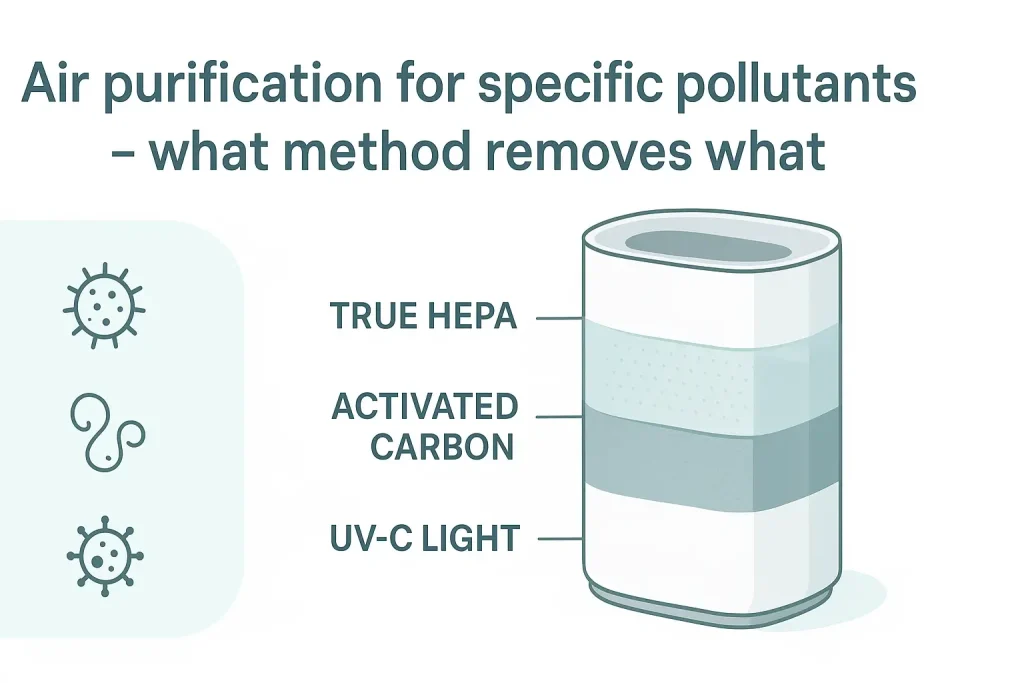
UV-C lights in portable air purifiers provide limited benefit because the air passes by the UV-C lamp too quickly for sufficient germicidal dose delivery. Effective UV-C inactivation of airborne pathogens requires a dwell time of 0.25 to 2 seconds at an irradiance of 1,000 to 10,000 microwatts per square centimeter, depending on the specific pathogen’s UV susceptibility.
In a typical portable purifier, air moves past the UV-C lamp at 100 to 300 CFM through a duct cross-section of 0.25 to 0.5 square feet, yielding a dwell time of 0.01 to 0.05 seconds at an irradiance of 200 to 500 microwatts per square centimeter. This dose is insufficient to inactivate most bacteria and viruses, making the UV-C stage a marginal addition rather than a meaningful germicidal step.
UV-C lamps also degrade over time, losing 30 to 50 percent of their output within the first 8,000 to 9,000 hours of operation (roughly one year of continuous use). A UV-C lamp that is not replaced annually may emit visible blue light but produce negligible germicidal UV-C at 254 nanometers, the wavelength actually needed for pathogen inactivation.
For medium rooms, a True HEPA filter is a more reliable pathogen removal mechanism than UV-C because it physically captures bacteria and virus-carrying particles regardless of UV dose or lamp condition. If pathogen inactivation is a priority, choose a purifier with a high CADR and HEPA filtration, not one that adds UV-C as a secondary feature.
Where Should I Place an Air Purifier in a Medium Room If I Have Allergies?
Place the purifier as close to your breathing zone as practical. In a bedroom, position it within 3 to 6 feet of the bed with the outflow directed toward the sleeping area, not toward a wall or window. This creates a pocket of filtered air around your head during sleep, the eight-hour period when allergy exposure has the most direct impact on next-day symptoms and sleep quality.
Elevate the purifier 18 to 24 inches on a sturdy nightstand or dedicated shelf rather than placing it directly on the floor. Floor placement pulls in the largest settled dust particles from the lowest 12 inches of the room, loading the pre-filter faster, while elevated placement draws from the breathing zone where airborne allergen concentrations matter most.
For living rooms, place the purifier between the primary seating area and the room’s main air infiltration source, such as a frequently used door or a window that is open seasonally. This intercepts incoming allergens before they disperse across the room and reach the seating area at higher concentrations.
Keep the purifier at least 12 inches from walls, curtains, and furniture on all sides. A purifier pressed against a wall or tucked behind a chair loses 20 to 30 percent of its effective CADR because the intake is starved and the outflow creates turbulence rather than laminar mixing across the room.
Can an Air Purifier Help with COPD in a Medium Room?
Research indicates that HEPA air purifiers can reduce indoor PM2.5 by 50 to 80 percent in medium rooms, which may help reduce COPD symptom exacerbation in individuals sensitive to particulate matter. However, the clinical evidence for air purifier use specifically for COPD management is still developing, and purifiers should be viewed as a supportive measure rather than a primary treatment.
The filtration requirements for COPD are similar to those for asthma management: a True HEPA filter delivering at least 4 to 5 ACH in the occupied room, CARB certification to ensure zero ozone emission, and continuous operation at a fan speed that maintains the target ACH without creating disruptive noise that interferes with rest. Our comprehensive guide on air purifier selection for individuals managing COPD covers the specific performance thresholds, clinical evidence, and practical setup considerations for respiratory conditions.
The most important factor is matching the purifier’s CADR to the room at 5 ACH, not at the manufacturer’s claimed 2 ACH coverage. An undersized purifier that achieves only 2 ACH provides less particle reduction and may not produce the level of air quality improvement needed to support respiratory health in a medium room.
Our Verdict: The Best Air Purifier for Most Medium Rooms
The Coway AP-1512HH wins as the best air purifier for most medium rooms because it delivers the highest combination of AHAM-certified CADR (246 CFM), acceptable noise (30 dB at sleep mode), and low operating cost ($30 per year in filters) at a purchase price ($200) that reflects build quality rather than brand markup. It covers a 300-square-foot room at 4.1 ACH and a 360-square-foot room at 2 ACH, making it adequate for the full medium-room range.
The Winix 5500-2 is the better choice if filter cost is your top priority and you value washable carbon for odor control. The Levoit Core 400S is the better choice if smart features, a 24 dB sleep mode, and app-based scheduling matter more than the $20 to $40 price difference. The Blueair 211+ is the better choice for larger medium rooms (350 to 400 square feet) where the higher 350 CFM CADR lets you run the unit at a quieter medium speed and still hit 5 ACH.
Measure your room. Calculate your CADR requirement at 5 ACH using the formula above. Match the purifier to the CADR requirement, not to the manufacturer’s coverage claim. Choose any of the four recommended models that meet your CADR target at a fan speed you can tolerate, and run it continuously at that speed.