Most basements trap moisture, radon, mold spores, and chemical odors from stored paints and cleaning supplies. A standard air purifier designed for a bedroom will struggle in this environment.
You need a unit with True HEPA for mold spores, substantial activated carbon for musty odors, and enough CADR to handle a space with poor natural ventilation. This guide compares the five best air purifiers for basements across the metrics that actually matter below ground.
Why Basement Air Quality Needs a Different Approach
Basements present a combination of air quality problems that rarely occur together on upper floors. High humidity creates conditions for mold growth while limited ventilation traps radon, VOCs, and particulate matter in a single space.
The stack effect, which is the natural upward movement of air in a home, draws basement air into living spaces above. According to research published in Indoor Air journal by the International Society of Indoor Air Quality and Climate, basement pollutants migrate to upper floors through floor penetrations and HVAC return ducts.
| Photo | Popular Air Purifiers | Price |
|---|---|---|

|
Air Purifiers for Home Large Room up to 1500ft², Tailulu H13 True HEPA Air Purifier for Pets Dust Odor Smoke, Air Purifier for Bedroom with 15dB Quiet Sleep Mode for Bedroom Office Living Room | Check Price On Amazon |
|
Afloia Air Purifier for Home, 4-in-1 Washable Filter for Allergies, Covers Up to 1076 ft², Quiet Operation, Auto Shut-Off & Night Light, Removes Pet Dander, Pollen, Dust, Mold, and Smoke, White,Pluto | Check Price On Amazon |

|
Nuwave OxyPure ZERO Air Purifier with Washable and Reusable Bio Guard Tech Air Filter, Large Room Up to 2002 Ft², Air Quality Monitor, 0.1 Microns, 100% Capture Irritants like Smoke, Dust, Pollen | Check Price On Amazon |

|
Air Purifiers for Home Large Room Up to 1,996 Ft², EOEBOT Air Purifier for Home Pets with Washable Filter, Quiet Sleep Mode, Air Quality Monitor, Air Purifier for Bedroom, Pet Hair, Dust, Smoke, White | Check Price On Amazon |
|
Afloia 2 IN 1 Air Purifier with Humidifier Combo, 3-Stage Filters for Home Allergies Pets Hair Smoker Odors, Evaporative Humidifier, Auto Shut Off, Quiet Air Cleaner with Seven Color Light,White | Check Price On Amazon |
This means a basement air purifier is not just protecting the basement. It is protecting every room above it.
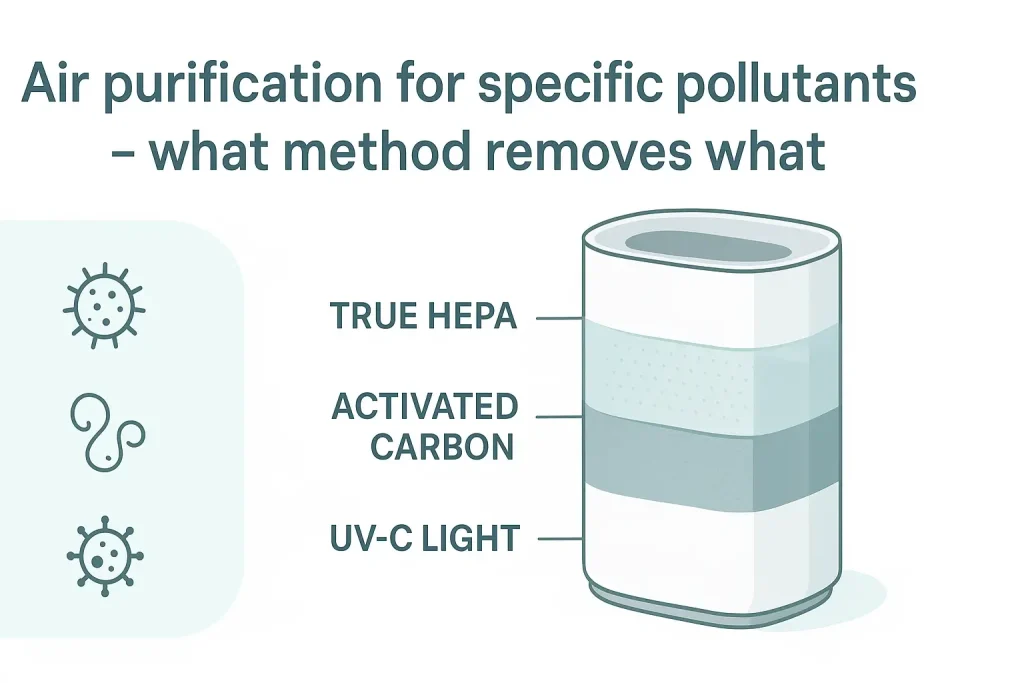
Standard air purifiers lack the activated carbon capacity needed for basement odors. A True HEPA air purifier with substantial activated carbon addresses both the particulate and gaseous pollutant load that defines below-grade spaces.
For readers dealing with sinus issues triggered by basement mold, our guide on air purifiers for sinusitis relief covers the connection between filtration and sinus health in detail.
Air Quality Data
Basement Air Quality – What the Research Shows
Sources: EPA Indoor Air Quality, ASHRAE, American Lung Association
Key Features to Look for in a Basement Air Purifier
True HEPA Filtration for Mold Spores and Particulates
True HEPA filters capture 99.97% of particles at 0.3 microns, the most penetrating particle size per IEST standards. Mold spores range from 3 to 40 microns, well within HEPA capture range.
This happens because mechanical HEPA filtration traps particles through impaction, interception, and diffusion across densely packed fiber layers. This only occurs when the filter meets the True HEPA standard (H13 grade or higher) with a properly sealed frame that prevents filter bypass.
If the filter is labeled HEPA-type or HEPA-like with no independent certification, the result is unverified efficiency that can fall below 90% at the critical 0.3-micron size. Fix it by selecting only units with AHAM-certified CADR ratings or stated H13/H14 grade.
Activated Carbon Weight and Capacity for Musty Odors
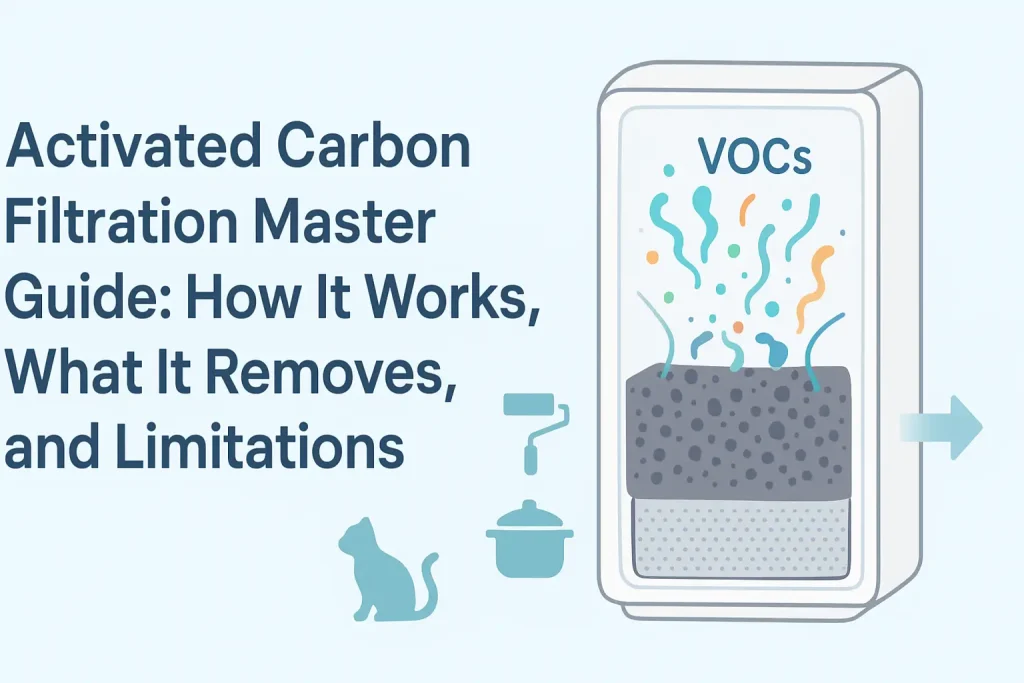
Musty basement smells come from volatile organic compounds released by mold, stored chemicals, and decomposing materials. HEPA filters cannot capture these gases. Only activated carbon adsorption removes them.
This happens because activated carbon’s porous structure (typically 500 to 1,500 square meters of surface area per gram) chemically traps VOC molecules on its surface through van der Waals forces. This only occurs when the carbon filter has sufficient weight, at minimum 1 pound of carbon for meaningful odor removal in basement conditions.
If the carbon filter is a thin mesh with only a few ounces of carbon, the result is odor adsorption that saturates within weeks and releases trapped VOCs back into the air when temperature or humidity rises. Fix it by choosing units with at least 2 to 3 pounds of activated carbon or carbon-zeolite blends for persistent basement applications.
Coverage Area Matched to 5 ACH, Not 2 ACH
Manufacturer coverage claims use 2 air changes per hour (ACH), which is the AHAM standard for general air cleaning. For basements with elevated mold risk, you need 5 ACH to maintain spore concentrations low enough to prevent colony growth on surfaces.
This means a unit rated for 300 square feet at 2 ACH only covers 120 square feet at 5 ACH. The effective coverage area drops to 40% of the stated figure when you need allergy-level filtration performance.
To calculate the right CADR for your basement at 5 ACH, use our detailed guide on CADR ratings and room sizing. The formula multiplies your room volume by the target ACH and divides by 60 to get the minimum smoke CADR you need.
CARB Certification and Zero Ozone Output
Basements have limited ventilation, which means any ozone produced by an air purifier accumulates rather than dispersing. Ozone is a respiratory irritant at concentrations above 0.050 ppm, the CARB CCR Title 17 legal limit for consumer air cleaners.
A CARB-certified unit guarantees ozone output stays below this threshold under all operating conditions. For basements where people spend extended time in enclosed spaces, this certification is not optional. Avoid ionizers and ozone generators entirely in below-grade rooms.
Top 5 Air Purifiers for Basements Compared
The five units below were selected based on smoke CADR performance at 5 ACH, activated carbon capacity for odor control, and CARB certification status. Each unit addresses a specific basement scenario.
1. Coway Airmega 400: Best Overall for Large Finished Basements
The Coway Airmega 400 delivers 400 CFM smoke CADR through dual fans and covers 1,560 square feet at 2 ACH or 624 square feet at the 5 ACH needed for mold control. Its washable pre-filter captures larger dust particles before they reach the HEPA stage, extending filter life in dusty basement environments.
Coway Airmega 400 air purifier operates at just 22 dB in sleep mode, making it suitable for basement home theaters or guest rooms. The activated carbon layer handles moderate musty odors, though very strong chemical smells may need supplemental carbon filtration.
- Smoke CADR: 400 CFM (AHAM certified)
- Coverage at 2 ACH: 1,560 sq ft
- Coverage at 5 ACH: 624 sq ft
- Annual filter cost: Approximately $60
- Noise: 22 dB sleep / 52 dB max
- Carbon capacity: Moderate (approximately 1 lb)
2. Winix 5500-2: Best Value for Medium Basements
The Winix 5500-2 provides 243 CFM smoke CADR with True HEPA plus an AOC (Advanced Odor Control) carbon filter at a price point under $160. Its PlasmaWave ionizer can be disabled, which you should do in a basement to prevent any ozone accumulation.
Winix 5500-2 air purifier covers 360 square feet at 2 ACH or 144 square feet at 5 ACH. This makes it suitable for a single finished basement room of approximately 12 by 12 feet when targeting allergy-level air quality.
- Smoke CADR: 243 CFM (AHAM certified)
- Coverage at 2 ACH: 360 sq ft
- Coverage at 5 ACH: 144 sq ft
- Annual filter cost: Approximately $50
- Noise: 27.8 dB sleep / 58 dB max
- Carbon capacity: Light (AOC carbon sheet)
3. Levoit Core 400S: Best Smart Features for Basement Monitoring
The Levoit Core 400S offers 260 CFM smoke CADR and a built-in PM2.5 sensor with real-time display, letting you monitor actual basement particulate levels. Its smart app control allows you to adjust fan speed and set schedules without physically accessing the unit in a basement.
Levoit Core 400S smart air purifier covers 400 square feet at 2 ACH or 160 square feet at 5 ACH. The 24 dB sleep mode and auto mode that adjusts fan speed based on sensor readings make it suitable for finished basement living spaces.
- Smoke CADR: 260 CFM (AHAM certified)
- Coverage at 2 ACH: 400 sq ft
- Coverage at 5 ACH: 160 sq ft
- Annual filter cost: Approximately $50
- Noise: 24 dB sleep / 52 dB max
- Carbon capacity: Light to moderate
4. Alen BreatheSmart 75i: Best Customizable Filtration for Basements
The Alen BreatheSmart 75i accepts interchangeable filter types, including a Fresh filter with antimicrobial treatment specifically designed for mold and mildew spores. With 347 CFM smoke CADR, it covers 1,300 square feet at 2 ACH or 520 square feet at 5 ACH.
Alen BreatheSmart 75i air purifier runs at 25 dB in sleep mode and carries a lifetime warranty on the unit itself. The Fresh filter option adds a layer of protection against microbial growth on the filter media, which matters in high-humidity basement environments.
- Smoke CADR: 347 CFM (AHAM certified)
- Coverage at 2 ACH: 1,300 sq ft
- Coverage at 5 ACH: 520 sq ft
- Annual filter cost: Approximately $100
- Noise: 25 dB sleep / 49 dB max
- Carbon capacity: Moderate (varies by filter type)
5. Austin Air HealthMate: Best for Basements with Chemical and VOC Concerns
The Austin Air HealthMate contains 15 pounds of activated carbon and zeolite, more than any other unit in this comparison. If your basement stores paint, solvents, cleaning chemicals, or fuel-burning appliances that release VOCs, this carbon capacity provides meaningful gas-phase filtration that lighter carbon filters cannot match.
Austin Air HealthMate purifier uses True HEPA plus the massive carbon-zeolite bed with a 5-year filter lifespan under normal conditions. For basements with chemical storage, read our guide on air purifiers for paint fumes which covers VOC filtration in detail.
- Smoke CADR: Approximately 250 CFM (manufacturer stated, not AHAM certified)
- Coverage at 2 ACH: 1,500 sq ft
- Coverage at 5 ACH: 600 sq ft
- Annual filter cost: Approximately $65 (5-year filter)
- Noise: 50 dB low / 66 dB high (louder than competitors)
- Carbon capacity: 15 lbs carbon plus zeolite
Product Comparison
Air Purifiers for Basements Compared – CADR, Coverage, Noise, and Filter Cost
Key specs compared across top basement picks. CADR from AHAM certified database. Coverage at 5 ACH calculated as smoke CADR x 12 / 5.
Use the table below to match your basement size and primary air quality concern to the right air purifier model.
| Model | Smoke CADR | Coverage at 2 ACH | Coverage at 5 ACH | Sleep Mode dB | Annual Filter Cost | Best For |
|---|---|---|---|---|---|---|
| Coway Airmega 400 | 400 CFM | 1,560 sq ft | 624 sq ft | 22 dB | $60/yr | Large finished basements |
| Winix 5500-2 | 243 CFM | 360 sq ft | 144 sq ft | 27.8 dB | $50/yr | Medium basements on a budget |
| Levoit Core 400S | 260 CFM | 400 sq ft | 160 sq ft | 24 dB | $50/yr | Smart-home basements |
| Alen BreatheSmart 75i | 347 CFM | 1,300 sq ft | 520 sq ft | 25 dB | $100/yr | Customizable mold filtration |
| Austin Air HealthMate | ~250 CFM* | 1,500 sq ft | 600 sq ft | 50 dB | $65/yr | Chemical and VOC removal |
CADR data from AHAM certified database except Austin Air (*manufacturer stated, not AHAM certified). Coverage at 5 ACH = smoke CADR x 12 / 5. Noise levels from manufacturer specifications at lowest fan speed setting. Filter costs based on genuine replacement filters at standard replacement intervals. Prices verified at time of publication.
Quick Reference
Basement Air Purifier Terms Explained
Definitions for technical terms used throughout this guide.
True HEPA (H13): Filter capturing 99.97% of particles at 0.3 microns per IEST standards. Distinct from HEPA-type, which has no standardized efficiency.
Smoke CADR: AHAM-certified metric in CFM measuring how fast an air purifier removes fine smoke particles (0.09 to 1.0 microns). The most relevant CADR for PM2.5 and mold spores.
ACH (Air Changes Per Hour): How many times per hour a purifier processes the entire room air volume. 2 ACH is standard. 5 ACH is recommended for mold and allergy control.
Activated Carbon: Porous carbon material that adsorbs VOCs, odors, and gaseous pollutants. Capacity is proportional to carbon weight in pounds.
CARB Certification: California Air Resources Board certification confirming ozone output below 0.050 ppm. Required for sale in California and strongly recommended for basements.
VOC (Volatile Organic Compound): Gaseous chemicals from paints, solvents, cleaners, and building materials. EPA notes indoor VOC levels are 2 to 10 times higher than outdoors.
AHAM Verifide: Independent CADR certification program by the Association of Home Appliance Manufacturers. The only reliable third-party performance verification for air purifiers.
PM2.5: Fine particulate matter 2.5 microns or smaller. Penetrates deep into lungs. True HEPA captures PM2.5 at 99.97% efficiency.
How to Calculate the Right CADR for Your Basement Space
Most buyers size their air purifier to the manufacturer’s coverage area claim at 2 ACH, then wonder why mold odors persist. For basement mold and musty air, you need to calculate CADR at 5 ACH instead.
The formula is straightforward. Multiply your basement room length by width by ceiling height (usually 8 feet) by your target ACH rate. Then divide that number by 60 to get the minimum smoke CADR in cubic feet per minute.
For a 400-square-foot finished basement with 8-foot ceilings at 5 ACH, the calculation is (400 x 8 x 5) divided by 60, which equals 267 CFM smoke CADR minimum. A unit like the Levoit Core 400S at 260 CFM would be slightly undersized for this space at allergy-level filtration.
The same room at the manufacturer-stated 2 ACH only needs 107 CFM. That is why coverage claims on product boxes do not tell the full story for basement applications.
For a deeper explanation of CADR and the complete formula with worked examples, read our full guide on CADR and room sizing calculations.
CADR Calculator
How Much CADR Do You Need for Your Basement?
Enter your basement dimensions and use case. Formula: (length x width x ceiling height x ACH) divided by 60. Source: AHAM methodology.
CADR = (length x width x ceiling height x ACH) / 60. For basement mold control, always calculate at 5 ACH, not the manufacturer-stated 2 ACH figure.
| Basement Room Size | CADR at 2 ACH (standard) | CADR at 5 ACH (mold control) | Example Models |
|---|---|---|---|
| 150 sq ft workshop | 100 CFM | 250 CFM | Winix 5500-2, Levoit Core 400S |
| 300 sq ft finished room | 200 CFM | 500 CFM | Coway Airmega 400 (400 CFM, slightly undersized) |
| 500 sq ft open basement | 333 CFM | 833 CFM | Two Coway Airmega 400 units or Blueair 605 |
| 700 sq ft large basement | 467 CFM | 1167 CFM | Multiple high-CADR units required |
Humidity, Mold, and Air Purifiers: What Actually Works
An air purifier captures airborne mold spores but does nothing to reduce basement humidity. Mold needs moisture to grow on surfaces. Without a dehumidifier keeping relative humidity below 50%, spores that land on walls or carpet will colonize regardless of how clean the air is.
This happens because mold growth requires three conditions: spores, organic material as food, and moisture above approximately 60% relative humidity. A True HEPA purifier removes the spores. A dehumidifier removes the moisture. Neither device alone stops mold in a damp basement.
This only occurs when both devices are sized correctly for the space and run continuously during humid seasons. If the dehumidifier is undersized or the air purifier runs on low fan speed, the result is airborne spore counts that remain elevated and surfaces that stay damp enough for growth.
For the best results, place the dehumidifier near the moisture source (foundation wall, laundry area) and the basement dehumidifier rated 50 pints or larger on the opposite side of the room for cross-circulation. This arrangement maximizes moisture removal and airborne spore capture simultaneously.
A PM2.5 air quality monitor with humidity sensor lets you track both particulate levels and relative humidity to confirm your setup is working. Target PM2.5 below 12 micrograms per cubic meter (EPA annual standard) and humidity between 30 and 50%.
Basement Air Purifier Myths Debunked
Myth vs Fact
Basement Air Purifier Myths Debunked – What the Evidence Actually Shows
Separating fact from fiction on basement air purification. Sources: EPA, AHAM, American Lung Association.
Myth
Air purifiers remove radon from basements.
Fact
Air purifiers do not remove radon gas. Radon is a radioactive noble gas that passes through HEPA and activated carbon filters. The EPA recommends active soil depressurization systems and professional radon mitigation, not air purifiers, to reduce radon levels. Test your basement for radon with an EPA-approved test kit before investing in any air quality equipment.
Myth
A HEPA air purifier alone will eliminate musty basement smell.
Fact
HEPA filters only capture particles, not gases or odors. Musty smells are VOCs released by mold metabolism. You need activated carbon with at least 2 to 3 pounds of carbon for meaningful odor removal. Units with thin carbon sheets provide negligible odor reduction in persistent basement conditions.
Myth
Any air purifier works in a basement since a room is a room.
Fact
Basements have higher humidity, lower temperatures, and different pollutant profiles than upper floors. Units with ionizers can produce ozone that accumulates in poorly ventilated basements. Units with thin carbon filters saturate faster due to the higher VOC load from stored chemicals and building materials.
Myth
A dehumidifier alone solves basement air quality problems.
Fact
Dehumidifiers reduce moisture but do not filter airborne particles, mold spores, dust, or chemical VOCs. A dehumidifier and a True HEPA air purifier with activated carbon serve complementary functions. One controls moisture. The other captures pollutants. Both are needed for comprehensive basement air quality.
Myth
Finished basements do not need special air purification considerations.
Fact
Finished basements still have below-grade walls that can transmit moisture. Carpeting and drywall provide organic material for mold if humidity rises above 60%. New basement renovations often off-gas VOCs from flooring, paint, and adhesives for months after completion.
Basement Air Purifier Buying Checklist
Use this checklist before making your final purchase decision. Each point addresses a basement-specific requirement that standard air purifier buying guides often miss.
Buying Guide
Before You Buy a Basement Air Purifier – Complete Checklist
Check off each point before making your decision. Based on AHAM, EPA, and CARB guidance for below-grade spaces.
Can an air purifier remove radon from my basement?
No air purifier can remove radon gas. Radon is a chemically inert noble gas that passes directly through HEPA and activated carbon filters without interacting with either material.
The EPA and the American Lung Association recommend active soil depressurization (ASD) systems installed by certified radon mitigation professionals. Test your basement with an EPA-approved radon test kit before purchasing air purification equipment. If radon levels exceed 4 pCi/L, professional mitigation is the only solution.
Do I need both a dehumidifier and an air purifier in my basement?
Yes, if your basement has humidity above 50% relative humidity. A dehumidifier controls moisture that enables mold growth on surfaces. An air purifier captures airborne mold spores, dust, and VOCs.
Neither device does the other’s job. A dehumidifier does not filter airborne particles. An air purifier does not reduce humidity. For comprehensive basement air quality, you need both devices running simultaneously, especially during humid summer months.
How long should I run an air purifier in a basement each day?
Run the air purifier 24 hours a day in basements with active mold, chemical storage, or humidity issues. Basements have minimal natural ventilation, so pollutants concentrate without continuous mechanical filtration.
Use auto mode if your unit has a PM2.5 sensor to adjust fan speed based on actual particulate levels. For detailed runtime guidance, read our guide on optimal air purifier run times which covers different room types and pollution scenarios.
What CADR do I need for a 500 square foot basement?
For mold control at 5 ACH in a 500-square-foot basement with 8-foot ceilings, you need a minimum smoke CADR of 333 CFM. The formula is (500 x 8 x 5) divided by 60.
If you use the manufacturer’s 2 ACH coverage claim, you only need 133 CFM, which would leave your basement under-filtered for mold spore control. The Coway Airmega 400 at 400 CFM smoke CADR would be the closest single-unit match for this space.
Can I use an air purifier in an unfinished basement?
Yes, but dust and concrete particles from unfinished surfaces will clog pre-filters faster. Choose a unit with a washable pre-filter and check it monthly.
Place the air purifier on a raised platform to keep it above any occasional floor moisture. Avoid units with ionizers in unfinished basements, where ozone can accumulate with no finished surfaces to absorb it.
Will an air purifier get rid of musty basement smell?
A True HEPA air purifier alone will not remove musty smells. Musty odors are gaseous VOCs that require activated carbon adsorption, not mechanical particle filtration.
Units with at least 2 pounds of activated carbon, such as the Austin Air HealthMate with 15 pounds of carbon and zeolite, provide meaningful odor reduction. Thin carbon sheet filters found in budget units saturate within weeks in persistently musty basements.
Are ionizers safe to use in basements?
Ionizers are generally not recommended for basements. They produce trace amounts of ozone as a byproduct, and basements have limited air exchange to disperse it.
Ozone concentrations above the CARB limit of 0.050 ppm can irritate airways. If your air purifier has an ionizer, disable it when used in a basement. For more on safe air purification, our guide on air purifiers for vaping and chemical aerosols covers filter types for different airborne contaminants.
How often should I replace filters in a basement air purifier?
Replace HEPA filters every 6 to 12 months in basement conditions, compared to the typical 12-month interval for upper floors. Higher humidity and dust loads accelerate filter loading.
Check your pre-filter monthly and clean or replace it as needed. Activated carbon filters in musty basements may saturate within 3 to 6 months. If you notice odors returning despite the purifier running, the carbon filter needs replacement regardless of the calendar interval.
Can one air purifier cover my entire basement?
One air purifier can cover an open-plan basement up to approximately 600 square feet at 5 ACH if you select a high-CADR unit like the Coway Airmega 400 or Alen BreatheSmart 75i. For basements divided into separate rooms, you need one unit per room or a unit placed centrally with doors kept open.
For basements larger than 700 square feet, two medium-CADR units placed at opposite ends provide better coverage than one very large unit. Air does not move around corners effectively, so multiple units overcome the poor air circulation that defines below-grade spaces.
What type of filter is best for basement mold spores?
True HEPA (H13 or H14) is the minimum for capturing mold spores, which range from 3 to 40 microns. All True HEPA filters capture these spore sizes at 99.97% efficiency.
For basements with active mold problems, choose a unit with an antimicrobial treated filter such as the Alen BreatheSmart 75i with the Fresh filter option. This treatment inhibits mold growth on the filter media itself, which matters when the unit processes high-humidity basement air continuously.
Do air purifiers work in cold basements?
Yes, air purifiers function normally in cold basements down to approximately 40 degrees Fahrenheit. Most consumer air purifiers are rated for indoor temperatures between 40 and 100 degrees Fahrenheit.
In unheated basements that drop below freezing, condensation can form on internal electronics and filter media when the unit cycles on and off. If your basement regularly drops below 40 degrees Fahrenheit, check the manufacturer’s operating temperature range before purchasing.
For most finished and semi-finished basements, the best air purifier for your space is a unit with True HEPA, at least 2 pounds of activated carbon, CARB certification, and smoke CADR calculated at 5 ACH for your specific square footage. Pair it with a dehumidifier to control moisture, and test for radon separately since no air purifier addresses that risk.
Use the CADR calculator above to determine your minimum smoke CADR requirement, then match it to one of the five units in our comparison table. For most finished basements between 200 and 600 square feet, the Coway Airmega 400 or Alen BreatheSmart 75i offer the best combination of CADR, carbon capacity, and quiet operation.