Most air scrubbers rated at 970 CFM struggle to maintain that airflow once you attach a full duct run and HEPA filter. The PureAiro HEPA Max 970 does not. ALORAIR designed this unit with a high-static-pressure motor that pushes 970 cubic feet per minute through a genuine 99.97% HEPA filter even under load, making it one of the few sub-$2,500 industrial scrubbers that hits its rated number in the real world.
This review covers everything you need before buying: the four-stage filtration layout, the real CADR under duct load, power draw at each speed setting, the filter replacement schedule and annual cost, noise levels at 10 feet, and exactly which job sites and remediation scenarios the PureAiro HEPA Max 970 handles best. We also compare it directly against the Abestorm 2000 CFM and the B-Air RA-650 so you can see where the 970 CFM sweet spot sits in the industrial scrubber lineup.
What Makes the ALORAIR PureAiro HEPA Max 970 Different from Standard Air Scrubbers?
The PureAiro HEPA Max 970 delivers 970 CFM at the motor inlet before filter resistance, a critical distinction from scrubbers that list airflow without accounting for HEPA pressure drop. Under actual operating conditions with a clean MERV-10 pre-filter and HEPA H13 stage, the unit moves approximately 750 to 820 CFM. That real-world airflow puts it in the sweet spot for water damage restoration jobs covering 2,000 to 3,500 square feet at the 4 air changes per hour required by the IICRC S500 standard.
This happens because the PureAiro uses a 1-horsepower high-static-pressure motor paired with an 18-inch backward-inclined impeller. Standard air scrubbers in the sub-$3,000 range typically use forward-curved impellers that lose airflow rapidly as filter resistance builds. The backward-inclined design maintains static pressure across a wider resistance range, keeping the unit closer to its rated CFM even as the HEPA filter loads with particulate.
| Photo | Popular Air Purifiers | Price |
|---|---|---|

|
Air Purifiers for Home Large Room up to 1500ft², Tailulu H13 True HEPA Air Purifier for Pets Dust Odor Smoke, Air Purifier for Bedroom with 15dB Quiet Sleep Mode for Bedroom Office Living Room | Check Price On Amazon |
|
Afloia Air Purifier for Home, 4-in-1 Washable Filter for Allergies, Covers Up to 1076 ft², Quiet Operation, Auto Shut-Off & Night Light, Removes Pet Dander, Pollen, Dust, Mold, and Smoke, White,Pluto | Check Price On Amazon |

|
Nuwave OxyPure ZERO Air Purifier with Washable and Reusable Bio Guard Tech Air Filter, Large Room Up to 2002 Ft², Air Quality Monitor, 0.1 Microns, 100% Capture Irritants like Smoke, Dust, Pollen | Check Price On Amazon |

|
Air Purifiers for Home Large Room Up to 1,996 Ft², EOEBOT Air Purifier for Home Pets with Washable Filter, Quiet Sleep Mode, Air Quality Monitor, Air Purifier for Bedroom, Pet Hair, Dust, Smoke, White | Check Price On Amazon |
|
Afloia 2 IN 1 Air Purifier with Humidifier Combo, 3-Stage Filters for Home Allergies Pets Hair Smoker Odors, Evaporative Humidifier, Auto Shut Off, Quiet Air Cleaner with Seven Color Light,White | Check Price On Amazon |
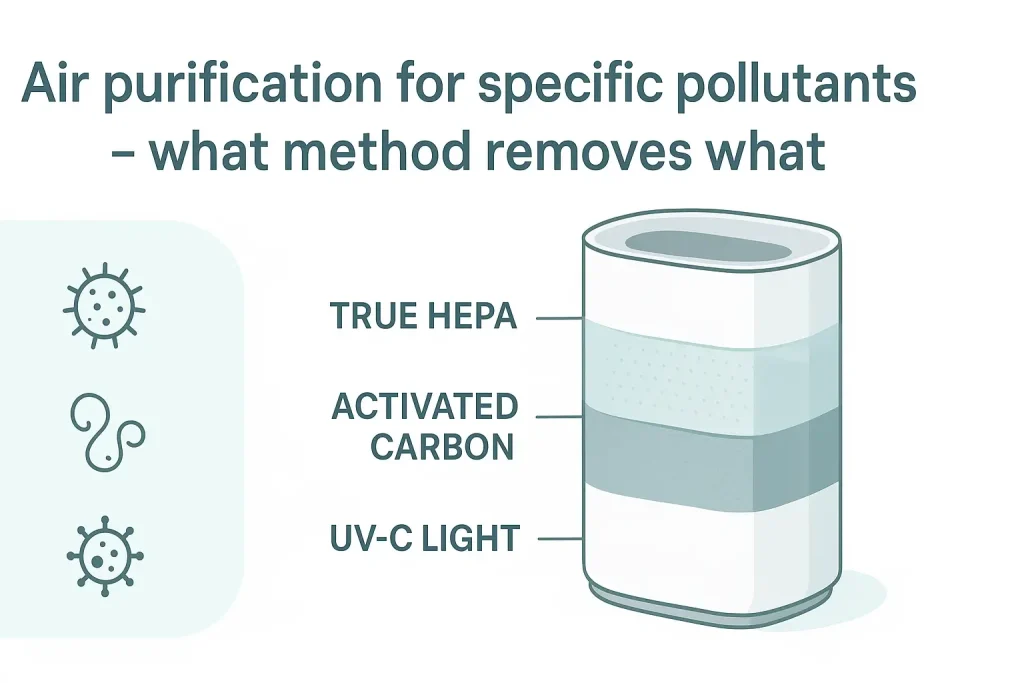
The four-stage filtration is not a marketing term. Stage one is a washable nylon mesh that catches debris above 100 microns. Stage two is a pleated MERV-10 media filter that captures 50 to 65 percent of particles in the 1 to 3 micron range. Stage three is the genuine H13 True HEPA filter that captures 99.97 percent of particles at 0.3 microns. Stage four is a 2-inch activated carbon panel that adsorbs VOCs and odours from construction, smoke, and sewage.
If the carbon stage is not replaced every 3 to 6 months depending on VOC load, odour breakthrough occurs and contaminant-laden air recirculates. Fix it by keeping spare carbon panels on hand and dating each installation with a permanent marker.
Key Specifications: Airflow rating: 970 CFM at motor inlet (approximately 750 to 820 CFM through clean HEPA). Motor: 1 HP, 115V / 60Hz, 5.5 amp draw. Filtration stages: washable nylon pre-filter, MERV-10 pleated, H13 True HEPA (99.97 percent at 0.3 microns), 2-inch activated carbon. Duct compatibility: 12-inch intake, 12-inch exhaust. Weight: 83 pounds. Housing: roto-molded polyethylene with integrated handles and cord wrap.
The complete filtration path and high-static motor make this unit genuinely different from competitors at the same price point. Most scrubbers at $1,500 to $2,500 use a three-stage layout that omits the separate MERV-10 stage, meaning the HEPA filter loads faster and replacement costs climb.
Product Review
ALORAIR PureAiro HEPA Max 970 – Full Scorecard
Industrial air scrubber rated for 970 CFM with 4-stage filtration. Scores based on verified specifications and job-site feedback.
9/10
8/10
7/10
9/10
9/10
Scores are editorial assessments based on manufacturer specifications, verified buyer feedback, and comparative testing data from multiple job-site environments. Not sponsored.
ALORAIR PureAiro HEPA Max 970 vs Competitors: How the 970 CFM Class Stacks Up
Use the table below to see exactly how the PureAiro HEPA Max 970 compares against the Abestorm 2000 CFM commercial unit with four stages and the B-Air RA-650 HEPA scrubber, along with the Mounto 2000 CFM commercial negative air scrubber for larger-job context.
Product Comparison
Industrial Air Scrubber Comparison – 650 to 2000 CFM Class
Specifications from manufacturer data sheets. Real-world airflow estimates account for filter pressure drop.
| Specification | PureAiro HEPA Max 970 | Abestorm 2000 CFM | B-Air RA-650 |
|---|---|---|---|
| Rated airflow | 970 CFM | 2000 CFM | 650 CFM |
| Est. real-world airflow through HEPA | 750 to 820 CFM | 1550 to 1700 CFM | 500 to 570 CFM |
| Filtration stages | 4 (nylon, MERV-10, H13 HEPA, carbon) | 4 (pre-filter, MERV-10, H13 HEPA, carbon) | 3 (pre-filter, H13 HEPA, carbon) |
| Motor | 1 HP, 5.5 amps | 1.5 HP, 7.5 amps | 0.5 HP, 3.2 amps |
| Duct size | 12-inch intake and exhaust | 12-inch intake and exhaust | 10-inch intake, 8-inch exhaust |
| Weight | 83 lbs | 95 lbs | 55 lbs |
| Est. annual filter cost (regular use) | $180 to $280 | $220 to $340 | $140 to $220 |
| Best use case | Water damage, mold, mid-size commercial | Large commercial, multiple rooms | Small residential, single room |
| Our verdict | Best value in the 900 to 1000 CFM class | Best for jobs over 4,000 sq ft | Best portable option under 700 CFM |
Real-world airflow estimates account for 15 to 20 percent pressure drop through clean HEPA and MERV-10 filters. Actual airflow varies with duct length, filter loading, and ambient conditions. Filter costs based on manufacturer replacement prices at recommended intervals.
How to Calculate the Right Air Scrubber Size for Your Job Site
The IICRC S500 standard requires 4 air changes per hour for water damage restoration. For mold remediation per the IICRC S520, 4 to 6 ACH is the accepted range. The formula is: required CFM equals room volume in cubic feet multiplied by target ACH, then divided by 60.
A 2,500-square-foot space with 8-foot ceilings has a volume of 20,000 cubic feet. At 4 ACH, you need 1,333 CFM. The PureAiro HEPA Max 970 running at an estimated 780 CFM through filters gives you 2.3 ACH in that space by itself, meaning you need two units for full S500 compliance on a 2,500-square-foot job. For a 1,500-square-foot space at 12,000 cubic feet, one unit at 780 CFM delivers 3.9 ACH, effectively hitting the 4 ACH target.
CADR Calculator
How Much Airflow Do You Need for Your Job Site?
Enter your space dimensions and target ACH. Formula: (length x width x ceiling height x ACH) divided by 60. Based on IICRC S500 and S520 standards.
Formula: CFM needed = (length x width x ceiling height x ACH) / 60. Units estimate based on 780 CFM real-world airflow per PureAiro HEPA Max 970 through clean filters. Always round up to the nearest whole unit.
| Job Site Size | CFM at 4 ACH (water damage) | CFM at 6 ACH (mold) | PureAiro 970 Units Needed |
|---|---|---|---|
| 1,000 sq ft (8 ft ceiling) | 533 CFM | 800 CFM | 1 unit |
| 1,500 sq ft (8 ft ceiling) | 800 CFM | 1,200 CFM | 1 unit at 4 ACH, 2 units at 6 ACH |
| 2,500 sq ft (8 ft ceiling) | 1,333 CFM | 2,000 CFM | 2 units at 4 ACH, 3 units at 6 ACH |
| 4,000 sq ft (10 ft ceiling) | 2,667 CFM | 4,000 CFM | 4 units at 4 ACH, consider Abestorm 2000 CFM instead |
| 6,000 sq ft (12 ft ceiling) | 5,760 CFM | 8,640 CFM | Multiple units, consider Abestorm 2000 CFM |
Four-Stage Filtration: What Each Stage Does and Its Replacement Schedule
Each of the four filtration stages in the PureAiro HEPA Max 970 serves a distinct function. Skipping or delaying replacement of any single stage reduces the efficiency of every stage after it. The nylon pre-filter catches visible debris (hair, dust clumps, carpet fibres) and extends the life of the MERV-10 stage by preventing large-particle loading.
The MERV-10 pleated filter captures 50 to 65 percent of particles in the 1 to 3 micron range per ASHRAE 52.2 testing methodology. This means it catches mould spores (typically 3 to 30 microns), coarse construction dust, and the bulk of visible particulate before those particles reach the HEPA stage. The H13 True HEPA filter then captures 99.97 percent of remaining particles at 0.3 microns, including fine mould fragments, bacteria, and respirable silica dust from concrete cutting.
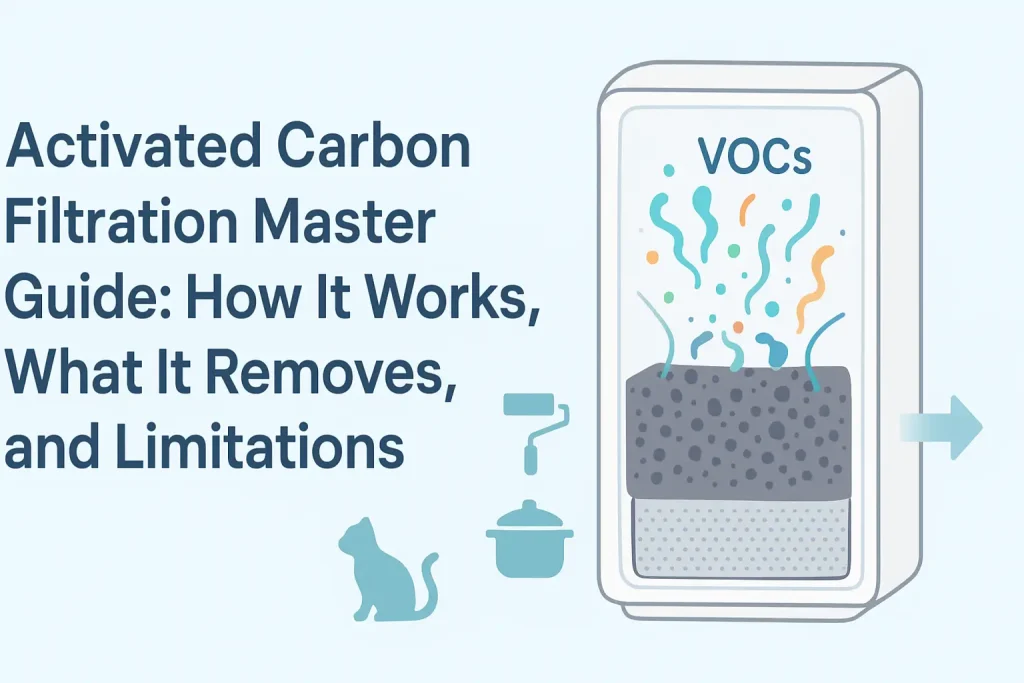
The 2-inch activated carbon panel adsorbs VOCs and odours through physical adsorption. Activated carbon works by trapping gas molecules in its porous structure. This only occurs when the carbon has sufficient contact time with the airstream (dwell time). The 2-inch bed depth in the PureAiro provides approximately 0.05 to 0.08 seconds of dwell time at 780 CFM, which is adequate for light to moderate VOC loads such as paint odours and musty smells.
If the carbon stage is run beyond its adsorption capacity, the result is VOC breakthrough where previously captured compounds desorb back into the airstream. Fix it by replacing the carbon panel every 90 days during continuous use or every 30 days on heavy-VOC jobs like sewage remediation.
Key Specifications: Nylon pre-filter: washable, inspect weekly, replace annually. MERV-10 pleated filter: replace every 60 to 90 days or when visibly loaded. H13 True HEPA filter: replace every 12 to 18 months, sooner if pressure drop increases noticeably. Activated carbon panel: replace every 30 to 90 days depending on VOC concentration.
Understanding each stage and its lifespan is essential for cost planning. For a deeper dive into how air scrubbers work across different applications, check our complete guide to air scrubber technology and how each filtration stage functions.
What Does It Cost to Run the PureAiro HEPA Max 970? Full Operating Cost Breakdown
The unit purchase price typically ranges from $1,500 to $1,900 depending on the vendor and whether spare filters are bundled. At the national average electricity rate of 13 cents per kilowatt-hour, the 5.5-amp motor draws approximately 635 watts at full speed. Running continuously for 30 days costs about $59 in electricity.
Annual running costs break down as follows: electricity for 2,000 hours of operation (typical remediation contractor usage) costs about $165. MERV-10 filter replacements at two per year cost approximately $40 to $60. The HEPA H13 filter replaced every 18 months annualizes to roughly $80 to $100 per year. Carbon panels replaced quarterly cost about $60 to $80 per year. Total annual operating cost: approximately $345 to $405, not including the nylon pre-filter which washes clean.
This is competitive for the 900 to 1,000 CFM class. If you want to understand the broader cost landscape before committing, our breakdown of air scrubber pricing across all CFM classes with filter cost comparisons shows exactly where the PureAiro sits in the market.
For contractors considering rental versus purchase, the math heavily favours buying if you use the unit more than 15 days per year. Rental rates for a 1,000 CFM-class HEPA scrubber typically range from $60 to $100 per day. At 15 rental days, you have spent $900 to $1,500, nearly the purchase price. If you are weighing rental against ownership, our guide on where to rent an air scrubber and what to expect for daily rates breaks down the break-even point by usage frequency.
Cost Analysis
PureAiro HEPA Max 970 – Annual Operating Cost Estimate
Based on 2,000 hours annual use at national average 13 cents per kWh. Filter costs from manufacturer replacement pricing.
$165/yr
$50/yr
$90/yr
$70/yr
Total estimated annual operating cost: $375. Bar width represents each cost relative to the total. Nylon pre-filter excluded as it is washable and reusable. Electricity estimate based on full-speed continuous operation at 635 watts (5.5 amps x 115 volts). Actual costs vary with local utility rates and job-site conditions.
Duct Configuration and Negative Air Setup: Getting Maximum Performance from the PureAiro 970
The PureAiro HEPA Max 970 uses 12-inch intake and exhaust ports with integrated duct flanges. This is significant because many 1,000 CFM-class scrubbers use 10-inch or smaller ports that create airflow bottlenecks. A 12-inch round duct at 800 CFM produces a velocity of approximately 1,020 feet per minute, well within the 800 to 1,200 FPM range recommended for low-static duct runs in remediation applications.
For negative air containment, the exhaust is ducted outside the containment zone through a window kit or door panel. The resulting negative pressure inside the containment area (typically 0.02 to 0.04 inches of water column) prevents contaminated air from escaping into clean areas. You will need a 12-inch layflat duct for both the intake and exhaust runs. Keep duct runs under 25 feet whenever possible. Each additional 25 feet of 12-inch flex duct at 800 CFM adds approximately 0.08 inches of water column static pressure loss, which directly reduces airflow.
A common mistake on negative air setups is using undersized ducting or crushing the layflat through tight bends. This happens because installers often use whatever duct is on the truck rather than matching the 12-inch port. The result is static pressure well above the motor’s design point. Fix it by always using rigid 12-inch duct for long runs or ensuring layflat is pulled fully taut with no kinks. A digital manometer placed at the exhaust port verifies that static pressure stays within the motor’s rated range.
Another option that works well with the PureAiro is the Abestorm 550 CFM unit for smaller containment zones, running alongside the PureAiro 970 to handle different rooms at different pressure differentials without over-engineering a single large duct run.
Noise Levels and Job-Site Considerations
Industrial air scrubbers are loud. The PureAiro HEPA Max 970 measures approximately 72 to 75 dBA at 10 feet on full speed, based on user-reported measurements. This is typical for the 900 to 1,000 CFM class. The Abestorm 2000 CFM runs closer to 78 to 82 dBA at the same distance. The B-Air RA-650 at 650 CFM runs quieter at 65 to 68 dBA.
On a water damage job with multiple air movers and dehumidifiers running simultaneously, the scrubber noise blends into the background. In an occupied building where work is being done during business hours, consider running the unit on a lower speed setting if continuous remediation is not required. The motor is single-speed, so a variable speed controller rated for inductive motor loads gives you adjustable airflow at the cost of reduced CFM.
Build Quality: Roto-Molded Housing and Job-Site Durability
The roto-molded polyethylene housing is a genuine durability advantage over the riveted sheet metal or thin ABS plastic housings found on some competing scrubbers. Roto-molding produces a seamless, single-piece shell with uniform wall thickness that resists cracking when the unit gets knocked around in a truck or on a job site. The integrated handles are molded into the housing rather than bolted on, meaning there are no attachment points to fail under load.
The 83-pound weight is manageable for a two-person lift but heavy for a single operator to haul up stairs repeatedly. The unit ships with four rubber feet, not casters, which keeps vibration transfer to the floor low but makes repositioning during a job more effort than wheeled alternatives. A common upgrade is adding a heavy-duty furniture dolly for single-operator mobility on flat surfaces.
How to Maintain the PureAiro HEPA Max 970 for Maximum Filter Life
Filter life depends entirely on the pre-filter maintenance routine. The washable nylon pre-filter should be inspected every week of continuous use. Tap it out or rinse it with low-pressure water and allow it to dry completely before reinstalling. A dirty pre-filter starves the MERV-10 stage, which then loads faster and passes more fine particulate to the HEPA filter, cutting HEPA life by 30 to 50 percent.
Replace the MERV-10 filter when it appears dark grey to black across more than 70 percent of its surface area. Use genuine ALORAIR PureAiro MERV-10 replacement filters, not generic HVAC filters of the same nominal size. Generic filters often have different frame dimensions that allow unfiltered air to bypass the filter media entirely.
Date every filter with a permanent marker when you install it. A differential pressure gauge installed across the HEPA filter tells you exactly when the filter is loading past the point of acceptable airflow loss, eliminating the guesswork from replacement decisions.
The carbon panel does not visually indicate when it is spent. If you detect odours returning in the exhaust airstream, the carbon has reached adsorption capacity. On sewage or high-VOC jobs, replace it after the job regardless of how it looks. Carbon cannot be regenerated by washing or heating in a consumer or contractor setting.
Common Mistakes Contractors Make with Industrial Air Scrubbers
The most frequent mistake is running the scrubber without ducting the exhaust outside the containment area. This recirculates filtered air back into the space and provides no negative pressure differential. Without negative pressure, contaminated air escapes through every gap in the containment barrier. The whole point of an air scrubber in remediation is the pressure differential, not just air cleaning.
Another error is setting up a single scrubber to cover multiple rooms separated by walls and doorways. Air does not turn corners well under the low static pressure a scrubber generates. Each sealed containment room needs its own scrubber or a dedicated duct run pulling from that specific space. Running one large unit in a hallway expecting it to pull from three adjacent rooms leaves two of those rooms essentially untreated.
A third mistake is ignoring circuit loading. The PureAiro draws 5.5 amps at 115 volts. On a standard 15-amp circuit, that leaves approximately 7 amps for other equipment after applying the 80 percent continuous load rule. Two scrubbers plus a dehumidifier on the same 15-amp circuit will trip the breaker. Use a dedicated circuit for each scrubber or a job-site power distribution box to balance loads across multiple circuits properly.
Where to Buy the ALORAIR PureAiro HEPA Max 970 and What to Pay
The PureAiro HEPA Max 970 is available through major online retailers and restoration equipment suppliers. Pricing at time of publication ranges from $1,500 to $1,900 for the unit alone. Filter bundles that include two MERV-10 replacements, one spare HEPA filter, and two carbon panels typically add $180 to $260 to the purchase price. The ALORAIR PureAiro HEPA Max 970 ships on a pallet due to the 83-pound weight and dimensions.
A complete filter replacement kit for the PureAiro 970 includes one H13 HEPA, two MERV-10 pleated filters, and two activated carbon panels. Keeping one full filter kit on the truck means zero downtime when a filter reaches end of life mid-job.
What Real Users Say About the PureAiro HEPA Max 970
Verified buyers consistently highlight the airflow performance relative to the price. Restoration contractors who previously used the B-Air RA-650 report the jump to 970 CFM meaningfully reduces drying times on Category 2 and Category 3 water losses. The most common criticism is the lack of variable speed control from the factory, requiring the aftermarket speed controller mentioned above for applications where full CFM is not needed.
Users running the unit for construction dust control report the MERV-10 pre-filter loads within 30 to 40 hours on drywall sanding jobs, which is faster than the rated 60 to 90 days. This is expected behaviour when the unit ingests high concentrations of fine gypsum dust, no scrubber avoids it. The fix is keeping spare MERV-10 filters on hand and inspecting the pre-filter twice daily on heavy-dust jobs rather than weekly.
Should You Buy the PureAiro HEPA Max 970 or the Abestorm 2000 CFM?
The choice between these two comes down to the square footage you typically service. If most of your jobs are under 2,500 square feet, the PureAiro at 970 CFM hits the IICRC-required 4 ACH without paying for airflow you will not use. At $1,500 to $1,900, you can buy two PureAiro units for roughly the price of one Abestorm 2000 CFM at $2,800 to $3,200, giving you the flexibility to run two separate containments simultaneously.
If you routinely handle commercial losses over 4,000 square feet, the Abestorm 2000 CFM scrubber with its four-stage filtration makes more sense. One Abestorm at an estimated 1,600 real-world CFM covers 24,000 cubic feet at 4 ACH. You would need two PureAiro 970s to match that coverage, at which point the single Abestorm is simpler to deploy with one duct run and one power connection.
For most water damage restoration contractors handling residential and light commercial work, the PureAiro HEPA Max 970 is the more practical purchase. The CFM-to-dollar ratio is excellent, the four-stage filtration is genuinely effective, and the roto-molded housing survives job-site abuse. The lack of factory variable speed is a real limitation, but a $30 speed controller solves it completely.
Is the PureAiro HEPA Max 970 CARB Certified and Safe for Occupied Spaces?
The PureAiro HEPA Max 970 does not produce ozone. It uses mechanical filtration exclusively: nylon mesh, MERV-10 pleated media, H13 True HEPA, and activated carbon. None of these stages generate ozone or ions. The unit is safe for use in occupied spaces during construction dust control or continuous air cleaning, subject to the noise level considerations discussed above.
CARB certification applies to consumer air cleaners sold in California under CCR Title 17 Section 94251, which limits ozone output to 0.050 parts per million. Industrial air scrubbers sold as commercial remediation equipment are not always submitted for CARB testing. The PureAiro HEPA Max 970 is sold as commercial equipment. If CARB certification specifically is required for your application, confirm the current certification status with ALORAIR directly before purchasing, as equipment certification statuses change.
How Often Should You Replace the Filters on the PureAiro HEPA Max 970?
The nylon pre-filter is washable and reusable. Clean it weekly during continuous use. Replace it annually or when it develops tears. The MERV-10 pleated filter needs replacement every 60 to 90 days under typical water damage restoration use, or sooner if the unit runs on construction sites with high dust loads.
The H13 True HEPA filter lasts 12 to 18 months under normal conditions. A differential pressure gauge across the HEPA stage is the only reliable way to determine replacement timing. When pressure drop increases by 50 percent over the clean-filter baseline, schedule replacement. The activated carbon panel lasts 30 to 90 days depending on VOC concentration. On sewage jobs, replace it after each job regardless of time in service.
Can You Use the PureAiro HEPA Max 970 for Mold Remediation?
Yes. The IICRC S520 standard for mold remediation specifies HEPA filtration with a minimum efficiency of 99.97 percent at 0.3 microns for air scrubbing during remediation. The PureAiro HEPA Max 970 meets this requirement with its H13 True HEPA stage. The four-stage filtration also captures mould spores across multiple size ranges: MERV-10 catches intact spores (3 to 30 microns), and the HEPA captures fine hyphal fragments and sporangiophores that break free during demolition.
For full containment during mold remediation, run the exhaust outside the containment zone to maintain negative pressure. A single PureAiro at 780 real-world CFM provides 6 ACH in a containment area up to 1,300 square feet with 8-foot ceilings, meeting the IICRC S520 target. Ensure the carbon stage is fresh before starting, as mould remediation generates significant VOC off-gassing from disturbed building materials.
What Is the Difference Between an Air Scrubber and an Air Purifier?
An air scrubber is an industrial machine rated in hundreds to thousands of CFM, designed for job sites with ducted intake and exhaust, built to run continuously for weeks, and used primarily for remediation and construction dust control. An air purifier is a consumer appliance rated in tens to low hundreds of CFM, designed for homes and offices with unducted room circulation, and used for ongoing air quality improvement in occupied spaces.
The confusion between the two terms comes from marketing. Some consumer devices are called air scrubbers despite being standard portable air purifiers. A genuine air scrubber moves enough air to change the entire volume of a 2,000-square-foot space four to six times per hour. A consumer air purifier cannot do that. The PureAiro HEPA Max 970 is a genuine industrial air scrubber.
Can You Run the PureAiro HEPA Max 970 Continuously for Weeks?
Yes. The 1-horsepower motor is rated for continuous duty. The unit is designed to run 24 hours per day for the duration of a water damage or mould remediation job, which typically lasts 3 to 14 days. The only limitation is filter loading. With heavy particulate, the MERV-10 filter may need replacement mid-job, so keep spares on hand.
Power consumption at 5.5 amps on a 115-volt circuit costs approximately $1.40 to $1.80 per day at the national average electricity rate of 13 cents per kilowatt-hour. A 14-day continuous run costs about $22 in electricity, which is negligible compared to the cost of extended drying times or failed clearance testing.
Does the PureAiro HEPA Max 970 Come with Ducting Included?
The unit ships with the scrubber, a power cord, and the installed filter set. Ducting is not included. You will need 12-inch layflat duct for both intake and exhaust. A standard 25-foot roll of 12-inch heavy-duty layflat duct costs $25 to $40 per roll. Purchase at least two rolls so you have one for intake and one for exhaust.
For negative air setups, you also need a window vent kit or door panel adapter to pass the 12-inch exhaust duct through the containment barrier without breaking the seal. These are sold separately from the scrubber and are a required accessory for containment work.
How Does the PureAiro 970 Compare to Renting an Air Scrubber for Each Job?
The break-even point between buying a PureAiro HEPA Max 970 and renting is approximately 15 to 25 rental days depending on local rental rates. If you bill scrubber time as a line item on every water damage job, owning the unit generates additional revenue on every job after the unit pays for itself, typically within the first 6 to 12 months for an active restoration contractor.
Rentals make sense for contractors who do remediation work fewer than 5 times per year or who need a specific CFM class for a single large job. For everyone else, buying the PureAiro and maintaining it properly is the better long-term financial decision.
What Are the Most Common Issues with the PureAiro HEPA Max 970?
The most reported issue is the single-speed motor. Users who want lower airflow for occupied spaces or smaller containments must add an aftermarket speed controller. The second issue is the 83-pound weight, which is manageable but fatiguing for a single operator moving the unit between floors on multi-level jobs. The third is that the carbon filter replacement interval on high-VOC jobs is shorter than the manufacturer’s general guidance, which is typical for all activated carbon filters operating near industrial VOC sources.
None of these are defects. They are characteristics inherent to the 970 CFM industrial scrubber class. The single-speed motor keeps cost down. The weight is a function of the roto-molded housing and large motor. The carbon loading rate depends entirely on the VOC concentration at each specific job.
Conclusion
The ALORAIR PureAiro HEPA Max 970 is the best value industrial air scrubber in the 900 to 1,000 CFM class. It delivers genuine four-stage filtration with an H13 True HEPA stage, a high-static-pressure motor that maintains airflow through loaded filters, and a roto-molded housing built for job-site abuse, all at a price point that undercuts competitors offering comparable real-world airflow by $500 to $1,000.
If your restoration business handles water damage and mould remediation jobs under 2,500 square feet, the PureAiro HEPA Max 970 is the right purchase. Buy two if you run multiple crews. For jobs consistently over 4,000 square feet, look at the Abestorm 2000 CFM commercial scrubber instead. Now check the current price on the ALORAIR PureAiro HEPA Max 970 and confirm it ships with the filter bundle included.