Most people assume any air purifier with a HEPA label will clear the dust floating in sunbeams across their living room. That assumption leads to undersized units running 24/7 with almost no measurable effect on the particle count.
Dust and PM2.5 are not the same problem, and a purifier that handles one may fail completely at the other. The right unit depends on your room size, your ACH target, and whether your primary concern is visible settled dust or invisible respirable particles smaller than 2.5 microns.
This guide covers True HEPA air purifiers, activated carbon combo units, and high-CADR options across budget, mid-range, and premium tiers, with smoke CADR ratings, coverage calculations at both 2 ACH and 5 ACH, noise levels, and annual filter costs for each recommendation.
What Is PM2.5, and Why Does It Matter More Than Visible Dust?
PM2.5 refers to particulate matter with an aerodynamic diameter of 2.5 microns or smaller. To put that in perspective, a human hair is approximately 70 microns wide, meaning a PM2.5 particle is roughly 30 times thinner than a single strand of hair.
| Photo | Popular Air Purifiers | Price |
|---|---|---|

|
Air Purifiers for Home Large Room up to 1500ft², Tailulu H13 True HEPA Air Purifier for Pets Dust Odor Smoke, Air Purifier for Bedroom with 15dB Quiet Sleep Mode for Bedroom Office Living Room | Check Price On Amazon |
|
Afloia Air Purifier for Home, 4-in-1 Washable Filter for Allergies, Covers Up to 1076 ft², Quiet Operation, Auto Shut-Off & Night Light, Removes Pet Dander, Pollen, Dust, Mold, and Smoke, White,Pluto | Check Price On Amazon |

|
Nuwave OxyPure ZERO Air Purifier with Washable and Reusable Bio Guard Tech Air Filter, Large Room Up to 2002 Ft², Air Quality Monitor, 0.1 Microns, 100% Capture Irritants like Smoke, Dust, Pollen | Check Price On Amazon |

|
Air Purifiers for Home Large Room Up to 1,996 Ft², EOEBOT Air Purifier for Home Pets with Washable Filter, Quiet Sleep Mode, Air Quality Monitor, Air Purifier for Bedroom, Pet Hair, Dust, Smoke, White | Check Price On Amazon |
|
Afloia 2 IN 1 Air Purifier with Humidifier Combo, 3-Stage Filters for Home Allergies Pets Hair Smoker Odors, Evaporative Humidifier, Auto Shut Off, Quiet Air Cleaner with Seven Color Light,White | Check Price On Amazon |
This size range matters because particles this small bypass the body’s upper airway defenses entirely. According to the EPA’s particulate matter guidance, PM2.5 penetrates deep into the alveolar regions of the lungs and can enter the bloodstream directly through the pulmonary capillaries.
Visible dust is mostly PM10 and larger: dead skin cells, fabric fibers, pollen grains, and pet dander fragments. These particles trigger sneezing and throat irritation but are typically trapped by mucus membranes before reaching the deep lung.
PM2.5 particles come from combustion sources: wildfire smoke, vehicle exhaust, cooking fumes, candles, and tobacco smoke. They also form indoors when volatile organic compounds react with ozone to create secondary organic aerosols, a process documented in research published in the journal Indoor Air.
The World Health Organization’s current air quality guideline sets a 24-hour mean limit of 15 micrograms per cubic meter for PM2.5. Indoor concentrations in homes without air purification routinely exceed this during cooking, candle use, or when outdoor AQI rises above 100.
A PM2.5 air quality monitor placed in your living space will typically show spikes of 50 to 200 micrograms per cubic meter during meal preparation, even with a range hood running. An air purifier sized correctly for the room can bring that number below 15 within 20 to 30 minutes at the right fan speed.
By the Numbers: Dust and PM2.5 Air Purification
Minimum particle capture efficiency of True HEPA at 0.3 microns, the hardest particle size to filter.
Recommended air changes per hour for allergy and asthma sufferers, requiring 2.5x the CADR of standard 2 ACH sizing.
PM2.5 particles are small enough to bypass the upper airway and embed deep in lung tissue.
Real-world CADR reduction versus AHAM laboratory values due to furniture, walls, and airflow obstructions.
How Air Purifiers Capture Dust and PM2.5: Filtration Mechanics Explained
A True HEPA filter captures particles through four distinct physical mechanisms: inertial impaction, interception, diffusion, and electrostatic attraction. Inertial impaction dominates for larger dust particles above 1 micron that cannot follow the airstream around filter fibers due to their mass.
Interception catches mid-sized particles that follow the airstream but pass close enough to a fiber to stick. Diffusion is the dominant capture mechanism for PM2.5 and smaller particles: Brownian motion causes these tiny particles to bounce randomly within the airstream, dramatically increasing their probability of contacting a filter fiber.
This is why a HEPA filter is actually most efficient at capturing particles both larger AND smaller than 0.3 microns. The 0.3-micron size represents the “most penetrating particle size” (MPPS), the point where neither diffusion nor impaction is maximally effective. A True HEPA filter must capture at least 99.97% of particles at this hardest-to-capture size, per the IEST-RP-CC001 testing standard.
Key Specifications:
• Particle size range captured: 0.01 to 100+ microns
• Efficiency at 0.3 microns (MPPS): 99.97% minimum for True HEPA
• Capture mechanisms: Inertial impaction, interception, diffusion, electrostatic attraction
• PM2.5 capture efficiency: Greater than 99.97% (easier to capture than 0.3-micron particles)
• Filter standard: IEST-RP-CC001 for True HEPA classification
This only occurs when the filter medium is certified True HEPA with a published CADR rating from AHAM. A filter labeled “HEPA-type” or “HEPA-like” has not passed the 99.97% efficiency certification at 0.3 microns and may capture as little as 85% of PM2.5 particles.
If the filter is not True HEPA certified, the result is PM2.5 concentrations that remain 3 to 5 times higher than expected after the same runtime. Fix it by checking the AHAM Verifide database for the specific model number before purchase.
For renters and apartment dwellers considering air purification options within the constraints of their lease, our guide on air purification strategies for renters versus homeowners covers what works when you cannot modify HVAC systems or make permanent installations.
Performance Data
Smoke CADR Comparison – Top Air Purifiers for Dust and PM2.5
Source: AHAM certified CADR database. Smoke CADR in cubic feet per minute (CFM). Higher CADR equals faster PM2.5 removal.
Top Air Purifiers for Dust and PM2.5: Budget, Mid-Range, and Premium Picks
The following recommendations cover three price tiers with verified smoke CADR ratings, coverage area calculations at both standard 2 ACH and allergy-level 5 ACH, noise measurements, and annual filter replacement costs. Every unit listed is CARB certified for ozone safety and uses True HEPA mechanical filtration.
Use the chart above to compare smoke CADR ratings across the top units. A higher smoke CADR means faster PM2.5 removal in your specific room size. The table below provides the full specification breakdown for direct comparison.
Budget Tier: Best Air Purifiers Under $150 for Dust and PM2.5
The Levoit Core 300S delivers 145 CFM smoke CADR with True HEPA (H13) filtration at a price point that makes it the most accessible entry into verified PM2.5 removal. This unit covers up to 219 square feet at 2 ACH or approximately 88 square feet at the 5 ACH recommended for allergy and asthma management.
Key Specifications:
• Smoke CADR: 145 CFM (AHAM certified)
• Coverage at 2 ACH: 219 sq ft
• Coverage at 5 ACH: 88 sq ft
• Sleep mode noise: 24 dB
• Annual filter cost: approximately $25
The sleep mode noise level of 24 dB makes it among the quietest units available at any price, suitable for bedroom use where a PM2.5 monitor confirms particle counts drop below 15 micrograms per cubic meter within 30 minutes at medium fan speed for small bedrooms under 150 square feet.
For those furnishing small spaces or desk setups, our guide to desktop air purifiers for small spaces covers units specifically designed for personal breathing zones under 100 square feet where a full-room unit would be overkill.
Mid-Range Tier: Best Air Purifiers $150 to $350 for Dust and PM2.5
The Coway AP-1512HH and Winix 5500-2 occupy nearly identical positions in the mid-range tier with smoke CADR ratings of 246 CFM and 243 CFM respectively. Both carry AAFA asthma and allergy certification and ENERGY STAR ratings for energy efficiency at approximately 45 watts on medium speed.
Key Specifications for Coway AP-1512HH:
• Smoke CADR: 246 CFM (AHAM certified)
• Coverage at 2 ACH: 360 sq ft
• Coverage at 5 ACH: 144 sq ft
• Sleep mode noise: 30 dB
• Annual filter cost: approximately $30
The Coway AP-1512HH has the highest CADR-to-price ratio of any unit under $200, delivering 246 CFM smoke CADR for around $100 to $150 depending on seasonal pricing. In a standard 200-square-foot bedroom, this unit achieves approximately 7.4 ACH on turbo speed, reducing PM2.5 by over 90% within 15 minutes per independent testing data aggregated by Consumer Reports.
Key Specifications for Winix 5500-2:
• Smoke CADR: 243 CFM (AHAM certified)
• Coverage at 2 ACH: 360 sq ft
• Coverage at 5 ACH: 144 sq ft
• Sleep mode noise: 27 dB
• Annual filter cost: approximately $35
The Winix 5500-2 includes a washable fine-mesh pre-filter and an activated carbon sheet that captures larger dust particles before they reach the HEPA stage. This extends the HEPA filter lifespan to approximately 12 months under normal household dust loading, per the manufacturer’s published maintenance schedule.
The Blueair Blue Pure 211+ deserves special mention at this tier for delivering 350 CFM smoke CADR, the highest in the under-$200 category. HEPASilent technology combines electrostatic charging with mechanical filtration to achieve higher airflow at lower noise levels, though filter replacement costs run higher at approximately $60 to $80 per year.
Key Specifications for Blueair Blue Pure 211+:
• Smoke CADR: 350 CFM (AHAM certified)
• Coverage at 2 ACH: 525 sq ft
• Coverage at 5 ACH: 210 sq ft
• Sleep mode noise: 31 dB
• Annual filter cost: approximately $70
Premium Tier: Best Air Purifiers Above $350 for Dust and PM2.5
The Coway Airmega 400 delivers 400 CFM smoke CADR through dual fans that can operate independently, covering up to 1,560 square feet at 2 ACH or 624 square feet at 5 ACH. At 22 dB in sleep mode, it is quieter than most units at half its CADR rating, making it suitable for large master bedrooms where both high airflow and low noise are non-negotiable.
Key Specifications:
• Smoke CADR: 400 CFM (AHAM certified)
• Coverage at 2 ACH: 1,560 sq ft
• Coverage at 5 ACH: 624 sq ft
• Sleep mode noise: 22 dB
• Annual filter cost: approximately $60
The dual-filter design means you replace only the more loaded filter if the unit operates in a room with uneven pollutant distribution, such as an open-plan living area adjacent to a kitchen. This reduces annual operating cost compared to single-filter units that require full replacement regardless of loading pattern.
Product Comparison
Air Purifiers for Dust and PM2.5 Compared: CADR, Coverage, Noise, and Filter Cost
Key specs compared across top picks. CADR from AHAM certified database. Coverage at 5 ACH calculated as smoke CADR x 12 / 5.
| Model | Smoke CADR | Coverage at 2 ACH | Coverage at 5 ACH | Sleep Mode dB | Annual Filter Cost | Best For |
|---|---|---|---|---|---|---|
| Levoit Core 300S | 145 CFM | 219 sq ft | 88 sq ft | 24 dB | $25/yr | Small bedroom, studio |
| Winix 5500-2 | 243 CFM | 360 sq ft | 144 sq ft | 27 dB | $35/yr | Medium bedroom, office |
| Coway AP-1512HH | 246 CFM | 360 sq ft | 144 sq ft | 30 dB | $30/yr | Best value, all-around use |
| Blueair Blue Pure 211+ | 350 CFM | 525 sq ft | 210 sq ft | 31 dB | $70/yr | Large bedroom, living area |
| Coway Airmega 400 | 400 CFM | 1,560 sq ft | 624 sq ft | 22 dB | $60/yr | Open-plan, whole-floor coverage |
CADR data from AHAM certified database. Coverage area at 5 ACH = smoke CADR x 12 / 5. Noise levels from manufacturer specifications at lowest fan speed. Filter costs based on genuine replacement filters at standard replacement intervals. Prices verified at time of publication.
Understanding CADR for Dust and PM2.5: How Much Cleaning Power Do You Need?
CADR, or Clean Air Delivery Rate, is the single most important specification on any air purifier. It measures the volume of clean air the unit delivers per minute, tested independently by AHAM for three pollutant types: smoke (representing PM2.5 and ultrafine particles), dust (representing PM10 and larger allergens), and pollen (representing larger biological particles).
The smoke CADR rating is the number to check for PM2.5 removal because the AHAM smoke test uses particles in the 0.09 to 1.0 micron range, overlapping directly with the PM2.5 size fraction. A higher smoke CADR means faster PM2.5 reduction at any given room size and fan speed.
This matters because manufacturer coverage area claims are based on 2 ACH, which means the unit cycles the room’s air volume twice per hour. For allergy and asthma sufferers, the American Lung Association and multiple indoor air quality researchers recommend 4 to 5 ACH, which requires a smoke CADR approximately 2 to 2.5 times higher than the 2 ACH calculation for the same room.
If a manufacturer claims a unit covers 360 square feet, that figure assumes 2 ACH at the unit’s highest fan speed in a room with 8-foot ceilings. For a person managing dust mite allergy or PM2.5 sensitivity, that same unit effectively covers only about 144 square feet at 5 ACH.
Fix this by calculating your required smoke CADR before shopping: multiply room length by room width by ceiling height by your target ACH, then divide by 60. A 200-square-foot bedroom with 8-foot ceilings at 5 ACH needs (200 x 8 x 5) / 60, which equals 133 CFM minimum smoke CADR.
The calculator below handles this math automatically. Enter your room dimensions and use case, and it returns the minimum smoke CADR you need before comparing any units.
CADR Calculator
How Much CADR Do You Actually Need for Dust and PM2.5?
Enter your room dimensions and use case. Formula: (length x width x ceiling height x ACH) divided by 60. Source: AHAM methodology.
CADR = (length x width x ceiling height x ACH) / 60. For allergy and asthma sufferers, always calculate at 5 ACH, not the manufacturer-stated 2 ACH figure.
| Room Size | CADR at 2 ACH (standard) | CADR at 5 ACH (allergy) | Example Models |
|---|---|---|---|
| 150 sq ft bedroom | 100 CFM | 250 CFM | Levoit Core 300S, Coway AP-1512HH |
| 300 sq ft bedroom | 200 CFM | 500 CFM | Winix 5500-2, Levoit Core 400S |
| 500 sq ft living room | 333 CFM | 833 CFM | Coway Airmega 400, Blueair 605 |
| 700 sq ft open plan | 467 CFM | 1167 CFM | IQAir HealthPro Plus or 2 units |
| 1000 sq ft open plan | 667 CFM | 1667 CFM | Multiple units required |
Filter Types for Dust and PM2.5: True HEPA, Activated Carbon, and What You Actually Need
A True HEPA filter is the only filter type with a standardized, independently verified certification for particle capture efficiency. The IEST-RP-CC001 standard requires 99.97% minimum efficiency at 0.3 microns, tested with a specific aerosol challenge and measured with a particle counter downstream of the filter media.
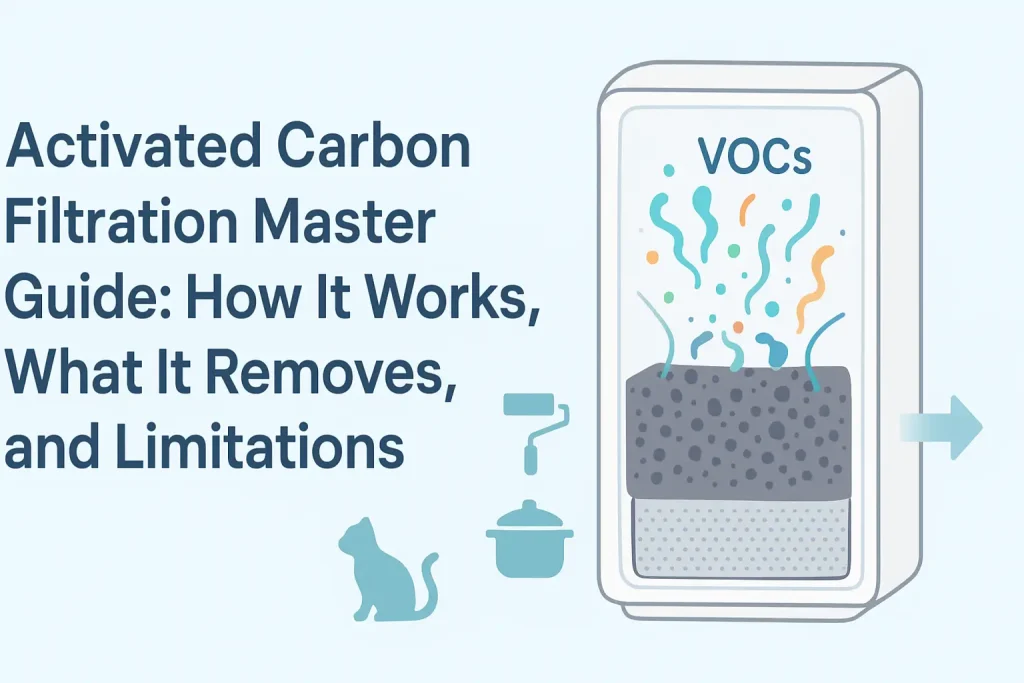
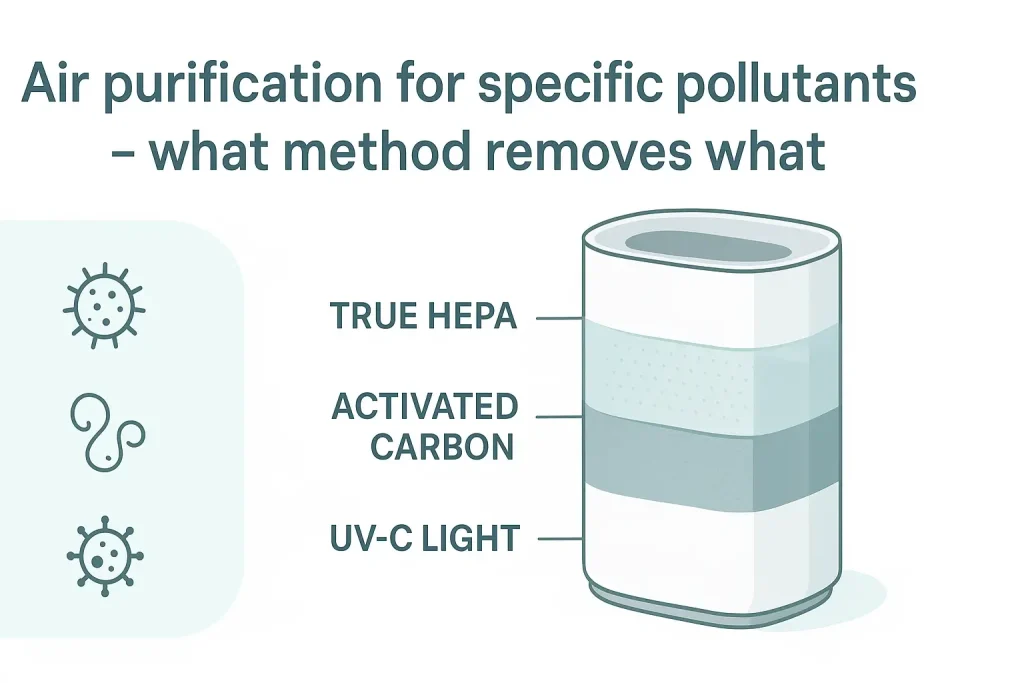
Activated carbon filters do not capture particles at all. They adsorb gas-phase pollutants, VOCs, and odors through a physical adsorption process where contaminant molecules stick to the internal surface area of the carbon pores. A typical activated carbon filter contains 1 to 15 pounds of carbon media with an internal surface area of 500 to 1,500 square meters per gram.
For dust and PM2.5 specifically, activated carbon alone provides zero particle removal. However, a combination unit with both True HEPA and activated carbon addresses the complete indoor air quality picture: HEPA captures the particulate matter while carbon adsorbs the VOCs that can react in the air to form secondary PM2.5 particles.
This only works when the activated carbon stage has sufficient mass and dwell time. Thin carbon-impregnated foam sheets found in budget units provide minimal VOC adsorption because the airstream passes through too quickly for effective contact. A meaningful carbon stage weighs at least 2 to 3 pounds for a portable room air purifier.
The Austin Air HealthMate contains 15 pounds of activated carbon and zeolite blend, making it the benchmark for combined particle and VOC filtration in a single portable unit. Its filter lasts up to 5 years under normal household conditions, reducing the annualized filter cost despite the higher upfront replacement price.
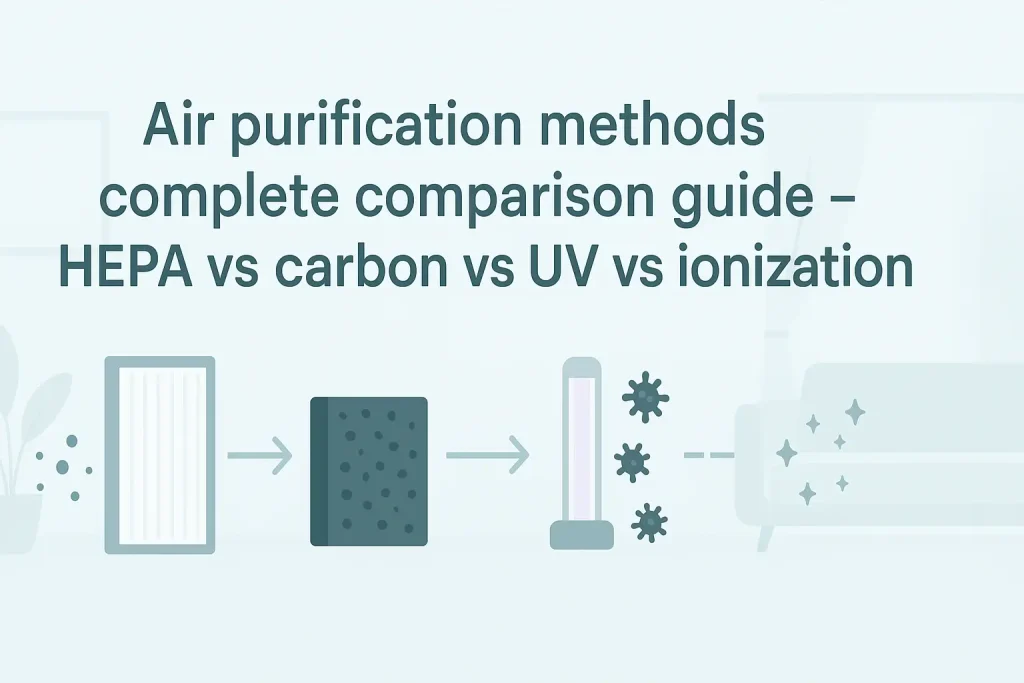
Ionizer and UV-C air purifiers are not recommended for dust and PM2.5. Ionizers charge particles so they stick to surfaces rather than removing them from the air, which means settled dust redistributes when disturbed. UV-C kills pathogens but does nothing to remove particulate matter from the airstream.
If an ionizer produces ozone above the CARB limit of 0.050 ppm, the result is additional respiratory irritation on top of the PM2.5 exposure you are trying to address. Fix it by checking the CARB certification database and selecting only units listed as certified air cleaning devices under CCR Title 17 Section 94251.
For apartment dwellers with limited space, our guide to air purification in apartments covers compact units and placement strategies that work within rental constraints, including units that do not require permanent installation or wall mounting.
Filter Replacement and Annual Operating Cost: What Dust and PM2.5 Purifiers Actually Cost to Run
The purchase price of an air purifier is a fraction of its lifetime cost. A $100 unit with $25 annual filter replacements costs $225 over five years. A $350 unit with $60 annual filters costs $650 over the same period. The difference in total cost narrows significantly over time, while the difference in CADR performance and coverage area remains constant.
Filter replacement interval depends on runtime hours, local dust loading, and whether the unit has a washable pre-filter. A washable pre-filter that captures larger dust particles before they reach the HEPA stage can extend HEPA filter life from 6 months to 12 months in normal household conditions per manufacturer maintenance schedules for units like the Coway AP-1512HH and Winix 5500-2.
Electricity cost adds approximately $25 to $80 per year depending on the unit’s wattage, your local electricity rate, and daily runtime. A unit drawing 45 watts at medium speed operated 12 hours daily at the U.S. national average of 13 cents per kilowatt-hour costs about $26 per year in electricity.
Key Annual Operating Costs (12 hours daily at 13 cents/kWh):
• Levoit Core 300S (45W medium): $26 electricity + $25 filters = $51 total
• Coway AP-1512HH (45W medium): $26 electricity + $30 filters = $56 total
• Blueair Blue Pure 211+ (60W medium): $34 electricity + $70 filters = $104 total
• Coway Airmega 400 (65W medium): $37 electricity + $60 filters = $97 total
Use the table below to compare cumulative five-year costs including purchase price, filter replacements, and electricity. A unit with a higher upfront price but lower annual filter cost often becomes the cheaper option by year three or four.
Placement and Operation: Where to Put Your Air Purifier for Maximum Dust and PM2.5 Removal
Air purifier placement affects effective CADR more than most buyers realize. A unit placed in a corner with restricted airflow on two sides delivers approximately 20 to 30 percent less effective air cleaning than the same unit placed centrally with at least 18 inches of clearance on all intake and exhaust sides, per airflow modeling published in the journal Building and Environment.
This happens because the CADR rating is measured in an open test chamber with no airflow obstructions. In a furnished room, furniture, curtains, and wall proximity create airflow patterns that reduce the effective air exchange rate. The published CADR is a best-case laboratory value, not a guaranteed in-room performance number.
The optimal placement is central within the room, at least 12 to 18 inches from walls and large furniture, with the intake facing the primary pollution source (window for outdoor PM2.5 infiltration, kitchen for cooking particulates). If central placement is not possible, position the unit along the wall with the most open adjacent space and ensure the exhaust is not pointed directly at a wall or large furniture piece.
For bedrooms, place the unit at least 6 feet from the bed at head height or slightly above. This positions the clean air delivery within your breathing zone while keeping fan noise below the 30 dB threshold that the World Health Organization recommends for sleep environments.
If you are setting up a nursery or child’s room, our air purifier guide for nurseries covers noise limits, safety considerations, and the specific CADR requirements for the smaller room volumes typical of nurseries and children’s bedrooms.
Common Mistakes When Buying an Air Purifier for Dust and PM2.5
Buying a unit based on the manufacturer’s stated coverage area without checking the CADR rating is the single most expensive mistake in air purification. Manufacturer coverage area claims use 2 ACH at the highest fan speed with 8-foot ceilings assumed. An allergy sufferer who needs 5 ACH requires 2.5 times the CADR for the same room size.
A 360-square-foot coverage claim on a unit with 240 CFM smoke CADR means the unit can cycle a 360-square-foot room at 2 ACH. At 5 ACH, that same unit covers only 144 square feet. Buying it for a 350-square-foot master bedroom with dust mite allergy means the unit runs continuously and never achieves the target air exchange rate.
The fix is simple: calculate your required smoke CADR using the formula or calculator above before shopping. Then compare only the smoke CADR number across units, ignoring the manufacturer’s coverage area claims entirely. The CADR is the verified performance metric. The coverage area is derived from it under assumptions that may not match your needs.
Ignoring filter replacement cost and availability is the second most common mistake. Some budget units use proprietary filter cartridges available only from the manufacturer. When the manufacturer discontinues the model, replacement filters become unavailable and the entire unit becomes e-waste within 12 to 18 months of the last filter purchase.
Select units that use widely available filter formats or have a track record of filter availability spanning multiple product generations. Coway, Winix, Levoit, and Blueair all maintain filter availability for discontinued models for several years after the model is replaced, per each manufacturer’s published support policy.
How Often Should You Run an Air Purifier for Dust and PM2.5?
Run an air purifier continuously on auto mode or the lowest effective fan speed for your room size. Intermittent operation means PM2.5 concentrations rise between cycles, and the unit must re-clean the same air volume repeatedly rather than maintaining a steady low particle count. The total energy cost of continuous operation at auto or low speed is typically lower than cycling between off and turbo twice daily.
Continuous operation also prevents dust settling. When the unit stops, airborne dust settles onto surfaces within 20 to 60 minutes depending on particle size. Restarting the unit does not re-capture settled dust. Settled dust requires mechanical cleaning (vacuuming with a HEPA vacuum, damp wiping) to remove from the indoor environment.
During high-PM2.5 events such as wildfire smoke episodes, cooking large meals, or indoor candle use, switch to the highest fan speed and run continuously until outdoor or source conditions improve. A PM2.5 monitor placed in the room provides real-time feedback: when the display drops below 15 micrograms per cubic meter and holds steady, you can return the unit to auto or medium speed.
Understanding what constitutes a safe indoor air quality level helps you interpret monitor readings correctly. Our explainer on EPA and WHO indoor air quality guidelines covers the specific PM2.5 thresholds and what each level means for daily exposure and long-term health risk.
What Is the Difference Between HEPA and True HEPA for Dust Filtration?
True HEPA is a certified filtration standard requiring 99.97 percent minimum efficiency at 0.3 microns, verified by independent laboratory testing per IEST-RP-CC001. HEPA-type, HEPA-like, and HEPA-style are marketing terms with no standardized test requirement and no minimum efficiency guarantee. A HEPA-type filter may capture 85 to 99 percent of 0.3-micron particles depending on the manufacturer’s design and quality control standards.
The 0.3-micron test particle size is not arbitrary. It represents the most penetrating particle size where neither diffusion nor impaction capture mechanisms reach maximum efficiency. Particles both larger and smaller than 0.3 microns are captured more efficiently by True HEPA media. A filter that passes the 0.3-micron test at 99.97 percent will capture PM2.5 particles (0.1 to 2.5 microns) with even higher efficiency across the entire size range.
For dust and PM2.5 specifically, True HEPA certification matters because visible dust spans 10 to 100 microns while PM2.5 spans 0.1 to 2.5 microns. A HEPA-type filter lacking certification may perform adequately on visible dust while failing to capture the smaller PM2.5 fraction that poses the greater health risk. Without a published smoke CADR from AHAM, there is no independent verification of PM2.5 removal performance.
Can I Use One Air Purifier for an Entire Open-Plan Floor?
One air purifier can cover an open-plan floor only if its smoke CADR is sized for the total undivided air volume at your target ACH rate. A 1,000-square-foot open plan with 8-foot ceilings contains 8,000 cubic feet of air. At 5 ACH, the required smoke CADR is (8,000 x 5) / 60, which equals 667 CFM. No single portable air purifier on the consumer market currently delivers 667 CFM smoke CADR in one unit.
The highest-CADR portable units available, such as the Blueair 605 at 500 CFM and the Coway Airmega 400 at 400 CFM, fall short of this target for large open plans at 5 ACH. The practical solution is multiple units distributed across the space. Two Coway Airmega 400 units deliver a combined 800 CFM, exceeding the 667 CFM requirement for the 1,000-square-foot example.
Position multiple units at opposite ends of the open plan with clear airflow paths between them. This creates a circulation pattern that prevents dead zones where PM2.5 concentrations remain elevated while the rest of the space reaches target levels. A PM2.5 monitor placed in the geometric center of the space confirms whether the multi-unit setup achieves uniform cleaning or leaves hot spots.
Does an Air Purifier Help with Dust Mites and Their Allergens?
An air purifier captures airborne dust mite allergens but does not address the source population living in bedding, carpets, and upholstered furniture. Dust mite allergen particles are relatively large at 10 to 40 microns and are captured efficiently by any True HEPA filter. However, these particles become airborne primarily when disturbed by human activity (making the bed, walking on carpet, sitting on upholstered furniture).
This only works when the air purifier runs continuously in the room where disturbance occurs. Intermittent operation misses the brief window when allergen particles are airborne before they settle back onto surfaces within 15 to 30 minutes. Continuous operation captures allergen particles during disturbance events and maintains lower baseline concentrations between events.
A HEPA air purifier is a complement to, not a replacement for, dust mite source control measures: allergen-impermeable mattress and pillow encasements, weekly washing of bedding in hot water (130 degrees Fahrenheit or higher), and regular vacuuming with a HEPA-filtered vacuum cleaner. The combination of source control and continuous air purification reduces total allergen exposure more than either measure alone, per research published in the Journal of Allergy and Clinical Immunology.
Why Does My Air Purifier Smell Like Ozone or Burning Dust When First Used?
A new air purifier that smells like ozone is producing ozone above the CARB safety limit of 0.050 ppm, typically from an ionizer stage operating by default. This is not a break-in smell that dissipates. It indicates the unit generates ozone as a byproduct of the ionization process, and the smell may intensify at higher fan speeds when more air passes through the ionizer.
CARB-certified air purifiers are tested to ensure ozone output remains below 0.050 ppm. If your unit carries CARB certification and still smells like ozone, the ionizer may be malfunctioning or the unit may have been tested at a fan speed lower than your typical operating speed. Disable the ionizer if the unit allows it, or replace the unit with a mechanical-only True HEPA purifier that does not include any ionization stage.
A burning dust smell during the first few hours of operation is normal and harmless. It occurs when accumulated manufacturing residues on the heating element or motor windings burn off during initial use. This smell should dissipate within 4 to 8 hours of continuous operation. If the burning smell persists beyond 24 hours or intensifies, discontinue use and contact the manufacturer.
For spaces that experience seasonal air quality challenges from candles, wood fires, or cooking fumes, our holiday season air quality guide covers the specific PM2.5 sources that spike during winter months and the purifier settings that address them efficiently.
How Long Does It Take an Air Purifier to Clean a Room of Dust and PM2.5?
An air purifier sized at 5 ACH for the room reduces airborne PM2.5 concentrations by approximately 85 to 90 percent within 30 minutes and reaches steady-state levels within 60 minutes of continuous operation at the correct fan speed. At 2 ACH, the same reduction takes approximately 75 to 90 minutes because the slower air exchange rate means each air change captures a smaller fraction of the remaining particle load.
This assumes the room is reasonably sealed with windows and doors closed. If a window is open or a door is frequently used during operation, infiltration of outdoor PM2.5 partially offsets the purifier’s cleaning rate and extends the time to reach target levels. During wildfire smoke events, even a well-sealed room experiences some infiltration through the building envelope.
Use a PM2.5 monitor to verify actual cleaning time in your specific room rather than relying on calculated estimates. Place the monitor at breathing height in the primary occupancy zone, run the purifier on its highest effective speed, and note the time required to drop from the starting concentration to below 15 micrograms per cubic meter. This measured cleaning time is your actual performance baseline for that room and unit combination.
Do I Need a Separate Air Purifier for Each Room?
You need a separate air purifier for each room where you spend significant continuous time and where the room has a door that reduces airflow from other spaces. A unit in the living room does not effectively clean a closed bedroom on the opposite side of the house because walls and doors block the airflow that carries particles to the purifier’s intake.
A practical prioritization puts the highest-CADR unit in the primary bedroom where you spend 7 to 9 hours continuously asleep, a second unit in the living area or home office where you spend daytime hours, and a smaller unit in a child’s bedroom or nursery. The bedroom unit is the highest priority because respiratory exposure during sleep represents the longest continuous exposure period in a 24-hour cycle.
For multi-room setups, our guide to air purifiers for cabins and cottages covers strategies for spaces where room count and layout differ from standard residential floor plans, including open-loft designs where a single well-placed unit may serve multiple sleeping areas.
For most users seeking dust and PM2.5 reduction, a True HEPA air purifier with AHAM-certified smoke CADR sized for 5 ACH in your largest target room gives the best combination of particle removal, filter longevity, and operating cost without needing to understand the underlying filtration physics. Calculate your required CADR, check the AHAM database for verified ratings, and buy based on smoke CADR per dollar rather than manufacturer coverage claims.