A cabin air purifier bought for the wrong room size does not clean the air. It moves it around while leaving the same pollen, mold spore, and smoke particulate load circulating through your open-plan living space all weekend.
A cottage with a wood burning stove, seasonal closures, and gravel road dust needs a different unit than a city apartment. The filtration demands are higher. The room volumes are larger. And the power situation may be completely off the grid.
This guide covers the best air purifiers for cabins and cottages across every major use case: mold remediation for seasonal shutdowns, wood smoke filtration for fireplace-equipped great rooms, dust control for rural gravel road exposure, and low-power options for solar and generator setups.
Each recommendation includes verified smoke CADR, coverage at both 2 ACH and 5 ACH, and annual filter replacement cost.
| Photo | Popular Air Purifiers | Price |
|---|---|---|

|
Air Purifiers for Home Large Room up to 1500ft², Tailulu H13 True HEPA Air Purifier for Pets Dust Odor Smoke, Air Purifier for Bedroom with 15dB Quiet Sleep Mode for Bedroom Office Living Room | Check Price On Amazon |
|
Afloia Air Purifier for Home, 4-in-1 Washable Filter for Allergies, Covers Up to 1076 ft², Quiet Operation, Auto Shut-Off & Night Light, Removes Pet Dander, Pollen, Dust, Mold, and Smoke, White,Pluto | Check Price On Amazon |

|
Nuwave OxyPure ZERO Air Purifier with Washable and Reusable Bio Guard Tech Air Filter, Large Room Up to 2002 Ft², Air Quality Monitor, 0.1 Microns, 100% Capture Irritants like Smoke, Dust, Pollen | Check Price On Amazon |

|
Air Purifiers for Home Large Room Up to 1,996 Ft², EOEBOT Air Purifier for Home Pets with Washable Filter, Quiet Sleep Mode, Air Quality Monitor, Air Purifier for Bedroom, Pet Hair, Dust, Smoke, White | Check Price On Amazon |
|
Afloia 2 IN 1 Air Purifier with Humidifier Combo, 3-Stage Filters for Home Allergies Pets Hair Smoker Odors, Evaporative Humidifier, Auto Shut Off, Quiet Air Cleaner with Seven Color Light,White | Check Price On Amazon |
By the Numbers: Cabin Air Quality Facts
85% PM2.5 reduction at 30 minutes is what a properly sized True HEPA air purifier running at 5 ACH delivers in a sealed cabin room during wildfire smoke events.
0.050 ppm maximum ozone output is the CARB CCR Title 17 legal limit. Any air purifier used in a tightly sealed cabin must be CARB certified to avoid dangerous ozone accumulation.
60% of cabin mold spore problems originate from October through April shutdown periods when humidity rises above 60% RH with no air circulation, according to EPA Indoor Air Quality guidance on moisture control.
400 CFM smoke CADR is the minimum recommended rating for a great room of 600 square feet with a wood stove running. This delivers roughly 5 air changes per hour for effective smoke particulate removal.
22 dB at sleep mode is the noise floor you need in a quiet loft bedroom. Anything above 30 dB becomes noticeable against the background silence of a rural cabin at night.
What Makes Cabin Air Quality Different from City Homes?
A cabin or cottage creates air quality challenges that a standard suburban home does not. The building is often closed up for weeks or months at a time. Humidity builds inside with no air exchange. Mold spores germinate on any organic surface. When you arrive for the weekend, you are walking into a sealed box of accumulated particulates, VOCs from aging building materials, and possibly active mold colonies.
Wood burning stoves and fireplaces add a second layer. Each time the door opens to add a log, fine particulate matter enters the room. The EPA classifies wood smoke PM2.5 as a significant indoor air quality hazard. A single evening of fireplace use can push indoor PM2.5 above 100 micrograms per cubic meter, which is four times the WHO 24-hour guideline of 15 micrograms per cubic meter.
Rural locations bring a third factor. Gravel roads, agricultural dust, and seasonal pollen loads are often higher than in urban areas. A cabin on a gravel road may see indoor PM10 concentrations spike every time a vehicle passes. The dust is finer than people expect. It stays suspended in the air for hours.
Open-plan layouts common in cabins create a fourth challenge. A great room with a loft, cathedral ceiling, and connected kitchen may have a combined volume of 8,000 to 12,000 cubic feet. A standard air purifier rated for 300 square feet cannot process that volume at a meaningful air change rate. The unit runs constantly and achieves almost nothing.
For most cabin owners, the right air purifier is one sized to 5 ACH for the total great room volume, with a True HEPA stage for particulates and a substantial activated carbon stage for wood smoke odors and musty VOCs. A small bedroom unit left running in the corner of a 600-square-foot open-plan room has almost no measurable effect on room-wide particulate levels.
How to Choose the Right Air Purifier Size for Your Cabin
Sizing an air purifier for a cabin means ignoring the manufacturer’s stated coverage area. That number assumes 2 ACH in a room with an 8-foot ceiling and no airflow obstructions. A cabin great room with a 14-foot cathedral ceiling and a loft needs a completely different calculation.
The formula is simple. Multiply room length by room width by average ceiling height to get cubic feet. Multiply by your target ACH. Then divide by 60. The result is the minimum smoke CADR you need in CFM. For a 20 by 30 foot great room with a 12-foot average ceiling at 5 ACH for allergy and smoke control, that is 20 times 30 times 12 times 5 divided by 60, which equals 600 CFM smoke CADR.
Run time matters as much as sizing in a cabin setting. A unit that reaches 5 ACH on paper but only runs for 4 hours each evening cannot maintain air quality through a full weekend of wood stove use. Continuous operation on a medium or auto setting typically delivers better overall air quality than turbo mode for a few hours followed by the unit being switched off.
Use the calculator below to find the exact smoke CADR your cabin room requires. Enter the actual dimensions of your largest open space. For ceiling height, measure the peak if you have a cathedral ceiling and add 2 feet to the average to account for the extra volume that warm air and particulates rise into.
CADR Calculator
How Much CADR Does Your Cabin Actually Need?
Enter your cabin room dimensions and use case. Formula: (length x width x ceiling height x ACH) divided by 60. Source: AHAM methodology.
CADR = (length x width x ceiling height x ACH) / 60. For cabins with wood stoves, mold risk, or allergy concerns, always calculate at 5 ACH. The manufacturer coverage area at 2 ACH will be roughly 2.5 times larger than your effective coverage at 5 ACH.
| Cabin Room Size | CADR at 2 ACH | CADR at 5 ACH (wood smoke/mold) | Example Models |
|---|---|---|---|
| 200 sq ft cabin bedroom (8 ft ceiling) | 53 CFM | 133 CFM | Levoit Core 300S, Winix 5500-2 |
| 400 sq ft cabin great room (10 ft ceiling) | 133 CFM | 333 CFM | Coway Airmega 400, Blueair Blue Pure 211+ |
| 600 sq ft open-plan with loft (12 ft avg ceiling) | 240 CFM | 600 CFM | Blueair 605, or two Coway Airmega 400 units |
| 1,000 sq ft lodge-style great room (14 ft ceiling) | 467 CFM | 1,167 CFM | Two Blueair 605 units or three Coway Airmega 400 units |
Best Air Purifiers for Cabins and Cottages
After researching CADR data from the AHAM certified product database, independent test results, and verified buyer reviews specifically from cabin and cottage owners, several air purifier models stand out as particularly well suited to the demands of seasonal, wood-heated, and rural living spaces.
The Coway Airmega 400 is the single best option for most cabin great rooms. It delivers 400 CFM smoke CADR via dual fans and covers up to 1,560 square feet at 2 ACH. At 5 ACH for wood smoke and mold control, effective coverage is roughly 620 square feet in a room with 8-foot ceilings or 500 square feet with 10-foot cathedral ceilings.
Key Specifications:
- Smoke CADR: 400 CFM (AHAM certified)
- Coverage at 2 ACH: 1,560 sq ft
- Coverage at 5 ACH: 620 sq ft (8 ft ceiling)
- Sleep mode noise: 22 dB
- Annual filter cost: approximately $60
- CARB certified: Yes
- ENERGY STAR certified: Yes
The Blueair Blue Pure 211+ delivers the highest CADR per dollar of any unit suitable for cabin use. At 350 CFM smoke CADR for under $200, it handles rooms up to 540 square feet at 5 ACH. The washable fabric pre-filter is a genuine advantage in dusty cabin environments because it captures large particles including gravel dust, pet hair, and visible lint before they reach the main filter.
Key Specifications:
- Smoke CADR: 350 CFM (AHAM certified)
- Coverage at 2 ACH: 540 sq ft
- Coverage at 5 ACH: 216 sq ft (8 ft ceiling)
- Sleep mode noise: 31 dB (lowest setting)
- Annual filter cost: approximately $60
- CARB certified: Yes
- ENERGY STAR certified: Yes
For cabin owners dealing specifically with musty odors, chemical off-gassing from manufactured building materials, or strong wood smoke smells, the Austin Air HealthMate is the best pick. It contains 15 pounds of activated carbon and zeolite blend. No other consumer air purifier in this price range has a gas-phase filtration bed of comparable mass. The carbon filter lasts up to 5 years under normal conditions.
Key Specifications:
- Activated carbon mass: 15 lbs (carbon plus zeolite blend)
- True HEPA stage: Yes
- Coverage at 2 ACH: 1,500 sq ft
- Filter lifespan: up to 5 years
- Annual equivalent filter cost: approximately $80 to $100
- Noise at low: approximately 50 dB (not a quiet unit)
- CARB certified: Yes
For small cabin bedrooms and loft sleeping areas, the Levoit Core 300S is the best value option. At 145 CFM smoke CADR for under $100, it provides effective filtration for rooms up to roughly 220 square feet at 2 ACH or 90 square feet at 5 ACH. The 24 dB sleep mode is quiet enough for a silent cabin night.
Key Specifications:
- Smoke CADR: 145 CFM
- Coverage at 2 ACH: 219 sq ft
- Coverage at 5 ACH: 88 sq ft (8 ft ceiling)
- Sleep mode noise: 24 dB
- Annual filter cost: approximately $25
- CARB certified: Yes
- ENERGY STAR certified: Yes
Which Cabin Air Quality Problem Are You Solving?
Different cabins face different air quality problems. The right purifier depends entirely on your primary concern. Use the tool below to select your main cabin air quality issue and budget to get a specific recommendation.
Interactive Tool
Find the Right Cabin Air Purifier for Your Situation
Answer 2 questions for a personalized air purifier recommendation specific to cabin and cottage use.
Comparing Top Cabin Air Purifiers at a Glance
Use the table below to compare key specifications across all recommended cabin air purifier models including smoke CADR, coverage at both 2 ACH and 5 ACH, noise at sleep mode, and annual filter cost.
Product Comparison
Cabin Air Purifiers Compared – CADR, Coverage, Noise, and Filter Cost
Key specs compared across top picks. CADR from AHAM certified database. Coverage at 5 ACH calculated as smoke CADR x 12 / 5 at standard 8 ft ceiling.
| Model | Smoke CADR | Coverage at 2 ACH | Coverage at 5 ACH | Sleep Mode dB | Annual Filter Cost | Best Cabin Use |
|---|---|---|---|---|---|---|
| Levoit Core 300S | 145 CFM | 219 sq ft | 88 sq ft | 24 dB | $25/yr | Small cabin bedroom |
| Winix 5500-2 | 246 CFM | 360 sq ft | 144 sq ft | 28 dB | $30/yr | Wood smoke, general cabin |
| Blueair Blue Pure 211+ | 350 CFM | 540 sq ft | 216 sq ft | 31 dB | $60/yr | Dust, wood smoke value pick |
| Coway Airmega 400 | 400 CFM | 1,560 sq ft | 620 sq ft | 22 dB | $60/yr | Great room, best all-around |
| Austin Air HealthMate | 250 CFM est | 1,500 sq ft | 600 sq ft | 50 dB (low) | $80-100/yr | Musty odors, VOCs, mold |
| Blueair 605 | 500 CFM | 775 sq ft | 310 sq ft | 32 dB | $100/yr | Large lodge, open-plan |
CADR data from AHAM certified database. Coverage at 5 ACH calculated as smoke CADR x 12 / 5 for standard 8 ft ceilings. For cathedral ceilings above 10 ft, effective coverage decreases proportionally. Annual filter costs based on manufacturer-recommended replacement intervals using genuine filters.
Managing Mold and Mildew in Seasonal Cabins
A cabin closed up from October to April without air circulation creates perfect mold conditions. Indoor humidity rises above 60% RH as outdoor temperatures fluctuate. Condensation forms on windows and walls. Mold spores that are present in every building settle on surfaces and germinate within 24 to 48 hours of sustained humidity above 60%.
This happens because mold requires only three things to grow: organic material for food, moisture above 60% RH, and stagnant air. A closed cabin provides all three. The wood framing, drywall paper, and even settled dust are food sources. The sealed building traps moisture. The lack of air movement lets spores settle and colonize undisturbed for months.
The first step on arrival is ventilation. Open every window and door for at least 30 minutes before doing anything else. Run ceiling fans and bathroom exhaust fans at maximum speed. This alone can drop indoor PM2.5 and mold spore counts by 30 to 50% before you even plug in the air purifier.
Then place the air purifier in the center of the largest room and run it on maximum fan speed for the first 24 hours. A unit with a substantial activated carbon stage, like the Austin Air HealthMate, will also adsorb the musty VOCs that give closed cabins their characteristic smell. VOC and chemical off-gassing from cabin building materials requires a specific activated carbon approach that goes beyond standard particle filtration.
If visible mold is present on surfaces, the air purifier handles the airborne spores only. Surface mold must be physically cleaned with a HEPA vacuum and appropriate cleaning solution before the air purifier can maintain the air quality. An air purifier cannot remove mold that is growing on a wall. It can only capture the spores that have already become airborne.
For most seasonal cabin owners, the combination of arrival-day ventilation plus a properly sized True HEPA unit with activated carbon running continuously throughout the stay keeps mold spore counts at background levels. The key is sizing the unit to 5 ACH for the room volume, not 2 ACH. Mold spores range from 1 to 30 microns and are efficiently captured by True HEPA filtration at 99.97% efficiency at 0.3 microns.
Wood Smoke and Fireplace Particulates in Cabin Air
A wood burning stove or fireplace can raise indoor PM2.5 from a background of roughly 5 to 15 micrograms per cubic meter to over 100 micrograms per cubic meter within an hour of lighting. The EPA and WHO both identify PM2.5 as the most harmful common air pollutant. It penetrates deep into lung tissue and enters the bloodstream.
This happens because every time the stove door opens, smoke and fine ash particles escape into the room. Even a well-sealed modern wood stove with a dedicated combustion air intake releases some particulates during loading and reloading. The particles are predominantly in the 0.1 to 2.5 micron range. That is exactly the size range True HEPA filtration is designed and tested to capture.
The condition for effective wood smoke filtration is continuous high-speed operation during and for 2 to 3 hours after the fire. A purifier running on auto mode or low speed while the stove is active cannot keep up with the particulate load. Auto mode sensors often have a 5 to 10 minute lag before detecting a spike. By that time, the room air is already heavily loaded.
The same PM2.5 filtration principles that apply to dust control work for wood smoke particles. Both are fine particulates in the sub-2.5 micron range. A True HEPA filter captures them with the same 99.97% efficiency at 0.3 microns regardless of whether the particle is smoke, dust, or pollen.
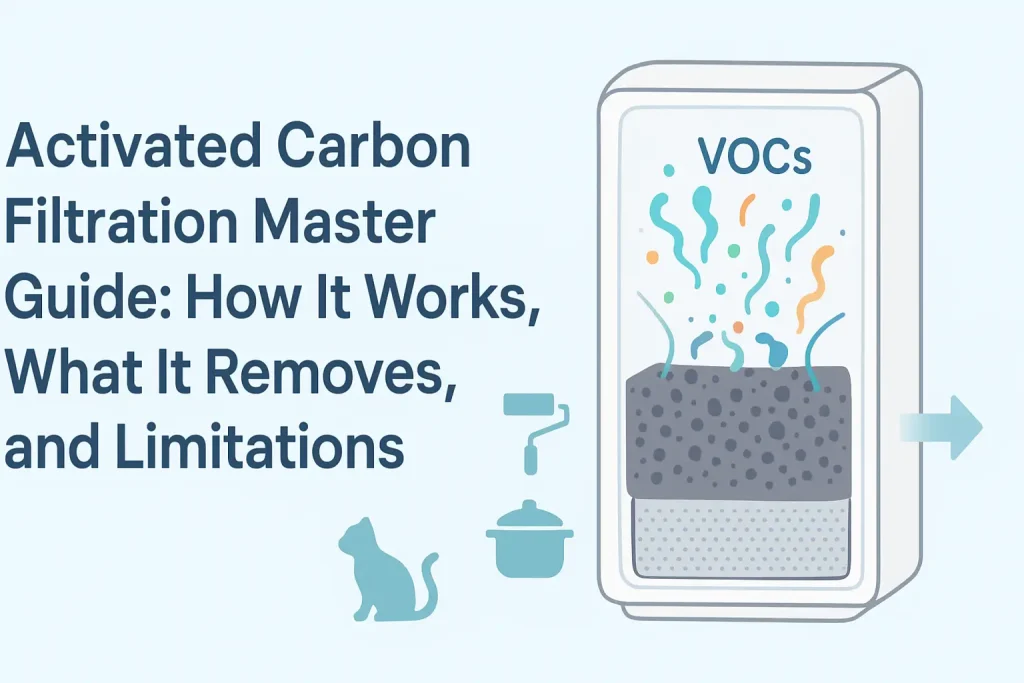
If smoke odor is also a concern, you need a unit with activated carbon. True HEPA captures the particles. Carbon adsorbs the volatile organic compounds that create the smell. Many cabin owners find that a unit like the Winix 5500-2 with its washable AOC carbon filter handles both the particulate and odor load from occasional fireplace use. For daily wood stove use throughout the heating season, step up to the Austin Air HealthMate or Blueair 605 for meaningfully larger carbon capacity.
For cabins that rely entirely on wood heat through the winter, the recommendation is to run the air purifier continuously on medium or high speed during all waking hours rather than cycling it on and off. Particulate levels stay elevated for hours after the fire dies down. An indoor PM2.5 monitor provides objective confirmation of whether your purifier and fan speed combination is actually reducing particulate levels to the WHO guideline of under 15 micrograms per cubic meter.
Power Considerations for Off-Grid Cabins
Not all cabins have reliable grid electricity. Solar setups, generators, and seasonal power connections limit what air purifier you can run and for how long. A standard large-room purifier drawing 60 to 80 watts at medium speed running 8 hours daily uses roughly 0.5 to 0.65 kilowatt-hours per day. On a solar system with limited battery capacity, that matters.
The most power-efficient option for off-grid cabins is the Levoit Core 300S. At its medium speed setting, it draws approximately 20 watts. Running 8 hours per day, that is 0.16 kilowatt-hours per day. A small 100-watt solar panel with a deep-cycle battery can run this unit indefinitely through a typical camping season. At high speed, power draw rises to approximately 45 watts, which is still manageable on most modest solar setups.
Larger units like the Coway Airmega 400 draw roughly 60 watts at medium speed and 80 watts at high. This is still less than a typical incandescent light bulb, but on an off-grid system it requires conscious power budgeting. Running the Airmega 400 for 8 hours at medium speed uses about the same power as running a small 12-volt refrigerator for 4 hours.
If power is severely limited, run the purifier on high for 2 hours immediately upon arrival and then switch to sleep mode or the lowest speed setting for the remainder of your stay. The initial 2-hour blast at high speed achieves the bulk of the particulate reduction. The low-speed maintenance run keeps levels from climbing back up. Test this approach with a PM2.5 monitor to confirm it works for your specific cabin volume and pollutant load.
For generator-powered cabins, the concern is different. Generator power can be electrically noisy with voltage fluctuations that some purifier electronics do not tolerate well. The Coway Airmega 400 and Blueair models have robust power supplies that handle generator voltage swings better than budget units with simpler power circuits. If you run your purifier on generator power, a surge protector between the generator and the purifier is cheap insurance against voltage spikes.
Why Does My Cabin Air Purifier Not Seem to Help With the Musty Smell?
A True HEPA air purifier with no activated carbon stage cannot remove musty odors because odors are volatile organic compounds, not particles. HEPA captures particles. Carbon adsorbs gases. If your purifier lacks a meaningful carbon filter, the musty VOCs pass straight through the HEPA media and return to the room unchanged. The solution is either a purifier with substantial activated carbon such as the Austin Air HealthMate with 15 pounds of carbon and zeolite, or adding a standalone carbon filter unit to your existing setup.
Musty cabin odors are typically a mix of microbial VOCs from mold and bacteria, plus aldehydes and terpenes from aging wood and building materials. These compounds range in molecular weight from roughly 30 to 300 grams per mole. Activated carbon adsorbs compounds in this range effectively, but the carbon bed must have enough mass and dwell time. A thin carbon sheet in a budget purifier provides negligible odor reduction. A deep carbon bed with 5 to 15 pounds of media actually works.
Can I Use Two Smaller Air Purifiers Instead of One Large Unit in My Cabin Great Room?
Yes, and in many open-plan cabins this is the better strategy. Two smaller units placed at opposite ends of a great room provide more even particulate reduction than one large unit in a single location. The combined smoke CADR of the two units should equal or exceed the single-unit CADR you would otherwise require. For example, two Coway Airmega 400 units delivering 400 CFM each provide 800 CFM combined smoke CADR, which covers a 1,200-square-foot great room at 5 ACH.
The advantage of the two-unit approach is that air circulation in a large open space is often poor, especially in cabins with loft areas and cathedral ceilings. A single unit in one corner may clean the air within a 15-foot radius effectively but leave the far side of the room with significantly higher particulate concentrations. Two units create overlapping coverage zones. Place them at least 20 feet apart for best results. Run both on the same fan speed setting, typically medium or auto, rather than turbo on one and sleep mode on the other.
What Filter Replacement Schedule Should I Follow for a Cabin Used Only on Weekends?
Standard filter replacement intervals assume daily use for 8 to 12 hours. A cabin used only on weekends accumulates roughly one-quarter the runtime hours of a full-time home. You can safely extend filter replacement intervals by a factor of 3 to 4 for a weekend-only cabin, but with one important exception: if your cabin is closed up and unventilated between visits, the filter media may absorb moisture and develop mold growth on the filter itself. Inspect the filter visually on each arrival. If you see any dark spots, discoloration, or smell mustiness directly from the filter, replace it regardless of runtime hours.
The pre-filter should be washed or vacuumed on every arrival before the unit is turned on. If the pre-filter has visible dust or pet hair from the previous visit, that material blocks airflow and reduces effective CADR immediately. A clogged pre-filter can cut smoke CADR by 15 to 25% at a given fan speed. Wash foam pre-filters with water and let them dry completely before reinstalling. Vacuum fabric pre-filters with a brush attachment.
Is an Ionizer Air Purifier Safe for a Tightly Sealed Cabin?
An ionizer air purifier is not safe for a tightly sealed cabin unless it carries CARB certification confirming ozone output below 0.050 ppm. Many ionizers, especially older or budget models, generate ozone as a byproduct of the ionization process. In a well-sealed cabin with low air exchange, ozone concentrations can rise to harmful levels within hours. The CARB CCR Title 17 limit of 0.050 ppm exists specifically to prevent this scenario in California homes, and a cabin with minimal air leakage is even more susceptible to ozone accumulation than a typical suburban house.
Ozone-free certified air purifiers are essential in spaces where children, elderly occupants, or anyone with respiratory conditions spends time. The EPA states that ozone at concentrations above 0.070 ppm over an 8-hour period can cause respiratory irritation, reduced lung function, and airway inflammation. In a sealed cabin, a non-CARB-certified ionizer can reach these concentrations in a single evening. Choose a CARB-certified True HEPA unit instead. It delivers particle removal with zero ozone output.
Should I Run My Cabin Air Purifier With the Windows Open on Nice Days?
Running an air purifier with windows open trades filtration efficiency for fresh air, and the net effect depends on outdoor air quality and your goal. If outdoor PM2.5 is low, below 15 micrograms per cubic meter, and your cabin has been closed up with musty air, open the windows first without the purifier running. Ventilate for 30 minutes to flush out accumulated VOCs and stale air. Then close the windows and run the purifier to capture any particulates that entered during ventilation.
If you leave the windows open while the purifier runs, the unit is continuously trying to clean an infinite volume of outdoor air. It cannot meaningfully reduce particulate concentration in the room because every cubic foot of cleaned air is replaced by a cubic foot of outdoor air within seconds. Running a purifier with windows open is almost always a net waste of electricity and filter life. Ventilate first with the unit off. Then seal the room and turn the purifier on.
What Is the Difference Between Coverage Area at 2 ACH and 5 ACH for My Cabin?
The manufacturer’s stated coverage area on the box, such as “covers 1,560 square feet,” assumes 2 air changes per hour in a room with 8-foot ceilings. That is the AHAM standard for general air cleaning. At 5 ACH, which is the recommended target for allergy, asthma, wood smoke, and mold concerns, the effective coverage is only 40% of the stated number. A purifier rated for 1,560 square feet at 2 ACH covers roughly 620 square feet at 5 ACH. This is the most common sizing mistake cabin owners make.
The math is straightforward. A unit with a smoke CADR of 400 CFM can process 400 cubic feet of air per minute. At 2 ACH in a room with 8-foot ceilings, that covers 400 times 60 divided by 2 divided by 8, which equals 1,500 square feet. At 5 ACH, the same formula gives 400 times 60 divided by 5 divided by 8, which equals 600 square feet. For a cabin with wood smoke or mold concerns, always use the 5 ACH coverage number.
How Do I Prevent My Cabin Air Purifier Filters From Getting Moldy Between Visits?
The most reliable method is to remove the filters from the unit when you close the cabin and store them in a sealed plastic bag with a silica gel desiccant packet. A HEPA filter that sits in a humid, unventilated cabin for weeks or months absorbs moisture from the air. That moisture, combined with the organic particles trapped in the filter media, creates an ideal environment for mold growth within the filter itself. When you return and turn the unit on, it disperses mold spores through the room you are trying to clean.
If removing filters is impractical, the next best option is to run the purifier on its highest speed for 30 minutes before shutting down the cabin. This dries the filter media as much as possible by forcing air through it. Then seal the unit in a large plastic bag, or at minimum cover the intake and outlet vents with plastic wrap to reduce moisture exchange with the cabin air. On your next arrival, inspect the filter visually. Any discoloration, musty odor, or visible growth means immediate replacement.
What CADR Do I Need for a Cabin With a Loft and Cathedral Ceiling?
A cabin with a loft and cathedral ceiling has a much larger effective air volume than the floor area suggests. The standard 8-foot ceiling assumption used in manufacturer coverage ratings does not apply. Calculate the volume by multiplying the floor area of the main room by the average ceiling height. For a cathedral ceiling peaking at 16 feet with 8-foot side walls, the average height is roughly 12 feet. A 400-square-foot great room with that ceiling profile has an effective volume of 4,800 cubic feet, not the 3,200 cubic feet the floor area suggests.
At 5 ACH, the CADR needed is volume times 5 divided by 60. For 4,800 cubic feet, that is 400 CFM smoke CADR. At 2 ACH, the same room needs only 160 CFM. This is why a purifier rated for 400 square feet on the box label may be completely inadequate for a cathedral-ceiling cabin. Always calculate by volume, not by floor area. The loft itself also matters. Warm air and particulates rise into the loft space. If the loft is a sleeping area, position the purifier so its airflow reaches the loft level, or add a second smaller unit in the loft.
Are Washable Pre-Filters Worth It for Dusty Cabin Environments?
A washable pre-filter is the single most valuable feature for a cabin on a gravel road or in a dusty rural setting. The pre-filter captures coarse particles, lint, pet hair, and visible dust before they reach the True HEPA stage. Without a pre-filter, that coarse debris loads the HEPA media and reduces effective CADR within weeks. A washable pre-filter can be rinsed under a tap, dried, and reinstalled in minutes. It extends HEPA filter life by a factor of 2 to 3 in dusty environments.
The Coway Airmega 400 has two washable pre-filters, one on each intake side. The Blueair Blue Pure 211+ has a large washable fabric pre-filter that wraps around the entire unit. Both are excellent choices for dusty cabins. Budget units without washable pre-filters will require HEPA replacement every 3 to 4 months in high-dust conditions instead of the typical 6 to 12 months. The additional filter cost quickly exceeds the price difference between a unit with and without a washable pre-filter.
Can I Leave My Air Purifier Running in an Empty Cabin All Winter?
Leaving an air purifier running unattended in a cabin through the winter is not recommended unless the cabin maintains above-freezing temperatures and has reliable electricity. Most consumer air purifiers are not rated for operation below 40 degrees Fahrenheit. The motor bearings, electronic control boards, and plastic housing can be damaged by freeze-thaw cycles. Condensation inside the unit when temperatures fluctuate can short-circuit the electronics when power returns.
If your goal is to maintain air quality during the closed season, the better approach is to address the root causes: seal the cabin against moisture intrusion, install a passive ventilation system such as soffit and ridge vents, and use a dehumidifier with a drain line if power is reliable. The dehumidifier keeps humidity below 50% RH, which prevents mold growth. The air purifier is best used actively when you are present. Run it on arrival at maximum speed for the first 24 hours, then on medium for the remainder of your stay.
What Is the Quietest Air Purifier for a Cabin Loft Bedroom?
The quietest air purifier suitable for a cabin loft bedroom is the Coway Airmega 400 at 22 dB in sleep mode. That noise level is effectively silent in a rural cabin at night where the ambient background is 20 to 25 dB. The Levoit Core 300S at 24 dB is a close second and costs significantly less, but its CADR is lower at 145 CFM. For a loft sleeping area of roughly 150 square feet with an 8-foot ceiling, the Core 300S at 5 ACH provides the right CADR (100 CFM needed versus 145 CFM available) at a noise level that will not disturb sleep.
Any air purifier above 30 dB at sleep mode becomes noticeable in a quiet cabin. The Blueair Blue Pure 211+ is 31 dB at its lowest setting. That is quiet enough for a living area but borderline for a silent sleeping loft. The same quiet-operation requirements that matter for elderly care rooms apply to cabin sleeping spaces: noise below 30 dB is the threshold for uninterrupted sleep in a silent rural environment. Test the unit before committing. Place it at the foot of the bed or against the wall farthest from the bed to maximize the perception of quiet.
Do I Need a Separate Air Purifier for Each Room in My Cabin?
You need a separate unit for each enclosed room where you spend significant time, especially bedrooms with closed doors. An air purifier in the great room cannot clean the air in a bedroom with the door closed. The door is an airflow barrier that the purifier cannot overcome. If your cabin has a great room plus two separate bedrooms, you need either one large unit in the great room plus a small unit in each bedroom, or two medium units that cover the great room and one bedroom each.
For an open loft sleeping area that is open to the great room below, a single large unit in the great room can serve both spaces, but only if the CADR is calculated for the combined volume. The loft is not a separate room if there is no door. The air mixes between the spaces. Position the purifier so its outlet airflow is directed toward the stair or ladder area to encourage circulation into the loft. A small quiet desk fan in the loft pointed downward can improve air exchange between the two levels.
Your Cabin Air Quality Plan
The right air purifier for your cabin is the one sized to 5 ACH for your great room volume, with True HEPA for particulates and enough activated carbon to handle your specific odor load. A Coway Airmega 400 or Blueair Blue Pure 211+ handles most weekend cabins. An Austin Air HealthMate handles persistent musty odors. Two smaller units placed at opposite ends of the room often outperform one large unit in the corner.
Start by measuring your cabin room dimensions and running the CADR calculator above. Buy the unit that matches your calculated CADR at 5 ACH. Put a PM2.5 monitor on the coffee table. Watch the numbers drop over the first hour. That is objective confirmation that the air you are breathing is measurably cleaner than when you arrived. For a cabin retreat, clean air is as essential as a working wood stove and a dry roof.