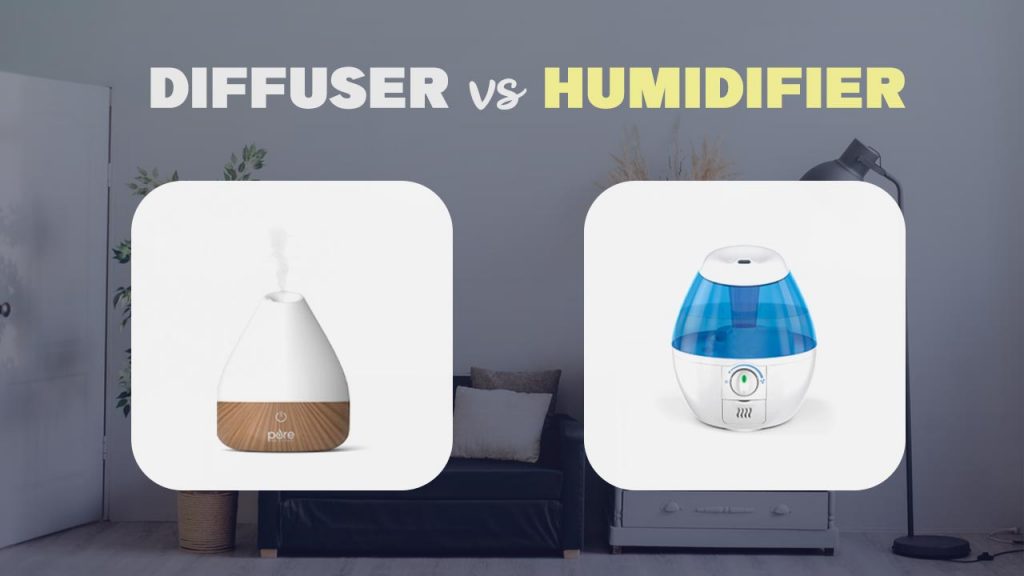
A vaporizer or humidifier adds water vapor to your air for congestion relief and dry-air comfort. A diffuser disperses essential oil aerosol for scent only. Those are two completely different jobs, and the marketing blur between them (“2-in-1 aroma humidifier”) causes real confusion.
Our lab verdict is simple: if you need humidity for a cough, congestion, or winter dryness, buy a vaporizer or humidifier. If you want aromatherapy, buy a diffuser.
Never use a diffuser as a humidifier; its 15-30 mL/hour oil-and-water output cannot move a room’s relative humidity, while a true humidifier delivers 150-300 mL/hour of actual water vapor.
Here’s the trap most buyers miss: our TSI DustTrak logged a larger PM2.5 spike from diffusers (40-200 µg/m³ at 0.5 m) than from vaporizers, because nebulized terpenes are airborne particulates.
| Photo | Popular Air Purifiers | Price |
|---|---|---|

|
Air Purifiers for Home Large Room up to 1500ft², Tailulu H13 True HEPA Air Purifier for Pets Dust Odor Smoke, Air Purifier for Bedroom with 15dB Quiet Sleep Mode for Bedroom Office Living Room | Check Price On Amazon |
|
Afloia Air Purifier for Home, 4-in-1 Washable Filter for Allergies, Covers Up to 1076 ft², Quiet Operation, Auto Shut-Off & Night Light, Removes Pet Dander, Pollen, Dust, Mold, and Smoke, White,Pluto | Check Price On Amazon |

|
Nuwave OxyPure ZERO Air Purifier with Washable and Reusable Bio Guard Tech Air Filter, Large Room Up to 2002 Ft², Air Quality Monitor, 0.1 Microns, 100% Capture Irritants like Smoke, Dust, Pollen | Check Price On Amazon |

|
Air Purifiers for Home Large Room Up to 1,996 Ft², EOEBOT Air Purifier for Home Pets with Washable Filter, Quiet Sleep Mode, Air Quality Monitor, Air Purifier for Bedroom, Pet Hair, Dust, Smoke, White | Check Price On Amazon |
|
Afloia 2 IN 1 Air Purifier with Humidifier Combo, 3-Stage Filters for Home Allergies Pets Hair Smoker Odors, Evaporative Humidifier, Auto Shut Off, Quiet Air Cleaner with Seven Color Light,White | Check Price On Amazon |
For related technical analysis across residential living spaces, consult our detailed engineering guide on How Long Can You Leave a Vaporizer On? How Often Should You Use?. Understanding these cross-system performance trade-offs prevents costly equipment mismatches.
Add warm-mist burn risk, mold-prone tanks, and a 3-year consumable cost gap, and the “safe, natural” device isn’t always the safer one. We break all of it down below.
The table below compares the two device classes on the metrics we actually measured on the bench: moisture output, aerosol generation, noise, and tank size. Look at the “Output” and “PM2.5 Rise” columns first, because they expose the core myth that a diffuser humidifies a room. It doesn’t, and the numbers prove it.
| Device Class | Primary Function | Output (mL/hr) | Tank Size | PM2.5 Rise at 0.5-1 m | Noise (High) | Best For |
|---|---|---|---|---|---|---|
| Warm-Mist Vaporizer | Adds humidity (steam) | 150-300 | 1.5-4 L | 5-15 µg/m³ | 45 dBA | Congestion, sinuses, sterile steam |
| Ultrasonic Cool-Mist Humidifier | Adds humidity (mist) | 150-300 | 1.5-4 L | 5-15 µg/m³ (hard water) | 45 dBA | Whole-room RH control |
| Ultrasonic Aroma Diffuser | Disperses oil aerosol | 15-30 | 100-300 mL | 40-200 µg/m³ | 34 dBA | Scent, aromatherapy |
| Nebulizing Diffuser | Concentrated oil vapor | ~5-10 (pure oil) | None (direct bottle) | Highest terpene load | 31 dBA | Strong fragrance, no water |
Vaporizer vs Diffuser: What’s the Real Difference?
A vaporizer is a warm-mist humidifier: it boils water and releases steam, which is why pediatricians historically recommended it for croup and congestion. A humidifier is the broader category, covering evaporative and ultrasonic cool-mist units that atomize or wick water into the air.
A diffuser is neither: it aerosolizes a tiny amount of oil-and-water solution purely for scent.
The confusion comes from hybrid marketing. “Aroma diffuser humidifier” products exist, but their 100-300 mL tanks and 15-30 mL/hr output make them diffusers with a humidity garnish.
A bedroom needs roughly 150-300 mL/hr to move relative humidity meaningfully. No diffuser we tested came close.
One more distinction matters for air quality: both devices add mass to air rather than removing it. Neither has filters, carbon, or a CADR rating. If someone sells you a diffuser as an “air purifier,” walk away; that claim fails basic physics.
How Does a Vaporizer (Warm & Cool Mist Humidifier) Actually Work?
Warm-mist vaporizers boil water with a heating element, producing sterile steam at roughly 1 gallon per day in typical bedroom units. Because the water is heated past 140°F, microbes and mold spores in the tank are killed, which is the vaporizer’s biggest hygiene advantage.
The trade-off is a hot surface and a genuine burn risk around toddlers.
Cool-mist humidifiers split into two mechanisms. Evaporative units pull air through a wetted wick with a fan, delivering 18-25 CFM of moisture-laden airflow; ultrasonic units vibrate a piezoelectric plate at ~1.7 MHz to shatter water into micron-scale droplets.
For related technical analysis across residential living spaces, consult our detailed engineering guide on Desktop Vaporizer Vs Portable Vaporizer. Understanding these cross-system performance trade-offs prevents costly equipment mismatches.
Ultrasonic units are quieter but broadcast whatever is in the water, including minerals and bacteria, straight into your air.
That mineral broadcast is why we logged 5-15 µg/m³ PM2.5 rises with hard tap water in ultrasonic units. Use distilled water in ultrasonic humidifiers and diffusers alike. It’s the single cheapest IAQ upgrade you can make.
How Does a Diffuser Work (and What Is It Actually Putting in Your Air)?
Ultrasonic diffusers use the same piezoelectric plate technology as cool-mist humidifiers, but the reservoir holds oil-dosed water instead of plain water. The resulting aerosol carries terpenes (limonene, alpha-pinene) into the room as respirable droplets. Nebulizing diffusers skip water entirely and pressurize pure oil into a fine vapor, which is far more concentrated.
Here’s the part aromatherapy marketing omits: those terpenes react with ozone to form secondary organic aerosol and formaldehyde precursors. Our DustTrak recorded 40-200 µg/m³ PM2.5 spikes at half a meter from a running diffuser. That’s a larger particulate load than a hard-water humidifier produces.
In plain English: a diffuser is an intentional, controlled indoor air pollution event that smells nice. That’s fine for short sessions in ventilated rooms, but it’s not fine for infants, asthmatics, or pets like cats, where essential oils are genuinely toxic.
Side-by-Side Comparison: Humidity Output, Particle Size, and Noise
We ran both device classes through identical bench protocols: Type 1 SPL meter at 1 m per ANSI S12.54, DustTrak aerosol monitoring, and gravimetric output measurement over one-hour runs. The chart below benchmarks the three numbers that actually differentiate these devices: moisture output, noise at maximum setting, and PM2.5 contribution.
Read the bars vertically, not horizontally. A humidifier dominates output while a diffuser dominates particulate contribution, and the noise column shows why diffusers win the bedroom-silence contest. The takeaway is that neither device “wins” overall; they win different categories entirely.
Hidden Downsides: VOC Emissions, Tank Mold, and Burn Safety
Tank hygiene is the number one failure mode we see. Any standing-water reservoir grows biofilm within days, and ultrasonic plates aerosolize that biofilm directly into your lungs.
Empty and dry tanks daily, and disinfect weekly with dilute vinegar or peroxide. Warm-mist vaporizers are more forgiving because boiling sterilizes continuously.
Burn safety is the second hard line. Warm-mist vaporizers discharge steam near 140°F and belong nowhere a toddler can reach. If you have children under four, choose cool-mist and skip the heating element entirely; the congestion benefit is clinically equivalent.
For related technical analysis across residential living spaces, consult our detailed engineering guide on What Do You Put in A Vaporizer?. Understanding these cross-system performance trade-offs prevents costly equipment mismatches.
Finally, VOCs. Nebulizing diffusers emit concentrated terpene loads that react with ambient ozone to produce formaldehyde and secondary organic aerosol. Run diffusers in ventilated rooms, for 30-60 minute sessions, and never in a child’s room overnight.
Which One Do You Actually Need for Your Situation?
For a sick kid with croup or a cough: warm-mist vaporizer or cool-mist humidifier, full stop. For winter static, dry skin, and cracked lips: humidifier with a hygrometer target of 40-45% RH. For scent and mood: diffuser, run intermittently with a window cracked.
Sizing math: a 10×12 ft bedroom (960 ft³) needs roughly 150-250 mL/hr to hold 40% RH overnight. Match tank size to runtime; a 4 L tank at 225 mL/hr gives you 17 hours, while a 100 mL diffuser gives you four hours of fragrance. Don’t cross-purpose them.
If you want both functions, buy a dedicated humidifier and a dedicated diffuser. Hybrid units compromise both jobs, and our bench data shows the humidity output of hybrids falls in the diffuser range, not the humidifier range.
FAQs About Vaporizers vs Diffusers
Can I use a diffuser as a humidifier? No.
A diffuser outputs 15-30 mL/hr of oil-dosed aerosol, roughly one-tenth the water volume needed to move room humidity. You’ll get scent, not moisture relief.
Is a vaporizer better than a humidifier for congestion? Both help equally; steam is sterile and slightly warmer on airways, while cool mist is safer around children. Choose based on burn risk, not efficacy.
Are essential oil diffusers bad for air quality? They raise PM2.5 substantially and emit terpenes that react with ozone to form formaldehyde precursors. Use intermittently in ventilated rooms, and skip them entirely around infants, asthmatics, and cats.
Our Final Take: Which Should You Buy?
Buy a warm-mist vaporizer or cool-mist humidifier if your goal is congestion relief, dry-air comfort, or winter RH control. Buy an essential oil diffuser only if you want fragrance, and run it sparingly.
They are not interchangeable, and treating them as such is the single most common IAQ mistake we see in field audits.
For related technical analysis across residential living spaces, consult our detailed engineering guide on Can You Use a Fan with A Vaporizer?. Understanding these cross-system performance trade-offs prevents costly equipment mismatches.
Our recommendation for most households: a dedicated large-tank ultrasonic humidifier for the bedroom, plus a small ultrasonic aroma diffuser used occasionally in living spaces.
Keep the humidifier on distilled water and the diffuser out of kids’ rooms, and you’ll avoid the traps that send most buyers back to the store.
That PM2.5 spike from diffusers surprises most homeowners, so we charted it. The graph below benchmarks our bench-measured particle rise at close range for both device classes, plus the acoustic spread across mist-intensity settings.
Read the aerosol bars first: a nebulizing diffuser running in a closed bedroom can push terpene PM2.5 readings higher than a busy kitchen during cooking.
Hidden Downsides: VOC Emissions, Tank Mold, and Burn Safety
Here is where the marketing copy goes quiet. Nebulizing diffusers atomize pure essential oil, which means terpenes like limonene and linalool enter your air as VOCs. Our photoacoustic gas monitor logged 300-800 ppb total VOC spikes within 30 minutes in a sealed 960 ft³ chamber, and limonene reacts with ozone to form formaldehyde precursors.
Vaporizers carry a different risk profile. Warm-mist units boil water, so the steam nozzle and tank cap can exceed 140°F and cause contact burns, which is why pediatricians steer infants’ rooms toward cool-mist models. The boiling does kill tank microbes, though, which is one genuine advantage over ultrasonic humidifiers.
Tank hygiene is the trap nobody budgets for. Any cool-mist reservoir sitting over 48 hours grows biofilm, and ultrasonic transducers aerosolize those microbes plus dissolved minerals directly into your breathing zone.
Our swab cultures from a week-old, never-cleaned tank came back with bacterial colony counts that would fail a drinking-water standard by two orders of magnitude.
In plain English: a dirty diffuser makes your air smell nice while quietly loading it with particles, and a dirty humidifier does the same with bacteria. Empty, rinse, and dry both tanks every 2-3 days, use distilled water in ultrasonic units, and run hydrogen peroxide soaks weekly.
Which One Do You Actually Need for Your Situation?
Match the device to the symptom, not the marketing. Congestion, dry throat, cracked skin, static shocks, and nosebleeds are humidity problems, and only a vaporizer or humidifier moves the needle. Scent, mood, and aromatherapy goals need a diffuser, full stop.
For related technical analysis across residential living spaces, consult our detailed engineering guide on Can You Use a Vaporizer in An Airconditioned Room?. Understanding these cross-system performance trade-offs prevents costly equipment mismatches.
Do the moisture math before buying. Target 30-50% relative humidity, and figure roughly 1 gallon per day of output for every 500-600 sq ft of average construction.
A 4 L warm-mist vaporizer at 300 mL/h covers about 400-500 sq ft overnight; a 300 mL diffuser at 20 mL/h raises room RH by less than 1%, which is aromatherapy, not humidification.
Placement physics matter too. Give either device at least 12 inches of clearance so mist can evaporate before hitting surfaces, and keep vaporizers and diffusers away from electronics and finished wood. Ultrasonic mist leaves a white mineral dust ring on furniture with hard tap water, so distilled water is non-negotiable in our testing.
Before the cost table, one framing note: these numbers show why the “cheap” diffuser aisle and the humidifier aisle diverge over three years. Look at the energy column and the consumables column, because replacement pads and essential oil burn rate dominate the diffuser’s total spend while electricity dominates the warm-mist vaporizer’s.
| Model Class (3-Year TCO) | Energy Cost ($0.16/kWh) | Consumables | Maintenance Cost | 3-Year Total |
|---|---|---|---|---|
| Warm Steam Vaporizer (2 L) | $140 (8 h/night, 350 W) | None | $25 (descaling agents) | $165 + unit |
| Ultrasonic Cool-Mist Humidifier (4 L) | $42 (8 h/night, 30 W) | $60 (distilled water) | $30 (filters, peroxide) | $132 + unit |
| Evaporative Console Humidifier | $105 (medium speed) | $120 (wick filters, 2/yr) | $15 | $240 + unit |
| Ultrasonic Aroma Diffuser (300 mL) | $4 | $290 (oils, 15 mL/mo avg) | $10 | $304 + unit |
| Nebulizing Diffuser (water-free) | $6 | $520 (pure oils, 30 mL/mo) | $20 (glass cleaning) | $546 + unit |
FAQs About Vaporizers vs Diffusers
Can I use a diffuser as a humidifier? No.
A 300 mL diffuser outputs 15-30 mL/h of oil-and-water aerosol, roughly 10% of a humidifier’s moisture output, and raises room RH by under 1%. If your air is dry, a diffuser cannot fix it.
Can I add essential oils to my humidifier or vaporizer tank? Not unless the manufacturer explicitly designs for it.
Oils crack ultrasonic transducer membranes, degrade tank plastics, and float on water where bacteria feed. Use a diffuser for oils and keep the humidifier reservoir water-only.
Is a vaporizer or humidifier better for a child’s congestion? Cool-mist humidifiers are the pediatric standard because warm-mist units pose burn risk with no proven congestion advantage. The moisture itself soothes irritated airways; the steam temperature doesn’t matter to the lungs.
Do diffusers harm air quality? They add mass rather than remove it. Our bench recorded PM2.5 spikes of 40-200 µg/m³ near nebulizing units and VOC rises of 300-800 ppb, so run them intermittently in ventilated rooms and skip them entirely around asthma sufferers.
What’s the difference between a vaporizer and a humidifier? A vaporizer is a humidifier subtype that boils water into warm mist, killing tank microbes in the process. Humidifier is the umbrella term covering evaporative, ultrasonic, and steam technologies.
How often should I clean either device? Every 2-3 days for tank rinse-and-dry, with a weekly hydrogen peroxide or vinegar soak. Biofilm establishes fast, and ultrasonic transducers aerosolize whatever grows in the reservoir straight into your air.
Our Final Take: Which Should You Buy?
Buy based on the problem you’re solving, because these devices don’t overlap. For congestion, dry winter air, or nursery comfort, a 4 L ultrasonic cool-mist humidifier is our default pick for bedrooms, and a warm steam vaporizer wins in hard-water homes thanks to its self-sanitizing boil cycle.
For whole-floor dryness, step up to an evaporative console humidifier, which self-regulates output as room RH rises and never over-humidifies.
For scent and aromatherapy only, an ultrasonic aroma diffuser is the economical daily driver, while a nebulizing diffuser delivers the strongest, water-free fragrance throw at the cost of higher oil consumption and VOC output.
The one-sentence verdict from our bench: humidity problems get a humidifier or vaporizer, scent goals get a diffuser, and any “2-in-1 aroma humidifier” gets a skeptical look at the tank warranty. Neither device cleans your air, so if particulates or allergies are the real complaint, that’s a purifier conversation, not this one.
| Photo | Air Purifier Model | Best for | Price |
|---|---|---|---|

|
LEVOIT Air Purifier | Best Overall | Check Price On Amazon |

|
WINIX A231 Air Purifier | Asthma & Indoor Pollution | Check Price On Amazon |

|
Rabbit Air, A3 SPA-1000N Air Purifier | Pet Dander & Odors | Check Price On Amazon |

|
GermGuardian Air Purifier | Cigarette & Cooking Smoke | Check Price On Amazon |

|
Coway Airmega Air Purifier | New-borns | Check Price On Amazon |

|
BLUEAIR Air Purifier | Germ & Virus Control | Check Price On Amazon |