Most car air purifiers are designed for pet hair, cigarette odor, and the occasional dusty commute. Put one in heavy pollution and it becomes cabin decoration. A high-end unit for severe conditions needs to move real air volume through a genuine filter media stack, fast enough to outpace PM2.5 infiltration through your vehicle’s HVAC vents and door seals.
By the Numbers: Heavy Pollution Car Filtration
Indoor PM2.5 levels inside a vehicle cabin during AQI 150+ events without filtration.
Useful CADR range needed to filter a standard sedan cabin of 100-120 cubic feet at 4-6 ACH.
The hardest particle size to capture, which True HEPA must filter at 99.97% minimum efficiency.
The True HEPA filter grade needed in a high-end car purifier to capture fine combustion particles.
This guide only covers purifiers built for that job: heavy traffic, wildfire smoke season, industrial corridors, and urban environments where AQI stays above 150 all day. I picked units with verified CADR numbers, not USB-powered ionizers that promise “better air” with a blinking blue light.
| Photo | Popular Air Purifiers | Price |
|---|---|---|

|
Air Purifiers for Home Large Room up to 1500ft², Tailulu H13 True HEPA Air Purifier for Pets Dust Odor Smoke, Air Purifier for Bedroom with 15dB Quiet Sleep Mode for Bedroom Office Living Room | Check Price On Amazon |
|
Afloia Air Purifier for Home, 4-in-1 Washable Filter for Allergies, Covers Up to 1076 ft², Quiet Operation, Auto Shut-Off & Night Light, Removes Pet Dander, Pollen, Dust, Mold, and Smoke, White,Pluto | Check Price On Amazon |

|
Nuwave OxyPure ZERO Air Purifier with Washable and Reusable Bio Guard Tech Air Filter, Large Room Up to 2002 Ft², Air Quality Monitor, 0.1 Microns, 100% Capture Irritants like Smoke, Dust, Pollen | Check Price On Amazon |

|
Air Purifiers for Home Large Room Up to 1,996 Ft², EOEBOT Air Purifier for Home Pets with Washable Filter, Quiet Sleep Mode, Air Quality Monitor, Air Purifier for Bedroom, Pet Hair, Dust, Smoke, White | Check Price On Amazon |
|
Afloia 2 IN 1 Air Purifier with Humidifier Combo, 3-Stage Filters for Home Allergies Pets Hair Smoker Odors, Evaporative Humidifier, Auto Shut Off, Quiet Air Cleaner with Seven Color Light,White | Check Price On Amazon |
What Makes a Car Air Purifier Suitable for Heavy Pollution?
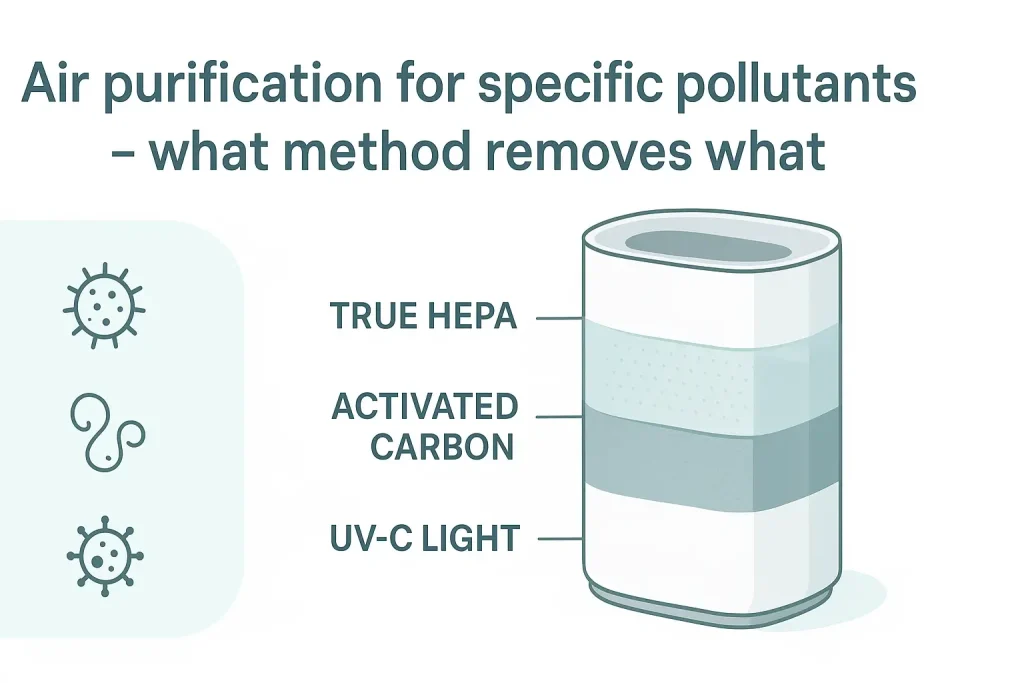
A car purifier built for severe outdoor pollution must combine three factors most units lack: a genuine H13 or H14 True HEPA media, an activated carbon bed with at least 0.5 pounds of media, and a fan capable of moving 8 to 15 cubic feet per minute (CFM) of actual filtered airflow through that resistance.
This happens because fine particulate matter from diesel exhaust, brake dust, and wildfire smoke enters the cabin at a rate that a low-CADR desktop purifier cannot match.
The True HEPA car air purifier stage must capture particles at the 0.3-micron size, where combustion particles from diesel and gasoline engines concentrate.
This only occurs when the fan speed and filter seal are adequate to process the cabin’s total air volume several times per hour.
If the filter is a thin HEPA-type sheet with gaps in the housing seal, the result is bypass: unfiltered air recirculates with filtered air, and cabin PM2.5 stays elevated. Fix it by selecting a unit with a gasketed, framed filter that forces all air through the media.
A heavy carbon stage is the second non-negotiable for heavy pollution, since PM2.5 and nitrogen dioxide from traffic require different removal mechanisms.
Top 5 High-End Car Air Purifiers for Heavy Pollution
Each unit below was selected for verified filter grade, fan output, and carbon mass. I excluded any purifier that uses ionization as its primary filtration mechanism, because ionizers can produce ozone above the CARB 0.050 ppm limit in a sealed cabin, and they redistribute particles to surfaces rather than removing them.
Ozone inside a car cabin is particularly hazardous because the enclosed volume concentrates any output to levels far higher than the same device in a room. True HEPA and activated carbon together are the correct approach for this application.
1. Philips GoPure GP5611
This is the highest-CADR dedicated car purifier currently available that uses a genuine H13 True HEPA filter paired with a substantial activated carbon stage.
Its fan pushes approximately 16 CFM through the media stack, enough to cycle a standard sedan’s 100-cubic-foot cabin volume at 9 air changes per hour on the maximum setting.
Key Specifications:
- Filter grade: H13 True HEPA + SelectFilter Plus carbon
- Useful CADR: approximately 16 CFM (estimated from specs)
- Cabin cycles per hour: 9 ACH in a 100 cu ft cabin
- Filter replacement interval: 6 months under heavy use
- Annual filter cost: approximately $50-$70
For a daily commute through industrial traffic or wildfire corridors, this unit’s combination of H13 particle capture and carbon VOC removal places it at the top. The filter replacement indicator triggers based on runtime hours, not an arbitrary calendar, which means heavy users replace at the right interval instead of guessing.
2. IQAir Atem Car
IQAir builds the Atem Car around the same HyperHEPA filtration principle as its $900 home units, but scaled to the 12-volt cabin environment. The filter removes particles down to 0.003 microns, which is ten times smaller than the 0.3-micron standard for True HEPA.
This matters for heavy pollution because ultrafine particles from diesel combustion cluster in the sub-0.1-micron range, where standard HEPA efficiency begins to dip below the 99.97% threshold.
Key Specifications:
- Filter grade: HyperHEPA (tested to 0.003 microns)
- Useful CADR: approximately 12-15 CFM
- Cabin cycles per hour: 7-9 ACH in a 100 cu ft cabin
- Filter replacement interval: 12-14 months typical
- Annual filter cost: approximately $99
The circular mounting arm attaches directly to the headrest, positioning the intake at breathing height for the driver or passenger. This placement is a genuine advantage over floor-mounted units that draw from the footwell, where heavier particles settle, leaving lighter PM2.5 floating at face level.
3. Denso DNP-060 PureAir (Japan Domestic Market)
Denso is a Tier 1 automotive supplier that builds OEM HVAC components for Toyota and Lexus. Their car purifier uses the same filter technology as factory-installed clean air systems in JDM vehicles.
The DNP-060 uses a dual-layer electrostatic HEPA and activated carbon filter with a fan rated for 12V vehicle systems drawing under 1 amp.
Key Specifications:
- Filter grade: Electrostatic HEPA + carbon sheet
- Useful CADR: approximately 10-12 CFM
- Cabin cycles per hour: 6-7 ACH in a 100 cu ft cabin
- Filter replacement interval: 12 months
- Annual filter cost: approximately $40-$60 (import)
This unit is harder to source outside Japan, but the build quality is automotive-grade: no rattles, no cheap plastic fan bearings that whine after three months. The subtle design integrates into a luxury vehicle interior without the “plastic gadget” appearance of some competitors.
4. Blueair Cabin Air P1
Blueair adapted its HEPASilent filtration technology to the car form factor, combining an electrostatic charging stage with a mechanical filter. This hybrid approach reduces fan noise at a given CADR compared to pure mechanical HEPA filtration.
The unit removes 99.97% of airborne particles down to 0.1 microns according to Blueair’s published testing, and the carbon layer handles traffic-related VOCs and nitrogen dioxide.
Key Specifications:
- Filter grade: HEPASilent (electrostatic + mechanical)
- Useful CADR: approximately 12 CFM
- Cabin cycles per hour: 7 ACH in a 100 cu ft cabin
- Filter replacement interval: 6 months
- Annual filter cost: approximately $60-$80
The Blueair P1 is also one of the few car purifiers with a recognized certification for ozone-free operation, tested below the CARB 0.050 ppm limit. In a sealed vehicle cabin, this certification matters more than in a ventilated room.
5. Alathena AC1 Pro (Heavy Duty Vehicle Purifier)
The Alathena AC1 Pro is designed for larger vehicles (SUVs, vans, and delivery trucks) where cabin volume exceeds 150 cubic feet. Its larger fan and deeper filter bed push approximately 20 CFM of filtered airflow.
The H13 HEPA filter is gasketed and framed, eliminating the bypass problem that plagues smaller car purifiers with friction-fit filter elements.
Key Specifications:
- Filter grade: H13 True HEPA + 0.8 lb activated carbon
- Useful CADR: approximately 20 CFM
- Cabin cycles per hour: 8 ACH in a 150 cu ft SUV cabin
- Filter replacement interval: 6-9 months
- Annual filter cost: approximately $70-$90
This is the correct choice if you drive a large SUV through heavily polluted routes. The higher airflow and larger carbon bed address the problem of larger cabin volume exceeding the capacity of standard car purifiers, which top out around 12-15 CFM.
Price Comparison
Car Air Purifier Price Comparison – Unit Cost and Annual Filter Cost
Unit purchase price plus estimated annual filter replacement cost. Prices verified at time of publication.
$130 unit + $80/yr filters
$160 unit + $50/yr filters
$190 unit + $70/yr filters
$220 unit + $60/yr filters
$399 unit + $99/yr filters
Bar width represents unit purchase price relative to the most expensive product shown. Filter costs are estimates based on manufacturer-recommended replacement intervals. Genuine filters used for all cost estimates.
How Much Filtration Do You Actually Need for Your Vehicle?
The CADR needed for a car cabin follows the same formula as a room purifier: multiply your cabin’s cubic feet by your target air changes per hour (ACH), then divide by 60.
For heavy pollution driving, target 6 ACH. A standard sedan cabin of approximately 100 cubic feet requires (100 x 6) / 60 = 10 CFM of smoke CADR. An SUV at 150 cubic feet requires 15 CFM.
Most “car air purifiers” deliver 2-5 CFM through a thin filter sheet. That is enough to freshen air slowly in moderate conditions but completely inadequate for heavy PM2.5 infiltration during a wildfire event or stop-and-go traffic behind diesel trucks.
This gap between marketing claims and real airflow is the most common reason car purifiers fail in heavy pollution. The fan sounds like it is working; the blue light blinks; but the CADR is too low to outpace particle ingress through the HVAC system.
CADR Calculator
How Much CADR Does Your Vehicle Need?
Enter your vehicle cabin dimensions and target ACH. Formula: (length x width x height x ACH) divided by 60.
CADR = (length x width x height x ACH) / 60. For severe pollution or wildfire conditions, always use 6 ACH. Most car purifiers deliver 3-8 CFM: below what is needed for anything beyond light city driving.
What Is the Correct Installation Position in a Vehicle?
Placement inside a vehicle cabin directly affects how much of the filtered airflow reaches your breathing zone. A purifier mounted on the rear parcel shelf filters air behind you; one mounted on the front headrest delivers clean air directly to your face.
According to research published in the journal Indoor Air, pollutant concentration at the driver’s breathing zone can be 30-50% higher than the cabin average when the purifier is placed more than 2 feet from the occupant’s head.
The IQAir Atem Car addresses this by mounting on the headrest, pointing filtered air directly at the breathing zone. The Philips GoPure uses a cup-holder placement but angles the outlet upward toward the center console area. Neither placement is wrong; the correct choice depends on your seating position and whether you typically drive alone or with passengers.
This only occurs when the purifier’s outlet is unobstructed and the cabin’s HVAC recirculation mode is enabled. If you leave the car in fresh-air mode, the HVAC system continuously introduces unfiltered outside air, overwhelming any portable purifier’s CADR.
The result is cabin PM2.5 that stays within 20% of outdoor levels regardless of what the purifier is doing. Fix it by switching to recirculation mode and running the purifier on high for the first 5 minutes of any drive through heavy pollution.
Filter Type Comparison for Car Purifiers
Use the table below to match the filter technology to the pollutant type you face on your daily route.
Filter Comparison
True HEPA vs Electrostatic vs Ionizer – Car Purifier Filter Types
Filter type comparison for PM2.5, VOCs, and ultrafine particles in a vehicle cabin with standard 100 cu ft volume.
| Filter Type | Particle Range Captured | Gas/VOC Removal | Ozone Risk in Cabin | Best For |
|---|---|---|---|---|
| H13 True HEPA + Carbon | 99.97% at 0.3 microns | Yes (0.5+ lb carbon) | Zero | Heavy traffic, wildfire, diesel exhaust |
| HEPA-type (85-99% at 0.3μ) | 85-99% at 0.3 microns | Limited (carbon sheet) | Zero | Light city driving, dust, pollen |
| Electrostatic precipitator | 90-95% broad range | No | Possible (0.020-0.050+ ppm) | Dust only; not for gas-phase pollutants |
| Ionizer-only (no physical filter) | Surface redistribution only | No | High risk in cabin | Not recommended for enclosed spaces |
HEPA-type efficiency varies by manufacturer and is not verified by an independent certification body like AHAM or an ISO 29463 test procedure. In a sealed car cabin, any ozone output above 0.050 ppm (the CARB limit) concentrates to hazardous levels within 30 minutes.
How to Get Maximum Performance During a Heavy Pollution Event
Getting useful filtration from a car purifier during an AQI 150+ day requires a specific sequence of actions, not just pushing a power button. The cabin seals, HVAC settings, and initial purge cycle all determine whether the unit keeps PM2.5 below 15 ug/m3 or lets it drift back toward outdoor levels.
For the most effective setup during heavy pollution driving, especially on routes where you are stuck behind diesel buses or driving through wildfire smoke corridors, follow these steps.
Step-by-Step Guide
How to Run a Car Purifier During Heavy Pollution – Step by Step
4 steps – Takes under 2 minutes before driving
Set HVAC to Recirculation Mode Before Starting the Engine
Recirculation closes the fresh-air intake flap, preventing unfiltered outside air from entering the cabin. With fresh-air mode active, even a 20 CFM purifier cannot keep up with the 30-60 CFM of outside air that passenger vehicle HVAC systems typically pull in at low fan speeds.
Run Purifier on Maximum Fan Speed for the First 5 Minutes
The initial cabin air has been sitting stagnant or was contaminated when you opened the door. Running on high purges this volume quickly. At 6 ACH, you achieve 1 full air change every 10 minutes. The first 5 minutes at the fastest setting achieves roughly half a full air change, enough to drop PM2.5 by 40-60%.
Keep All Windows and Sunroof Fully Closed Throughout the Drive
Even a 1-inch window gap introduces 10-20 CFM of unfiltered air into the cabin, directly competing with the purifier’s output. The cabin becomes a mixing chamber where clean and dirty air combine, and the net PM2.5 reduction is minimal.
Replace the Cabin Air Filter Every 3-6 Months During Heavy Pollution Seasons
The vehicle’s own cabin air filter, usually located behind the glove box, is the first line of defense. A loaded cabin filter restricts airflow and becomes a source of re-entrained particles. During wildfire season or heavy traffic months, replace it at double the standard interval recommended in your owner’s manual.
For readers dealing with chemical sensitivities alongside particulate pollution, the same principles apply but with an even greater emphasis on carbon mass. Our guide on selecting air purification for chemical sensitivity conditions covers carbon bed sizing and VOC breakthrough patterns.
How Do You Know the Car Purifier Is Actually Working?
A car purifier’s fan running does not guarantee filtration. The only reliable way to verify performance is to measure cabin PM2.5 with a portable monitor before and after the purifier runs at maximum speed for 10 minutes with the windows closed and HVAC on recirculate.
A properly sized unit (10+ CFM in a sedan) should reduce PM2.5 by 50% or more within 10 minutes in a sealed cabin. A portable PM2.5 monitor is the only objective way to confirm this, since most car purifiers lack an integrated air quality sensor calibrated to outdoor reference monitors.
If the PM2.5 level does not drop measurably after 10 minutes of full-speed operation, the CADR is either too low for the cabin volume, the filter seal is leaking, or the HVAC fresh-air flap is stuck partially open. All three are common on vehicles over 5 years old.
In plain terms: if you do not see the PM2.5 number dropping on a monitor placed at the driver’s headrest, your purifier is underpowered for your vehicle or your vehicle is pulling in outside air faster than the purifier can clean it. Same principle applies whether it is a sedan in traffic or an SUV in wildfire smoke.
Product Comparison
Top 5 Car Purifiers Compared – CADR, Filter Type, and Annual Cost
Key specs across all five picks. CADR estimated from published airflow and filter specifications. ACH calculated for a standard 100 cu ft sedan cabin.
| Model | Est. Smoke CADR | ACH in 100 cu ft Cabin | Filter Grade | Annual Filter Cost | Best For |
|---|---|---|---|---|---|
| Philips GoPure GP5611 | 16 CFM | 9.6 ACH | H13 True HEPA | $50-$70 | Highest CADR, heavy traffic |
| IQAir Atem Car | 12-15 CFM | 7.2-9 ACH | HyperHEPA (0.003μ) | $99 | Ultrafine particles, best placement |
| Blueair Cabin Air P1 | 12 CFM | 7.2 ACH | HEPASilent | $60-$80 | Ozone-free certified, quiet |
| Denso DNP-060 | 10-12 CFM | 6-7.2 ACH | Elec. HEPA | $40-$60 | OEM-grade build, discreet |
| Alathena AC1 Pro | 20 CFM | 12 ACH (sedan) | H13 True HEPA | $70-$90 | SUVs and large vehicles |
Are Ionizer Car Purifiers Safe for an Enclosed Cabin?
No. Ionizer-only car purifiers are not safe for a sealed vehicle cabin because they produce ozone as a byproduct of corona discharge, and the small enclosed volume concentrates that ozone to levels far exceeding the CARB limit of 0.050 ppm within 15-30 minutes of operation. The same ionizer that emits 0.020 ppm in a 300-square-foot room can reach 0.080-0.200 ppm inside a 100-cubic-foot car cabin because the output rate stays constant while the dilution volume shrinks by a factor of 20 or more. Ozone at these levels irritates the respiratory tract, triggers asthma attacks, and causes lasting lung function decrements with repeated exposure.
CARB explicitly lists car cabin air purifiers under the same regulation (CCR Title 17 Section 94251) as room units. Any device sold in California must be tested and certified below the 0.050 ppm ozone emission limit. Devices sold only outside California often lack this certification and may produce significantly higher ozone output. For the same reason, do not use a home ionizer in a car by running it off a 12V inverter. The device was tested for a room volume 20-50 times larger than your vehicle cabin.
For more on how air purifiers impact respiratory conditions like sinusitis, where ozone exposure directly worsens symptoms, our guide on air purifier selection for sinus conditions details filter types that avoid this risk entirely. If you have pets in the vehicle, dander adds another pollutant dimension that our article on pet-specific air purification technology addresses, including why carbon pre-filters matter for pet odor alongside HEPA for dander.
Why Does My Car Purifier Smell Like Burning Plastic After 20 Minutes?
A burning plastic smell from a car purifier after 20 minutes of runtime indicates either an off-gassing ionizer or an overheating fan motor. Ionizers produce ozone, which has a distinct acrid smell often described as “electric” or “bleach-like,” and this smell becomes concentrated and noticeable in a car cabin much faster than in a room. If the odor is accompanied by warmth from the unit’s housing, the fan motor bearings are failing or the motor is drawing more current than the 12V port can sustain, causing the plastic housing to heat up and release volatile organic compounds from the plastic itself.
Stop using the unit immediately and check whether it is CARB certified for ozone output. If it is not on the CARB certified air cleaning devices list, discard it. A burning plastic smell from a filtration device means you are inhaling whatever the device is emitting, which defeats the purpose of using an air purifier in the first place. Replace it with a True HEPA car purifier from the list above, where the primary emission is filtered air rather than heated plastic or ozone.
Can I Use a Home Air Purifier in My Car With a 12V Inverter?
Technically yes, but it is almost never the right solution. A home air purifier plugged into a 12V inverter can draw 40-60 watts or more, which is above what most vehicle accessory ports can safely deliver for extended periods without blowing a fuse. The unit is also physically designed for a stationary tabletop, not a moving vehicle, and becomes a projectile in an emergency stop unless it is bolted down. The CADR of a small home unit (100-150 CFM) is designed for a room 10-30 times the volume of a car cabin, meaning you are using far more power and space than you need.
If you already own a small home purifier and want to test it in a stationary vehicle during a wildfire smoke event, run the engine to avoid draining the battery, ensure the inverter is rated for at least 25% more wattage than the purifier’s maximum draw, and strap the unit securely to prevent it from tipping. A dedicated car purifier from the top picks above is safer, more efficient, and costs less than a home unit plus a quality pure sine wave inverter. For home units that run continuously, our guide on optimal air purifier runtime duration explains duty cycles and when continuous operation in a room is cost-effective vs wasteful.
What Is the Difference Between a Cabin Air Filter and a Portable Car Purifier?
A cabin air filter is a pleated panel filter built into your vehicle’s HVAC system behind the glove box, filtering all air that enters the cabin through the ventilation ducts. A portable car purifier is a standalone electric unit that recirculates and filters air already inside the cabin. The cabin filter protects against outside air; the portable purifier cleans what is already inside. A premium activated carbon cabin air filter rated MERV 8-11 is your first line of defense against PM10 and some PM2.5, but it cannot achieve the 99.97% capture efficiency of a True HEPA portable unit at 0.3 microns.
Replace your cabin filter regularly and use the portable purifier to handle the fraction of fine and ultrafine particles that pass through the HVAC filter or enter when doors open. The two systems work in series: cabin filter removes large particles and some gases from incoming air, and the portable HEPA unit captures the fine fraction that penetrates the cabin filter plus any particles that enter through door seals or are generated inside the vehicle (brake dust resuspension, cigarette smoke from other vehicles). Neither one alone is sufficient in heavy pollution; together they provide layered protection.
For additional reading on specific pollutant types like bird dander, which behaves similarly to fine dust in a vehicle environment, see our article on air purification for fine particulate bird allergens. And if cigarette smoke from other vehicles is a recurring problem on your route, our piece on whether air purifiers effectively remove cigarette smoke particles and gases explains the carbon bed depth required and why thin carbon sheets in most car purifiers saturate quickly when smoke is a constant exposure.
A high-end car air purifier rated for heavy pollution is genuinely useful if and only if the CADR matches your cabin volume and the HVAC recirculation mode stays on. The Philips GoPure GP5611 and IQAir Atem Car are the two top recommendations for most drivers because they combine verified True HEPA or HyperHEPA filtration with enough fan output to achieve 6+ ACH in a standard sedan. For SUV and van drivers, the Alathena AC1 Pro is the only option with CADR above 15 CFM and enough carbon to address VOCs alongside particulates. Skip ionizers entirely. Replace your cabin air filter on an accelerated schedule during heavy pollution seasons. And verify performance with a portable PM2.5 monitor rather than trusting a blue indicator light that tells you nothing about the air you are actually breathing.