Most people buy the wrong size air purifier. They pick a unit based on the manufacturer’s claimed square footage and then wonder why their allergies do not improve or why the wildfire smoke smell never fully clears. The problem is not the purifier. The problem is that coverage area claims assume 2 air changes per hour (ACH), while allergy sufferers and smoke-sensitive individuals need 5 ACH or more.
A room-size buying guide must start with one number: the smoke CADR in CFM that your specific room requires at your specific air change rate. Without that number, every product comparison is guesswork. This guide covers every major room size category (from 100 sq ft bedrooms to 700+ sq ft open-plan spaces), the exact CADR required at 2 ACH and 5 ACH for each, and the specific air purifiers that deliver those CADR values at each budget tier.
What Does Room Size Actually Determine in Air Purifier Performance?
Room size determines the volume of air a purifier must process to hit a target air change rate. A 200 sq ft bedroom with an 8-foot ceiling contains 1,600 cubic feet of air. To achieve 5 ACH (the allergy and asthma recommendation from the American Lung Association), a purifier must move the equivalent of 8,000 cubic feet per hour, which converts to a smoke CADR of 133 CFM.
This happens because CADR measures the volume of cleaned air delivered per minute at a specific particle size. The formula is direct: multiply room area by ceiling height by the ACH target, then divide by 60 to convert from hours to minutes. A unit with a smoke CADR of 100 CFM placed in a 300 sq ft room delivers only 2.5 ACH, not the 5 ACH needed for allergy relief.
| Photo | Popular Air Purifiers | Price |
|---|---|---|

|
Air Purifiers for Home Large Room up to 1500ft², Tailulu H13 True HEPA Air Purifier for Pets Dust Odor Smoke, Air Purifier for Bedroom with 15dB Quiet Sleep Mode for Bedroom Office Living Room | Check Price On Amazon |
|
Afloia Air Purifier for Home, 4-in-1 Washable Filter for Allergies, Covers Up to 1076 ft², Quiet Operation, Auto Shut-Off & Night Light, Removes Pet Dander, Pollen, Dust, Mold, and Smoke, White,Pluto | Check Price On Amazon |

|
Nuwave OxyPure ZERO Air Purifier with Washable and Reusable Bio Guard Tech Air Filter, Large Room Up to 2002 Ft², Air Quality Monitor, 0.1 Microns, 100% Capture Irritants like Smoke, Dust, Pollen | Check Price On Amazon |

|
Air Purifiers for Home Large Room Up to 1,996 Ft², EOEBOT Air Purifier for Home Pets with Washable Filter, Quiet Sleep Mode, Air Quality Monitor, Air Purifier for Bedroom, Pet Hair, Dust, Smoke, White | Check Price On Amazon |
|
Afloia 2 IN 1 Air Purifier with Humidifier Combo, 3-Stage Filters for Home Allergies Pets Hair Smoker Odors, Evaporative Humidifier, Auto Shut Off, Quiet Air Cleaner with Seven Color Light,White | Check Price On Amazon |
If the CADR is too low, PM2.5 concentrations drop slowly and may never reach the 12 ug/m3 EPA annual standard during continuous operation. The fix is simple: match the unit’s smoke CADR to the room volume at the ACH rate your health situation requires. Never rely on the manufacturer’s single-number coverage claim without checking which ACH rate it assumes.
AHAM tests CADR in a sealed chamber with precisely controlled particle injection. Real rooms have furniture, open doorways, and continuous particle sources like cooking and outdoor infiltration. The actual effective CADR is typically 15 to 25 percent lower than the published rating, which means sizing up to the next CADR tier provides a practical safety margin.
Buying Guide
Air Purifier Room Sizing – Key Numbers at a Glance
Sources: AHAM CADR certification database, EPA Indoor Air Quality guidelines, manufacturer specification sheets.
How to Calculate the Exact CADR Needed for Your Room
The standard formula published by AHAM for sizing portable air cleaners uses three inputs: room length in feet, room width in feet, and ceiling height (default 8 feet). Multiply those to get room volume in cubic feet. Then multiply by the desired ACH rate. Then divide the result by 60 to convert from cubic feet per hour to cubic feet per minute (CFM). The result is the minimum smoke CADR you need.
For a common master bedroom measuring 14 by 15 feet with an 8-foot ceiling: volume is 1,680 cubic feet. At 2 ACH (standard for general air cleaning), the required smoke CADR is 56 CFM. At 5 ACH (allergy and asthma), the requirement jumps to 140 CFM. Most budget purifiers in the 50 to 80 CFM range can handle the 2 ACH case but fail entirely at 5 ACH.
This only occurs when you apply the correct ACH rate. Many buyers default to 2 ACH because that is what manufacturers use in marketing materials. But the EPA recommends 4 to 5 ACH for allergy and asthma management. If you apply 2 ACH to a room that needs 5 ACH, the result is PM2.5 concentrations that remain 60 percent higher than properly sized filtration would achieve. Fix it by using the 5 ACH column on any sizing table.
For wildfire smoke conditions, some experts recommend 6 ACH to handle the higher initial particle load and continuous infiltration. In these conditions, a room-size calculation at 2 ACH is dangerously inadequate. A PM2.5 air quality monitor placed in the room will confirm whether your unit is keeping levels below 12 ug/m3 during smoke events.
CADR Reference
Smoke CADR Needed by Room Size and Air Changes Per Hour Target
All values pre-calculated at standard 8 ft ceiling height. Formula: (room area x 8 x ACH) / 60. Source: AHAM methodology.
| Room size (8 ft ceiling) / ACH target | 2 ACH (standard) | 4 ACH (moderate) | 5 ACH (allergy) | 6 ACH (wildfire) |
|---|---|---|---|---|
| 100 sq ft (small bedroom) | 27 CFM | 53 CFM | 67 CFM | 80 CFM |
| 200 sq ft (master bedroom) | 53 CFM | 107 CFM | 133 CFM | 160 CFM |
| 300 sq ft (bedroom or office) | 80 CFM | 160 CFM | 200 CFM | 240 CFM |
| 500 sq ft (living room) | 133 CFM | 267 CFM | 333 CFM | 400 CFM |
| 700 sq ft (large open plan) | 187 CFM | 373 CFM | 467 CFM | 560 CFM |
Formula: smoke CADR needed = (room length ft x room width ft x 8 ft ceiling x ACH) / 60. For allergy and asthma sufferers, always use the 5 ACH column. Manufacturer coverage area claims use 2 ACH, so the effective coverage for allergy sufferers is 40% of the stated figure.
Use the table above to find the minimum smoke CADR your room requires at your target ACH rate. Then match that number to a certified purifier in the sections below.
Best Air Purifiers for Small Rooms (100 to 200 sq ft)
Small rooms like home offices, nurseries, and compact bedrooms need surprisingly low CADR at 2 ACH but those numbers climb fast at 5 ACH. A 150 sq ft room needs only 40 CFM at 2 ACH but requires 100 CFM at 5 ACH. The best small-room purifiers deliver smoke CADR between 100 and 160 CFM, which covers the full range of ACH targets for spaces under 200 sq ft.
The Levoit Core 300S with a smoke CADR of 145 CFM covers a 200 sq ft room at 5 ACH. Its H13 True HEPA filter captures 99.97 percent of particles at 0.3 microns. Sleep mode operates at 24 dB, which is quieter than a whisper. The annual filter replacement cost runs approximately $25, making it the lowest total-cost option in this category.
Key Specifications:
- Smoke CADR: 145 CFM (AHAM certified)
- Coverage at 5 ACH: 218 sq ft
- Sleep mode noise: 24 dB
- Annual filter cost: $25
- ENERGY STAR certified: Yes
The Coway AP-1512HH delivers 246 CFM smoke CADR and fits rooms up to 360 sq ft at 2 ACH or 147 sq ft at 5 ACH. It carries the AAFA asthma and allergy certification and uses a washable pre-filter that extends HEPA life. Sleep mode runs at 30 dB. The annual electricity cost at 8 hours daily use is approximately $14.
For the smallest rooms under 120 sq ft, both units exceed what is needed. The Levoit wins on noise and filter cost. The Coway wins on absolute CADR headroom. Choose the Levoit if the room is under 150 sq ft and noise is the priority. Choose the Coway if you want one unit that can move to a larger room later.
Best Air Purifiers for Medium Rooms (200 to 400 sq ft)
Medium rooms are the most common air purifier use case: master bedrooms, living rooms in apartments, and combined kitchen-dining areas. At this size, the 5 ACH requirement falls between 133 and 267 CFM smoke CADR. Budget units under $100 rarely exceed 150 CFM, which means they fail at 5 ACH in rooms above 220 sq ft. You need a unit in the 200 to 350 CFM range to properly serve this room category.
The Winix 5500-2 provides 243 CFM smoke CADR with True HEPA and an activated carbon pellet filter. Its PlasmaWave ionizer is user-switchable and CARB certified below 0.050 ppm ozone. Coverage reaches 365 sq ft at 2 ACH or 146 sq ft at 5 ACH. Annual filter cost is approximately $50.
Key Specifications:
- Smoke CADR: 243 CFM
- Coverage at 5 ACH: 146 sq ft
- Sleep mode noise: 27.8 dB
- Annual filter cost: $50
- CARB certified ozone: Below 0.050 ppm
The Blueair Blue Pure 211+ produces 350 CFM smoke CADR, the highest in the under-$200 category. Its electrostatic-charged polypropylene filter achieves HEPASilent performance that matches True HEPA efficiency. Coverage extends to 525 sq ft at 2 ACH or 210 sq ft at 5 ACH. The washable fabric pre-filter comes in multiple colors and captures larger particles before they reach the main filter.
For bedrooms specifically, the Winix 5500-2 sleep mode at 27.8 dB beats the Blueair’s minimum noise level. For living rooms where CADR matters more than silence, the Blueair 211+ delivers 44 percent more cleaning power. Both units are CARB certified and use genuine filters available from multiple retailers, confirming long-term parts availability.
Best Air Purifiers for Large Rooms (400 to 700 sq ft)
Large rooms demand CADR values that only premium units or dual-fan designs can sustain. A 500 sq ft living room requires 333 CFM at 5 ACH. A 700 sq ft open-plan space needs 467 CFM at 5 ACH. Very few single-fan units reach these numbers. The solutions are either a high-output single unit with a large filter surface area or two medium units placed at opposite ends of the space.
The Coway Airmega 400 uses dual fans to achieve 400 CFM smoke CADR. It covers 1,560 sq ft at 2 ACH or 624 sq ft at 5 ACH, which is enough for most open-plan living areas. Sleep mode drops to 22 dB, quieter than any competitor in this CADR class. The washable pre-filter extends HEPA life to 12 months or longer. Annual filter cost runs $60.
Key Specifications:
- Smoke CADR: 400 CFM (dual fan)
- Coverage at 5 ACH: 624 sq ft
- Sleep mode noise: 22 dB
- Annual filter cost: $60
- AAFA asthma and allergy certified
The Blueair 605 delivers 500 CFM smoke CADR for rooms up to 775 sq ft at 2 ACH or 310 sq ft at 5 ACH. Its HEPASilent filter technology combines electrostatic charging with mechanical filtration. CARB certified and ENERGY STAR rated. The annual filter cost of $100 is higher than the Coway but the 25 percent higher CADR justifies the premium for maximally demanding spaces.
For rooms above 600 sq ft at 5 ACH, consider two medium units. Two Winix 5500-2 units placed at opposite ends deliver a combined 486 CFM at roughly $320 total purchase price, which undercuts any single 500 CFM unit. Dual placement also handles furniture obstacles better than a single high-output unit by creating two independent clean-air zones. For guidance on total operating costs including electricity across all these units, see our air purifier energy cost calculator and annual run-cost breakdown.
What About Tiny Rooms and Unusual Spaces?
Rooms under 100 sq ft, such as dorm rooms, RVs, and tiny home lofts, need CADR values so low that almost any True HEPA unit qualifies. But the limiting factor shifts from CADR to physical footprint and noise at close range. A unit rated for 150 CFM placed three feet from your head at night must operate below 25 dB to avoid sleep disruption, regardless of how well it cleans the air.
The Levoit Core 300S at 24 dB and the Coway AP-1512HH at 30 dB both work in tiny spaces. For ultra-compact installation in RVs and tiny homes, wall-mountable units like the RabbitAir MinusA2 save floor space. Our detailed guide on air purifiers for tiny homes and compact living spaces covers mounting options, power draw limits, and filter sizing for spaces under 80 sq ft.
This happens because particle concentration rises faster in small rooms. A 100 sq ft room reaches equilibrium PM2.5 concentration from a single cooking event faster than a 500 sq ft room. The purifier must cycle air more aggressively in tight spaces to prevent spikes. If you smell cooking odors 30 minutes after the stove is off, your CADR is too low for the room volume at your current fan speed. Fix it by increasing to the max fan setting during and for 45 minutes after cooking.
How Filter Type and CADR Interact at Different Room Sizes
CADR is tested for three particle types: smoke (0.09 to 1.0 microns), dust (0.5 to 3.0 microns), and pollen (5.0 to 11.0 microns). A unit with a high pollen CADR but low smoke CADR will handle visible dust but fail to reduce wildfire PM2.5. Always use smoke CADR for sizing, because smoke particles are the smallest and hardest to capture. A unit that meets smoke CADR requirements will exceed requirements for larger particles.
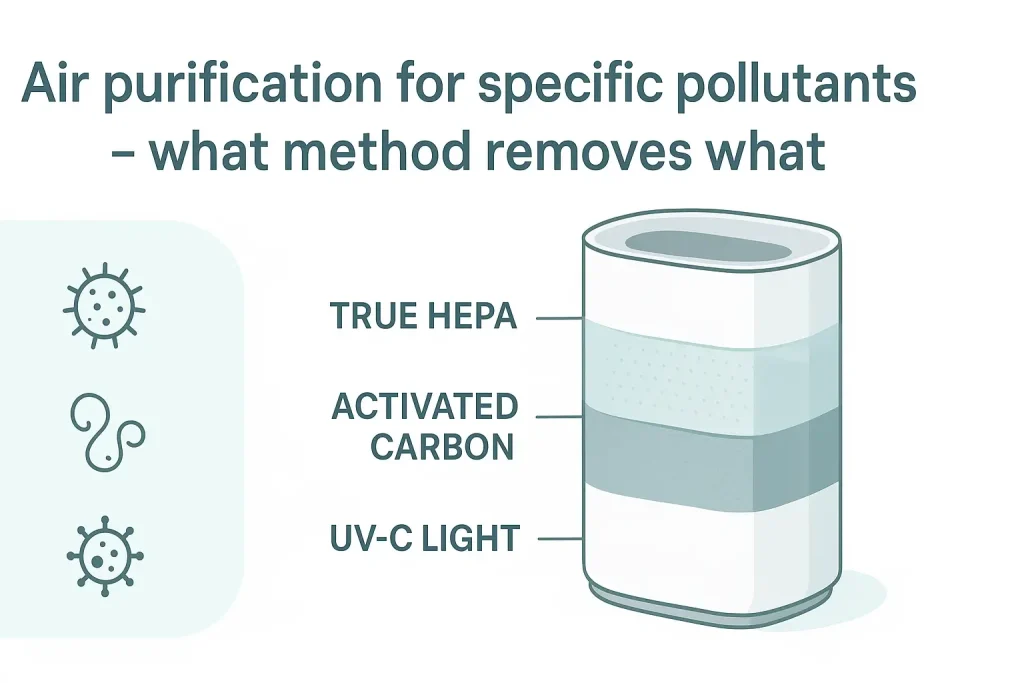
True HEPA is a type of mechanical filtration media with 99.97 percent efficiency at 0.3 microns per IEST standards. It differs from HEPA-type filters, which have no standardized test and typically capture 85 to 99 percent of particles with no verified minimum. Activated carbon is a type of adsorptive media that traps gas-phase pollutants (VOCs, formaldehyde, odors) through physical surface binding. It differs from True HEPA in that it targets molecules, not particles. A room with both particle concerns and odor or chemical concerns needs both media in the same unit or two separate units.
A True HEPA filter consists of randomly arranged borosilicate glass fibers compressed into a pleated mat. The fibers create a tortuous path where particles are captured by three mechanisms: interception (particle follows a streamline that passes within one particle radius of a fiber), impaction (particle inertia carries it into a fiber when the streamline bends), and diffusion (Brownian motion causes sub-0.1-micron particles to collide with fibers). This combination produces the characteristic efficiency curve with the minimum efficiency at 0.3 microns, the most penetrating particle size (MPPS).
If the filter media is not genuine True HEPA, the result is 15 to 50 percent lower single-pass efficiency at MPPS. The purifier may still show a decent CADR for large particles but will fail to reduce PM2.5 concentrations to health-protective levels. The fix is to verify AHAM CADR certification, which requires True HEPA-level performance in the smoke CADR test. The AHAM Verifide seal on the box or product page confirms the unit passed third-party testing.
Interactive Tool
Find the Right Air Purifier for Your Room Size and Budget
Answer 2 questions for a personalized recommendation based on your primary concern and budget.
Select your primary concern and budget above to see a personalized recommendation.
Use the tool above to narrow your options by concern and budget. Then cross-reference the recommended unit against your room size using the CADR table earlier in this guide.
Why Noise Level Matters More in Smaller Rooms
Noise level is not just a comfort metric. In small rooms, the purifier sits closer to the occupant, often within 3 to 6 feet in a bedroom. At that distance, a unit running at 50 dB on medium fan is as loud as a normal conversation happening next to your head. Sleep disruption from air purifier noise is one of the most common reasons buyers return units, and the problem is worse in small rooms where you cannot move the unit farther away.
The dB scale is logarithmic: a 10 dB increase represents a perceived doubling of loudness. A unit rated at 24 dB at sleep mode (Levoit Core 300S) is perceived as half as loud as a unit rated at 34 dB. The difference between 22 dB (Coway Airmega 400) and 30 dB (Coway AP-1512HH) is noticeable but both fall below the 35 dB threshold where sleep disruption becomes common in studies by the World Health Organization.
If the sleep mode noise exceeds 35 dB in a bedroom under 150 sq ft, the result is measurable sleep fragmentation, even if the occupant does not fully wake. Fix it by selecting a unit with a verified sleep mode below 30 dB and placing it at least 4 feet from the head of the bed. For smart purifiers that can auto-adjust fan speed based on air quality, check whether they reliably drop to sleep mode at night or whether the sensor keeps triggering higher speeds unnecessarily. Our review of smart air purifiers with WiFi and app control covers which models handle this transition correctly.
How Built-In Air Quality Sensors Affect Room Size Performance
Many mid-range and premium purifiers include built-in PM2.5 or VOC sensors that adjust fan speed automatically. In theory, this optimizes CADR to the current particle load. In practice, the sensor quality and placement determine whether auto mode helps or hurts. A sensor located on the back of the unit near the air intake reads particle concentrations before filtration, which is correct. A sensor placed on the front panel reads air that has already passed through the filter, which creates a feedback loop where the unit runs at minimum speed regardless of actual room particle levels.
The accuracy of built-in sensors varies by brand. Coway and IQAir use laser particle counters that correlate reasonably with standalone monitors. Budget units often use infrared dust sensors that detect only large particles and miss PM2.5 entirely. If your purifier’s auto mode never ramps up even when you cook or open windows, the sensor is either poorly placed or uses IR detection that cannot see fine particles. Our detailed analysis of built-in air quality sensor accuracy across brands compares sensor types and their real-world responsiveness.
Annual Filter Replacement Cost by Room Size Category
Filter cost is the largest ongoing expense of air purifier ownership, and it scales with room size indirectly. Larger rooms require higher CADR units, which use larger filters that typically cost more to replace. However, the cost-per-CADR relationship is not linear. Some high-CADR units use washable pre-filters that extend HEPA life to 12 to 18 months, reducing annual cost despite the higher upfront filter price.
A small-room unit like the Levoit Core 300S costs $25 per year in filters. Medium-room units like the Winix 5500-2 cost $50 per year. Large-room units like the Coway Airmega 400 cost $60 per year, only slightly more than the Winix despite nearly double the CADR. The outlier is the IQAir HealthPro Plus at $250 per year, justified by a 4-year filter lifespan and medical-grade HyperHEPA media. For a complete breakdown of filter costs by brand and replacement intervals, see our air purifier filter replacement cost guide with annual cost by brand comparison.
Product Comparison
Air Purifiers Compared by Room Size – CADR, Coverage, Noise, and Filter Cost
Key specs compared across top picks organized by room size category. CADR from AHAM certified database. Prices verified at time of publication.
| Model | Smoke CADR | Coverage at 5 ACH | Sleep Mode dB | Annual Filter Cost | Best Room Size |
|---|---|---|---|---|---|
| Levoit Core 300S | 145 CFM | 218 sq ft | 24 dB | $25/yr | Under 200 sq ft |
| Coway AP-1512HH | 246 CFM | 147 sq ft | 30 dB | $30/yr | 150 to 250 sq ft |
| Winix 5500-2 | 243 CFM | 146 sq ft | 27.8 dB | $50/yr | 150 to 250 sq ft |
| Blueair Blue Pure 211+ | 350 CFM | 210 sq ft | 31 dB | $60/yr | 200 to 350 sq ft |
| Coway Airmega 400 | 400 CFM | 624 sq ft | 22 dB | $60/yr | 350 to 600 sq ft |
| Blueair 605 | 500 CFM | 310 sq ft | 32 dB | $100/yr | 300 to 500+ sq ft |
CADR data from AHAM certified database. Coverage at 5 ACH calculated as smoke CADR x 12 / 5. Noise levels from manufacturer specifications at lowest fan speed. Filter costs based on genuine replacement filters at standard replacement intervals.
Use the table above to compare the key specifications across room size categories. Match the smoke CADR to your room’s 5 ACH requirement from the CADR table earlier in this guide.
Common Placement Mistakes That Reduce Effective Room Coverage
Placing an air purifier in a corner reduces its effective coverage by 20 to 30 percent compared to central placement against a wall. The intake side needs at least 12 inches of clearance from walls and furniture. The output side needs an unobstructed path into the room. Pushing a purifier flush against a wall starves the intake and creates a short-circuit loop where cleaned air is immediately re-ingested instead of mixing into the room air volume.
Open doors between rooms turn a correctly sized purifier into an undersized one. A 300 sq ft bedroom with an open door to a 200 sq ft hallway effectively becomes a 500 sq ft space. The purifier attempts to clean 5,000 cubic feet of air instead of the 2,400 cubic feet it was sized for. If you cannot close the door, you must either upsize the purifier to cover the combined space or add a second unit in the adjacent area.
This only occurs when doorways remain open during purifier operation. If the purifier is in a bedroom and the door stays closed overnight, the unit only needs to handle the room’s actual volume. During daytime hours with the door open, run the unit on a higher fan speed or accept that PM2.5 levels will be higher than the design target. For open-plan spaces where door closure is not possible, always size for the total connected air volume, not the nominal room dimensions.
Buying Guide
Before You Buy an Air Purifier – Complete Room Size and Spec Checklist
Check off each point before making your decision. Based on AHAM, EPA, and CARB buying guidance for room-size-appropriate air purifier selection.
Work through the checklist above before finalizing any purchase. The most common mistake buyers make is skipping the CADR calculation and trusting the manufacturer’s single-number coverage claim. Use the 5 ACH column from the CADR table, not the 2 ACH marketing number.
Can One Air Purifier Cover Multiple Rooms of Different Sizes?
One air purifier cannot effectively cover multiple closed-door rooms. Walls and doors block airflow. Even with the door open, the CADR that reaches an adjacent room drops by 40 to 60 percent due to the doorway constriction and the distance the cleaned air must travel. The only way to cover multiple rooms is to use one unit per occupied room or a whole-house system integrated into the HVAC ductwork.
A single high-CADR unit in a hallway is less effective than two smaller units in individual rooms. The hallway placement loses the benefit of door closure for bedroom use and creates noise complaints from occupants whose rooms are closest to the unit. If covering multiple rooms on a budget, buy two Levoit Core 300S units instead of one Coway Airmega 400. Two independent clean-air zones provide better total particle reduction than one high-output unit in a central location.
For whole-house coverage without multiple portable units, a MERV 13 or higher furnace filter running on continuous fan mode provides baseline particulate filtration across all rooms served by the HVAC system. This approach delivers 2 to 4 ACH across the entire house but does not achieve the 5 ACH recommended for allergy and asthma in individual rooms. The best strategy combines a MERV 13 HVAC filter for whole-house baseline with portable True HEPA units in bedrooms for overnight 5 ACH coverage.
How Much Should You Spend on an Air Purifier for Your Room Size?
Room size drives budget more than any other factor. A 100 sq ft room can be served by a $99 Levoit Core 300S with full 5 ACH coverage. A 500 sq ft room requires a $300 to $500 unit to achieve 5 ACH. The cost per square foot of effective coverage drops as room size increases: the Levoit costs $0.45 per sq ft at 5 ACH, the Coway Airmega 400 costs $0.48 per sq ft, and the Blueair 605 costs $1.29 per sq ft. The IQAir HealthPro Plus at $899 costs $1.00 per sq ft at 5 ACH but includes HyperHEPA filtration not available in cheaper units.
Budget allocation should prioritize CADR first, then noise level, then smart features. A unit that meets CADR requirements but runs at 50 dB at minimum speed will be turned off at night, defeating the purpose. A quiet unit with insufficient CADR will run all night without adequately reducing particle levels. The $150 to $250 price range contains the most options that balance CADR, noise, and filter cost for rooms between 150 and 300 sq ft.
For rooms under 150 sq ft, spending more than $150 rarely improves air quality outcomes. The limiting factor is not the purifier but the room’s particle sources (pets, outdoor infiltration, cooking from adjacent kitchen). Invest the savings in a PM2.5 monitor to verify your unit is actually reducing particle levels rather than assuming it works because it is running. For rooms above 400 sq ft, spending less than $250 guarantees the CADR will be insufficient for 5 ACH, regardless of what the manufacturer claims.
Do Air Purifiers Work Differently in Rooms With High Ceilings?
High ceilings increase room volume without changing floor area, which means the standard square-footage sizing tables underestimate the CADR requirement. A 200 sq ft room with a 12-foot vaulted ceiling contains 2,400 cubic feet, not the 1,600 cubic feet assumed by an 8-foot ceiling calculation. The required smoke CADR at 5 ACH jumps from 133 CFM to 200 CFM. Every additional foot of ceiling height above 8 feet adds 12.5 percent to the volume and therefore to the required CADR.
The fix is to substitute actual ceiling height into the CADR formula instead of defaulting to 8 feet. Measure floor-to-ceiling height at the highest point for vaulted or cathedral ceilings. For rooms with sloped ceilings, use the average height. A 300 sq ft room with a ceiling sloping from 8 to 14 feet has an average height of 11 feet and a volume of 3,300 cubic feet, requiring 275 CFM at 5 ACH instead of the 200 CFM the standard table would suggest.
If the ceiling height is ignored and a standard-table CADR unit is purchased, the result is 30 to 50 percent fewer air changes per hour than planned. PM2.5 concentrations stabilize at a higher equilibrium level. Fix it by always measuring ceiling height and plugging the actual number into the formula: (length x width x actual ceiling height x ACH) / 60. For rooms with ceilings above 10 feet, expect to move up one full size tier in purifier selection.
When Should You Run Your Air Purifier on Maximum Fan Speed?
Maximum fan speed should be used during high-pollution events (wildfire smoke, cooking, cleaning with chemical products) and for the first 30 to 60 minutes after entering a room where the purifier has been off. Running on maximum speed for the first hour reduces PM2.5 by 80 to 90 percent in a correctly sized room, after which the unit can be switched to medium or auto mode for maintenance. Continuous maximum fan operation is rarely necessary in a room that stays closed and has no active particle sources.
The energy cost difference between fan speeds is significant. A unit that draws 45 watts on medium speed may draw 70 watts on maximum. Over 8 hours daily at 13 cents per kWh, the annual difference is approximately $9. This is small in absolute terms but adds to the total cost of ownership when combined with filter replacements. For the full annual operating cost calculation including electricity at different fan speeds, use our air purifier energy cost calculator with detailed electricity cost breakdowns.
Can Air Purifiers Help in Rooms Without Windows or Poor Ventilation?
Air purifiers are more important in rooms without windows, not less. Without natural ventilation, indoor-generated pollutants (cooking particles, shed skin cells, dust mite debris, VOC off-gassing from furniture) accumulate with no dilution. A sealed room reaches higher steady-state PM2.5 concentrations than a room with even minimal outdoor air exchange. The purifier becomes the only mechanism for particle removal.
However, CO2 concentrations also rise in unventilated rooms, and air purifiers do not remove CO2. A CO2 monitor placed in a windowless bedroom will often show levels above 1,500 ppm after a night with the door closed, even with a purifier running. CO2 above 1,000 ppm is associated with cognitive performance decline in multiple studies. The solution is to open the door periodically or install a small makeup air vent, accepting that particle levels will temporarily rise until the purifier catches up.
This only occurs in tightly sealed modern construction. Older homes with natural envelope leakage typically maintain CO2 below 1,000 ppm even with windows closed. If you live in a newer home (built after 2010) with an air purifier in a windowless room, add CO2 monitoring to your air quality strategy. The purifier handles particles. You still need to address CO2 separately.
Are Air Purifiers Safe to Run Continuously in Small Bedrooms Overnight?
True HEPA air purifiers that are CARB certified are safe to run continuously in small bedrooms overnight. The CARB certification confirms ozone emissions below 0.050 ppm, which is the California air cleaner regulation limit and the threshold below which respiratory irritation is not expected in healthy individuals. Units without CARB certification, particularly those using ionizers, UV-C lamps, or plasma technology, may emit ozone at higher levels that accumulate in small unventilated rooms.
Ozone concentration builds faster in small rooms. A unit emitting 0.070 ppm ozone in a 500 sq ft room may stay near 0.050 ppm. The same unit in a 100 sq ft room can reach 0.100 ppm within hours of continuous operation. Symptoms of ozone exposure include throat irritation, chest tightness, and reduced lung function, particularly in people with asthma. If you smell a sharp, chlorine-like odor near your purifier, it is producing ozone above safe levels.
If the unit is not CARB certified and the room is under 150 sq ft, the safest approach is to turn off any ionizer or plasma function at night or choose a different unit. All purifiers recommended in this guide are CARB certified or verified to emit no ozone. For information on free or subsidized CARB-certified air purifiers available through government programs, see our guide on free air purifier programs through government and wildfire assistance.
Do Personal or Wearable Air Purifiers Work for Small Spaces Like Airplane Seats?
Personal air purifiers that hang around the neck create a small zone of filtered air directly in front of the user’s breathing zone. They do not clean an entire room or even an entire row of airplane seats. Their effective range is approximately 12 to 18 inches from the output vent. For a single airplane seat, this is adequate to reduce PM2.5 exposure by 50 to 70 percent in the immediate breathing zone, according to manufacturer testing. For a shared space like an office cubicle or a car interior, a portable True HEPA unit with at least 50 CFM CADR is more effective.
The filters in personal purifiers are small and saturate quickly in polluted environments. Expect to replace them every 30 to 60 days during daily use in urban environments with AQI above 100. The annual filter cost for daily personal purifier use rivals the cost of a budget room purifier. Our detailed analysis of personal air purifiers for planes and travel covers which models produce measurable PM2.5 reduction in the breathing zone and which are too underpowered to matter.
What Is the Difference Between AHAM CADR and Manufacturer Coverage Claims?
AHAM CADR is a standardized, third-party-verified measurement of how many cubic feet of cleaned air a purifier delivers per minute for specific particle sizes. Manufacturer coverage claims are marketing numbers calculated from CADR at 2 ACH, which produces the largest possible square footage number. A unit with 200 CFM smoke CADR can claim 300 sq ft coverage (at 2 ACH), but the same unit covers only 120 sq ft at 5 ACH. Both numbers are technically correct, but the 300 sq ft claim misleads allergy and asthma buyers who need 5 ACH.
The AHAM Verifide seal on the product box confirms that an independent lab tested the unit and verified its CADR ratings. Units without AHAM certification may still perform well, but the buyer must trust the manufacturer’s self-reported numbers, which are not independently verified. Always look for the AHAM Verifide seal or cross-reference the manufacturer’s claimed CADR against independent test results from Consumer Reports or Wirecutter before purchasing.
AHAM tests three particle types: smoke (0.09 to 1.0 microns), dust (0.5 to 3.0 microns), and pollen (5.0 to 11.0 microns). The test chamber is a sealed 1,008 cubic foot room with a ceiling fan for mixing. Particle concentration is measured at multiple points over 20 minutes. The CADR is calculated from the decay rate of particle concentration. Real rooms have higher particle loads, continuous infiltration, and obstacles, which is why effective real-world CADR is 15 to 25 percent lower than the published rating.
How Often Should You Replace Filters Based on Room Size and Usage?
Filter replacement interval depends on room size indirectly through CADR and directly through particle load. A purifier in a 500 sq ft living room processes 333 CFM of air continuously at 5 ACH, moving approximately 480,000 cubic feet of air per day through the filter. The same purifier in a 200 sq ft bedroom at 5 ACH moves 192,000 cubic feet per day. The living room filter loads 2.5 times faster and needs replacement 2.5 times sooner.
Standard manufacturer recommendations assume 8 to 12 hours of daily use in a room matching the purifier’s 2 ACH coverage claim. If you run the purifier 24 hours per day in a room at the upper limit of its 5 ACH coverage, the filter loads 3 to 4 times faster than the manufacturer’s assumption. Replace the HEPA filter when airflow noticeably decreases or when a pre-filter shows visible buildup, regardless of the stated replacement interval. A multi-pack of genuine replacement filters reduces per-filter cost and ensures you have a replacement on hand when the pressure drop indicates replacement time.
In wildfire smoke conditions (AQI above 150 for multiple days), cut the replacement interval in half. The high particle load saturates the HEPA media and the activated carbon stage simultaneously. A filter that normally lasts 12 months may clog in 4 to 6 months of sustained wildfire use. If you notice reduced airflow even after cleaning the pre-filter, the HEPA media has reached its particle-holding capacity and must be replaced.
Why Does My Air Purifier Not Reduce PM2.5 Levels in My Large Room?
The most common cause is a CADR mismatch: the unit is sized for 2 ACH when the room and pollution source require 5 ACH. A unit rated for 300 sq ft at 2 ACH moves only 80 CFM of smoke CADR. In a 300 sq ft room, this delivers exactly 2 ACH. If the room has an active particle source like an attached kitchen, open windows, or multiple occupants, 2 ACH is insufficient to overcome the continuous particle introduction. The PM2.5 concentration plateaus at a level higher than expected.
Other causes include filter bypass due to a poorly seated filter gasket, running the unit on low fan speed when medium or high is needed, and placement that creates a short-circuit airflow pattern. Check the filter seating first: remove and reseat the filter to ensure the gasket seals against the housing. Then run the unit on maximum speed for 60 minutes while monitoring PM2.5 with a standalone sensor placed across the room from the purifier. If PM2.5 does not drop by at least 60 percent in a correctly sized room, the unit may have a CADR rating that does not match its claimed specification.
Can I Use a Larger Air Purifier Than Needed for My Room Size?
Using a larger purifier than needed provides a safety margin for CADR and allows lower fan speeds to achieve the same ACH rate. A unit with 400 CFM smoke CADR running at 50 percent speed in a 200 sq ft room still delivers approximately 200 CFM, which is 5 ACH. The lower fan speed produces less noise and consumes less energy than a smaller unit running at maximum to hit the same CADR. There is no downside to oversizing a True HEPA purifier other than the higher upfront purchase price and the physical footprint of a larger unit.
The only exception is units with ionizers or UV-C stages that emit trace ozone. A larger unit may have a larger ionizer or UV-C lamp that emits more total ozone. In a small room, the ozone concentration may exceed the 0.050 ppm CARB limit even if the unit itself is CARB certified at its rated room size. This is a rare edge case, but it applies if you put a 500 CFM unit with an always-on ionizer in a 100 sq ft room. Always check whether the ionizer can be switched off independently, and disable it in small rooms.
For most buyers, the practical recommendation is to buy the highest CADR unit your budget allows, provided it fits physically in the room and operates below 30 dB at sleep mode. The extra CADR headroom means you can run the unit on lower, quieter fan speeds and still achieve your ACH target. It also means the unit remains effective if you move to a larger space in the future.
What Is the Best Air Purifier Placement for Maximum Room Coverage?
Place the air purifier against a wall near the center of the longest wall in the room with at least 12 inches of clearance behind the intake. The output should face the room’s open space, not a piece of furniture or a corner. If the room has a known particle source (a window facing a busy street, a kitchen pass-through, a pet bed), place the purifier between that source and the occupant’s primary position (bed, desk, sofa) to intercept particles before they reach the breathing zone.
Avoid placing the purifier under a desk, behind a sofa, or inside an alcove. These locations restrict airflow and create a short-circuit loop where cleaned air bounces off the confining surfaces and is immediately re-ingested. The effective coverage drops by 30 to 50 percent in these trapped placements, regardless of the unit’s rated CADR. If space constraints force a corner placement, angle the unit at 45 degrees so the output faces into the room rather than parallel to one wall.
For open-plan spaces, position the purifier at the boundary between functional zones. In a combined living-dining-kitchen area, place it between the kitchen and living zones to intercept cooking particles before they spread. If the open plan exceeds 600 sq ft, use two units at opposite ends rather than one unit in the middle. Two units create two independent clean-air zones that together cover the space more evenly than a single high-output unit creating one zone with decreasing effectiveness at distance.
The single most important number in air purifier selection is the smoke CADR your room needs at 5 ACH. Calculate it from your actual room dimensions and ceiling height. Match a CARB-certified True HEPA unit with AHAM-verified CADR to that number. Place it with clearance on all sides, run it at the appropriate fan speed for your current air quality conditions, and verify performance with a PM2.5 monitor. A correctly sized, correctly placed air purifier reduces PM2.5 by 85 to 95 percent within 30 minutes of operation in a closed room. An incorrectly sized unit runs continuously without achieving health-protective particle levels. The difference is a single calculation.