A CADR of 200 CFM in a 400-square-foot living room sounds powerful. It is not. It delivers roughly 3.75 air changes per hour in that space.
For allergy sufferers who need 5 air changes per hour to reduce symptoms, that unit is underpowered by 25%. The living room is the hardest room to size correctly because it is usually the largest, most open space in the home, and it connects to kitchens, hallways, and entryways that constantly introduce new particulate matter.
A wrong purchase here means paying for a unit that runs continuously without ever reaching the air quality target you bought it for.
This guide covers the specific CADR thresholds, noise constraints, and filter cost realities that determine whether an air purifier actually works in a living room, or just moves air around while burning through filters.
| Photo | Popular Air Purifiers | Price |
|---|---|---|

|
Air Purifiers for Home Large Room up to 1500ft², Tailulu H13 True HEPA Air Purifier for Pets Dust Odor Smoke, Air Purifier for Bedroom with 15dB Quiet Sleep Mode for Bedroom Office Living Room | Check Price On Amazon |
|
Afloia Air Purifier for Home, 4-in-1 Washable Filter for Allergies, Covers Up to 1076 ft², Quiet Operation, Auto Shut-Off & Night Light, Removes Pet Dander, Pollen, Dust, Mold, and Smoke, White,Pluto | Check Price On Amazon |

|
Nuwave OxyPure ZERO Air Purifier with Washable and Reusable Bio Guard Tech Air Filter, Large Room Up to 2002 Ft², Air Quality Monitor, 0.1 Microns, 100% Capture Irritants like Smoke, Dust, Pollen | Check Price On Amazon |

|
Air Purifiers for Home Large Room Up to 1,996 Ft², EOEBOT Air Purifier for Home Pets with Washable Filter, Quiet Sleep Mode, Air Quality Monitor, Air Purifier for Bedroom, Pet Hair, Dust, Smoke, White | Check Price On Amazon |
|
Afloia 2 IN 1 Air Purifier with Humidifier Combo, 3-Stage Filters for Home Allergies Pets Hair Smoker Odors, Evaporative Humidifier, Auto Shut Off, Quiet Air Cleaner with Seven Color Light,White | Check Price On Amazon |
By the Numbers: Living Room Air Purification
Minimum air changes per hour allergy sufferers need to meaningfully reduce inhaled allergens in a living space.
Smoke CADR range required for a 350 sq ft living room at 5 ACH. Units below 300 CFM fall short.
Acceptable noise range at medium fan speed for a living room where conversation and television are priorities.
Annual filter replacement cost range for high-CADR living room units. Budget this before buying the hardware.
CARB ozone emission limit. Any unit exceeding this adds respiratory irritants to your largest occupied space.
What Makes a Living Room Air Purifier Different from a Bedroom Unit?
The primary difference is the required CADR, and the gap is larger than most buyers realize. A bedroom air purifier rated for 250 sq ft needs a smoke CADR of only 167 CFM to hit 5 ACH in that space. A 350 sq ft living room at the same 5 ACH target requires a smoke CADR of 292 CFM. An open-plan 500 sq ft living area needs 417 CFM.
That is a 75% to 150% higher CADR requirement for the living room compared to a master bedroom. Units designed for bedrooms simply cannot reach the air change rates needed in larger living spaces. The consequence is not just slower cleaning. It is incomplete cleaning. Particles remain suspended while the unit runs continuously on turbo, burning through filters and generating noise without ever reducing PM2.5 to the target level.
The second difference is noise tolerance. A bedroom unit must operate at 24 to 30 dB to allow sleep. A living room unit can operate at 35 to 55 dB without disrupting conversation or television audio. This higher noise ceiling means living room purifiers can use larger fans and move more air without the acoustic engineering constraints that drive up the cost of ultra-quiet bedroom units. The best living room air purifiers lean into this trade-off, sacrificing some noise suppression for higher CADR per dollar.
How to Calculate the Right CADR for Your Living Room Size
The CADR formula is straightforward. The failure point is that most buyers use the manufacturer’s stated coverage area instead of running their own calculation. Manufacturer coverage areas are calculated at 2 ACH, which is appropriate for general dust control but inadequate for allergy management, wildfire smoke, or cooking-related particulate spikes.
The formula is: smoke CADR needed = (room length in feet x room width in feet x ceiling height in feet x target ACH) divided by 60. For a standard 8-foot ceiling, this simplifies to (square footage x 8 x ACH) divided by 60.
CADR Calculator
Calculate Your Living Room CADR Requirement
Enter your living room dimensions and use case. Formula: (length x width x ceiling height x ACH) / 60. Source: AHAM methodology.
CADR = (length x width x ceiling height x ACH) / 60. For asthma and allergy management, always calculate at 5 ACH, not the manufacturer-stated 2 ACH figure.
| Living Room Size | CADR at 2 ACH (standard) | CADR at 5 ACH (allergy) | Example Models |
|---|---|---|---|
| 250 sq ft living room | 167 CFM | 417 CFM | Coway Airmega 400, Blueair 605 |
| 350 sq ft living room | 233 CFM | 583 CFM | Coway Airmega 400S or two units |
| 500 sq ft open plan | 333 CFM | 833 CFM | Two Blueair 605 units or IQAir HealthPro Plus |
| 700 sq ft great room | 467 CFM | 1167 CFM | Multiple high-CADR units required |
A 350 sq ft living room with 8-foot ceilings at 5 ACH needs a smoke CADR of 233 CFM. The Coway Airmega 400 delivers 400 CFM smoke CADR, which covers 480 sq ft at 5 ACH with headroom to spare. The Levoit Core 400S delivers 260 CFM smoke CADR, which covers 312 sq ft at 5 ACH and would be adequate for a smaller living room but undersized for 350 sq ft or more. Always calculate your specific room dimensions before comparing any model numbers.
What Is the Best Filter Type for a Living Room Air Purifier?
The living room requires a combination of True HEPA for particulate matter and a substantial activated carbon stage for odors and volatile organic compounds. A True HEPA filter alone is insufficient for living rooms because cooking, pets, furniture off-gassing, and foot traffic introduce gaseous pollutants that mechanical filtration does not address. The carbon stage weight in living room units should be at least 2 to 3 pounds for meaningful VOC and odor reduction.
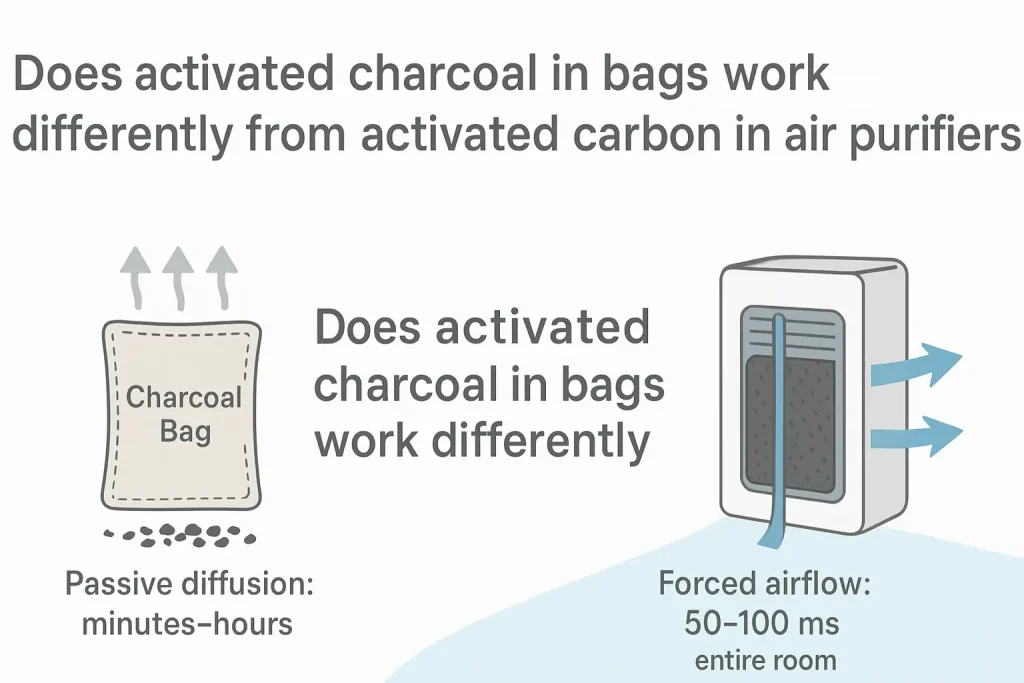
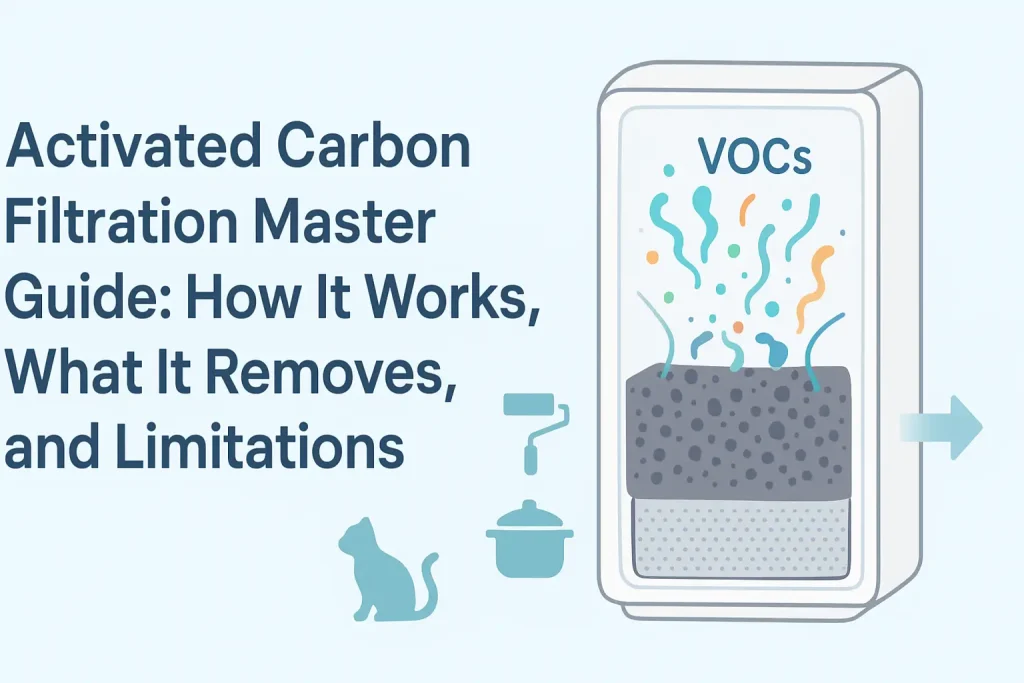
According to AHAM AC-1 testing standards, True HEPA must capture 99.97% of particles at 0.3 microns. This includes PM2.5, pet dander, pollen, dust mite allergen, and mold spores. The activated carbon stage works through adsorption, where gas molecules adhere to the carbon’s surface area. This happens because activated carbon has a porous structure with 500 to 1,500 square meters of surface area per gram, creating millions of binding sites for VOCs, formaldehyde, and cooking odor molecules. This only occurs when the carbon bed has sufficient dwell time, meaning the air must pass through it slowly enough for adsorption to take place.
If the carbon stage is too thin or air moves through it too quickly at high fan speeds, the result is odor breakthrough. The purifier appears to work because particles are removed, but cooking smells and chemical odors pass through the carbon bed without being captured. Fix this by choosing a unit with at least 2 to 3 pounds of activated carbon granules rather than a thin carbon-impregnated sheet, and run the unit on medium rather than turbo for ongoing maintenance after an initial high-speed cleaning period.
True HEPA vs HEPA-Type: Why the Distinction Matters for Large Spaces
HEPA-type filters lack a standardized testing protocol. A True HEPA filter is certified to capture 99.97% of particles at 0.3 microns. A HEPA-type filter may capture 85% to 99% of the same particles with no independent verification. In a large living room where the volume of air to be cleaned is high, the efficiency gap compounds with every pass. A unit using True HEPA at 99.97% efficiency achieves target air quality faster than a unit using 95% efficient HEPA-type filtration, even at the same CADR.
According to Consumer Reports testing, some HEPA-type filters in budget air purifiers perform at 90% to 95% efficiency for particles in the 0.3 to 1 micron range, which covers fine smoke and some bacteria. For pollen and dust mite allergen (larger than 2 microns), both filter types perform similarly. For wildfire smoke particles in the 0.1 to 0.4 micron range, the True HEPA advantage is measurable and worth the price difference in living rooms over 250 sq ft.
Activated Carbon Weight and VOC Removal in Shared Living Spaces
The activated carbon stage is the component that sets living room purifiers apart from bedroom models. Bedroom purifiers often use carbon-impregnated fiber sheets weighing less than 0.5 pounds, which are adequate for light odors but ineffective for cooking fumes, pet odors, and furniture off-gassing. Living room units need granular activated carbon pellets weighing 2 to 3 pounds or more.
The Austin Air HealthMate contains 15 pounds of activated carbon and zeolite, the highest carbon-to-price ratio among consumer air purifiers. The IQAir GC MultiGas uses multi-stage gas-phase filtration cartridges weighing 12 pounds total, designed specifically for VOC and chemical removal. Both units are CARB certified for zero ozone emission above 0.050 ppm. The trade-off is upfront cost and physical size. These units are larger and more expensive than standard HEPA purifiers, but they are the only option for living rooms with new furniture, attached garages, or frequent cooking that introduces ongoing VOC loads.
Best Air Purifiers for Living Rooms by CADR and Room Size
Use the table below to match your living room square footage to a unit with sufficient CADR at 5 ACH, plus real noise measurements and annual filter costs.
| Model | Smoke CADR | Coverage at 5 ACH | Sleep/Med Noise | Annual Filter Cost | Carbon Weight | Best For |
|---|---|---|---|---|---|---|
| Coway Airmega 400 | 400 CFM | 480 sq ft | 22 / 43 dB | $60/yr | 2.2 lbs | 350-500 sq ft living rooms |
| Blueair 605 | 500 CFM | 600 sq ft | 32 / 49 dB | $100/yr | 3 lbs | Open-plan 500+ sq ft |
| Winix 5500-2 | 243 CFM | 292 sq ft | 28 / 45 dB | $40/yr | 1.5 lbs | Small living rooms under 300 sq ft |
| IQAir HealthPro Plus | 300 CFM | 360 sq ft | 22 / 41 dB | $250/yr | 5 lbs | Severe allergies, medical-grade |
| Levoit Core 400S | 260 CFM | 312 sq ft | 24 / 44 dB | $50/yr | 1.5 lbs | Value pick, smaller living rooms |
CADR data from AHAM certified database. Coverage at 5 ACH = smoke CADR x 12 / 5. Noise levels from manufacturer specifications at sleep/medium fan speed. Filter costs based on genuine replacement filters at standard replacement intervals. Carbon weight from manufacturer technical specifications.
Living Room Air Purifier Placement: Where Should You Put It?
Place the air purifier at least 6 inches from any wall and 3 feet from any large furniture obstruction. Central placement against the longest available open wall space maximizes airflow circulation across the entire room. Corner placement reduces effective coverage by 20% to 30% according to airflow modeling studies, because the intake and exhaust are partially blocked on two sides and the clean air does not mix with the farthest corners of the room.
Do not place the unit behind a sofa, curtain, or entertainment center. These obstructions create a short-circuit loop where cleaned air exits the unit and is immediately drawn back into the intake without circulating through the room. The result is a small pocket of clean air around the purifier and unchanged particulate levels everywhere else. A PM2.5 monitor placed 15 feet from the unit will confirm this within 30 minutes of operation.
Open-Plan Living Rooms and Connected Kitchens: One Unit or Two?
An open-plan living room connected to a kitchen without a door requires treating the combined square footage as a single space. A 350 sq ft living room opening into a 200 sq ft kitchen is a 550 sq ft continuous air volume. One unit rated for 350 sq ft will clean the combined space at a lower effective ACH, roughly 60% of the target rate.
The correct approach is either one high-CADR unit rated for the full 550 sq ft, or two units placed in each zone. Two Coway Airmega 400 units (400 CFM each) in a 550 sq ft open plan at 5 ACH deliver 733 CFM combined, covering the combined space with headroom. Our guide on running multiple air purifiers in connected living spaces covers the combined CADR calculation and optimal placement patterns for L-shaped rooms.
How Much Noise Is Acceptable in a Living Room?
A living room air purifier at medium fan speed should operate between 35 and 50 dB. This is equivalent to a quiet conversation (35 dB) to moderate rainfall (50 dB). It will not interfere with television dialogue or normal conversation at these levels. At maximum fan speed, noise levels of 55 to 60 dB are acceptable for short-duration high-pollution events but are too loud for continuous use during social activity.
The Coway Airmega 400 measures 43 dB at medium fan speed and 22 dB at sleep mode, making it the quietest high-CADR option for living rooms that also serve as evening relaxation spaces. The Blueair 605 at 49 dB medium is noticeably louder but delivers 25% more CADR. For living rooms with high ambient noise from street traffic or open windows, the higher CADR of the Blueair at medium speed outweighs the noise difference.
Annual Filter Replacement Cost: What a Living Room Unit Actually Costs Per Year
Filter replacement cost is the line item most buyers ignore until the first replacement cycle. High-CADR living room units use larger filters than bedroom models, and the replacement cost scales accordingly. The Coway Airmega 400 uses a combined True HEPA and activated carbon filter set that costs approximately $60 per year at the standard 12-month replacement interval. The Blueair 605 filter costs approximately $100 per year. The IQAir HealthPro Plus uses a three-stage filter system costing approximately $250 per year.
A $200 unit with $100 annual filter costs surpasses the total cost of a $400 unit with $30 annual filters within 4 years. The Winix 5500-2 replacement filter at approximately $40 per year offers the lowest annual filter cost among units with sufficient CADR for living rooms under 300 sq ft. The Coway Airmega 400 filter set at $60 per year is the best value for living rooms over 350 sq ft. Always confirm that genuine replacement filters are available from multiple retailers before purchasing any air purifier. Proprietary filters available from only the manufacturer create a single-supplier dependency that makes you vulnerable to price increases and stock shortages.
Living Room Air Purifier and Pets: What Changes?
Pet dander, fur, and odor add three challenges that a standard living room setup does not address. First, pet dander particles range from 2.5 to 10 microns, larger than fine smoke but smaller than visible dust. True HEPA captures dander at 99.97% efficiency, but the pre-filter clogs faster with visible fur and must be cleaned every 2 to 4 weeks instead of every 2 to 3 months. Second, pet odors are gaseous and require activated carbon adsorption. A carbon stage of 2 pounds or more is necessary for a living room with one or more pets to prevent ongoing odor.
Third, the CADR requirement increases because pets continuously shed dander and fur throughout the day. The particulate load in a living room with two dogs or cats is 2 to 3 times higher than in a pet-free space. A unit sized to the room square footage at 5 ACH for a pet-free home may need to run at 6 ACH or higher to achieve the same air quality in a pet-occupied space. Our guide on air purifiers specifically designed for bird dander and fine feather dust covers the extra pre-filtration needed for avian particulates, which are lighter and remain suspended longer than mammal dander.
How Does Living Room Air Quality Affect the Rest of the House?
The living room is typically the largest open volume in a home and connects to hallways, staircases, and adjacent rooms. Particulate matter generated in the living room migrates throughout the entire floor within 1 to 2 hours via normal air currents and foot traffic. An air purifier in the living room that achieves 5 ACH effectively scrubs the air that feeds those connected spaces.
This happens because the living room acts as a central air reservoir. When particulates are removed at 5 ACH in the living room, concentration gradients drive cleaner air into connected rooms where the air is dirtier. This only occurs when the living room unit is sized correctly for the space and runs continuously on medium or auto mode rather than intermittently on turbo. If the unit is undersized or turned off during the day, the result is no meaningful air quality improvement in connected rooms. Fix this by running the living room unit 24/7 at its medium fan speed setting, which is the most energy-efficient mode relative to CADR output for most ENERGY STAR certified large-room purifiers.
True HEPA vs Activated Carbon vs UV-C: Which Combination for a Living Room?
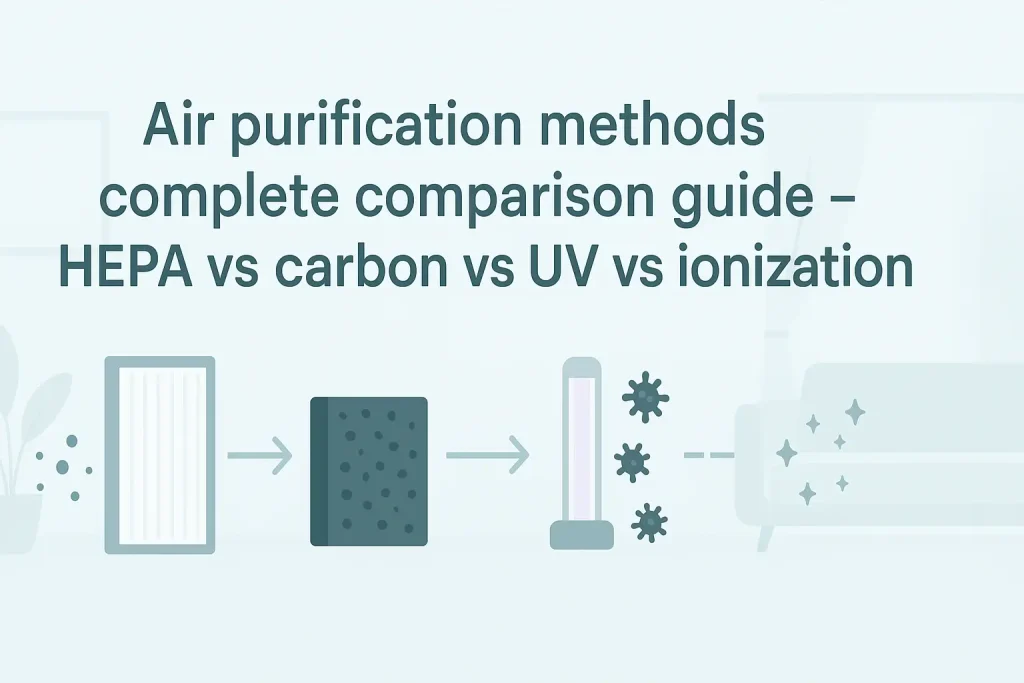
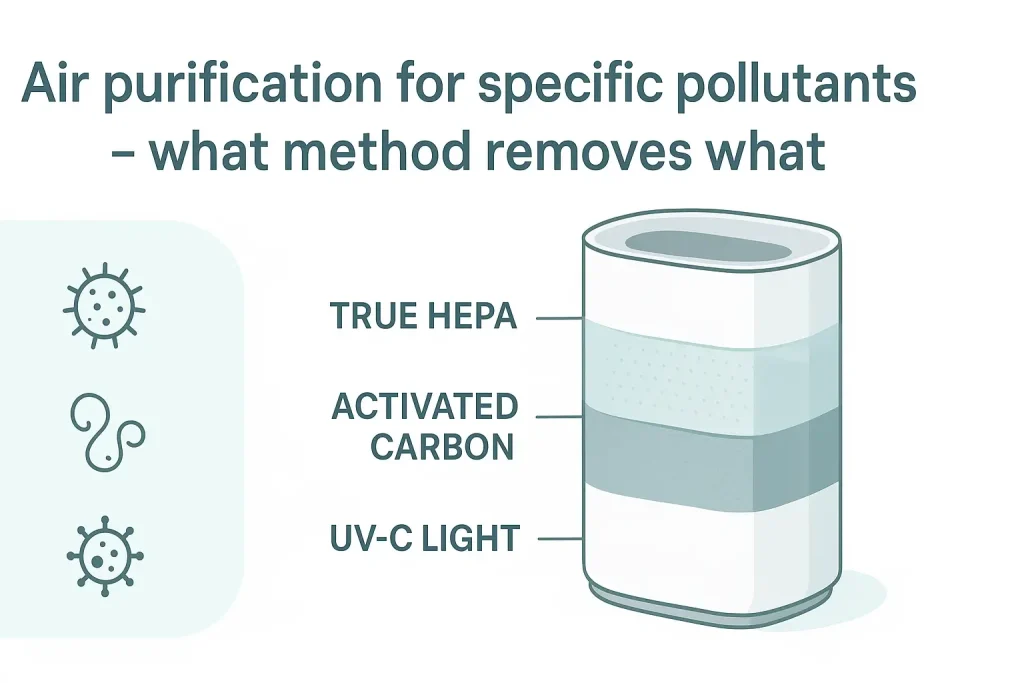
True HEPA removes particles. Activated carbon removes gases and odors. UV-C kills airborne pathogens. A living room with cooking, pets, and multiple occupants needs True HEPA plus activated carbon. UV-C adds pathogen inactivation but contributes nothing to particle or odor reduction. Ionizers are not recommended for living rooms because charged particles deposit on walls, furniture, and floors rather than being captured in a filter.
According to the EPA, ionizers that generate ozone above 0.050 ppm (the CARB limit) introduce respiratory irritants into the largest occupied room in the home. The Winix 5500-2 includes an ionizer that can be switched off, and the unit is CARB certified below 0.050 ppm when the ionizer is off. The Coway Airmega 400 and Blueair 605 use no ionizer and achieve high CADR through mechanical filtration alone.
What Is the Best Air Purifier for a Living Room with Asthma Sufferers?
The Coway Airmega 400 is the highest-rated living room air purifier for asthma management because it combines 400 CFM smoke CADR with AHAM certification and AAFA asthma and allergy friendly approval. It is one of fewer than 10 air purifiers to carry both certifications. The AAFA certification means the unit has been independently tested to reduce allergens in a specific room size at a specific ACH rate, not just in a laboratory chamber.
For a 350 sq ft living room at 5 ACH, the Airmega 400 delivers adequate CADR with headroom to run on medium rather than turbo, which keeps noise below 44 dB. Filter replacement costs of approximately $60 per year are at the low end for high-CADR units. Our full guide on air purifiers specifically designed for asthma management covers additional models and the specific trigger thresholds that determine whether a unit is adequate or merely marketed as asthma-friendly.
Can You Run an Air Purifier 24/7 in the Living Room?
Yes. An air purifier can run continuously in the living room without any risk to the unit or occupants, provided it is CARB certified and uses no ionization. Continuous operation on auto or medium fan speed is the intended use case for all AHAM-certified purifiers. The motor and fan in units like the Coway Airmega 400 and Blueair 605 are rated for continuous duty cycles of 8,000 to 40,000 hours, equivalent to 1 to 5 years of continuous operation before any bearing degradation.
Running a unit continuously on medium consumes less electricity than intermittent operation on turbo. The Coway Airmega 400 draws approximately 44 watts at medium speed, costing $50 per year at the U.S. average electricity rate of 13 cents per kilowatt-hour if run 24/7. Intermittent turbo operation at 77 watts may cost more overall depending on duty cycle, while achieving the same or lower total air changes per day due to off-cycle particulate accumulation.
Why Does My Living Room Air Purifier Smell Like Burning or Ozone?
A burning smell from a new air purifier within the first 48 hours of operation is off-gassing from manufacturing residues on the motor, plastic housing, or filter adhesives. This is harmless and dissipates completely within 2 to 3 days of continuous operation. Open windows and run the unit on turbo for the first 48 hours in an unoccupied room to accelerate off-gassing before placing it in the living room.
A persistent ozone or electrical smell after the first week indicates either a defective ionizer generating ozone above the CARB 0.050 ppm limit, or a failing motor generating electrical arcing. Turn the unit off immediately and check whether the ionizer is engaged on models like the Winix 5500-2. If the smell persists with the ionizer off, the unit needs repair or replacement. Do not continue running an air purifier that produces a detectable ozone smell in an occupied living room. Ozone at concentrations above 0.050 ppm causes airway irritation, coughing, and reduced lung function in healthy adults within hours of exposure.
What Went Wrong When My Air Purifier Made the Air Feel Stuffy Instead of Fresh?
A stuffy feeling after running an air purifier for several hours is almost always caused by inadequate activated carbon, not the HEPA filter. The True HEPA stage removes particles, making the air measurably cleaner. But if the carbon stage is too small or exhausted, gaseous pollutants including exhaled CO2 and low-level VOCs accumulate because the unit recirculates room air without introducing fresh outdoor air.
An air purifier does not add oxygen or remove CO2. It only filters the air already in the room. In a tightly sealed living room with closed windows and multiple occupants, CO2 levels rise regardless of air purifier operation. The solution is not a different purifier. It is 5 to 10 minutes of window ventilation every 2 to 3 hours to exchange indoor air for fresh outdoor air, then resume purifier operation to clean the newly introduced outdoor particulates.
Is a Bigger Air Purifier Always Better for a Living Room?
No. An oversize air purifier in a small living room cycles air faster but does not clean to a lower particle concentration than a correctly sized unit at the same ACH target. A 500 CFM unit in a 200 sq ft living room reaches 5 ACH in 12 minutes. A 250 CFM unit in the same room reaches 5 ACH in 24 minutes. After 24 minutes, both rooms have the same particle reduction (approximately 85% at 5 ACH).
The oversize unit costs more upfront, costs more in annual filter replacements, and typically generates more noise at equivalent fan speeds. The only valid reason to oversize is for intermittent high-pollution events where the unit must clean the room from a high starting PM2.5 to a target level in the shortest possible time. Our guide on how air purifiers reduce dust settling on furniture explains the relationship between room air changes, particle suspension time, and surface dust accumulation.
What Is the Difference Between AHAM CADR and Manufacturer Coverage Area?
AHAM CADR is a laboratory-measured airflow rate in cubic feet per minute for smoke, dust, and pollen, tested in a standardized chamber per AHAM AC-1. Manufacturer coverage area is a derived number, typically calculated as smoke CADR multiplied by 1.55 to get square footage at 2 ACH. The formula is: coverage area at 2 ACH = smoke CADR x 1.55.
A unit with a 300 CFM smoke CADR claims coverage of 465 sq ft at 2 ACH. At 5 ACH, the same unit covers only 186 sq ft (300 x 12 / 5 = 720 / 5 = 144 sq ft at 8-foot ceilings, adjusted to 186 sq ft with AHAM’s ceiling height assumption). The manufacturer coverage area is always at 2 ACH, which is the minimum standard for general air quality improvement. For any health-related use case including allergies, asthma, or wildfire smoke, always calculate coverage at 4 to 5 ACH using the AHAM formula.
Do Air Purifiers Help with Cooking Smells in an Open-Plan Living Room?
Yes, but only if the unit has sufficient activated carbon. Cooking smells are a mixture of particulate matter (oil droplets, smoke particles) and gaseous VOCs (volatile organic compounds from heated oils, spices, and food). True HEPA captures the particulates. Activated carbon adsorbs the VOCs that carry the smell.
A carbon-impregnated fiber sheet of less than 0.5 pounds, common in budget purifiers, saturates within 20 to 30 minutes of active cooking and allows odor breakthrough. A granular activated carbon bed of 2 to 3 pounds handles 30 to 60 minutes of cooking odor without saturation. For open-plan kitchens, install a range hood that vents outdoors as the primary cooking emission control, and use the air purifier as secondary cleaning for particulate matter that escapes the hood’s capture area.
Can Cigarette Smoke Be Fully Removed from a Living Room by an Air Purifier?
An air purifier with True HEPA and a substantial activated carbon stage reduces cigarette smoke particulate and odor significantly, but does not fully remove all smoke constituents. The particulate phase of cigarette smoke, visible as a blue-gray haze, is captured by True HEPA at 99.97% efficiency. The gaseous phase, containing hundreds of VOCs including benzene, formaldehyde, and acrolein, requires a heavy activated carbon bed of 5 pounds or more for meaningful reduction.
Third-hand smoke residue deposited on walls, furniture, carpets, and curtains continues to off-gas VOCs for weeks to months after smoking stops. An air purifier only addresses airborne contaminants. It does not remove deposited residue. Our detailed guide on what air purifiers can and cannot do for cigarette smoke covers the particle vs gas phase distinction and the specific carbon weights needed for meaningful smoke VOC reduction.
How Long Does It Take an Air Purifier to Clean a Living Room?
At 5 ACH, an air purifier reduces airborne particle concentration by approximately 85% to 90% within 30 minutes of operation starting from a typical indoor background PM2.5 level of 10 to 20 micrograms per cubic meter. At 2 ACH, the same reduction takes approximately 60 to 75 minutes. ACH is the dominant variable. CADR, room volume, and ACH are linked by the formula ACH = (CADR x 60) / room volume in cubic feet.
A 350 sq ft living room with 8-foot ceilings has a volume of 2,800 cubic feet. A 400 CFM smoke CADR unit in this room delivers (400 x 60) / 2,800 = 8.6 ACH on turbo. At medium speed with approximately 300 CFM effective CADR, the unit delivers 6.4 ACH. The time to achieve approximately 90% particle reduction at 6.4 ACH is roughly 22 minutes. At 2 ACH from an undersized unit, the same reduction takes approximately 70 minutes.
What Certifications Should a Living Room Air Purifier Have?
The minimum certification requirement is CARB certification to confirm ozone emissions are below 0.050 ppm per California Air Resources Board CCR Title 17. This is required by law for sale in California and serves as the de facto national safety standard. AHAM Verifide certification confirms that the CADR values stated on the unit packaging are independently tested and verified in an AHAM-accredited laboratory. ENERGY STAR certification confirms that the unit meets current energy efficiency standards for continuous operation.
AAFA asthma and allergy friendly certification is the highest certification for health-related use, requiring independent verification that the unit reduces allergen levels in a specific room size under real-world conditions. Fewer than 10 units on the market carry both AHAM and AAFA certification. The Coway Airmega 400 and RabbitAir MinusA2 are among the units that carry all three certifications: CARB, AHAM, and AAFA.
Do Living Room Air Purifiers Help with Mold Spores?
Yes. Mold spores range from 3 to 40 microns in size, well within the capture range of True HEPA filtration at 99.97% efficiency. An air purifier captures airborne mold spores that have already been released from a mold colony. It does not kill the colony, remove mold embedded in walls or carpets, or reduce the humidity that drives mold growth.
A living room with visible mold on walls or a persistent musty odor needs source remediation and humidity control (below 50% relative humidity), not just air purification. The air purifier is a supplementary measure that reduces spore count in the air while the underlying moisture problem is addressed. Our guide on choosing an air purifier specifically for mold spore reduction covers the CADR, filter type, and humidity control combination that actually works for mold-sensitive occupants.
The right living room air purifier does not add a new appliance to your space. It replaces the particulate load you are already breathing with air that meets the same standard as the AHAM test chamber, 5 air changes per hour, at a noise level and running cost you can sustain year-round. Calculate your square footage, multiply by your ceiling height, multiply by 5 ACH, divide by 60, and buy nothing below that CADR number. Run the unit on medium speed continuously, replace the filters on schedule, and confirm the results with a PM2.5 monitor placed across the room. The formula is specific. The outcome is clean air in the largest and most lived-in room of your home.