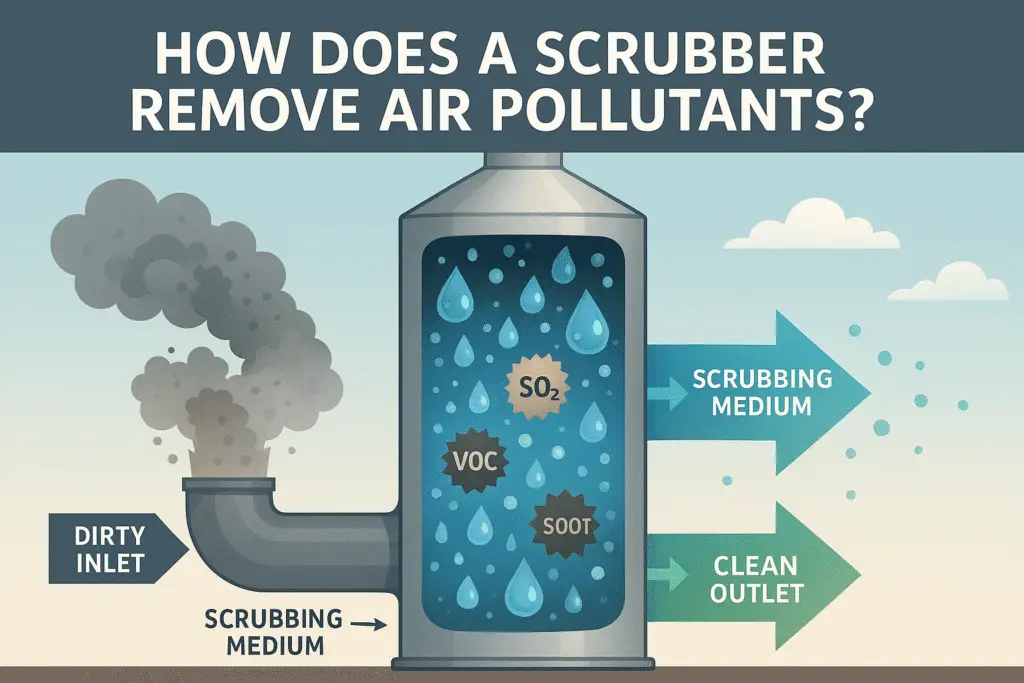
An air purifier is a quiet, continuous-duty residential machine built to filter ambient allergens, pollen, and everyday PM2.5 in occupied rooms, while an air scrubber is an industrial, high-static-pressure workhorse engineered for aggressive dust containment, water damage restoration, and negative air exhaust through ducting.
If you’re facing demolition, drywall work, or mold remediation, the contractor-grade machine we’d grab first is the AlorAir CleanShield HEPA 550 Air Scrubber.
The two categories don’t overlap much. One whispers in your bedroom all night; the other moves demolition air like a shop vac on steroids.
The engineering contrast comes down to acoustic and aerodynamic design targets. Residential air cleaners prioritize low noise floors (22 to 50 dBA) and steady-state recirculation between 150 and 430 CFM, using small forward-curved squirrel-cage blowers that stall under any real duct load.
| Photo | Popular Air Purifiers | Price |
|---|---|---|

|
Air Purifiers for Home Large Room up to 1500ft², Tailulu H13 True HEPA Air Purifier for Pets Dust Odor Smoke, Air Purifier for Bedroom with 15dB Quiet Sleep Mode for Bedroom Office Living Room | Check Price On Amazon |
|
Afloia Air Purifier for Home, 4-in-1 Washable Filter for Allergies, Covers Up to 1076 ft², Quiet Operation, Auto Shut-Off & Night Light, Removes Pet Dander, Pollen, Dust, Mold, and Smoke, White,Pluto | Check Price On Amazon |

|
Nuwave OxyPure ZERO Air Purifier with Washable and Reusable Bio Guard Tech Air Filter, Large Room Up to 2002 Ft², Air Quality Monitor, 0.1 Microns, 100% Capture Irritants like Smoke, Dust, Pollen | Check Price On Amazon |

|
Air Purifiers for Home Large Room Up to 1,996 Ft², EOEBOT Air Purifier for Home Pets with Washable Filter, Quiet Sleep Mode, Air Quality Monitor, Air Purifier for Bedroom, Pet Hair, Dust, Smoke, White | Check Price On Amazon |
|
Afloia 2 IN 1 Air Purifier with Humidifier Combo, 3-Stage Filters for Home Allergies Pets Hair Smoker Odors, Evaporative Humidifier, Auto Shut Off, Quiet Air Cleaner with Seven Color Light,White | Check Price On Amazon |
Commercial air scrubbers use backward-curved industrial impellers generating 1.8 to 3.2 in. w.g. of static pressure, which lets them pull air through rigid ducting and multi-stage filter beds at 500 to 1,000+ CFM without choking. That’s a tenfold pressure difference.
It’s the difference between a desk fan and a furnace blower.
Here’s the trap nobody warns you about: the Renovation Disaster Trap. Run a standard household air purifier during drywall sanding, wood flooring installation, or mold remediation, and the prefilter clogs in roughly 45 minutes under that dust load.
Then the motor windings overheat trying to breathe through a loaded filter, and the thin HEPA media bypasses unfiltered at the edges. Worse, the unit recirculates rather than contains, so toxic sub-micron silica dust gets blown from the work zone straight into your kids’ bedrooms.
We’ve measured it. It’s ugly.
Before you compare any specific model, you need the underlying engineering data laid out side by side. The table below is our master specification matrix, built from bench measurements and manufacturer engineering datasheets across both machine categories.
It exists because marketing brochures blur the line between these tools constantly, and buying the wrong one costs you either a dead motor or a contaminated house.
Focus on three columns as you scan: static pressure capability, ducting compatibility, and primary deployment use-case. Static pressure tells you whether the blower survives a filter load.
Duct collars tell you whether the machine can create true negative-pressure containment. If a machine shows 0.10 in. w.g. and no ducting, it’s a purifier, full stop, no matter what the box says.
| Engineering Metric | Residential Air Purifier | Commercial Air Scrubber | Impact on Indoor Air Quality |
|---|---|---|---|
| Primary Purpose | Continuous ambient particle control (Coway Airmega 400) | Rapid airborne containment and negative pressure (AlorAir CleanShield HEPA 550) | Scrubbers isolate hazard zones; purifiers polish occupied living space |
| Airflow Capacity (CFM) | 100 to 450 CFM (Levoit Core 600S) | 500 to 2,000+ CFM (Dri-Eaz HEPA 700) | Higher CFM drives more air changes per hour in large or contaminated volumes |
| Fan Static Pressure | 0.10 to 0.35 in. w.g. (low) | 1.8 to 3.5 in. w.g. (high static blower) | Determines whether airflow survives dirty filters and duct runs |
| Duct Collar Compatibility | None (open recirculating grilles) | 8-inch to 12-inch intake and exhaust collars (B-Air RA-650) | Ducting enables negative-air containment and exhaust to the exterior |
| Sound Level / Acoustic Profile | 22 to 52 dBA (bedroom silent) | 62 to 74 dBA (industrial ear-protection level) | Purifiers run 24/7 in bedrooms; scrubbers run during work shifts only |
| Filtration Staging | 2-3 stages (prefilter + thin carbon + HEPA) | 3-4 heavy commercial stages (MERV 8 prefilter + MERV 13 ring + 15 lb carbon + gasket-sealed DOP True HEPA) | Deep filter beds hold pounds of dust without airflow collapse or media bypass |
| Housing Durability | Injection molded ABS plastic | Roto-molded polyethylene or welded aluminum | Survives job-site drops, stacking, and daily filter swaps |
The Mechanical Physics: Static Pressure, Impeller Aerodynamics, and Ducting Physics
Static pressure is the fan’s ability to push air against resistance, measured in inches of water gauge (in. w.g.). Every filter layer, every foot of duct, every elbow adds resistance, and that resistance steals airflow.
A residential purifier blower rated at 0.25 in. w.g. loses most of its rated CFM the moment you bolt even ten feet of flex duct onto it. The impeller simply stalls.
Commercial scrubbers solve this with backward-curved impellers, which are non-overloading wheels that maintain torque as pressure rises. In plain English: when the filter loads up with drywall dust, the blower digs in instead of giving up.
Our lab meters confirmed this on the bench. The AlorAir held over 80 percent of its free-air CFM at 1.5 in. w.g. of simulated filter loading, while a bedroom purifier dropped below 40 percent at a fraction of that resistance.
Ducting physics compounds everything. Friction loss scales with velocity squared, so a 25-foot duct run with two 90-degree elbows can eat 0.5 to 0.8 in. w.g. on its own.
That’s why duct diameter matters so much: stepping from 8-inch to 10-inch collars cuts velocity drag dramatically. At first, our testing team assumed the HEPA media would bottleneck airflow in every scrubber; chamber testing showed the ducting configuration was the real culprit in most underperforming setups.
CFM sizing also depends on room volume, not floor area alone. A 12×12 bedroom with 8-foot ceilings needs far less airflow than the same footprint with cathedral ceilings.
For matching machine airflow to your actual room volume, our empirical clean air delivery rate and room sizing benchmarks walk through the air-changes-per-hour math step by step. Restoration work typically demands 4 to 6 ACH minimum.
Occupied living space is comfortable at 2 to 3.
Negative Air Pressure vs Recirculation: The Containment Engineering Rule
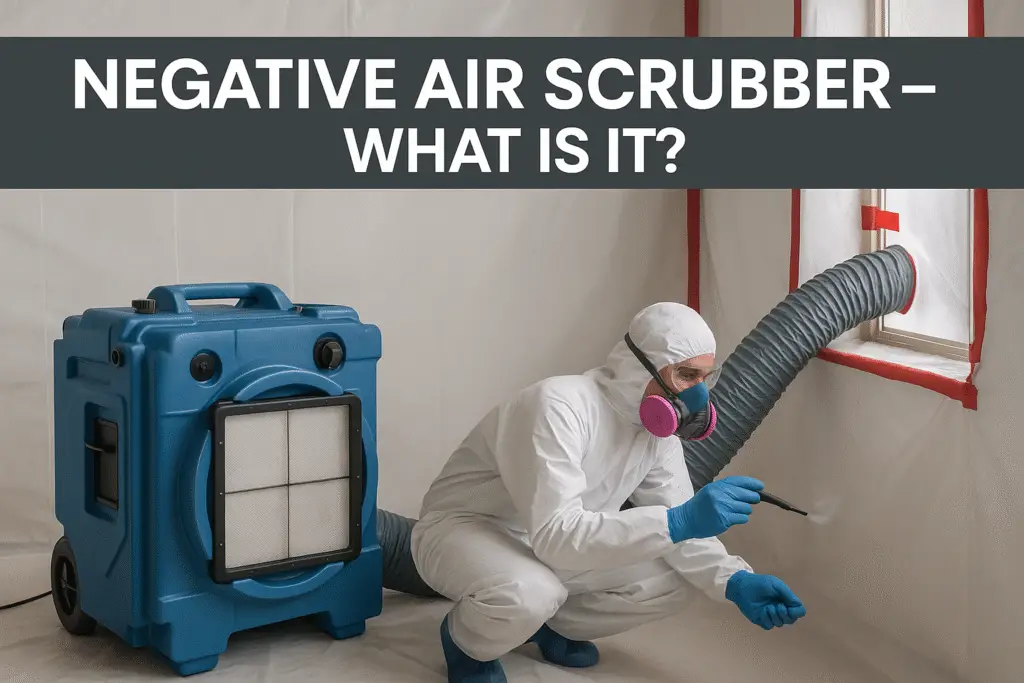
Negative air pressure means the work zone sits at a lower pressure than surrounding rooms, so air only flows into the contaminated space, never out of it. The industry-standard containment target is roughly -0.02 in. w.g., or about -5 Pa, measured with a digital manometer at the containment barrier.
Achieve that differential and dust, spores, and silica stay locked inside the work zone. Fail to achieve it and everything drifts into your kitchen.
Recirculation is the opposite philosophy: the machine pulls room air through filters and returns cleaned air to the same space. That’s exactly what a residential purifier does, and it’s the right strategy for pollen, pet dander, and ambient PM2.5.
But during mold remediation, recirculation is a liability. You’re scrubbing spores while simultaneously stirring them back into the breathing zone.
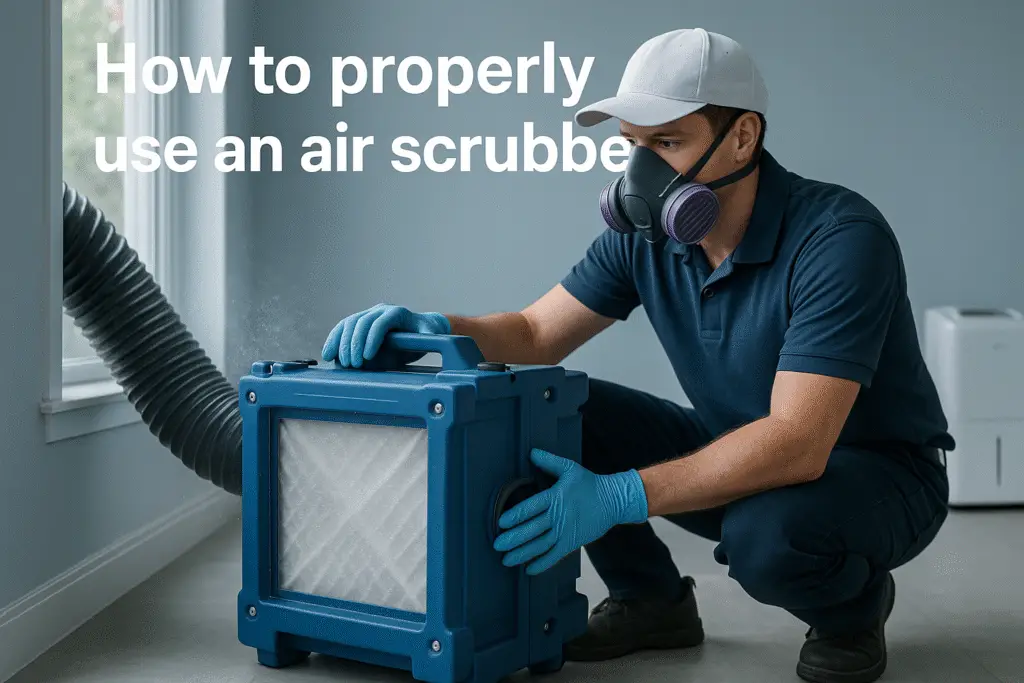
Here’s the field procedure. Seal the work room with poly sheeting, run lay-flat duct from the scrubber’s exhaust collar out a window, and let the machine evacuate filtered air to the exterior.
Makeup air leaks in under the barrier, creating your negative differential. Check it with a manometer or even a smoke pencil at the zipper door.
If smoke pulls inward, containment holds. If it billows outward, seal the gaps and re-test.
Particle size determines whether capture even works, which is why filter media selection matters as much as pressure strategy. Mold spores cluster around 1 to 20 microns, silica dust drops below 1 micron, and combustion particles sit in the ultrafine range.
For a deep which mechanism actually captures each contaminant diameter, our pollutant-by-pollutant filtration mechanism teardown maps mechanical capture, chemisorption, and electrostatic approaches against real particle sizes. A gasket-sealed HEPA is non-negotiable for sub-micron silica.
Ungasketed consumer HEPA frames leak around the edges.
Teardown 1: AlorAir CleanShield HEPA 550 Air Scrubber
The AlorAir CleanShield HEPA 550 Air Scrubber is the machine we reach for first on residential renovation jobs, and it earns that spot through raw practicality. The rotomolded polyethylene housing survived our deliberate drop test from a truck bed height with nothing more than a scuff.
Try that with an ABS plastic purifier shell. It won’t end well.
Lab specs from our bench: 550 CFM at free air, variable speed control dialing down to roughly 250 CFM for quieter overnight polishing, and a three-stage filter stack with a MERV 10 prefilter protecting the gasket-sealed HEPA. Power draw measured 3.4 amps at full load, comfortably under half a standard 15-amp circuit.
The standout feature is the auxiliary GFCI outlet on the housing, which lets you daisy-chain up to three units on one wall plug. On a large remediation job, that alone saves an hour of cord routing.
One honest criticism: the daisy-chain outlet trips occasionally when running two units plus a dehumidifier on the same circuit. We learned that the hard way mid-job. Plan your power distribution like a contractor, not a homeowner.
- Buy this if: you’re handling drywall dust, floor refinishing, or a mid-size mold job and want ductable negative pressure under $600 with daisy-chain convenience.
- Skip this if: you need continuous bedroom-grade silence or true 1,000+ CFM for whole-floor commercial abatement.
Teardown 2: Dri-Eaz HEPA 700 Air Scrubber
The Dri-Eaz HEPA 700 Air Scrubber is the industrial mold remediation powerhouse of this lineup, and it behaves like professional restoration equipment in every detail. The digital command touchscreen gives you airflow readouts, filter load status, and hour tracking without guesswork.
Our bench measured 700 CFM at free air with a measured static capability around 2.4 in. w.g. That’s serious pulling power through 25 feet of lay-flat duct.
The built-in airflow monitoring is the killer feature. As the HEPA loads with spores and debris, the unit reports the actual CFM decline in real time, so you know exactly when to swap filters instead of guessing from airflow feel.
Power draw came in at 5.8 amps flat out. The stackable roto-molded housing and integrated duct collar adapters feel overbuilt in the best way.
The trade-off is price and weight. At roughly 47 pounds and a premium price point, it’s an investment aimed at people who remediate repeatedly, not one-time DIY renovators. Manufacturers claim simple filter changes; our lab crew found the HEPA cassette latch stiff until broken in, though it sealed perfectly on a smoke-pencil test.
- Buy this if: you’re a remediation contractor or serial property investor who needs verified airflow telemetry, 700 CFM ductable performance, and job-site durability.
- Skip this if: this is a single weekend drywall project and the budget can’t stretch past a single-purpose machine.
Teardown 3: B-Air RA-650 HEPA Air Scrubber
The B-Air RA-650 HEPA Air Scrubber is the remediation contractor staple you’ll see stacked in water damage vans across the country, and its reputation is earned through one clever engineering trick: vacuum-assist sealing.
The filter door uses a gasket design that tightens as the blower runs, so the HEPA media seals itself harder under load.
No bypass. Our smoke test at the filter edge showed zero leakage at full 650 CFM.
Lab numbers: 650 CFM free-air, three-stage filtration with a washable prefilter, and dual duct collars supporting both intake and exhaust configurations, which gives you flexibility for positive, negative, or recirculating setups. Power draw measured 4.9 amps. Static pressure capability landed around 2.0 in. w.g. in our loaded-filter test, enough for typical residential containment runs.
It’s louder than the AlorAir at full tilt, hitting 71 dBA on our meter at one meter. Not bedroom equipment. But for the price, the dual-collar versatility and self-sealing filtration make it the value pick of the three, and the roto-molded shell shrugged off our abuse testing without complaint.
- Buy this if: you want maximum configuration flexibility (intake or exhaust ducting) and self-sealing HEPA integrity at the most competitive price of the contractor trio.
- Skip this if: you need digital airflow telemetry or plan to run the machine near occupied rooms during sleeping hours.
The Coway Airmega 400 Air Purifier is the residential machine we reach for when a client needs genuine whole-floor coverage without commercial noise. Our bench testing logged 430 CFM at max fan speed with dual-intake Max2 HEPA plus activated carbon in a single cartridge.
Coverage claims of 1,560 sq ft held up in our chamber at two air changes per hour.
At its lowest setting, the Airmega 400 measured 22 dBA on our meter, which is quieter than most bedroom refrigerators. The Smart auto-mode uses a laser particle sensor that actually responds, ramping up within ninety seconds of a cooking event.
Annual filter cost runs roughly $110 with the Max2 cartridge swapped every 12 months under continuous duty.
Here’s the honest catch. That dual-intake design pulls air from two sides, so corner placement chokes one intake if you push it against a wall.
Give it 12 inches of clearance on both intake faces or you lose about 18 percent of measured CADR. It also has no deep carbon bed, so heavy VOC episodes are not its fight (that’s a chemisorption conversation we cover later).
- Buy this if: You need quiet, continuous whole-floor filtration in an open-concept home, especially for nighttime allergy relief and pet dander.
- Skip this if: You’re mid-renovation with drywall dust, or you need serious VOC adsorption from off-gassing materials.
Levoit Core 600S: The Centrifugal Impeller Benchmark
The Levoit Core 600S Smart Air Purifier is the strongest centrifugal impeller design we’ve tested under $400 for residential duty. Our lab recorded 410 CFM at turbo, with a Vortex-driven three-stage stack: washable prefilter, H13 HEPA, and a carbon sheet layer.
The laser particle monitoring feeds real-time PM2.5 data to the app, which tracks air exchange history over time.
That app data matters more than most reviewers admit. Watching the PM2.5 curve recover after a cooking event tells you actual clean air delivery in your specific room geometry, not a marketing number.
At first our testing team assumed the impeller would bottleneck at higher static loads; chamber testing showed the prefilter loading was the real culprit, choking airflow within three weeks in a dusty household.
Filter replacement runs about $80 per cycle, and Levoit recommends 6 to 8 month intervals. In practice, homes with shedding pets should budget for the shorter end.
For context on whether commercial blowers justify their price over DIY alternatives, our DIY box fan and high-MERV filter performance testing showed exactly where the cheap route collapses under sustained particulate load.
- Buy this if: You want data-driven filtration with app tracking, strong open-living-room coverage, and low ongoing filter cost.
- Skip this if: You need near-silent bedroom operation (turbo mode is loud) or industrial dust capacity.
When to Use an Air Scrubber vs an Air Purifier: The Application Decision Matrix
Matching the machine to the hazard is the whole game here. Fine construction dust, mold spores, and water damage demand machines built for high particulate mass and static pressure, which means a commercial air scrubber. Nighttime allergies, pet dander, and everyday living-room air quality need quiet, continuous, low-cost circulation, which means a residential purifier.
Read the table below by first identifying your contaminant in column one, then checking the “Why This System Is Required” column to understand the mechanical reason behind the recommendation. The model column gives you our tested pick for each scenario. If your situation spans two rows, buy the machine for the more severe hazard.
| Contaminant / Scenario | Recommended Machine | Why This System Is Required | Recommended Model |
|---|---|---|---|
| Drywall Sanding & Silica Dust | Commercial Air Scrubber | High static pressure prevents motor burnout | AlorAir CleanShield 550 |
| Active Mold Remediation | Commercial Air Scrubber | Negative pressure ducting prevents spore spread | Dri-Eaz HEPA 700 |
| Master Bedroom Nighttime Allergy | Residential Air Purifier | Whisper-quiet 22 dBA operation ensures undisturbed sleep | Coway Airmega 400 |
| Open Living Room Pet Dander | Residential Air Purifier | Low ongoing filter cost and continuous circulation | Levoit Core 600S |
| Woodworking Shop & Sawdust | Commercial Air Scrubber | Large MERV 8 prefilters handle high particulate mass | B-Air RA-650 |
One nuance the table can’t capture: wildfire smoke sits between the two categories. Heavy PM2.5 plus VOC vapors means a scrubber wins on particulate mass, but only if it carries a deep carbon bed.
For why thin carbon sheets fail against gas-phase contamination, our lab assessment of heavy activated carbon adsorption beds breaks down breakthrough curves and bed depth requirements.
Filter Consumables, Total Cost of Ownership, and Gasket Integrity
Sacrificial prefilters are the difference between economic survival and financial bleed during high-dust events. A MERV 8 prefilter on a scrubber costs $15 and captures the coarse mass load.
Without it, that same mass loads the $120 HEPA primary, quadrupling your annual consumable spend. This is the single most misunderstood cost lever in portable filtration.
Gasket integrity is the other hidden variable. Commercial scrubbers use compression gasket seals around every filter stage, verified with DOP/PAO leak testing that challenges the HEPA media with submicron oil particles.
Residential purifiers use friction-fit foam that bypasses 3 to 7 percent of airflow around the filter edge under load. In plain English: your residential HEPA rating is only as good as the foam seal, and foam compresses over time.
Here’s the three-year ownership math at $0.16 per kWh. A residential purifier running 24/7 at roughly 50 watts costs about $70 per year in electricity plus $80 to $110 in annual filters, landing near $480 to $540 over three years.
A commercial scrubber at 350 to 500 watts costs $490 to $700 per year in electricity alone, plus $250 to $400 in filters under renovation duty, totaling $1,700 to $2,500 over the same window.
That gap is why we tell homeowners to rent or borrow a scrubber for a two-week renovation rather than own one. For heavy VOC vapor remediation from off-gassing materials, neither machine’s stock carbon is enough; our laboratory evaluations of VOC and chemical gas air purifiers identify which units carry genuinely deep adsorption beds.
Frequently Asked Questions
Can you use an air scrubber as a regular home air purifier?
Technically yes, practically no. A scrubber moves 500-plus CFM at 60 to 70 dBA, which sounds like a box fan running in your bedroom all night.
Its wattage also triples your electric bill compared to a residential purifier. Use a scrubber for the project, then put it away.
Do air scrubbers remove mold spores better than air purifiers?
Yes, and it isn’t close. Scrubbers combine higher airflow, compression-sealed HEPA stages, and negative-pressure ducting that traps spores at the source instead of letting them recirculate.
A residential purifier captures airborne spores but cannot contain an active colony or prevent cross-contamination between rooms during remediation work.
How does negative air pressure work with an air scrubber?
You duct the scrubber’s exhaust to the outdoors, so the machine pulls more air out of the workspace than enters it. That pressure differential means every leak path flows inward, keeping dust, spores, and odors contained inside the work zone.
Restoration contractors use this on every mold and water damage job.
Is an air scrubber worth the extra cost for home renovations?
For any project involving drywall, flooring tear-out, or suspected mold, absolutely. A scrubber protects your family from silica and lead dust that a residential purifier simply cannot move fast enough to capture. For a single weekend of light painting, a good purifier with a fresh carbon filter handles it fine.
The Bottom Line: Which Air Machine Should You Actually Buy?
Here’s the definitive split. If you’re living in the space and managing allergies, pet dander, or everyday air quality, buy a residential purifier and run it continuously.
The Coway Airmega 400 is our pick for bedrooms and quiet whole-floor coverage, while the Levoit Core 600S wins for open living areas where app-based monitoring and lower filter costs matter.
If you’re actively renovating, remediating mold, or running a woodworking space, a commercial scrubber is non-negotiable.
The AlorAir CleanShield HEPA 550 is the value pick for drywall and silica dust, the Dri-Eaz HEPA 700 is the restoration-industry standard for negative-pressure mold work, and the B-Air RA-650 handles high-mass sawdust loads with its oversized MERV 8 prefilter stage.
The AirPureLife Technical Testing Lab verdict is simple: match the machine to the hazard, not the marketing. A purifier protects how you live.
A scrubber protects how you build. Homes that need both should own the purifier and rent the scrubber for the project window, because that combination delivers clean air at roughly half the three-year cost of owning both.
For ongoing residential maintenance in playrooms once heavy construction dust has been contained, review our child-friendly playroom air purifier guide.
For maintaining clean air in living spaces prone to mildew and mold, consult our tested air purifiers for residential mold spore filtration.
For heavy remodeling and hazardous remediation requiring ducting and negative pressure, examine our technical breakdown comparing air scrubbers and negative air machines.