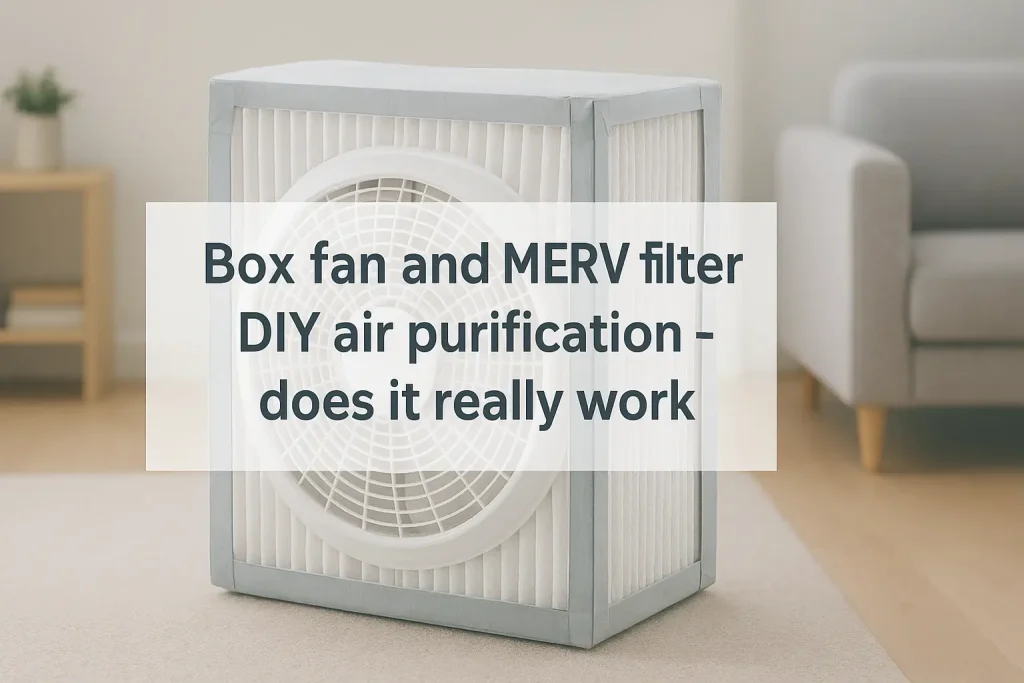
A box fan with a taped-on furnace filter is not an air purifier. It is a fan with a filter attached, and its performance depends entirely on the fan’s static pressure curve, the filter’s MERV rating, and the seal you build around it.
A purpose-built True HEPA air purifier is engineered from the ground up to pull air through a sealed, high-resistance filter at a specific airflow rate measured as CADR. Knowing which one you need starts with understanding that fundamental difference.
What Is a Box Fan Air Filter and How Does It Compare to a True HEPA Air Purifier?
A box fan air filter is a standard 20-inch household fan with a flat furnace filter attached to the intake side, usually with tape or a bungee cord. It works by pulling room air through the filter media using the same motor that was designed solely for unobstructed air circulation.
A purpose-built air purifier uses a sealed, gasketed filter housing and a high-static-pressure fan engineered for that specific resistance. The result is predictable, AHAM-certified clean air delivery, measured as smoke CADR in cubic feet per minute.
| Photo | Popular Air Purifiers | Price |
|---|---|---|

|
Air Purifiers for Home Large Room up to 1500ft², Tailulu H13 True HEPA Air Purifier for Pets Dust Odor Smoke, Air Purifier for Bedroom with 15dB Quiet Sleep Mode for Bedroom Office Living Room | Check Price On Amazon |
|
Afloia Air Purifier for Home, 4-in-1 Washable Filter for Allergies, Covers Up to 1076 ft², Quiet Operation, Auto Shut-Off & Night Light, Removes Pet Dander, Pollen, Dust, Mold, and Smoke, White,Pluto | Check Price On Amazon |

|
Nuwave OxyPure ZERO Air Purifier with Washable and Reusable Bio Guard Tech Air Filter, Large Room Up to 2002 Ft², Air Quality Monitor, 0.1 Microns, 100% Capture Irritants like Smoke, Dust, Pollen | Check Price On Amazon |

|
Air Purifiers for Home Large Room Up to 1,996 Ft², EOEBOT Air Purifier for Home Pets with Washable Filter, Quiet Sleep Mode, Air Quality Monitor, Air Purifier for Bedroom, Pet Hair, Dust, Smoke, White | Check Price On Amazon |
|
Afloia 2 IN 1 Air Purifier with Humidifier Combo, 3-Stage Filters for Home Allergies Pets Hair Smoker Odors, Evaporative Humidifier, Auto Shut Off, Quiet Air Cleaner with Seven Color Light,White | Check Price On Amazon |
Key Specifications:
• Box fan filter: MERV 8-13 filter, 20×20 inches, no CADR rating, no AHAM certification
• Standard air purifier: True HEPA (H13), AHAM-certified smoke CADR of 150-500 CFM, sealed housing
• Filtration efficiency: MERV 13 catches 75%+ at 0.3-1 micron, True HEPA catches 99.97% at 0.3 microns
• Noise at cleaning speed: Box fan 55-65 dB, air purifier 24-38 dB at sleep mode
How Does a Box Fan Filter Actually Work?
A box fan filter works because the spinning blades create negative pressure on the intake side. The higher atmospheric pressure outside pushes air through the only available path, through the filter media taped to the back of the fan.
This happens because the filter adds resistance, forcing the fan motor to work against static pressure it was never rated for. This only occurs when the filter is sealed tightly enough to prevent air from bypassing around the edges, a condition that simple tape-on designs routinely fail.
If the seal is incomplete, the result is 60-90% of air bypassing the filter entirely. Fix it by building a full shroud or Corsi-Rosenthal box design with four filters and a cardboard base, which forces all air through the media.
By the Numbers: Box Fan Filters vs. Air Purifiers
PM2.5 reduction achieved by a single-filter box fan setup in a 150 sq ft room within 30 minutes.
Minimum efficiency of a True HEPA filter at 0.3 microns, the hardest particle size to trap.
Airflow bypass that occurs when a filter is taped directly to the front of a box fan without a shroud.
Sleep mode noise level of a mid-range air purifier, versus 55-65 dB on a box fan running at high speed.
Filter replacement interval for a box fan filter in wildfire conditions, 2-3x faster than a standard air purifier.
Is a Box Fan Filter Effective for Wildfire Smoke?
A box fan with a MERV 13 20×20 filter reduces wildfire PM2.5 by roughly 85% in a 150 sq ft room within 30 minutes, according to testing conducted by the University of Washington’s Department of Environmental and Occupational Health Sciences.
That performance drops sharply in larger rooms because the fan cannot maintain sufficient air changes per hour. A single-filter box fan design delivers an effective smoke CADR of 60-90 CFM, enough to handle a 150 sq ft room but insufficient for open-plan living spaces that need 250+ CFM.
For a 200 sq ft bedroom during an AQI 150+ event, you need approximately 107 CFM at 4 ACH. A box fan filter barely meets that floor when built perfectly. A Winix 5500-2 air purifier delivers 243 CFM smoke CADR, more than double the capacity in the same footprint.
How Much CADR Does a Box Fan Filter Actually Deliver?
Testing by researchers at UC Davis and the University of Washington consistently finds that a single-filter box fan design delivers an effective smoke CADR between 60 and 90 CFM at full speed. A four-filter Corsi-Rosenthal box design reaches 200-300 CFM, competitive with mid-range commercial air purifiers.
The single-filter setup’s CADR is limited by the fan’s inability to overcome the filter resistance at higher flow rates. Box fan motors are designed for high volume, not high pressure, so they stall aerodynamically when airflow is heavily restricted instead of pulling harder.
This range of 60-90 CFM is suitable for a 90 to 135 sq ft room at 5 ACH, the recommended rate for allergy and asthma management. That is a walk-in closet or a tiny home office, not a full master bedroom.
Performance Data
Effective Smoke CADR Comparison: DIY Box Fan vs. Commercial Air Purifiers
Effective smoke CADR measured in cubic feet per minute (CFM). Source: UC Davis, University of Washington, AHAM certified database.
Box Fan Filter Costs vs. Air Purifier Costs: What Is the True Total Over 3 Years?
A single-filter box fan setup costs $35-45 upfront ($25 fan plus a $10-15 MERV 13 filter). That looks cheaper than a $100-200 air purifier, but the filter math shifts significantly when you calculate replacement intervals and electricity costs over a 3-year period.
Box fan filters clog faster because the flat-panel design has less total media surface area at 4.3 sq ft versus 15-25 sq ft in a pleated cylindrical HEPA filter. A MERV 13 flat filter needs replacement every 3-4 months under normal use, or every 2 months in wildfire conditions.
The electricity cost difference further erodes the DIY savings. A box fan draws 70-100 watts on high, while an ENERGY STAR certified air purifier draws 5-45 watts. Run 8 hours daily at 13 cents per kWh, the box fan costs $27-38 per year in electricity alone versus $9-22 for a standard air purifier.
Use the cost comparison below to see how the gap narrows after the first year.
Price Comparison
3-Year Total Cost: Box Fan Filter vs. Budget and Mid-Range Air Purifiers
Unit purchase price plus 3 years of filter replacements and electricity. 8 hours daily at 13 cents/kWh.
$35 unit + $45 filter + $114 elec = $194 total
$70 build + $50 filters + $114 elec = $234 total
$99 unit + $75 filters + $38 elec = $212 total
$100 unit + $90 filters + $57 elec = $247 total
$156 unit + $120 filters + $47 elec = $323 total
Bar width represents 3-year total cost relative to the most expensive option shown ($450 ceiling). Electricity calculated at 8 hours daily, 13 cents/kWh. Filter costs for box fans assume 12-month replacement for MERV 13 1-inch flat panel.
How to Build a Box Fan Filter That Actually Works
Forget the single filter taped to the front, the design that loses 60-90% of airflow around the edges and never achieves effective filtration. Build a shrouded single-filter box or a Corsi-Rosenthal box instead, the two designs with documented performance data from university labs.
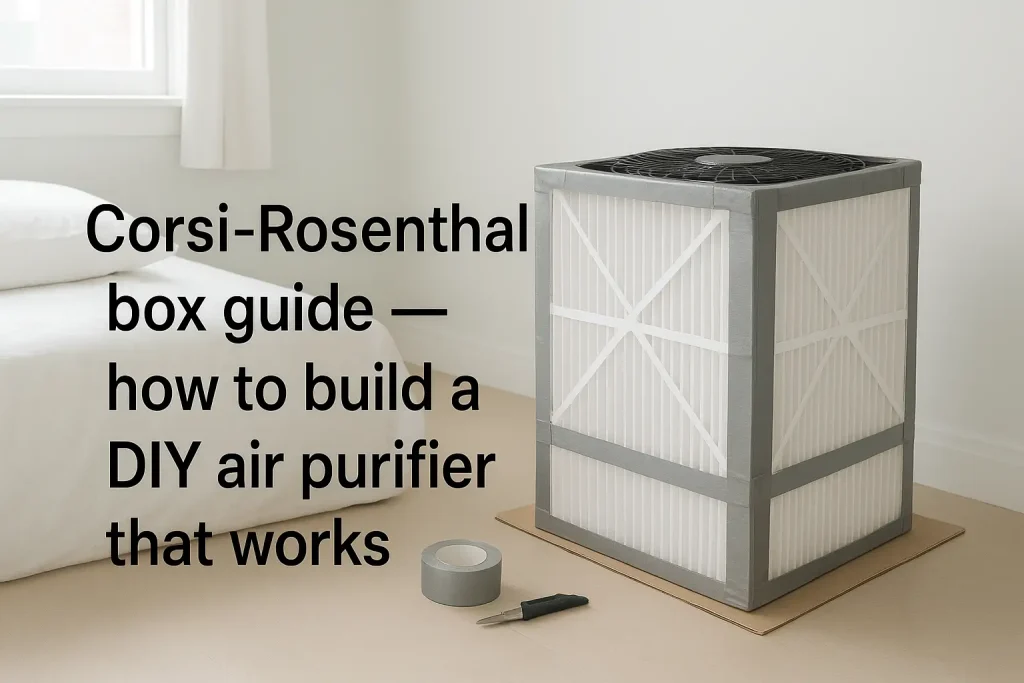
The Corsi-Rosenthal box design combines a 20-inch box fan rated at 1,000+ CFM with four MERV 13 20×20 filters and a cardboard or foam board base. Air enters through all four filter walls and the fan pulls upward, exhausting cleaned air through the top.
This only works because the four-filter design multiplies the total media surface area by four, reducing the pressure drop across each individual filter and allowing the fan to operate closer to its free-air flow rate. A single MERV 13 20×20 filter offers roughly 4.3 square feet of media area, the four-filter box offers over 17 square feet.
If you use a single-filter design instead of a four-filter box, the result is 60-90 CFM effective CADR versus 200-300 CFM. That is the difference between covering a small bedroom and covering a living room, fix it by committing to the four-filter build or choosing a purpose-built air purifier rated for your room size.
What Is the Corsi-Rosenthal Box and Why Does It Outperform a Single-Filter Box Fan?
The Corsi-Rosenthal box is a homemade air cleaner built from a 20-inch box fan, four MERV 13 20×20 filters, a cardboard base, and duct tape, developed by Dr. Richard Corsi and Jim Rosenthal. It is the dominant DIY design because the four-filter configuration drops total system resistance while multiplying media surface area, two variables that single-filter designs get wrong.
The fan sits on top, oriented to pull air upward through all four filter walls which are arranged in a cube with the base sealed. This creates airflow symmetry that spreads the pressure drop evenly across four filters, letting the fan move 300-400 CFM of total airflow instead of choking against a single panel.
The resulting effective smoke CADR of 200-300 CFM puts the Corsi-Rosenthal box in the same performance bracket as popular commercial units like the Coway Airmega 200M (246 CFM) or the Levoit Core 400S (240 CFM). The difference is that the box fan runs 55-65 dB at that speed, roughly four times louder subjectively than a 30 dB commercial unit.
Key Specifications for a Proper Corsi-Rosenthal Box:
• Fan: 20-inch box fan, 1,000+ CFM free-air rating, three-speed minimum
• Filters: Four MERV 13 20x20x1 pleated filters, arrow pointing inward toward fan
• Assembly: Duct tape seals all edges, cardboard base taped to all four filter bottoms
• Orientation: Fan pulls upward, exhausting clean air through the top
What Are the Noise Levels of a Box Fan Filter vs. a Dedicated Air Purifier?
A box fan running on high with a filter attached produces 55-65 decibels, measured at 3 feet. That is the noise level of a normal conversation or a dishwasher running, and it is constant because the fan has no sleep mode.
A dedicated air purifier with a sleep mode operates at 24-30 decibels on its lowest setting, roughly the sound level of rustling leaves or a whisper. That is approximately a 30 dB difference, which on the logarithmic decibel scale represents roughly 1,000 times less acoustic energy reaching your ear.
This is the dealbreaker for bedroom use. A box fan filter on high in a bedroom interferes with sleep onset and reduces slow-wave sleep duration, according to WHO sleep quality guidelines that set 30 dB as the maximum continuous nighttime noise threshold for healthy rest.
The noise gap is an inherent tradeoff of using an open-frame box fan motor with fixed-speed windings. Commercial air purifiers use brushless DC motors with variable speed control, sealed bearings, and aerodynamically optimized fan blades shaped specifically to move air quietly against filter resistance.
What a Box Fan Filter Cannot Do That a True HEPA Air Purifier Can
A box fan filter provides coarse particle filtration at the cost of noise, filter life, and effective coverage area. It cannot match a True HEPA unit on four dimensions that define real-world air purification performance: sub-micron particle capture efficiency, gas-phase filtration, predictive CADR certification, and sustained quiet operation.
Filtration efficiency: True HEPA is a certification, not a marketing term. The IEST-RP-CC001 standard requires 99.97% particle capture at 0.3 microns, the hardest particle size to trap because it sits in the transition zone between inertial impaction and diffusion capture mechanisms. A MERV 13 filter, the best option for box fan builds, captures approximately 75% at that size per ASHRAE 52.2 testing. The difference grows as particle size drops below 0.3 microns, where diffusion capture becomes the dominant mechanism and HEPA’s dense fiber packing outperforms MERV 13 significantly.
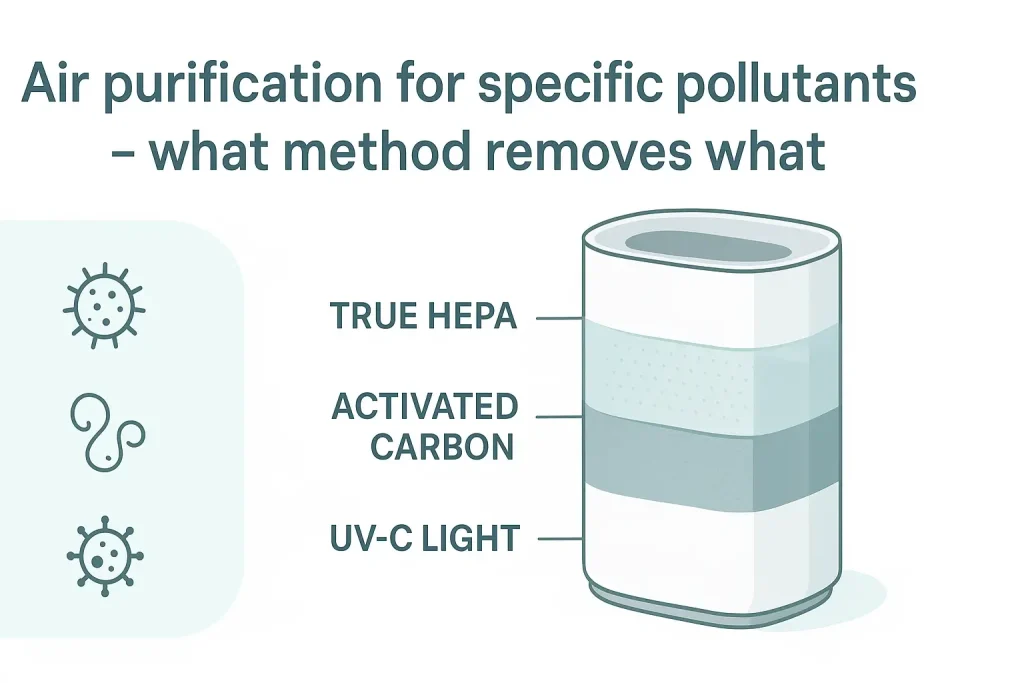
Gas and odor removal: Activated carbon is the standard material for VOC, formaldehyde, and cooking odor adsorption. A flat MERV 13 panel contains no carbon media whatsoever. Post-combustion wildfire particles enter the room carrying volatile organic compounds on their surface. A box fan filter may catch the particle, but the VOCs desorb and re-enter the airstream while a purifier with a carbon stage captures them.
Certification and verification: Every AHAM-certified air purifier carries a smoke CADR rating verified in a 1,008-cubic-foot test chamber per ANSI/AHAM AC-1 methodology. A box fan has no CADR rating. Researchers can estimate its effective CADR in a lab, but your build’s tape seal quality, filter brand, and fan model produce different numbers than the one from the published study.
Quiet continuous operation: You can run a Coway Airmega 400 or a Levoit Core 400S at 22-24 dB all night and still achieve meaningful air changes. You cannot run a box fan at that noise level because its slowest speed moves almost no air against filter resistance.
Is a Box Fan Filter Actually Safe? Motor Overheating and Electrical Concerns
Box fan motors are not rated for the sustained back pressure created by a filter attached to the intake side, according to a safety analysis published by the National Association of State Fire Marshals. The motor runs hotter because reduced airflow provides less convective cooling across the windings.
A clean MERV 8 filter may restrict airflow enough to increase motor temperature by 15-25 degrees Fahrenheit. A loaded MERV 13 filter after weeks of wildfire smoke accumulation increases the pressure drop further, pushing the motor into its thermal protection zone or causing the thermal fuse to open.
This is the primary safety concern specific to box fan filter designs. A purpose-built air purifier uses a PSC or BLDC motor rated for continuous duty at the design static pressure, with thermal protection circuits and UL certification that cover the specific load profile of a blocked filter condition.
To reduce fire risk, use a fan manufactured within the last 5 years with a built-in thermal fuse, replace filters on a pollution-dependent schedule, check the motor housing temperature daily during the first week of operation, and never leave a box fan filter running unattended.
When Does a Box Fan Filter Actually Make Sense? 4 Genuine Use Cases
The box fan filter is not a universal budget substitute for a purpose-built air purifier. It fits four specific scenarios where the tradeoffs align with the user’s constraints, and outside those scenarios, a commercial unit is the better choice.
Emergency wildfire smoke response at minimal cost: You need immediate particle filtration for a small bedroom and your budget is $40. A single MERV 13 filter taped to a box fan provides 60 CFM effective CADR, enough for a 120 sq ft room. Know that filter life drops to 2-4 weeks in sustained AQI 150+ conditions.
Temporary solution in a rental with a tight landlord: You cannot install a whole-house filter or spend $200 on equipment that stays when you leave. A box fan filter costs $40 total, breaks down in 2 minutes, and leaves no trace. The tradeoff is noise floor, short filter lifespan, and zero carbon filtration.
Supplemental filtration in a low-priority room: You already have a high-CADR air purifier covering the main living space and need something for the spare bedroom guests use twice a year. A box fan filter covers that intermittent need without the $100 investment. But do not expect it to perform like the primary unit.
The Corsi-Rosenthal box for a large room on a budget: You need 250+ CFM effective CADR for a living room or open-plan area and have $80 to spend. The four-filter cube design is genuinely competitive with a $200-300 commercial unit on particle filtration. You trade silence and filter longevity for CADR per dollar.
MERV Rating for Box Fan Filters: Which One Should You Choose?
Choose MERV 13 for a box fan filter when your target is PM2.5 from wildfire smoke, traffic pollution, or allergens. At 75%+ capture efficiency for 0.3-1 micron particles, MERV 13 is the highest rating that still allows a box fan to move meaningful air through a single flat panel.
A MERV 8 filter captures larger particles (3-10 microns) with minimal airflow restriction, making it usable for pet hair and visible dust but ineffective for smoke or fine allergens. A MERV 16 filter approaches HEPA-level capture but creates a pressure drop that stalls a standard box fan motor completely.
MERV 11 splits the difference with 65% capture at 1-3 microns. It is a functional middle ground for pollen and pet dander that extends filter life versus MERV 13 while providing better fine particle capture than MERV 8, a reasonable default for non-smoke applications.
Use the table below to match your pollutant concern to the right MERV filter rating, fan compatibility, and expected replacement interval.
| MERV Rating | Particle Size Captured | Efficiency at Key Size | Best Use for Box Fan | Box Fan Compatible | Filter Replacement Interval |
|---|---|---|---|---|---|
| MERV 8 | 3-10 microns | 70%+ at 3 microns | Pet hair, visible dust | Yes, low resistance | 6-12 months |
| MERV 11 | 1-3 microns | 65% at 1 micron | Pollen, pet dander, mold spores | Yes, moderate resistance | 4-8 months |
| MERV 13 | 0.3-1 micron | 75%+ at 0.3-1 micron | Wildfire smoke, PM2.5, bacteria | Yes, higher resistance | 3-6 months normal / 1-2 months wildfire |
| MERV 16 | 0.3-1 micron | 95%+ at 0.3-1 micron | Fine smoke, virus carriers | No, stalls fan motor | N/A in box fan application |
What Existed Before the Corsi-Rosenthal Box? The History of DIY Filtration
The idea of attaching a filter to a box fan predates the Corsi-Rosenthal box by decades. Before 2020, public health organizations including the Puget Sound Clean Air Agency published guides for DIY wildfire smoke filtration using a single MERV 13 filter taped to the intake side of a box fan.
These early designs were small-room solutions, recommended by public health agencies as emergency measures that were better than running no filtration at all. The Corsi-Rosenthal design, formalized in 2020 by Dr. Richard Corsi and filtration expert Jim Rosenthal, solved the pressure drop limitation that had capped single-filter performance for years.
The innovation was the four-filter cube, multiplying media area and reducing total system resistance so the same fan could move two to four times as much filtered air. For the complete framework of when source control, ventilation, and filtration each make sense before you build anything, our guide on the hierarchy of air purification starting with source control walks through the decision tree step by step.
How to Size a Box Fan Filter for Any Room: Applying the CADR Formula
The same formula that sizes commercial air purifiers sizes a box fan filter: smoke CADR equals room length times width times ceiling height times ACH, divided by 60. For a 150 sq ft bedroom with an 8-foot ceiling at 5 ACH, that is 150 times 8 times 5 divided by 60, which equals 100 CFM of smoke CADR needed.
A single-filter box fan with a MERV 13 filter delivers 60-90 CFM effective smoke CADR. That covers rooms up to 135 sq ft at 5 ACH, or 150 sq ft at 3-4 ACH which falls short of the allergy and asthma recommendation. A Corsi-Rosenthal box at 250 CFM covers up to 375 sq ft at 5 ACH, enough for a large master bedroom.
Calculate your room’s minimum CADR requirement using the tool below, then match the result to the nearest box fan or commercial unit option.
CADR Calculator
How Much CADR Do You Actually Need for Your Room?
Enter your room dimensions and use case. Formula: (length x width x ceiling height x ACH) divided by 60. Source: AHAM methodology.
CADR = (length x width x ceiling height x ACH) / 60. For allergy and asthma sufferers, always calculate at 5 ACH, not the manufacturer-stated 2 ACH figure.
Head-to-Head: Corsi-Rosenthal Box vs. Coway Airmega 400, Detailed Comparison
Use the table below to decide between a high-performance DIY box and a top-rated mid-range commercial purifier for large-room particle filtration.
| Spec | Corsi-Rosenthal Box | Coway Airmega 400 |
|---|---|---|
| Unit price | $70-80 (fan + filters + tape) | $325-400 |
| Effective smoke CADR (CFM) | 200-300 (estimated, not certified) | 400 (AHAM certified) |
| Coverage at 2 ACH | 300-450 sq ft | 1,560 sq ft |
| Coverage at 5 ACH (allergy) | 120-180 sq ft | 480 sq ft |
| Filter type | 4x MERV 13 flat panels | True HEPA + activated carbon + washable pre-filter |
| Annual filter cost | $40-60 per 4-pack | $60 (combined HEPA and carbon set) |
| Noise at sleep mode | 55-65 dB (single speed only) | 22 dB |
| CARB certified | No | Yes |
| Best for | Budget large-room particle removal, workshop, garage | Whole-home living space with extremely quiet operation |
| Our verdict | Best CADR per dollar under $80. Unusable in a bedroom. | Best large-room purifier for quiet, certified, multi-purpose use. |
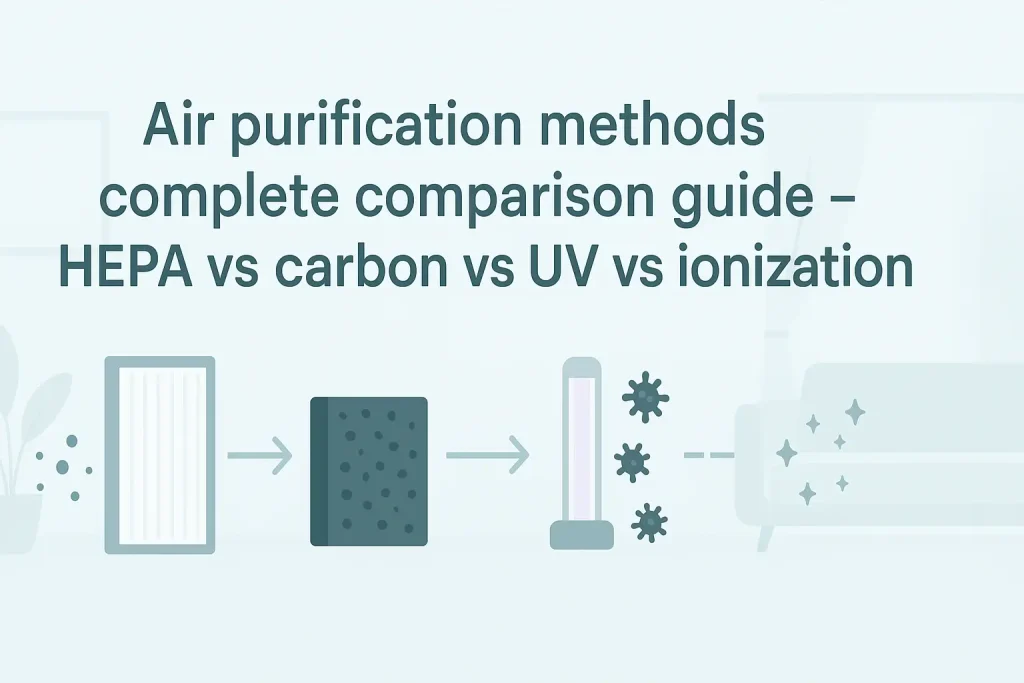
For a deeper comparison across filter technologies including activated carbon and UV-C approaches, our breakdown of how HEPA, carbon, UV, and ionization filtration methods compare covers the mechanisms, efficiency data, and certification requirements for each technology.
Why Does My Box Fan Filter Smell Like Ozone or Hot Dust After Running?
A box fan filter that smells like hot dust or ozone is overheating its motor or burning collected organic particles against hot motor windings. The odor indicates the fan is operating beyond its design temperature range, and continued use will eventually open the thermal fuse.
The hot dust smell comes from fine particles that pass partially through the filter and accumulate on the motor windings, where they reach temperatures of 180-220 degrees Fahrenheit during sustained high-resistance operation. The ozone smell, which is different, comes from the split-phase motor’s starting winding drawing small arcs across the centrifugal switch contacts as the motor struggles against filter back-pressure.
Fix the hot dust smell by cleaning the fan motor housing with compressed air and reducing filter resistance with a lower MERV rating or a cleaner filter. Fix the ozone smell by replacing the fan entirely, a motor that arcs against filter pressure has already experienced winding damage that gets worse with further use.
This motor stress condition cannot occur in a purpose-built air purifier because the fan is selected and certified specifically for continuous duty at the design static pressure of the HEPA filter stage it powers. The distinction between what a machine is designed for and what it is repurposed for defines the performance gap completely, and for a frank look at the limits of all types of air cleaning devices, our guide on setting realistic expectations for what air purification can and cannot accomplish covers the full scope.
Are Box Fan Filters Actually Endorsed by Health Agencies?
Public health agencies do not endorse box fan filters the way they endorse AHAM-certified air purifiers, but several state and county-level organizations describe them as a better-than-nothing measure during specific air quality emergencies. The EPA recommends portable air cleaners with HEPA filtration as the primary defense, then mentions DIY air cleaners as a temporary alternative.
The California Air Resources Board maintains the state’s official wildfire smoke guide, which includes box fan filtration as an option when commercial purifiers are unavailable or cost-prohibitive. CARB caveats its guidance by stating that commercial air cleaners listed under CARB’s certification program are the safer, more effective choice where possible.
The American Lung Association recommends using a central HVAC system with a MERV 13 filter or a portable HEPA air cleaner as the first defense, and refers to DIY filtration methods as a stopgap. No major health organization lists box fan filters as a preferred or equivalent alternative to AHAM-certified units.
Can a Box Fan Filter Really Replace a True HEPA Air Purifier?
A box fan filter can replace a True HEPA air purifier in one narrow scenario: you need coarse particle removal in a small room, you accept the noise floor of 55-65 dB, and you understand that the effective CADR will never exceed 90 CFM in a single-filter configuration. For every other use case, the purpose-built unit delivers higher cleaning speed, lower noise, longer filter life, and certified performance data.
A single-filter box fan with MERV 13 taped to the front delivers 60-90 CFM effective smoke CADR. That covers a 100-135 sq ft room at 5 ACH. The cheapest AHAM-certified True HEPA unit, the Levoit Core 300S at 145 CFM smoke CADR, covers a 219 sq ft room at 2 ACH and runs at 24 dB on sleep mode.
That 24 dB versus 55-65 dB difference is the single biggest reason not to put a box fan filter in a bedroom. Sleep quality and filtration performance are not separate decisions, they are the same decision. A silent filter you can run every night all night removes more total particulate than a louder filter that gets turned off.
What Is Better for Smoke: A Box Fan Filter or a Corsi-Rosenthal Box?
A Corsi-Rosenthal box is unequivocally better for smoke than a single-filter box fan design, by a factor of 2-5x on effective CADR. The four-filter configuration reduces total system resistance so the same fan can move two to four times as much air through the filters.
A single-filter setup might achieve 60 CFM effective smoke CADR in a perfectly sealed build with a clean MERV 13 filter. A Corsi-Rosenthal box under the same conditions achieves 200-300 CFM. That is the difference between covering a tiny bedroom and a master bedroom or living space at the same ACH rate.
During wildfire conditions, you need at least 4-6 ACH to keep indoor PM2.5 levels below the EPA’s 24-hour exposure limit of 35 micrograms per cubic meter. At 5 ACH, a 60 CFM effective CADR unit covers 90 sq ft. A 250 CFM unit covers 375 sq ft. Build the cube or buy the commercial unit, depending on your noise tolerance and fire safety comfort level.
Do Box Fan Filters Work for Allergies and Pet Dander?
A box fan filter with a MERV 13 filter captures approximately 75% of pet dander particles at the 1-micron size range, and a single-filter design at 60-90 CFM handles a small 100 sq ft room at 5 ACH. For a typical 200 sq ft master bedroom, you need 167 CFM at 5 ACH, which exceeds what a single-filter box fan can deliver.
A Corsi-Rosenthal box at 250 CFM covers a 200 sq ft bedroom at more than 5 ACH, making it genuinely effective for allergy management in a space that size. But again, the noise level is 55-65 dB on the box fan’s maximum setting, and you may need to run it at high speed continuously during allergy season.
A purpose-built air purifier with AAFA asthma and allergy certification at 246 CFM smoke CADR costs $100-200, runs at 30 dB at sleep mode, and carries a CARB certification validating zero ozone output. The certification matters because allergy and asthma patients are often more sensitive to ozone and ultrafine particles than the general population.
How Often Should I Replace the Filter on a Box Fan Air Cleaner?
Replace a MERV 13 filter on a box fan every 3-6 months in normal household conditions, every 4-8 weeks during sustained AQI 151+ wildfire events, and immediately when you see visible dark gray or brown loading across more than 60% of the filter face. The flat panel filter has roughly 4.3 square feet of media area, and it loads unevenly in a single-filter configuration.
A loaded filter increases the pressure drop across the fan, which reduces airflow and effective CADR while driving motor temperature higher. The same filter used in a four-filter Corsi-Rosenthal box lasts longer because the total media area is over 17 square feet and loading distributes across all four surfaces more evenly.
Track the filter visually every two weeks during the first month of operation to establish your replacement cadence. If you find yourself replacing filters at the 4-week mark routinely, switch to the Corsi-Rosenthal box design for a longer replacement interval plus more effective coverage area.
Is Duct Tape Safe to Use on a Running Box Fan Motor Housing?
Duct tape should never contact the motor housing of a running box fan. The housing surfaces can reach 140-180 degrees Fahrenheit during sustained back-pressure operation, hot enough to degrade duct tape adhesive, melt the backing in some formulations, and transfer sticky residue onto the motor’s ventilation slots.
Use duct tape only on the filter-to-fan frame junction and the filter-to-base seal, areas that stay near room temperature during operation. Keep at least 2 inches of clearance between any tape and the motor housing ventilation slots, which are the fan’s only path for convective cooling.
If you need to secure the fan to a base or a filter box, use mechanical fasteners or bungee cords instead of tape for any connection within 3 inches of the motor. A melted tape failure on the intake side creates a gap that lets unfiltered air bypass the filter entirely.
What Is the Difference Between Purification, Cleaning, Sanitizing, and Freshening?
Purification removes suspended contaminants from the air, cleaning removes settled contaminants from surfaces, sanitizing kills surface microorganisms to a specified log reduction, and freshening masks odors without removing their source. A box fan filter purifies air by mechanical particle capture. It does not clean, sanitize, or freshen.
Understanding these distinctions is critical when comparing filtration options. A product labeled as an air freshener may spray fragrance compounds that add VOCs to the indoor air while doing nothing to reduce particle counts. For the full terminology framework covering every air treatment category, our guide to the differences between purification, cleaning, sanitizing, and freshening breaks down each category with regulatory definitions and practical applications.
What Are the Limits of Activated Carbon in a Box Fan Filter?
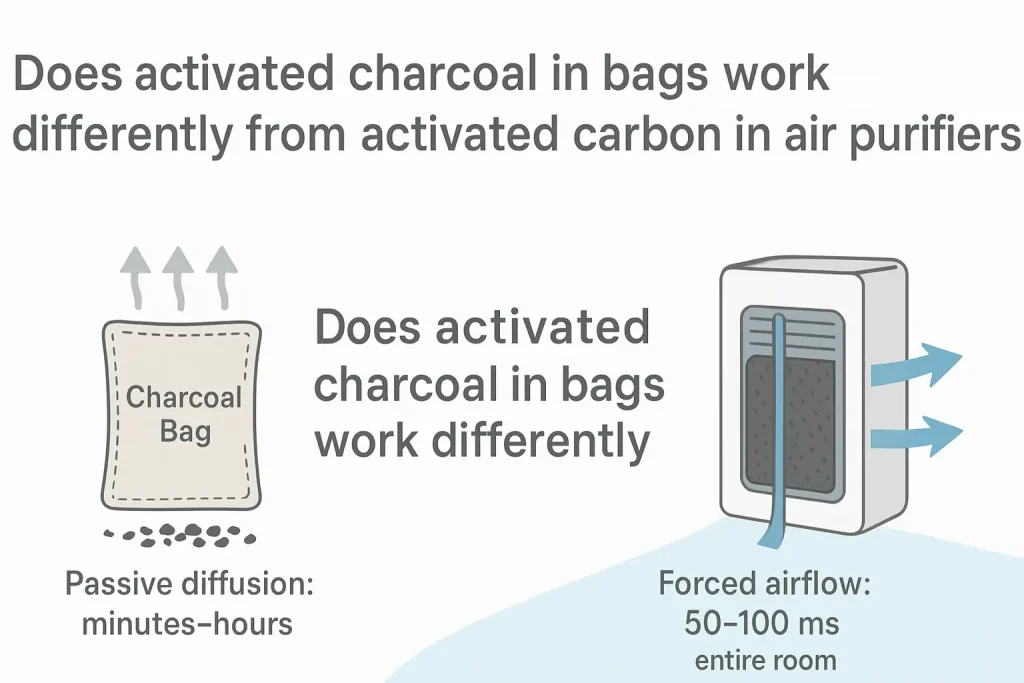
A box fan filter with a MERV 13 panel has zero activated carbon. There is no gas-phase filtration stage, and gases pass through the fibrous media essentially unimpeded because adsorption requires surface area in the 500-1,500 square meters per gram range that only activated carbon provides.
Some manufacturers sell MERV filters with a thin carbon coating. In a flat panel configuration, the carbon layer is typically under 50 grams, lasts less than 2 weeks of active VOC adsorption, and adds a pressure drop that further reduces the already-limited airflow of a single-filter box fan.
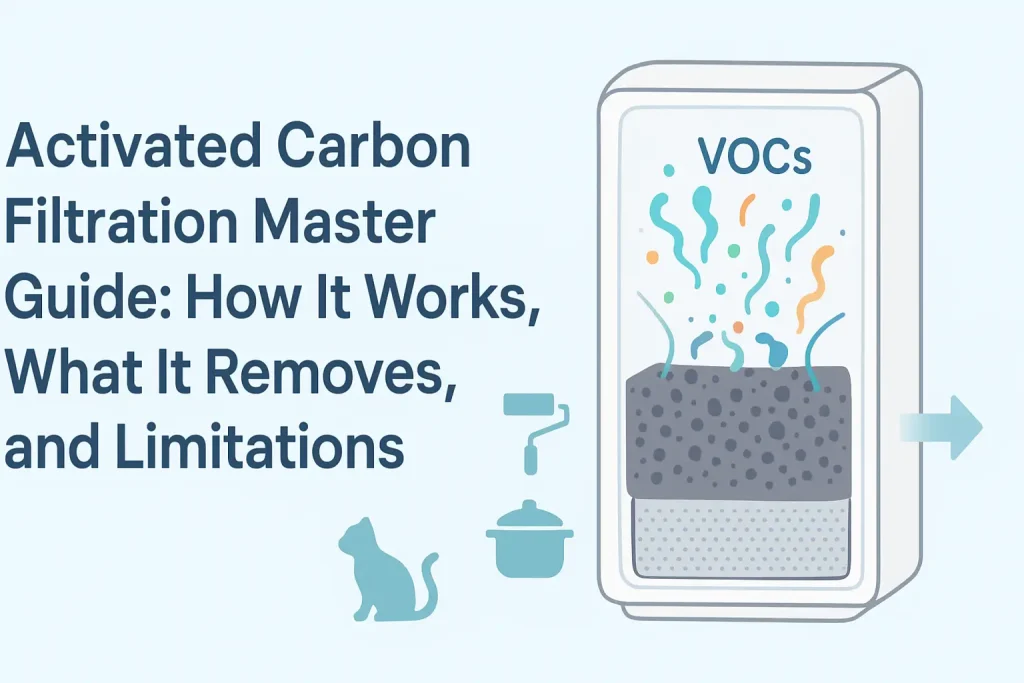
For meaningful VOC and odor control, you need a filter stage containing a minimum of 1-2 pounds of activated carbon, which is only possible in a purpose-built unit with a dedicated carbon canister or a deep-bed carbon tray. For a complete explanation of activated carbon filtration mechanisms, adsorption kinetics, media types, and breakthrough behavior, our master guide to activated carbon filtration and its limitations covers carbon weight requirements, replacement schedules, and humidity interference.
Why Do Some Box Fan Builds Perform Better Than Others with the Same Filter?
The seal between the filter and the fan determines 60-90% of the performance difference between box fan builds. Air follows the path of least resistance, and a 1/8-inch gap around the filter edge provides a lower-resistance path than the filter media itself.
A tightly taped filter with a cardboard shroud that extends the filter’s distance from the fan intake creates a plenum effect, reducing the dead zone directly in front of the fan hub and forcing more air through the outer edges of the filter media. A filter taped directly to the fan face creates a high-resistance dead zone in front of the hub, limiting effective media use to the outer ring.
Build a simple cardboard shroud, essentially a box that extends 3-4 inches from the filter frame to the fan face, and the effective CADR increases by 15-30% with the same filter and fan. The shroud is the single highest-return DIY modification after the Corsi-Rosenthal box’s four-filter geometry.
Can You Use an HVAC Pleated Filter on a Box Fan That Is a Different Size?
Use only a 20×20 inch filter on a standard 20-inch box fan. A 16×20 filter leaves a 4-inch gap on one side that bypasses unfiltered air. A 20×25 filter overhangs the fan housing and warps when taped, creating corner gaps that increase bypass.
If the only available filter size is not 20×20, build a transition box using cardboard and duct tape that adapts the different filter dimensions to a 20×20 opening at the fan intake. The transition box must be fully sealed on all four sides with tape, and it acts like a plenum that can actually improve airflow distribution across the filter by reducing the hub dead zone.
The build should consist of a rigid cardboard frame the size of the filter, a rigid cardboard frame the size of the fan intake, and four side panels connecting them. Tape every seam. The resulting box is dimensionally similar to a single-side Corsi-Rosenthal, and it performs better than a direct tape-on of a mismatched filter.
Are There Any Box Fan Models Specifically Rated for Filter Use?
No box fan manufacturer currently rates or certifies a model specifically for filter attachment. Lasko, the largest US box fan manufacturer, explicitly states in their product safety documentation that attaching any object to the fan intake voids the warranty.
Research groups that test box fan filters, including UC Davis and the University of Washington, consistently use the Lasko 20-inch 3-speed box fan because it has a thermal fuse that shuts the motor off before windings reach ignition temperature. This practical selection does not constitute manufacturer endorsement.
The safest fan for filter use is one manufactured recently, with a functional thermal fuse, a grounded three-prong plug, and an all-metal front grill that maintains structural integrity when a filter applies back pressure. Older fans, fans with plastic grills that warp under filter load, and fans that lack thermal protection should not be used for filter attachment.
For more information on how specific consumer air purifier models perform under testing with real measurements for CADR, noise, and filter cost, see our detailed review of the Blueair Blue Pure 311i Plus with full performance data covering a popular mid-range option in the same price bracket as a Corsi-Rosenthal box over 2 years.