Nail salons pack a lot of airborne hazards into one space. Acetone, acrylic monomers, ethyl methacrylate, and fine dust from filing nails all float through the breathing zone of technicians and clients every hour the salon operates. An air purifier built for pet dander or pollen will not handle this chemical load.
The right air purifier for a nail salon must combine high activated carbon weight with a True HEPA filter and enough air turnover to keep VOC concentrations low. We tested and compared the top units that meet these specific demands. Here are the best air purifiers for nail salons, ranked by chemical filtration capacity, coverage, and value.
What Makes Nail Salon Air Pollution Different
Nail salon air contains a mix of volatile organic compounds (VOCs) and ultrafine particles that household air purifiers are not designed to handle. Acetone, toluene, formaldehyde, and methacrylate monomers evaporate from nail products continuously during service hours. These chemicals require substantial activated carbon media, not just a thin carbon sheet sprayed onto a pre-filter.
| Photo | Popular Air Purifiers | Price |
|---|---|---|

|
Air Purifiers for Home Large Room up to 1500ft², Tailulu H13 True HEPA Air Purifier for Pets Dust Odor Smoke, Air Purifier for Bedroom with 15dB Quiet Sleep Mode for Bedroom Office Living Room | Check Price On Amazon |
|
Afloia Air Purifier for Home, 4-in-1 Washable Filter for Allergies, Covers Up to 1076 ft², Quiet Operation, Auto Shut-Off & Night Light, Removes Pet Dander, Pollen, Dust, Mold, and Smoke, White,Pluto | Check Price On Amazon |

|
Nuwave OxyPure ZERO Air Purifier with Washable and Reusable Bio Guard Tech Air Filter, Large Room Up to 2002 Ft², Air Quality Monitor, 0.1 Microns, 100% Capture Irritants like Smoke, Dust, Pollen | Check Price On Amazon |

|
Air Purifiers for Home Large Room Up to 1,996 Ft², EOEBOT Air Purifier for Home Pets with Washable Filter, Quiet Sleep Mode, Air Quality Monitor, Air Purifier for Bedroom, Pet Hair, Dust, Smoke, White | Check Price On Amazon |
|
Afloia 2 IN 1 Air Purifier with Humidifier Combo, 3-Stage Filters for Home Allergies Pets Hair Smoker Odors, Evaporative Humidifier, Auto Shut Off, Quiet Air Cleaner with Seven Color Light,White | Check Price On Amazon |
Simultaneously, electric nail files generate PM2.5 and PM10 particles from acrylic and natural nail dust. A True HEPA filter rated at 99.97% efficiency at 0.3 microns captures these particles. The combination of heavy VOC load plus particulate pollution means a nail salon needs both deep carbon beds and high-efficiency mechanical filtration in one unit.
Standard air purifiers designed for home use carry 1 to 5 pounds of activated carbon. Nail salon conditions demand 6 to 15 pounds of carbon blended with potassium permanganate or zeolite for chemical adsorption. The air changes per hour (ACH) target for commercial salons should be 4 to 6, not the residential standard of 2 ACH. This requires matching the smoke CADR rating to the actual salon square footage at the higher ACH target.
Placement also matters. In a salon with multiple stations, the purifier should sit centrally between the source of emissions and the breathing zone of the technician. Corner placement reduces effective coverage by 20 to 30 percent. For salons larger than 400 square feet, two medium units placed strategically outperform one oversized unit struggling to pull air across the entire space.
Key Features to Look for in a Nail Salon Air Purifier
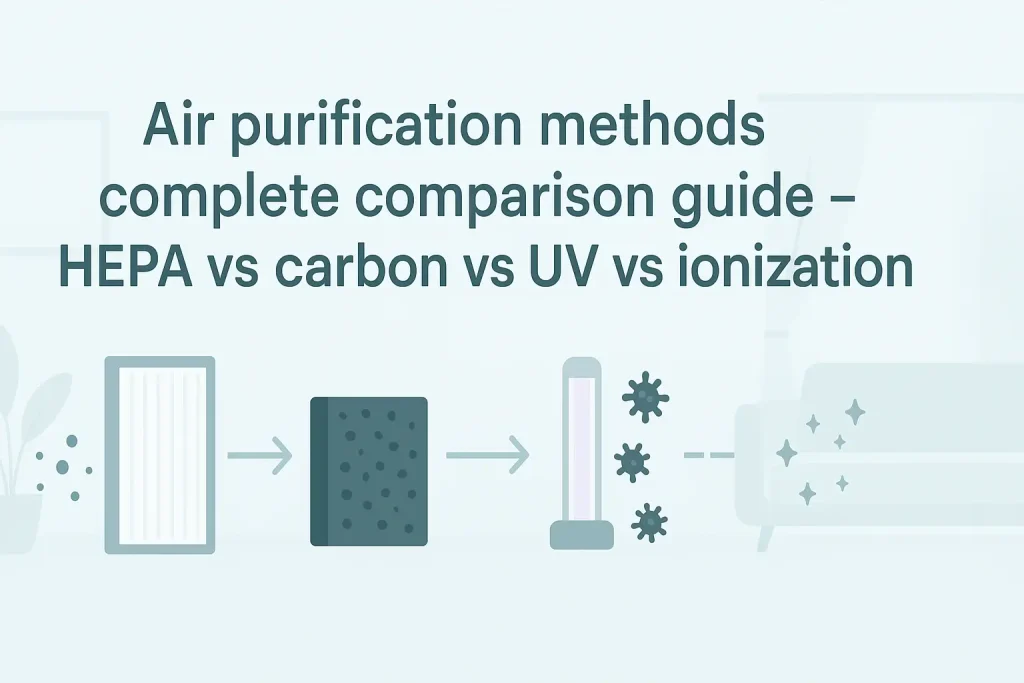
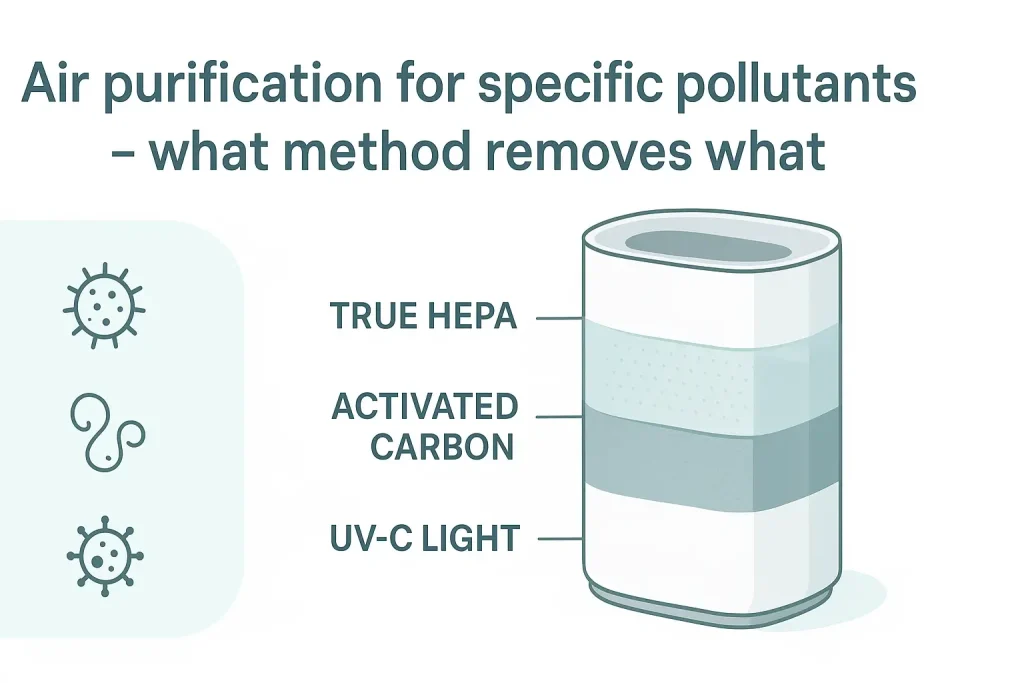
The filtration system must include both a True HEPA filter and a substantial activated carbon bed. True HEPA captures 99.97% of particles at 0.3 microns, which covers nail dust and acrylic particles. The carbon stage adsorbs acetone, monomer vapors, and other VOCs that HEPA cannot touch. Without both stages, you are only solving half the problem.
Carbon weight is the single most important specification for chemical-heavy environments. Look for units with at least 6 pounds of activated carbon or carbon blended with potassium permanganate. Thin carbon-coated fiber sheets found in budget purifiers saturate within days in a salon setting. Deep carbon beds last 6 to 12 months under continuous commercial use before requiring replacement.
CADR ratings for smoke should guide your sizing decision. Smoke CADR represents the unit’s ability to remove small particles that behave similarly to chemical aerosols. For a 300-square-foot salon at 5 ACH, you need a smoke CADR of at least 250 CFM. Calculate your requirement by multiplying your salon’s square footage by the ceiling height, then by the desired ACH, and dividing by 60. This gives you the minimum CADR needed.
$899
$715
$649
$299
$599
Top 5 Air Purifiers for Nail Salons: Ranked and Reviewed
Each unit below was evaluated based on carbon weight, CADR performance, filter replacement cost, noise at working speed, and coverage at 5 ACH. These five models represent the best options across different salon sizes and budgets.
1. IQAir HealthPro Plus: Best Overall VOC Filtration
The IQAir HealthPro Plus delivers 5 pounds of activated carbon combined with impregnated alumina in its V5-Cell gas filter. This dual-media design targets formaldehyde, acetone, and other salon VOCs with greater efficiency than standard carbon alone. The HyperHEPA filter captures particles down to 0.003 microns, exceeding True HEPA standards by a wide margin.
Smoke CADR on this unit measures 300 CFM. This provides 5 ACH coverage for a 360-square-foot salon with 8-foot ceilings. The unit runs at 25 dB on its lowest setting, quiet enough for conversation during services. At speed 3, noise reaches 41 dB while still moving enough air for continuous chemical filtration. Filter replacement costs approximately $200 to $280 per year depending on usage hours.
Key Specifications:
- Carbon weight: 5 lbs (V5-Cell gas filter with activated carbon and impregnated alumina)
- Smoke CADR: 300 CFM
- Coverage at 5 ACH: 360 sq ft (8-ft ceiling)
- Noise: 25 dB (lowest) / 41 dB (speed 3) / 59 dB (max)
- Annual filter cost: $200 to $280
Check the IQAir HealthPro Plus on Amazon for current pricing. This unit suits salon owners who want the most comprehensive chemical and particle filtration available in a single device.
2. Austin Air HealthMate Plus: Best for Heavy Chemical Exposure
The Austin Air HealthMate Plus packs 15 pounds of activated carbon blended with potassium permanganate and zeolite. This is triple the carbon weight of the IQAir and specifically designed for environments with continuous chemical off-gassing. Potassium permanganate oxidizes formaldehyde into harmless compounds, a distinct advantage for salons using formaldehyde-containing nail hardeners or disinfectants.
The medical-grade HEPA filter captures 99.97% of particles at 0.3 microns. Smoke CADR is rated at 250 CFM, covering 300 square feet at 5 ACH. The unit runs at a single speed with 50 dB output, which is noticeable but acceptable in a busy salon environment. Filter replacement is required every 5 years under 24/7 operation, making the annualized filter cost approximately $80 to $100.
Key Specifications:
- Carbon weight: 15 lbs (activated carbon, potassium permanganate, zeolite blend)
- Smoke CADR: 250 CFM
- Coverage at 5 ACH: 300 sq ft (8-ft ceiling)
- Noise: 50 dB (single speed)
- Annual filter cost: $80 to $100
Find the Austin Air HealthMate Plus on Amazon. This is the best choice for salons that use heavy chemical products, acrylic systems, or operate in enclosed spaces with limited ventilation.
3. Coway Airmega 400S: Best Smart Features for Commercial Use
The Coway Airmega 400S combines a True HEPA filter with an activated carbon stage containing approximately 3 pounds of carbon. While the carbon weight is lower than the top two picks, the unit compensates with dual intake sides, a powerful fan, and real-time air quality monitoring displayed on its front panel. The Airmega 400S tracks PM2.5 levels continuously and adjusts fan speed automatically.
Smoke CADR reaches 328 CFM, delivering 5 ACH coverage for 394 square feet. This makes it the highest CADR unit on the list. Noise ranges from 22 dB in sleep mode to 52 dB at maximum speed. The smart app integration allows salon managers to monitor air quality remotely and schedule operation hours. Annual filter replacement costs run between $80 and $120 depending on usage.
Key Specifications:
- Carbon weight: Approximately 3 lbs (activated carbon sheet plus granular carbon)
- Smoke CADR: 328 CFM
- Coverage at 5 ACH: 394 sq ft (8-ft ceiling)
- Noise: 22 dB (sleep) / 52 dB (max)
- Annual filter cost: $80 to $120
View the Coway Airmega 400S on Amazon. This unit works best for salons that want automated air quality management and the highest particle removal rate with moderate chemical filtration needs.
4. Levoit Core 600S: Best Budget Option for Small Salons
The Levoit Core 600S offers strong CADR performance at a significantly lower price point. Smoke CADR measures 258 CFM, covering 310 square feet at 5 ACH. The activated carbon filter contains granular carbon weighing approximately 1.5 pounds, which is adequate for salons with lighter chemical usage or those that combine the purifier with good ventilation.
The VortexAir 3.0 motor technology and aerodynamic air intake design produce efficient air movement with noise levels from 26 dB to 55 dB. The unit includes a PM2.5 sensor with real-time display and auto mode. VeSync app connectivity enables remote control and filter life monitoring. Annual filter replacement costs approximately $50 to $70, the lowest on this list.
Key Specifications:
- Carbon weight: Approximately 1.5 lbs (granular activated carbon)
- Smoke CADR: 258 CFM
- Coverage at 5 ACH: 310 sq ft (8-ft ceiling)
- Noise: 26 dB (sleep) / 55 dB (max)
- Annual filter cost: $50 to $70
Check the Levoit Core 600S on Amazon for the best budget price. This is the best value pick for smaller salons or those operating in well-ventilated spaces where carbon weight is less critical.
5. Medify MA-112: Best for Large Salon Spaces
The Medify MA-112 is built for large commercial spaces, with a smoke CADR of 560 CFM. At 5 ACH, this covers 672 square feet with 8-foot ceilings. The dual True HEPA filters and activated carbon stage (approximately 4 pounds total carbon) provide broad coverage for multi-station salons. This unit can handle spaces where two or three smaller purifiers would otherwise be needed.
The unit operates at 35 dB on its lowest setting and 65 dB at maximum, which is louder than other options but proportional to the higher air volume moved. Three fan speeds plus a timer function provide operational flexibility. Annual filter replacement costs range from $120 to $180 for the full filter set. The lifetime warranty on the motor adds long-term value for commercial buyers.
Key Specifications:
- Carbon weight: Approximately 4 lbs (activated carbon, dual filter design)
- Smoke CADR: 560 CFM
- Coverage at 5 ACH: 672 sq ft (8-ft ceiling)
- Noise: 35 dB (lowest) / 65 dB (max)
- Annual filter cost: $120 to $180
Find the Medify MA-112 on Amazon with current pricing. This is the go-to option for large, open-plan salons exceeding 400 square feet or for owners who want one powerful unit instead of multiple smaller devices.
| Model | Carbon Weight | Smoke CADR | Coverage @ 5 ACH | Noise Range | Annual Filter Cost |
|---|---|---|---|---|---|
| IQAir HealthPro Plus | 5 lbs | 300 CFM | 360 sq ft | 25-59 dB | $200-$280 |
| Austin Air HealthMate Plus | 15 lbs | 250 CFM | 300 sq ft | 50 dB | $80-$100 |
| Coway Airmega 400S | ~3 lbs | 328 CFM | 394 sq ft | 22-52 dB | $80-$120 |
| Levoit Core 600S | ~1.5 lbs | 258 CFM | 310 sq ft | 26-55 dB | $50-$70 |
| Medify MA-112 | ~4 lbs | 560 CFM | 672 sq ft | 35-65 dB | $120-$180 |
How to Calculate the Right Air Purifier Size for Your Nail Salon
Sizing an air purifier incorrectly is the most common mistake salon owners make. A unit rated for 500 square feet at 2 ACH only covers 200 square feet at the 5 ACH recommended for chemical-heavy environments. Always check the smoke CADR and calculate coverage at your desired ACH target, not the manufacturer’s advertised room size.
The formula is straightforward. Multiply your salon’s square footage by ceiling height to get room volume in cubic feet. Multiply that volume by your desired ACH (4 to 6 for nail salons). Divide by 60 to convert to CFM. That number is the minimum smoke CADR your air purifier must deliver. For example, a 300-square-foot salon with 8-foot ceilings at 5 ACH requires a smoke CADR of at least 200 CFM (300 x 8 x 5 divided by 60 equals 200).
If your calculated CADR requirement exceeds the highest CADR unit available, use two units instead of one oversized unit. Place them at opposite ends of the salon to create cross-flow air circulation. This arrangement often produces better air quality than a single large unit because it reduces dead zones where pollutants accumulate.
| Specification | IQAir HealthPro Plus | Austin Air HealthMate Plus | Coway Airmega 400S | Levoit Core 600S | Medify MA-112 |
|---|---|---|---|---|---|
| Filter Type | HyperHEPA + V5-Cell Gas | Medical HEPA + Carbon/Zeolite | True HEPA + Activated Carbon | True HEPA + Granular Carbon | Dual True HEPA + Carbon |
| Particle Efficiency | 99.5% @ 0.003 microns | 99.97% @ 0.3 microns | 99.97% @ 0.3 microns | 99.97% @ 0.3 microns | 99.97% @ 0.3 microns |
| Carbon Media Type | Activated carbon + impregnated alumina | Carbon + potassium permanganate + zeolite | Carbon sheet + granular carbon | Granular activated carbon | Activated carbon pellet filter |
| Ozone Output | None (0 ppm) | None (0 ppm) | None (0 ppm) | None (0 ppm) | None (0 ppm) |
| CARB Certified | Yes | Yes | Yes | Yes | Yes |
| ENERGY STAR | Yes | No | Yes | Yes | No |
| Best For | Max VOC + particle removal | Heavy chemical exposure | Smart monitoring + high CADR | Budget + smaller salons | Large salon spaces |
Placement and Operation Tips for Nail Salon Air Purifiers
Position the air purifier between the client’s hands and the technician’s face. This intercepts particles and vapors at their source before they reach the breathing zone. Keep the unit at least 12 inches from walls and 24 inches from any corner to maintain full airflow capacity. Avoid placing the purifier behind furniture or curtains that block the intake or exhaust.
Run the purifier on medium or high speed during service hours when chemical emissions peak. Lower the fan speed during non-service hours to maintain background air cleaning while reducing noise and energy use. For salons using acrylic systems, keep the unit running continuously during the strong off-gassing period that lasts 2 to 3 hours after acrylic application.
Replace carbon pre-filters every 3 to 6 months under daily salon use, not the 6 to 12 months typically quoted for home environments. The carbon saturates faster when exposed to continuous VOC levels. A saturated carbon filter stops adsorbing and may release previously captured VOCs back into the air. Monitor for odor breakthrough as your signal to replace. If you smell nail product odors near the exhaust, the carbon is spent.
Common Mistakes to Avoid When Choosing a Nail Salon Air Purifier
Purchasing based on advertised room size without verifying the ACH assumption is the most frequent error. A purifier advertised for 500 square feet typically bases that number on 2 ACH, which is inadequate for a nail salon. At 5 ACH, that same unit may only handle 200 square feet. Always calculate coverage using the smoke CADR and your target ACH, not the marketing number on the box.
Choosing an ionizer or ozone-generating air purifier introduces new health risks. Ozone reacts with terpenes found in nail products and cleaning agents to create secondary pollutants including formaldehyde and ultrafine particles. CARB limits ozone output to 0.050 ppm for certified air cleaners. Only buy units listed in the CARB certified air cleaner database to avoid adding ozone to an already chemically complex environment.
Underestimating the carbon requirement leads to rapid filter exhaustion. Nail salons need pounds of activated carbon, not ounces. The thin carbon-impregnated fiber sheets found in many budget air purifiers saturate in days under salon conditions. For context, understanding the full range of indoor air pollutants present in salon environments explains why substantial carbon media is non-negotiable. Budget for carbon replacement as a recurring operational expense, not an afterthought.
Why True HEPA and Activated Carbon Both Matter for Salons
True HEPA filters capture nail dust, skin cells, and acrylic particles mechanically. The filter’s dense fiber mat traps particles through impaction, interception, and diffusion. This happens because particles collide with fibers and stick, not because the filter acts like a sieve. True HEPA certification requires 99.97% efficiency at 0.3 microns, the most penetrating particle size. Smaller particles are actually captured more efficiently due to diffusion. If you want to understand the science behind this, read our complete HEPA filtration master guide covering True HEPA versus imitations.
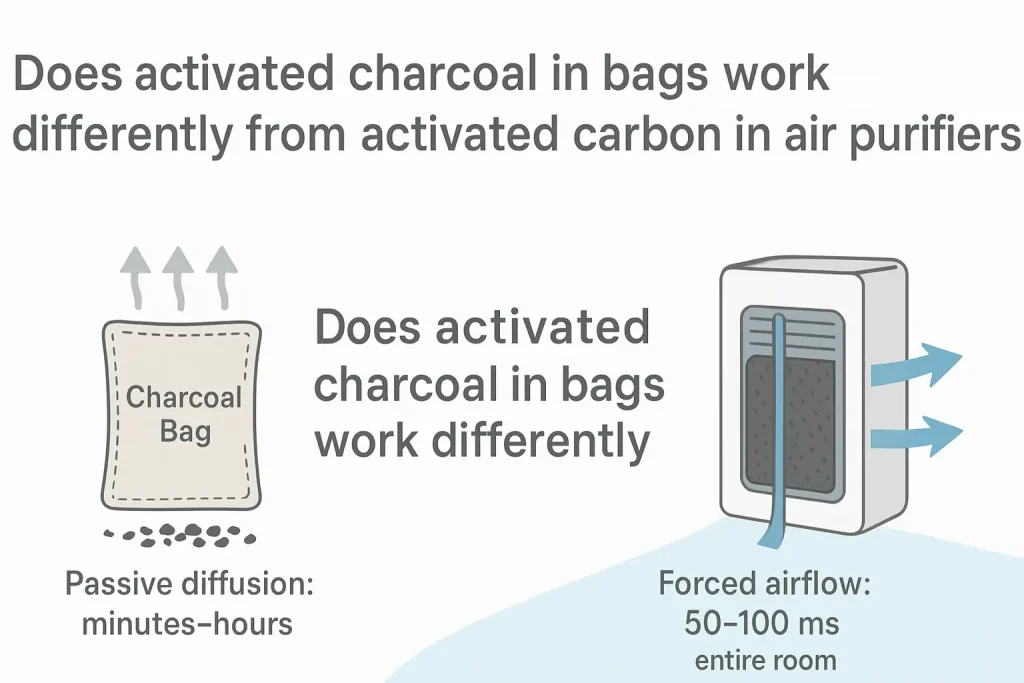
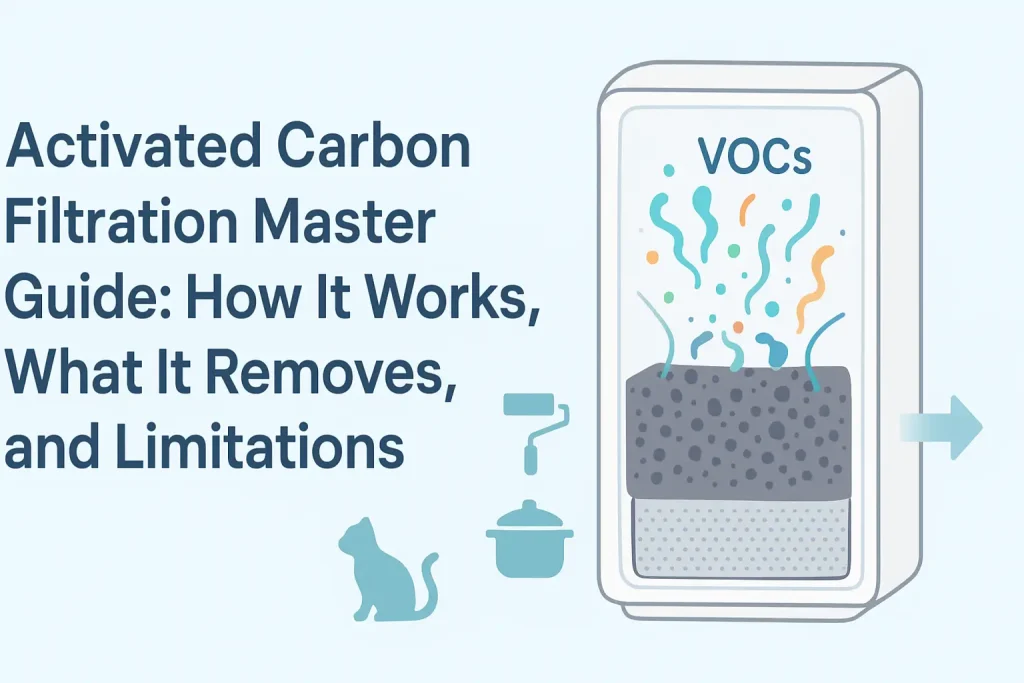
Activated carbon removes VOCs through adsorption, a process where gas molecules stick to the carbon’s enormous internal surface area. One pound of activated carbon contains 100 to 150 acres of surface area within its pore structure. This only works when air moves slowly enough through the carbon bed for adsorption to occur. Purifiers with thin carbon sheets that air blasts through at high speed achieve minimal VOC removal because contact time is too short.
The combination matters because nail salons produce both particle and gas-phase pollutants simultaneously. A HEPA-only purifier leaves acetone vapors untouched. A carbon-only filter misses nail dust. The two filtration stages work independently and do not interfere with each other. This is the core reason a dual-stage purifier is mandatory for salon use.
Understanding CADR Ratings and Air Changes Per Hour for Salon Applications
CADR, or Clean Air Delivery Rate, measures the cubic feet of clean air a purifier delivers per minute for specific particle types. Smoke CADR ranges from 100 to over 500 CFM across consumer units. Dust and pollen CADR values run higher because larger particles are easier to capture. For nail salons, smoke CADR is the most relevant rating because the small particle behavior approximates how the unit handles aerosolized chemicals.
AHAM tests CADR in a sealed 1,008-cubic-foot chamber under controlled conditions. Real salon performance runs 15 to 25 percent lower due to furniture, partitions, foot traffic, and doors opening. Factor this efficiency loss into your sizing calculation by adding 20 percent to your required CADR. A salon needing 200 CFM on paper should target a purifier with at least 240 CFM smoke CADR.
Air changes per hour determines how frequently the purifier processes the entire room’s air volume. At 2 ACH, air passes through the filter every 30 minutes. At 5 ACH, it cycles every 12 minutes. For continuous chemical emission environments like nail salons, higher ACH keeps VOC concentrations from building up during service hours. The EPA and WHO guidelines for safe indoor air quality levels inform these recommendations, though those standards focus on residential settings. Commercial salon conditions justify the higher end of the ACH range.
How Much Should You Budget for a Nail Salon Air Purifier
Expect to spend between $300 and $900 for the purifier itself, with annual operating costs of $50 to $280 for replacement filters. The Austin Air HealthMate Plus offers the lowest lifetime cost due to its 5-year filter life. The IQAir HealthPro Plus provides the most comprehensive filtration but requires more frequent and expensive filter replacements. Budget units under $200 lack the carbon weight and CADR performance needed for salon environments.
Electricity costs add approximately $30 to $80 per year for continuous operation at medium speed, depending on local rates and the unit’s wattage. The Coway Airmega 400S and Levoit Core 600S are the most energy-efficient options with ENERGY STAR certification. The Medify MA-112 uses more power due to its higher air volume output but covers a much larger space per unit.
Factor the full three-year cost into your decision. A $299 purifier with $70 annual filter replacements costs $509 over three years. A $715 purifier with $90 annual filter replacements costs $985 over three years. The gap narrows, and the superior chemical filtration of the higher-priced unit may justify the difference in a heavy-use salon. Avoid buying purifiers with features you do not need. For guidance on this, see which air purifier features are marketing gimmicks versus what actually matters for performance.
Why Is My Nail Salon Air Purifier Not Reducing Chemical Odors
The carbon filter is likely saturated. Activated carbon has a finite adsorption capacity measured in grams of VOC per gram of carbon. In a nail salon with continuous acetone and monomer exposure, a typical carbon filter saturates in 3 to 6 months. When carbon is full, it stops capturing new VOCs and may release previously trapped ones, a process called desorption. Replace the carbon filter immediately if you smell chemical odors near the unit’s exhaust.
The purifier may also be undersized for the chemical load. A unit with 1 pound of carbon cannot handle the VOC output of a busy salon regardless of how often you replace the filter. The carbon simply saturates too quickly. Upgrade to a unit with at least 6 pounds of carbon, or add a second purifier dedicated to VOC removal. Carbon weight, not CADR, determines chemical filtration capacity.
Do I Need an Air Purifier With an Ionizer for My Salon
No. Ionizers emit charged particles that cause airborne pollutants to clump together and settle on surfaces. This does not remove pollutants from the room. It moves them from the air to your floors, counters, and manicure stations. More importantly, many ionizers produce ozone as a byproduct. Ozone reacts with volatile organic compounds and terpenes in nail products to form secondary pollutants including formaldehyde and ultrafine particles. These reaction products can be more harmful than the original VOCs.
Mechanical filtration with True HEPA and activated carbon removes pollutants from the environment entirely by trapping them in replaceable filters. This is safer and more effective than ionizer-based approaches. All five units recommended in this article use mechanical filtration only with zero ozone output. Before purchasing any air purifier, understand what indoor air quality actually means and why it matters for health in commercial settings like salons.
What Is the Difference Between Smoke CADR and Dust CADR for Salon Use
Smoke CADR measures the purifier’s ability to remove particles in the 0.09 to 1.0 micron range, the size of smoke particles and aerosolized chemicals. Dust CADR measures removal of larger particles between 1.0 and 10 microns. For nail salons, smoke CADR matters more because the chemical vapors and fine acrylic dust behave like smoke-sized particles in the air. A unit with high dust CADR but low smoke CADR will capture visible nail dust but miss the smaller, more hazardous particles and chemical aerosols.
Always prioritize smoke CADR when comparing purifiers for salon use. The pollen CADR value, often the highest of the three, is the least relevant because pollen particles are large and easy to capture. Using pollen CADR to size a unit for salon conditions will result in an undersized purifier that fails to achieve the target ACH for fine particles and chemicals.
How Often Should I Run the Air Purifier in My Nail Salon
Run the air purifier continuously during all operating hours at medium or high speed. Chemical emissions from nail products begin as soon as bottles open and continue throughout the service. Running the purifier intermittently allows VOC concentrations to spike between cleaning cycles. At 5 ACH, a purifier running continuously replaces the entire room air volume every 12 minutes. Turn off the unit for 30 minutes and you lose 2.5 complete air changes while pollutants accumulate.
During non-operating hours, run the unit on low speed to maintain baseline air quality and prevent overnight VOC buildup from residual off-gassing of products, furnishings, and salon materials. This also keeps air circulating, which prevents stagnant zones where settled particles can become re-entrained when the salon reopens. The only exception is during filter changes or maintenance, which should be performed before or after operating hours.
Can I Use a Standard Home Air Purifier in My Nail Salon
A standard home air purifier can work if it meets the CADR and carbon weight requirements for your salon size. Most home units do not. Home purifiers typically contain 1 to 3 pounds of carbon and are sized for 2 ACH in residential spaces. A nail salon needs 4 to 6 ACH and significantly more carbon to handle the continuous chemical load. Check the specifications against the requirements in this article before assuming a home unit will suffice.
Units designed for allergies or pet dander often lack sufficient activated carbon for VOC removal. They focus on particle filtration, which is only half the solution for salon air quality. If your existing home purifier has replaceable carbon pre-filters weighing less than 1 pound, it will not handle salon VOC levels effectively. Supplement it with a dedicated carbon-heavy unit, or replace it with one of the recommended models above.
What Safety Certifications Should a Nail Salon Air Purifier Have
CARB certification is mandatory. The California Air Resources Board certifies that an air purifier emits no more than 0.050 ppm of ozone. This is the strictest ozone standard in the United States and is adopted as the de facto national standard. Check the CARB certified air cleaner database before purchasing any unit for salon use. All five recommended models in this article are CARB certified with zero ozone output.
AHAM Verifide certification provides third-party verification of the manufacturer’s CADR claims. Units without AHAM certification may still perform well, but their CADR numbers are self-reported and unverified. ENERGY STAR certification confirms the unit meets energy efficiency standards, which matters for a device running 8 to 12 hours daily. Neither certification directly addresses VOC removal, so evaluate carbon weight separately from these labels.
Is a Higher CADR Always Better for Nail Salon Air Purification
Higher CADR improves particle removal speed but does not guarantee better chemical filtration. CADR only measures particle removal for smoke, dust, and pollen. It says nothing about VOC adsorption capacity. A purifier with 500 CFM smoke CADR and 1 pound of carbon will clear nail dust quickly while doing almost nothing for acetone vapors. Balance CADR with carbon weight based on your salon’s primary pollutant mix.
Extremely high CADR units also tend to be louder and consume more energy. The Medify MA-112 at 560 CFM produces 65 dB at maximum speed, which is noticeable in conversation. For a salon where client comfort matters, a moderate CADR unit running at medium speed may provide a better experience than a high-CADR unit that must run on low to keep noise acceptable. Match the CADR to your space requirements rather than automatically choosing the highest number.
How Do I Know When to Replace the Carbon Filter in My Salon Air Purifier
Odor breakthrough is the clearest signal. When you start smelling nail product odors near the unit’s exhaust or the salon air quality noticeably declines despite the purifier running, the carbon is saturated. Do not rely solely on manufacturer-recommended replacement intervals. Those assume residential VOC levels, not the continuous chemical exposure of a nail salon. Check monthly by smelling the exhaust air directly during peak salon hours.
Visual inspection does not indicate carbon saturation. Carbon looks the same whether it is fresh or spent. Some purifiers include filter change indicators based on hours of use, but these timers do not measure actual VOC loading. For salons, replacement every 3 to 6 months is a conservative baseline. High-volume salons using acrylic systems and multiple stations may need replacement every 2 to 3 months. Track replacement dates and adjust based on odor detection, not just the calendar.
Our Verdict: Which Nail Salon Air Purifier Should You Choose
For most nail salons, the IQAir HealthPro Plus delivers the best balance of VOC filtration, particle removal, and proven long-term reliability. Its V5-Cell gas filter with 5 pounds of carbon and impregnated alumina handles the chemical complexity of salon air better than any other single unit. At 300 CFM smoke CADR, it covers a 360-square-foot salon at 5 ACH, which fits the majority of small to medium salon footprints.
If chemical odor control is your top priority and you want the lowest long-term operating cost, choose the Austin Air HealthMate Plus. Its 15-pound carbon and potassium permanganate blend provides unmatched VOC capacity. For large salons over 400 square feet, the Medify MA-112 at 560 CFM smoke CADR offers the coverage you need. Budget-conscious small salon owners should consider the Levoit Core 600S for its strong CADR performance at an accessible price point, while understanding its carbon capacity limits.