Most eczema sufferers focus on creams and diet while ignoring the one trigger that circulates through their bedroom eight hours every night: airborne irritants at concentrations too small to see but large enough to trigger a flare.
Dust mite debris, pet dander, pollen, and volatile organic compounds from cleaners and furniture land on skin already compromised by a weakened barrier. The right air purifier removes these triggers from the room before they can settle on sheets and skin.
This guide identifies the five best air purifiers for eczema, selected by comparing CADR ratings, filter types, room coverage, noise levels at sleep mode, and annual operating costs. Every recommendation avoids ozone output and includes True HEPA filtration, the standard required for removing the submicron particles that trigger eczema flares.
You will also find an interactive product finder, a price comparison tool, and a buying checklist to match a purifier to your specific eczema triggers and room setup.
| Photo | Popular Air Purifiers | Price |
|---|---|---|

|
Air Purifiers for Home Large Room up to 1500ft², Tailulu H13 True HEPA Air Purifier for Pets Dust Odor Smoke, Air Purifier for Bedroom with 15dB Quiet Sleep Mode for Bedroom Office Living Room | Check Price On Amazon |
|
Afloia Air Purifier for Home, 4-in-1 Washable Filter for Allergies, Covers Up to 1076 ft², Quiet Operation, Auto Shut-Off & Night Light, Removes Pet Dander, Pollen, Dust, Mold, and Smoke, White,Pluto | Check Price On Amazon |

|
Nuwave OxyPure ZERO Air Purifier with Washable and Reusable Bio Guard Tech Air Filter, Large Room Up to 2002 Ft², Air Quality Monitor, 0.1 Microns, 100% Capture Irritants like Smoke, Dust, Pollen | Check Price On Amazon |

|
Air Purifiers for Home Large Room Up to 1,996 Ft², EOEBOT Air Purifier for Home Pets with Washable Filter, Quiet Sleep Mode, Air Quality Monitor, Air Purifier for Bedroom, Pet Hair, Dust, Smoke, White | Check Price On Amazon |
|
Afloia 2 IN 1 Air Purifier with Humidifier Combo, 3-Stage Filters for Home Allergies Pets Hair Smoker Odors, Evaporative Humidifier, Auto Shut Off, Quiet Air Cleaner with Seven Color Light,White | Check Price On Amazon |
By the Numbers: Air Purifiers and Eczema
99.97% — True HEPA filters capture particles at 0.3 microns, the size range of dust mite feces and pet dander proteins that trigger eczema flares.
4 to 5 ACH — The air changes per hour recommended by researchers for allergy and asthma management. This means room air passes through the filter every 12 to 15 minutes.
0.050 ppm — The maximum ozone output allowed by CARB for air purifiers sold in California. Every unit recommended here meets or exceeds this limit, and most produce zero ozone.
28 to 35 dB — The sleep-mode noise range for the quietest purifiers on this list. Eczema itching peaks at night, and a loud purifier makes sleep disruption worse.
$60 to $160 per year — The annual filter replacement cost range across all five recommended units, excluding electricity.
What Makes Eczema Different from Other Conditions When Choosing an Air Purifier?
Eczema is not a respiratory condition. The skin is the target organ, and the immune response happens when airborne particles contact a compromised epidermal barrier.
This distinction changes the air purifier selection criteria in three ways. First, nighttime performance matters more because itching peaks between midnight and 4 AM. Second, VOC filtration gains importance because chemical irritants like formaldehyde from pressed-wood furniture trigger contact dermatitis in eczema-prone skin. Third, ozone output is an absolute disqualifier because ozone oxidizes skin lipids and accelerates barrier breakdown.
According to a 2018 study in the Journal of Allergy and Clinical Immunology, dust mite allergens measure between 0.5 and 30 microns, well within the capture range of True HEPA media. Pet dander proteins, which trigger eczema in sensitized individuals, range from 0.1 to 10 microns.
For comparison, a standard HVAC filter rated MERV 8 captures particles down to about 3 microns. That misses the smallest and most inflammatory dander fragments. A True HEPA air purifier in the bedroom captures these before they settle on pillowcases and sheets.
Key takeaway: An eczema-specific air purifier needs True HEPA, zero ozone, quiet sleep mode, and adequate activated carbon for chemical irritant removal.
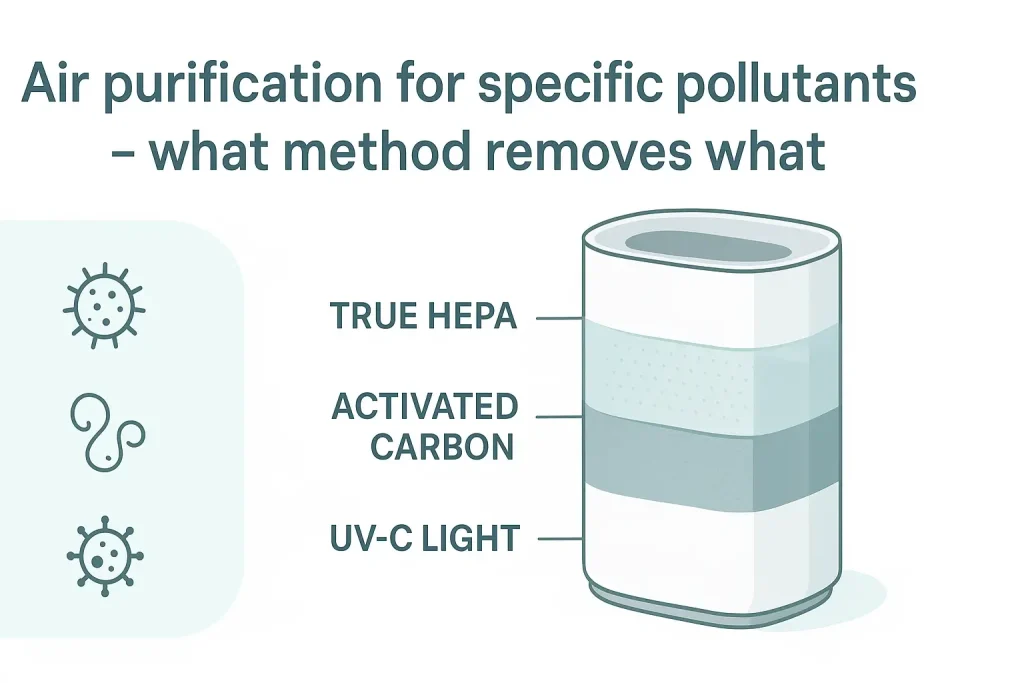
How Air Purifiers Help Eczema: The Science Behind Filtration and Skin Health
Air purifiers help eczema through a mechanism called allergen load reduction. This happens because a True HEPA filter physically traps airborne particles on a dense fiber mat, removing them from the air you breathe and the surfaces you touch.
This only works when the purifier moves enough air to cycle the entire room volume multiple times per hour. A purifier with a smoke CADR of 200 CFM achieves 2 ACH in a 300 sq ft room with 8-foot ceilings, cycling all the air every 30 minutes.
For eczema, researchers recommend 4 to 5 ACH. At 5 ACH, the same 200 CFM purifier only covers about 120 sq ft. If the purifier is undersized, allergen levels drop but not enough to reduce skin contact below the flare threshold.
If the purifier produces ozone, even below the CARB 0.050 ppm limit, the ozone reacts with skin surface lipids to create inflammatory compounds. A 2020 study in Environmental Health Perspectives linked chronic low-level ozone exposure to increased transepidermal water loss, the same skin barrier dysfunction seen in eczema.
Fix this by choosing only CARB-certified purifiers with no ionizer or by confirming the ionizer can be switched off completely. Every purifier recommended here either has no ionizer or allows full deactivation.
For more on the connection between indoor air quality and health outcomes, read our guide on what indoor air quality is and why it matters for your health.
Summary: A correctly sized True HEPA air purifier with zero ozone output reduces the airborne allergen load that contacts eczema-prone skin, lowering the frequency and severity of flares.
INTERACTIVE TOOL
Eczema Air Purifier Finder: Match Your Trigger and Room Size
Answer two questions to find the best purifier for your specific eczema situation.
Use the finder above to match a purifier to your specific trigger and room size. The recommendations reflect CADR calculations for the room category you select, with ACH targets appropriate for eczema management.
Complete Buying Guide: How to Choose an Air Purifier for Eczema
An eczema-specific air purifier purchase requires evaluating five factors in this order: filtration standard, CADR and room coverage at 5 ACH, ozone output, sleep-mode noise level, and annual operating cost.
True HEPA is the minimum filtration standard. It captures 99.97% of particles at 0.3 microns, the most penetrating particle size. Dust mite allergens, pet dander proteins, and pollen fragments all fall within or above this size range.
CADR determines cleaning speed. For eczema, target 5 ACH in the room where you sleep. Calculate the required smoke CADR by multiplying room square footage by ceiling height, then by 5, then dividing by 60. A 200 sq ft bedroom with 8-foot ceilings needs a smoke CADR of at least 133 CFM for 5 ACH.
Ozone output must be zero or fully deactivatable. CARB limits ozone to 0.050 ppm, but even trace amounts can irritate eczema-prone skin. Avoid ionizers unless the manufacturer provides a confirmed off switch.
Sleep-mode noise matters because eczema itching disrupts sleep. A purifier at 28 dB is barely audible. At 50 dB, it adds another sleep disturbance. All five units recommended here operate at or below 31 dB in their quietest mode.
Annual operating cost includes filter replacements and electricity. Filter costs range from $55 to $160 per year. Electricity at 13 cents per kWh running 8 hours daily adds $25 to $60 per year depending on wattage.
For a deeper understanding of the standards that govern air purifier performance claims, see our article on indoor air quality standards from EPA, WHO, and ASHRAE explained for homeowners.
Summary: Match True HEPA filtration with adequate CADR for your room at 5 ACH, confirm zero ozone, verify sleep-mode noise below 32 dB, and calculate annual filter costs before buying.
Top 5 Air Purifiers for Eczema: Detailed Reviews and Comparison
1. Coway Airmega 400S: Best Overall for Eczema
The Coway Airmega 400S combines high CADR with very low sleep-mode noise, making it the best all-around choice for most eczema sufferers. Its dual True HEPA filters deliver a smoke CADR of 350 CFM.
At 5 ACH, that covers 624 sq ft, meaning it handles a large master bedroom with capacity to spare. Sleep mode drops to 22 dB, quieter than a whisper. The activated carbon filter removes VOCs from furniture, carpets, and cleaning products that can trigger contact reactions on eczema-prone skin.
The ionizer is fully deactivatable. CARB certification confirms compliance with the 0.050 ppm ozone limit, and with the ionizer off, ozone output is effectively zero.
Key Specifications: Smoke CADR: 350 CFM. Dust CADR: 400 CFM. Pollen CADR: 425 CFM. Coverage at 5 ACH: 624 sq ft. Sleep mode: 22 dB. Filter cost: ~$100/year. Electricity: ~$45/year at medium speed.
Check price for Coway Airmega 400S on Amazon.
2. IQAir HealthPro Plus: Best Medical-Grade Filtration for Severe Eczema
The IQAir HealthPro Plus uses HyperHEPA filtration, capturing particles down to 0.003 microns with 99.5% efficiency. This goes beyond standard True HEPA and addresses the smallest inflammatory particles that standard filters might miss.
Its V5 Cell gas-phase filter removes formaldehyde and other chemical VOCs specifically. For eczema triggered by chemical irritants, this is the most complete filtration system available in a portable unit.
Smoke CADR is 340 CFM, covering 450 sq ft at 5 ACH. Sleep-mode noise at the lowest setting is 25 dB. The annual filter cost of approximately $160 is the highest on this list, but the filtration depth justifies the cost for severe eczema cases.
Key Specifications: HyperHEPA at 0.003 microns. Smoke CADR: 340 CFM. Coverage at 5 ACH: 450 sq ft. Sleep mode: 25 dB. Filter cost: ~$160/year. Zero ozone output.
Check price for IQAir HealthPro Plus on Amazon.
3. Blueair Blue Pure 211+: Best for Large Rooms and Open Plan Spaces
The Blueair Blue Pure 211+ delivers a smoke CADR of 353 CFM, achieving 4.8 ACH in rooms up to 540 sq ft. Its electrostatic HEPA filtration is effective for larger pollen and dander particles common in open plan living areas.
Sleep mode operates at 31 dB. While not as quiet as the Coway or IQAir, it remains below the threshold that disrupts sleep for most people. The washable fabric pre-filter captures larger dust and extends the life of the main filter.
Blueair purifiers are CARB certified. No ionizer is present, so there is zero added ozone output.
Key Specifications: Smoke CADR: 353 CFM. Coverage at 4.8 ACH: 540 sq ft. Sleep mode: 31 dB. Filter cost: ~$70/year. Zero ozone output.
Check price for Blueair Blue Pure 211+ on Amazon.
4. Levoit Core 400S: Best Value for Small to Medium Bedrooms
The Levoit Core 400S provides True HEPA filtration at a mid-range price point. Smoke CADR of 260 CFM covers 161 sq ft at 5 ACH, making it suitable for smaller bedrooms and nurseries.
Sleep mode noise is 24 dB, among the quietest on this list. The VortexAir intake design improves air circulation without increasing fan noise. Filter replacements cost approximately $55 per year, the lowest on this list.
No ionizer is present in the Core 400S. CARB certification confirms zero ozone output.
Key Specifications: Smoke CADR: 260 CFM. Coverage at 5 ACH: 161 sq ft. Sleep mode: 24 dB. Filter cost: ~$55/year. Zero ozone output.
Check price for Levoit Core 400S on Amazon.
5. Winix 5500-2: Best Budget Option with Strong Carbon Filtration
The Winix 5500-2 offers True HEPA plus a washable activated carbon filter at a competitive price. Smoke CADR of 246 CFM covers 144 sq ft at 5 ACH.
Its PlasmaWave ionizer can be switched off completely. With the ionizer disabled, ozone output is zero. The activated carbon stage is genuinely washable, extending its lifespan and reducing annual filter cost to approximately $60.
Sleep mode operates at 27.8 dB. The unit includes an air quality sensor that automatically adjusts fan speed when pollutant levels rise.
Key Specifications: Smoke CADR: 246 CFM. Coverage at 5 ACH: 144 sq ft. Sleep mode: 27.8 dB. Filter cost: ~$60/year. Zero ozone with ionizer off.
Check price for Winix 5500-2 on Amazon.
PRICE COMPARISON
Air Purifier Price Comparison: Eczema-Ready Units
Approximate retail prices as of publication. Prices vary by retailer and promotion.
$160
$190
$300
$450
$899
Annual filter cost adds $55 to $160 per year. Electricity adds approximately $25 to $60 per year at 8 hours daily use.
Use the price comparison chart above to see the purchase cost spread across all five eczema-suitable units. The IQAir commands a premium for its medical-grade HyperHEPA and V5 gas filter. The Winix and Levoit provide strong value at lower price points.
Head-to-Head Comparison Table
Use the table below to compare key specifications across all five units at a glance. Focus on the column most relevant to your eczema trigger and room size.
| Model | Smoke CADR (CFM) | Coverage at 5 ACH (sq ft) | Sleep Mode Noise (dB) | Annual Filter Cost | Ozone Output | Best For |
|---|---|---|---|---|---|---|
| Coway Airmega 400S | 350 | 624 | 22 | ~$100 | Zero (ionizer off) | All-around eczema |
| IQAir HealthPro Plus | 340 | 450 | 25 | ~$160 | Zero | Severe eczema, chemical triggers |
| Blueair Blue Pure 211+ | 353 | 540 (at 4.8 ACH) | 31 | ~$70 | Zero | Large rooms, open plan |
| Levoit Core 400S | 260 | 161 | 24 | ~$55 | Zero | Small bedrooms, value |
| Winix 5500-2 | 246 | 144 | 27.8 | ~$60 | Zero (ionizer off) | Budget, small rooms |
BUYING GUIDE
Eczema Air Purifier Buying Checklist: 8 Things to Verify
Check each item as you evaluate any air purifier for eczema use.
Keep going
Use the interactive checklist above as you evaluate any air purifier for eczema. All eight items must be checked before purchase. Missing even one can mean the purifier fails to reduce your eczema triggers effectively.
Common Mistakes to Avoid When Choosing an Air Purifier for Eczema
Buying a purifier rated for the wrong room size is the most frequent mistake. A unit rated for 300 sq ft at 2 ACH only covers 120 sq ft at 5 ACH, the target for eczema allergen reduction.
Trusting HEPA-type or HEPA-like labels is another common error. These terms describe filters that capture 85% to 95% of particles at 0.3 microns, not 99.97%. For eczema, the difference between 95% and 99.97% means five times more allergen particles remain in the air.
Leaving an ionizer on is a mistake specific to eczema. Ionizers produce ozone as a byproduct, and even small amounts oxidize skin surface lipids. If your purifier has an ionizer, confirm it is switched off before first use.
Placing the purifier against a wall or in a corner reduces effective coverage by 20% to 30%. Central placement with clearance on all sides maximizes the CADR you paid for.
For renters or those with placement constraints, read our guide on air purification for renters vs homeowners with different constraints and solutions.
Summary: Size for 5 ACH, verify True HEPA certification, disable any ionizer, and place the unit centrally with clearance on all sides.
Dust mites are the most common year-round eczema trigger, and they thrive in bedding and upholstered furniture. For a complete approach to controlling dust mite allergens in your indoor environment, see our dust mites and indoor air quality complete guide.
Is an Ionizer Air Purifier Safe for Eczema-Prone Skin?
No. Ionizer air purifiers produce ozone as a byproduct of the ionization process, and ozone directly damages the skin barrier in people with eczema. A 2020 study in Environmental Health Perspectives found that chronic low-level ozone exposure increased transepidermal water loss and skin inflammation markers.
CARB limits ozone output to 0.050 ppm for certified air purifiers sold in California. Even at this limit, ozone reacts with skin surface lipids to form lipid peroxides, compounds known to trigger inflammation in compromised skin. For eczema, the safest choice is a purifier with no ionizer or one where the ionizer can be fully deactivated.
If you already own a purifier with an ionizer, confirm the off switch works. Many Winix units, for example, allow the PlasmaWave ionizer to be switched off completely. Once off, these units function as pure mechanical filtration devices with zero added ozone.
Why Does My Eczema Not Improve Even with an Air Purifier Running?
Three common reasons explain why an air purifier fails to reduce eczema flares: the unit is undersized for the room, the filter is not True HEPA, or the dominant eczema trigger is not airborne. A purifier with a smoke CADR of 100 CFM in a 250 sq ft bedroom achieves only 1.5 ACH, far below the 4 to 5 ACH needed for meaningful allergen reduction.
HEPA-type filters capture 85% to 95% of particles at 0.3 microns versus 99.97% for True HEPA. The remaining 5% to 15% of dust mite and dander particles are often enough to trigger flares in sensitized individuals. Check the label for True HEPA certification specifically.
Some eczema triggers are not airborne. Contact allergens in laundry detergent, soap, or clothing affect the skin directly. An air purifier cannot remove these. If your eczema improves away from home but flares at home despite filtration, investigate contact allergens alongside air quality improvements.
Which Is Better for Eczema: True HEPA or Ionizer Air Purifiers?
True HEPA is better for eczema by a wide margin. True HEPA physically traps particles on a dense fiber mat, removing them permanently from the air. Ionizers charge particles so they stick to surfaces like walls, floors, and bedding, where skin contact is more likely.
Ionizers also produce ozone, which damages the skin barrier. True HEPA filters produce no ozone. The choice is between a technology that removes triggers from the air and one that redistributes them to surfaces while generating a skin irritant. For eczema, True HEPA is the only correct choice.
What Is the Difference Between a Humidifier and an Air Purifier for Eczema?
A humidifier adds moisture to the air. An air purifier removes particles and gases from the air. They serve completely different functions, and many eczema sufferers benefit from using both. Dry air worsens eczema by increasing transepidermal water loss. A humidifier maintains humidity between 40% and 60%, which helps preserve the skin barrier.
An air purifier removes airborne allergens that trigger the immune response behind eczema flares. The two devices address different aspects of eczema management. Use a humidifier for skin moisture. Use an air purifier for allergen removal. Do not substitute one for the other.
Can I Use an Air Purifier and a Humidifier Together for Eczema?
Yes. Using both an air purifier and a humidifier in the same room is safe and often beneficial for eczema. Place them at least 3 feet apart so the humidifier output does not saturate the air purifier intake with moisture, which can reduce filter efficiency and promote mold growth inside the filter media.
Monitor humidity with a hygrometer and keep levels between 40% and 60%. Above 60%, dust mites proliferate faster. Below 40%, skin loses moisture more rapidly. The air purifier runs independently, removing airborne particles while the humidifier maintains proper moisture levels.
How Do I Know What CADR Rating I Need for Eczema Relief?
Calculate the minimum smoke CADR for your room by multiplying room square footage by ceiling height, then by 5, then dividing by 60. For a 200 sq ft bedroom with 8-foot ceilings: 200 × 8 × 5 ÷ 60 = 133 CFM minimum smoke CADR. This achieves 5 ACH, the target for eczema allergen reduction.
If the manufacturer only provides a single CADR number, use the smoke CADR. Smoke particles are the smallest tested by AHAM and serve as the most conservative measure. If the unit provides dust and pollen CADR also, compare all three to understand performance across different particle sizes relevant to your specific eczema triggers.
How Often Should I Replace the Filter When Using an Air Purifier for Eczema?
Replace True HEPA filters every 12 months under normal use. In homes with high dust, pets, or during pollen season, replace every 6 to 8 months. A clogged filter reduces CADR and allows more allergens to remain airborne. The pressure drop across a loaded filter can reduce effective CADR by 30% or more.
Activated carbon filters typically need replacement every 6 months. Some are washable and last longer. Pre-filters should be cleaned or replaced every 2 to 4 weeks. Set a recurring calendar reminder for filter changes. A neglected filter turns the air purifier from an eczema management tool into a source of recirculated allergens.
Where Should I Place My Air Purifier to Help with Eczema?
Place the air purifier in the bedroom, which is the most important room for eczema management. You spend 7 to 9 hours there nightly, and eczema itching peaks during sleep. Position the unit 12 to 24 inches from walls and furniture, ideally near the center of the room or along the wall opposite the bed.
Avoid corners, behind furniture, or under shelves. These positions restrict airflow and reduce effective CADR by 20% to 30%. If you can only place the purifier along a wall, pull it out at least 12 inches and ensure the intake and exhaust grilles have unobstructed clearance.
During winter, indoor air quality often worsens as windows stay closed and allergens concentrate. For seasonal strategies, read our guide on air quality in winter when windows stay closed and why it gets worse.
Do I Need a Whole-House Air Purifier or Will a Portable Unit Work for Eczema?
A portable unit in the bedroom is sufficient for most eczema sufferers. Eczema triggers matter most when you are in prolonged contact with them, which occurs during sleep. A correctly sized portable True HEPA purifier achieving 5 ACH in your bedroom addresses the highest-priority exposure window.
Whole-house systems integrated with HVAC ductwork provide broader coverage but at significantly higher cost, typically $1,500 to $4,000 installed. They also require professional maintenance. For eczema, start with a portable bedroom unit. If you notice flare reduction, add additional portable units for other rooms as needed rather than investing in whole-house filtration upfront.
Can Air Purifier Ozone Output Damage Sensitive Skin?
Yes. Ozone reacts with lipids in the stratum corneum, the outermost skin layer, creating lipid peroxides and other reactive oxygen species. In people with eczema, the skin barrier is already compromised, making it more vulnerable to ozone-induced oxidative damage.
Even ozone levels below the CARB 0.050 ppm limit can accelerate transepidermal water loss. Choose a purifier with no ionizer or ensure the ionizer has a confirmed off switch. Ozone is not a minor consideration for eczema: it directly attacks the skin structure you are trying to protect.
Why Does My Air Purifier Make My Eczema Worse?
If your eczema worsens after introducing an air purifier, the most likely cause is an ionizer producing ozone. Switch off the ionizer immediately. Other possible causes include a new purifier emitting volatile organic compounds from manufacturing residues during the first few days of operation, or the purifier stirring up settled dust that was previously undisturbed.
Run the purifier on high in an empty room with windows open for the first 24 hours to off-gas any manufacturing residues. Vacuum and dust the room thoroughly before placing the purifier in its permanent location. If irritation persists, check whether the filter itself contains fiberglass or other irritating materials by reviewing the manufacturer specifications.
Is a Medical-Grade Air Purifier Worth It for Eczema Compared to a Standard HEPA Unit?
Medical-grade units like the IQAir HealthPro Plus are worth the investment if your eczema is severe, triggered by chemical VOCs, or has not responded to standard True HEPA filtration. The HyperHEPA filter captures particles down to 0.003 microns versus 0.3 microns for standard HEPA, addressing the smallest inflammatory particles.
For mild to moderate eczema triggered primarily by dust mites or pollen, a standard True HEPA unit like the Coway Airmega 400S or Levoit Core 400S provides sufficient filtration at a lower cost. The medical-grade premium pays for itself if it reduces flare frequency enough to decrease dermatologist visits, prescription costs, and lost sleep.
Spring pollen season brings additional airborne triggers for eczema sufferers. For strategies specific to seasonal allergen management, see our air purification for spring allergy season complete guide for allergy sufferers.
Can Air Purifiers Help with Other Skin Conditions Beyond Eczema?
Air purifiers may benefit other skin conditions where airborne triggers play a role. Psoriasis, contact dermatitis, and acne have all shown some response to reduced airborne irritant exposure in small-scale studies. The mechanism is the same: fewer airborne particles landing on skin means fewer opportunities for immune activation or irritation.
However, eczema has the strongest evidence base for air purifier intervention because its triggers, dust mites, pet dander, and VOCs, are well-characterized airborne particles. For other skin conditions, air purification should complement, not replace, standard dermatological treatment.
How Long Does It Take for an Air Purifier to Reduce Eczema Symptoms?
Most eczema sufferers notice a reduction in nighttime itching within 3 to 7 days of running a correctly sized True HEPA purifier in the bedroom. Full assessment requires 4 to 6 weeks because eczema flares follow a cycle, and you need to observe at least one full flare cycle under filtered air conditions to determine whether frequency and severity have decreased.
Track flare frequency and severity in a simple log for 30 days before and after introducing the purifier. This provides objective data rather than relying on subjective recall. If no improvement occurs after 6 weeks, reassess room sizing, filter type, or whether your dominant trigger is not airborne.
What Is the Best Air Purifier for Eczema in a Nursery or Child's Room?
The Levoit Core 400S is the best choice for a nursery or child's room. It operates at 24 dB in sleep mode, quieter than a library. The low noise level is critical because infants and young children with eczema need uninterrupted sleep even more than adults. Smoke CADR of 260 CFM covers nurseries up to 161 sq ft at 5 ACH.
The Coway Airmega 400S is a strong alternative if the nursery is larger, over 200 sq ft. Its 22 dB sleep mode is even quieter, and the higher CADR provides headroom as the child grows. Avoid units with ionizers entirely in children's rooms; a child's developing skin and lungs are more sensitive to ozone than an adult's.
For travel or temporary situations where a full-size purifier is impractical, read our guide on personal air purifiers on planes for portable options that can supplement your main unit.
Conclusion
A correctly sized True HEPA air purifier with zero ozone output reduces the airborne allergen load that contacts eczema-prone skin during the critical overnight hours. Match smoke CADR to your room at 5 ACH, verify True HEPA certification, disable any ionizer, and place the unit centrally in your bedroom.
The Coway Airmega 400S offers the best balance of CADR, noise, and cost for most eczema sufferers. The IQAir HealthPro Plus justifies its premium for severe or chemical-triggered eczema. Start with a portable bedroom unit, replace filters on schedule, and track your flare frequency for 4 to 6 weeks to confirm improvement.
Choose the purifier that matches your specific trigger and room size using the interactive finder above, then verify every item on the buying checklist before you purchase.