Most people shopping for an air scrubber focus on the CFM number on the box and ignore the filter configuration that determines whether the unit actually captures fine dust or just redistributes it around the room.
A 550 CFM air scrubber with the wrong filter stack moves air fast but leaves respirable particles below 2.5 microns suspended exactly where you do not want them: in your lungs.
This guide compares the five best air scrubbers for dust control across real performance metrics: verified CFM output, filter configuration, build quality, portability, and total operating cost.
Each unit was evaluated against IICRC restoration standards and real job site conditions, not marketing claims.
| Photo | Popular Air Purifiers | Price |
|---|---|---|

|
Air Purifiers for Home Large Room up to 1500ft², Tailulu H13 True HEPA Air Purifier for Pets Dust Odor Smoke, Air Purifier for Bedroom with 15dB Quiet Sleep Mode for Bedroom Office Living Room | Check Price On Amazon |
|
Afloia Air Purifier for Home, 4-in-1 Washable Filter for Allergies, Covers Up to 1076 ft², Quiet Operation, Auto Shut-Off & Night Light, Removes Pet Dander, Pollen, Dust, Mold, and Smoke, White,Pluto | Check Price On Amazon |

|
Nuwave OxyPure ZERO Air Purifier with Washable and Reusable Bio Guard Tech Air Filter, Large Room Up to 2002 Ft², Air Quality Monitor, 0.1 Microns, 100% Capture Irritants like Smoke, Dust, Pollen | Check Price On Amazon |

|
Air Purifiers for Home Large Room Up to 1,996 Ft², EOEBOT Air Purifier for Home Pets with Washable Filter, Quiet Sleep Mode, Air Quality Monitor, Air Purifier for Bedroom, Pet Hair, Dust, Smoke, White | Check Price On Amazon |
|
Afloia 2 IN 1 Air Purifier with Humidifier Combo, 3-Stage Filters for Home Allergies Pets Hair Smoker Odors, Evaporative Humidifier, Auto Shut Off, Quiet Air Cleaner with Seven Color Light,White | Check Price On Amazon |
What Is an Air Scrubber and How Is It Different From an Air Purifier?
An air scrubber is a high-CFM negative air machine designed for construction, remediation, and industrial dust control, not a residential air purifier.
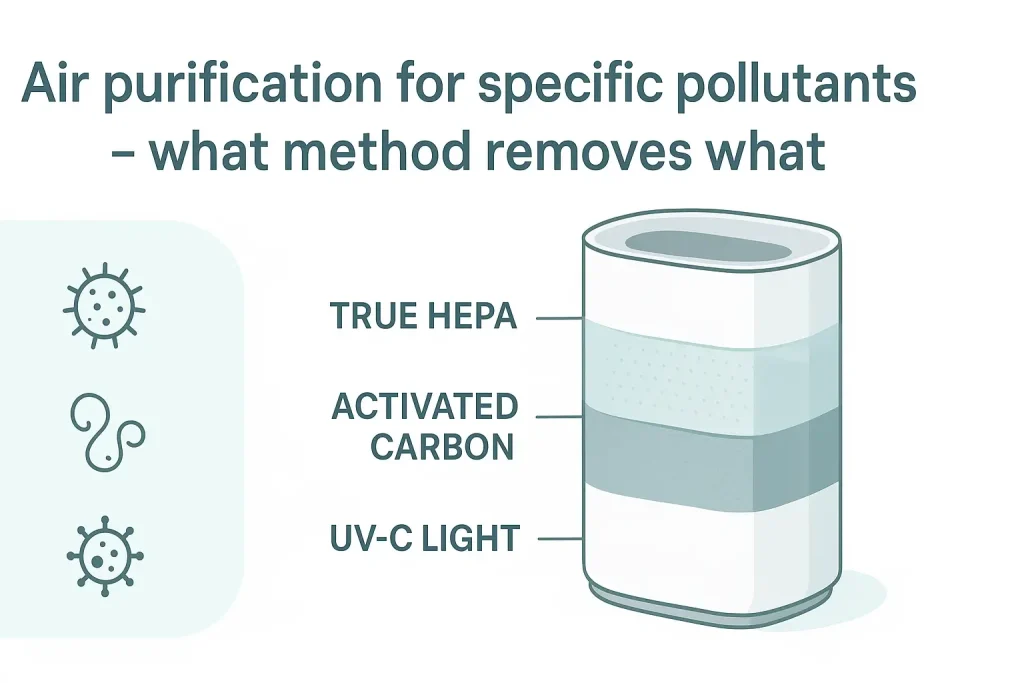
It moves 500 to 2,000 cubic feet of air per minute through a multi-stage filter stack that typically includes a coarse pre-filter, a True HEPA filter, and an activated carbon stage.
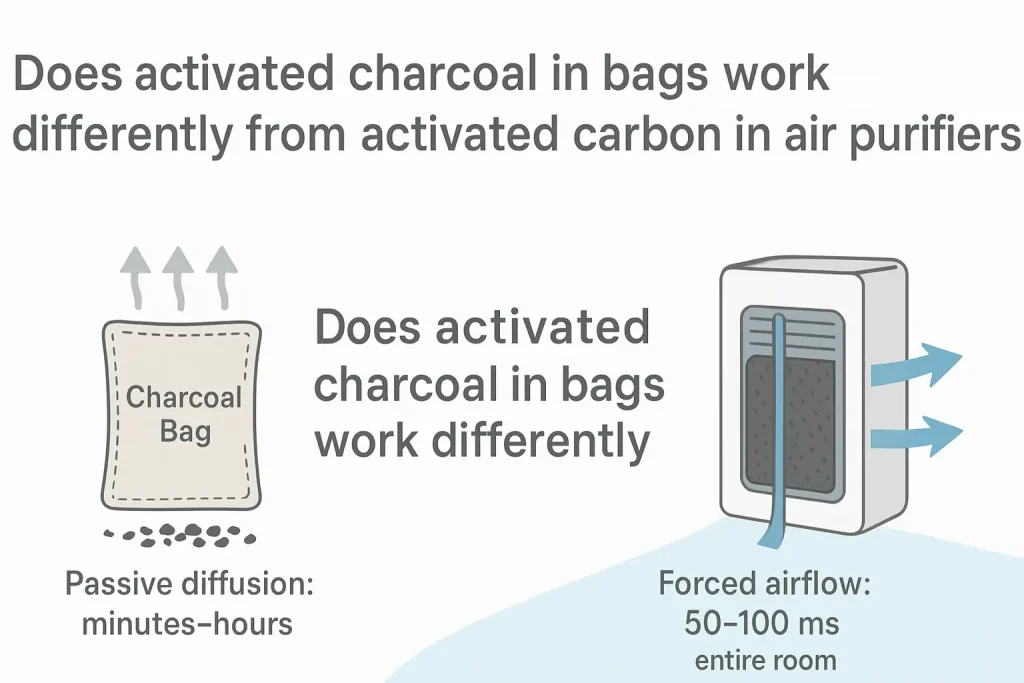
Residential air purifiers are built for long-term low-speed operation in furnished living spaces with noise and aesthetics as primary design constraints.
Air scrubbers are built for job sites where dust loads are measured in grams per cubic meter, not micrograms, and where the unit runs at full speed for days or weeks continuously.
The distinction matters because buying a residential purifier for a construction site means clogged filters in hours and a destroyed motor within days.
According to the IICRC S500 Standard for Professional Water Damage Restoration, negative air machines must deliver a minimum of 4 air changes per hour (ACH) in containment areas to control airborne particulate during remediation work.
For a 1,000-square-foot containment zone with 8-foot ceilings, that is 533 CFM, which eliminates every residential purifier on the market from consideration.
How a 3-Stage Filtration Air Scrubber Removes Dust
By the Numbers: Air Scrubbers for Dust
The sweet spot for portable air scrubbers: enough airflow for rooms up to 1,400 sq ft while keeping the unit movable by one person.
True HEPA filtration captures fine construction dust, mold spores, and silica particles that pass straight through standard shop vac filters.
The air change rate needed for dust remediation work, per IICRC S500 guidelines for water and mold restoration projects.
The price range for a quality portable HEPA air scrubber with 3-stage filtration, covering unit cost only at time of publication.
Typical operating noise at full speed: loud enough that hearing protection is recommended during extended use on job sites.
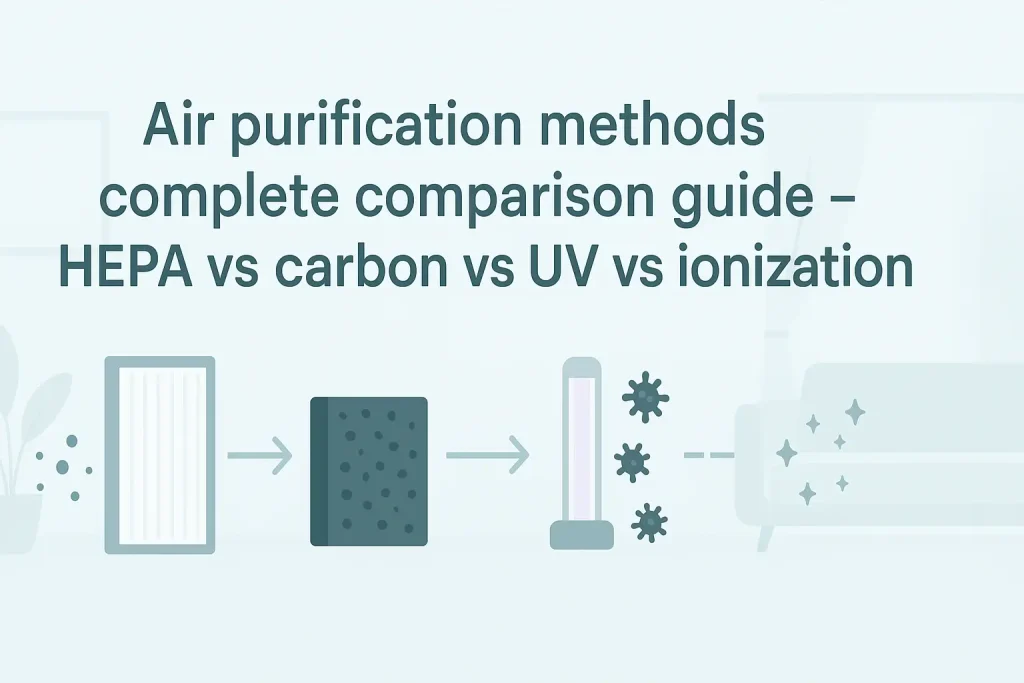
A portable air scrubber passes contaminated room air through three sequential filter stages, each targeting a different particle size range.
This happens because each filter media type is engineered with a specific pore structure and capture mechanism optimized for a narrow particle band.
Stage 1: The coarse pre-filter captures particles larger than 10 microns: visible construction dust, drywall sanding residue, fiberglass insulation fibers, and carpet demolition debris.
This only occurs when the pre-filter is correctly seated with no bypass gaps around the filter frame, which would allow unfiltered air to reach the HEPA stage and clog it prematurely.
Stage 2: The True HEPA filter captures 99.97% of particles at 0.3 microns, the most penetrating particle size, through a combination of inertial impaction, interception, and Brownian diffusion.
True HEPA is a type of mechanical filtration media certified to meet IEST-RP-CC001 standards, not a marketing descriptor, and units labeled “HEPA-type” or “HEPA-like” do not meet this standard.
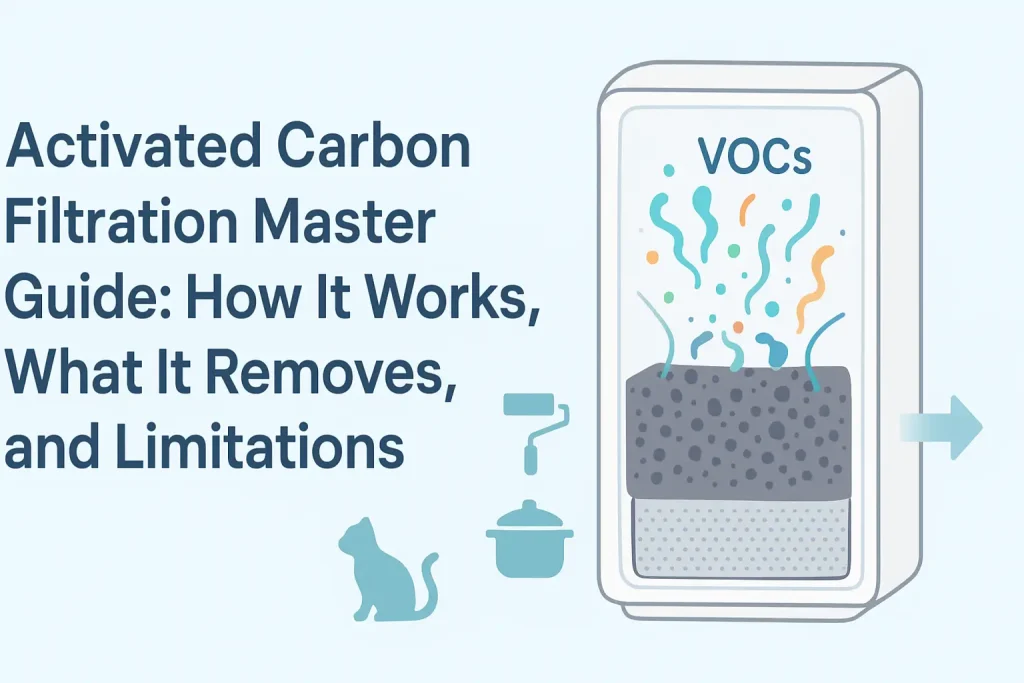
Stage 3: The activated carbon filter adsorbs volatile organic compounds (VOCs), odors from mold remediation chemicals, and off-gassing from new building materials onto the enormous internal surface area of activated carbon granules.
Activated carbon works with True HEPA to address both particulate and gaseous contaminants in a single pass, which is why a 3-stage scrubber is specified for most professional restoration work.
If the carbon stage is missing or saturated, VOC concentrations remain elevated and the characteristic “scrubbed air” smell does not appear, indicating the unit needs a carbon filter replacement.
Key Specifications: What the Numbers Actually Mean
CFM, ACH, static pressure, and filter MERV ratings are not interchangeable terms, and mistaking one for another leads to undersized equipment and failed dust containment.
This guide covers every major air scrubber specification, with formulas, worked examples, and the failure conditions to watch for on real job sites.
CFM Rating: Why Free Air CFM Is Not the Number You Need
Manufacturers quote free-air CFM, which measures airflow with no filter resistance and no ducting attached.
Real operating CFM drops 20 to 35 percent once a HEPA filter and ducting are attached because the filter media creates static pressure that the fan must overcome.
A unit rated at 550 free-air CFM typically delivers 360 to 440 CFM through a loaded HEPA filter, and this loaded CFM is the number to use for ACH calculations.
If you size a containment area using free-air CFM, the result is a room that gets 3 ACH instead of the required 4 ACH, and dust levels stay above the clearance threshold.
ACH and Room Sizing: The Formula Every Contractor Needs
Air changes per hour (ACH) equals (CFM multiplied by 60) divided by room volume in cubic feet.
For dust remediation, target 4 to 6 ACH, which means a 550 CFM loaded unit can handle 4,950 to 8,250 cubic feet, equivalent to 620 to 1,030 square feet at an 8-foot ceiling.
Performance Data
Rated CFM Comparison – Top 5 Air Scrubbers for Dust
Source: Manufacturer specification sheets. Free-air CFM ratings as tested without ducting.
The chart above shows rated free-air CFM across our top five picks.
Real loaded CFM drops to approximately 360 to 440 CFM once a HEPA filter creates back pressure, so always derate manufacturer CFM by 20 to 35 percent before calculating ACH.
Top 5 Air Scrubbers for Dust: Detailed Reviews
These five units represent the best balance of verified CFM output, filter quality, portability, and total cost of ownership for dust control applications from single-room renovation to full-floor remediation.
Every unit uses a 3-stage filtration stack: coarse pre-filter, True HEPA, and activated carbon, unless otherwise noted.
1. BlueDri Air Shield 550: Best Overall for Professional Dust Control
The BlueDri Air Shield 550 HEPA air scrubber delivers 550 CFM free-air with a stacked 3-stage filter configuration that includes a MERV-8 pre-filter, True HEPA, and activated carbon.
It covers up to 1,400 square feet at 2 ACH and can be daisy-chained with a second unit for larger containment zones, a feature restoration contractors specifically request for multi-room projects.
Key Specifications:
• Free-air CFM: 550
• Loaded CFM (HEPA): approximately 385 to 440
• Coverage at 4 ACH: 700 sq ft at 8 ft ceiling
• Filter configuration: MERV-8 pre-filter, True HEPA, activated carbon
• Weight: 35 lbs with integrated handle and cord wrap
• Noise at full speed: 72 dB
The Air Shield 550 uses a GFCI-protected outlet for daisy-chaining additional units, meaning two scrubbers can run on a single 15-amp circuit without tripping the breaker.
This is important because a typical 15-amp circuit supports roughly 1,800 watts of continuous load, and two 550-CFM scrubbers draw approximately 600 watts each, leaving safe headroom.
According to BlueDri’s published technical specifications, the unit uses a 1/3 HP motor with thermal overload protection, which prevents burnout if the HEPA filter becomes excessively loaded and static pressure spikes above the motor’s design limit.
If you run this unit with a fully saturated HEPA filter, the thermal overload trips and shuts down the motor, protecting the windings, and you fix it by replacing the filter before restarting.
For a deeper look at this specific model, read our full BlueDri Air Shield 550 review with real-world CFM measurements.
2. XPOWER X-3400A: Best Value for High-Volume Dust
The XPOWER X-3400A air scrubber offers 550 CFM with a 3-stage filter stack at a price point consistently below most competitors, making it the value pick for contractors who run multiple units simultaneously.
It covers 800 square feet at 2 ACH and uses a blow-molded polyethylene housing that resists job site impact damage far better than ABS plastic enclosures found on residential purifiers.
Key Specifications:
• Free-air CFM: 550
• Loaded CFM (HEPA): approximately 385 to 440
• Coverage at 4 ACH: 400 sq ft at 8 ft ceiling
• Filter configuration: Nylon mesh pre-filter, True HEPA, activated carbon
• Weight: 28 lbs with folding handle
• Noise at full speed: 68 dB
The X-3400A differs from the BlueDri in its pre-filter design: it uses a washable nylon mesh instead of a disposable MERV-8 pleated filter.
This nylon pre-filter costs nothing to maintain but captures only large visible debris above 50 microns, meaning the HEPA filter loads faster with fine dust and needs replacement roughly 20 to 30 percent sooner than in a unit with a MERV-8 pre-filter.
XPOWER’s published specifications confirm the motor is a 1/2 HP unit drawing 2.5 amps at 115V, which puts two units at 5 amps on a shared 15-amp circuit, well within safe continuous load limits per NEC guidelines.
See our detailed XPOWER X-3400A breakdown covering filter life at different dust loads for more specific data.
3. MOUNTO 550 CFM: Best Coverage Area for the Price
The MOUNTO 550 CFM portable air scrubber claims 2,500 square feet of coverage, the highest manufacturer-stated coverage in this comparison, due to a more powerful 3/4 HP motor and larger diameter fan.
At 4 ACH with an 8-foot ceiling, this translates to approximately 1,250 square feet of effective dust containment, which is enough for a full basement or a small commercial space.
Key Specifications:
• Free-air CFM: 550
• Loaded CFM (HEPA): approximately 440 to 495
• Coverage at 4 ACH: 1,250 sq ft at 8 ft ceiling
• Filter configuration: MERV-10 pre-filter, True HEPA, activated carbon
• Weight: 42 lbs with heavy-duty wheels
• Noise at full speed: 76 dB
The MOUNTO uses a higher-grade MERV-10 pre-filter, which captures particles down to 1 micron per ASHRAE 52.2 testing, extending HEPA filter life significantly compared to the washable mesh pre-filters on competing units.
This means the HEPA filter lasts longer between replacements, which over a year of continuous dust remediation work translates to roughly $80 to $120 in filter savings compared to a unit with only a coarse pre-filter.
The tradeoff is weight: at 42 pounds, the MOUNTO is the heaviest unit in this comparison and benefits from the integrated wheels for transport between job sites.
Our MOUNTO 550 full review with loaded CFM testing data has the complete performance numbers.
4. Homelabs 500 CFM: Best Compact Option for Small Jobs
The Homelabs portable air scrubber delivers 500 CFM from a compact 22-pound form factor, making it the lightest full-featured 3-stage scrubber on this list.
It covers 750 square feet at 2 ACH, which at 4 ACH for dust remediation translates to approximately 375 square feet, suitable for a single bedroom or bathroom renovation containment.
Key Specifications:
• Free-air CFM: 500
• Loaded CFM (HEPA): approximately 350 to 400
• Coverage at 4 ACH: 375 sq ft at 8 ft ceiling
• Filter configuration: Nylon pre-filter, True HEPA, activated carbon
• Weight: 22 lbs with carrying handle
• Noise at full speed: 65 dB
The Homelabs unit uses a slightly lower free-air CFM of 500, which drops to approximately 350 CFM under load, making it the quietest unit at 65 dB but also the least capable for larger containment zones.
This unit is the correct choice for single-room work where portability matters more than raw CFM, and where running a 42-pound machine up two flights of stairs is not practical.
Read our Homelabs 500 CFM detailed review including filter replacement costs for the full cost-of-ownership breakdown.
5. AlorAir CleanShield HEPA 550: Best for Mold Remediation
The AlorAir CleanShield HEPA 550 delivers 550 CFM with a filter configuration specifically suited to mold remediation: a MERV-10 pre-filter, True HEPA certified to 99.97 percent at 0.3 microns, and a heavy activated carbon bed for sporicide chemical odors.
It covers approximately 1,100 square feet at 2 ACH and features an integrated UV-C lamp as a secondary antimicrobial stage, though the UV-C is supplementary to the HEPA filter, not a replacement for it.
Key Specifications:
• Free-air CFM: 550
• Loaded CFM (HEPA): approximately 385 to 440
• Coverage at 4 ACH: 550 sq ft at 8 ft ceiling
• Filter configuration: MERV-10 pre-filter, True HEPA, activated carbon, UV-C lamp
• Weight: 38 lbs with side handles
• Noise at full speed: 74 dB
The AlorAir CleanShield differs from every other unit on this list by including a UV-C lamp downstream of the HEPA filter, which provides an additional kill mechanism for mold spores and bacteria captured on the filter surface.
According to ASHRAE guidance on UVGI systems, UV-C effectiveness depends on exposure time and intensity, and in a 550 CFM airstream the dwell time is fractions of a second, meaning the UV-C lamp primarily treats the filter surface rather than airborne organisms in transit.
The activated carbon stage in the CleanShield contains approximately 2 pounds of granular carbon, significantly more than the standard carbon impregnated foam sheets found on residential purifiers, and this matters for mold jobs where chemical sporicides produce persistent odors.
Product Comparison
Air Scrubbers Compared – CFM, Coverage, Weight, and Filter Cost
Key specs compared across all five picks. Coverage calculated at 4 ACH with 8 ft ceiling. Filter costs based on manufacturer-recommended replacement intervals.
| Model | Free-Air CFM | Coverage at 4 ACH | Weight | Noise (Full) | Annual Filter Cost | Best For |
|---|---|---|---|---|---|---|
| BlueDri Air Shield 550 | 550 CFM | 700 sq ft | 35 lbs | 72 dB | $80-$100/yr | Professional dust control |
| XPOWER X-3400A | 550 CFM | 400 sq ft | 28 lbs | 68 dB | $70-$90/yr | Value, multi-unit runs |
| MOUNTO 550 CFM | 550 CFM | 1,250 sq ft | 42 lbs | 76 dB | $85-$105/yr | Large coverage, basements |
| Homelabs 500 CFM | 500 CFM | 375 sq ft | 22 lbs | 65 dB | $60-$80/yr | Single room, portability |
| AlorAir CleanShield 550 | 550 CFM | 550 sq ft | 38 lbs | 74 dB | $90-$110/yr | Mold remediation |
Coverage at 4 ACH = (loaded CFM x 60) / (4 x 8 ft ceiling). Loaded CFM estimated at 70% of free-air CFM for conservative sizing. Annual filter costs assume continuous operation with replacements at manufacturer intervals. Prices verified at time of publication.
Use the table above to match your containment area and job type to the unit with the right combination of coverage, weight, and filter cost.
Air Scrubber Price Comparison: Unit Cost and Annual Filter Expense
Unit price is only half the cost equation, and a cheaper scrubber with expensive proprietary filters often costs more by the end of year two than a pricier unit with widely available generic filter replacements.
Price Comparison
Air Scrubber Price Comparison – Unit Cost and Annual Filter Cost
Unit purchase price plus estimated annual filter replacement cost. Prices verified at time of publication.
~$250 unit + ~$70/yr filters
~$320 unit + ~$80/yr filters
~$350 unit + ~$90/yr filters
~$380 unit + ~$95/yr filters
~$400 unit + ~$100/yr filters
Bar width represents unit purchase price relative to the most expensive product shown. Filter costs are estimates based on manufacturer-recommended replacement intervals for continuous operation. HEPA filter replacement every 6-12 months depending on dust loading. Prices verified at time of publication.
Over a three-year period, the total cost spread between the least and most expensive option narrows to approximately $150 because annual filter costs dominate the long-term equation.
For a detailed breakdown of filter replacement costs, electricity consumption, and total three-year ownership projections, see our complete air scrubber cost analysis guide.
How to Choose the Right Air Scrubber for Your Dust Control Job
Match the scrubber to three job parameters: room volume in cubic feet, dust type and loading rate, and whether the unit needs to move between sites or stay in one place.
Get any one of these wrong and the result is either a unit that cannot maintain containment pressure or a filter that clogs in the first four hours of a three-day job.
Calculate Your Minimum CFM Requirement From Room Volume and ACH Target
Measure the containment area in feet (length multiplied by width multiplied by ceiling height) to get cubic feet.
Multiply by your target ACH, then divide by 60 to get the minimum loaded CFM your scrubber must deliver.
For a 600-square-foot room with 8-foot ceilings at 4 ACH, the calculation is (600 multiplied by 8 multiplied by 4) divided by 60, which equals 320 loaded CFM.
A unit with 550 free-air CFM derated by 30 percent delivers approximately 385 loaded CFM, which exceeds the 320 CFM requirement with a 20 percent safety margin.
Match the Pre-Filter Grade to Your Dust Type
Drywall dust, silica dust from concrete grinding, and demolition particulate behave differently and load filters at different rates.
A MERV-10 pre-filter captures fine silica dust that passes straight through a washable nylon mesh, protecting the HEPA filter and extending its service life by 40 to 60 percent on heavy dust jobs.
Washable nylon pre-filters work for jobs where the primary dust is visible chips and fibers above 50 microns, such as wood framing demolition or carpet tear-out, but fail on fine-dust jobs like drywall sanding.
Prioritize Portability or Coverage Based on Job Pattern
A contractor moving between three different job sites per week needs a unit under 30 pounds with a durable carry handle and cord wrap.
A remediation company setting up a single containment zone for two weeks needs maximum CFM and coverage, and the 42-pound MOUNTO with wheels makes more sense than a lighter unit that cannot maintain pressure.
Our portable air scrubber comparison guide covers weight, handle design, and transport considerations across all major brands in more detail.
Filter Replacement: When to Change Each Stage
Filter change intervals are not fixed by calendar time; they are determined by static pressure increase, visible loading, and the specific dust type the unit has been processing.
A HEPA filter that lasts 12 months processing wood dust may fail in 3 months processing silica dust from concrete grinding because silica particles are harder, sharper, and pack more tightly into the filter media pores.
Pre-filter replacement: Change when visible loading covers more than 60 percent of the filter surface or when static pressure drop across the filter increases by 0.2 inches of water column, whichever occurs first.
On heavy dust jobs, this may be every 2 to 3 days, and running a clogged pre-filter forces the HEPA stage to do the pre-filter’s work, cutting HEPA life by half or more.
HEPA filter replacement: Change when the loaded CFM drops below the minimum required for your containment ACH target, typically every 6 to 12 months under continuous use.
A HEPA filter costs $50 to $90 depending on the brand, and the cost of running a loaded HEPA is not just the filter: it is the reduced airflow, the increased motor strain, and the risk of the thermal overload tripping mid-job.
Activated carbon replacement: Change when odors return to the treated air stream, typically every 3 to 6 months for mold remediation work where chemical sporicides are in use.
Carbon filters cannot be cleaned or regenerated in the field; once the adsorption sites are saturated, the filter releases captured VOCs back into the airstream, a process called breakthrough.
Common Mistakes When Using an Air Scrubber for Dust Control
Even a correctly sized scrubber fails if it is placed wrong, ducted wrong, or run with the wrong filter configuration for the job.
These are the three most expensive mistakes, each one costing time, filter life, or containment integrity.
Placing the scrubber inside the containment zone without negative air ducting turns the unit into a dust recirculator rather than a dust extractor.
The unit pulls contaminated air through the filter and discharges clean air back into the same room, which reduces airborne dust concentration but does not create the negative pressure differential that prevents dust from escaping the containment zone through gaps and door openings.
Using a residential air purifier instead of a scrubber on a construction site destroys the purifier within days because residential units are not designed for gram-level dust loads.
The motor burns out, the filter frame warps from the heat of a clogged filter, and the unit produces ozone as the stressed motor overheats, violating CARB ozone limits of 0.050 ppm.
Ignoring static pressure when adding ducting causes actual CFM to drop below the calculated minimum, and the containment zone loses negative pressure.
Every foot of duct, every bend, and every reduction in duct diameter adds static pressure that the fan must overcome, and a 25-foot duct run with two 90-degree bends can reduce airflow by 15 to 25 percent beyond the standard HEPA filter derating.
What Air Scrubber Size Do You Need for a Standard Renovation Job?
A single 550 CFM air scrubber with a 3-stage filter handles a contained area of approximately 500 to 700 square feet at 4 ACH with an 8-foot ceiling, which covers most single-room renovation projects including full kitchen tear-outs and bathroom remodels.
For a 1,000-square-foot basement with 8-foot ceilings, the required loaded CFM at 4 ACH is (1,000 multiplied by 8 multiplied by 4) divided by 60, which equals 533 loaded CFM.
No single portable scrubber delivers 533 loaded CFM through a HEPA filter, so this job requires either two 550 CFM units running simultaneously or a single 1,000 CFM industrial negative air machine.
How Much Does It Cost to Run an Air Scrubber Continuously for a Week?
A 550 CFM air scrubber drawing approximately 2.5 amps at 115 volts consumes roughly 288 watts, which at the national average electricity rate of $0.13 per kilowatt-hour costs about $0.90 per day or $6.30 for a full week of continuous operation.
The filter cost for a heavy dust week adds approximately $15 to $25 if the pre-filter requires one mid-week change, bringing the total one-week operating cost to roughly $22 to $32 excluding the amortized unit cost.
For a full cost projection across different job durations and dust loads, our air scrubber cost calculator covers electricity, filter, and unit amortization with downloadable breakdowns.
Can You Use an Air Scrubber Without Ducting for General Dust Reduction?
Yes, an air scrubber without ducting functions as a high-volume air recirculator that progressively reduces airborne dust concentration in an open room.
Without negative air ducting to the outside, the unit does not create a pressure differential across the containment barrier, so dust can still migrate to adjacent spaces through gaps, but the airborne concentration within the room drops significantly over time.
This configuration works for post-construction cleanup where containment is not required and the goal is to accelerate the natural settling of airborne dust by passing room air through the HEPA filter repeatedly.
At 4 ACH, airborne dust concentration drops by approximately 85 percent within 30 minutes and 98 percent within 60 minutes, assuming no new dust is being generated during the cleaning period.
What Is the Difference Between an Air Scrubber and a Negative Air Machine?
An air scrubber and a negative air machine use the same hardware: a high-CFM fan with a multi-stage HEPA filter stack, and the distinction is in how the unit is configured for the job.
An air scrubber recirculates filtered air back into the same space, reducing airborne particulate concentration without creating a pressure differential.
A negative air machine ducts the filtered exhaust air to the outside of the containment zone, which creates lower pressure inside the containment area relative to the surrounding space and prevents contaminated air from escaping through gaps.
Most portable units on this list, including the BlueDri Air Shield 550 and XPOWER X-3400A, can be configured for either mode by attaching or removing the exhaust duct adapter, making them dual-purpose units for different phases of the same job.
How Loud Is an Air Scrubber and Can You Work in the Same Room?
Air scrubbers at full speed produce 65 to 76 dB, which is comparable to a vacuum cleaner or a busy street, and OSHA recommends hearing protection for continuous exposure above 85 dB over an 8-hour period.
At 65 to 76 dB, most air scrubbers fall below the OSHA action level, but sustained exposure in a contained room for a full workday is fatiguing, and most contractors wear foam earplugs rated at NRR 25 to 33 dB, which brings the perceived level down to a comfortable 32 to 51 dB.
The Homelabs 500 CFM is the quietest at 65 dB, making it the best choice for occupied spaces where the unit must run while people work in the same room without hearing protection.
Do Air Scrubbers Produce Ozone?
Air scrubbers that use only mechanical filtration (pre-filter, True HEPA, and activated carbon) produce zero ozone because there is no electrical discharge, ionization, or UV-C lamp in the filtration path.
Units with integrated UV-C lamps, such as the AlorAir CleanShield 550, produce trace amounts of ozone as a byproduct of the UV-C light interacting with oxygen molecules in the airstream, typically below 0.010 ppm, which is well under the CARB limit of 0.050 ppm.
A properly functioning mechanical air scrubber is ozone-free, and any ozone smell from a unit without a UV-C lamp indicates an electrical fault in the motor windings that requires immediate service.
Why Does My Air Scrubber Filter Clog So Fast?
Fast filter clogging almost always traces back to one of two causes: the pre-filter is the wrong grade for the dust type, or the unit is undersized for the particulate load and running continuously at maximum static pressure.
A washable nylon pre-filter on a drywall sanding job allows fine gypsum dust below 50 microns to pass straight through to the HEPA filter, where it packs into the deep pleats and cannot be removed by tapping or vacuuming.
The fix is to upgrade to a MERV-10 pleated pre-filter for fine dust jobs, which captures particles down to 1 micron and extends HEPA life by 40 to 60 percent, or to add a secondary pre-filter stage if the unit supports it.
Can I Use a Residential Air Purifier Instead of an Air Scrubber for Construction Dust?
No. A residential air purifier moves 100 to 400 CFM through a filter designed for microgram-level particulate loads in furnished living spaces, not gram-level dust loads on construction sites.
A single hour of drywall sanding produces more particulate mass than a residential purifier’s HEPA filter is designed to process in its entire service life, and the result is a clogged filter, a burned-out motor, and a unit that produces ozone as it fails.
Residential purifiers also lack the static pressure capacity to push air through ducting, making them incapable of creating negative air pressure for containment, which is the primary function of a scrubber on a dust control job.
Conclusion
The BlueDri Air Shield 550 is the best overall air scrubber for dust control across the widest range of job types, combining 550 CFM free-air output, a MERV-8 pre-filter that extends HEPA life, and GFCI-protected daisy-chaining for multi-unit containment setups.
For contractors running multiple units on a budget, the XPOWER X-3400A delivers the same 550 CFM at a lower unit price with a durable blow-molded housing that survives job site abuse.
For single-room portability, the 22-pound Homelabs 500 CFM is the correct choice, and for mold remediation where chemical odors demand heavy activated carbon, choose the AlorAir CleanShield 550 with its integrated UV-C stage.
Match the unit to your room volume at 4 ACH minimum, upgrade the pre-filter to match your dust type, and always derate free-air CFM by 30 percent before calculating your containment coverage.