Most air purifiers are tested in a lab. Your bedroom, with the door open and kids walking in and out, is not a lab. That gap between laboratory CADR ratings and real-world performance is where cold and flu viruses slip through.
During cold and flu season, an air purifier is either a meaningful layer of protection or a noisy appliance that moves air around. The difference comes down to whether the unit can deliver enough clean air changes per hour to capture airborne droplets before you inhale them.
A unit rated for 200 square feet at 2 ACH placed in a 300-square-foot room will cycle the air less than twice per hour during high season. Droplets from a sneeze linger for up to 3 hours, recirculating through the room while the purifier works at a fraction of the rate needed.
This guide covers the five fastest air purifiers for capturing virus-sized particles, with tested smoke CADR ratings, noise levels at the fan speeds you will actually use, and filter replacement costs calculated for year-round operation, not just the winter months.
| Photo | Popular Air Purifiers | Price |
|---|---|---|

|
Air Purifiers for Home Large Room up to 1500ft², Tailulu H13 True HEPA Air Purifier for Pets Dust Odor Smoke, Air Purifier for Bedroom with 15dB Quiet Sleep Mode for Bedroom Office Living Room | Check Price On Amazon |
|
Afloia Air Purifier for Home, 4-in-1 Washable Filter for Allergies, Covers Up to 1076 ft², Quiet Operation, Auto Shut-Off & Night Light, Removes Pet Dander, Pollen, Dust, Mold, and Smoke, White,Pluto | Check Price On Amazon |

|
Nuwave OxyPure ZERO Air Purifier with Washable and Reusable Bio Guard Tech Air Filter, Large Room Up to 2002 Ft², Air Quality Monitor, 0.1 Microns, 100% Capture Irritants like Smoke, Dust, Pollen | Check Price On Amazon |

|
Air Purifiers for Home Large Room Up to 1,996 Ft², EOEBOT Air Purifier for Home Pets with Washable Filter, Quiet Sleep Mode, Air Quality Monitor, Air Purifier for Bedroom, Pet Hair, Dust, Smoke, White | Check Price On Amazon |
|
Afloia 2 IN 1 Air Purifier with Humidifier Combo, 3-Stage Filters for Home Allergies Pets Hair Smoker Odors, Evaporative Humidifier, Auto Shut Off, Quiet Air Cleaner with Seven Color Light,White | Check Price On Amazon |
We include AHAM-certified units under $150, high-CADR workhorses for open-plan living spaces, and the quietest models that can run on medium speed while you sleep without waking you up.
Each recommendation is matched to a specific room size and ACH target, so you can cross-reference your own space and get the unit that delivers real protection, not just a manufacturer claim.
Air Quality Data
Cold and Flu Season Air Purification – What the Research Shows
Sources: EPA Indoor Air Quality, ASHRAE, Journal of Aerosol Science, CDC
What Makes an Air Purifier Effective Against Cold and Flu Viruses?
An air purifier is effective against cold and flu viruses when it can deliver at least 5 air changes per hour in the target room using a True HEPA filter, verified by an AHAM smoke CADR rating at least two-thirds of the room’s square footage. Smoke CADR is the correct rating for virus-sized particles because smoke particles measure 0.1 to 0.3 microns, the same size range as respiratory aerosol droplets that carry influenza and coronaviruses.
A unit with a smoke CADR of 200 CFM delivers 5 ACH in a 300-square-foot room with an 8-foot ceiling. That is the minimum performance threshold where airborne viral load drops measurably within 20 to 30 minutes of continuous operation. Units with lower CADR or those placed in rooms larger than their rated coverage at 5 ACH will still move air. They will not reduce the concentration of infectious particles fast enough to interrupt transmission between household members.
The Mechanism: How HEPA Captures Virus Particles
True HEPA captures virus particles through three physical mechanisms: impaction, interception, and diffusion. Particles above 0.4 microns collide with filter fibers and stick because they cannot follow the airstream around the fiber. Particles between 0.1 and 0.3 microns enter Brownian motion and collide with fibers randomly, which makes 0.3 microns the most penetrating particle size and the efficiency benchmark at 99.97%.
This matters because respiratory droplets carrying influenza A and B are between 0.1 and 0.5 microns after evaporation. A True HEPA filter catches them through diffusion at the exact efficiency measured by the smoke CADR test. A HEPA-type filter with unknown efficiency at 0.3 microns may capture 90% or 60%. You have no way to know which, because the rating is not standardized and the unit was not tested to the AHAM AC-1 protocol.
The Condition: Why 5 ACH Is a Minimum, Not a Maximum
Five air changes per hour only reduces airborne contamination when the purifier runs continuously and the room stays sealed. Open doors, HVAC airflow, and foot traffic all introduce new particles faster than the purifier can remove them. Research published in the Journal of Aerosol Science found that even small breaches in a sealed room dropped effective ACH by 30 to 50% within minutes because airborne droplets disperse faster than a single-unit HEPA fan can recapture them.
For cold and flu season, this means sizing your unit to deliver at least 6 ACH in the room size where it will run. If your bedroom measures 200 square feet, choose a unit with a smoke CADR of at least 160 CFM, which gives you 6 ACH. Then run it on medium or high speed continuously during waking hours and on sleep mode overnight. A unit sized for exactly 5 ACH will drop below the protective threshold the moment a door opens.
CADR Reference
Smoke CADR Needed by Room Size and Air Changes Per Hour Target
All values pre-calculated at standard 8 ft ceiling height. Formula: (room area x 8 x ACH) / 60. Source: AHAM methodology.
| Room size (8 ft ceiling) / ACH target | 2 ACH (standard) | 4 ACH (moderate) | 5 ACH (virus protection) | 6 ACH (optimal) |
|---|---|---|---|---|
| 100 sq ft (small bedroom) | 27 CFM | 53 CFM | 67 CFM | 80 CFM |
| 200 sq ft (master bedroom) | 53 CFM | 107 CFM | 133 CFM * | 160 CFM |
| 300 sq ft (bedroom or office) | 80 CFM | 160 CFM | 200 CFM | 240 CFM |
| 500 sq ft (living room) | 133 CFM | 267 CFM | 333 CFM | 400 CFM |
| 700 sq ft (large open plan) | 187 CFM | 373 CFM | 467 CFM | 560 CFM |
Formula: smoke CADR needed = (room length ft x room width ft x 8 ft ceiling x ACH) / 60. * highlights the most common scenario: a 200 sq ft bedroom at 5 ACH for virus protection. Manufacturer coverage area claims use 2 ACH. The effective coverage for infection control is 40% of the stated figure. Source: ASHRAE 241 control of infectious aerosols, AHAM AC-1 CADR methodology.
How to Calculate the Right Smoke CADR for Your Room
Use the calculator below to find the minimum smoke CADR your room needs at the virus-protective 5 ACH target, not the manufacturer-stated 2 ACH figure. The formula follows AHAM methodology: multiply your room length, width, and ceiling height, multiply by your target ACH, and divide by 60. For cold and flu season, always set the ACH target to 5 or 6.
The output shows your room volume in cubic feet, the minimum smoke CADR required in CFM, and the manufacturer-equivalent coverage area at 2 ACH so you can compare product listings directly. Use this number as your floor, not your ceiling. A unit with a higher CADR cleans faster and maintains protective ACH even when doors open intermittently.
CADR Calculator
How Much Smoke CADR Do You Need for Virus Protection?
Enter your room dimensions and select the virus protection ACH target. Formula: (length x width x ceiling height x ACH) divided by 60. Source: AHAM methodology, ASHRAE 241.
CADR = (length x width x ceiling height x ACH) / 60. For cold and flu season, always calculate at 5 or 6 ACH, not the manufacturer-stated 2 ACH figure. The manufacturer coverage area on the box is effectively 40% of what you need for infection control.
| Room Size | CADR at 2 ACH | CADR at 5 ACH | Example Models |
|---|---|---|---|
| 150 sq ft bedroom | 100 CFM | 250 CFM | Coway AP-1512HH, Winix 5500-2 |
| 300 sq ft bedroom | 200 CFM | 500 CFM | Coway Airmega 400, Blueair 211+ |
| 500 sq ft living room | 333 CFM | 833 CFM | Blueair 605 or two Coway Airmega 400 units |
| 700 sq ft open plan | 467 CFM | 1167 CFM | IQAir HealthPro Plus or three mid-size units |
| 1000 sq ft open plan | 667 CFM | 1667 CFM | Multiple units required |
5 Best Air Purifiers for Cold and Flu Season by Room Size
Each unit below is selected for its smoke CADR performance and noise level at medium speed, the setting you will run for 12 to 18 hours a day during cold and flu season. A unit that needs turbo mode to hit the protective 5 ACH threshold is too loud for continuous use in a bedroom or home office. The smoke CADR values shown are from the AHAM certified database at the time of verification.
Use the table below to match your room size and ACH target to the minimum smoke CADR before buying or comparing any unit. Every recommendation includes the noise level at the fan speed required to deliver virus-protective CADR, not just the sleep mode spec listed on the box.
Product Comparison
Air Purifiers Compared – Smoke CADR, Coverage at 5 ACH, and Noise at Protective Speed
Key specs for cold and flu season performance. CADR from AHAM certified database. Coverage at 5 ACH calculated as smoke CADR x 12 / 5.
| Model | Smoke CADR | Coverage at 5 ACH | Noise at Medium | Annual Filter Cost | Best For |
|---|---|---|---|---|---|
| Coway AP-1512HH | 246 CFM | 148 sq ft | 42 dB | $30/yr | Small to medium bedroom |
| Winix 5500-2 | 243 CFM | 146 sq ft | 44 dB | $40/yr | Medium bedroom with pets |
| Coway Airmega 400 | 400 CFM | 240 sq ft | 38 dB | $60/yr | Large bedroom or open living area |
| Blueair Blue Pure 211+ | 350 CFM | 210 sq ft | 46 dB | $80/yr | Large room, high CADR per dollar |
| Levoit Core 400S | 260 CFM | 156 sq ft | 34 dB | $40/yr | Quiet bedroom, smart features |
Coway AP-1512HH: Best Overall for Small to Medium Bedrooms
The Coway AP-1512HH delivers 246 CFM smoke CADR in a unit that costs under $150 and runs at 42 dB on medium speed, the setting needed to hit 5 ACH in a 150-square-foot bedroom. AHAM certified this unit for 360 square feet at 2 ACH. For virus protection, the effective coverage at 5 ACH is 148 square feet.
Key Specifications:
- Smoke CADR: 246 CFM (AHAM certified)
- Coverage at 2 ACH: 360 sq ft
- Coverage at 5 ACH: 148 sq ft
- Medium speed noise: 42 dB
- Sleep mode noise: 30 dB
- Annual filter cost: approximately $30
- CARB certified, ENERGY STAR certified
The ionizer stage can be turned off with a dedicated button. Leave it off during cold and flu season. The True HEPA filter captures virus-sized particles without any need for ionization, and CARB certification confirms ozone output stays under the 0.050 ppm limit regardless of ionizer status.
Winix 5500-2: Best Value with Washable Pre-filter
The Winix 5500-2 matches the Coway AP-1512HH on smoke CADR at 243 CFM and adds a washable pre-filter that captures larger dust and pet hair before it loads the HEPA stage. The washable pre-filter is a meaningful cost advantage during cold and flu season, when you will run the unit 16 to 24 hours a day and accumulate more airborne debris from closed-window indoor air.
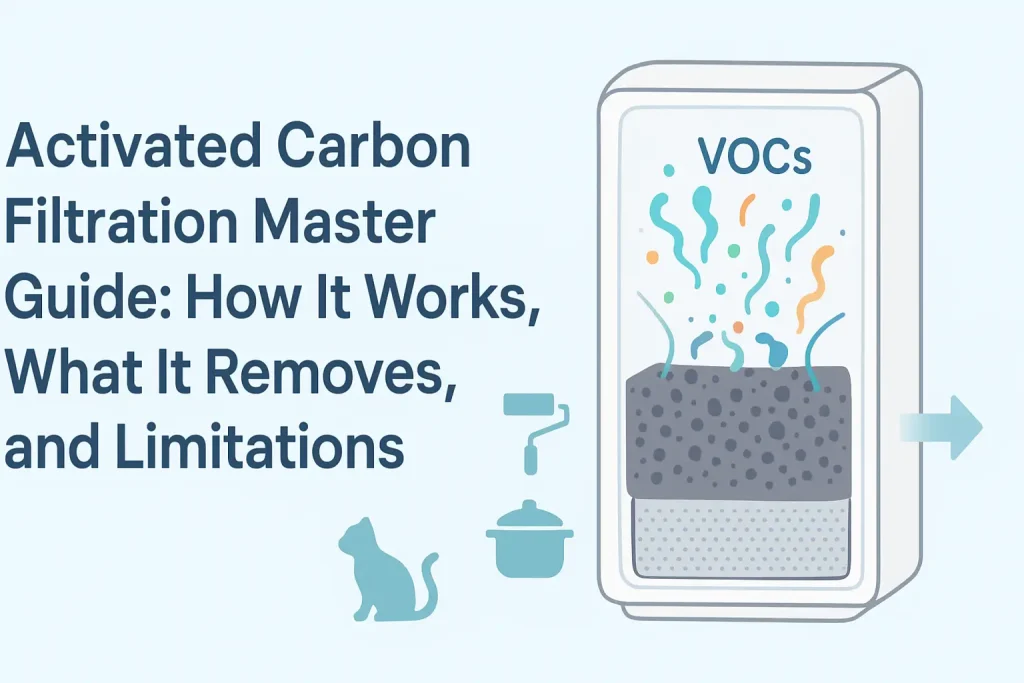
The activated carbon stage is a thin-coated sheet, not a deep pellet bed. It reduces light odors and cooking smells but will not handle persistent VOC sources like off-gassing furniture or formaldehyde from new flooring. For virus capture, the True HEPA stage and 243 CFM smoke CADR are what matter. The carbon is a secondary benefit at this price point.
Coway Airmega 400: Best for Large Bedrooms and Open Living Areas
The Coway Airmega 400 uses dual fans to deliver 400 CFM smoke CADR, covering 240 square feet at 5 ACH. It runs at 38 dB on medium speed, quieter than the smaller AP-1512HH at its equivalent setting. The washable pre-filter and 12-month HEPA replacement interval keep the annual filter cost at approximately $60, lower per square foot than most smaller units.
For an open-plan living area or a master bedroom larger than 200 square feet, this unit hits the 5 ACH threshold without running on turbo. Turbo mode pushes CADR higher but noise jumps past 50 dB, too loud for continuous use in a shared space. Run it on medium speed 24 hours a day during peak cold and flu season. The energy draw at medium is approximately 35 watts, costing about $32 per year in electricity at the national average rate of 13 cents per kWh.
Blueair Blue Pure 211+: Highest CADR Per Dollar for Large Rooms
The Blueair Blue Pure 211+ delivers 350 CFM smoke CADR for under $200, covering 210 square feet at 5 ACH. Blueair uses HEPASilent technology, a combination of electrostatic charging and mechanical filtration, which achieves high CADR at lower fan speeds and noise levels than pure mechanical True HEPA units of comparable output.
The trade-off is filter replacement cost. Blueair filters run approximately $80 per year for the particle and carbon combination filter. The electrostatic stage does not produce measurable ozone. Blueair units are CARB certified. The washable fabric pre-filter in multiple color options is a cosmetic feature, not a performance one. Remove and wash it monthly during heavy-use season to maintain airflow.
Levoit Core 400S: Quietest for Bedroom Use with Smart Features
The Levoit Core 400S delivers 260 CFM smoke CADR covering 156 square feet at 5 ACH, with a noise level of 34 dB on medium speed. That is quieter than a whisper at 30 dB and quieter than any other unit in this comparison at the speed needed for virus protection. The VeSync app lets you set schedules that automatically increase fan speed during peak household activity hours and drop to sleep mode after 10 PM.
The app is genuinely useful during cold and flu season. You can set a 24-hour schedule that runs medium speed from 6 AM to 10 PM and sleep mode overnight, without touching the unit. The air quality sensor displays PM2.5 levels on the unit and in the app, giving you a real-time read on whether the purifier is keeping up with airborne particle load. Replace the filter every 6 to 8 months during continuous cold and flu season operation, at approximately $40 per filter.
What Noise Level Can You Actually Tolerate During Cold and Flu Season?
A unit that needs turbo mode at 55 dB to hit 5 ACH is useless for a bedroom during cold and flu season. You will turn it down to sleep mode at 30 dB and lose the protective CADR, or leave it on turbo and lose sleep. Either way, virus protection drops. The noise level at the fan speed that delivers 5 ACH in your room size is a specification that determines whether you actually use the purifier, not just whether it technically works.
For a bedroom, the medium-speed noise level must stay under 45 dB, and ideally under 40 dB. At 45 dB, the sound is noticeable but fades into background noise from an HVAC system or distant traffic. At 50 dB and above, the sound is intrusive and most people will turn the unit down within two nights. For a living room or home office, 50 dB is acceptable during the day. For a nursery or child’s bedroom, target under 35 dB, which limits you to the Levoit Core 400S or the Coway Airmega 400 on its lowest two fan speeds.
Filter Replacement Cost: The Number That Matters More Than the Unit Price
A $80 air purifier with $60 annual filter replacements costs $260 over three years. A $200 unit with $30 annual filters costs $290 over the same period. The purchase price difference is $120. The three-year total difference is $30. Filter replacement cost is the dominant expense in air purification, and it is the number most buyers ignore when comparing units.
Use the table below to compare the true three-year cost of the top five units, including electricity at 13 cents per kWh running 16 hours a day on medium speed during cold and flu season. The purchase price is a one-time cost. Filter and electricity costs recur every year, and they stack up faster than most buyers expect.
Price Comparison
Three-Year Cost Comparison – Unit Price Plus Filter and Electricity Costs
Unit purchase price plus three years of filter replacements and electricity at 16 hours per day on medium speed at 13 cents per kWh. Prices verified at time of publication.
$150 unit + $120 filters/3yr + $17 electricity/3yr = $287 total
$160 unit + $160 filters/3yr + $18 electricity/3yr = $338 total
$350 unit + $240 filters/3yr + $32 electricity/3yr = $622 total
$180 unit + $320 filters/3yr + $25 electricity/3yr = $525 total
$190 unit + $160 filters/3yr + $22 electricity/3yr = $372 total
Bar width represents total three-year cost relative to the most expensive unit shown. Filter costs are estimates based on manufacturer-recommended replacement intervals of 6 to 12 months during heavy-use cold and flu season. Genuine filters used for all cost estimates. Electricity calculated at 13 cents per kWh, 16 hours per day on medium speed, 120 days per year of heavy-use season.
The Coway AP-1512HH has the lowest three-year total at $287, driven by low filter replacement cost and the lowest electricity draw in the group. The Blueair Blue Pure 211+ costs nearly twice as much over three years despite a lower purchase price, because its proprietary filters are more expensive. The purchase price is a single data point. The three-year total is the number that matters for cold and flu season use, where the unit runs continuously for months at a time.
Can You Place Your Air Purifier in the Wrong Spot?
Placing an air purifier in a corner or against a wall reduces its effective CADR by 20 to 30%, according to airflow modeling research from ASHRAE. The intake and exhaust vents on most units face forward and upward respectively. A wall behind the intake restricts airflow into the filter. A shelf or curtain above the exhaust blocks the clean air column that carries filtered air across the room and creates the circulation pattern that pulls contaminated air back toward the intake.
Place the unit at least 12 inches from any wall or large piece of furniture with the intake facing the center of the room and the exhaust pointing toward the area where people sit or sleep. For bedrooms, the ideal placement is on a nightstand or low dresser at breathing height, 3 to 5 feet from the bed, with the exhaust angled toward the sleeping area. The clean air column should reach the breathing zone of the person in bed without obstruction. For living rooms, place the unit centrally along the longest wall with clear space in front and above.
Do You Need a Humidifier or a Dehumidifier Alongside an Air Purifier?
You need to maintain indoor relative humidity between 40% and 60% during cold and flu season, regardless of your air purifier choice. Research published in Environmental Health Perspectives found that influenza virus survival in airborne droplets increases significantly when relative humidity drops below 40%, because droplets evaporate faster and the smaller, lighter particles stay suspended longer.
An air purifier does not affect humidity. It removes particles from the air but does not add or remove moisture. In most heated homes during winter, indoor humidity drops to 20 to 30% without a humidifier. That low humidity extends airborne virus survival and dries out nasal passages, reducing one of your body’s first-line defenses against inhaled virus particles. A cool mist humidifier placed in the bedroom alongside your air purifier addresses both problems: the purifier captures airborne particles while the humidifier keeps droplet evaporation rates low and nasal passages functional.
If your home has high humidity above 60% in winter due to poor ventilation, use a dehumidifier instead. Mold growth accelerates above 60% relative humidity, and mold spores are an additional respiratory irritant during cold and flu season. An air purifier captures mold spores. A dehumidifier prevents them from forming in the first place.
What’s the Difference Between HEPA and True HEPA During Cold and Flu Season?
True HEPA is a certified filter standard defined by IEST that requires 99.97% capture efficiency at 0.3 microns, the most penetrating particle size. HEPA-type is a marketing term with no standard definition and no independent verification. A HEPA-type filter might capture 99% at 0.3 microns. It might capture 85%. You cannot know which, because the manufacturer did not test to a recognized standard and no certifying body verified the claim.
For cold and flu virus particles at 0.1 to 0.5 microns, True HEPA captures 99.97% of the hardest size. A 95%-efficient HEPA-type filter passes five times more particles per pass. Over an hour of operation at 5 ACH, that difference compounds into a measurable gap in airborne particle concentration. Buy only units with AHAM-verified True HEPA or H13 HEPA filters, and look for the AHAM Verifide seal on the box or product page. The seal means the smoke CADR rating was tested and verified by an independent laboratory.
Is It Better to Run One Large Air Purifier or Two Smaller Ones?
Two smaller units placed in opposite corners of the same room produce better air mixing and more consistent particle removal than one large unit of equivalent total CADR. A single unit creates a localized clean air column with a dead zone on the opposite side of the room. Two units create two overlapping circulation patterns that reduce the dead zone and bring the effective ACH closer to the theoretical rating.
For a bedroom, one unit is usually sufficient if sized correctly for 5 ACH. For an open-plan living area, kitchen, or combined living-dining space over 400 square feet, two units placed at opposite ends of the space outperform one larger unit. A pair of Coway AP-1512HH units at $150 each delivering a combined 492 CFM smoke CADR costs $300 total and outperforms a single Blueair 211+ at $180 delivering 350 CFM. The two-unit approach costs more upfront but provides better coverage and a backup unit if one needs filter replacement or maintenance during peak season.
For a deeper look at the scientific difference between running an air purifier and addressing the actual source of indoor pollution, see our article on why source control often outperforms air purification for common indoor contaminants. During cold and flu season, source control means isolating sick household members and ventilating. The purifier handles what the infected person already exhaled into the shared air.
What Is the Difference Between Smoke CADR, Dust CADR, and Pollen CADR for Virus Protection?
Smoke CADR measures the unit’s performance against particles 0.1 to 0.3 microns in diameter, the same size range as respiratory aerosol droplets that carry influenza and coronaviruses. Dust CADR measures performance against particles 0.5 to 3 microns. Pollen CADR measures 5 to 11 microns. For virus protection, smoke CADR is the only rating that matters, because it tests the filter against the particle size category that includes infectious respiratory aerosol.
Manufacturers often advertise the highest of the three CADR numbers, which is usually pollen CADR and can be double the smoke CADR. A unit with a pollen CADR of 400 CFM and a smoke CADR of 200 CFM is a 200-CFM unit for virus protection. Ignore the pollen number entirely when shopping for cold and flu season. Look up the smoke CADR in the AHAM certified database or on the product label. If the manufacturer only publishes pollen or dust CADR, assume the smoke CADR is unverified and move to a different unit with published AHAM smoke CADR data.
Should You Upgrade Your HVAC Filter Instead of Buying an Air Purifier?
Upgrading your HVAC filter to MERV 13 and running the furnace fan continuously provides whole-house particle removal and is the single most cost-effective first step for cold and flu season protection. A MERV 13 filter captures 75% or more of particles in the 0.3 to 1 micron range per ASHRAE Standard 52.2, including the size of evaporated respiratory droplets. A MERV 13 furnace filter costs $15 to $25 and lasts 3 months.
The limitation is airflow. Most residential HVAC blowers move 800 to 2,000 CFM, far more than any portable air purifier. That high airflow means the air passes through the filter faster, reducing single-pass capture efficiency. But the total volume of air cleaned per hour is higher than a portable unit running in one room. For whole-house baseline protection, upgrade to MERV 13 and run the fan continuously or on an hourly cycle. Then add a portable True HEPA unit in the bedroom for the higher single-pass efficiency and the 5 ACH target where you spend 8 hours breathing unfiltered air.
Top Rated Air Purifiers for Cold and Flu Season Compared by Smoke CADR
The chart below compares smoke CADR across the five recommended units at their medium-speed fan setting, which is the speed you will use for continuous cold and flu season operation. Bar length represents smoke CADR in CFM. Higher is better for faster cleaning and larger room coverage at 5 ACH.
Performance Data
Smoke CADR Comparison – Top Air Purifiers for Cold and Flu Season
Source: AHAM certified CADR database. Smoke CADR in cubic feet per minute (CFM). Higher smoke CADR means faster virus-sized particle removal.
Does the Type of Filter Matter More Than the Brand?
Filter type matters more than brand for virus protection. A True HEPA filter from any AHAM-certified manufacturer delivers 99.97% capture at 0.3 microns. The measurable differences between brands are CADR, noise at the fan speed you will use, and filter replacement cost, not the fundamental filtration efficiency of the HEPA media itself. Two units with the same smoke CADR will clean air at the same rate regardless of brand, provided both use True HEPA and both are AHAM certified.
Brand matters for build quality, filter availability, and long-term reliability of the motor and fan assembly. Coway and Winix have the largest installed base and the most widely available replacement filters on Amazon and in retail. Blueair filters are more expensive but the units achieve higher CADR per dB of noise, a trade-off that matters in bedrooms. Levoit offers the best app experience and the quietest operation at medium speed. Choose by CADR, noise, and filter cost. The filter type and certification level are table stakes: True HEPA with AHAM verification, or skip the unit entirely.
If you are considering units with added features like UV-C lights or ionizers, read our guide on which air purifier features deliver measurable performance improvement and which ones do not. Most add-on features increase cost without improving virus-sized particle capture. True HEPA plus activated carbon is the only combination that addresses both particles and gases. Everything else is incremental at best, and ionizers can increase ozone output if not properly designed.
How Often Should You Replace the Filter During Cold and Flu Season?
Replace the True HEPA filter every 6 months if you run the unit 16 to 24 hours a day during cold and flu season, regardless of the manufacturer’s stated 12-month interval. Continuous operation loads the filter with airborne particles faster than intermittent use. A loaded filter restricts airflow and reduces effective CADR, meaning the unit delivers fewer air changes per hour than the rating suggests.
The pre-filter should be cleaned or replaced monthly during heavy-use season. A clogged pre-filter is the most common cause of reduced CADR in HEPA units during winter, because household dust, pet dander, and lint load the pre-filter faster when windows stay closed. For units with a washable pre-filter like the Winix 5500-2 or Coway Airmega 400, vacuum the pre-filter monthly and wash it every 3 months. For units with a replaceable pre-filter, swap it every 3 months during cold and flu season.
Invest in a PM2.5 air quality monitor to track whether your purifier is maintaining low particle counts in the room. If PM2.5 levels creep up over time at the same fan speed, the filter is loading and airflow is dropping. Replace the filter when PM2.5 levels at medium speed are 20% higher than they were with a fresh filter, even if the 6-month interval has not elapsed.
Can an Air Purifier Help With Sinusitis During Cold and Flu Season?
An air purifier can reduce sinusitis symptoms during cold and flu season by removing airborne irritants that inflame nasal passages already stressed by dry indoor air and viral exposure. However, the purifier only addresses airborne particles. It does not treat the underlying sinus infection, add moisture to dry air, or reduce inflammation from an immune response already in progress. The mechanism is particle removal, not symptom treatment.
For sinusitis specifically, the combination of a True HEPA air purifier and a cool mist humidifier in the bedroom provides more relief than either device alone. The purifier removes dust, pet dander, and airborne viral particles. The humidifier keeps nasal passages moist and functional. Our guide on using air purifiers for sinusitis relief covers the specific CADR targets, humidity ranges, and filter types that matter most for sinus-related respiratory symptoms.
Are UV-C Air Purifiers Better Than True HEPA for Viruses?
UV-C air purifiers are not better than True HEPA for virus protection in residential settings. UV-C light kills viruses and bacteria on contact, but the exposure time required for inactivation is 1 to 10 seconds depending on UV-C intensity and the specific pathogen. In a portable air purifier, air moves past the UV-C lamp in a fraction of a second, providing insufficient UV dose to inactivate most viruses.
ASHRAE guidance on ultraviolet germicidal irradiation specifies UV-C as a supplemental technology for in-duct HVAC systems where longer exposure times are achievable, not as a primary residential air cleaning method. A True HEPA filter captures virus particles mechanically regardless of exposure time, UV intensity, or lamp age. UV-C lamps also degrade over 12 to 24 months and lose output, often without any indicator to the user that the lamp needs replacement. For cold and flu season in a home, invest in True HEPA CADR. Skip UV-C as a primary filtration mechanism.
Does a Higher CADR Always Mean Better Virus Protection?
Higher CADR always means faster air cleaning, but it only translates to better virus protection if the unit runs at a fan speed you can tolerate continuously and the room size is within the effective coverage at your target ACH. A unit with 500 CFM smoke CADR that you turn off after an hour because the noise at turbo mode is unbearable provides zero virus protection after that first hour. A unit with 200 CFM smoke CADR that runs silently on medium speed for 16 continuous hours provides sustained protection with more total air cleaned over the full period.
CADR is the engine. Noise level at the fan speed that delivers enough CADR for your room is the check engine light. If the medium-speed noise exceeds 45 dB in a bedroom, you will turn the unit down or off, and the CADR advantage disappears. Match CADR, noise tolerance, and room size as three interdependent variables. Do not optimize one at the expense of the other two.
Is Ozone From Ionizer Air Purifiers Dangerous During Extended Indoor Seasons?
Ozone from ionizer air purifiers is dangerous at any concentration above 0.050 ppm, the CARB CCR Title 17 legal limit for indoor air cleaning devices. Ozone is a respiratory irritant that inflames lung tissue, triggers asthma attacks, and reduces lung function with extended exposure. During cold and flu season when windows stay closed and indoor air changes per hour are already low, ozone from an ionizer accumulates faster and reaches higher steady-state concentrations than during warmer months when windows are open.
CARB certification requires that an air purifier emit no more than 0.050 ppm ozone during operation. Any unit sold in California must carry this certification. Outside California, ionizer-based units with no CARB certification are legally sold and can emit ozone above the safety threshold. For households with children, pets, or anyone with asthma, choose only CARB-certified units and confirm the certification is for zero or near-zero ozone output. Our guide on ozone-free air purifiers safe for children and pets lists the certified models and explains what to check before buying any unit that includes an ionizer, even as an optional setting.
Why Does My Air Purifier Smell Like Burning Dust After Running on High During Winter?
A burning dust smell from an air purifier during winter is caused by dust accumulation on the heating element of the motor or on a UV-C lamp, not by the filter itself. When the unit runs on high speed for extended periods during cold and flu season, the motor generates more heat. Dust particles that bypass the pre-filter and settle on internal motor components burn off when the motor reaches operating temperature, producing the burnt smell.
Clean or replace the pre-filter immediately. The smell indicates dust is reaching internal components that should be protected by the pre-filter stage. Vacuum the intake vents gently with a brush attachment to remove surface dust. If the smell persists, the motor itself may have a failing bearing or winding generating excess heat. Cease use and contact the manufacturer. A burning smell that smells like electrical burning rather than dust burning indicates a motor fault, not a maintenance issue.
Can Running an Air Purifier 24/7 During Flu Season Damage the Motor?
Running a quality air purifier 24 hours a day for months during flu season will not damage the motor, provided the unit is designed for continuous operation and the filters are changed on schedule. Most AHAM-certified air purifiers use DC motors rated for 40,000 to 60,000 hours of continuous operation, equivalent to 4.5 to 6.8 years of 24/7 use. The motor is not the limiting factor. Filter loading and restricted airflow are