Cigarette smoke is one of the toughest indoor air pollutants to remove. It contains over 7,000 chemicals, and at least 69 of those are known carcinogens.
Most standard air purifiers cannot handle the combination of fine particulate matter and gaseous toxins that cigarette smoke produces. You need a unit with high smoke CADR, substantial activated carbon, and True HEPA filtration to make a real difference.
After analyzing AHAM certified performance data, filter specifications, and long-term ownership costs, we identified five air purifiers that actually remove cigarette smoke rather than just mask it.
This comparison covers smoke CADR ratings, carbon filter capacity, room coverage at different air change rates, noise levels, and annual operating costs for each unit.
| Photo | Popular Air Purifiers | Price |
|---|---|---|

|
Air Purifiers for Home Large Room up to 1500ft², Tailulu H13 True HEPA Air Purifier for Pets Dust Odor Smoke, Air Purifier for Bedroom with 15dB Quiet Sleep Mode for Bedroom Office Living Room | Check Price On Amazon |
|
Afloia Air Purifier for Home, 4-in-1 Washable Filter for Allergies, Covers Up to 1076 ft², Quiet Operation, Auto Shut-Off & Night Light, Removes Pet Dander, Pollen, Dust, Mold, and Smoke, White,Pluto | Check Price On Amazon |

|
Nuwave OxyPure ZERO Air Purifier with Washable and Reusable Bio Guard Tech Air Filter, Large Room Up to 2002 Ft², Air Quality Monitor, 0.1 Microns, 100% Capture Irritants like Smoke, Dust, Pollen | Check Price On Amazon |

|
Air Purifiers for Home Large Room Up to 1,996 Ft², EOEBOT Air Purifier for Home Pets with Washable Filter, Quiet Sleep Mode, Air Quality Monitor, Air Purifier for Bedroom, Pet Hair, Dust, Smoke, White | Check Price On Amazon |
|
Afloia 2 IN 1 Air Purifier with Humidifier Combo, 3-Stage Filters for Home Allergies Pets Hair Smoker Odors, Evaporative Humidifier, Auto Shut Off, Quiet Air Cleaner with Seven Color Light,White | Check Price On Amazon |
Air Quality Data
Cigarette Smoke and Indoor Air Quality – What the Research Shows
Sources: EPA Indoor Air Quality, CDC, American Lung Association
Why Most Air Purifiers Fail Against Cigarette Smoke
Cigarette smoke attacks indoor air quality on two fronts simultaneously. The visible smoke is mostly fine particulate matter (PM2.5 and smaller), while the invisible component includes volatile organic compounds (VOCs), carbon monoxide, and other gaseous pollutants.
A basic air purifier with only a HEPA filter captures the particles but misses the gases entirely. The room air might look cleaner while toxic compounds like benzene and formaldehyde remain suspended at dangerous levels.
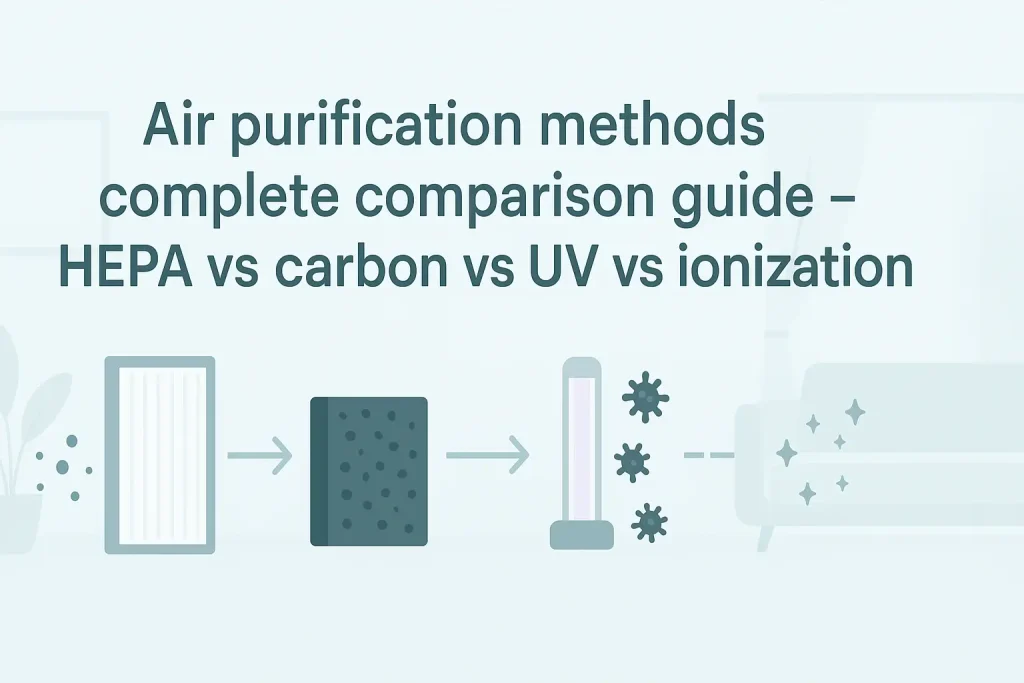
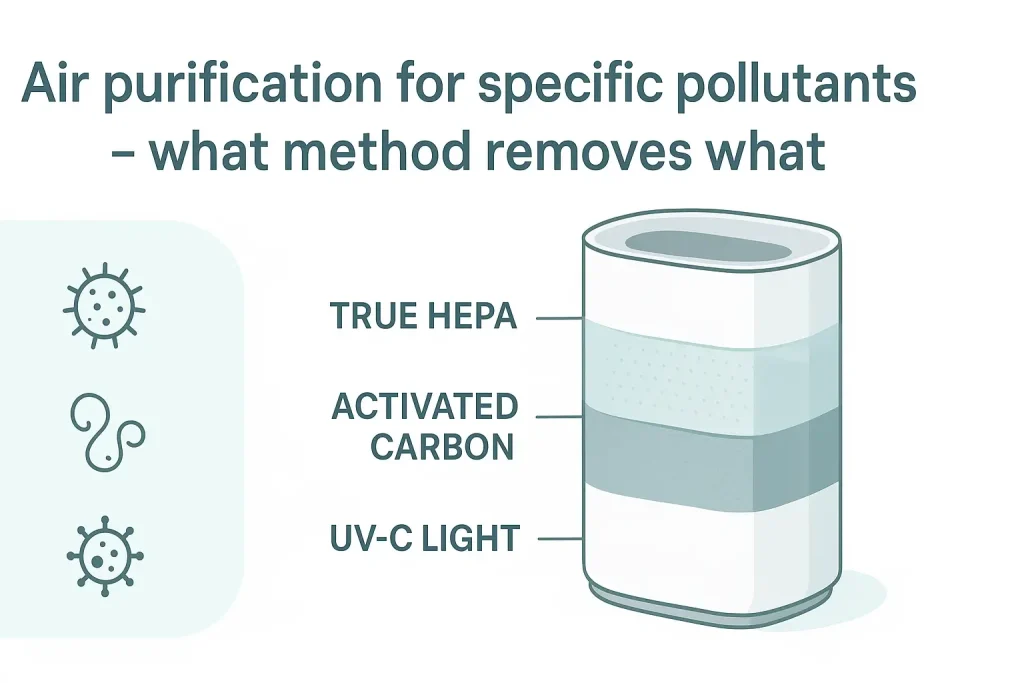
This is the critical distinction that makes cigarette smoke different from dust or pollen. You need both mechanical filtration for particles and adsorption media, usually activated carbon, for the gaseous phase.
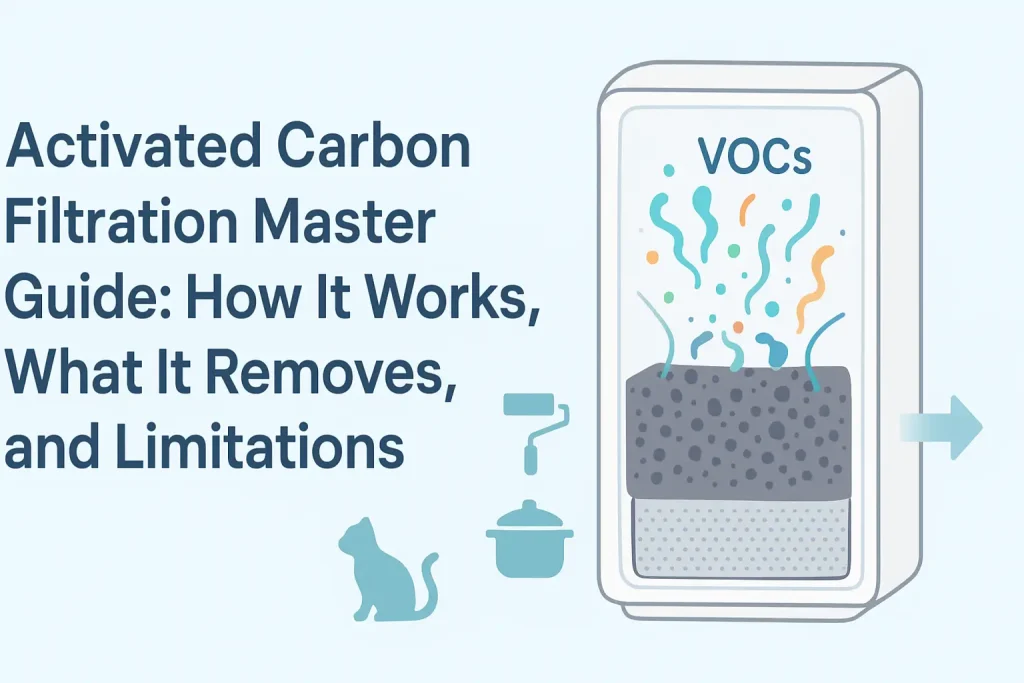
The mechanism works like this: True HEPA fiber layers physically trap smoke particles as air passes through the dense filter mesh. Simultaneously, activated carbon pellets or impregnated foam sheets chemically bind VOC molecules to their porous surface through adsorption.
This dual-stage process only works when both filter stages have adequate capacity. A thin carbon spray coating on a HEPA filter, common in budget units, saturates within days when exposed to cigarette smoke. You need pounds of carbon, not grams.
The failure mode is predictable. A unit with insufficient carbon releases trapped VOCs back into the room as the filter media reaches saturation. The air smells clean for a week, then the odor returns because the carbon stage is exhausted.
For a smoking household, the minimum viable configuration is a True HEPA primary filter with at least one pound of activated carbon in a dedicated secondary stage. CADR ratings for smoke must match the room volume at the desired air change rate.
Product Comparison
Top 5 Air Purifiers for Cigarette Smoke – Head-to-Head Comparison
Smoke CADR, carbon capacity, and annual costs compared. Source: AHAM Verifide database and manufacturer specifications.
| Model | Smoke CADR (CFM) | Carbon Weight | Room at 4 ACH | Noise Min/Max (dB) | Annual Filter Cost | Price Range |
|---|---|---|---|---|---|---|
| IQAir HealthPro Plus | 300 | 5 lbs (V5-Cell) | 450 sq ft | 22 / 56 | $299 | $899-$999 |
| Coway Airmega 400S | 325 | 1.5 lbs (dual filter) | 488 sq ft | 22 / 52 | $129 | $549-$649 |
| Alen BreatheSmart 75i | 280 | 3.6 lbs (smoke filter) | 420 sq ft | 25 / 49 | $119 | $649-$749 |
| Levoit Core 600S | 410 | 0.8 lbs (composite) | 615 sq ft | 26 / 55 | $80 | $299-$349 |
| Blueair Blue Pure 211i Max | 270 | 0.5 lbs (mesh wrap) | 405 sq ft | 23 / 53 | $70 | $299-$349 |
Room coverage calculated at 4 ACH (air changes per hour), recommended for smoking households. Carbon weight from manufacturer technical specifications. Annual filter cost based on manufacturer recommended replacement schedule at MSRP.
What to Look for in an Air Purifier for Cigarette Smoke
Four specifications determine whether an air purifier can handle cigarette smoke effectively. Ignore marketing claims about coverage area unless they include the ACH assumption used to calculate that number.
Smoke CADR Rating
CADR, or Clean Air Delivery Rate, measures how quickly an air purifier removes particles of a specific size from a test chamber. The smoke CADR specifically tests removal of particles in the 0.09 to 1.0 micron range, which matches cigarette smoke particle size.
AHAM tests CADR according to the ANSI/AHAM AC-1 standard in a controlled chamber. The resulting CFM number tells you exactly how much clean air the unit delivers per minute for that particle type.
For cigarette smoke, you need a smoke CADR that delivers at least 4 air changes per hour in your target room. The formula is straightforward: multiply room volume in cubic feet by the desired ACH, then divide by 60 to get the required CADR.
A 300-square-foot room with 9-foot ceilings has a volume of 2,700 cubic feet. At 4 ACH, you need a smoke CADR of at least 180 CFM. That same room at 5 ACH requires 225 CFM.
Activated Carbon Capacity
Carbon filter weight is the single most overlooked specification in smoke-rated air purifiers. Most budget units include a thin carbon sheet that weighs a few ounces. It saturates in days when exposed to continuous cigarette smoke.
Look for carbon filters weighing at least one pound for light smoking and three to five pounds for heavy indoor smoking. The IQAir V5-Cell contains five pounds of granular activated carbon and potassium permanganate for chemical adsorption.
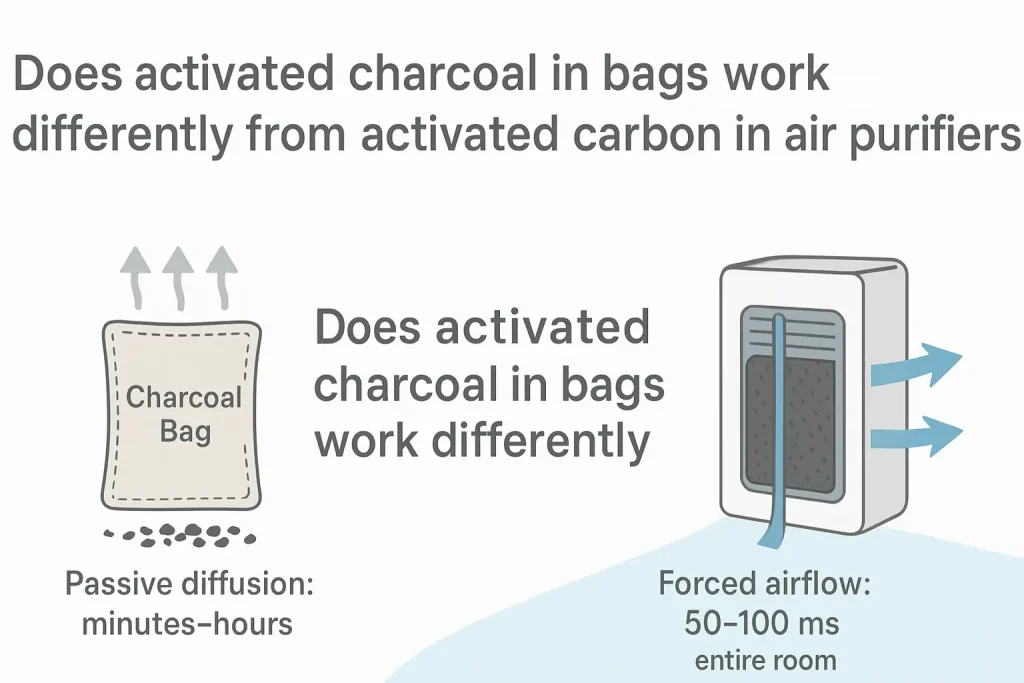
Carbon removes VOCs through physical adsorption, where gas molecules stick to the vast internal surface area of the carbon pores. One gram of activated carbon can have over 500 square meters of internal surface area.
When that surface area fills up, the filter stops working. There is no visual indicator for carbon saturation, so you must track usage hours and replace the carbon stage on schedule based on your smoking frequency.
Filter Configuration and Seal Quality
A proper smoke-rated air purifier uses multiple filter stages with airtight seals between them. Any air that bypasses the filters, called filter bypass, carries unfiltered smoke particles straight back into the room.
Look for units with gasketed filter housings and clearly specified filter efficiency at the most penetrating particle size (MPPS). True HEPA filters certified to capture 99.97% of particles at 0.3 microns are the minimum standard.
HyperHEPA filtration, found in IQAir units, captures particles down to 0.003 microns at over 99.5% efficiency. This matters for cigarette smoke because many smoke particles fall below the 0.3-micron HEPA test threshold.
Noise Level at Effective Fan Speed
An air purifier running on its lowest setting produces minimal noise but also minimal air cleaning. Cigarette smoke removal typically requires medium to high fan speeds, where noise levels range from 40 to 56 dB depending on the unit.
Check the noise specification at the fan speed that delivers your required CADR. A unit rated at 22 dB on sleep mode but 55 dB on the setting that produces 300 CFM smoke CADR will dominate the soundscape of your living room.
Coway Airmega 400S: Best Value for High Smoke CADR
The Coway Airmega 400S delivers the highest smoke CADR in this comparison at 325 CFM, and it achieves that at a significantly lower price than the IQAir. The dual filtration system uses two separate True HEPA filters and two activated carbon filters running in parallel.
The parallel filter design is the reason the Airmega 400S can process such a high volume of air. Two fans pull air through two independent filter stacks simultaneously, effectively doubling the filtration capacity compared to a single-stack design of similar size.
Key Specifications:
- Smoke CADR: 325 CFM (AHAM certified)
- Room coverage: 488 sq ft at 4 ACH, 975 sq ft at 2 ACH
- Filter stages: Washable pre-filter, two True HEPA filters, two activated carbon filters
- Carbon capacity: Approximately 1.5 lbs total (two 0.75 lb carbon filters)
- Noise: 22 dB at low, 52 dB at high
- Annual filter cost: $129 (two HEPA + two carbon filters)
- Smart features: Wi-Fi, app control, air quality sensor with color display
The carbon capacity of 1.5 pounds is adequate for light to moderate smoking but will saturate faster than the IQAir’s five-pound V5-Cell. For a household with one pack-per-day smoking, expect to replace the carbon filters every six months rather than the manufacturer-suggested twelve months.
The real-time air quality display on the front panel shows PM2.5 concentration as a number and a color-coded ring. After smoking indoors, you can watch the number drop from over 200 µg/m³ down to under 12 µg/m³ within approximately 30 minutes at high speed in a properly sized room.
For smokers who want high CADR without the extreme upfront cost of the IQAir, the Coway Airmega 400S represents the best balance of performance and cost.
If you live in an apartment and smoke, placement and coverage calculations become even more critical. Our guide on air purification strategies for apartment and rental living covers room-specific placement to maximize smoke removal in shared ventilation environments.
Alen BreatheSmart 75i: Best Customization for Smoke-Specific Filtration
The Alen BreatheSmart 75i is the only unit in this comparison that offers a filter specifically designed for smoke and heavy odor removal. The Smoke filter variant contains 3.6 pounds of activated carbon with a specialized pellet formulation that targets the chemical profile of tobacco smoke.
Alen sells four filter types for the 75i: HEPA-Pure (allergens), HEPA-Silver (mold), HEPA-OdorCell (VOCs), and HEPA-Smoke (heavy smoke and chemicals). The smoke filter uses a different carbon blend with higher density pellets than the standard odor filter.
Key Specifications:
- Smoke CADR: 280 CFM (with smoke filter installed)
- Room coverage: 420 sq ft at 4 ACH, 1,050 sq ft at 2 ACH
- Filter stages: Pre-filter, True HEPA smoke filter with 3.6 lbs carbon
- Carbon capacity: 3.6 lbs (in smoke filter variant)
- Noise: 25 dB at speed 1, 49 dB at turbo (pink noise frequency profile)
- Annual filter cost: $119 (smoke filter variant)
- Color options: 14 front panel colors
The 75i uses pink noise rather than white noise for its fan output. Pink noise has equal energy per octave, which human ears perceive as a softer, more natural sound compared to the harsher high-frequency white noise that most air purifiers produce.
This matters for smokers who run the unit at medium or high speed in a bedroom. At 49 dB on turbo, the 75i is subjectively quieter than the Coway Airmega 400S at its similar 52 dB output because the frequency distribution lands lower on the psychoacoustic annoyance scale.
The Alen BreatheSmart 75i with the smoke filter is the best choice for bedrooms and spaces where noise sensitivity matters as much as smoke removal performance.
Levoit Core 600S: Highest CADR at the Lowest Price
The Levoit Core 600S posts an astonishing 410 CFM smoke CADR at a price point of $299 to $349. On paper, that is the highest smoke CADR in this comparison by a significant margin. The Core 600S uses a single large cylindrical filter that combines True HEPA and activated carbon in one composite element.
The trade-off is carbon capacity. The composite filter contains approximately 0.8 pounds of activated carbon integrated into the HEPA media. This is substantially less than the dedicated carbon stages in the IQAir and Alen units.
Key Specifications:
- Smoke CADR: 410 CFM (AHAM certified)
- Room coverage: 615 sq ft at 4 ACH, 1,225 sq ft at 2 ACH
- Filter type: Single composite True HEPA + carbon filter
- Carbon capacity: Approximately 0.8 lbs (integrated into HEPA media)
- Noise: 26 dB at sleep, 55 dB at max
- Annual filter cost: $80 (one replacement filter)
- Smart features: Wi-Fi, VeSync app, PM2.5 display, auto mode
The Core 600S excels at particle removal. With a 410 CFM smoke CADR, it can clean a 600-square-foot space at 4 ACH. For particle-heavy smoke from cigarettes, the HEPA filtration performance is outstanding at this price.
Where it falls short is long-duration odor control. The 0.8 pounds of carbon saturates relatively quickly in a smoking household. For a light smoker who only smokes near an open window, the carbon will last six months. For heavy indoor smoking, expect to detect odor breakthrough within two to three months.
The Levoit Core 600S is the best budget option for smokers who prioritize particle removal and are willing to replace filters more frequently to maintain odor control.
Blueair Blue Pure 211i Max: Best for Occasional Smokers on a Budget
The Blueair Blue Pure 211i Max uses electrostatic and mechanical filtration rather than True HEPA. Its particle removal efficiency is not as high as True HEPA at the most penetrating particle size, but its CADR numbers are competitive at 270 CFM for smoke.
Blueair’s HEPASilent technology combines an electrostatic charging section with a mechanical filter. This allows lower air resistance, which means the fan can move more air at a given noise level. The result is competitive CADR with lower energy consumption.
Key Specifications:
- Smoke CADR: 270 CFM (AHAM certified)
- Room coverage: 405 sq ft at 4 ACH, 810 sq ft at 2 ACH
- Filter type: Electrostatic + mechanical with carbon mesh wrap
- Carbon capacity: Approximately 0.5 lbs (mesh wrap around main filter)
- Noise: 23 dB at low, 53 dB at max
- Annual filter cost: $70
- Energy use: 38 watts at medium (lowest in comparison)
- CARB certified: Yes (ozone below 0.050 ppm limit)
The carbon layer is a thin mesh wrap around the main filter rather than a dedicated pellet bed. For occasional smokers who smoke near windows or outside most of the time, this is adequate. For daily indoor smoking, the carbon capacity is insufficient for meaningful VOC removal.
Blueair units carry CARB certification, which means they have been tested and confirmed to emit less than 0.050 ppm ozone. This is important because some electrostatic air purifiers can produce ozone as a byproduct of the charging process.
The Blueair Blue Pure 211i Max works best for occasional smokers who need effective particle removal and low energy consumption in a single-room setting.
How to Calculate the Right Smoke CADR for Your Room
CADR without room context is a meaningless number. A smoke CADR of 300 CFM produces very different results in a 200-square-foot bedroom versus a 600-square-foot living room. You must match CADR to your specific room dimensions and desired air change rate.
The formula is (Room Length x Room Width x Ceiling Height x ACH) divided by 60. This gives you the minimum smoke CADR in CFM required for that room at your target air changes per hour.
For smoking households, the EPA and ASHRAE recommend a minimum of 4 ACH. Allergy and asthma organizations often recommend 5 ACH for sensitive individuals. General air quality improvement can work at 2 ACH.
Here is a pre-computed lookup for common room sizes at 4 ACH with standard 9-foot ceilings:
- 150 sq ft bedroom: 90 CFM smoke CADR required
- 200 sq ft bedroom: 120 CFM smoke CADR required
- 300 sq ft living room: 180 CFM smoke CADR required
- 400 sq ft open area: 240 CFM smoke CADR required
- 500 sq ft open plan: 300 CFM smoke CADR required
- 600 sq ft large space: 360 CFM smoke CADR required
All five units in this comparison can handle a 300-square-foot room at 4 ACH. Only the Levoit Core 600S and Coway Airmega 400S can manage a 600-square-foot space at the same air change rate.
For portable units in wildfire-prone regions, the sizing formula changes because outdoor smoke infiltrates continuously. Our guide to air purification during Canadian wildfire smoke events explains the specific CADR requirements when both indoor smoking and outdoor smoke are factors.
Filter Replacement Schedule for Smoking Households
Manufacturer filter life estimates assume average household pollutant loads. A smoking household produces pollutant concentrations 3 to 5 times higher than a non-smoking household. You must adjust replacement schedules accordingly.
For heavy indoor smoking (one or more packs per day), use these adjusted replacement intervals:
HEPA pre-filters: Replace every 3 to 4 months instead of the standard 6 months. The pre-filter captures the largest smoke particles and clogs faster under heavy smoke load.
True HEPA main filters: Replace every 9 to 12 months instead of the standard 12 to 24 months. Smoke particles in the 0.1 to 0.3 micron range are the hardest to capture and gradually reduce HEPA airflow as they accumulate.
Activated carbon filters: Replace every 3 to 6 months for units with under 1 pound of carbon. Replace every 6 to 12 months for units with 1 to 3 pounds. Replace every 12 to 24 months for the IQAir V5-Cell with 5 pounds. Carbon saturation has no visual indicator, so set a calendar reminder based on your smoking frequency.
Missing filter changes in a smoking household has two consequences. First, particle filtration efficiency drops as the HEPA filter loads up, because the fan must work harder to pull air through the clogged media. Second, saturated carbon releases previously captured VOCs back into the room, which is worse than having no carbon filter at all.
Annual filter costs in the comparison table above use the adjusted replacement schedule for moderate smoking. Heavy smokers should budget approximately 50% more for filters than the listed amounts.
Placement Strategy for Maximum Smoke Removal
Where you place the air purifier in the room affects its effective CADR more than most people realize. An air purifier pushed against a wall or in a corner loses 20 to 30% of its rated CADR because the intake or outflow is partially blocked.
Place the unit at least 12 inches from walls on all sides. The intake side should face the area where smoke concentrates. In a living room where someone smokes on a couch, position the purifier so its intake pulls air from that specific zone.
For bedrooms, place the purifier on the side of the bed where the smoker sleeps, not across the room. The smoke particles are generated closest to the smoker’s breathing zone, and you want the purifier to intercept those particles before they disperse throughout the room.
If you have a whole-house HVAC system, consider upgrading your HVAC filter alongside using a portable purifier. Our article on selecting the right MERV rating for smoke filtration in HVAC systems covers how whole-home and portable filtration work together.
Do not place the air purifier near an open window or exterior door. The negative pressure created by outdoor air infiltration pulls unfiltered air past the purifier’s intake zone, effectively wasting a significant portion of its cleaning capacity.
Ozone Safety and Cigarette Smoke Air Purifiers
Some air purifiers marketed for smoke removal use ozone generation or ionization as their primary cleaning mechanism. These should not be used in occupied spaces. Ozone reacts with the chemicals in cigarette smoke to form new compounds, some of which are more irritating to the respiratory system than the original smoke constituents.
The CARB air cleaner regulation (CCR Title 17 Section 94251) sets a maximum ozone emission of 0.050 parts per million for any air cleaning device sold in California. This is the strictest standard in the United States and all five units in this comparison meet or exceed it.
Ionizers that charge particles to make them stick to surfaces do not remove cigarette smoke chemicals from the room. They move particles from the air onto walls, furniture, and floors. The particles can re-enter the air later through normal activity, a phenomenon called particle resuspension.
The EPA explicitly advises against using ozone generators for air cleaning in occupied spaces. Their guidance states that ozone concentrations high enough to kill microorganisms are also high enough to cause lung damage and worsen asthma symptoms.
For cigarette smoke, the only safe and effective approach is mechanical filtration with HEPA and activated carbon. All five units recommended in this article use mechanical filtration without intentional ozone production.
The choice between portable and whole-house systems for smoke comes down to whether you need zoned or whole-home coverage. Our comparison of portable versus whole-house air purifiers for smoke protection walks through the decision framework for different living situations.
Which Air Purifier Is Best for Cigarette Smoke in a Car or Small Enclosed Space?
Portable air purifiers designed for cars or small offices rarely have the CADR or carbon capacity to handle cigarette smoke effectively. Most car purifiers use a small fan with a thin carbon sheet that saturates almost immediately when exposed to smoke in an enclosed vehicle cabin.
A better approach for car smoke odor is to run the vehicle’s cabin air filter on recirculate mode with a high-MERV cabin filter installed, combined with periodic ozone shock treatments performed by a professional detailer when the vehicle is unoccupied.
For a small home office of 100 square feet or less where someone smokes, any of the five units in this comparison will work effectively. The Levoit Core 600S provides the most airflow per dollar for a small enclosed space, but its large physical footprint may be impractical for very tight quarters.
Can an Air Purifier Remove Cigarette Smoke Smell from Walls and Furniture?
Air purifiers remove airborne particles and gases. They cannot remove the tar and nicotine residue that has already deposited on walls, ceilings, carpets, and furniture. That residue, called thirdhand smoke, continues to off-gas VOCs long after the last cigarette is extinguished.
An air purifier with adequate carbon filtration will capture those off-gassed VOCs as they enter the air. But it does not eliminate the source. The residue must be physically cleaned from surfaces or, in severe cases, the affected drywall and carpeting must be replaced.
For a room with years of smoking history, run the air purifier continuously for at least two weeks at the highest speed the noise level allows. Simultaneously clean all hard surfaces with a trisodium phosphate (TSP) solution and have carpets and upholstery professionally steam cleaned.
How Long Does It Take for an Air Purifier to Clear Cigarette Smoke from a Room?
At 4 ACH, an air purifier theoretically replaces the entire room air volume with filtered air four times per hour. In practice, mixing efficiency reduces the effective cleaning rate. Most researchers use a mixing factor of 0.7 to 0.8 for real-world room conditions.
With a mixing factor of 0.8, a properly sized purifier running at 4 ACH will reduce smoke particle concentration by approximately 90% in 35 to 40 minutes. Achieving a 99% reduction takes roughly 70 to 80 minutes under the same conditions.
This assumes continuous operation at the fan speed that delivers the rated CADR. If you run the unit on a lower speed setting, the CADR drops proportionally and the clearing time increases. A unit running at half its rated CADR takes twice as long to achieve the same reduction.
Gaseous pollutants from cigarette smoke clear more slowly than particles because carbon adsorption is a slower process than HEPA mechanical filtration. Expect VOC levels to decline over several hours rather than minutes, especially for heavier compounds like formaldehyde.
Is One Air Purifier Enough for a Whole House with a Smoker?
A single air purifier only cleans the room where it is placed. Interior doors, hallways, and staircases restrict air movement between rooms. Smoke particles and VOCs from one room will gradually migrate throughout the house through pressure differentials and foot traffic.
For a multi-room residence with one indoor smoker, the minimum configuration is one purifier in the primary smoking room plus one purifier in each bedroom where non-smokers sleep. The non-smoking bedrooms need protection from smoke that infiltrates under doors and through HVAC ductwork.
If the house has a forced-air HVAC system, upgrading the central HVAC filter to MERV 13 provides whole-house particle filtration that supplements the portable units. However, standard residential HVAC fans do not move enough air for the 4 ACH needed in smoking environments, so portable units remain essential.
For allergy sufferers in smoking households, the filtration requirements are even more stringent because smoke particles act as carriers for allergens. Our guide on choosing air purifiers specifically for allergy relief details the CADR and filter requirements when both smoke and allergens are present.
Do Air Purifiers Help with Secondhand Smoke Health Risks?
Air purifiers with True HEPA and adequate activated carbon reduce but do not eliminate the health risks of secondhand smoke. The EPA has stated that no air purifier can completely remove all the hazardous components of environmental tobacco smoke from indoor air.
An air purifier rated for the room size and operated continuously at the appropriate fan speed can reduce PM2.5 from cigarette smoke by 85 to 95% under controlled conditions. This reduction meaningfully lowers particulate exposure but does not address all gaseous carcinogens simultaneously.
The only way to fully protect non-smokers from secondhand smoke is to eliminate indoor smoking entirely. An air purifier is a harm reduction tool, not a solution that makes indoor smoking safe for bystanders. This distinction is critical for households with children, elderly residents, or individuals with respiratory conditions.
What Is the Difference Between Smoke CADR and Dust CADR?
AHAM tests CADR separately for three particle types: smoke (0.09 to 1.0 microns), dust (0.5 to 3.0 microns), and pollen (5.0 to 11.0 microns). The test aerosol for smoke CADR uses particles in the size range that matches both cigarette smoke and wildfire smoke.
Smoke CADR is always the lowest of the three CADR numbers for a given air purifier because smaller particles are harder to capture. A unit with a dust CADR of 350 CFM and a smoke CADR of 280 CFM is normal. The smoke CADR is the limiting factor for cigarette smoke applications.
When sizing an air purifier for cigarette smoke, use the smoke CADR specifically. The dust or pollen CADR will overestimate the unit’s performance against smoke particles. Most manufacturers prominently advertise the highest CADR number (usually pollen), so you must dig into the detailed specifications to find the smoke CADR.
Why Does My Air Purifier Still Smell Like Smoke After Running All Day?
If your air purifier still smells like smoke after hours of operation, one of three things is happening. The most likely cause is that the activated carbon filter is saturated and can no longer adsorb new VOC molecules from the air.
Replace the carbon filter immediately if it has been in service longer than the adjusted replacement interval for your smoking frequency. A saturated carbon filter not only stops working, it can release previously captured odor compounds back into the air under certain temperature and humidity conditions.
The second possibility is that the unit is undersized for the room. If the smoke CADR is too low to achieve at least 4 ACH, smoke particles and gases are being generated faster than the purifier can remove them. Run the CADR calculation for your room dimensions and compare to the unit’s smoke CADR.
The third possibility is thirdhand smoke residue on surfaces continuing to off-gas VOCs. The purifier is capturing some of these, but the emission rate from walls and furniture exceeds the carbon filter’s adsorption rate. Deep cleaning the room is the only solution in this scenario.
What MERV Rating Should My HVAC Filter Have If Someone Smokes Indoors?
A MERV 13 filter is the minimum recommended rating for HVAC systems in smoking households. MERV 13 filters capture at least 50% of particles in the 0.3 to 1.0 micron range and over 85% of particles in the 1.0 to 3.0 micron range.
MERV 13 filters provide meaningful supplemental particle filtration when the HVAC fan runs, but they are not a substitute for portable HEPA air purifiers. The HVAC system does not run continuously in most homes, and the filtration only occurs when the fan is operating.
Do not install MERV 14 or higher filters without confirming your HVAC system can handle the increased air resistance. Higher MERV ratings create more pressure drop across the filter, which can reduce airflow and strain the blower motor in residential systems not designed for high-efficiency filtration.
How Often Should I Run My Air Purifier If I Smoke Indoors?
An air purifier in a smoking household should run 24 hours per day. Smoke particles and VOCs are continuously present in the air, and filtration must be continuous to maintain reduced concentrations. Turning the purifier off allows pollutant levels to climb back to pre-filtration levels within minutes to hours.
If noise at night is a concern, run the purifier on medium or high speed during waking hours and reduce to a lower speed for sleeping. The accumulated air changes during daytime operation at higher speed will compensate for the reduced nighttime cleaning rate.
For units with smart sensors and auto mode, verify that the sensor actually triggers higher fan speeds when smoking occurs. Some sensors are slow to respond to rapid PM2.5 spikes from cigarette smoke, which means the unit stays on low speed when it should ramp up immediately.
Can I Use Two Cheaper Air Purifiers Instead of One Expensive One?
Using two smaller air purifiers can work if their combined smoke CADR meets the room requirement and if they are positioned to cover different zones of the space. Two units each delivering 150 CFM smoke CADR do not automatically equal one unit delivering 300 CFM because air mixing between the two zones is imperfect.
Place the two purifiers on opposite sides of the room with their intake sides facing toward the center. This creates a cross-flow pattern that improves overall mixing compared to a single central unit. Each unit effectively cleans a semi-independent air volume.
The carbon capacity limitation remains the primary concern. Two budget units with 0.3 pounds of carbon each still only provide 0.6 pounds of total carbon capacity. That is less than a single mid-range unit with 1.5 pounds. You get more particle CADR per dollar with two cheap units, but you do not get proportionally more VOC removal capacity.
The best strategy is to use one primary high-carbon unit like the IQAir HealthPro Plus or Alen BreatheSmart 75i with smoke filter in the primary smoking area and supplement with a high-CADR budget unit like the Levoit Core 600S for particle removal in adjacent spaces.
Does the Type of Cigarette Matter for Air Purifier Performance?
The type of cigarette affects the ratio of particles to gases in the smoke, which changes which filter stage becomes the limiting factor. Cigarettes with higher tar content produce more particulate matter, loading the HEPA filter faster. Cigarettes with additives and flavorings produce more VOC variety, loading the carbon filter faster.
Cigars produce substantially more particulate matter per unit than cigarettes because of their larger tobacco mass and longer burn time. A room where cigars are smoked needs approximately twice the smoke CADR of a cigarette-smoking room of the same size to maintain equivalent air quality.
E-cigarettes and vaping devices produce primarily VOCs and ultrafine particles in the 0.01 to 0.1 micron range. The particle mass is lower than cigarette smoke, so HEPA CADR requirements are lower, but the VOC concentration can be comparable or higher depending on the e-liquid formulation.
The Coway Airmega 400S handles cigar smoke particle loads better than the other units because its dual parallel filters provide the highest combined smoke CADR. For vaping, prioritize carbon capacity over raw CADR, making the IQAir HealthPro Plus the most appropriate choice for heavy vape aerosol.
Cigarette smoke removal requires careful attention to filter specifications and room sizing that goes far beyond picking a well-reviewed air purifier. The combination of True HEPA for particles and substantial activated carbon for chemicals is non-negotiable for effective smoke management.
The IQAir HealthPro Plus delivers the most complete filtration for heavy indoor smoking, while the Coway Airmega 400S offers the best balance of CADR and cost. The Levoit Core 600S provides the highest CADR per dollar for budget-conscious buyers who can commit to more frequent filter changes.
Calculate your specific room CADR requirement using the formula and table in this guide before making a purchase decision. Match the smoke CADR to your room at a minimum of 4 ACH, and select a unit with enough carbon capacity to handle your actual smoking frequency without premature saturation.