Most air purifiers under $100 share a hidden problem that no spec sheet mentions. A smoke CADR of 140 CFM sounds adequate until you calculate it against your actual bedroom size at 5 air changes per hour.
Then that $80 unit covers 112 square feet, not the 219 square feet printed on the box. The manufacturer number assumes 2 ACH. Allergy sufferers and anyone with pets or nearby traffic need 5 ACH to get meaningful particulate reduction within 30 minutes.
This guide covers the best air purifiers under $100 that actually deliver True HEPA filtration with AHAM-certified smoke CADR ratings. I include annual filter replacement costs, noise levels at sleep mode, and coverage area recalculated for both 2 ACH and 5 ACH so you can match a unit to your actual room and your actual breathing needs.
| Photo | Popular Air Purifiers | Price |
|---|---|---|

|
Air Purifiers for Home Large Room up to 1500ft², Tailulu H13 True HEPA Air Purifier for Pets Dust Odor Smoke, Air Purifier for Bedroom with 15dB Quiet Sleep Mode for Bedroom Office Living Room | Check Price On Amazon |
|
Afloia Air Purifier for Home, 4-in-1 Washable Filter for Allergies, Covers Up to 1076 ft², Quiet Operation, Auto Shut-Off & Night Light, Removes Pet Dander, Pollen, Dust, Mold, and Smoke, White,Pluto | Check Price On Amazon |

|
Nuwave OxyPure ZERO Air Purifier with Washable and Reusable Bio Guard Tech Air Filter, Large Room Up to 2002 Ft², Air Quality Monitor, 0.1 Microns, 100% Capture Irritants like Smoke, Dust, Pollen | Check Price On Amazon |

|
Air Purifiers for Home Large Room Up to 1,996 Ft², EOEBOT Air Purifier for Home Pets with Washable Filter, Quiet Sleep Mode, Air Quality Monitor, Air Purifier for Bedroom, Pet Hair, Dust, Smoke, White | Check Price On Amazon |
|
Afloia 2 IN 1 Air Purifier with Humidifier Combo, 3-Stage Filters for Home Allergies Pets Hair Smoker Odors, Evaporative Humidifier, Auto Shut Off, Quiet Air Cleaner with Seven Color Light,White | Check Price On Amazon |
BY THE NUMBERS
$25 to $60 per year: Annual filter replacement cost range for sub-$100 True HEPA air purifiers. A unit with $60 annual filters costs more over 3 years than a $120 unit with $25 annual filters.
140 to 246 CFM smoke CADR: The CADR range of AHAM-certified air purifiers available under $100. At 5 ACH, this covers rooms from 112 to 197 square feet.
24 to 35 dB at sleep mode: Noise range at lowest fan speed. Below 30 dB is inaudible to most sleepers. The Levoit Core 300S reaches 24 dB. The GermGuardian AC4825 sits at 35 dB.
0.050 ppm: Maximum ozone output allowed under CARB CCR Title 17. All units recommended in this guide are CARB certified and produce zero intentional ozone.
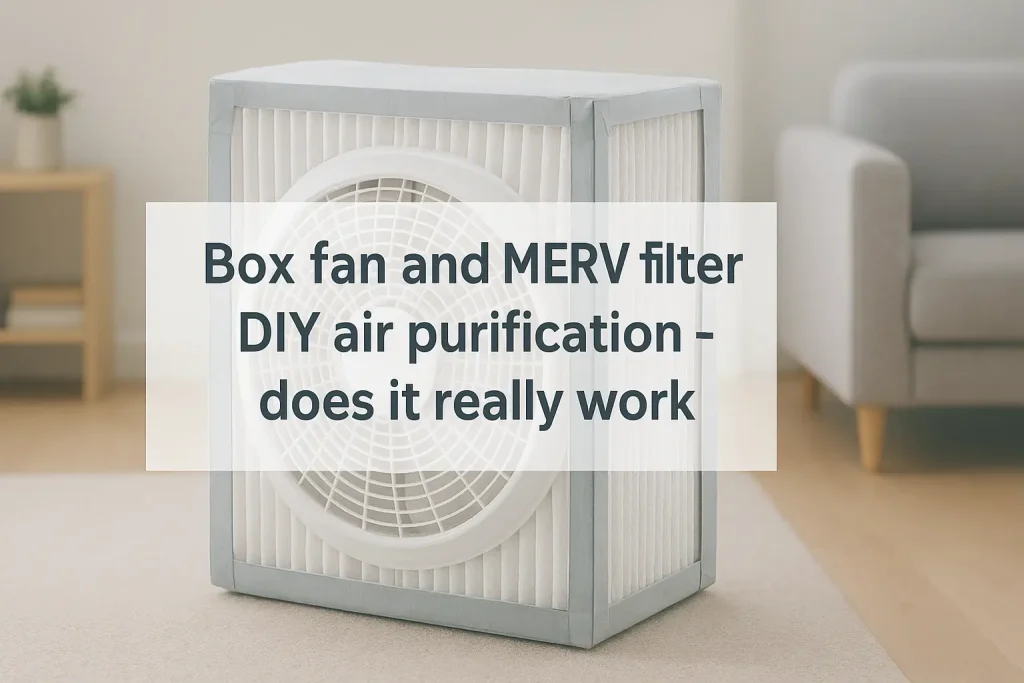
What Separates a Good Budget Air Purifier From a Noisy Box Fan With a Filter Strapped to It
A budget air purifier earns its place on your nightstand or desk by delivering three things simultaneously. AHAM-certified smoke CADR high enough for your room at 5 ACH. Sleep mode noise below 30 dB. Annual filter cost under $50.
Most units under $100 hit two of these three. The skill is knowing which two matter for your situation. A bedroom unit for allergies needs low noise and sufficient CADR above all else. A living room unit for pet dander can be louder but must move more air.
The filtration mechanism inside a budget True HEPA purifier works identically to units costing $400. A HEPA media filter is a dense mat of randomly arranged polypropylene or fiberglass fibers that captures particles through three physical mechanisms: interception, impaction, and diffusion.
This happens because the filter fibers create a tortuous path where particles cannot follow the airstream around obstacles. Particles 0.3 microns and larger collide with fibers and stick through electrostatic attraction and van der Waals forces. This only occurs when the filter media meets the 99.97% at 0.3 microns standard defined by IEST-RP-CC001 and the fan generates sufficient static pressure to pull air through the dense media.
If the fan is undersized or the filter housing has gaps around the seal, the result is filter bypass where 15 to 40% of air flows around the filter rather than through it. Fix it by choosing units with AHAM certification, which tests the complete assembled device in a sealed chamber, not just the filter media in isolation.
Budget units cut costs in three areas: fan motor quality, filter media surface area, and housing refinement. A $400 IQAir HealthPro Plus uses a 300 CFM fan with a filter that has over 60 square feet of pleated media surface. A $50 Levoit Core 300 uses a smaller fan with roughly 12 square feet of media surface. Both capture 99.97% at 0.3 microns on the first pass. The difference is how long the filter lasts before loading reduces airflow, and how much air the fan can push through increasingly loaded media.
For most home users, a True HEPA unit under $100 with AHAM-certified smoke CADR matched to your room at 5 ACH gives real, measurable particulate reduction, and the main tradeoff is more frequent filter replacement rather than worse filtration.
Below is a price comparison of the top budget air purifiers under $100, including both the unit purchase price and the annual filter replacement cost so you can see the true first-year cost before making a decision.
Price Comparison
Air Purifier Price Comparison – Unit Cost and Annual Filter Cost Under $100
Unit purchase price plus estimated annual filter replacement cost. Prices verified at time of publication.
$50 unit + $25/yr filters
$80 unit + $25/yr filters
$100 unit + $30/yr filters
$100 unit + $40/yr filters
$55 unit + $40/yr filters
$95 unit + $60/yr filters
Bar width represents unit purchase price relative to the most expensive product shown ($100). Filter costs are estimates based on manufacturer-recommended replacement intervals of 6 to 8 months. Genuine filters used for all cost estimates. The Honeywell HPA100 appears cheaper upfront but costs $60 more per year in filters than the Levoit Core 300.
Levoit Core 300 and Core 300S: The Best Overall Air Purifier Under $100
The Levoit Core 300 delivers AHAM-certified smoke CADR of 145 CFM in a 7.5-pound cylindrical unit that costs under $60. That CADR number is the highest verified smoke CADR available under $60 among all current AHAM-certified models.
The Core 300S adds Wi-Fi connectivity, app control, and voice assistant compatibility for approximately $80. Both variants use the same motor and the same filter cartridge and produce identical CADR numbers. The S model adds convenience, not additional cleaning power.
Key Specifications:
- Smoke CADR: 145 CFM (AHAM certified)
- Coverage at 2 ACH: 219 sq ft
- Coverage at 5 ACH: 87 sq ft
- Sleep mode noise: 24 dB
- Annual filter cost: approximately $25
- Filter type: True HEPA (H13) plus activated carbon pre-filter
- Annual electricity cost: approximately $9 at 13 cents/kWh (8 hours daily at medium speed)
The 24 dB sleep mode noise level is the quietest in the sub-$100 category. At that level, you cannot hear the unit from more than 3 feet away. For a bedroom nightstand placement, the Core 300 is effectively silent.
The main limitation is coverage area at 5 ACH. At 87 square feet, the Core 300 is correctly sized for a small bedroom, nursery, or home office up to roughly 9 by 10 feet. Put it in a 200-square-foot master bedroom and you get only 2.2 ACH, which is adequate for general air quality but insufficient for allergy or asthma management.
Who should buy the Core 300: Someone with a small bedroom or office under 100 square feet who wants verified True HEPA filtration with the lowest possible noise and operating cost. The $25 annual filter cost and $9 annual electricity cost make this the cheapest True HEPA unit to own over a 3-year period.
Who should skip it: Anyone with a room over 150 square feet who needs 5 ACH for allergies or asthma. The CADR is simply too low for larger spaces at higher air change rates.
Coway AP-1512HH: The Highest CADR Under $100 When On Sale
The Coway AP-1512HH Mighty lists at approximately $120 but regularly drops to $99 during major sale events. At that price, it delivers 246 CFM smoke CADR, which is 70% more cleaning power than the Levoit Core 300 for roughly 25% more upfront cost.
That 246 CFM smoke CADR covers 369 square feet at 2 ACH or 148 square feet at 5 ACH. This is the only unit under $100 that can deliver 5 ACH in a standard 12-by-12-foot bedroom.
Key Specifications:
- Smoke CADR: 246 CFM (AHAM certified)
- Coverage at 2 ACH: 369 sq ft
- Coverage at 5 ACH: 148 sq ft
- Sleep mode noise: 30 dB
- Annual filter cost: approximately $30
- Filter type: True HEPA plus activated carbon plus ionizer (switchable, off by default)
- AAFA asthma and allergy certified
The AP-1512HH carries the Asthma and Allergy Foundation of America certification, which requires independently verified allergen reduction in a sealed chamber. It is one of only a handful of sub-$150 units with this certification.
The ionizer stage is physically present but switched off by default. CARB certification confirms ozone output below 0.050 ppm even with the ionizer active. Leave it off and you have a purely mechanical filtration unit with zero ozone output.
The 30 dB sleep mode is 6 dB louder than the Levoit Core 300. That is a perceptible difference, roughly the volume of a whisper at 3 feet versus silence. For light sleepers, the Levoit is better. For anyone who can sleep with a quiet fan running, the Coway is inaudible enough and delivers substantially more cleaning power.
Who should buy the AP-1512HH: Allergy or asthma sufferers with a bedroom between 100 and 150 square feet who need 5 ACH on a budget under $100 (when on sale). The higher CADR makes the difference between adequate and insufficient filtration at 5 ACH in a standard bedroom.
Winix 5500-2: The Best All-Round Filtration Package at $100
The Winix 5500-2 frequently prices between $90 and $100 and provides 243 CFM smoke CADR with a washable pre-filter, an activated carbon sheet filter, True HEPA media, and PlasmaWave bipolar ionization that can be independently switched off.
The 243 CFM smoke CADR covers 365 square feet at 2 ACH or 146 square feet at 5 ACH. This is effectively identical to the Coway AP-1512HH in cleaning performance. The differentiation lies in the filtration stages and the control panel.
Key Specifications:
- Smoke CADR: 243 CFM (AHAM certified)
- Coverage at 2 ACH: 365 sq ft
- Coverage at 5 ACH: 146 sq ft
- Sleep mode noise: 28 dB
- Annual filter cost: approximately $40
- Filter type: Washable pre-filter, activated carbon sheet, True HEPA, PlasmaWave (switchable)
- CARB certified, ENERGY STAR certified
The washable pre-filter catches hair, dust, and large particles before they reach the HEPA media. Rinse it every 2 weeks and you extend HEPA filter life from 6 months to 9 to 12 months in normal household conditions. This is the feature that justifies the Winix over the Coway for pet owners, where pre-filter loading happens faster from airborne fur and dander.
The PlasmaWave ionizer is CARB certified and produces ozone below 0.050 ppm. Turn it off if you prefer purely mechanical filtration. The unit ships with it on by default, so check the button on your first use.
Annual filter cost runs higher than the Coway because the activated carbon sheet needs replacement every 3 months. At roughly $10 per sheet, that is $40 per year in carbon sheets plus one $30 HEPA filter, totaling approximately $70 per year. For homes with cooking odors, VOCs, or pet smells, the carbon sheet is doing real work and the cost is justified. For dust-only situations, the Coway is cheaper to run.
Who should buy the Winix 5500-2: Pet owners and anyone with cooking odors or mild VOC concerns who benefits from more frequent carbon filtration changes. The washable pre-filter directly reduces HEPA loading from pet dander and fur.
Use the table below to compare the key specifications of all recommended budget air purifiers side by side, including CADR, coverage at both 2 ACH and 5 ACH, noise levels, and annual operating costs.
Product Comparison
Air Purifiers Under $100 Compared: CADR, Coverage, Noise, and Filter Cost
Key specs compared across top picks. CADR from AHAM certified database. Coverage at 5 ACH calculated as smoke CADR x 12 / 5.
| Model | Price | Smoke CADR | Coverage at 2 ACH | Coverage at 5 ACH | Sleep Mode dB | Annual Filter Cost | Best For |
|---|---|---|---|---|---|---|---|
| Levoit Core 300 | $50 | 145 CFM | 219 sq ft | 87 sq ft | 24 dB | $25/yr | Small bedroom, nursery |
| Levoit Core 300S | $80 | 145 CFM | 219 sq ft | 87 sq ft | 24 dB | $25/yr | Small room + smart features |
| Coway AP-1512HH | $100 | 246 CFM | 369 sq ft | 148 sq ft | 30 dB | $30/yr | Allergy, standard bedroom |
| Winix 5500-2 | $100 | 243 CFM | 365 sq ft | 146 sq ft | 28 dB | $40/yr | Pets, odors, carbon filtration |
| GermGuardian AC4825 | $55 | 118 CFM | 177 sq ft | 71 sq ft | 35 dB | $40/yr | Tiny room, desk use, UV-C |
| Honeywell HPA100 | $95 | 100 CFM | 150 sq ft | 60 sq ft | 33 dB | $60/yr | Brand trust, small room only |
CADR data from AHAM certified database. Coverage area at 5 ACH = smoke CADR x 12 / 5. Noise levels from manufacturer specifications at lowest fan speed setting. Filter costs based on genuine replacement filters at standard 6 to 8 month replacement intervals. The Honeywell HPA100 has the worst CADR-to-price ratio in this group despite strong brand recognition.
GermGuardian AC4825: The Budget UV-C Option With Important Caveats
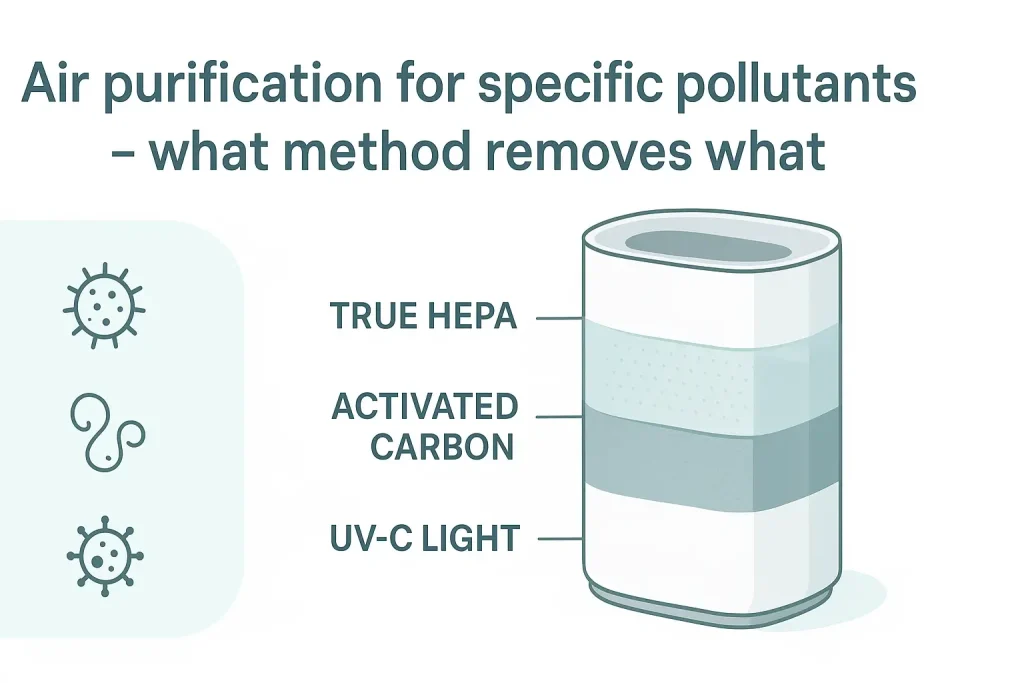
The GermGuardian AC4825 sells for approximately $55 and is the only sub-$100 unit that includes a UV-C lamp alongside True HEPA and activated carbon filtration. The UV-C lamp is a 5-watt bulb positioned after the HEPA filter that exposes passing air to ultraviolet light in the 254 nm wavelength range.
At 254 nm, UV-C radiation damages the DNA and RNA of bacteria, viruses, and mold spores, preventing them from reproducing. This is a well-established disinfection mechanism used in water treatment plants and hospital HVAC systems.
Key Specifications:
- Smoke CADR: 118 CFM (AHAM certified)
- Coverage at 2 ACH: 177 sq ft
- Coverage at 5 ACH: 71 sq ft
- Sleep mode noise: 35 dB
- Annual filter cost: approximately $40
- UV-C lamp replacement: $15 every 12 months
- Filter type: True HEPA plus activated carbon plus UV-C
This only occurs when air spends sufficient time in the UV-C exposure zone. The GermGuardian AC4825 moves air at 118 CFM through a narrow chamber. The residence time of any given air parcel in the UV-C exposure zone is under 0.5 seconds at maximum fan speed. For effective UV-C disinfection of airborne pathogens, ASHRAE recommends a minimum UV-C dose of 1,500 to 2,000 microwatt-seconds per square centimeter at the target surface.
If the UV-C dose is insufficient due to high air velocity or low lamp output, the result is bacteria and viruses passing through the UV zone without receiving enough radiation to inactivate them. Fix it by understanding that the UV-C in this unit is a supplemental feature, not a replacement for the HEPA filter. The HEPA filter does the primary pathogen capture. The UV-C adds a secondary disinfection layer for what the filter already trapped.
The 35 dB sleep mode is the loudest in this group. It is audible as a low hum in a quiet bedroom. The tower form factor is taller and narrower than the cylindrical Levoit units, which may fit better on a narrow desk or shelf.
Who should buy the AC4825: Someone with a very small room under 80 square feet who wants UV-C as a secondary disinfection stage and prefers the tower form factor for narrow placement. The UV-C adds a layer of pathogen inactivation on the filter surface itself, where captured microbes are exposed to continuous UV radiation rather than flash exposure in the airstream.
Honeywell HPA100: Brand Trust at a CADR Premium
The Honeywell HPA100 costs approximately $95 and delivers 100 CFM smoke CADR. At that CADR, it covers 150 square feet at 2 ACH or 60 square feet at 5 ACH. These are the lowest coverage numbers in the group despite being the second most expensive unit.
Honeywell is a trusted HVAC brand with decades of filtration engineering experience. The HPA100 uses a True HEPA filter manufactured by Honeywell’s filtration division, which also produces industrial and commercial-grade air filtration media. The build quality and filter media quality are excellent.
Key Specifications:
- Smoke CADR: 100 CFM
- Coverage at 2 ACH: 150 sq ft
- Coverage at 5 ACH: 60 sq ft
- Sleep mode noise: 33 dB
- Annual filter cost: approximately $60
- Filter type: True HEPA (Honeywell R replacement filter)
- ENERGY STAR certified
The annual filter cost of $60 is the highest in this group. Over 3 years, the HPA100 costs $275 total ($95 unit + $180 in filters) compared to $125 for a Levoit Core 300 ($50 unit + $75 in filters). The Honeywell delivers lower CADR at higher total ownership cost.
The HPA100 makes sense only if brand trust and filter availability are your overriding priorities. Honeywell replacement filters are available at most hardware stores and big-box retailers, not just online. In an emergency filter replacement situation during wildfire season, that retail availability matters.
Who should buy the HPA100: Someone who wants a Honeywell specifically, values retail filter availability, and has a room under 60 square feet at 5 ACH. For all other use cases, the Levoit Core 300 or Coway AP-1512HH deliver more CADR at lower total cost.
How to Calculate Whether a Budget Air Purifier Can Actually Clean Your Room
CADR is the only number that tells you how fast a purifier cleans a specific room. A smoke CADR of 200 CFM in a 300-square-foot room delivers 5 air changes per hour. That is enough to reduce wildfire smoke particles by 85% within 30 minutes.
Manufacturers print the room coverage at 2 ACH on the box. Allergy sufferers, asthma patients, pet owners, and anyone in a wildfire-prone region need 5 ACH. The effective coverage area at 5 ACH is 40% of the manufacturer’s stated number. A unit claiming 219 square feet of coverage covers 87 square feet for someone who needs 5 ACH.
The formula matches smoke CADR to room size and ACH target. CADR needed equals room length in feet times room width in feet times ceiling height in feet times target ACH, all divided by 60. For a standard 12-by-10-foot bedroom with an 8-foot ceiling at 5 ACH, you need (12 x 10 x 8 x 5) divided by 60, which equals 80 CFM of smoke CADR.
For allergy and asthma management, always calculate at 5 ACH, not the manufacturer’s 2 ACH figure. A unit that meets the 2 ACH requirement for your room cleans the air only 40% as frequently as you need for meaningful symptom reduction.
Use the calculator below to find the minimum smoke CADR your room needs based on its actual dimensions and your target air change rate. Match this number to any unit’s AHAM-certified smoke CADR before buying.
CADR Calculator
How Much CADR Do You Actually Need for Your Room?
Enter your room dimensions and use case. Formula: (length x width x ceiling height x ACH) divided by 60. Source: AHAM methodology.
CADR = (length x width x ceiling height x ACH) / 60. For allergy and asthma sufferers, always calculate at 5 ACH, not the manufacturer-stated 2 ACH figure. The effective coverage for allergy is 40% of the printed coverage number.
| Room Size | CADR at 2 ACH (standard) | CADR at 5 ACH (allergy) | Budget Model That Works |
|---|---|---|---|
| 100 sq ft small bedroom | 27 CFM | 67 CFM | Levoit Core 300 (145 CFM) |
| 150 sq ft bedroom | 40 CFM | 100 CFM | Coway AP-1512HH (246 CFM) |
| 200 sq ft master bedroom | 53 CFM | 133 CFM | Coway AP-1512HH or Winix 5500-2 |
| 300 sq ft living room | 80 CFM | 200 CFM | Two Levoit Core 300 units |
| 500 sq ft open plan | 133 CFM | 333 CFM | Over $100 budget required |
Why Filter Replacement Cost Matters More Than Unit Price on a Budget
A $50 Levoit Core 300 with $25 annual filter replacements costs $125 over 3 years. A $95 Honeywell HPA100 with $60 annual filter replacements costs $275 over the same period. The cheaper unit costs less than half as much to own.
This math is not obvious when you are staring at two boxes on a shelf or two product pages in a browser. The manufacturer has no incentive to highlight the filter cost. The retailer has no incentive to calculate your 3-year total.
Budget air purifier buyers are the most vulnerable to this cost trap. A $20 difference in unit price feels significant at the register. A $35 difference in annual filter cost feels abstract. Over 3 years, the filter difference is $105. The unit price difference was $45. The filters cost more than twice what the unit price difference saved you.
Before buying any unit under $100, look up the cost of a genuine replacement filter on the manufacturer’s site or Amazon. Multiply by the number of filter changes per year (typically 1.5 to 2 for most budget units). Add that to the unit price. That number is your true first-year cost.
For ongoing costs, a detailed breakdown of air purifier energy costs at different fan speeds and electricity rates helps you project total operating cost beyond just filter replacements. Electricity is the smallest variable, typically $5 to $15 per year for budget units, but it adds up across multiple rooms and 24/7 operation.
Annual filter costs for the budget units in this guide range from $25 (Levoit Core 300) to $60 (Honeywell HPA100). Always use genuine manufacturer filters. Off-brand replacement filters frequently have lower media density, worse gasket seals, and no AHAM certification. A filter that costs $10 less but leaks 15% of airflow around the seal saves nothing.
Placement and Positioning: Getting Maximum Performance From a Budget Unit
A budget air purifier with 145 CFM smoke CADR loses 20 to 30% of its effective coverage when placed in a corner or against a wall. The intake side needs at least 12 inches of clearance from any surface. The output side needs at least 36 inches of unobstructed space to throw filtered air into the room.
Place the unit centrally along the longest wall, at least 18 inches from the wall itself, with the output facing the center of the room. For bedroom use, position the unit between the door and the bed so cleaned air reaches your breathing zone before mixing with infiltration from the hallway.
This only occurs when the room has reasonable air mixing. If the room has a ceiling fan, run it on low speed to circulate cleaned air without creating drafts that pull unfiltered air from adjacent rooms. The goal is to create a clean air bubble around your breathing zone, not to filter the entire room volume perfectly uniformly.
If the unit is pushed into a corner with 3 inches of clearance on the intake side, the result is restricted airflow that drops effective CADR by 30 to 40%. Fix it by pulling the unit out from the wall and giving it at least a foot of breathing room on all intake sides. This costs zero dollars and increases effective CADR more than upgrading to a slightly more expensive unit.
True HEPA vs HEPA-Type: The Label That Separates Real Filtration From Marketing
True HEPA means the filter meets the IEST-RP-CC001 standard of 99.97% capture of particles at 0.3 microns. HEPA-type, HEPA-like, and HEPA-style are marketing terms with no standardized test behind them. They can mean anything from 85% to 99% efficiency at unknown particle sizes.
All units recommended in this guide use True HEPA filtration verified by AHAM CADR testing. The AHAM test runs the complete assembled device in a sealed chamber with controlled particle injection. The smoke CADR number tells you how fast the unit removes fine particulate matter, which is the most penetrating particle size and the hardest to filter.
A unit labeled HEPA-type with a smoke CADR of 80 CFM may capture only 90% of particles at 0.3 microns on the first pass. A True HEPA unit with the same 80 CFM captures 99.97%. After 4 complete room air changes, the True HEPA unit has removed 99.99% of initial particle load. The HEPA-type unit has removed 99.9%. The difference sounds small on paper. In a room with continuous particle generation from pets, cooking, or outdoor infiltration, the True HEPA unit maintains a steady-state concentration 10 times lower.
For a complete understanding of what goes into filter replacement planning, see our guide on planning a full year of filter replacements for your air purifier, which covers seasonal variation in filter loading and how wildfire season changes your replacement schedule.
Do not buy any unit labeled HEPA-type, HEPA-like, or HEPA-style. These terms exist to confuse buyers into purchasing products that do not meet the True HEPA standard. The price difference is rarely enough to justify the filtration performance gap.
What About Ionizers and Ozone Generators Under $100?
Ionizer-only air purifiers under $100 are widely available and universally worse than a True HEPA unit at the same price. An ionizer works by emitting negatively charged ions into the air. These ions attach to particles, causing them to clump together and fall out of the air onto surfaces.
The particles are not removed from the room. They are redistributed from the air onto your floor, furniture, and walls. Walking across the room, sitting on the couch, or opening a window resuspends them back into the air. A True HEPA filter removes particles from the room entirely by trapping them in filter media that you throw away.
Ionizers also produce ozone as a byproduct of the corona discharge that generates the ions. CARB limits ozone output from indoor air cleaning devices to 0.050 ppm (50 parts per billion). Many ionizers under $100 are not CARB certified and produce measurable ozone above this limit, particularly in small rooms with limited ventilation.
Ozone is a lung irritant that causes airway inflammation, reduced lung function, and increased asthma symptoms at concentrations as low as 0.060 to 0.080 ppm. The EPA specifically warns against using ozone-generating air cleaners in occupied spaces. If you see a unit under $100 that claims to clean the air with ions, activated oxygen, or plasma without a True HEPA filter, skip it. Buy a True HEPA unit instead.
The Coway AP-1512HH and Winix 5500-2 both include ionizers that can be switched off. Both are CARB certified with ozone output below 0.050 ppm even with the ionizer active. The ionizer is a secondary feature, not the primary cleaning mechanism. The True HEPA filter does the work regardless of whether the ionizer is on or off.
Noise Levels: What the Decibel Numbers Actually Mean in a Bedroom
Decibel ratings are logarithmic. A 3 dB increase is a doubling of sound energy. A 10 dB increase sounds twice as loud to the human ear. The difference between 24 dB (Levoit Core 300) and 35 dB (GermGuardian AC4825) is 11 dB. The GermGuardian sounds more than twice as loud at sleep mode.
For bedroom use, target sleep mode noise at or below 30 dB. At 24 to 28 dB, the unit is inaudible or blends into background noise for most sleepers. At 30 to 33 dB, it is audible as a quiet hum, similar to a laptop fan at idle. At 35 dB, it is a noticeable continuous sound that may disturb light sleepers.
The noise comparison between Honeywell and Dyson units shows that motor and fan design matter as much as raw decibel numbers. A unit with a poorly balanced fan blade produces tonal noise at specific frequencies that is more annoying than broadband noise at a higher decibel level. Budget units tend to have less refined fan balancing, so two units with the same dB spec can sound different subjectively.
If noise is your top priority, the Levoit Core 300 at 24 dB is the quietest unit under $100. The Coway AP-1512HH at 30 dB is quiet enough for most sleepers and delivers nearly double the CADR.
Energy Costs: Budget Units Cost Pennies Per Day to Run
All units recommended in this guide are ENERGY STAR certified and draw between 30 and 60 watts at their highest fan speed. At medium speed, typical power draw is 20 to 40 watts. At 13 cents per kilowatt-hour and 8 hours of daily use at medium speed, annual electricity cost ranges from $8 to $15.
At sleep mode, power draw drops to 5 to 15 watts. Running a unit in sleep mode for 8 hours every night costs $2 to $6 per year. The electricity cost for a budget air purifier is negligible compared to filter replacement cost. Do not make purchase decisions based on energy consumption differences of 5 to 10 watts. Focus on CADR, noise, and filter cost.
The total annual cost of ownership breakdown including filters and power consumption shows that filters represent 70 to 85% of the annual operating cost for budget True HEPA units. Electricity is the smaller piece by a wide margin.
Can You Get a Free or Subsidized Air Purifier?
Government programs and wildfire assistance initiatives sometimes provide free air purifiers to residents in high-risk areas. The eligibility criteria vary by program and location, but most target low-income households, seniors, and people with respiratory conditions in regions with recurring wildfire smoke events.
Our guide on government programs that provide free air purifiers and wildfire assistance covers the current programs, application processes, and eligibility requirements. If you live in California, Oregon, Washington, or other wildfire-prone states, check whether your county health department offers air purifier assistance before spending $100 out of pocket.
Do Air Purifiers Under $100 Help With Wildfire Smoke?
A budget True HEPA air purifier reduces wildfire smoke PM2.5 by 70 to 85% within 30 to 60 minutes in a correctly sized room running at maximum fan speed. This happens because wildfire smoke particles are predominantly in the 0.1 to 2.5 micron range, well within the capture efficiency curve of True HEPA media that targets 0.3 microns as the most penetrating particle size.
This only works when the CADR matches the room size at a high ACH target. During wildfire smoke events, target 5 to 6 ACH. A Levoit Core 300 with 145 CFM smoke CADR can handle a room up to 87 square feet at 5 ACH during wildfire conditions. For a 150-square-foot bedroom, you need at least 188 CFM smoke CADR to hit 5 ACH. That requires a Coway AP-1512HH (246 CFM) or running two Levoit Core 300 units in the same room.
If the CADR is too low for the room at 5 ACH, the result is PM2.5 concentrations that stabilize at a higher equilibrium than they would with a properly sized unit. The purifier removes particles from the air, but infiltration from outside keeps adding new particles at a rate the undersized unit cannot keep up with. Fix it by either getting a higher-CADR unit or sealing the room better: close windows, use weatherstripping on doors, and run the HVAC fan with a MERV 13 filter to reduce infiltration load.
For wildfire smoke specifically, replace filters at twice the normal frequency. A filter that normally lasts 6 months may load to capacity in 2 to 3 months during sustained wildfire smoke events with AQI above 150. Keep at least one spare filter on hand during fire season so you are not stuck with a clogged filter and no replacement when the air quality is at its worst.
What Is the Best Air Purifier Under $100 for Pet Hair and Dander?
The Winix 5500-2 is the best sub-$100 unit for pet hair and dander because of its washable pre-filter that catches visible fur and hair before it reaches the HEPA media. Rinse the pre-filter every 2 weeks and the HEPA filter life extends from 6 months to 9 to 12 months in a home with pets.
Pet dander particles range from 2 to 20 microns, larger than the 0.3-micron most penetrating particle size. True HEPA captures pet dander with near-100% single-pass efficiency. The challenge with pets is not the filtration efficiency. It is the loading rate. A home with two cats or one dog can load a HEPA filter with dander and fur 2 to 3 times faster than a pet-free home.
The Coway AP-1512HH also works well for pets, with a 246 CFM smoke CADR and a mesh pre-filter that catches larger debris. The pre-filter on the Coway is not washable, so it needs vacuuming and eventual replacement. The Winix washable pre-filter is the better design for heavy shedders.
For pet odors, the Winix activated carbon sheet filter provides meaningful odor reduction that the Coway’s carbon-coated sheet (thinner, less carbon mass) does not match. Replace the Winix carbon sheet every 3 months for ongoing odor control. The carbon sheet costs approximately $10 per replacement.
Can I Run My Air Purifier 24/7 Without Burning Out the Motor?
Yes. All units recommended in this guide are designed for continuous 24/7 operation. The fan motors are rated for 40,000 to 60,000 hours of continuous use, which is 5 to 7 years of nonstop operation. The motor will outlast several sets of replacement filters.
Running the unit 24/7 on auto mode or medium speed is the standard operating procedure for allergy and asthma management. Particulate levels rise continuously from outdoor infiltration, cooking, dust resuspension, and occupant activity. Turning the unit off for 8 hours allows PM2.5 to climb back to pre-filtration levels. Turning it back on requires the unit to re-clean the entire room volume from the elevated baseline, which takes longer and uses more energy than maintaining a steady clean state.
At sleep mode or low speed, the motor draws minimal power and produces minimal wear. The electricity cost of running a budget unit at sleep mode 24/7 is $15 to $25 per year. The filter replacement cost is unchanged. Continuous operation extends filter life slightly because the unit maintains steady-state low particulate rather than cycling between clean and dirty air, which causes faster loading during the re-cleaning phase.
Why Does My Air Purifier Smell Like Plastic or Chemicals When New?
New air purifiers sometimes emit a plastic or chemical odor for the first 24 to 72 hours of operation. This is off-gassing from the plastic housing, adhesives used in filter construction, and residual manufacturing compounds on internal components. The odor comes from volatile organic compounds that evaporate at room temperature from new materials.
This happens because the injection-molded ABS plastic housing contains residual styrene monomer and other low-molecular-weight compounds that slowly release into the airstream. The activated carbon pre-filter in a new unit also contains loose carbon dust and adsorbed compounds from manufacturing and storage that release during initial operation.
If the odor persists beyond 72 hours of continuous operation, the unit may have a manufacturing defect, contaminated filter media, or an electrical issue causing overheating of internal components. Fix it by running the unit on maximum speed in a ventilated room or near an open window for the first 48 hours. The odor should dissipate completely within 3 days. If it does not, contact the manufacturer. A persistent chemical smell is not normal and may indicate a problem with the motor or filter materials.
If you smell something sharp and metallic like the air after a thunderstorm, that is ozone from an ionizer stage. Turn the ionizer off. If the smell persists with the ionizer off, the unit may be producing ozone through unintended corona discharge from a faulty electrical component. Stop using the unit and contact the manufacturer. CARB-compliant units should produce zero detectable ozone with the ionizer disabled.
How Often Should I Replace the Filter in a Budget Air Purifier?
Replace the True HEPA filter in a budget air purifier every 6 to 8 months under normal household conditions. Under heavy loading from pets, wildfire smoke, or construction dust, replace every 4 to 6 months. The activated carbon pre-filter or sheet filter needs replacement every 3 months for effective odor and VOC reduction.
Most budget units have a filter replacement indicator light that runs on a simple timer rather than measuring actual filter loading. The light illuminates after a preset number of operating hours, typically 2,500 to 4,000 hours, which corresponds to 6 to 12 months at 8 to 12 hours of daily use. This timer assumes average loading conditions. Your actual conditions may be heavier or lighter.
The most reliable way to determine filter condition is visual inspection. Remove the filter and hold it up to a light. If you cannot see light through the filter media, it is loaded and needs replacement. A new True HEPA filter is bright white or pale gray. A loaded filter is visibly gray, brown, or black with accumulated particulate. If the filter has a visible dust cake on the intake side, it is past due for replacement.
Do not attempt to vacuum or wash a True HEPA filter to extend its life. Vacuuming removes surface dust but does not clean the deeply embedded particles that cause airflow restriction. Washing damages the pleated structure and creates gaps in the filter media that allow air bypass. A True HEPA filter is a consumable, not a cleanable component.
What Is the Difference Between AHAM CADR and Manufacturer Coverage Claims?
AHAM CADR is a standardized test conducted by an independent laboratory in a controlled chamber with specific particle injection and measurement protocols. The smoke CADR number tells you exactly how many cubic feet of clean air the unit delivers per minute for fine particulate matter. Manufacturer coverage claims are marketing numbers that assume 2 ACH and 8-foot ceilings, conditions that rarely match real-world use.
The AHAM test protocol injects a known concentration of cigarette smoke (for smoke CADR), fine dust (for dust CADR), or paper mulberry pollen (for pollen CADR) into a sealed test chamber. Sensors measure the particle decay rate with the air purifier running versus the natural decay rate. The difference, multiplied by the chamber volume, gives the CADR in cubic feet per minute.
A manufacturer claiming 300 square feet of coverage is simply multiplying the smoke CADR by 1.5 (the conversion factor for 2 ACH at 8-foot ceilings). A unit with 200 CFM smoke CADR times 1.5 equals 300 square feet at 2 ACH. The same unit covers 120 square feet at 5 ACH. The manufacturer prints 300. The allergy sufferer who buys it for a 300-square-foot room gets 2 ACH, not the 5 ACH they need. Always check the AHAM-certified smoke CADR and do your own ACH calculation for your actual room dimensions.
Do I Need a Separate Air Purifier for Each Room?
Yes, if you need 5 ACH in multiple rooms simultaneously. A single unit cannot clean two separated rooms effectively because walls block airflow. The clean air delivery from one unit stays mostly in the room where the unit runs, with limited mixing through open doorways.
For budget-conscious buyers, the strategy is to prioritize one room as the clean air sanctuary and place the best unit you can afford there. The bedroom is the highest-priority room because you spend 6 to 8 continuous hours there breathing air at close range. A unit with sufficient CADR for your bedroom at 5 ACH provides more health benefit than two undersized units split between bedroom and living room.
If you need coverage in two rooms on a tight budget, buy one unit with verified CADR for your bedroom and a second inexpensive unit for the secondary space. Two Levoit Core 300 units at $50 each cost $100 total and provide 145 CFM smoke CADR in each room. This is better than one $100 unit that leaves one room unfiltered. The bedroom gets clean air all night. The secondary room gets clean air when occupied during the day.
For open-plan living spaces where the kitchen, dining, and living areas share air volume, calculate the total square footage of the open area and size a unit for that combined volume. An open-plan space of 400 square feet needs 267 CFM smoke CADR at 5 ACH. No single unit under $100 delivers that CADR. Two units placed at opposite ends of the open space provide the combined CADR needed.
Are Air Purifiers Under $100 Safe to Use Around Babies and Children?
True HEPA air purifiers with no ionizer stage are safe for use in nurseries and children’s bedrooms. The filtration is purely mechanical with no chemical emissions, no ozone production, and no ion generation. The Levoit Core 300 and Coway AP-1512HH (with ionizer switched off) are both safe for use around infants.
Avoid units with UV-C lamps in nurseries. The GermGuardian AC4825 includes a UV-C bulb that emits ultraviolet radiation at 254 nm. While the bulb is enclosed within the housing, any housing crack, loose panel, or curious child could result in UV exposure. UV-C at 254 nm causes eye damage and skin burns at close range. It is an unnecessary risk in a room where a child may interact with the device unsupervised.
Avoid any unit with an ionizer that cannot be independently disabled. Ionizers produce ozone as a byproduct, and infants have higher respiratory rates relative to body weight than adults, making them more sensitive to airborne irritants. CARB sets the ozone limit at 0.050 ppm for all populations, but infant-specific data on chronic low-level ozone exposure is limited. The precautionary principle says eliminate the exposure entirely.
For a nursery, the Levoit Core 300 at 24 dB sleep mode is the best option. It is quiet enough to not disturb sleep, has no ionizer or UV-C, and the 145 CFM smoke CADR is adequate for a typical nursery of 100 to 120 square feet at 5 ACH. The cylindrical design with no sharp corners and a stable base is also safer around mobile infants than tower-style units that can be tipped over.